In Aporia, Spaceman Spiff explains the function and value of what are called “dead man’s switches” both for railway locomotives and societies:
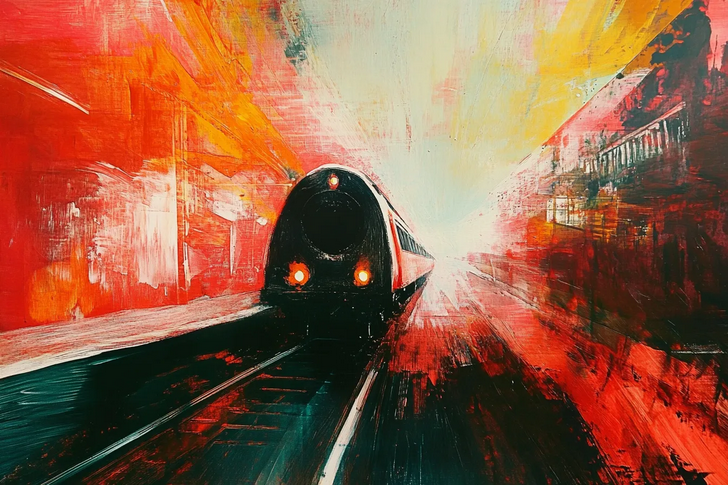
Image from Aporia
A dead man’s brake is a safety feature found in dangerous machines such as lifts or trains. With this mechanism, a brake is always on, preventing action or movement. A conscious choice or effort must be made to override it.
On a train, a human driver must be present to depress a foot pedal that disengages the brake so the train can move at all. If he is absent the train cannot move. If he withdraws his foot while the train is in motion — if he dies, for instance — the train stops. Hence the name.
The key feature of a dead man’s brake is that it requires energy to operate. Its default zero-energy position is OFF; only with energy can it go to ON.
Wariness of strangers, xenophobia, is the default position for most human beings. This is a hardwired evolutionary response to protect us. It served us well. It requires no energy to operate. Children quickly point out people who seem different.
Intentionally elevating strangers above ourselves, xenophilia, is artificial. We must be educated to make it happen, and explicitly taught to overlook differences. It must be reinforced to remain in operation as our instincts typically push against it.
This requires energy. In parts of the world not subject to Western educational norms, they do not teach it to children. Consequently, they do not usually adopt policies like mass immigration or asymmetric multiculturalism.
It is worth noting that xenophobia denotes a wariness of strangers, not hatred or disdain of them. In practice, our working assumption is people different from us may be a threat, and our actions should reflect this until proven otherwise.
Xenophobia is not the racial animosity the propaganda wishes us to believe, such as harming others based on visible differences like skin colour. Such extreme views are in fact rare. The underlying drive of xenophobia is caution, not aggression. Xenophilia attempts to ignore this sensible restraint, which is why it often fails without external pressure.
These instincts are deeply embedded within us because a cautious approach is a strong foundation upon which to preserve our lives and our cultures. It is the reason we have a nation and a culture in the first place.
Xenophilia, then, is a dead man’s brake. It requires energy applied to something that would not typically occur in nature. It makes us ignore differences in order to get along. Or so the theory goes.
Update, 26 September: Welcome, Instapundit readers! Please do have a look around at some of my other posts you may find of interest. I send out a daily summary of posts here through my Substack – https://substack.com/@nicholasrusson that you can subscribe to if you’d like to be informed of new posts in the future.