Quotulatiousness

February 3, 2026

Conformity is a very powerful force among western women

Filed under: Media, Politics, USA — Tags: , , , , , — Nicholas @ 03:00

On the social media site formerly known as Twitter, Devon Eriksen responded to a post by Meghan Murphy that began “Unfortunately for women, the extent of retardation I’m seeing in the Instagram stories of women I know is making me think women are retarded”:

No, women are not retarded.

They are conformist.

To fall for, actually fall for, narratives like the Covid story, the BLM story, the ICE is Gestapo story, to actually whole-heartedly believe them, yeah, you would have to be kinda retarded.

But women didn’t “fall for” those stories. Not exactly.

They aligned to them.

This means they went along with them, repeated them, reinforced them, not because they were convinced by evidence, but because they were convinced by the appearance of consensus.

Women are evolved to believe what the rest of the tribe appears to believe. Evidence is not considered.

Why?

Well, humans are smart. We survive by being smart. And in order to be smart, we need to grow big brains, and get started growing those brains early.

Which means human babies have giant heads. And in order to deliver those giant heads, human babies have to be born prematurely. Otherwise, head won’t fit through pelvic girdle, and baby and mother both die.

This means all human babies are premature. That’s why horses can run at the age of six hours, but humans can’t lift our giant heads for months.

This means that human women, whether they are pregnant with a giant-headed baby, caring for a giant-headed baby, or just might be either one at any moment, are uniquely helpless and dependent on the support and goodwill of the tribe.

Metaphorically, and often literally, a woman lives in someone else’s house — not because she’s a useless layabout, but because she is too busy building the future to support herself in the present.

When you’re in that position, you have to keep your controversial ideas to yourself.

And when you evolve in that position, you evolve to have no controversial ideas.

This was fine for millions of years. There was a division of labor. Women made people, men made stuff. And because the women made all those biological sacrifices to make men with big brains, the men were really good at making stuff. And the stuff was really, really useful, and it became big piles of stuff called “cities”, and then it became a global system of stuff called “civilization”.

The stuff became so valuable that there were big arguments about what to do with the stuff, which was called “politics”. But the women stayed out of politics, because politics was about stuff, stuff was men’s job, and no matter who won the arguments, the winners always made sure the women had enough stuff.

Why?

Because dependent, future-investing, conformist women didn’t evolve in a vacuum. Men evolved along with them. When you have dependent women, you evolve protective men, because tribes full of men who aren’t protective don’t have future generations.

So women didn’t wield political power directly. They were represented by men, and had a lot less skin in the game.

Eventually, someone decided this was unfair. This idea didn’t happen suddenly, and for no reason at all, but that’s a topic for another day.

But something funny happens when you give political power to women, especially in the form of a vote.

You see, then you have a situation where 50% of the vote is held by people who require a great variety of different persuasion techniques or evidence to convince them of something. And the other 50% is held by women, who are persuaded by only one thing … the appearance of prevailing consensus and power.

And what form of persuasion do you think is cheapest and easiest to project?

Women’s suffrage removes evidence and discourse from politics, and replaces it with “consensus theater” … a puppet show designed to create the illusion of a single prevailing opinion.

When a narrative prevails, women vote for it, not because they are persuaded, but because it prevails.

This is an explosive feedback loop — a reverse thermostat which turns the air conditioner on when it’s freezing, and runs the furnace all summer.

Because women’s idea of how urgent an issue is comes not from an analysis of the situation, but an analysis of how many people endorse it.

And any opinion, no matter how contrary to obvious facts, no matter how retarded, no matter how destructive, can become the prevailing political platform, so long as women can be convince that most other people think so.

Covid was a Chinese bioweapon. The Covid shot was toxic and did not protect against Covid.

George Floyd was violent drug zombie who died of an overdose, and Derek Chauvin is in prison merely for being the last guy to touch him.

Police officers do not disproportionately kill innocent black men who are minding their own business, and body cams prove this.

Men cannot become women. The technology doesn’t exist, and may not ever exist.

Diversity is, in fact, our greatest weakness. Diversity + integration = war.

America is better off without the vast majority of immigrants, even the ones who don’t murder and steal.

Socialism doesn’t work in any unit larger than the extended family. Communism has never worked, and cannot work.

Cows are health food. Plants are usually not.

Some kids are smarter than others, and we need to invest more effort in them, not less.

All of these things are inherently obvious, and women are not too retarded to see that, because they are not retarded at all. They are merely conformist. Susceptible to political theater.

So democracies cannot permanently survive female suffrage. No one is particularly happy about this, not even curmudgeonly iconoclasts like me who are willing to say it out loud. It’s not only unfair in principle, it’s decidedly inconvenient in practice.

The universe, of course, does not care.

We cannot change women. We can only change politics.

That won’t be easy, either. But it’s possible, even if the eventual process involves a lot more violence, or space colonization, than we find convenient.

QotD: Are men funnier than women and if so, why?

Filed under: Humour, Quotations, Science — Tags: , , , — Nicholas @ 01:00

    critter @BecomingCritter
    genuinely why are men funnier than women? do you have a theory?

I didn’t have a theory of this until you ask the question. Now I do.

A lot of ethologists who have studied differences in behavior between men and women have noted that men have much better-developed methods for resolving physical conflict and threats short of lethal violence.

To put it a different way, women in conflict basically have two settings: either peaceful or unhinged screamingly vicious. Men have more intermediate gradations, and rituals about how they move among them.

Men having better developed senses of humor might best be seen as part of their instincts for social de-escalation.

ESR, The social media site formerly known as Twitter, 2025-11-01.

January 24, 2026

Modern biochemistry through a trio of Nora Ephron movies

Filed under: Health, Media, USA — Tags: , , , , — Nicholas @ 04:00

Not being a movie fan, I was only vaguely aware of the author Nora Ephron’s work being turned into movies, but Unbekoming uses three of them (When Harry Met Sally, Sleepless in Seattle, and You’ve Got Mail) to help illustrate one of the major reasons why so many relationships go sour:

I think this shows stills from Nora Ephron romantic comedies.

The films show what was delivered. But neither fully explains why the delivery was so effective — why millions of women watched these films repeatedly, quoted them to friends, absorbed their vocabulary of magic and clockwork as though it described something they already knew.

The films resonated because they did describe something these women already knew. They just misnamed its source.

The Altered Audience

By the time When Harry Met Sally appeared in 1989, hormonal contraception had been widely available for nearly three decades. The women watching Ephron’s films in theaters — women in their twenties and thirties, the target demographic — were largely women who had been on the pill since adolescence. Many had never experienced an adult month with their natural hormonal cycles intact.

This matters because the pill doesn’t merely prevent pregnancy. It alters brain chemistry, affects mood, suppresses libido, and — most remarkably — changes who women are attracted to.

Research has documented that women on hormonal contraception prefer different types of men than women who are cycling naturally. The pill disrupts the normal attraction toward genetic diversity, causing women to prefer men with similar immune markers rather than complementary ones. Women who meet their partners while on the pill often experience a dramatic shift in attraction when they stop taking it. The man who felt right becomes somehow wrong. The spark disappears. The relationship that seemed stable reveals itself as empty.

The films gave this experience a name: settling. They told women that the absence of “magic” meant they were with the wrong partner — not that they were chemically disconnected from their own desire.

The Misnamed Feeling

Consider what a woman on hormonal contraception might actually be experiencing:

Suppressed libido — the pill is documented to reduce sexual desire, sometimes dramatically. A woman with chemically suppressed desire might experience her stable relationship as passionless, as “clockwork”, without recognizing that the suppression is pharmaceutical rather than relational.

Altered mood — studies show significantly elevated rates of depression and anxiety among pill users. A woman experiencing low-grade, chemically-induced depression might feel that something essential is missing from her life, that she’s “settling”, that the right partner would make her feel alive again.

Disrupted attraction — if the pill alters who women are attracted to, then a woman who chose her partner while on hormonal contraception may genuinely feel reduced attraction to him. The films told her this meant he was the wrong partner. The chemistry told a different story.

Ephron’s films offered a romantic explanation for what was partly a pharmaceutical experience. The vocabulary of “magic” versus “clockwork”, of transformation versus settling, gave women language for feelings they couldn’t otherwise explain. Of course the stable partner feels insufficient. Of course you’re still searching. Of course something is missing. The films validated the dissatisfaction and pointed toward a romantic solution: find the right partner, and the feeling will resolve.

But if the dissatisfaction was partly chemical — induced by years of synthetic hormones disrupting natural mood, desire, and attraction — then finding the right partner couldn’t resolve it. The search would continue indefinitely, the “magic” always receding, the next partner eventually revealing himself as another disappointment.

The Perfect Delivery Mechanism

This is why the films worked so well as cultural programming. They didn’t need to persuade women to feel dissatisfied; the pill had already accomplished that. They only needed to provide a framework that directed that dissatisfaction toward romantic optimization rather than pharmaceutical questioning.

A woman who felt disconnected from her partner, experienced low desire, struggled with mood, and sensed that something fundamental was missing had two possible interpretations:

  1. Something is wrong with this relationship — I need to find someone who makes me feel alive
  2. Something is wrong with my body — I need to understand what these hormones are doing to me

The films relentlessly promoted the first interpretation. They never acknowledged the second. They couldn’t — the entire romantic comedy structure depends on the premise that the right partner resolves the longing. If the longing is chemical, the genre collapses.

So millions of women absorbed the lesson: the problem is the partner, not the pill. Keep searching. The magic is out there. When you find him, you’ll know.

And they searched, and the years passed, and the window narrowed, and many of them discovered too late that what they were searching for couldn’t be found in another person — because what they had lost was connection to themselves.

Update: Fixed missing URL.

January 20, 2026

Those awful AWFLs

Filed under: Media, Politics, USA — Tags: , , , , , , — Nicholas @ 05:00

On Substack, Rohan Ghostwind responds to a recent New York Times opinion from Michelle Goldberg pretending not to understand why “the right” is against Affluent White Female Liberals (AWFLs):

Michelle Goldberg recently wrote an opinion piece in the New York Times called “The Right Is Furious With Liberal White Women

Specifically, she talks about the rising contempt for the AWFL: Affluent white female liberal.

The first part of the opinion piece is a play-by-play of the Renee Good situation, pointing out that the right is freaking out about roving bands of Karens.

The part I find interesting is in the final paragraph:

    It wasn’t long ago that casual contempt for white women was the domain of the left, at least that part of the left that took books like “White Fragility” seriously. So it’s striking how easily conservatives, who’ve been stewing over insults to white people for at least five years, have singled out a group of white women as the enemy.

Here’s the interesting part: throughout the course of her opinion piece, she touches on White Female Liberal part. Conspicuously missing is the first part of the acronym: affluent.

This is par for the course for an NYT Opinion piece: play into the identity politics aspect while simultaneously downplaying class. This is, of course, a big reason why the Democrats lost ground with working class people during the 2024 election.

[…]

Rob Henderson popularized the term luxury beliefs …

And if it was ever one group of people who embody the most luxury beliefs per capita it would be the AWFL’s.

What makes them uniquely annoying is their persistent refusal to acknowledge how sanctimonious they come across to the rest of the world. As far as they’re concerned, they are the only intelligent and moral group of people, and they will eventually get what they want by scolding everybody else into submission.

People hate this, because people would actually prefer bigotry to infantilization — but the affluent white woman, by virtue of being affluent, never has to reality test her beliefs against the real world.

January 8, 2026

QotD: Canned food and the early days of the Raj

Consider the history of canned food. It has obvious military applications — Napoleon famously quipped that an army marches on its stomach, and as canning was largely invented in France, he made some effort to issue food to his troops (as opposed to local procurement and / or “living off the land”). He didn’t quite get there, but the resultant revolution in logistics was as important to the conduct of war, in its way, as just about anything else. If you don’t know how armies are provisioned, you’re likely to miss something when you talk about wars.

You might even miss something culturally. For instance, there’s an entire sub-subdiscipline called “Food and Foodways”, and it’s not as silly as it sounds. Canned food was an important part of British cultural life in the Raj, for instance. File it under “Women Ruin Everything” — once it got safe enough for ladies to have a reasonable chance of surviving East of Suez, the awesome freewheeling decadence of the “White Mughals” period was replaced by dour, dowdy Victorian bullshit. Every summer the “fishing fleet” pulled into Calcutta harbor, disembarking scads of ugly British girls with a Bible in one hand and a can of spotted dick in the other, determined to snag the highest-ranking ICS man they could and, in the process, turn India into another boring suburb of Edinburgh. Anglo-Indian cookbooks are full of recipes for horrid British glop straight out of cans, and if you routinely got really, really sick from eating spoiled stuff, well, hard cheese, old chap! Heaven forbid you eat the delicious, nutritious, climate-optimized cuisine that was literally right there …

If you want to argue that the Indian Army fought so many border wars just to get away from sour, hectoring memsahibs and their godawful tinned slop, I’m not going to stop you.

Anyway, the point is, IF you are conversant enough with the relevant technical stuff, it occurs to me that you can get a snapshot of embedded cultural assumptions by looking at a period’s characteristic or representative technology.

Severian, “Assumption Artifacts”, Founding Questions, 2024-04-30.

January 3, 2026

Penelope vs Clytemnestra in Greek Mythology

Filed under: Books, Greece, History — Tags: , , , , — Nicholas @ 02:00

MoAn Inc.
Published 10 Sept 2025

I’m trying out shorter videos on the channel, so this is a very basic breakdown explanation. Clytemnestra and Penelope are polar opposites, and their characters bookend The Odyssey. One is seen as the best wife, one is seen as the worst. They’re supposed to be compared and contrasted in this way: Agamemnon’s homecoming to Mycenae is a warning to Odysseus about what could potentially go very, very wrong with his own return to Ithaca. There are so many fascinating ways to dissect these two women, so please don’t take this as a be-all-end-all!

Voice of Erica Stevenson, host of MoAn Inc.
(more…)

December 21, 2025

Women are walking away from the corporate world

Filed under: Business, Media, Politics, USA — Tags: , , , — Nicholas @ 05:00

On her Substack, Elizabeth Nickson starts her most recent post with the shocking headline that “400,000 women left the workforce this year”:

Digging into these reports, it seems the problem is that no one wants to mentor young women, as seniors traditionally have done for young men. No one seems to want to promote women as equally as they do men. Also women don’t want to “work as hard”. They aren’t “as ambitious” as men.

Also women do twice as much uncompensated labor as men, taking on the great majority of household chores, and, as well, are expected to organize the Christmas party. Not me, I might add — on a personal note. I cook. He does everything else.(editors note)

This means they are over-burdened and resentful and they are quitting. Four hundred thousand women left the workforce in 2025, putting down their tools and refusing to spend their lives working for “the man”.

The reports and accompanying “analyses” in the mainstream cry that government and corporations should do more! More of other people’s money chasing a fruitless dream that goes against human nature and sets sex against sex, turns family dynamics into a conflict zone, and takes away yet another chunk of private life to be traded on the market.

Quitting is the right choice.

    Rather than leaving a job they love, they are quitting for a better life. As one creator said, “Women, during the pandemic, got a sense of what it felt like to not be tied to a desk five days a week in an office. Women started to expand their dreams, expand what was inside of them, and they started to really tun into what was in their gut and in their heart. And a lot of that was ‘I don’t want to work for somebody else’s dreams. I want to spend more time with my kids, I want to spend more time in community, I want to launch a business, I wanna a robust side hustle. I want to be an author, I want to be a content creator.’ I’m excited to see what women build when they are untethered to a corporate job. For a lot of millennial women, it’s I’m going to do something better, I’m gonna do something different.”

This in fact, is enormously exciting to me. Because our towns and cities are bereft of female genius — which is not moving widgets around for McKinsey. Our main streets are mostly barren wastes of utility, and the only town center in most places is the parking lot of a big box store. Unless you live in a tourist town and then it’s commercial cosplaying of an earlier better time.

Charitable work is equally as utilitarian, and the assignment of care of the weak to government is brutal and failing. There are more homeless, more lost and broken people every single year. It’s as if the vast, resplendently-funded homeless bureaucracies think that filing quarterly and annual reports filled with noble-sounding “initiatives” is the same as actually solving the problem. I had one middle-class woman warrior in my house say that they were trying to get more hookers on the streets of good neighborhoods. These people are literally, insane.

Women individuating and returning to a private life indicates they are yearning after a more traditional and based occupation for women and I’m not talking about submission, early child bearing and a boss daddy. My pioneer family women, all ten thousand of them ran small businesses, a home farm, the general store, did bookkeeping, ran a workshop, and/or (usually and) some kind of business in town that was charitable, before that was taken over by corporatism and the ravenous maw of the public service who never saw an innovation they didn’t want to ruin by systematizing and ripping out the heart and purpose.

That and only that is the history of women in America, not this cobbled together whining, mewling, weak, oppressed, screeching, “stressed”, “exhausted”, victim. Women, from 1600-1950 had real problems to solve. They were fully adult.

The generations since tried corporate life. It sucked. And they’re not going back. I think this is a forerunner of the life pattern of women into the future. In fact, in millennial-world, one person with a W-2 job and one person with an entrepreneurial spirit is touted as how you game the system to perfection. Taxes are limited, security is up-levelled, and you can actually build something together, rather than both partners slaving away in the globalist maw.

I expect this to take flight almost immediately.

Because women in corporate life?

Nightmare.

This is what these reports are ignoring. Senior officers do not want to mentor or promote women because they are nightmares to work with. They have been trained by their universities and culture to be ideological freaks, demanding and whining and surreptitiously tearing each other down. There was a study done in the 80’s, before ideology took over social research, that found women in corporate life practiced Power Dead Even, which meant crabs in a bucket, baby. If someone was perceived as too powerful, tear them down.

Introduce that into corporate “culture” and nothing gets done. No wonder senior executives don’t mentor or promote women.

Update, 22 December: Welcome, Instapundit readers! Please do have a look around at some of my other posts you may find of interest. I send out a daily summary of posts here through my Substackhttps://substack.com/@nicholasrusson that you can subscribe to if you’d like to be informed of new posts in the future.

Getting Dressed – Victorian Maid, Christmas 1853

Filed under: Britain, History — Tags: , , , — Nicholas @ 02:00

CrowsEyeProductions
Published 5 Dec 2018

A Victorian maidservant dresses ready for a day of work, then ventures out into a cold evening …
(more…)

December 20, 2025

QotD: Women’s Rugby

Filed under: Britain, Health, Quotations, Sports — Tags: , , — Nicholas @ 01:00

I came across an article on my phone about a women’s rugby championship. It is unseemly for women to play rugby, and they will never be any good at it. It is a game made for men and increasingly for monsters. In the days when it was still a genuinely amateur sport, those who played it were of ordinary dimensions and often young men who went on to sensible careers in medicine, law, business, and the like.

Now, however, the sport is professional and played by men who seem to be eight feet wide and run straight into one another, very fast and often headfirst. Not surprisingly, a significant proportion of them suffer from traumatic dementia very early in their lives, and some, understandably though I do not think justifiably, try in the early stages of their sad condition to obtain financial compensation. The sport has become so violent that even people who are not unduly sensitive to violence shrink from observing it close-up.

Freud might have taken these women’s desire to participate in a sport that is so radically unsuited to them as an instance of what, in one of his absurd speculations about the psychology of women, he called penis envy. I think, rather, it is a sign of the masculinization of at least some women, who are responding to the overvaluation in our culture of the exercise of power as the supreme end in life. The exercise of all power is fleeting, sporting prowess being among its most fleeting forms; but the illusion dies hard.

Theodore Dalrymple, “All in a Day’s Irk”, New English Review, 2025-08-29.

December 19, 2025

“2014 was the hinge, the year DEI became institutionalized across American life”

Filed under: Business, Education, Government, Media, Politics, USA — Tags: , , , , , — Nicholas @ 05:00

In Compact, Jacob Savage talks about the “Lost Generation” … not a reference to the group before the “Greatest Generation” who fought and died in their millions in the trenches of World War One … but a much more recent group who are still becoming living casualties of a war fought without weapons and uniforms, but just as bitter and unnecessary:

In retrospect, 2014 was the hinge, the year DEI became institutionalized across American life.

In industry after industry, gatekeepers promised extra consideration to anyone who wasn’t a white man — and then provided just that. “With every announcement of promotions, there was a desire to put extra emphasis on gender [or race],” a former management consultant recalled. “And when you don’t fall into those groups, that message gets louder and louder, and gains more and more emphasis. On the one hand, you want to celebrate people who have been at a disadvantage. On the other hand, you look and you say, wow, the world is not rooting for you — in fact, it’s deliberately rooting against you.”

As the Trump Administration takes a chainsaw to the diversity, equity, and inclusion apparatus, there’s a tendency to portray DEI as a series of well-meaning but ineffectual HR modules. “Undoubtedly, there has been ham-fisted DEI programming that is intrusive or even alienating,” explained Keeanga-Yamahtta Taylor in The New Yorker. “But, for the most part, it is a relatively benign practice meant to increase diversity, while also sending a message that workplaces should be fair and open to everyone.”

This may be how Boomer and Gen-X white men experienced DEI. But for white male millennials, DEI wasn’t a gentle rebalancing — it was a profound shift in how power and prestige were distributed. Yet practically none of the thousands of articles and think-pieces about diversity have considered the issue by cohort.

This isn’t a story about all white men. It’s a story about white male millennials in professional America, about those who stayed, and who (mostly) stayed quiet. The same identity, a decade apart, meant entirely different professional fates. If you were forty in 2014 — born in 1974, beginning your career in the late-90s — you were already established. If you were thirty in 2014, you hit the wall.

Because the mandates to diversify didn’t fall on older white men, who in many cases still wield enormous power: They landed on us.

[…]

Institutions pursuing diversity decided that there would be no backsliding. If a position was vacated by a woman or person of color, the expectation was it would be filled by another woman or person of color. “The hope was always that you were going to hire a diverse candidate,” a senior hiring editor at a major outlet told me. “If there was a black woman at the beginning of her career you wanted to hire, you could find someone … but if she was any good you knew she would get accelerated to The New York Times or The Washington Post in short order.”

The truth is, after years of concerted effort, most news outlets had already reached and quietly surpassed gender parity. By 2019, the newsrooms of ProPublica, The Washington Post, and The New York Times were majority female, as were New Media upstarts Vice, Vox, Buzzfeed, and The Huffington Post.

And then 2020 happened, and the wheels came off.

[…]

There are many stories we tell ourselves about race and gender, especially in academia. But the one thing everyone I spoke to seemed to agree on is it’s best not to talk about it, at least not in public, at least not with your name attached. “The humanities are so small,” a millennial professor nervously explained. “There’s a difference between thinking something and making common knowledge that you think it,” said another.

So it came as a bit of a shock when David Austin Walsh, a Yale postdoc and left-wing Twitter personality, decided to detonate any chance he had at a career with a single tweet.

“I’m 35 years old, I’m 4+ years post-Ph.D, and — quite frankly — I’m also a white dude,” he wrote on X. “Combine those factors together and I’m for all intents and purposes unemployable as a 20th-century American historian.”

The pile-on was swift and vicious. “You are all just laughable,” wrote The New York Times‘ Nikole Hannah-Jones. “Have you seen the data on professorships?” “White males are 30 percent of the US population but nearly 40 percent of faculty,” tweeted a tenured professor at GWU. “Hard to make the case for systemic discrimination.”

It didn’t matter that as far back as 2012 women were more likely to be tenure-track across the humanities than men, or that a 2015 peer-reviewed study suggested that STEM hiring favored women, or even that CUPAHR, an association of academic DEI professionals, found that “assistant professors of color (35 percent) and female assistant professors (52 percent) are overrepresented in comparison to US doctoral degree recipients (32 percent and 44 percent respectively).”

As in other industries, what mattered were the optics. When people looked at academia, they still saw old white men. Lots of them.

“A big part of why it’s hard to diversify is the turnover is really slow,” a tenured millennial professor explained. “And that’s become worse now, because Boomers live a long time.” Many elite universities once had mandatory retirement at 70. But in 1994, Congress sunsetted the academic exemption for age discrimination, locking in the demographics of the largely white male professoriate for a generation.

White men may still be 55 percent of Harvard’s Arts & Sciences faculty (down from 63 percent a decade ago), but this is a legacy of Boomer and Gen-X employment patterns. For tenure-track positions — the pipeline for future faculty — white men have gone from 49 percent in 2014 to 27 percent in 2024 (in the humanities, they’ve gone from 39 percent to 21 percent).

QotD: “1998 was the official start of the Girlboss Era”

Filed under: Media, Quotations, USA — Tags: , , , , — Nicholas @ 01:00

    Paltrow seemed to arrive on the scene having everything and wanting for nothing.

Funny, that’s also the most accurate description of an AWFL ever penned. Who the hell are they, and where did they come from? How do they have the free time and endless disposable cash to do literally every single thing they do?

    In 2001, she promoted Shallow Hal — in which she played Rosemary, an obese woman whose “inner beauty” is only visible to Hal (Jack Black) — by talking about doing practice runs in her character’s fat suit. “I got a real sense of what it would be like to be that overweight, and every pretty girl should be forced to do that.”

Wait, this is supposed to be a hit piece? Because that might be the most sensible thing I have ever heard a woman say. Yes, definitely they should be forced to do that, if not the full Norah Vincent. If you’re halfway presentable, ladies — hell, if you’re not grossly deformed — you’re playing life on “God mode”. Look at all the simps in your social media feeds, and tell me I’m wrong. Being forced to go around in a fat suit for a week or two is a necessary corrective.

    Paltrow’s first big trip on the Hollywood hater-go-round was 1998, the year she won the Best Actress Oscar for Shakespeare in Love and gave a memorably messy, genuinely emotional acceptance speech. (Days after her win, Salon was among many outlets eviscerating her.) What viewers didn’t see, Odell notes, is the amount of effort by Miramax head Harvey Weinstein to make Shakespeare a winner, raise the profile of his still-independent studio, and solidify his belief that Paltrow belonged to him.

I’m going to stop here, because there’s really no point. I just wanted everyone to remember Shakespeare in Love. You do remember Shakespeare in Love, don’t you?

Of course you don’t; it was silly and forgettable at the time, and now is remembered, if at all, as a bizarre footnote — it’s the movie that won Best Picture over Saving Private Ryan. From the perspective of 2025, then, it sure looks like 1998 was the official start of the Girlboss Era.

Severian, “Kvetching Up With Karen: DC Edition”, Founding Questions, 2025-08-14.

December 18, 2025

QotD: Reserved for women

Filed under: Health, Quotations — Tags: , , , — Nicholas @ 01:00

Woman is the luckier sex for two reasons. Without shame we can indulge in a good cry and we have the babies.

Tears do help, no matter what the cynics say. The resilience and longer life of women probably are due to our ability to clear supercharged emotional atmosphere with occasional violent storms.

The symptoms follow a pattern. For days you feel low. You mope, and worry over nothing. Then some little upset comes and you hit bottom. Waves of misery wash over you. They flatten you out.

Then grief grips your soul and sobs rack your body. When ended it’s as if you were born again. The good old “I’m alive” feeling floods your being. You wash your face, and powder your nose and for the next six months the family can expect reasonable behavior from you. Such outbursts are better than a bottle of drug store tonic for feminine nerves.

Men, poor things, can’t have such a release for fear of becoming softies. Instead, they indulge in profanity, which is a poor substitute for tears.

They mention their great achievements with pride, but not one ever emerged from months of discomfort and pain, clasping a live baby.

Life’s high moments are rare and brief. And God saved the best for us.

“Nonsense,” I can hear the realists say. “Babies are a commonplace biological fact.” Which proves that they talk nonsense, for every woman knows that her baby is a miracle made of Heaven-spun dreams.

Mrs. Walter Ferguson, “Reserved for women”, The Pittsburgh Press, 1946-09-17.

December 14, 2025

Andrea Dworkin – feminism’s anti-sex evangelist

Filed under: Books, History, Media, Politics, USA — Tags: , , , — Nicholas @ 05:00

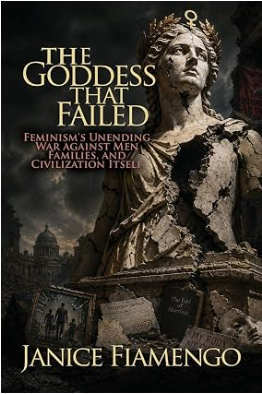
On her Substack, Janice Fiamengo examines the life and work of Andrea Dworkin, whose influence on modern feminism is still quite strong, twenty years after her death:

A friend wrote a couple of days ago to say that he had seen shiny new copies of works by feminist author Andrea Dworkin (1946-2005) in Munro’s Books, one of Canada’s premier independent bookstores. One of the books was positioned on a shelf with the cover facing out to indicate that it was being showcased.

It is both shocking and unsurprising that Picador Books decided to reprint three of Dworkin’s texts in the past year, calling her a “prescient and visionary writer” who was “ahead of her time”. Anti-male paranoia is a sanctioned, cultivated taste more popular now, perhaps, than ever before, and Andrea Dworkin is its most notorious propagandist.

Known for her physical bulk, impassioned rhetoric, unkempt hair, and lesbian-identified overalls, Dworkin was a feminist icon in the 1980s and 90s, loved and hated in equal measure. No one did more to outline and consolidate the modern feminist understanding of sex than she, writing on the subject obsessively and with unparalleled fervor in books with titles such as Woman Hating (1974) and Pornography: Men Possessing Women (1981). The MeToo movement is almost unimaginable without the influence of Dworkin’s pronouncements.

Like other radical feminists, Dworkin wrote about rape, pornography, and prostitution, but her special focus was the degradation for women of sex itself: regular sex, the commonly accepted, normalized indignity that men allegedly inflict on women every day. Tempering her words in the white-heat of her revulsion, Dworkin became feminism’s anti-sex evangelist.


Sex, Dworkin believed, embodied nothing less than men’s hatred of everything female: “Intercourse is the pure, sterile, formal expression of men’s contempt for women” (p. 175). This is the thesis of her most representative book, Intercourse, which was first published in 1987 when Dworkin was 41 years old. Dworkin’s characterization of heterosexual sex as the ultimate enactment of misogyny has had an enduring impact on North American culture.

Intercourse set out to illuminate, through select readings of literary texts, what Dworkin believed to be a constant of male culture: the “hatred of women, unexplained, undiagnosed, mostly unacknowledged, that pervades sexual practice and sexual passion” (pp. 175-76). The phrase she most often used in the book to refer to intercourse was “the fuck”, which was meant to signify the raw dehumanization that supposedly characterized it.

Dworkin nominated herself the expert on male contempt for women because she had been its victim. “Specifically, am I saying that I know more than men about fucking?” she asked defiantly in the book’s preface, and answered, “Yes, I am […] the way anyone used knows the user” (p. xxxi).

While she also claimed in the preface that the book “does not say that all men are rapists or that all intercourse is rape” (p. xxxii), she does essentially say that, if not in quite those words. As she asserted only a page after the denial, “Intercourse conveys […] what it means that men — and now boys — feel entitled to come into the privacy of a woman’s body in a context of inequality” (p. xxxiv).

In another segment, she clarified that most, even the vast majority, of men were sexually abusive. She charged that men object to feminist criticism of pornography and prostitution because “So many men use these ignoble routes of access and domination to get laid,” that “without them the number of fucks would so significantly decrease that men might nearly be chaste” (p. 61). The implication was that men who objected to her arguments about the omnipresence of sexual exploitation were themselves sexual abusers who didn’t like the thought of their exploitation being curtailed.

This was the Dworkin who made feminists swoon with admiration: bombastic, hyperbolic, and incandescent with accusatory rage.

December 9, 2025

The “Great Feminization” of western culture

In the National Post, Barbara Kay outlines the way society has been trending further away from traditional values and more and more toward the values of “empathy, safety, and cohesion” which have been predominantly feminine values in contrast to more male-oriented values of “rationality, risk, and competition”:

In September, public intellectual Helen Andrews caused a stir when she delivered a provocative 17-minute speech, titled “Overcoming the Feminization of Culture”, to the National Conservatism Conference, later published as an article for Compact, titled “The Great Feminization“.

Andrews summarized feminization as the prioritizing of feminine over masculine interests, but additionally prioritizing “empathy over rationality, safety over risk, cohesion over competition”. All these traits combine, she believes, in institutions where females are numerically dominant, to define “wokeness” and “cancel culture”.

Andrews points to Bari Weiss’ 2020 resignation letter from the New York Times where Weiss was labeled and ostracized for her social ties and cut off by perceived friends. In 2018, the newsroom there had tipped to a female majority which Andrews argues changed the work environment’s dynamics to one where cohesion is preferred, and covert undermining would replace open debate in favour of emotional harmony.

And I would argue that the more feminized society’s institutions become, the more readily extreme, empathic attitudes replace rational decision-making at policy-making levels, and the more society loses confidence in its ability to thrive.

Ironically, instead of directing empathy towards our own citizens, feminization also tends to direct empathy internationally. That is exactly what is happening at our national level, when our government earmarks funds for programs such as “Gender-Just, Low-Carbon, Rice Value Chains in Vietnam”.

This is also happening at a micro-level to the Jewish community in North America. Our spiritual leadership in non-orthodox synagogues is growing increasingly female, and, by no coincidence, is wokeness spreading, and, by no further coincidence, so is alignment with radical anti-Zionism.

[…]

Claims that Israel was guilty of genocide and apartheid, the authors write, were a constant feature of their education. Most shockingly, they write — and this at a rabbinical training institution headed by a female rabbi — that “the sexual violence Israelis experienced (on October 7) was never mentioned, even during Women’s History Month”.

What about the Christian clergy? A 2024 report on female Christian clergy found that in a 2018 sample, about 14 per cent of U.S. churches were headed by a senior female clergyperson. So, churches are not yet in danger of feminization. Good luck to them.

If there is a solution to the feminization-linked problem of anti-Zionism in the non-Orthodox rabbinate, I don’t know what it is. I only know this trend cannot end well for our community. What is essential in Jews’ spiritual homes now, more than ever in our history, is that they be spaces where “ahavat Yisrael” — love of Israel — is the prevailing norm. If we are not for ourselves, who will be?

On a more individual level, the Great Feminization has worked not to make women equal, but to increase their existing privileges and to demonize men who even notice the inequality now runs directly opposite to the narrative:

Image from Steve’s Substack

Over thirty years ago, I knew a woman who felt ecstatic joy taunting men with her nudity. She loved to flash her breasts at truckers on the highway. Thrilled at the thought that she left them frustrated, she would boast about her sexual power.

This is clear, unequivocal abuse. Imagine her taunting a village of starving Africans with BBQ’d steak. She then flees to her 5-star hotel, laughing and bragging that she had left them hungry and frustrated. This is how the West raises women. Self-obsessed, over-entitled and insufferable (insert obligatory, “not-all-women” clause here – yawn).

Feminists have gotten more sophisticated with their abuse since then. We now have transgressions that include absurd accusations like prolonged looking, mansplaining and manspreading. TikTokers go to the gym essentially nude in order to video and humiliate men who happen to notice.

We had the, “Yes means Yes” campaign that insists a man should repeatedly pester his partner with endless questions for permission during every intimate encounter. Never mind that a normal woman is likely to leave the bed after a few of these interruptions, rightly despising the insecure man who obeys that tripe. Anywhere outside of a deep feminist indoctrination camp, a woman will wonder whether your mother dropped you on your head as a child. I’ll bet that not even the most committed believer follows their own advice. This is not good communication — it denies healthy context, body language and facial expression.

And there’s nothing romantic about it; it is designed for feminist power. There is no number of reassurances that could possibly satisfy. The emphasis upon a non-stop verbal Q&A is courtroom strategy. And that’s the point: eliminate the human context, and set a trap for the man. “Did he ask permission to engage in number 17 of the 32 listed steps before sex? No, your honor, that’s where the sexual assault happened.”

Human intimacy is negotiated using mostly unspoken signals, and everybody likes it that way. Obviously there’s a need for clear communication, especially in a new relationship. I only need to include this disclaimer because the world is filled with pedantic manhating feminists eager to accuse me of denying women’s humanity. Grow up, child. Healthy women have absolutely no problem setting their own limits during intimacy. I’ve never met one who didn’t.

We cover for even the worst of women’s transgressions. When a woman murders her child, we call it infanticide and blame postpartum depression. When she murders her husband we call it battered wife syndrome, which is the title of a book by Canadian feminist law professor, Elizabeth Sheehy. Feminist lawyers even argue to eliminate female incarceration and close all women’s prisons, and for decriminalization of husband murder. This nonsense from the feminist cult for women with daddy issues protects mentally ill women who need psychological help, and/or belong in prison.

Every woman has a plethora of options, and near-infinite sympathy and support, in Western culture. Maybe that’s the problem: we don’t hold women responsible for their own behavior. Many women have not been socialized into adulthood.

At risk of making this a TLDR post, here’s Mark Steyn on the cultural side of our ever-more-feminized culture:

Welcome to another in our ongoing series of As I Said Twenty Sod-Bollocking Years Ago. Women have inherited the thrones of great powers — Elizabeth I, Catherine the Great, Victoria — and presided over massed ranks of courtiers drawn from the “pale, male and stale” (thank you, David Cameron). But America and its client states are the first in history in which every significant venue aside from ladies’ sport is now dominated by women. The west is closer than any society should be to the end of men — which is a big source of the terrible confusion in our schools that has led children to offer themselves up for bodily mutilation and irreversible infertility. Helen Andrews’ much noted “viral” essay on the phenomenon informs us inter alia that by 2024 American law schools were fifty-six per cent female and that sixty-three per cent of judges appointed by Joe Biden’s autopen are likewise on the distaff side. Elsewhere, fifty-five per cent of New York Times reporters are women (up from ten per cent half-a-century ago) and 57.3 per cent of US undergraduates are what we would once have called “coeds”.

At the same time, the principal source of immigration to the west is from a patriarchal culture even more severe (if you can believe it) than 1950s sitcom dads. If you live in London, Paris, Brussels, Stockholm, Dearborn, do you see more body-bagged crones on the streets than you did a generation back? Are you figuring on seeing more still in another twenty years? Or are you betting that the tide will have receded?

It is at the intersection of these two not entirely compatible trendlines — a feminised society with a patriarchal immigration policy — where lies the future (such as it is) of the western world. With that in mind, the annual commemoration of the 1989 Montreal massacre each December 6th has a symbolism that extends far beyond my own deranged dominion. Not just because it was an early example of the state hijacking the actual news to impose a narrative more helpful to its own needs. In the dismantling of manhood and manliness, no lie is too outrageous. As I wrote in The National Post of Canada on December 12th 2002 – twenty-three years ago:

    For women’s groups, the Montreal Massacre is an atrocity that taints all men, and for which all men must acknowledge their guilt. Marc Lépine symbolizes the murderous misogyny that lurks within us all.

    M Lépine was born Gamil Gharbi, the son of an Algerian Muslim wife-beater, whose brutalized spouse told the court at their divorce hearing that her husband “had a total disdain for women and believed they were intended only to serve men”. At eighteen, young Gamil took his mother’s maiden name. The Gazette in Montreal mentioned this in its immediate reports of the massacre. The name “Gamil Gharbi” has not sullied its pages in the thirteen years since.

The Gazette notwithstanding, that might open up many avenues of journalistic investigation, don’t you think? The potential implications of Canadian immigration policy. The misogyny in particular of Islam, and its compatibility with developed societies. But instead everyone who mattered in the Dominion’s elite decided it was all the fault of Canadian manhood in general — of Gordy and Derek’s, or Émile and Pierre’s, culture of toxic masculinity. That narrative has held for two generations. The only even slight modification has been from a sliver of academics who posit Gamil Gharbi as “the first incel“. I’m not sure “incels” — young men who are “involuntarily celibate” — existed as a mass phenomenon back in 1989: they are a consequence of the societal feminisation Ms Andrews writes about. The “incel” segment was by far the most interesting part of the Tucker/Fuentes convo, and the least remarked upon, but the notion that they’re itching to kill women bolsters the original 1989 framing, so the media are minded to entertain it.

Yet we all know, surely, that the young ladies in that Montreal classroom would have benefited from a little bit of available “masculinity” that day. Alas, the men to hand were in a certain sense far more profoundly disarmed than the wildest dreams of “gun control” advocates. From my book After America:

    To return to Gloria Steinem, when might a fish need a bicycle? The women of Montreal’s École Polytechnique could have used one when Marc Lépine walked in with a gun and told all the men to leave the room. They meekly did as ordered. He then shot all the women.

Which is the more disturbing glimpse of Canadian manhood? The guy who shoots the women? Or his fellow men who abandon them to be shot? For me, the latter has always been the darkest element of the story. From my column in Maclean’s, January 9th 2006:

    Every December 6th, our own unmanned Dominion lowers its flags to half-mast and tries to saddle Canadian manhood in general with the blame for the Montreal massacre — the fourteen women murdered by Marc Lépine, born Gamil Gharbi, the son of an Algerian Muslim wife-beater, though you wouldn’t know that from the press coverage. Yet the defining image of contemporary Canadian maleness is not M Lépine/Gharbi but the professors and the men in that classroom, who, ordered to leave by the lone gunman, obediently did so, and abandoned their female classmates to their fate — an act of abdication that would have been unthinkable in almost any other culture throughout human history. The “men” stood outside in the corridor and, even as they heard the first shots, they did nothing. And, when it was over and Gharbi walked out of the room and past them, they still did nothing. Whatever its other defects, Canadian manhood does not suffer from an excess of testosterone.

So the annual denunciation of manhood in general is the precise inversion of the reality of the event. That was unusual in 1989, but has become routine since: the UK Government’s “Prevent” programme, set up in the wake of the July 7th Tube bombings to “prevent” further “Islamist” attacks, now focuses its energies on the threat from a “far right” boorish enough to insist on noticing all these Islamic provocations; January 6th is an insurrection for which trespassing gran’mas have to be hunted down and banged up in solitary, but Thoroughly Modern Milley telling the ChiComs he’ll ignore his commander-in-chief or James Comey taking to Twitter to urge his chums to “eighty-six” the President is true patriotism of the highest order; in German cities saving democracy is so critical that it is necessary to ban the leading political party.

So the inversion of reality is pretty much standard operating procedure these days. There is, however, a sense in which that terrible one-off atrocity from the late Eighties has become a portent of tomorrow — of a western world thoroughly unmanned. Your average feminist lobby group doesn’t see it that way, naturally. “The feminism I think of is the one that embodies inclusivity, multiculturalism and the ability to change the world through the humanity that women do bring,” says Stephanie Davis, executive director of Atlanta’s Women’s Foundation. “If there were women in power in representative numbers — fifty-two per cent — I think that the World Trade Center would still be standing.”

November 30, 2025

The plight of most young western men

Filed under: Health, Media, USA — Tags: , , , , — Nicholas @ 05:00

At Postcards from Barsoom, John Carter explores the dangerous psychological rift in western thought that casts young men into a literal no-win situation and yet blames them for not succeeding:

La Belle Dame Sans Merci by Frank Bernard Dicksee, 1901

A great deal of Discourse revolves around the desultory state of the broken modern young man. We wring our hands about porn brained incels, and about the incel’s mirror image in the sociopathic gym bro fuckboy. We talk about how men need to man up, put down the console controller, get out of the basement, talk to real girls, and wife them up. At the same time, we do everything we can to make this as difficult and unappealing as possible. Male sexuality is relentlessly demonized, and this is at the root of great deal of social dysfunction.

Our society has established new social norms that make talking to girls in the wild, or even looking at them, tantamount to a sex crime. Buying a girl a drink at the bar is an imposition, an implicit expectation that she will at the very least say thank you, and this is essentially sexual harassment. As a result of this men do not buy girls drinks anymore. Glance at a girl’s cameltoe as she places her yoga pants between you and the mirror to do hip thrusts while you’re trying to focus on your deadlift, and get put on blast on TikTok as a perv. As a result men carefully avoid looking at girls, and girls wonder why they don’t get attention. Office romances are right out: ask Betty from accounting if she’d like to get a coffee, and you’re rolling the dice between getting lucky and getting a talking to from HR (if you’re lucky). Friend-group romances are discouraged: they bring too much drama.

The only romantic avenue still permitted is the dating apps. The de facto proscription of every other venue was so abrupt and thorough that I can’t help but wonder if MeToo was engineered by Match Group, in order to do to dating what Uber did to taxis. Just like Uber took an occupation that was able to provide a reasonable living standard for working class guys and turned it into piece-work for an imported third-world precariat, so Tinder wiped away thousands of years of accumulated social technologies optimized for the purpose of bringing young men and women together into stable, loving, and fecund matrimony, and replaced it with a winner-take-all meat market in which a small minority of the best-looking men swipe their way through a digital harem of emotionally crippled cum-dumpsters, while women retaliate by using their matches to get free meals and ghosting as soon as the cheque comes without so much as a thanks for the company. Commoditizing romance left everyone more lonesome and miserable than ever, but would you look at that market cap.

The decay set in long before Tinder, however.

Feminists have gotten a great deal of mileage out of Freud’s Madonna-whore complex. This is the idea of a Manichean division of femininity: the chaste purity of the innocent nurturing mother, contrasted with the wanton looseness of the degraded prostitute. The Madonna is embodied by the Virgin Mary, whose only begotten child was conceived immaculately, which is to say without actually having sex. Both archetypes are caricatures that fail to capture the full range of feminine sexuality, but a traditional, god-fearing society effectively forced women to choose between one or the other. Either she represses her instincts and lives a passionless life of quiet misery, or she becomes a fallen woman.

Unlike much of Freud’s oeuvre, which largely consisted of the author’s barely concealed fetishes, the Madonna-whore complex has held up fairly well in the era of evolutionary psychology. Freud’s explanation for the phenomenon – that it is rooted in the Oedipal desire to rut with your own mother – is of course nonsense (except possibly insofar as it may have applied to him). Its origin is more plausibly in the predicament of paternal uncertainty which has bedevilled men since before the dawn of mankind, and which leads to a trade-off between short- and long-term mating strategies with easy women on the one hand (with whom paternity is always in question, and in whom investment should therefore be kept to a minimum, but since they’re easy you can sow your seed in lots of them), and chaste women on the other (with whom paternity can be more reliably determined, and in whom greater investment is therefore warranted). It doesn’t matter that we have paternity tests now: evolved instincts don’t care about your technology.

In the aftermath of the sexual revolution female sexuality was freed from these ancient constraints. Women are permitted to dress as they please, date who they want, have sex with as many partners as they desire. Any attempt to dissuade women from such behaviour is attacked as slut shaming, a ploy by the patriarchy to control their bodies.

Promiscuous premarital sex was once a one-way street to single motherhood. The pill and legal abortion reduced that risk considerably, which provided the justification for eliminating sexual restraint in the first place. Male sexual psychology presents its own problems, however. Revealing attire invites male attention, and often not from the males whose attention a woman wants to attract. Women enjoy male attention, and so dress to attract it. Sexually excited men are liable to behave badly. Badly behaving men result in women getting hurt. Obviously, if a man behaves badly, society will punish him … but the wise course is to avoid putting temptation in his way in the first place. Those ancient restrictions on female sexuality weren’t there to oppress women: they were there to protect women from themselves.

Women may have chafed under the chastity belt of the Madonna-whore complex, but it caused problems for men too. Men don’t generally want either a frigid Victorian schoolmarm or a drunken slattern for a wife: he wants the happy medium between the two, purity in the streets but a prostie in the sheets, a girl who enjoys sex and is good at it, but only has it with him. The Madonna-whore complex is a schizoid separation of these two conflicting desires, which then leads to the romantic frustration of both sexes: men have to choose between two equally unappealing options, and women are required to deny one or the other aspect of their own sexuality.

Just like men, women tend to want two, somewhat contradictory things from the opposite sex. First, they want men to protect and provide for them: to build what needs building, fix what needs fixing, pay for dinner, buy them pretty jewellery. In other words, they want men to sacrifice their time and energy of their behalf. At the same time they want men who are dominant, strong, confident, and at least potentially dangerous, for the obvious reason that men must compete with other men, and men who do not possess these traits make terrible protectors and providers in comparison with men who do. The necessary tension is that dominant, aggressive men are generally much less interested in protecting and providing: a man who won’t submit easily to other men, won’t submit to women either; a man who can force other men to submit to his will, can also force a woman to do the same. This mirrors the tension in male desires: a girl who’s a good lay might not be the most impeccably virginal of innocent maidens.

We can’t call women whores anymore in order to enforce virginal purity, but bad romantic decisions still carry bad consequences, and women also need to be protected from those consequences (and can’t ever be held responsible for them). The emphasis has therefore shifted from policing female sexuality to policing male sexuality. The result of this is the emergence of the simp-rapist complex.

The only way to create a safe environment for women whose behaviour is entirely unrestricted is to ruthlessly suppress precisely those masculine traits of dominance and aggression that women find attractive in the first place. All of these traits get included into the broad category of “rape culture”. Even looking at a woman without her expressly stated positive consent becomes a problematic act. Men who violate these norms become, according to this standard, “rapists”.

Update, 1 December: Welcome, Instapundit readers! Please do have a look around at some of my other posts you may find of interest. I send out a daily summary of posts here through my Substackhttps://substack.com/@nicholasrusson that you can subscribe to if you’d like to be informed of new posts in the future.

« Newer PostsOlder Posts »

Powered by WordPress