
Quotulatiousness

April 9, 2013

Britain’s wartime rationing was the actual start of the modern welfare state

Filed under: Britain, Bureaucracy, Food, Government, History, WW2 — Tags: , , , — Nicholas @ 08:31

In the Telegraph, Daniel Hannan shows that the wartime coalition government led by Winston Churchill actually laid the groundwork for the post-war “creation” of the welfare state:
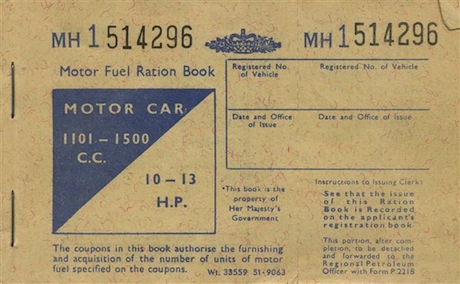
British WW2 Fuel ration book cover

It wasn’t the 1945 Labour Government that created the welfare state, that Saturn which now devours its children. The real power-grab came in 1940.

With Britain’s manpower and economy commandeered for the war effort, it seemed only natural that ministers should extend their control over healthcare, education and social security. Hayek chronicled the process at first hand: his Road to Serfdom was published when Winston Churchill was still in Downing Street.

Churchill had become prime minister because he was the Conservative politician most acceptable to Labour. In essence, the wartime coalition involved a grand bargain. Churchill was allowed to prosecute the war with all the nation’s resources while Labour was given a free hand to run domestic policy.

The social-democratic dispensation which was to last, ruinously, for the next four decades — and chunks of which are rusting away even today — was created in an era of ration-books, conscription, expropriations and unprecedented spending. The state education system, the NHS, the Beveridge settlement — all were conceived at a time when it was thought unpatriotic to question an official, and when almost any complaint against the state bureaucracy could be answered with “Don’t you know there’s a war on?”

All quite true, and all quite necessary at the time. Without significant amounts of imported food, Britain could not feed its people. Even with imports, the amount of available food was subject to unpredictable fluctuations as losses at sea interrupted supply and left empty shelves in grocery stores. Although losses were relatively low early in the war (early U boats were unable to stay at sea for long periods, and German bases were a long way from most British trade routes), the writing was on the wall if the war continued for years.

To fight a totalitarian regime, Britain had to emulate some of its methods (ironically, full rationing wasn’t introduced in Germany until much later in the war). For the middle classes, this was an unwelcome intrusion of the state into private affairs, but generally accepted due to the war. For the working classes, in many cases it was actively welcomed. While the rations were small, there was the promise — and generally a fulfilled promise — that some would be made available even in the poorest areas of the country. My mother was nine when the war began, and she remembers seeing more food in the stores of Middlesbrough after rationing was introduced. After the deprivations of the Great Depression, many people in the north and in Scotland were better fed and clothed during the rationing period than they had been for nearly a decade.

Given that information, it should not be surprising that so many people voted for Labour in the 1945 elections: they’d had what they believed to be a live demonstration of the benefits of socialism for six years of war, and didn’t want to go back to the pre-1940 status quo.

December 8, 2012

Jefferson, Lincoln, Churchill, and Yogi Berra

Filed under: Books, History, Media, Politics, Quotations — Tags: , , , — Nicholas @ 11:27

What do these four men have in common? They’re “flypaper figures“: people who frequently are quoted as saying things they never said:

“People will see a quote and it appeals to an opinion that they have and if it has Jefferson’s name attached to it that gives it more weight,” she says. “He’s constantly being invoked by people when they are making arguments about politics and actually all sorts of topics.”

A spokeswoman for the Guide‘s publisher said it was looking into the quote. Mr. Norris’s publicist didn’t respond to requests for comment.

To counter what she calls rampant misattribution, Ms. Berkes is fighting the Internet with the Internet. She has set up a “Spurious Quotations” page on the Monticello website listing bogus quotes attributed to the founding father, a prolific writer and rhetorician who was the principal author of the Declaration of Independence.

[. . .]

Jefferson is a “flypaper figure,” like Abraham Lincoln, Mark Twain, Winston Churchill and baseball player and manager Yogi Berra — larger-than-life figures who have fake or misattributed quotes stick to them all the time, says Ralph Keyes, an author of books about quotes wrongly credited to famous or historical figures.

October 12, 2012

Winston Churchill’s papers now available online

Filed under: Britain, History, Media, WW2 — Tags: — Nicholas @ 09:41

Anna Leach at The Register on the newly available writings of Winston Churchill:

The man who famously stated that the British would “fight them on the beaches” in the event of a German invasion has had some of his less-often quoted words including his private letters (and his receipts for cigars) fully digitised and made available online in the Churchill archive.

Winston Churchill’s private musings, letters to Stalin, doodles and appointments diaries are now on the internet after two years of painstaking digitisation at Churchill College, Cambridge.

The haul of papers documents all areas of the great man’s life and times from the most trivial to the most important.

August 6, 2012

Admiral Fisher: an excitable sort of man

Filed under: Britain, Germany, History, Humour, WW1 — Tags: , , , — Nicholas @ 10:41

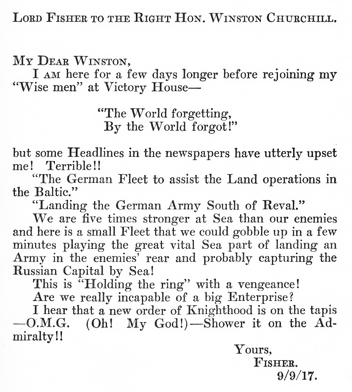
Admiral “Jackie” Fisher was a major historical figure in the Royal Navy, advocate of the modern dreadnought battleship and a tad high-strung (“…and on one occasion, the king asked him to stop shaking his fist in his face”). His relationship with Winston Churchill at the Admiralty must have been something to observe, as two of the most influential men in London worked together (for a while). After leaving the Admiralty for the last time, he still kept in touch with Churchill. Here is an example of his communication style:

This is believed to be the first documented use of the now familiar “OMG”.

H/T to Shaun Usher.

September 2, 2009

Speaking of historical revisionism, here’s Pat Buchanan!

Filed under: Europe, Germany, History, WW2 — Tags: , , , — Nicholas @ 12:47

Pat Buchanan recently published a book called Churchill, Hitler and ‘The Unnecessary War. From the title, you can probably pick up the notion that he feels that Hitler was misunderstood and didn’t really want to go to war. If you aren’t busy retching already, try this on for size:

Did Hitler Want War?

Well, from the title alone, we’re off into cloud-cookoo land already. Yes, Hitler did want war. He was pretty emphatic about it too, and not just in 1939. His written-in-prison Mein Kampf was not a particularly pacific and conciliatory little homily.

The German-Polish war had come out of a quarrel over a town the size of Ocean City, Md., in summer. Danzig, 95 percent German, had been severed from Germany at Versailles in violation of Woodrow Wilson’s principle of self-determination. Even British leaders thought Danzig should be returned.

Why did Warsaw not negotiate with Berlin, which was hinting at an offer of compensatory territory in Slovakia? Because the Poles had a war guarantee from Britain that, should Germany attack, Britain and her empire would come to Poland’s rescue.

Danzig was an excuse, not a reason. The plebiscite had shown that the inhabitants wanted to be part of Germany again, which is probably not surprising as the pre-war Polish government was anti-German and were actively trying to suppress the German language and culture in former German areas of Poland. The Polish government was authoritarian, not democratic, and were not the innocents that some later portrayals might try to indicate. Few of the governments of central or eastern Europe would pass muster as democracies in the 1930s.

Poland did not trust the German government to negotiate in good faith, with plenty of reason, so trying to blame them for the outbreak of the war is ludicrous.

But where is the evidence that Adolf Hitler, whose victims as of March 1939 were a fraction of Gen. Pinochet’s, or Fidel Castro’s, was out to conquer the world?

Um. There’s a tiny little bit of evidence. His book. His speeches. The war plans he had his military leaders draw up. The re-armament program, far in excess of what a peaceful nation with nearby enemies might need as a deterrent.

But yeah, aside from that, he didn’t — so far as we know — conduct a secret pinky-swear session with Mussolini and Hirohito at midnight in the Chancellery basement to conquer the world or else. I mean that’d be the smoking gun, wouldn’t it?

But if Hitler was out to conquer the world — Britain, Africa, the Middle East, the United States, Canada, South America, India, Asia, Australia — why did he spend three years building that hugely expensive Siegfried Line to protect Germany from France? Why did he start the war with no surface fleet, no troop transports and only 29 oceangoing submarines? How do you conquer the world with a navy that can’t get out of the Baltic Sea?

Why did he build the Westwall (aka “Siegfried Line“)? Well, perhaps it was because the French had already constructed large sections of the Maginot Line? This — at least as far as generals on both sides thought — provided a dual purpose: to prevent a German attack into France, and to provide a safe starting point for a French attack into Germany. The fact that the line failed to prevent an attack which came from beyond the flank of the line is hindsight. The Westwall was also multi-purpose, in this case it had three goals: prevent the French attacking, provide a base for an attack on France, and (borrowing the modern term) infrastructure. The Nazi party came to power partly because of the unemployment situation in Germany in the early 1930s. A vast construction project like the Westwall offered chances to soak up lots of “excess” labour . . . and to provide money to the “right” kind of private firms (those who supported the Nazis or those which the Nazis needed to curry favour with).

Go read the whole thing if you’re interested, but I’m feeling that there’s little point in going on . . . I’m certainly not going to persuade Mr. Buchanan or his followers of anything.

« Newer Posts

Powered by WordPress

