Quotulatiousness

July 5, 2012

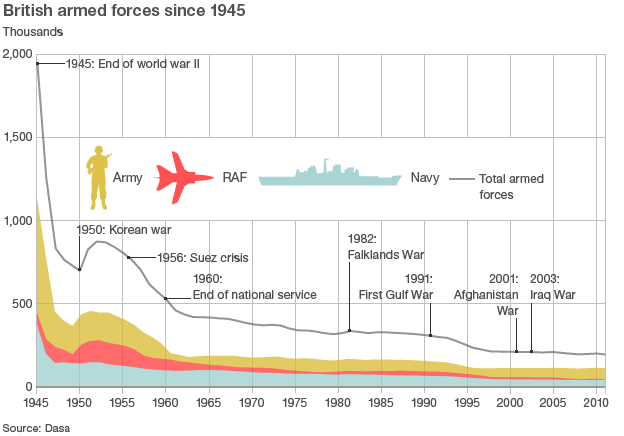
British army reduces and consolidates 17 units

Filed under: Britain, Military — Tags: , , , — Nicholas @ 09:47

As reported earlier, the British army will be losing several battalions of infantry in the consolidation effort to reduce the army’s total manpower by 20,000:

The four infantry battalions to disappear are the 2nd Battalion the Royal Regiment of Fusiliers, the 2nd Battalion the Yorkshire Regiment (Green Howards), the 3rd Battalion the Mercian Regiment and the 2nd Battalion the Royal Welsh.

A fifth infantry battalion, the 5th Battalion the Royal Regiment of Scotland (Argyll and Sutherland Highlanders), will become a single company to carry out public duties in Scotland.

The Armoured Corps will be reduced by two units with the mergers of the Queen’s Royal Lancers and the 9th/12th Royal Lancers and the 1st and 2nd Tank Regiments.

The Royal Artillery, the Royal Engineers, the Army Air Corps, the Royal Logistic Corps, the Royal Electrical and Mechanical Engineers and the Royal Military Police will also be affected.

[. . .]

Details of the other changes are:

  • The Royal Artillery will be reduced from 13 to 12 units with the withdrawal of the 39th Regiment Royal Artillery
  • The Royal Engineers will be reduced from 14 to 11 units with the withdrawal of 24 and 28 Engineer Regiments and 67 Works Group
  • The Army Air Corps will reduce from five to four units as 1 Regiment AAC merges with 9 Regiment AAC
  • The Royal Logistic Corps will be reduced from 15 to 12 units with 1 and 2 Logistic Support Regiments withdrawn from the Order of Battle and 23 Pioneer Regiment disbanded
  • The Royal Electrical and Mechanical Engineers will be reduced to seven units with the withdrawal of 101 Force Support Battalion
  • 5 Regiment Royal Military Police will be removed

Update: As you’d expect, the changes are not being welcomed by current or former soldiers.

The reforms have caused anger and frustration within senior ranks. Earlier this week, a leaked letter to General Wall from one senior officer in the Royal Fusiliers showed the anger brewing over the scale of the proposed cuts.

Brigadier David Paterson, the honorary Colonel of the Regiment of Fusiliers, said the decision to axe one of its battalions would not “best serve” the armed forces and “cannot be presented as the best or most sensible military option”.

He added: “I, as Colonel, have the duty to tell my men why it is their battalion, which at the time of the announcement will be the best manned battalion in the army, with recruits waiting in the wings, was chosen by CGS. I will then also have to explain to my Fusiliers in a fully manned battalion why they are likely to be posted to battalions that cannot recruit. This will not be an easy sell.”

July 1, 2011

Duleep Allirajah: “The Most Pointless Sporting Argument Ever”

Filed under: Britain, Soccer — Tags: , , , , , — Nicholas @ 11:32

He’s quite right: this has to be the nadir of international sporting debates:

Where do you stand on the controversial issue of a Great Britain football team? Disgusted that the British Olympic Association is threatening the independence and proud traditions of the home football nations? Angered that the Welsh, Scottish and Northern Irish associations are trying to thwart the Olympic dreams of their young players? Or, like me, do you want to be woken up when The Most Pointless Sporting Argument Ever is over?

If you’re wondering why the proposal for a unified British football team has caused such controversy, let me explain. There has never been a single UK football association. Instead, all four countries — England, Scotland, Wales and Northern Ireland — have their own football associations. Each country is recognised by FIFA as a separate entity even though they are not sovereign nations. It’s one of the residual privileges enjoyed by the nation that invented the game. Although the Brits have minimal influence within FIFA, as the 2018 World Cup bid and the farcical presidential election demonstrated, all four UK nations are represented on the eight-member International Football Association Board (IFAB), which is the sport’s law-making body. The home nations also retain the right to appoint a FIFA vice-president. Although the English FA is keen on fielding a British team in the 2012 Games, the other national associations fear that their independence and FIFA privileges will be jeopardised as a result.

The debate took a farcical twist this week when the British Olympic Association (BOA) announced that an ‘historic agreement’ had been reached with all the home nations to field a Great Britain team at the Olympics. However, no sooner had the BOA made its announcement than the Wales, Scotland and Northern Ireland football associations angrily denied that any agreement had been reached. Oops!

« Newer Posts

Powered by WordPress