
In Slate magazine, SF author Ursula LeGuin complains that the producers of the new Earthsea miniseries have butchered her work. One form of butchery that she zeroes in on is by casting characters who she intended to be red, brown, or black as white people.
I have mixed feelings. LeGuin has every right to be POed at how her intentions were ignored, but on the other hand my opinion of her has not been improved by learning that she intended the books as yet another wearisomely PC exercise in multiculturalism/multiracialism.
I liked those books when I read them as a teenager. I didn’t notice any character’s skin color. I would really prefer not to have had my experience of those characters retrospectively messed with by LeGuin’s insistence that the race thing is important.
Note: I am not claiming that all casting should be colorblind. I remember once watching an otherwise excellent Kenneth Branagh production of Much Ado About Nothing that was somewhat marred for me by Branagh’s insistence on casting an American black man as a Renaissance Italian lord. This was wrong in exactly the same way that casting a blue-eyed blond as Chaka Zulu or Genghis Khan would be — it’s so anti-historical that it interferes with the suspension of disbelief. Fantasy like LeGuin’s, however, doesn’t have this kind of constraint. Ged and Tenar don’t become either more or less plausible if their skin color changes.
But what really annoyed me was LeGuin’s claim that only whites have the “privilege” of being colorblind. This is wrong and tendentious in several different ways. Colorblindness is not a privilege of anyone, it’s a duty of everyone — to judge people not by the color of their skin but the content of their character, and to make race a non-issue by whatever act of will it takes. (It doesn’t take any effort at all for me.)
Eric S. Raymond, “The Racist of Earthsea”, Armed and Dangerous, 2004-12-16.
May 7, 2017
QotD: The privilege of colourblindness
May 6, 2017
Marine Le Pen versus Emmanuel Macron
Megan McArdle is in France this week and watched the televised debate between Le Pen and Macron on Wednesday. She found some interesting parallels between it and the US presidential debates, but some significant differences, too:
Watching last night’s presidential debate here in France, I found it hard not to think about our own presidential debates in the U.S., lo these many months ago. In many ways, it was the same: the populist upstart against the center-left representative of the establishment, the status quo against the YOLO, the woman against the man. In other ways, it was very different — which is why, according to almost everyone, Emmanuel Macron is going to be elected president next week, and Marine Le Pen will not.
Macron, like Hillary Clinton, is the candidate of “more of the same, but with, you know, more of the same.” His contempt for Le Pen was obvious, and if this were an American debate, would have hurt him. My French is good enough to read a newspaper (very slowly) and to sort of follow the debate as long as no one else was talking. So as I watched, I paid attention to tone and body language as much as content.
[…]
Le Pen, like Trump, is basically the candidate of “things were better 40 years ago, so let’s go back there.” And it’s easy to understand why that’s appealing for a lot of voters in both France and America. The problem is, even if it were desirable to migrate en masse back to the mid-20th century, no one knows how to do it. France may be struggling to integrate its immigrants, but they are here, and cannot simply be removed the way one might get rid of a piece of furniture that clashes with the rest of the décor. Trade may have resulted in painful deindustrialization, but de-industrialization is a one-way street, and pulling out of those trade relationships will not bring back the lost factories. The euro may have been a very bad idea — no, strike that, the euro was a very bad idea, probably the worst one France has had since “let’s get into a land war in Southeast Asia” — but leaving the euro is not the same as having never adopted it. In the short term, at least, it would be catastrophically messy.
To this, Le Pen’s supporters might reply “but at least we could stop making things worse.” But even if you hold out more hope for her agenda than I do, the fact remains that if you reject the status quo in favor of radical change, you necessarily raise the risk that things will get much worse. We know approximately what the status quo looks like. Radical action means launching off into the dark. Which is why radical candidates inevitably seem less prepared, knowledgeable and plausible than their mainstream opponents.
That said, compared to Donald Trump, Marine Le Pen sounds like a wonk’s wonk. Nor does she have his propensity to lose his cool. Watching the French debate, I was struck by a repeated thought: if Clinton had had Le Pen’s speaking ability, she would be president now. During the campaign, and after, Clinton’s supporters frequently complained that Clinton was being penalized for being an older woman. But Le Pen is living proof that middle-aged ladies can be effective politicians. I don’t like her agenda, and I really don’t like her party. But looking strictly at effectiveness on the stump, she’s pretty good.
May 3, 2017
QotD: “Patrick Macnee was a Serious Feminist”
Patrick Macnee
- Refused to model Steed after James Bond because Bond “uses women like battering rams”
- Embraced the concept of a female partner after being cast opposite a male one for a season
- Listened when Honor Blackman began telling him about gender inequality
- Didn’t think that being saved by a woman in any way injured his character’s masculinity
- Consistently gave the women credit for the success of the show
- Recognized that the male producers were chauvinists, and blamed himself for not doing more about it
- Stood up for Linda Thorson when the producers tried to bully her (and was apparently terrifyingly angry about it)
- Was literally the only person on that show that Diana Rigg never said a bad word about
- Consistently talked about being raised by women and viewing women as equal to men
Lauren H. Brooks, “Patrick Macnee was a Serious Feminist”, Kinkiness … and Patrick Mcnee, 2017-04-21.
April 30, 2017
QotD: Famous for being famous
Every country that has television, which is all of them, must have celebrities who are famous for almost nothing. The U.K. practically specializes in this. But the “almost” is important. Even the weird layer of U.K. celebrity that subsists on the old country’s old-fashioned panel and reality shows normally tends to demand that a celeb have been a member of Parliament or received a surgically enhanced bosom. If possible, both.
Colby Cosh, “On the ignominious downfall of Jared from Subway”, National Post, 2015-08-20.
April 28, 2017
Words & Numbers: Actually, Life is Pretty Awesome
Published on 26 Apr 2017
This week, James and Antony take a brief departure from talking about the growing national debt, and our absurd tax system to discuss the numerous ways in which more economic and personal freedom has made people wealthier, more equal, and better off all over the world. We’re actually living in pretty amazing times.
Read more:
https://fee.org/articles/actually-life-is-pretty-awesome/
April 23, 2017
The Real Reason We Never Hear From Monty Python Anymore
Published on 20 Apr 2017
The legendary comedy group Monty Python was once a force of nature, influencing everything that came after them with their surreal, absurdist approach to comedy. So, why don’t we hear from them anymore? When Graham Chapman ceased to be in 1989, fellow Python member Terry Jones described it as “the worst case of party-pooping [he’d] ever seen.” His death came the day before Python’s 20th anniversary, and what followed was a bizarre but fitting eulogy, written to pay tribute to the man who’d written a dead parrot into one of the troupe’s most famous sketches. Chapman becoming an ex-person seemed to put a damper on any kind of authentic reunion, but what about the others? What happened to the late, great Monty Python?
Terry Jones’s illness | 0:44
Michael Palin’s travel shows | 1:54
John Cleese’s purism | 3:01
Terry Gilliam’s moved on | 4:13
Eric Idle’s Broadway ambitions | 5:06
They want to finish on a good note | 6:02Read more here → http://www.grunge.com/53323/never-hear-monty-python-anymore-2/
March 27, 2017
2017 – the year of the Great Dissatisfaction
Kevin Williamson says that “our world is full of wonders, but not everyone finds a place in it”:
Once, the question the ambitious and dissatisfied asked themselves was: “How do I climb that ladder?” Current tastes run more toward smashing the ladder and the hierarchies for which it stands in the name of … whatever: feminism or anti-feminism, black liberation or white nationalism, global justice or national sovereignty.
We spend our days surrounded by great miracles and minor irritations. My friend Jay Nordlinger recently recounted how Joseph Stalin allowed the film The Grapes of Wrath to be shown in the Soviet Union, believing that to see an indictment of capitalism from within the beast itself would be salutary for the proletariat. The proletariat took another lesson from the film: The Joads, apparently the poorest people in America, had a Ford, a luxury no working man in the workers’ paradise could dream of. A similar story is told about the television series Dallas: The Soviets thought their subjects would recoil from the mischief of J. R. Ewing and his Texas oil cronies, but all the poor Russians could see was that American servants lived better than Soviet doctors and professors. If we could share our daily tales of woe with our great-grandparents — e.g., my complaints about the Wi-Fi on airplanes — they would not take from that the conclusion we intended.
We do not have a problem of privation in the United States. Not really. What we have is something related to what Arthur Brooks (“the most interesting man in Washington,” Tim Alberta calls him) describes as the need for earned success. We are not happy with mere material abundance. We — and not to go all Iron John on you, but I think “we” here applies especially to men — need to feel that we have earned our keep, that we have established a place for ourselves in the world by our labor or by other virtues, especially such masculine virtues as physical courage and endurance. I suspect that is a big part of the reason for the exaggeratedly reverential, practically sacramental attitude we current express toward soldiers, police officers, and firemen. Of course they are brave and deserve our gratitude, but if we had felt the need to ceremonially thank everyone for their service in 1948, we’d never have done anything else with our time. In 2017, there are many more jobs for courtiers than for soldiers, and the virtues earning the highest return are not bravery or toughness but conversational cleverness, skill in social navigation, excellence in bureaucracy, and keenness in finance.
[…]
And there is the paradox within our paradox: The world is wondrous and beautiful and exciting and rich, and many of us have trouble finding our place in it, in part, because it is wondrous and beautiful and exciting and rich, so much so that we have lost touch with certain older realities. One of those realities is that children need fathers. Another is that fathers need children.
But these are what my colleague David French calls the “wounds that public policy will not heal.” Our churches are full of people who would love to talk to you about healing, but many have lost interest in that sort of thing, too. And so they turn to Trump, to Le Pen, to Chavismo (which is what Bernie Sanders is peddling), and, perhaps, to opiate-induced oblivion. Where will they turn when they figure out — and they will figure it out — that there are no answers in these, either?
And what will we offer them?
March 18, 2017
QotD: MILFs
I’m not sure if my predilection for MILFs came naturally or if it was learned over time. I came of age in the ’70s and ’80s and back then, only pedophiles liked young girls. All our pinups were old. When Raquel Welch appeared on The Muppet Show, I started having feelings I’d never felt before. We all did and we talked about her on the swings at school. She was 38. Pretty much every man of my generation has Olivia Newton-John at the end of Grease burned into his boner. She was 30 in that movie. Bailey was over 30 when WKRP was on. Loni Anderson was in her late 30s. Mary Ann wasn’t quite 30 on Gilligan’s Island, but Ginger was 33. Mr. Kotter’s wife was 31 when the show ended. Chrissy Amphlett was 10 years older than me when the Divinyls released “I Touch Myself,” but I almost had a heart attack looking at her thigh-high socks. Nobody paid attention to young girls when I was a young man. It was considered creepy. If one of them wore a Catholic school uniform on Halloween, we’d barf. There may be some disgusting perverts in the world, but in America, “MILF” tops the list of porn searches. Sure, there’s some extra meat around the waist and a little more junk in the trunk. What tepid eunuch can’t handle that? Real men are into women, not girls. No wonder blacks and Hispanics are trampling our masculinity like we’re a bunch of bitch-ass maricóns. We can barely handle a fat ass. You can keep your perky tits. I want breasts with a bit of hang to them. I’m not talking about National Geographic saggy, but if you can hold five pencils under your left one, I’ll write you a love letter. It’s like my friend Trevor once said: “I dated a chick with droopers when I was 19 and I really wasn’t into it — but I sure wouldn’t mind messing with them right now!” He looms in for the second part with a leering grin on his face. This is something young men will never understand. As Steve Coogan points out in The Trip, the spectrum of what you find attractive widens greatly as you get older.
Gavin McInnes, “In Praise of the Benjamin Button Babes”, Taki’s Magazine, 2015-07-24.
March 14, 2017
The Real Reason Why Firefly Was Canceled
Published on 8 Aug 2016
Joss Whedon’s Firefly was poised to be the next huge sci-fi series to change television. Unfortunately, those hopes were dashed after one incomplete season. Let’s look back at the reasons why Firefly‘s lights went out…
A small, loyal fan base | 0:15
Marriage trouble | 0:35
Friday night fright | 0:59
The episodes aired out of order | 1:21
The promos didn’t capture the spirit of the show | 1:45
Low ratings | 2:11
An executive defense | 2:32
March 6, 2017
“What could possibly account for that growth? Statistical fakery so fake that a Vegas bookie would weep”
Daniel Greenfield on how to hoax the media into reporting on a burgeoning anti-Muslim movement in the United States:
“Huge Growth in Anti-Muslim Hate Groups During 2016: SPLC Report,” wails NBC News. “Watchdog: Number of anti-Muslim hate groups tripled since 2015,” FOX News bleats. ABC News vomits up this word salad. “Trump cited in report finding increase in US hate groups for 2nd year in a row.”
The SPLC stands for the Southern Poverty Law Center: an organization with slightly less credibility than Ringling Bros and Barnum & Bailey Clown College, and without the academic degree in greasepaint.
And you won’t believe the shameless way the SPLC faked its latest Islamophobia crisis.
The Southern Poverty Law Center’s latest “hate group” sightings claims that the “number of anti-Muslim hate groups increased almost three-fold in 2016.”
That’s a lot of folds.
And there is both bad news and good news from its “Year in Hate and Extremism.”
First the good news.
Casa D’Ice Signs, the sign outside a bar in K-Mart Plaza in Allegheny County, Pennsylvania, is no longer listed as a hate group. The sign outside the bar had been listed as a hate group by the SPLC for years. The owner of Casa D’Ice had been known for putting politically incorrect signs outside his bar. So the SPLC listed the “signs” as a hate group. (Even though there was only one sign.) Not the bar. That would have made too much sense.
Since then Casa D’Ice was sold and the SPLC has celebrated the defeat of another hate group. Even if the hate group was just a plastic sign outside a bar.
But the bad news, according to the Southern Poverty Law Center, is that anti-Muslim hate groups shot up from only 34 in 2015 to 101 in 2016.
What could possibly account for that growth? Statistical fakery so fake that a Vegas bookie would weep.
March 5, 2017
QotD: “Call it Fifty Shades of Orange“
The sequel to that stupid mommy porn bondage movie is now in theaters, giving naughty thrills to bored housewives whose liberal husbands can’t cut it manwise, but the real festival of S&M was in the White House as President Trump unleashed his iron discipline on the media. Call it Fifty Shades of Orange.
It wasn’t a press conference – it was a kinky dungeon session where masochistic journalists eagerly sought out the delicious pain Master T was dealing. Hack after hack stepped up, tried to play “gotcha.” and ended up whimpering in the fetal position. The best part was CNN’s Jim Acosta, fresh from whining about how conservative outlets now get to ask questions too, basically handing Trump the cat-o-nine tails. Dude, next time keep from talking yourself into more public humiliation by biting down on the ball gag.
The media’s safe word is “Objectivity,” but none of them uttered it.
The wonderful thing about Trump – and the thing that sets the Fredocons and wusspublicans fussing – is that he gives exactly zero damns about the media’s inflated and ridiculous self-image. He doesn’t pay lip service to their lie that they are anything but what Instapundit calls “Democratic Party operatives with bylines.” Trump called them the “the enemy of the American People,” to which normals responded with “Yeah, sounds about right.”
Kurt Schlicter, “President Trump Has Been Far Too Nice To The Mainstream Media”, Townhall.com, 2017-02-20.
March 4, 2017
The miniatures of Gerry Anderson’s UFO
One of my favourite shows in the early 1970s was UFO, by the same creator and production team of the classic “supermarionation” shows Fireball XL5, Thunderbirds, and Captain Scarlet. The Prop Gallery has an overview of how the miniatures used in the show were developed and filmed:

UFO is a 1970 science fiction television series created by Gerry and Sylvia Anderson and was the final production of Century 21, formally AP Films, who had previously been responsible for other hit shows such as Thunderbirds and Captain Scarlet and the Mysterons. UFO was the Anderson’s first live action series, financed by the Incorporated Television Company (ITC) of media mogul Lew Grade who like what he saw in the Anderson produced film Doppelganger, the series was aimed at a more adult demographic than their earlier marionette based work.
The series follows a secret military organisation known as SHADO, an acronym for Supreme Headquarters Alien Defence Organisation, who defend the Earth from alien invasion under the cover of the Harlington-Straker Studios. Starring Ed Bishop as Commander Straker much of the series was filmed the MGM British Studios, later known as Elstree, which doubled as the Straker Studio in a clever money saving move. While the series may have lacked puppets it did feature Anderson’s other trademark, stunning model miniature effects sequences realised by longtime collaborator Derek Meddings who would go on to become an Academy Award winner and one of the most highly regarded and influential effects talents ever to work in the industry.
In early 1969 Century 21 set about realising the requirements for filming from their studios in Slough and work began on developing the various SHADO vehicles. Instrumental in this process were Derek Meddings and prolific designer Mike Trim who created concepts which were to bring yet another Anderson world to life. Miniatures were built in various scales by the talented Century 21 model makers, the old puppet stages used on previous shows were transformed in to fully fledged visual effects stages to handle the construction of larger model sets and filming began in April 1969 under the supervision of Meddings.

March 1, 2017
The different “flavours” of propaganda
Cory Doctorow on the various types of propaganda in use around the world:
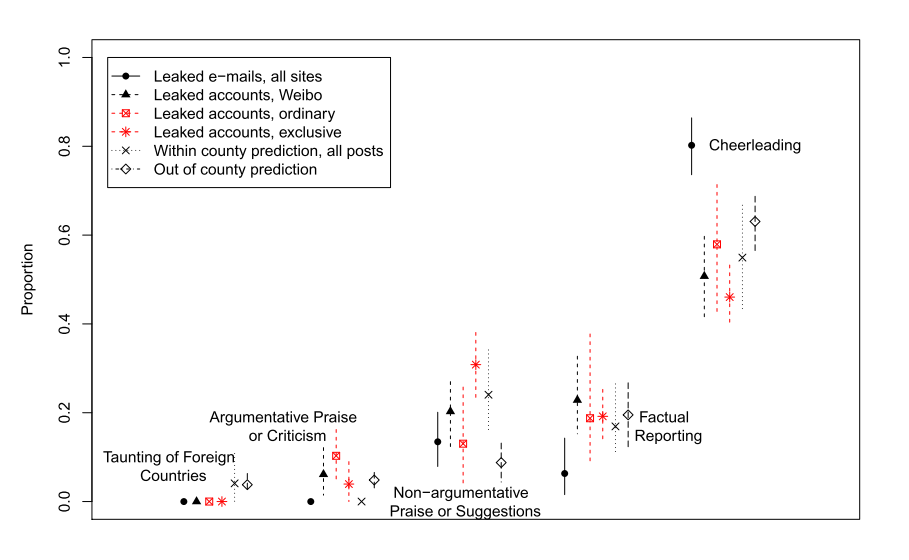
Jonathan Stray summarizes three different strains of propaganda, analyzing why they work, and suggesting counter-tactics: in Russia, it’s about flooding the channel with a mix of lies and truth, crowding out other stories; in China, it’s about suffocating arguments with happy-talk distractions, and for trolls like Milo Yiannopoulos, it’s weaponizing hate, outraging people so they spread your message to the small, diffused minority of broken people who welcome your message and would otherwise be uneconomical to reach.
Stray cites some of the same sources I’ve written about here: Tucker Max’s analysis of Yiannopoulos’s weaponized hate and The Harvard Institute for Quantitative Science team’s first-of-its kind analysis of leaked messages directing the activities of the “50-cent army, which overwhelms online Chinese conversation with upbeat cheerleading (think of Animal Farm‘s sheep-bleating, or Nineteen Eighty-Four‘s quackspeak).
But I’d never encountered the work he references on Russian propaganda, by RAND scholar Christopher Paul, who calls Russian disinformation a “firehose of falsehood.” This tactic involves having huge numbers of channels at your disposal: fake and real social media accounts, tactical leaks to journalists, state media channels like RT, which are able to convey narrative at higher volume than the counternarrative, which becomes compelling just by dint of being everywhere (“quantity does indeed have a quality all its own”).
Mixing outright lies with a large dollop of truth is key to this tactic, as it surrounds the lies with a penumbra of truthfulness. This is a time-honored tactic, of course: think of the Christian Science Monitor‘s history of outstanding international coverage, accompanied by editorials about God’s ability to heal through prayer; or Voice of America‘s mixture of excellent reporting on (again) international politics and glaring silence on US crises (see also: Al Jazeera as a reliable source on everything except corruption in the UAE; the BBC World Service‘s top-notch journalism on everything except UK complicity in disasters like the Gulf War, etc).
In addition to this excellent taxonomy of propaganda, Stray proposes countermeasures for each strain: for Russia-style “firehoses of falsehood,” you have to reach the audience first with an alternative narrative; once the firehose is on, it’s too late. For Chinese quackspeak floods, you need “organized, visible resistance” in the streets. For pathetic attention-whores like Yiannopoulos, Stray says Tucker Max is right: you have to ignore him.
February 3, 2017
“In a secular age … it is inevitable that people will attach themselves like limpets to miniature religions”
Colby Cosh draws some parallels between the early Federalists in post-revolutionary America and the mainstream media today: both groups attempted to retain their privileged position in society as that society changed dramatically all around them:
But now the seeds of fleeting confusion have fallen into the fertile soil of Internet crap-mongering. On social media there were immediate, unabashed, conflicting total lies circulating about the identities of the “two” perpetrators. Now, before much is known at all of the actual killer, we are seeing deliberately engineered hints at some kind of inexplicable cover-up by the (Muslim-controlled?!) police of Quebec, or by higher authorities — Liberals, reptoids, George Soros clones? Pick your poison!
Those trivial little wobbles in the initial news coverage are being exploited by journalists and commentators who have abandoned respect for facts like “there are always reports of a second shooter” in favour of efficient, direct manipulation of “the narrative.” The actual full-fledged conspiracy theories are being designed as we speak, and soon will be ready for harvest.
We live in a post-revolutionary media environment, and traditional newspapers and broadcasters are like the American Federalists: we are hoping to stay on top as trusted, sensible informers and teachers. I make no claim that this hope is well-founded or appropriate, but either way, the strategy did not end very well for the Federalists. One notices that they are already in irreversible, humiliating retreat at the moment when Wood’s book begins.
There is money in offering an alternative account, any alternative account of anything important or dramatic, to the gullible. Build a suspicious audience of millenarians and ignoramuses, and some of them will keep following you until you can start selling them protein supplements, bulk food for the apocalypse, religious knick-knacks, or penis pills. (Which business line will Rebel Media break into first? It’s only a matter of time!)
In a secular age, like ours or like the late 18th century, it is inevitable that people will attach themselves like limpets to miniature religions. Today they range from gold-bugs to survivalist “preppers” to disturbingly overenthusiastic Harry Potter fans to Gwyneth Paltrow’s Goop. (My apologies to those readers, and I’m sure there are a few, who are devotees of all four faiths.) Such subcultures are the reliable basis of a bulletproof “news” media model. The horrible part is this: they might be the only such model.


