H/T to Jason Ciastko and John McCluskey for the link.
November 13, 2010
November 12, 2010
Former TSA agent says “Shut Up And Get In The Scanner”
A former TSA scanner talks about the uproar about the full body scanners:
As a former TSA Federal Security Officer aka “screener” I have seen some incredible stuff come through the airport. I have worked in every position over the 5 years I was there. I have screened you, your carry on luggage, your checked luggage and even cargo you may have sent someplace. I have seen tons and trust me a naked image of you is not a problem.
When I worked in the checkpoint and screened passengers and their carry-on luggage, not only could I see what you had in your carry-on bag, I could see you. I could connect the image on the screen with the passenger. If that didn’t humiliate you then this tiny little naked image shouldn’t either. The TSA officer who is looking at the image will never see you and you won’t see them. But that vibrator in your carry-on luggage that looks like it would satisfy an elephant, yeah I see that and I see you standing right in front of me. But sure be offended by the naked x-ray image a person in another room is seeing, don’t worry about the vibrator at all or the other weird and crazy crap in your bag.
[. . .]
The Invasive Pat Down [. . .] is bullshit. It is a terror tactic by TSA to get you to walk through the more thorough body scanner. I can’t defend TSA on this one. I have talked to the TSA officers and it is no more effective than the old pat down procedure. They tested it out with trainers and each other. It is purely a terror tactic by TSA. Shame on TSA and anyone who has to get one should write a complaint in afterward. You still have to get it though if you want to get on the plane. Throwing a fit will not get you out of it.
As I’ve mentioned in other posts, I’ve pretty much given up on flying except for distances that are impractical for driving. I sure haven’t missed the “joys” of airport security for the last few years.
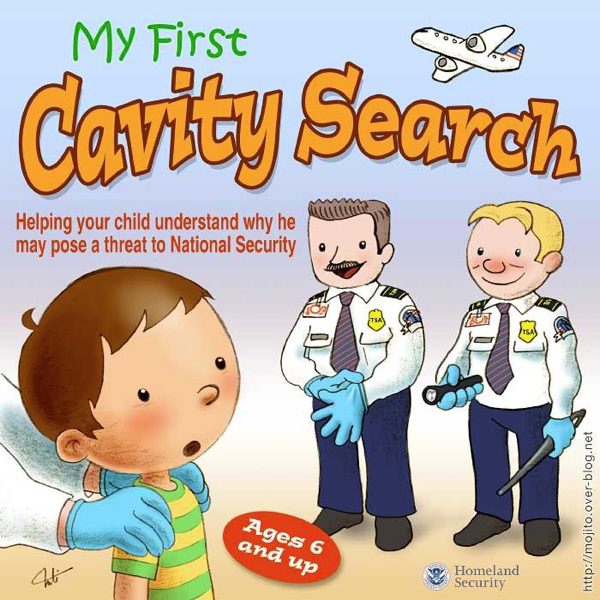
New book for kids about to fly for the first time
Mark Frauenfelder has the book to give to your child before going to the airport:

Got to start ’em early . . . by the time they’re full-grown, they’ll accept any intrusion from government officials as a matter of course.
The original version (in French) is here.
November 10, 2010
“Don’t you know who I am?” UK style
It’s all very well to pass restrictions on the peons, but when those restrictions are applied to your aristocratic self, you’re apparently entitled to rant:
Britain’s anti-terror chief launched an astonishing attack on airport security staff after they stopped her taking a banned amount of liquid onto a plane.
Home Office minister Baroness Neville-Jones, in charge of national security, was en route to a Washington summit when she was found to have an over-sized aerosol can in her bag.
[. . .]
The Baroness was ticked off by border staff, who did not recognise her. But she took offence when they told her how important security is.
The 71-year-old Baroness, known for being haughty, ranted: “Of course I know how important it is, I’m the Security Minister.”
It’s so tedious to have to put up with back-chat from the peasantry, isn’t it?
October 30, 2010
“People, when faced with a choice, will inevitably choose the Dick-Measuring Device over molestation”
Air travel, already burdened with far too many special Security Theatre Extravaganzas, is about to get even more awful:
This past Wednesday, I showed up at Baltimore-Washington International for a flight to Providence, R.I. I had a choice of two TSA screening checkpoints. I picked mine based on the number of people waiting in line, not because I am impatient, but because the coiled, closely packed lines at TSA screening sites are the most dangerous places in airports, completely unprotected from a terrorist attack — a terrorist attack that would serve the same purpose (shutting down air travel) as an attack on board an aircraft.
[. . .]
At BWI, I told the officer who directed me to the back-scatter that I preferred a pat-down. I did this in order to see how effective the manual search would be. When I made this request, a number of TSA officers, to my surprise, began laughing. I asked why. One of them — the one who would eventually conduct my pat-down — said that the rules were changing shortly, and that I would soon understand why the back-scatter was preferable to the manual search. I asked him if the new guidelines included a cavity search. “No way. You think Congress would allow that?”
I answered, “If you’re a terrorist, you’re going to hide your weapons in your anus or your vagina.” He blushed when I said “vagina.”
“Yes, but starting tomorrow, we’re going to start searching your crotchal area” — this is the word he used, “crotchal” — and you’re not going to like it.”
In other words, enough people are refusing to go through the “Dick Measuring Device” that TSA is deliberately going to make the alternative so invasive and degrading that people will have to go through the back-scatter imager. Not that it will actually improve anyone’s safety, but it will increase the compliance ratio for the next stupid policy to come down from the security theatre directors.
H/T to BoingBoing for the link.
October 23, 2010
Protip: crocs are not considered appropriate hand luggage
At least, not in cases like this:
A stowaway crocodile on a flight escaped from its carrier bag and sparked an onboard stampede that caused the flight to crash, killing 19 passengers and crew.
The croc had been hidden in a passenger’s sports bag — allegedly with plans to sell it — but it tore loose and ran amok, sparking panic.
A stampede of terrified passengers caused the small aircraft to lose balance and tip over in mid-air during an internal flight in the Democratic Republic of Congo.
The unbalanced load caused the aircraft, on a routine flight from the capital, Kinshasa, to the regional airport at Bandundu, to go into a spin and crash into a house.
October 20, 2010
“We got an opt-out!”
I’ve said before that I’ve been avoiding going anywhere by plane for the last few years, but I didn’t realize the security theatre also applied to aircrew:
My name is Michael Roberts, and I am a pilot for ExpressJet Airlines, Inc., based in Houston (that is, I still am for the time being). This morning as I attempted to pass through the security line for my commute to work I was denied access to the secured area of the terminal building at Memphis International Airport. I have passed through the same line roughly once per week for the past four and a half years without incident. Today, however, the Transportation Security Administration (TSA) agents at this checkpoint were using one of the new Advanced Imaging Technology (AIT) systems that are currently being deployed at airports across the nation. These are the controversial devices featured by the media in recent months, albeit sparingly, which enable screeners to see beneath people’s clothing to an extremely graphic and intrusive level of detail (virtual strip searching). Travelers refusing this indignity may instead be physically frisked by a government security agent until the agent is satisfied to release them on their way in what is being touted as an “alternative option” to AIT. The following is a somewhat hastily drafted account of my experience this morning.
As I loaded my bags onto the X-ray scanner belt, an agent told me to remove my shoes and send them through as well, which I’ve not normally been required to do when passing through the standard metal detectors in uniform. When I questioned her, she said it was necessary to remove my shoes for the AIT scanner. I explained that I did not wish to participate in the AIT program, so she told me I could keep my shoes and directed me through the metal detector that had been roped off. She then called somewhat urgently to the agents on the other side: “We got an opt-out!” and also reported the “opt-out” into her handheld radio. On the other side I was stopped by another agent and informed that because I had “opted out” of AIT screening, I would have to go through secondary screening. I asked for clarification to be sure he was talking about frisking me, which he confirmed, and I declined. At this point he and another agent explained the TSA’s latest decree, saying I would not be permitted to pass without showing them my naked body, and how my refusal to do so had now given them cause to put their hands on me as I evidently posed a threat to air transportation security (this, of course, is my nutshell synopsis of the exchange). I asked whether they did in fact suspect I was concealing something after I had passed through the metal detector, or whether they believed that I had made any threats or given other indications of malicious designs to warrant treating me, a law-abiding fellow citizen, so rudely. None of that was relevant, I was told. They were just doing their job.
I’m not surprised that they refused him entry after he declined to participate in the latest act of security theatre . . . but I wonder if aircrew have not — until now — been required to go through the full indignity that awaited mere travellers if they refused AIT screening.
H/T to Jon Henke for the link.
October 9, 2010
QotD: The American car
In making automobiles more safe and ecologically friendly, we’ve often lost sight of the basic cost benefit factor — I think this is probably more true in the safety than in ecology — and one of the things that is precious about the American automobile industry is that it provided a cheap and reliable means of transportation for practically everyone in society, and then when those vehicles became used vehicles, it gave cheap and mostly reliable transportation to everybody, to the point where the Oakies in the dust bowl were in Model T fords and not on foot. When we undertake to make the automobile this humming, electronic device that provides a perfect egg of safety and closure and creates no adverse externalities (as people like to say these days) we lose sight of the purpose of the damn thing in the first place. And the purpose was to allow freedom — freedom and horizontal mobility to the masses. That’s why cash for clunkers was just sinful. You’re taking a bunch of perfectly good vehicles, inexpensive vehicles that could be used by people without much in the way of material means, and crushing them. If someone took a valuable resource — something that could really be useful to people — and destroyed it, they’d be in jail if they were private citizens.
P.J. O’Rourke, “P.J. O’Rourke Likes Puppies and America, Dislikes Flip Flops at the Airport [Texas Book Festival Interview]”, Austinist.com, 2010-10-08
September 27, 2010
Air travel: does the punishment fit the crime?
Terry Teachout isn’t enjoying his air travel experiences on his current trip. A selection of his Twitter updates from this morning:
First: I’m at LaGuardia and seized with an all-consuming hatred for air travel, every aspect of which is disgusting, degrading, and dehumanizing.
Second: I’d also like to throttle most of my fellow travelers, including all who are conducting cell-phone conversations within earshot of me.
Third: Finally, I’d like to offer a special welcome in hell to the people at Gate D6 who are reading self-evidently stupid books and magazines.
Fourth: Gee, you wouldn’t think that I’m H.L. Mencken’s biographer, would you?
Fifth: “Democracy is the theory that the common people know what they want, and deserve to get it good and hard.”
Sixth: I guess I’m in what I like to call one of my exterminate-all-the-brutes moods. This, too, shall pass…
As I’ve mentioned before, I’ve pretty much given up on air travel since my last flight experience. I’ll use it for extreme long distance or trans-oceanic travel, but otherwise, I’ll continue to avoid it as much as possible. (Probably my worst trip overlapped with one of the attempted terrorist attacks.)
September 15, 2010
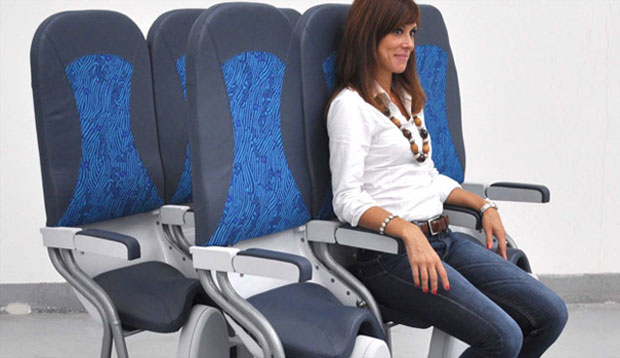
Think of coach seating as “cattle class”?
If you thought it wasn’t possible to make air travel even worse, you just don’t think big enough:
Italian company Aviointeriors showed off its new “Skyrider” seat at an airshow in California. The curious-looking seats have just 23-inches of space between the seat and the row in front of you. Current airline seating configurations gives you a seemingly spacious 30-inches or so.
I’ve pretty much given up on air travel already, except for trans-Atlantic flights, but this little innovation would probably make me look for steerage class bookings on freighters . . .
August 10, 2010
Travel advice for unsettled times
“Gulliver” offers some useful travel tips for people going to dangerous cities:
The first concerns how not be blown up when in Kabul, and comes courtesy of an American TV journalist who was on the course with us. You do not need Kevlar, or night-vision goggles, or an armoured car to evade the Taliban, he said: your secret weapon is to have a jolly good long lie-in every morning. In Kabul, at least, suicide bombs apparently almost always go off early in the morning. Have a leisurely breakfast and, once you venture out after 11am or so, your chances of being killed are drastically reduced. The explanation given was that the bombers spend all night psyching themselves up, then say their prayers at dawn, and go off to murder. A second helping of Corn Flakes could save your life.
The second tip is useful even for those of us who don’t travel to warzones. When booking a hotel, we were told, try to get a room between the second and sixth floors. Being on at least the second floor means you’re a little further away from whatever dangers may lurk near reception: opportunist robbers won’t venture deep into the hotel, and if things get nastier — car-bombs, shootouts and so on — you’re a little further away from the action. So far, pretty obvious.
But why not go above the sixth floor — wouldn’t that be even safer? Apparently not. More likely than a bomb or a shootout is a plain old fire, in which case you will want to make a hasty exit. More storeys mean more stairs and more delay, of course. But the killer, literally, is this: if the stairs are blocked, you will need rescuing from your window by a ladder. And in many parts of the world, the sixth floor is as high as the local fire-engines can reach.
August 9, 2010
I’ll have to remember to use this in future
As reported by Chris Taylor, Paul Jané coined exactly the right moniker to hang around Air Canada’s scrawny corporate neck:
Mapleflot
July 13, 2010
Lacrosse team caught in international issue over passports
This is a confusing situation, as Aboriginal tribes/nations are sometimes considered separate political entities from the country within which they live and other times are not. The Iroquois nation apparently has been issuing their own passports, but now the British and US governments don’t want to honour them as they have in the recent past:
The Iroquois team, known as the Nationals, represents the six Indian nations that comprise the Iroquois Confederacy, which the Federation of International Lacrosse considers to be a full member nation, just like the United States or Canada. The Nationals enter this year’s tournament ranked fourth in the world.
The Nationals’ 50-person delegation had planned to travel to Manchester, England, on Sunday on their own tribal passports, as they have done for previous international competitions, team officials said.
But on Friday, the British consulate informed the team that it would only issue visas to the team upon receiving written assurance from the United States government that the Iroquois had been granted clearance to travel on their own documents and would be allowed back into the United States. Neither the State Department nor the Department of Homeland Security would offer any such promise.
If the US government has allowed the use of Iroquois travel documents before, why are they now pretending they’ve never encountered them before? Is it a formal change in policy or just a bureaucrat flexing his or her ability to cause inconvenience and delay on a whim?
Update, 14 July: The New York Times reports that the team has been allowed to travel on their Iroquois passports:
The State Department’s blessing ends a five-day standoff between the Iroquois team and the federal government over whether the players could travel on their own documents instead of United States passports, as they have done in past international competitions.
Representative Louise M. Slaughter, Democrat of New York, said in a statement that Secretary of State Hillary Clinton personally intervened in the case on Wednesday morning and that the team would be able to depart on Wednesday afternoon.
“I am extremely grateful to Secretary of State Clinton, who responded to this glitch promptly and efficiently,” Ms. Slaughter said. “Going forward, we must find a way to balance homeland security concerns with some common sense and a border policy that does not create unintended consequences.”
Part of the reason appears to have been technical: “The Iroquois passports are partly hand-written and do not include any of the security features that make United States passports resistant to counterfeiting.”
April 10, 2010
Recoverin’
The border crossing was almost comically simple compared to past experiences: short line-ups, a pleasant customs official, straightforward questions, and then we were waved on through. We got home in time for dinner (Victor was glad to see us and the dogs were very happy to see us too).
My plan for today involve no driving whatsoever . . .
April 9, 2010
Returnin’
Didn’t find the time to do updates for the last couple of days . . . how did you survive without me? On the final leg of the journey today, north through West Virginia, Pennsylvania, and New York. Unless the border crossing is really bad, we should be home for dinner.