
As reported by Chris Taylor, Paul Jané coined exactly the right moniker to hang around Air Canada’s scrawny corporate neck:
August 9, 2010
July 13, 2010
Lacrosse team caught in international issue over passports
This is a confusing situation, as Aboriginal tribes/nations are sometimes considered separate political entities from the country within which they live and other times are not. The Iroquois nation apparently has been issuing their own passports, but now the British and US governments don’t want to honour them as they have in the recent past:
The Iroquois team, known as the Nationals, represents the six Indian nations that comprise the Iroquois Confederacy, which the Federation of International Lacrosse considers to be a full member nation, just like the United States or Canada. The Nationals enter this year’s tournament ranked fourth in the world.
The Nationals’ 50-person delegation had planned to travel to Manchester, England, on Sunday on their own tribal passports, as they have done for previous international competitions, team officials said.
But on Friday, the British consulate informed the team that it would only issue visas to the team upon receiving written assurance from the United States government that the Iroquois had been granted clearance to travel on their own documents and would be allowed back into the United States. Neither the State Department nor the Department of Homeland Security would offer any such promise.
If the US government has allowed the use of Iroquois travel documents before, why are they now pretending they’ve never encountered them before? Is it a formal change in policy or just a bureaucrat flexing his or her ability to cause inconvenience and delay on a whim?
Update, 14 July: The New York Times reports that the team has been allowed to travel on their Iroquois passports:
The State Department’s blessing ends a five-day standoff between the Iroquois team and the federal government over whether the players could travel on their own documents instead of United States passports, as they have done in past international competitions.
Representative Louise M. Slaughter, Democrat of New York, said in a statement that Secretary of State Hillary Clinton personally intervened in the case on Wednesday morning and that the team would be able to depart on Wednesday afternoon.
“I am extremely grateful to Secretary of State Clinton, who responded to this glitch promptly and efficiently,” Ms. Slaughter said. “Going forward, we must find a way to balance homeland security concerns with some common sense and a border policy that does not create unintended consequences.”
Part of the reason appears to have been technical: “The Iroquois passports are partly hand-written and do not include any of the security features that make United States passports resistant to counterfeiting.”
Comments Off on Lacrosse team caught in international issue over passports
April 10, 2010
Recoverin’
The border crossing was almost comically simple compared to past experiences: short line-ups, a pleasant customs official, straightforward questions, and then we were waved on through. We got home in time for dinner (Victor was glad to see us and the dogs were very happy to see us too).
My plan for today involve no driving whatsoever . . .
April 9, 2010
Returnin’
Didn’t find the time to do updates for the last couple of days . . . how did you survive without me? On the final leg of the journey today, north through West Virginia, Pennsylvania, and New York. Unless the border crossing is really bad, we should be home for dinner.
Comments Off on Returnin’
April 6, 2010
Boatin’
A few photos taken on our boat tour out into Charleston harbour, including a stop at Fort Sumter:
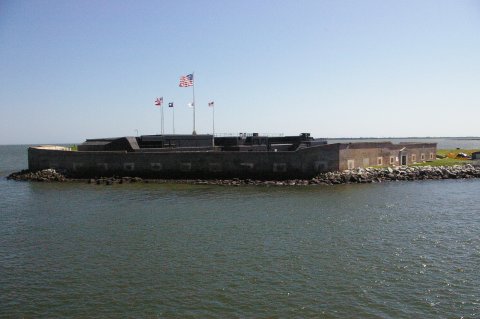
The (remains of) the fort, from the inner harbour, approaching the dock
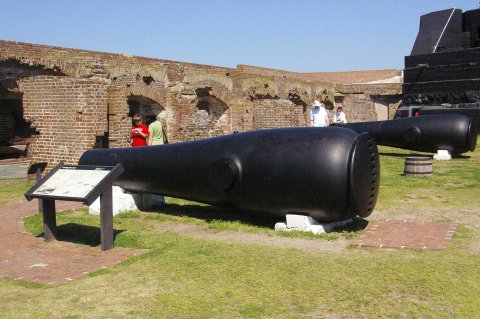
Some of the recovered cannon from the Civil War sieges

The USS Yorktown, taken from the Aquarium on the other side of the river.
April 5, 2010
Still tourin’
With yesterday being Easter Sunday, we had no idea how busy things might be, or even what might be open. On the way into Charleston, we stopped at Middleton Place, which I expected to be an hour or so side-trip, but turned into the main activity of the day. It’s a huge property (6500 acres) that had been a rice plantation until the Civil War, when the property was destroyed by Union troops in 1865. The family could only afford to re-build one of the three main buildings, the south “flanker”. The unreconstructed remains of the other two buildings were thrown down in the 1886 earthquake.

The rebuilt south flanker, from the river side

The remains of the main house, after war and earthquake damage.
Comments Off on Still tourin’
April 4, 2010
Tourin’
Arrived at our base of operations for the week — Summerville, SC. The initial plan for yesterday was just to get on the I-77 for the bulk of the run, but within a mile of joining the main route, we hit a miles-long traffic jam. It took us about 15 minutes to get the 1/4 mile to the next exit (W.V. state road 16). That took us away from the traffic, but it also took us deep into coal country:
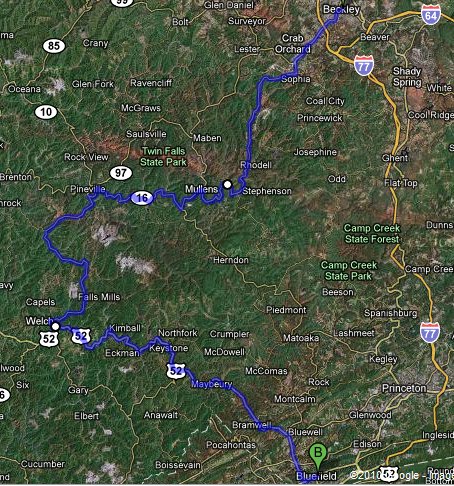
I had no idea how deep those valleys were: the valleys we drove through the previous day were nothing in comparison. I lost track of the tiny little villages we passed through which were literally just wide spots in the road, with a couple of dozen houses crammed between the valley walls, with the road, the railway, and the river taking up the only flattish spots.
It was very much like a trip back in time, as aside from the few newer buildings in the larger villages (a few new suburban-style houses, a couple of government buildings, one or two small primary schools), everything else looked like it’d been there for a century or more. The roads switched back and forth to match the valley side, and I honestly have to say that in many cases the posted speed limit was higher than I think was really safe: and I can’t think of many other places I’ve visited where I can say that. 55 MPH on some of those mountain roads is very literally taking your life in your hands.
Comments Off on Tourin’
April 3, 2010
Still travellin’
Got as far as Beckley, West Virginia yesterday. The scenery along the way was . . . um. Once you get into West Virginia, your line of sight drops off to a few hundred metres in any direction except straight up: there’s always a wooded hill or ridge or whatever blocking your line of sight (to be fair, it’s blocking your view of yet another wooded hill, etc.).
I’d have stopped to take some photos (especially of the New River gorge), but we were trying to get as far towards today’s destination as we could, so we limited the stops to the absolute minimum.
February 11, 2010
Montreal’s U.S. airport – Canadians voting with their feet
A new study shows that Canadian travellers can do basic math (which means bad news for Canadian airlines and airport authorities):
It’s not just the cheap fares, many Canadians report it’s simply easier to pass through United States customs via land than air. They also report security lineups at the small regional hubs offer a fraction of the waiting time of their Canadian counterparts.
Self-employed Toronto business owner Mike Payer says the past two years he has flown out of Buffalo’s airport for Christmas vacation because the price difference has been too hard to ignore.
“I saved $3,000 flying to Fort Lauderdale. It was $4,500 [for a family of four] to fly from Toronto but only US$1,200 from Buffalo. On top of all that it’s just so much simpler with U.S. Customs. You stay in a hotel overnight and most of them will even let you leave your car there [while on vacation]. I guess the only risk is the weather and missing a flight.”
I suspect there’s a mistake in the second paragraph of the linked article: no matter how much you can save, I strongly doubt that 18% of Canadians flew out of their closest US airport. 18% of Canadians who flew, maybe, but not 18% of the whole population.
Some regional airports are booming with the new Canadian traffic:
The pitch has been probably the strongest in Plattsburgh, a little town of 25,000 that spent millions in 2007 to convert a former air force base into an airport that would attract Quebec passengers. The airport, which is 100 kilometres from downtown Montreal, is fully bilingual.
“They don’t even call us Plattsburgh. We’re known as Montreal’s U.S. airport now,” said Michele Power, vice-president of marketing with the Plattsburgh-North County Chamber of Chamber of Commerce.
January 26, 2010
A message from Transport Canada
From the Rick Mercer Report.
Comments Off on A message from Transport Canada
January 20, 2010
Air New Zealand goes for free advertising by courting outrage
It’s been done often enough, but apparently still works every time. I’m talking about generating huge amounts of press coverage by creating a highly controversial ad (whether you ever intend to run it or not), and allowing the media to publicize it for you. This is Air New Zealand’s offering:
Here’s some of the free publicity, by way of The Economist and The Telegraph.
January 9, 2010
QotD: The awfulness of airports
Over the weekend, an idiot walked the wrong way through a secure exit for arriving passengers at Newark airport. An entire terminal was shut down so that everybody on the “sterile” side of the security barriers could be herded back out and rescreened. The entire process took just under seven hours. The cascading delays disrupted air travel worldwide. They didn’t even catch the doofus who caused the ruckus. No doubt, if they’d announced his location over the paging system, he’d have been drawn and quartered by a mob of traveling salesmen from 3M and a gaggle of middle-school girls returning from a volleyball tournament.
Now, I should back up. When I referred to the “sterile” side of the security barrier, I was using the term narrowly, to refer to folks who’d been through the metal detectors. Because to use the word “sterile” in its usual context in a sentence with “airports” — those belching Petri dishes of bathroom effluence and unidentifiable noisome miasma — would be a grotesque abrogation of journalistic trust.
According to the latest epidemiological research, airports reside somewhere between no-frills Haitian brothels and Penn State fraternity bathrooms when it comes to hygiene. USA Today recently surveyed the health-inspection records of airport restaurants and found that serious code violations were as commonplace as rat and mouse droppings; 77 percent of 35 restaurants reviewed at Reagan National Airport had at least one major violation.
I could go on, of course. The petty humiliations, the routine deceptions from airline employees desperate to rid themselves of troublesome travelers (“Oh, they can definitely help you at the gate!”), the stress-position seats, the ever-changing rules for what can and cannot be in your carry-on, being charged for food that the Red Cross would condemn if it were served at Gitmo: Air travel is the most expensive unpleasant experience in everyday life outside the realm of words ending in -oscopy.
Jonah Goldberg, “A No-Fly List? Count Me In: Flying before 9/11 was already awful, and it has only become worse”, National Review, 2010-01-08
Comments Off on QotD: The awfulness of airports
December 31, 2009
Tweet of the day: Ohio
Radley Balko is in transit across Ohio. He’s finding it less than entertaining:
radleybalko: driving thru ohio. motto: nothing much to look at, but you’re gonna be here awhile.
radleybalko: ohio. new motto: yep. you’re still here.
I haven’t driven in every state, although I’ve managed to visit most of ’em east of the Mississippi, and Ohio is always the state I hate driving through:
. . . Ohio must be located in a time warp, because the drive from Cincinnati to Toledo seemed to take weeks, not the three or so hours it should have done . . .
In either direction:
The drive south along the I-75 went relatively smoothly, at least once we got out of the rutted road section between the bridge and the Ohio state line. I don’t know if Michigan deliberately leaves that stretch of road in poor condition to discourage locals from escaping or if it’s a full employment scheme for alignment shops at the exits. Either way, it’s almost the worst stretch of road we encountered during the entire trip.
As mentioned before, the I-75 between Toledo and Cincinnati seems to exist in a universe where time has no meaning. Entire geological epochs seemed to pass as we endlessly drove towards the intermediate towns. I’m certain that the continents re-arranged themselves twice in the time it seemed to take between Lima and Dayton.
Driving through Cincinnati at 6:00 p.m. on a Saturday is rather like a combination of riding the Wild Mouse, taking a speed-reading test, and riding through a buffalo stampede. The very worst drivers, of course, had Ontario license plates.
Of course, not having driven in any state to the left of the Mississippi River (aside from California), I’m sure that some of those square-ish territories could challenge Ohio for the title. You know, those places that only ever appear in the “Odd News” section, like Missouransas, Oklarado, Wyotana, South Iobraska, and Nevazona.
Comments Off on Tweet of the day: Ohio
November 13, 2009
October 29, 2009
Amtrak: still losing $32 per passenger on every trip
Amtrak would not survive without federal government subsidy, as most people already know. What you may not have realized is just how much taxpayers subsidize every rider:
The Pew Charitable Trusts SubsidyScope Project has just released a new report that finds 41 out of Amtrak’s 44 routes lose money. The losses ranged from nearly $5 to $462 per passenger, depending upon the line, and averaged $32 per passenger. According to the report:
The line with the highest per passenger subsidy — the Sunset Limited, which runs from New Orleans to Los Angeles — carried almost 72,000 passengers last year. The California Zephyr, which runs from Chicago to San Francisco, had the second-highest per passenger subsidy of $193 and carried nearly 353,000 passengers in 2008. Pew’s analysis indicates that the average loss per passenger on all 44 of Amtrak’s lines was $32, about four times what the loss would be using Amtrak’s figures: only $8 per passenger. (Amtrak uses a different method for calculating route performance).
The Northeast Corridor has the highest passenger volume of any Amtrak route, carrying nearly 10.9 million people in 2008. The corridor’s high-speed Acela Express made a profit of about $41 per passenger. But the more heavily utilized Northeast Regional, with more than twice as many riders as the Acela, lost almost $5 per passenger.
Comments Off on Amtrak: still losing $32 per passenger on every trip


