The NHS has not served the nation well, if international comparison is the criterion by which it should be judged. For example, when the NHS was founded (when British healthcare was among the best rather than the worst in Europe) the population of France had a life expectancy six years lower than that of Britain; it is now two years higher. The health of the population in Spain improved more under Franco than that of the British under the NHS in the same years. Of course, there are determinants of life expectancy other than healthcare systems, but at the very least the comparisons do not suggest any particular virtue to the NHS.
Survival from many serious illnesses such as cancer, heart attacks and strokes is lower in Britain than in most European countries. Publicity is sometimes given to these statistics but they are not immediately apparent to patients or their relatives, and in any case the NHS is immune to criticism because its deficiencies are assumed to be departures from its essential goodness or the result of inadequate funding.
No number of scandals, such as that of Mid Staffs in which hundreds of patients were neglected to a degree that often defied belief, all in plain sight of a large bureaucracy supposedly devoted to ensuring the quality of patient care, can dent faith in the NHS. Staff committed, and management connived at, acts of cruelty that would have made Mrs Gamp blush. Mr Cameron’s government, anxious not to seem an enemy of the NHS, which would have been politically damaging, swept the scandal under the carpet.
A system whose justification for its nationalisation of healthcare was egalitarianism has failed even in the matter of equality. If anything, the difference between the health of the richest and poorest sections of the population has increased rather than decreased under the NHS.
The gap between the life expectancy of unskilled workers and that of the upper echelons, which had been stable for decades before the foundation of the NHS, began to widen afterwards and is now far wider than it ever was. Again, there are reasons for inequality in health other than the deficiencies of healthcare, the prevalence of smoking and obesity, for example; but if systems are to be judged by their effects, the NHS has failed in its initial goal.
Theodore Dalrymple, “Empire of conformists”, The Critic, 2020-04-29.
October 11, 2020
September 9, 2020
Today’s intelligentsia: helpless captives of their uber-woke disciples
Theodore Dalrymple on the temptations of power:

A building burning in Minneapolis following the death of George Floyd.
Photo by Hungryogrephotos via Wikipedia.
One must not exaggerate, of course. We do not yet live under a Soviet-type tyranny in which every university thesis, on no matter how arcane a subject, was obliged by hook or by crook to quote Lenin. It is still possible, though not at all easy, to live as a scholar in our societies outside the university system. But it does not require the tyranny of the complete police state to obtain a high degree of intellectual conformity, as we can now observe at our leisure. Young university academics of my acquaintance in several countries tell me that they are now afraid to speak their mind, not because they would fear for their lives, but fear for their promotion. This is not the same, or as terrible, as fearing for their lives, but it is nonetheless very far from the Millian ideal of freedom of thought and speech.
There is much worse. It is not merely that they must keep their mouth shut and not say what they think, bad enough as this must be for those who have chosen the life of the mind; it is that they must positively subscribe to things that they believe to be bad or false. And this is a mark of totalitarianism. They must subscribe to doctrines they believe absurd, for example by describing in job applications their future efforts to promote diversity, so-called. By making the expression of untruth the condition of employment, probity is destroyed in advance. Those who lack it are easier to control.
Increasingly, social movements do not allow any neutrality with regard to the causes that they promote. Non-adherence is no different from enmity and derogation is evil: if you are not part of the solution you are part of the problem. In vain might you argue that your interest is elsewhere, in the taxonomy of grasshoppers, for example, or in the biochemistry of acorns, or in the bibliography of Alexander Pope: there is one subject that trumps all others in importance, and on it only one opinion is permissible. You must pass a test of loyalty.
The latest of these movements is, of course, Black Lives Matter, and its success in cowing so large a part of the intelligentsia is in a way admirable, a model of political organization for the future, though one much to be feared. By claiming that silence is violence, it has made hand-wringing (to avoid its anathema) the mark, and almost the whole, of virtue. It has successfully reversed Martin Luther King’s goal, such that the colour of a man’s skin is once again more important than the content of his character, and it has made respectable that most Stalino-Maoist of notions, that people should be promoted and rewarded according to their social (in this case, racial) origins. And anyone who disagrees is an Enemy of the People, the word People being here used in a severely technical sense, to mean the arbiters of the allocation of rewards.
September 1, 2020
QotD: The “envy of the world”, Britain’s NHS
One morning, for example, I received an e-mail advertisement from a chain of bookstores (a near-monopoly in the British bookstore trade) of which I am an occasional customer, for an anthology of stories specially written in praise of the NHS titled Dear NHS: 100 Stories to Say Thank You. An anthology of poetry, These Are the Hands: Poems from the Heart of the NHS has also just been published. I will pass over in silence the emotional kitschiness of all this.
These books, of course, deliberately confound the NHS itself with the devotion and skill of the people working within it. They are not the same thing — very far from it — and it might well be that good results are often achieved despite the system rather than because of it.
The propaganda in favour of the NHS has been more or less continuous since its foundation in 1948, though it has become ever shriller, as propaganda tends to do, as it departs further and further from reality. Indeed, one might surmise that the purpose of propaganda in general is to forestall any proper examination of reality in favour of simplistic slogans convenient to political power.
I grew up, for example, in the inculcated belief that the National Health Service was, according to the slogan of the time, “the envy of the world.” Millions of people believed this, and indeed it was an assertion heard for many years whenever the subject of health care came up. The slogan was last wheeled out in any force in 2008 for the 60th anniversary of its founding.
Theodore Dalrymple, “Worshipping the NHS”, Law & Liberty, 2020-05-04.
August 29, 2020
QotD: Britain’s most sacred of sacred cows
This was an unintended insult to the doctors and nurses of other countries, as if in their benighted lands without the NHS they did not work with skill or devotion. The NHS is neither necessary nor sufficient for medical and nursing staff to show devotion. The parents of a well-taught schoolchild do not thank the Ministry of Education.
No doubt the prime minister’s praise of the NHS was politically shrewd — one casts no doubt on the perfection of the Koran in Mecca — but in the long run such praise does no service to the nation, which at some time or other ought to face up to the fact that its healthcare system is at best mediocre by comparison with that of other countries at a similar level of economic development, and that being ill and seeking treatment is a more unpleasant experience in Britain than in it is many civilised countries.
Untold numbers of people receive excellent care under the NHS. One must neither exaggerate nor catastrophise. But there is another side to the coin as well, and it is surely not a coincidence that no one in Europe would choose Britain as their country of medical care, rather the reverse. If a German were to say, “For God’s sake, get me to the NHS!”, a psychiatrist would be called.
Theodore Dalrymple, “Empire of conformists”, The Critic, 2020-04-29.
August 24, 2020
Theodore Dalrymple reviews White Fragility by Robin DiAngelo and How to Be an Antiracist by Ibram X. Kendi
The two books share many characteristics, says the good doctor (in his “Anthony Daniels” guise), and the most noteworthy is a shared hectoring tone:
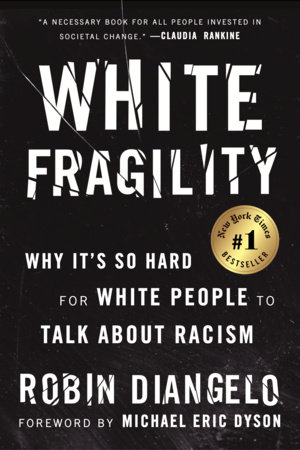
DiAngelo’s book displays a curious admixture of influences: the Chinese Cultural Revolution, Jimmy Swaggart, Freudian psychoanalysis, and Uriah Heep, the four of them being present in approximately equal proportion.
DiAngelo has apparently made a career of anti-racist struggle sessions in which ordinary employees of various organizations must confess publicly to their racism however hidden it might be, as university professors, primary school teachers, doctors working in slums, etc., had once in China to confess to bourgeois propensities and counter-revolutionary ideas. They may never have uttered a racist sentiment, they may never have been rude to a person of another race, let alone violent towards one, they may have friends of other races or even be married to a person of another race, but they carry racism deep within them like Original Sin, with this difference: there can be no redemption from it even after having read DiAngelo’s book and attended her struggle sessions. Personally, I should not be at all surprised if the end result of all her efforts, at least among the men she has “trained” (which is to say tried to indoctrinate), was to have acted as a recruitment officer for the Ku Klux Klan.
After thirty years of constant work of supposedly anti-racist training, she confesses — like the tearful Jimmy Swaggart — to being still guilty of racism herself, promising to reform, although reform is ex hypothesi impossible because racism is in her society’s DNA, as it were. One is reminded of the type of psychoanalysis which after thirty years of hourly sessions four times a week fails to get to the root of the analysand’s problem, let alone solve it, because it doesn’t even know what the problem is. But failure is also an opportunity, because, like psychoanalysis, the more anti-racist training fails, the more it is needed. DiAngelo, all credit to her, has found an economic niche for herself for the rest of her life. One has a sneaking admiration for such entrepreneurs. They are the asset-strippers of the soul.
As for Uriah Heep, DiAngelo has obviously heard, read, marked, learned, and inwardly digested (as my teachers used to demand of me) David Copperfield. Her oleaginous approach to all “people of color,” as she coyly calls them, makes Uriah Heep seem positively blunt and straight-talking. DiAngelo regards all nonwhite people, ex officio, as being incapable of exaggeration or unjustified self-pity, let alone of lying. As well as being sycophantic, this is, to coin a word, racist, for one of the most important manifestations of free will, and therefore of humanity itself, is the capacity to lie. In effect, then, she regards “people of color” as infra-human truth-uttering mechanisms: they speak, therefore what they say is true. No critical faculties need be applied to what they say.
[…]
DiAngelo is a tremendous moral narcissist. This is shown by her use of the term “people of color.” Until page 31, I thought that it meant black, but on that page I learned that it meant non-white. She shows no interest in the question of whether the Japanese, Chinese, Indians, Burmese, Vietnamese, Cambodians, Austronesians, Amerindians, and Africans, et al., would all be delighted to be put in the same category, let alone interest in their many cultures. On page 33, we read:
White supremacy is more than the idea that whites are superior to people of color; it is the deeper premise that supports the idea — the definition of whites as the norm or standard of human, and people of color as a deviation from that norm.
Lumping non-white people together as “people of color” is precisely an instance of what she criticizes: this is what happens when moral rhetoric far outruns intelligence.
August 18, 2020
QotD: Stigma
But in fact there is almost a law of conservation of stigma that operates in human societies, such that if it does not attach to one thing, it will attach to another. No doubt there is more stigma in shame societies than in guilt societies, but even in the latter everyone, except perhaps the most psychopathic of psychopaths, is afraid of being shown up in some respect or another.
Stigma begins early in life and children are much guided or influenced in their conduct by the fear of it. A teacher told me the following story. A child of about seven or eight came crying to her one day because another child had called him names.
“What did he say?” she asked.
“He called me a virgin.”
“What is a virgin?” asked the teacher,
“I don’t know,” said the boy. “But I know it’s something horrible.”
Stigma is a kind of shorthand to indicate what we detest. Anyone who pretends that he never stigmatises is probably lying, or perhaps I should say not telling the truth, since not every untruth that emerges from the human mouth is a lie. There are people who can contradict themselves without disbelieving in the law of non-contradiction, and therefore people who can genuinely despise people who pass moral judgment on others.
What would living completely without stigma and stigmatisation mean? Surely that there was nothing that we or anyone else could do to make people think badly of us. One of the reasons — I don’t say the only one — that I don’t steal is that I don’t want to be stigmatised as a thief. One sin doesn’t define a person’s character, however, so that when we stigmatise we must be careful to be just and proportionate. If we called everyone a liar who had told a lie, then we should all be liars (quite apart from the fact that it is sometimes virtuous to tell a lie). We call a liar someone who habitually lies, so that untruthfulness is a central part of his character.
Stigma is one of those many things that is neither good nor bad in itself, and depends for its social beneficence or maleficence on what it attaches to and how strongly. In the company of rogues or scoundrels, one can be stigmatised for honesty. Many a cruel act has been performed to avoid the stigma of being too cowardly to be cruel.
Theodore Dalrymple, “The Situational Nature of Scorn and Stigma”, New English Review, 2020-04-28.
June 26, 2020
QotD: “The freedom to tell lies is one of the most basic freedoms of all”
But even if there were answers to these questions that were a good deal more certainly true than any answers that we possess today, it still would not be right to silence doubters and deniers: for error and even malice are the price of freedom. In the realm of intellectual freedom it is not truth that sets you free, but error, or rather the permissibility of error. And the freedom to tell lies is one of the most basic freedoms of all. There can be no freedom without it.
Well, the audience was only young and perhaps this was strong meat for their immature digestions rendered sensitive by a constant diet of modern pieties, as the young these days are said to be more likely to develop allergies because of the sterility and cleanliness of modern homes and ways of life (what they need is more dirt and early contact with potential pathogens). But soon they would be going off to university, where it was likely that they would encounter an even narrower and powerfully self-reinforcing view of the world. The pressure to conform would add to the natural self-righteousness of youth, which is often mistaken for idealism, and their impulse to censor in the name of their own irreproachable virtue would be strengthened and entrenched.
The long-term prospects for freedom of speech, then, are not altogether rosy. Those who value it are less vehement in their defence of it than are the self-righteous in their assault on it.
Anthony Daniels, “Free Speech’s Emboldened Enemies”, Quadrant, 2018-03-10.
June 17, 2020
“We don’t need no stinkin’ badges!”
Theodore Dalrymple on the use of badges within the NHS to virtue signal and compel compliance in the unwilling:

Not actually the official symbol of Britain’s National Health Services … probably.
In Britain’s highly-centralized, almost Soviet-style healthcare system, the National Health Service, staff are being encouraged all over the country to wear little rainbow-coloured metal badges to show that they are homosexual, bisexual, and transsexual-friendly, and do not discriminate against them. The wearing of these badges is voluntary, but about 3,000 of the staff of Guy’s and St Thomas’ Hospitals, for example, now wear them. The self-congratulatory website of those ancient hospitals — St. Thomas’ is over 800 years old and Guy’s was founded in 1721, now combined into one administrative unit — says:
The badges are just one way to show that Guy’s and St Thomas’ is an open, non-judgmental and inclusive place for people that identify as LGBT+ [which] stands for lesbian, gay, bisexual and transgender). The + simply means we are inclusive of all identities, regardless of how people identify themselves.
This language, which combines the unctuous with the bureaucratic, is typical of the way British hospital administrators express themselves nowadays. And if, as Buffon said, the style is the man himself, we may justly fear for a semi-totalitarian future.
By implication, the badges bully the staff, for if any of them refuse to wear one, their refusal is likely to be taken to mean that their minds are closed, judgmental (in the sense of being censorious, for even the attempt to avoid making judgments is itself based on a judgment), and exclusionary. It is to imply that they would deliberately treat any patients in the above mentioned categories differently and worse from all other patients. Wear the badge or declare yourself to be a bigot.
This is an insult to all those people who worked before the advent of the badges (or who now refuse to wear them) who strove and continue to strive always to treat patients to the best of their ability, irrespective of the many categories into which any individual patient falls. In my experience, the great majority of doctors have always tried to do this.
Let me give an example. Working as I did as a doctor in prison, I met many men who had done terrible things. I treated them, as a matter of course, to the best of my ability. I remember, for example, a man who had strangled three children and then impaled them on railings. Though I did not think he was a good man, and in that sense passed a judgment on him within the privacy of my mind, I treated him for his bronchitis exactly as I would have treated anyone else with bronchitis. I did not find this difficult in the least and do not claim any special merit for having done so, for it is only what all my colleagues in the profession did — as a matter not only of course, but of principle.
A couple of years ago, I read the diary of one of Marshal Pétain’s doctors during the latter’s imprisonment after World War II. The doctor had been a member of the Resistance and had no reason to love Pétain, to say the least: Pétain’s supporters would have had not a second thought about killing him if he had fallen into their power. Yet, as the diary makes clear, the doctor treated Pétain, who by then was demented, with the greatest humanity. Moreover, the doctor refused to publish his diary, despite the financial advantage of doing so, because he thought that publishing it would be to break patient confidentiality. It was only after his death, and more than half a century after Pétain’s, that the diary was published. The doctor’s adherence to his medical ethics was impressive, and he needed no badge to proclaim his virtue.
May 29, 2020
Theodore Dalrymple reviews 100 Principles for a New World by Nicolas Hulot
It’s kind of subtle, but I don’t think he’s a fan of the writer or his work:
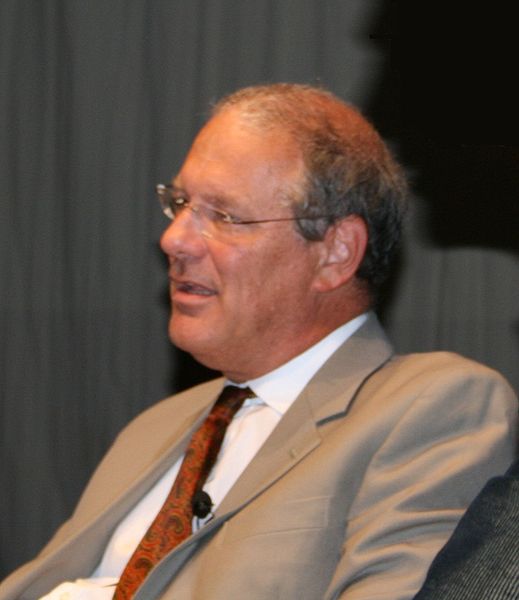
Theodore Dalrymple on 24 September 2007.
Photo by jaapstronks at Flickr via Wikimedia Commons.
No opinion is worth expressing that is not also worth contradicting (except, perhaps, this one); nevertheless, clichés have their attraction. They are the teddy-bears of the mind, or, to change the metaphor slightly, the mental lifebuoys we cling to in times of stormy intellectual or political weather. They are the sovereign remedy for thought, which is always a rather painful activity.
“Can’t you stop me thinking, doctor?” asked some of my patients in the prison in which I worked, in the hope of a prescription of pills that would make them feel fuzzy and incapable of coherent mentation. For those who prefer a less drastic or non-pharmacological solution to the discomforts wrought by the contemplation of the world and their part in it, there are pseudo-thoughts with comforting connotations of wisdom, generosity, goodness, kindness, benevolence, etc. They are the kind of people, I suppose, who might think that Kahil Gibran’s kitsch vapourings are profound.
They would no doubt like Nicolas Hulot’s 100 Principles for a New World, published on 7 May in Le Monde. Hulot, an ecological activist, television personality and journalist once specialising in motorcycle racing, was M. Macron’s Minister for the Ecological and Solidary Transition (by their job titles shall ye know them) until he resigned with maximal noise in August 2018, having held the post for 15 months.
I confess that I was shocked by the banality of the mind, or alternatively the cynicism, of the person who could have written and published a manifesto such as Hulot’s – to say nothing of the astonishing lack of judgment of a respectable newspaper in publishing it. The last time that I was shocked so much by a politician’s vacuity was when I heard another Nicolas, Sarkozy this time, give a speech in person. He was like a dried pea rattling about and shaken in a tin box. He jumped around the stage making a passionate verbal noise, but nothing he said had any discernible tether to anything concrete. Within seconds of his finishing, no one could have given any account of what he had said. Is mastery of this kind of meaningless verbalisation, eloquently empty and passionately delivered, the key to political success? And if so what does it say of us, the citizens of democracies?
But to return to Hulot and his Hundred Principles. They each started “The time has come to…” or “The time has come for…”, followed by a cliché, a truism, or a banal falsehood, all expressed with a self-satisfaction that would have made Mr Pecksniff seem like a self-doubter.
February 15, 2020
Theodore Dalrymple on the death penalty
From the New English Review:

“Tombstone Courthouse State Historic Park” by August Rode is licensed under CC BY-NC-SA 2.0


I happened to read a book published in 1965, the year Britain legislated to end the death penalty, titled Murder Followed by Suicide, by the distinguished criminologist, D.J. West. For forty years up to that date, about a third of homicides had been followed by the suicide of those who committed them.
Most people who committed homicide followed by suicide were highly disturbed psychologically, if not outright mad. For example, in killing their families they imagined that they were saving them from a worse fate. They were not the kind of people who would be deterred by anything, including the death penalty.
Here was a natural experiment. I hypothesized that if the death penalty acted as a deterrent, the homicide rate would increase but the proportion of homicide followed by suicide, which in absolute numbers would remain more or less the same, would decrease. My friend, the criminologist David Fraser, looked at the actual figures and found that this was indeed the case. Some sane people who might otherwise be inclined to kill managed to control themselves knowing that they might be executed if they did.
For the death penalty to deter, it was not necessary for it to be applied in every case. Although the death penalty for murder was mandatory in Britain, it was commuted in nine cases out of ten. All that was necessary for it to deter was that execution was a real possibility. We shall never know whether the death penalty would have deterred even more if it had been applied more rigorously.
Does its deterrent effect, then, establish the case for the death penalty, at least in Britain? No, for two reasons. First, effectiveness of a punishment is not a sufficient justification for it. For example, it might well be that the death penalty would deter people from parking in the wrong place, but we would not therefore advocate it. Second, the fact is that in all jurisdictions, no matter how scrupulously fair they try to be, errors are sometime made, and innocent people have been put to death. This seems to me the strongest, and perhaps decisive, argument against the death penalty.
Against this might be urged the undoubted fact that some convicted murderers who have been spared death have gone on to kill again, and this will continue to be so. Victims of those who murder a second time are probably more numerous than those executed in error. Therefore, utilitarians might argue, even if mistakes are sometimes made, that the death penalty overall would save lives. (Let us disregard the fact that those murderers who go on to murder a second time would not necessarily have been executed after their first murder, for nowhere are all murderers executed.)
The argument holds only if utilitarianism is accepted as a true ground of ethics. But few of us would accept that it is. It might be that hanging the wrong person after the commission of a terrible crime would have a better social outcome than hanging no one at all, provided only that it was never publicly known that the wrong person had been hanged: but we would still be horrified at the prospect. Moreover, in practice, the execution of the innocent, once it is known, serves disproportionately to undermine faith in the justice system. And surely it is true that for the state to kill an innocent man is peculiarly horrific.
February 4, 2020
QotD: Brutalist “sincerity”
Unrefined concrete was an honest expression of [brutalist architects’] intentions, while plain forms and exposed structures were similarly sincere.
This is like saying that the Gulag was an honest expression of Stalin’s intentions. Sincerity of intentions is not a virtue irrespective of what those intentions are, and as a matter of fact those of the inspirer and founder of brutalism were clearly evil, as the slightest acquaintance with his writings will convince anyone of minimal decency. And what exactly is “sincerity of form and exposed structures”? Is it meant to imply that anything other than brutalism is insincere?
The same article continues:
Beyond their architectural function, Brutalist buildings serve other uses. Skateboarders, graffiti artists and parkour practitioners, for example, have all used Brutalism’s concrete surfaces in innovative ways.
Dear God! I have nothing against playgrounds — they are socially commendable, especially for children — but to regard the urban fabric as properly an extended playground is surely to infantilize the population. As for graffiti artists, to regard the extension of their “canvas” to large public buildings is an abject surrender to vandalism. No one, I presume, would say of a wall, “And in addition it would make an excellent place for a firing squad.”
Theodore Dalrymple, “The Brutalist Strain”, Taki’s Magazine, 2019-11-02.
January 23, 2020
QotD: The “great” modern architects
Moreover, claiming respectable ancestors is somewhat at variance with equal claims to be starting from zero (as Gropius put it), but such a contradiction is hardly noticed by the grand narrative history of modernism that Professor Curl attacks and destroys.
He is not unable or unwilling to praise where it is due, though it is due rarely enough; and he is particularly effective in tracing the opportunistic ideological divagations of the modernists, whose one constant predilection was for absolute power over others. Mies, for example, was attracted to socialist totalitarianism, and his only objection to Nazism was that the Nazis eventually rejected his desire to have everything built according to his prescriptions. He left Nazi Germany because he feared his previous pro-leftism made him permanently suspect in its eyes, not because he was appalled by its brutality. If only they’d let him build! But contrary to apologists for Mies, and to a legend constantly repeated, it was not the Nazis who closed the Bauhaus but Mies himself, and he left Germany only four years after their assumption of power.
Finding refuge in America, Mies quickly perceived that the power of patronage of megalomaniac building lay with giant corporations rather than with fascists or communists and persuaded many of them to build his preternaturally inhuman and uninspired monstrosities. By a strange quirk of history, and because of mankind’s perpetual propensity to make logical errors, Mies was able to pose dishonestly as anti-totalitarian and even as a friend of freedom precisely because he had fled Nazi Germany where they hadn’t patronised him. He was fortunate that soon afterwards the United States had another totalitarian enemy, the Soviet Union. Mies and his allies were thus able to claim that his totalitarian modernism was actually a manifestation of western freedom. There are many such ironies pointed up in this book that would be delicious had they not had such appalling consequences.
Corbusier was a fascist in the most literal sense of the word, and early during the Occupation advocated the removal by force of the majority of Paris’ population because it had no business to be living there. Can one wonder that a man with thoughts like that built monstrosities?
Theodore Dalrymple, “Architectural Dystopia: A Book Review”, New English Review, 2018-10-04.
January 7, 2020
QotD: The cult of Le Corbusier
A dangerous cult may be defined as a kind of false religion, adoption of a system of belief based on mere assertions with no factual foundations, or as excessive, almost idolatrous, admiration for a person, persons, an idea, or even a fad. The adulation accorded to Le Corbusier, accorded almost the status of a deity in architectural circles, is just one example. It has certain characteristics which may be summarized as follows: it is destructive; it isolates its believers; it claims superior knowledge and morality; it demands subservience, conformity, and obedience; it is adept at brainwashing; it imposes its own assertions as dogma, and will not countenance any dissent; it is self-referential; and it invents its own arcane language, incomprehensible to outsiders.
Anyone who thinks this is an exaggeration has not read much Le Corbusier. (His writing is as bad as his architecture, and bears out precisely what Curl says.) Nor is it difficult to find in the architectural press examples of cultish writing that is impenetrable and arcane, devoid of denotation but with plenty of connotation. Here, for example, is Owen Hatherley, writing about an exhibition of Le Corbusier’s work at London’s Barbican Centre (itself a fine example of architectural barbarism). According to Hatherley, Le Corbusier was:
the architect who transformed buildings for communal life from mere filing cabinets into structures of raw, practically sexual physicality, then forced these bulging, anthropomorphic forms into rigid, disciplined grids. This might be the work of the “Swiss psychotic” at his fiercest, but the exhibition’s setting, the Barbican — with its bristly concrete columns and bullhorn profiles, its walkways and units — proves that even its derivatives can become places rich with perversity and intrigue, without a pissed-in lift [elevator] or a loitering youth in sight. … [T]hese collisions of collectivity and carnality have no obvious successors today.
Theodore Dalrymple, “Crimes in Concrete”, First Things, 2019-06.
November 10, 2019
Theodore Dalrymple on today’s doomsday cults
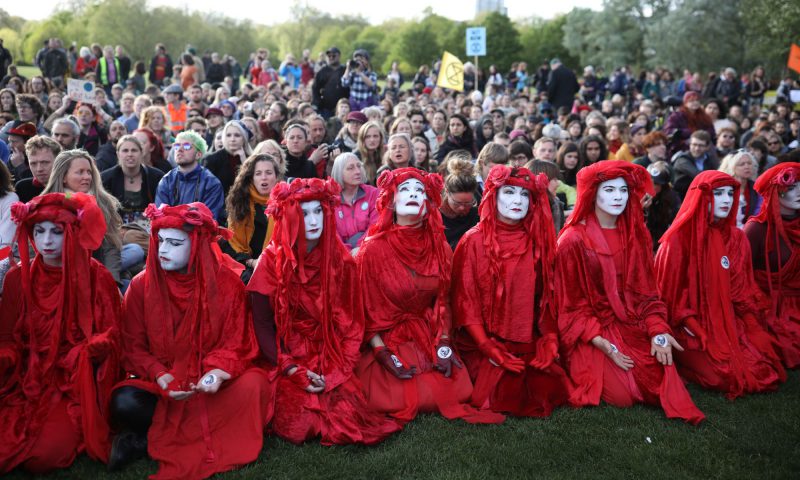
The recent antics of Extinction Rebellion activists in London encouraged Theodore Dalrymple to do a bit of reading on the psychology of such cults and their followers:
Man is the only creature, as far as we know, that enjoys the contemplation of its own disappearance from the face of the earth. We find the prospect of our annihilation by disease, famine, war, asteroid, or climate change deeply satisfying. We feel, somehow, that we deserve it and that the world would be a better planet without us.
When to this strange source of satisfaction is conjoined a license to behave badly in the name of salvation from earthly perdition, we can expect a mass movement that approaches insanity. So it is with the Extinction Rebellion, whose fanatical members have brought chaos to London recently by blocking streets, occupying crossroads, gluing themselves to public buildings and railings, and standing atop underground trains, to the fury of thousands of rush-hour commuters who don’t want to save the world but only get to work.
In order to try to understand their state of mind, I recently read a book by three psychologists, Leon Festinger, Henry W. Riecken, and Stanley Schachter, first published in 1956, called When Prophecy Fails. It recounts the reaction of a small doomsday sect in America founded by a housewife, who believed that most of North America was soon to be inundated by a great flood. When this failed to happen on the predicted date, members did not immediately conclude that the absurd grounds upon which their belief was based were false, but became even more convinced of their truth. When there is a contradiction between what we want to be the case and what is the case, our desire to believe often triumphs, at least for a time.
The beginning of the book gives a brief and selective history of sects that have predicted Man’s total annihilation in the near future, among them that of the Millerites in the 1840s in the United States. Reading the account of this sect, I could not help but think of the Extinction Rebellion that is now gripping London, to the growing fury of the rest of the population.
October 9, 2019
Theodore Dalrymple on Justin Trudeau and David Cameron
He doesn’t hate either of them, he just thinks they are either fools or knaves. As the Instapundit often says, it might be time to “embrace the healing power of ‘and'”:

No doubt it is the mark of bad character to rejoice, as I do, in the spectacle of a man being hoist with his own petard, and as the Canadian Prime Minster, Justin Trudeau, has recently been hoist. And while I am at it, I confess also that, though I know that there is no art to find a mind’s construction in the face, I cannot help also but judge people, at least to an extent, by their physiognomy. And the fact is that Mr Trudeau has a face as characterless as that of the former British Prime Minister, David Cameron. They are of the same ilk. You look at them and think “What nullities!” The main character discernible in their faces is lack of character.
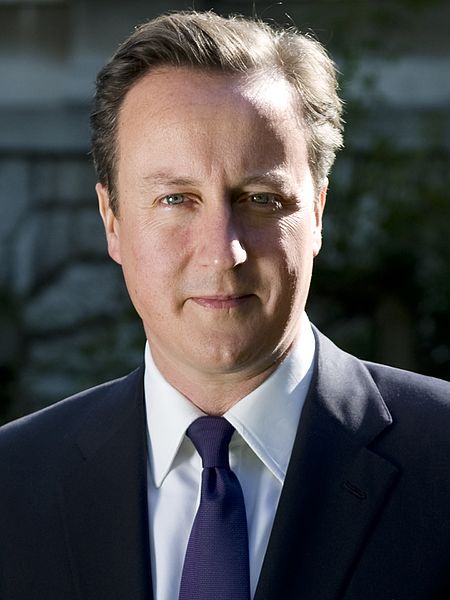
David Cameron’s official portrait from the 10 Downing Street website, 3 August 2010.
Open Government Licensed image via Wikimedia Commons.It is not their fault, perhaps; besides which I, or you, might be mistaken in our assessment of them and actually they have backbones (or what my teachers use to call moral fibre) of enormous strength. In any case, there are worse things to be, especially in the field of politics, than a nullity: an evil monster, for example, would be far worse, and no one could seriously claim that either of Messrs Trudeau and Cameron are, or were, evil monsters, however little they inspire admiration.
No one, then, could accuse me of partiality for Mr Trudeau, and the abjectness of his apology for his behaviour when he was a very young man did nothing to increase my liking for him. But it seems to me that sins as a young man were venial at worst, a callow disregard of the sensibilities of others which I common in youth. I very much doubt that he was a deep-dyed racist in any dangerous way, more a silly boy having a bit of fun.
There is a serious side to this imbroglio, of course. If the political leader of an important country can be overthrown or not re-elected on so relatively trivial a ground, while at the same town no one cares in the least about his shallow but dangerous moral posturing and obviously weak-minded pandering to the ayatollahs of an absurd and ill-founded political morality, then a new nadir of decadence and cowardice has been reached. It is a difficult question of moral philosophy as to whether it would be worse if Mr Trudeau actually believed his own political correctness or merely made use of it as a means to power. If the former, he is a fool; if the latter a knave. I leave it to others to decide which is better in a politician, or indeed in any other human being, foolishness or a knavery.
Political correctness is dangerous because when fools or knaves get into power, they may try to implement its dictates. And since many people are much more concerned to appear good than to do good, and since they are unlikely to suffer the consequences of their own actions (except when hoist on their own petard), the implementation may continue for a long time after the negative effects of its dictates have become clear. When implemented, those dictates create a clientele dependent upon their continuation, which turns any attempt to undo the harm into a nasty social conflict.