
Protectionists always speak of tariffs and other import restrictions as impositions the burdens of which fall exclusively on foreign producers (usually, as in the case of antidumping cases, on foreign producers who have the audacity to sell their wares to us at prices that are especially low). And while domestic protectionist measures do indeed harm foreign producers, every protectionist measure is also – indeed, chiefly – a restriction on the freedom of domestic consumers to spend their money as they choose. Tariffs, antidumping duties, and all protectionist impositions make domestic citizens less free (by closing off areas of voluntary exchange that they would otherwise choose to engage in) and less prosperous (by diminishing the volume of goods and services available in the domestic market for people to consume).
Protectionism is rank economic idiocy and an unquestionable assault on liberty. And it becomes no smarter or prettier just because it is costumed in moralistic language (such as “fair trade” or “leveling the playing field”) or is pushed by your preferred political party rather than by some other political party.
Don Boudreaux, “Quotation of the Day…”, Café Hayek, 2016-12-06.
November 10, 2018
QotD: Protectionism helps domestic producers but hurts domestic consumers
November 3, 2018
“[I]t makes no sense to punish Americans with tariffs in order to convince foreign governments to stop punishing their citizens with tariffs”
Veronique de Rugy discusses the mercantilist errors that still influence politicians and voters on free trade policies:
There are many changes to domestic policy that could help protect Americans from the predations of protectionism. For instance, when considering whether or not to grant U.S. firms “trade remedies,” such as countervailing duties, officials should have to take into account the consequences for American consumers of any tariffs they’re thinking of imposing. Policy makers aren’t currently required to do that, and one agency — the International Trade Commission—is actually forbidden from doing so.
This must change. Recent developments prove that it’s dangerous to simply assume all U.S. presidents and a critical mass of legislators will remain committed to the principles of reciprocal free trade. Buyers of imported goods or products made with imported materials — which, to be clear, is all of us — can’t depend on the economic acumen of the policy makers deciding whether or not to impose tariffs. Instead, consumer protections need to be built into the regulatory process. Because there are virtually always more workers in consuming industries downstream of the trade barrier than there are in the sector receiving the protection, a requirement to take the harm to consumers into consideration would make it very hard to impose protectionist policies.
Some free trade sympathizers have floated the possibility of Congress reclaiming its power to impose tariffs from the White House. Sen. Mike Lee (R–Utah), for instance, has introduced the Global Trade Accountability Act, which would require congressional approval for tariff increases or other “unilateral trade actions.” Unfortunately, if this otherwise well-designed bill became the law of the land, it would be akin to guarding the hen house with a hungry dog instead of a fox.
An extensive literature shows that moving tariff-setting policy away from Congress (and its parochial, locally focused interests) was a critical part of reducing protectionist influence in Washington. President Trump is terrible on this issue, but in general, a president is more likely than are members of Congress to consider the interest of the entire country — and, hence, to support broad trade liberalization.
October 3, 2018
USMCA (aka son-of-NAFTA) – what’s the damage after all?
The most common sentiment from Canadian comments appears to be “meh, it could have been much worse”. That doesn’t mean it’s particularly good, either:
All that cross-border yelling, a solid year of bluster and petulance, dire rhetoric about “stabs in the back” and “special places in hell,” fake deadlines and all-night negotiations, and we end up with pretty much the agreement we started with? All that was required to fix NAFTA, that destroyer of American jobs and pox on its prosperity, the deal Donald Trump memorably complained was “the worst agreement in history,” was to change its name — from North American Free Trade Agreement to US-Mexico-Canada Agreement? Seriously?
Not quite. The result is certainly a far heave from some of the more apocalyptic scenarios we had been entertaining ourselves with. But neither is it the largely unaltered “NAFTA 2.0” of much initial comment. There are substantive changes in there, most of them bad, and not all of them imposed by an overbearing U.S. on an unwilling Canada.
Still, it’s not quite the conflagration we’d been banking on, is it? Trump is the bully in middle school who threatens to take your lunch money, only to settle for a half a slice of your pizza. Or, in this case, 3.6 per cent of it.
That’s the share of the Canadian dairy market to which the U.S. will now have tariff-free access, a slight advance on the 3.25 per cent market share the U.S. had negotiated under the Trans Pacific Partnership — before Trump withdrew from it. (Oh, and “milk price classes 6 and 7” are eliminated, for fans of that dispute. It involves skim milk solids.) There are also some minor increases in tariff-free imports in the other supply-managed sectors: eggs, chicken, cheese and so on. Everything else will face the same triple-digit tariffs, as before.
That’s unfortunate. Supply management is a blight on the Canadian political and economic landscape we could well do without. The NAFTA re-negotiations were an ideal opportunity to bargain it away, as it should have been in the original NAFTA. That it remains more or less intact — even the dairy lobby could manage only a half-hearted jeremiad of imminent lacto-doom in response — is one of the chief disappointments in this agreement.
Still, what did you expect? There was never any chance of these negotiations resulting in a deepening and broadening of NAFTA — not with protectionists on both sides of the table. The only question was whether the status quo protectionists on this side — who wished to preserve all of NAFTA’s existing exemptions — could hold out against the expansionist protectionists on the other, who wished to cut NAFTA into little mercantilist pieces. As it turns out the answer is: surprisingly well.
A quick summary of the winners and losers in this agreement:
Is this a free trade agreement?
No. Unlike NAFTA, this latest agreement makes no pretense to be about free trade (or even freer trade). It’s a protectionist agreement imposed by the U.S. on the other two countries.
Who benefits from the agreement?
The primary beneficiaries of the agreement are labor unions, U.S. dairy farmers, U.S. drug manufacturers, and companies that provide automation for manufacturers (e.g., robot makers).
The agreement will require at least 30 percent of cars (rising to 40 percent by 2023) to be made by workers earning $16 an hour. This will force more cars to be produced in the U.S. and Canada since the typical manufacturing wage in Mexico is only about $5 per hour. The agreement also requires Mexico to make it easier for workers to form unions, which will make them less competitive against more productive unionized workers in the U.S. and Canada.
U.S. dairy farmers will also gain greater access to the Canadian market. Because of new restrictions on how much dairy Canada can export, there is the potential for U.S. dairy to gain a greater market share in foreign countries.
U.S. drug companies will also be able to sell pharmaceuticals in Canada for 10 years (rather than eight) before facing generic competition.
Because the agreement makes human labor in the three countries somewhat more costly, companies that create robots and other automation will likely be the long-term beneficiaries.
Who are the biggest losers in this agreement?
As with almost all protectionist trade agreements, consumers are the ones who will be hurt the most.
As the Washington Post notes, economists and auto experts think USMCA is going to cause car prices in the U.S. to “rise and the selection to go down, especially on small cars that used to be produced in Mexico but may not be able to be brought across the border duty-free anymore.”
Because the restrictions on Canadian steel and aluminum also remain in place, businesses that use those materials in manufacturing will pay inflated prices, and their products will be less competitive on the global market.
September 28, 2018
The staunch Progressive dismissal of Warren Harding and Calvin Coolidge
In Richard Epstein’s review of Jill Lepore’s recent book These Truths: A History of the United States, there’s some interesting discussion of the Harding and Coolidge administrations:
Lepore’s narrative of this period begins with President Warren Harding, who, she writes, “in one of the worst inaugural addresses ever delivered,” argued, in his own words, “for lightened tax burdens, for sound commercial practices, for adequate credit facilities, for sympathetic concern for all agricultural problems, for the omission of unnecessary interference of Government with business, for an end to Government’s experiment in business, for more efficient business in Government, and for more efficient business in Government administration.” Harding’s sympathetic reference of farmers is a bit out of keeping with the rest of his remarks. Indeed, farmers had already been a protected class before 1920, and the situation only got worse when Franklin Roosevelt’s administration implemented the Agricultural Adjustment Acts of the 1930s, which cartelized farming. But for all her indignation, Lepore never explains what is wrong with Harding’s agenda. She merely rejects it out of hand, while mocking Harding’s conviction.
Given her doggedly progressive premises, Lepore may have predicted a calamitous meltdown in the American economy under Harding, but exactly the opposite occurred. Harding appointed an exceptionally strong cabinet that included as three of its principal luminaries Charles Evans Hughes as Secretary of State, Andrew Mellon as Secretary of Treasury, and Herbert Hoover as the ubiquitous Secretary of Commerce, with a portfolio far broader than that position manages today. And how did they perform? Lepore does not mention that Harding coped quickly and effectively with the serious recession of 1921 by refusing to follow Hoover’s advice for aggressive intervention. Instead, Harding initiated powerful recovery by slashing the federal budget in half and reducing taxes across the board. Both Roosevelt and Obama did far worse in advancing recovery with their more interventionist efforts.
To her credit, Lepore notes the successes of Harding’s program: the rise of industrial production by 70 percent, an increase in the gross national product by about 40 percent, and growth in per capita income by close to 30 percent between 1922 and 1928. But, she doesn’t seem to understand why that recovery was robust, especially in comparison with the long, drawn-out Roosevelt recession that lingered on for years when he adopted the opposite policy of extensive cartelization and high taxes through the 1930s.
Lepore is on sound ground when she attacks Harding and Coolidge for their 1920s legislation that isolated the American economy from the rest of the world. The Immigration Act of 1924 responded to nativist arguments by seriously curtailing immigration from Italy and Eastern Europe, subjecting millions to the ravages of the Nazis a generation later. Harding and Coolidge also increased tariffs on imports during this period. What Lepore never quite grasps is that any critique of these actions rests most powerfully on the classical liberal worldview that she rejects. Indeed, Harding and Coolidge exhibited the same intellectual confusion that today animates Donald Trump, who gets high marks for supporting deregulation and tax reductions at home, while simultaneously indulging in unduly restrictive immigration policies and mercantilist trade wars abroad. Analytically, however, the same pro-market policies should control both domestically and abroad. Hoover never got that message — as president, he signed the misguided Smoot-Hawley Tariff Act of 1930 that sharply reduced the volume of international trade to the detriment of both the United States and all of its trading partners, which helped turn what had been a short-term stock market downturn in 1929 into the enduring Great Depression of the 1930s.
September 23, 2018
How to use the stock market as a scorecard during a trade war
At the Continental Telegraph, Tim Worstall explains how even the financial journalists at Fortune are misunderstanding what the changes in stock market values mean during Trump’s ongoing trade disputes with China:
… how stock markets react is not a good guide to the positive effects of tariffs. Quite the opposite in fact. It’s a much better guide to how we’re all getting screwed by tariffs. That is, the better the US stock market does the more evidence we’ve got of the bad effects of tariffs and a trade war.
Think on it. Why is Trump imposing tariffs? To protect American business from competition by those dastardly foreigners. Who loses in the absence of competition from the Yellow Peril? Those American consumers who would have bought those better/cheaper Chinese goods if they were able to. Who gains from tariffs? American businesses who can now gouge the American consumer a little more in the absence of those items imported from East Asia.
So, a rise in the US stock market is a guide to how much more profit American business can screw out of the American public. It’s a measure, a reasonably good and precise one too, of how much we the people are losing from the trade war and tariffs. More exactly, it’s the capitalised value of the ongoing losses we’re suffering from this restriction of our choices, the competition those who supply us face.
That is, the better the stock market performance the higher those costs and the more we’re losing the trade war. That is, as long as you accept that it is consumers, not producers, that matter, but then that’s the standard economic assumption ever since Adam Smith even if it gets lost in Washington DC often enough.
The US stock market rising in response to US tariffs is evidence of the losses from tariffs, not the gains.
July 27, 2018
“Tariffs are the classic example of government interventions with concentrated benefits and dispersed costs”
Robert Higgs on what he describes its supporters as “waging the trade war to end all trade wars”:
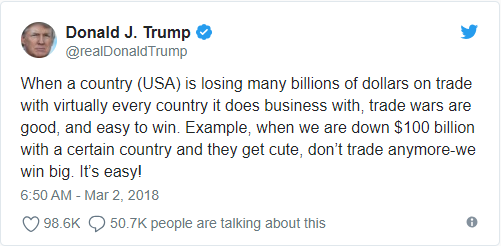
… even as Trump spouts venerable fallacies to justify and seek support for his destructive trade policies and related ad hoc actions, he and his supporters have sometimes offered a strange defense of their tactics: they purport to be seeking, at the end of the game, universal free trade, a world in which all countries have abandoned tariffs, quotas, subsidies, and other government intrusions in international exchange. In Wilsonian terms, they claim to be waging the trade war to end all trade wars. The idea is that by raising U.S. tariffs, they will induce other governments to lower and ultimately eliminate their own.
Of course, this rationale may be nothing more than wily claptrap, tossed out as a rhetorical bone to Republicans who favor freer trade. The administration’s actions to date certainly give no indication that it is aiming at global free trade. On the contrary. So the Wilsonian gambit may consist of nothing but hot air.
But if Trump and his trade advisers actually take this tactic seriously, they are deluding themselves.
First, and surely obviously, U.S. tariff increases will not induce other governments to lower their own, but to raise them, as the EU, China, Mexico, Canada, and other trading partners have already demonstrated. That’s why it’s called a trade war — because the “enemy” shoots back. History has shown repeatedly, most notably in the early 1930s, in the wake of the Smoot-Hawley Tariff Act of 1930, that such trade wars only spiral downward, choking off more and more trade, despoiling the international division of labor in accordance with comparative advantage, and thereby diminishing real income in all the trading countries.
Second, the prospect of the U.S. government’s ever abandoning tariffs is slim to none. Tariffs are the classic example of government interventions with concentrated benefits and dispersed costs. This character makes them attract great support from protected special interests and little opposition from the general public — including other producers — when they are enacted or extended. They are easy for politicians to put in place and diabolically difficult for anyone to eliminate. Although the costs are great — much greater than the benefits for the economy as a whole — hardly anyone’s costs are great enough to justify mounting a potent political attack on the tariffs.
People who get tariffs put in place to protect them in the first place are well positioned to marshal strong opposition to any political attempt to eliminate these taxes on consumers who buy from competing, foreign suppliers. Consumers rarely know anything about why foreign goods are priced as they are, and producers, in general, are usually not affected enough by tariffs on imported raw materials and components to justify well-funded politicking against them.
July 26, 2018
The Trump tariffs are working exactly as designed
That is, they’re becoming a drag on the economy and will take away a lot of the economic activity that was stimulated by the tax cuts enacted earlier. Warren Meyer says that it’s time that congress reclaimed the tariff powers it has outsourced to the executive branch over the years:
I Know Congress Hates To Challenge A President of Its Own Party, But…
…Congress simply has to pare back the tariff authority it has delegated the President. It is simply insane that Trump can just unilaterally impose 20% tariffs on foreign automobiles, a $200 billion new tax on US consumers.
It is appalling to see Trump following the usual blue model of economic regulation, imposing one intervention after another, each meant to fix the unintended consequences of the last intervention. Steel tariffs increased costs to domestic auto makers, so Trump proposes tariffs on foreign autos. When tariffs result (inevitably) in counter-tariffs on US agricultural exports, Trump proposes more agricultural subsidies. People (not me) lament gridlock in government and want more fluid lawmaking — well here it is. And it sucks. It is mindless and reactive and emotional and totally ignorant of economics.
These tariffs, when combined with earlier actions, will result in tax increases on consumers that swamp the tax cuts Trump and the Republicans were so proud of last year.
Jon Gabriel on the most recent “fix” for one of those unintended consequences:
A few months back, President Trump declared that “trade wars are good, and easy to win.” Now, just as nearly every economist on the left and right predicted, Americans are being hurt.
The White House slapped tariffs on imported steel and aluminum. China retaliated with planned tariffs on soybeans, meats and various agricultural products. Mexico, Canada and the European Union also struck back at farm goods and other U.S. exports.
A smart leader would notice his mistake and end the destructive policy. Instead, Trump declared that “tariffs are the greatest” and created a multibillion-dollar federal program to mitigate a small part of the mess he created.
Since Agriculture Secretary Sonny Perdue estimated $11 billion in damage to the industry, he announced a $12 billion payoff to make up the difference.
The administration used emergency executive powers created during the Great Depression; that way Congress wouldn’t get to weigh in.
“This is obviously a short-term solution that will give President Trump time to work on a long-term trade policy and deal to benefit agriculture as well as all sectors of the American economy,” Perdue told reporters.
It’s certainly short-term, but hardly a solution. Trade deals and networks are disrupted, farmers can’t plan for the future, and non-agricultural industries are still losing money. Not to mention all the American consumers watching prices rise on all sorts of household goods.
But red states have a lot of farmers and the midterms are just three months away. Maybe borrowing a few billion dollars will hide enough economic pain to convince voters to keep Republicans in power for two more years.
July 14, 2018
Trump’s tariffs are working
Tim Worstall explains that the recent US price hikes in washing machines is exactly what the Trump administration wanted:
The part of import tariffs that all too many fail to understand is that it is consumers being “protected” by them who actually pay them. That is, import tariffs on foreign goods entering the United States are paid by those inside the United States. Or, as we can also put it, Trump’s tariffs are making Americans poorer. This isn’t a known to be desired effect of economic policy.
However, it’s important to note that the real burden doesn’t come from the rise in price of the imports. It’s what the domestic producers do to us all in the absence of that foreign competition which is important:
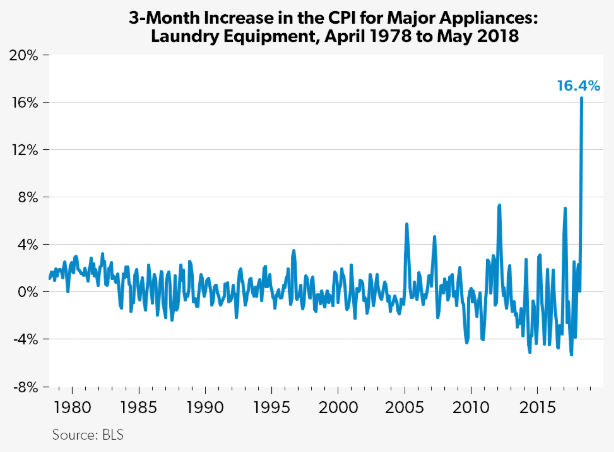
The clear and obvious effect of import tariffs – Credit, BLS, via Mark Perry and AEI, by permission
If you’re unfortunate enough to be shopping for a new washing machine, you can thank the Trump tariffs on imported washing machines, washing machine parts, steel and aluminum for the largest three-month price increase — 16.4% from February to May this year — in the 40-year history of the BLS series for Major Appliances: Laundry Equipment that started in January 1978 (see chart above). In the May CPI report (see Table 2), the one-month increase in the CPI for Laundry Equipment of 7.4% in May followed a 9.6% increase in April, and in both months was the largest monthly price increase of any of the 300 individual CPI categories or sub-categories. For the month of May, the 7.4% increase in the washing machine series was twice the increase of the next highest increase of 3.7% for educational books and supplies (mostly college textbooks).
What’s worse than this price rise is that this is planned. This is the desired outcome from the people who imposed these taxes.
July 6, 2018
“That’s what governments are for — get in a man’s way”
Veronique de Rugy says that the 4th of July is a good time to reflect on the American Founding Fathers fighting to gain independence from a distant tyrannical government … and the rest of the year is devoted to coping with a less-distant but no-less tyrannical government in Washington:
Consider the oil and gas industry. Over the years, the federal government has adopted many regulations meant to hinder the industry. As Nick Loris, an energy policy analyst at the Heritage Foundation, reminds me, one such regulation is the Merchant Marine Act, also known as the Jones Act, which makes it more expensive to ship oil and natural gas from coast to coast. Then there are the past administrations’ outright moratoriums on drilling in certain areas of America’s coasts, which massively increases the cost of doing business. As Loris notes, there are many costly bureaucratic delays in issuing leases and processing applications for permits to drill (APDs), which stalls production on federal lands. On average, the federal processing of APDs in the last year of the Obama administration was 257 days, while state processing is typically 30 days or less.
Since Uncle Sam has a lot of regulations in place to make the operations of domestic oil and gas companies more costly, why is the biggest beneficiary of loans from the federal government export credit agency (the U.S. Export-Import Bank) the gigantic Mexico state-owned oil and gas company Pemex? Between 2007 and 2013 (the most complete data set we have), Pemex received over $7 billion in loans backed by American taxpayers to buy U.S. goods. Thanks to Uncle Sam, this discounted borrowing power gives Pemex a leg up on its competition with domestic oil and gas companies.
Then there’s the Trump administration tariffs. These import taxes on foreign goods coming from Europe, China, and other countries have not only raised the cost of doing business but also triggered retaliatory measures from foreign governments. For instance, the farm industry is paying a steep price from the tariffs on steel because they increase the cost of farm machinery, lowering profit margins. Farmers are also hurt by the European, Mexican, Canadian, and Chinese governments that have imposed retaliatory export restrictions on U.S. farm products. Many small farms are calling for help to survive. It’s so bad that the entire Iowa congressional delegation sent a letter to President Trump on June 25 in which it called the tariffs “catastrophic for Iowa’s economy.”
Quote in the headline from Firefly episode “Serenity, Part 1”.
June 23, 2018
QotD: The protectionist two-step, Alberta craft-beer variant
Economic protectionism has two classic rationales. Sometimes, as in the case of Alberta’s clumsy attempt at an interprovincial tariff on craft beer, it is undertaken in the name of defending small, emerging “infant industries” that a government wishes to give time to establish themselves in its territory. And sometimes, as in the case of Canadian dairy supply management, it is done to defend “strategic” industries that have existed forever and that allegedly create an irreplaceable quantity of employment and profits.
Give yourself a gold star if you spotted that these canonical pretexts for trade barriers are contradictory. The inherent promise of protection for “infant industries” is that they will grow up and leave the nest. But, oops: by the time they reach adulthood, they may have become too “strategic” to expose to market forces. Heads, the favoured firms win; tails, the consumer loses.
Of course, on the level of fine detail, the arguments for trade barriers are manifold and complicated. (If you get into a quarrel about dairy, and take the free-trade side, you will find them being changed by your interlocutor every 30 seconds.) Alberta’s program for supporting small brewers has an unclear, touchy-feely small-is-beautiful justification. By design, the tariff applies only to businesses that have no intention of attaining industrial scale. It’s right there in the term “craft brewing,” isn’t it? Whatever the esthetic merits of craft beer, this is surely the deliberate encouragement of what the urbane left likes to calls “precarious” jobs that could be flung into disarray by a bad season, a shift in fashions, or a supply problem.
And, also, it’s illegal.
Colby Cosh, “A court refuses to swallow Alberta’s thinly disguised craft-beer tariff”, National Post, 2018-06-22.
June 17, 2018
Conrad Black – Trump’s not bluffing
In the National Post (but linked from his personal website), Conrad Black warns of the danger of assuming that Trump is just blustering on his trade threats:
Justin Trudeau struck just the right Canadian note of our gentle nature but refusal “to be pushed around,” and he predictably will reap the short-term reward for standing up for the country opposite the ideal American bogeyman, the blustering billionaire president who has been a Garry Trudeau caricature of the Ugly American for 25 years. (It is a very incomplete picture, like most caricatures, but it works for Trump and he often cultivates it.) The boycotts of American goods and holidays will be a bonus to Canada economically and the anti-Trump American media will be along within two weeks to lionize doughty Canada like “Gallant little Belgium” in 1914 and “Plucky Israel” in 1947, and it will strengthen Canada’s always fragile self-regard opposite the United States.
On the other hand, Trump isn’t just a blowhard; all his career he has known how to go for the jugular and his reference to 270-per-cent Canadian tariffs on butter is a valid complaint that threatens to tear the scab off this egregious payoff to the comparatively small number of Quebec dairy farmers who mainly profit from it. The same issue was hammered hard by Martha Hall Findlay when she ran for the federal Liberal leadership in 2013 and by Maxime Bernier when he ran narrowly behind Andrew Scheer for the Conservative federal leadership last year. The issue died down after their unsuccessful campaigns, but if Donald Trump is incited to hammer that theme, he will roil the domestic Canadian political waters and English-French relations in the country generally.
Presumably our trade negotiators will not become so intoxicated by the prime minister’s peppy talk and spontaneous popular boycotts of the U.S. that they forget the correlation of forces. An aroused American administration could do serious damage to Canada’s standard of living, and it could be a tempting tactic to expedite more important negotiations with Mexico and the principal Asian and European powers. The United States is now enjoying three times as great a rate of economic growth as Canada (4.8 to 1.5 per cent), has lower tax rates, 11 times as great an economy, and more unfilled jobs than unemployed people.
Behind the peeling façades of Norman Rockwell and Walt Disney, the United States is a monster, and not always an amiable monster. If Canadians are blinded by their visceral dislike of Donald Trump, as the antithesis of Canadian criteria for likeable public figures, they will be exposed to the ruthless pursuit of the national interest that in his own career propelled him from technical insolvency to immense wealth and celebrity and then, against all odds, to control of a great political party and to the headship of the most powerful country in the world. If these talks blow up, the U.S. doesn’t have to settle for WTO rules; it can impose outright protectionist measures. Justin Trudeau has been agile, and the country has responded admirably. But Canadian policy-makers must understand that they are playing for almost mortal stakes with potentially dangerous protagonists who have no sense of fair play and no interest in what Canada thinks of them.
June 13, 2018
Imagine … a tariff-free world
Danny Chabino on what he calls “Trump’s G7 Surprise”:
In what I consider a brilliant move on the part of Trump and his team, instead of initially discussing what tariffs he would increase if x,y and z didn’t happen or if whichever nation wouldn’t reduce tariffs on whatever industry, he simply raised the simple question of why don’t we just not have tariffs at all? It’s brilliant in the sense that it not only shut down all the anticipated arguments, but also placed the world’s leaders in a position of having to awkwardly defend the very idea of tariffs (and subsidies), and they knew they couldn’t really do that. It highlighted the true intentions of the world’s leaders as representatives of the authoritarian nature of almost every existing government in the world today.
Now, please don’t misunderstand this article as me beaming with a Trump glow. In fact, Trump knew full well no one would take him up on such an offer. I do believe if they had he would have followed through, but his next moves will be ones that I believe are the wrong ones. He will seek to raise tariffs, which has always done more harm to the nation raising the tariffs than it has done good that nation. Trump will do just as he has threatened and hurt his own country;’s economy with new tariffs.
What I do enjoy, though, is that all of the world’s major leaders had to essentially admit that they don’t want their people and their economies to be better off. At least not on their own. They want their people and economies to be dependent upon their leadership and their governments. While everyone at the summit knew that the greatest of outcomes would be for all the world’s most powerful nations to exercise free trade, and that this would benefit the entire world in great proportions, that really wasn’t their aim. Their aim was to gain greater power. What an incredible admission!
When given a golden opportunity to end tariffs and increase freedom and prosperity for most citizens of the world, the world’s leaders instead chose to cling hard to their own designs. The world’s leaders know full well that tariffs hurt their own citizens, but they don’t care. Tariffs have never served the function of creating market efficiency, and they have never helped protect a nation’s economy. Instead, they have always been a means for governments to exercise control over huge parts of their own economies, and where there is control, there is power. Politicians and world leaders seek power. It’s like their drug of choice, and they can never get enough of it.
June 11, 2018
Jay Currie says it’s time to light the Bat Signal for … Brian Mulroney?
I find it hard to believe that things have gotten to the point that anyone, let alone Jay Currie, is looking to former PM Brian Mulroney to pull Justin’s chestnuts out of the Trumpian fire:
In Canada, more specifically Ontario, the destruction of the auto industry would be a full scale, all hands on deck, disaster. Realistically, the auto sector is Ontario’s largest private sector employer and the largest manufacturing sector. Being priced out of the US market would kill tens of thousands of well-paid jobs.
Trump has taken the measure of Trudeau and his tiny, annoying, Minister of External Affairs, Chrystia Freeland and concluded they are featherweights. Which means that Canada is potentially screwed because Trump has no faith in our leadership. You don’t call people dishonest publicly if you plan to do business with them.
It is unlikely that Trudeau will be aware of just how badly he has failed for a few days. The Canadian media are heavily invested in a narrative which has Justin standing up to the big, bad, Trump. Trudeau’s tone-deaf advisors are, no doubt, revelling in the fact they got lots of “gender” language into the communique.
It will take a few days for the more sober side of the media to realize what peril Trudeau has put us in. And a few more for the geniuses in the PMO to figure out that Trump is not playing the same game as they are.
When they do figure it out the question will arise, “What the fuck do we do now?”
As I am quite sure Butz and his posse read this blog I have a simple suggestion.
Normally, I would have suggested they get in touch with Simon Reisman who negotiated both the Auto-Pact and NAFTA. Alas, Reisman is dead.
Second best by a long shot? Brian Mulroney. A man I have next to no time for but who a) managed to get Canadians onboard for NAFTA, b) was a quite successful Canadian Prime Minister, c) is wired into both Trump World and broad swaths of corporate America.
If Trudeau could get Mulroney to do it Mulroney would be going into the US with a serious, well thought out, everything on the table, pitch. Likely starting with first principles – no tariffs, no subsidies, no non-tariff barriers. Be prepared to dump dairy and end transhipment of Chinese steel. And pitch it to the Trump people as the template for the deals which could be made with the EU, Japan, India and so on. (China is a whole other thing.)
The key point here is that Canada has to move, and move quickly, away from the finger-wagging politics of gender inclusion and climate change to a hard-nosed business approach to getting the best deal we can with an America which is now willing to put its own interests first.
June 7, 2018
Trade war with Canada justified because the White House was torched in the War of 1812
Maybe it was intended as a joke, but what else was Trump supposed to say when Trudeau actually asked what actual security threat Canada poses to the United States?
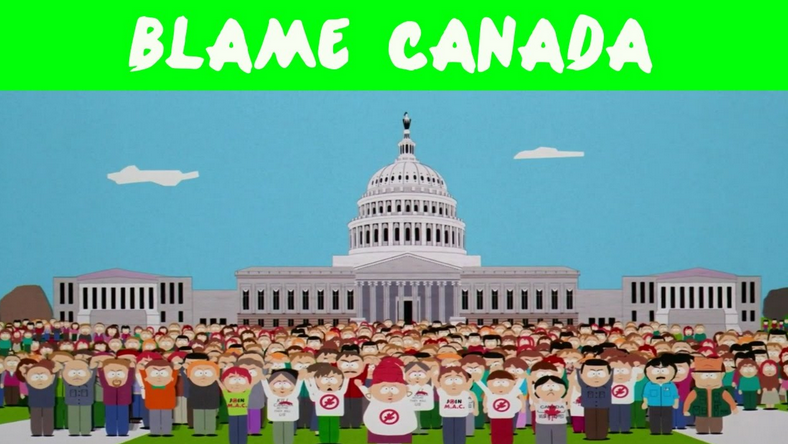
During a phone call with Canadian Prime Minister Justin Trudeau last weekend, President Donald Trump reportedly justified his decision to impose tariffs on Canadian steel and aluminum by invoking … the burning of the White House by British troops during the War of 1812.
At least, that’s what CNN is reporting this afternoon. Here’s how they put it, citing information from “sources familiar with the call: “Trudeau pressed Trump on how he could justify the tariffs as a ‘national security’ issue. In response, Trump quipped to Trudeau, ‘Didn’t you guys burn down the White House?'”
That is, presumably, a reference to the War of 1812, during which British troops invaded Washington, D.C., and set fire to the White House. Despite the war’s name, the burning of the White House actually occurred in 1814. And it wasn’t carried out by Canadians because, well, Canada did not become an independent nation until 1867 — or 53 years after the White House burned.
But, sure, whatever. The War of 1812 makes Canada a national security threat in the year 2018, despite our having been allies for the last century, sharing the world’s longest unpatrolled border, and exchanging more than $620 billion in goods last year. The rationales for war with Canada in Canadian Bacon and South Park: Bigger, Longer & Uncut are more grounded in reality.
June 4, 2018
The economic damage of tariffs
Tim Worstall fisks a recent Pat Buchanan brain fart article on the glories of erecting tariff walls against foreign trade:
Pat Buchanan has been going on for decades about how wondrous tariffs are and if only they were brought back then things would be just peachy. Sadly, this all seems to be based on his not understanding trade, tariffs, nor apparently even history. That’s not a good set of recommendations for a policy about trade and tariffs, one that has been tried many a time in history.
Now, it is entirely true that if we returned to a more Hamiltonian policy era then we’d all be richer. But that wouldn’t be because we had tariffs which paid for government rather than an income or corporate tax. It’s because government would be confiscating a very much smaller portion of what we all produce to pay for itself. If the Feds took 3% of everything we do instead of the current 18% or so then sure, we’d all be richer. But that’s true however that tax is raised.
[…]
His argument is that, protected from foreign competition, American business was able to develop and grow into being world beaters. No, I don’t think this is true – I insist that behind tariff barriers companies stagnate. Indeed it’s standard economics that the medium to long term effects of trade are that the competition from foreigners is what makes the domestic companies stronger and more productive. But put that argument to one side. Assume that Buchanan is correct.
For his conclusion to be correct then it must have been true that the total costs of trade were rising in that time period. Total costs being tariffs plus transport. Only if the total costs were rising was protection rising. The tariffs are only part of the story. And as it happens total protection was falling over this time period. The falls in the costs of transport – for the US externally primarily the steam ship – were greater than the rises in the tariffs. Thus the US was becoming more open to trade at this time when industry was booming and growing to world class levels.
That’s not an argument in favour of trade protection now, is it?
The U.S. relied on tariffs to convert from an agricultural economy in 1800 to the mightiest manufacturing power on earth by 1900.
Well, it’s also true that what the US was inside those tariff barriers was the largest free trade area in the world. I’m the guy insisting that free trade makes places grow, Pat the opposite. And the place with more free trade among more people than anywhere else grows fastest? That’s a point in my favour, no, not Pat’s? Remember, the US Constitution expressly forbids the individual states from having tariffs between them…..that regulation is left to the Feds who have never imposed them.
How have EU nations run up endless trade surpluses with America? By imposing a value-added tax, or VAT, on imports from the U.S., while rebating the VAT on exports to the USA. Works just like a tariff.
No, a VAT does not work like a tariff. In no manner at all does it do so in fact. As every economist keeps trying to point out. Within the EU all goods and services, no matter where they’re made, pay the exact same rate of VAT. Well, OK, ladies unmentionables pay a lower rate than motor cars, that’s true, but all unmentionables pay the same rate, all cars. There is no difference made between domestic and foreign production. It’s entirely unlike a tariff therefore, the crucial component of which is that distinction made between home and foreign production.
Stuff made in the EU and sold in the US pays no VAT. Stuff made in the US and sold in the US pays no VAT. Again, we’ve no distinction by source or origin, this is entirely and completely unlike a tariff.


