Quotulatiousness

August 29, 2012

QotD: Government funding for the arts “stinks in God’s nostrils”

Filed under: Books, Government, Media, Politics, Quotations — Tags: , , , , — Nicholas @ 15:14

There’s at least a third reason to stop state funding of the arts, and it’s the one I take most seriously as a literary scholar and writer. In the 17th century, a great religious dissenter, Roger Williams (educated at Cambridge, exiled from the Massachusetts Bay Colony), wrote the first case for total separation of church and state in the English language. Forced worship, said Williams, “stinks in God’s nostrils” as an affront to individual liberty and autonomy; worse still, it subjugated theology to politics.

Something similar holds true with painting, music, writing, video and all other forms of creative expression. Forced funding of the arts — in whatever trivial amounts and indirect ways — implicates citizens in culture they might openly despise or blissfully ignore. And such mandatory tithing effectively turns creators and institutions lucky enough to win momentary favour from bureaucrats into either well-trained dogs or witting instruments of the powerful and well-connected. Independence works quite well for churches and the press. It works even more wonderfully in the arts.

Nick Gillespie, featured guest for “Economist Debates: Arts Funding”, The Economist, 2012-08-29

August 21, 2012

Farewell to The Northlander

Filed under: Cancon, Economics, Railways — Tags: , — Nicholas @ 12:00

The economics of long-distance passenger rail service is brutal: this announcement is not really a surprise, but it is disappointing anyway.

If a train stops running through the hinterland, does anybody hear?

The Ontario government has just announced the end of the line for the Northlander. The Ontario Northland train that runs between Toronto and Cochrane, Ontario, will cease service at the end of September.

What’s the word for that? Disappointing doesn’t cut it. Short-sighted is accurate, but insufficient. Regrettable is an understatement, too.

You’d think as a nation once united by the railway, we would have coined a term to cover the loss, the heartache, the sense of isolation, betrayal and rejection that comes from losing a railway line.

The only expression that comes close is “they’ve killed another train.”

Time and time again, we’ve seen passenger service reduced to little more than a quaint memory in many parts of the country.

Despite the historical appeal, long distance passenger rail loses money just about everywhere: government subsidies have been necessary for decades to keep the trains running. Political jockeying may keep a line open for a longer period, but nothing is going to change the facts. Passenger trains can be competitive for short-to-medium distances, but quickly lose out in efficiency (and potential profits) to air service over medium-to-long distances. Every time someone rides a VIA or Ontario Northland passenger train, the taxpayer is picking up part of the tab (and the longer the distance being travelled, the greater the required subsidy from the government).

Garnet Rogers explains what happens next:

The last train rolled out of town today;
You might have seen it on the news.
We gathered round the engine yard
To say our good-byes to the crews.
Well the cheering stopped, the laughter died
It dwindled down the tracks
“That’s that”, I heard someone say,
“We’ve fallen through the cracks.”

August 14, 2012

Ethanol: starving the third world, by government policy

Filed under: Economics, Environment, Food, Government, USA — Tags: , , , — Nicholas @ 08:47

Jeffrey Tucker on the absurd and cruel implications of a government mandate:

Corn prices are officially through the roof, spiking to record highs. It’s been headed this way through six years of crazy volatility. Now the spike is undeniable. At the same time, crop yields are lower they have been since 1995.

Everyone blames the drought, as if the market can’t normally handle a supply change. The real problem is that the corn market is fundamentally misshaped by government interventions that have made a mess of this and many more markets. The distortions are never contained, but spread and spread.

[. . .]

“Corn is the single most important commodity for retail food,” Richard Volpe, an economist for the USDA told the Los Angeles Times. “Corn is either directly or indirectly in about three-quarters of all food consumers buy.”

Fine, then, answer me this, Mr. Government Economist Man: Why is 40% of the corn crop being burned up in our gas tanks? The answer is a Soviet-like, fascist-like, stupid-like government mandate. It is actually relatively new. It came about in 2005 and 2007. It mixes nearly all the gas we can buy with a sticky product now in rather short supply.

Of all the government regulations I’ve looked at in detail over the last 10 years, the ethanol mandate is, by far, the worst. There are no grounds on which it is defensible. None!

Like so many government initiatives, this was supposed to do something good: reduce the consumption of fossil fuel for gasoline production by substituting a proportion of ethanol. While gas was expensive and ethanol was cheap this might make sense — but when ethanol becomes more expensive, and the raw material used to produce the ethanol would be far better used for food and feedstock, the whole policy becomes an act in the theatre of the absurd.

August 12, 2012

China’s economic situation in Keynesian and Austrian terms

Filed under: China, Economics — Tags: , , , , — Nicholas @ 09:27

Tyler Cowen in the New York Times:

Keynesian economics holds that aggregate demand — the sum of all consumption, investment, government spending and net exports — drives stability, and that government can and should help in difficult times. But the Austrian perspective, developed by the Austrian economists Ludwig von Mises and Friedrich A. Hayek, and championed today by many libertarians and conservatives, emphasizes how government policy often makes things worse, not better.

Economists of all stripes agree that China may be in for a spill. John Maynard Keynes emphasized back in the 1930s the dangers of speculative bubbles, and China certainly seems to have had one in its property market.

[. . .]

The Austrian perspective introduces some scarier considerations. China has been investing 40 percent to 50 percent of its national income. But it is hard to invest so much money wisely, particularly in an environment of economic favoritism. And this rate of investment is artificially high to begin with.

Beijing is often accused of manipulating the value of its currency, the renminbi, to subsidize its manufacturing. The government also funnels domestic savings into the national banking system and grants subsidies to politically favored businesses, and it seems obsessed with building infrastructure. All of this tips the economy in very particular directions.

The Austrian approach raises the possibility that there is no way for China to make good on enough of its oversubsidized investments. At first, they create lots of jobs and revenue, but as the business cycle proceeds, new marginal investments become less valuable and more prone to allocation by corruption. The giddy booms of earlier times wear off, and suddenly not every decision seems wise. The combination can lead to an economic crackup — not because aggregate demand is too low, but because the economy has been producing the wrong mix of goods and services.

Lots of earlier discussion of the problems in China’s economy here.

July 18, 2012

Who Exploits You More: Capitalists or Cronies?

Filed under: Business, Government, Liberty, Politics — Tags: , , , , — Nicholas @ 09:48

June 1, 2012

This is why I always cheer for whoever is bidding against Toronto to host the Olympics

Filed under: Britain, Economics, Sports — Tags: , , , , — Nicholas @ 00:02

If publicly funded professional sports stadiums are bad for the local economy (and they almost always are), “winning” the bid to host the Olympic Games is far worse:

The history of the modern Olympics (and of other large-scale sporting events) reveals a consistent pattern. Organizers or local politicians in the host city commission “impact studies,” which almost always promise extravagant economic benefits. Studies performed after the event, however, find no positive effect at all — let alone one approaching the initial estimates. So it isn’t surprising that a PriceWaterhouseCoopers study commissioned by the British government forecasts that the Games would add about $9.4 billion to London’s GDP between 2005 and 2016. That seems like a large number until you realize that the London metro area’s GDP is roughly $712 billion annually. If the Games’ benefits were spread evenly throughout the decade, they would increase London’s GDP level by 0.1 percent each year.

Further, that $9.4 billion benefit pales compared with the cost of hosting the Olympics. In 2002, the UK’s Department for Culture, Media and Sport estimated that the cost would be $2.8 billion. Ten years later, London’s budget for hosting the Games is $15 billion. Costs already run above that figure and are likely to rise to approximately $38 billion, according to an investigation by the TV network Sky Sports. That would easily dwarf the economic benefits that the PriceWaterhouseCoopers study predicts. Security alone will be extremely costly: more British troops will patrol London than there are currently at war in Afghanistan. And these figures don’t count many hidden and indirect costs of hosting the Olympics — most prominently, disruption to business and traffic congestion. Traffic in London is already difficult; with special lanes for Olympics-related traffic, daily commutes will become a nightmare. (London’s transportation commissioner, Peter Hendy, helpfully advises commuters to go to the pub to avoid rush hour.)

Update, 5 June: The good news just keeps on coming for the London Olympics:

The boom to the economy that the Government hoped the Games would bring to the capital appears to become a bust with tens of thousands to tourists spurning the hiked prices, congestion and heightened security.

While bookings for July and August are down by 35 per cent on last year other European capitals appear to be prospering from London’s gloom.

French ministers, who lost the Olympic bid to Britain, might be quietly rubbing their hands with glee not only for dodging the £10 billion Games bill but also with a 50 per cent rise in tourism bookings. Similarly Barcelona and Berlin have seen their tourist numbers soar by 100 per cent over the summer.

This is an example of why, when the announcement was made that Paris had lost out on the bid for the 2012 Olympics to London, Reason titled their coverage “Lucky Paris“.

May 29, 2012

The fuzzy good intentions of equalization and the bad results

Filed under: Cancon, Economics, Government — Tags: , , , , — Nicholas @ 10:07

Peter Holle in the National Post, outlining the economic distortions of federal equalization payments in the recipient provinces:

Equalization, viewed critically, does no favours to either the funding or recipient provinces. After 50 years, outside transfers constitute an ever larger portion of the economies in have-not provinces. In an otherwise globally-oriented, market-driven world, Canada’s equalization program has encouraged the development of locally-oriented, public-sector driven economies.

Here are just a few ways that equalization provides incentives to harmful policy, stunting economic growth in the jurisdictions the policy means to help.

  • Inflating the public sector: Equalization has allowed recipient jurisdictions to create disproportionately larger public sectors because someone else is paying the bill. Manitoba’s public sector, for instance, employs 103 people per 1,000 residents, compared to a Canadian average of 84.
  • Politicizing spending. The external funding from equalization has allowed local politicians to build up vote-buying infrastructure with little political cost, by disconnecting taxation from benefit. Quebec’s $7-a-day daycare, and university tuition at less than half the Canadian average, would be unworkable without $7.4-billion in annual equalization subsidies from the rest of Canada.
  • Incentives for higher taxes. A path-breaking study by the Atlantic Institute for Market Studies showed that equalization rewards recipient provinces for imposing high and damaging tax rates, which deter private-sector investment and job creation. Manitoba, the only have-not province in Western Canada, has the highest income taxes in the region, and also has the lowest rate of private-sector investment.
  • Artificially inexpensive hydro power. By excluding the true value of renewable hydro energy revenues from the calculation of revenue capacity, the equalization formula rewards Manitoba and Quebec for charging artificially low domestic electricity prices. Below-market prices, in turn, encourage consumers to use more resources that otherwise would be conserved in response to accurate price signals.

May 9, 2012

A call to ban college football

Filed under: Economics, Education, Football, Government, Media, USA — Tags: , , , — Nicholas @ 00:02

This Wall Street Journal piece by Buzz Bissinger is guaranteed to stir up controversy:

In more than 20 years I’ve spent studying the issue, I have yet to hear a convincing argument that college football has anything do with what is presumably the primary purpose of higher education: academics.

That’s because college football has no academic purpose. Which is why it needs to be banned. A radical solution, yes. But necessary in today’s times.

[. . .]

Who truly benefits from college football? Alumni who absurdly judge the quality of their alma mater based on the quality of the football team. Coaches such as Nick Saban of the University of Alabama and Bob Stoops of the University of Oklahoma who make obscene millions. The players themselves don’t benefit, exploited by a system in which they don’t receive a dime of compensation. The average student doesn’t benefit, particularly when football programs remain sacrosanct while tuition costs show no signs of abating as many governors are slashing budgets to the bone.

If the vast majority of major college football programs made money, the argument to ban football might be a more precarious one. But too many of them don’t—to the detriment of academic budgets at all too many schools. According to the NCAA, 43% of the 120 schools in the Football Bowl Subdivision lost money on their programs.

The other big beneficiaries of the college football system is, of course, the NFL. Unlike baseball or NHL teams, it doesn’t have to maintain a “farm team” league or leagues to provide training and play opportunities for would-be professional football players. This burden, instead, is carried by the taxpayer as part of their share of higher education.

April 19, 2012

“Ontario is on track to have the highest electricity prices … in North America”

Scott Stinson explains why Ontario consumers are facing huge price hikes for electricity over the next 18 months:

It’s no secret that Dalton McGuinty’s Liberals have placed a huge bet on growing a green-energy sector by subsidizing the production of renewable energy. Although energy bills have been steadily rising since the party took power in 2003 — the average cost of a kilowatt of electricity was more than 30% higher last year than it was five years ago — the Liberals have somewhat masked this fact by handing a 10% rebate back to consumers with the euphemistically named Clean Energy Benefit, which also happens to utterly contradict the conservation incentive that should be part of a switch to a greener grid.

Electricity costs, though, are set to spike.

“Ontario’s power system is fuelled by consumers to the tune of about $16-billion a year,” says Tom Adams, an energy consultant who has written extensively on electricity and environmental issues. “That number is headed for $23-billion or $24-billion soon, by 2016,” he says in an interview.

[. . .]

Mr. Adams notes that when the Green Energy Act, with its guarantees of above-market rates for wind and solar electricity known as feed-in-tariffs (FIT), was introduced in 2009, the Liberals said electricity costs would only be impacted by about 1% annually. We now know that rates for consumers are rising by 9% a year. “The government says about half of that is due to Green Energy, but if they were being honest it would be more than that,” Mr. Adams says.

The coming increases, meanwhile, which can partly be attributed to locked-in contracts for renewable energy, are also a result of a host of other factors, from new generation capacity being introduced to phase-out costs of existing facilities to new transmission capacity being added to the energy grid.

March 12, 2012

GM: the re-Volting face of corporatism

Redmond Weissenberger on the decline of GM from world-class manufacturer to crony capitalist shell:

General Motors was once the Jewel in the crown of American Capitalism. By many, it was considered the greatest manufacturing company in America, if not the world. The company was destroyed by the insidious nature of the Neo-National Socialism that has infected the USA for well on 80 years now, when the merger of state and corporate power that swept across Europe was aped first by Hoover and then by FDR in the disastrous New Deal. The unions that were encouraged to eat away at GM from the inside were bailed out and the US Federal government took a 25% ownership in company. In the 2009 deal to “restructure” GM, the bondholders were wiped out, and the Unions were given a free pass to continue their destructive behaviors.

Built by what is now a de facto state-owned corporation, the Volt was the child of the green-washed brains of the Obama administration. The Volt was built for no-one, but a vision of the perfect, “New eco-Socialist Man”. Who is buying the Volt? According to Bill Visnic, senior editor of Edmunds.com, “The Volt appeals to an affluent, progressive demographic” General Motors itself stated that the average income of a Volt buyer is $175,000 a year. This trend does of course line up with the type of individual who has been at the forefront of the environmental movement since day one. A rarefied elite, righteously indignant, statist in nature, ready to have the government force eco-correct behavior on all who inhabit the land. The classic example is Prince Philip, Duke of Edinburgh, who once opined that “In the event that I am reincarnated, I would like to return as a deadly virus, to contribute something to solving overpopulation”.

The Volt is a very good example of what happens when the means of production falls into the hands of the State. The system of profit and loss that can only operate when prices are set by the private owners of the materials and the means of production. The Chevy Volt can only exist within the sphere of the state wherein there is no rational economic calculation possible.

[. . .]

It is estimated by Tom Gantert that the Volt has received up to $3 Billion in Local, State and Federal Subsidies. And if you believe that GM has indeed sold 6,000 Volts, then the total subsidy per car can be estimated anywhere from $50,000 to $250,000. All of this for a mid-sized 4 door sedan that retails for $39,828 (eligible for a $7,500 federal rebate of course).

March 5, 2012

The failure of wind power

Matt Ridley on the inability of wind power advocates to distort reality:

To the nearest whole number, the percentage of the world’s energy that comes from wind turbines today is: zero. Despite the regressive subsidy (pushing pensioners into fuel poverty while improving the wine cellars of grand estates), despite tearing rural communities apart, killing jobs, despoiling views, erecting pylons, felling forests, killing bats and eagles, causing industrial accidents, clogging motorways, polluting lakes in Inner Mongolia with the toxic and radioactive tailings from refining neodymium, a ton of which is in the average turbine — despite all this, the total energy generated each day by wind has yet to reach half a per cent worldwide.

If wind power was going to work, it would have done so by now. The people of Britain see this quite clearly, though politicians are often wilfully deaf. The good news though is that if you look closely, you can see David Cameron’s government coming to its senses about the whole fiasco. The biggest investors in offshore wind — Mitsubishi, Gamesa and Siemens — are starting to worry that the government’s heart is not in wind energy any more. Vestas, which has plans for a factory in Kent, wants reassurance from the Prime Minister that there is the political will to put up turbines before it builds its factory.

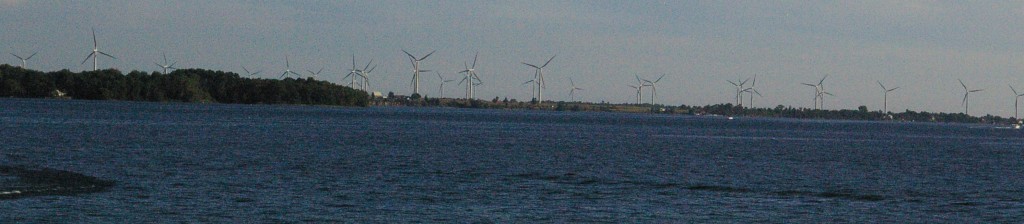
It’s a lesson we still need the Ontario government to learn: our electricity prices are scheduled to go up substantially to finance the massive wind farm investment the McGuinty government has signed up for. Much more of our landscape will look like this in future:

Even in a boom, wind farms would have been unaffordable — with their economic and ecological rationale blown away. In an era of austerity, the policy is doomed, though so many contracts have been signed that the expansion of wind farms may continue, for a while. But the scam has ended. And as we survey the economic and environmental damage, the obvious question is how the delusion was maintained for so long. There has been no mystery about wind’s futility as a source of affordable and abundant electricity — so how did the wind-farm scam fool so many policymakers?

One answer is money. There were too many people with snouts in the trough. Not just the manufacturers, operators and landlords of the wind farms, but financiers: wind-farm venture capital trusts were all the rage a few years ago — guaranteed income streams are what capitalists like best; they even get paid to switch the monsters off on very windy days so as not to overload the grid. Even the military took the money. Wind companies are paying for a new £20 million military radar at Brizlee Wood in Northumberland so as to enable the Ministry of Defence to lift its objection to the 48-turbine Fallago Rig wind farm in Berwickshire.

March 4, 2012

Passenger rail as the ultimate political luxury good?

Filed under: Economics, Government, Politics, Railways — Tags: , , , — Nicholas @ 00:14

A post at Coyote Blog from last month looks at the eye-popping financial arrangements keeping the New Mexico “Railrunner” passenger service in operation:

Of course, as is typical, the Republic article had absolutely no information on costs or revenues, as for some reason the media has adopted an attitude that such things don’t matter for rail projects — all that matters is finding a few people to interview who “like it.” So I attempted to run some numbers based on some guesses from other similar rail lines, and made an educated guess that it had revenues of about $1.8 million and operating costs of at least $20 million, excluding capital charges. I got a lot of grief for making up numbers — surely it could not be that bad. Hang on for a few paragraphs, because we are going to see that its actually worse.

The equipment used in the New Mexico Railrunner operation looks remarkably similar to what GO Transit runs in the GTA:

Click to see original image at Coyote Blog

Anyway, I got interested in checking back on the line to see how it was doing. I actually respected them somewhat for not running mid-day trains that would lose money, but my guess is that only running a few trains a day made the initial capital costs of the line unsustainable. After all, high fixed cost projects like rail require that one run the hell out of them to cover the original capital costs.

As it turns out, I no longer have to guess at revenues and expenses, they now seem to have crept into the public domain. Here is a recent article from the Albuquerque Journal. Initially, my eye was attracted to an excerpt that said the line was $4 million in the black.

[. . .]

Now it looks like taxes are covering over half the rail’s costs. But this implies that perhaps $10 million might be coming from users, right? Nope, keep reading all the way down to paragraph 11

    The Rail Runner collects about $3.2 million a year in fares and has an annual operating budget of about $23.6 million. That does not include about $41.7 million a year in debt service on the bonds — a figure that include eventual balloon payments.

So it turns out that I was actually pretty close, particularly since my guess was four years ago and they have had some ridership increases and fare increases since.

At the end of the day, riders are paying $3.2 million of the total $65.3 million annual cost. Again, I repeat my reaction from four years ago to hearing that riders really loved the train. Of course they do — taxpayers (read: non-riders) are subsidizing 95.1% of the service they get. I wonder if they paid the full cost of the train ride — ie if their ticket prices were increased 20x — how they would feel about the service?

If all of that wasn’t enough, the financing arrangement has a nasty sting in the tail: in the mid 2020’s, the state will owe two separate payments of over $200 million. Enjoy the subsidized rides now, folks … the payment comes due just in time for your kids to face as they graduate.

January 27, 2012

Is VIA Rail an unaffordable luxury?

Filed under: Cancon, Economics, Government, Railways — Tags: , , , — Nicholas @ 00:02

It hurts me to admit that long-distance passenger rail is an expensive relic of the past, and Canada’s government-owned passenger rail corporation is little more than a drain on the budget. I’m a railway fan: I founded a railway historical society, for crying out loud. I love trains, although I rarely get to use them myself. The freight railway business is doing well and it should continue to do so, as it’s generally much more economical for long-haul bulk cargo than any other option. But unlike in Europe, where population density allows passenger railways to remain a key part of the transportation network, distances and population distribution mean passenger railways can only operate profitably in a few areas (Windsor-Toronto-Montreal-Quebec City, and Boston-New York-Washington, for example).

Lorne Gunter says that recent reports about the federal government looking to sell off some or all of VIA Rail make lots of sense:

Bloomberg reported last week that the federal Tory government is quietly contemplating privatizing some or all of VIA Rail. Good. It’s about time, just as it was about time in 1991 when the Tories under Brian Mulroney thought about selling off VIA, or in 2000 when the Chretien Liberals considered it, or 2003 (Liberals again) or 2009 — the first time the current crop of Tories mulled it over.

It’s easy to imagine that every few years, Transport Canada bureaucrats return to the cabinet drawer marked “Keeping the Minister Preoccupied,” extract the file labelled “Secret Plans to Privatize VIA,” blow off the cobwebs and hand it to their latest boss. Then they sit back and wait for the predictable outcry from assorted special interests and from those few central Canadians who do actually use the train regularly.

Most years, VIA spends nearly twice as much as it makes. In 2010, for instance, VIA’s expenses were $536 million, while its revenues were just $274 million. That left a deficit of $262 million that had to be made up by Ottawa. Put another way, for every dollar VIA charges passengers for tickets, taxpayers put in 96 cents.

Shortly after we got married, Elizabeth and I took the train from Toronto to Halifax and had a great time: it was a very enjoyable trip, and we thought of the train ride as part of the vacation, not just a means of transportation. I’ve always wanted to ride The Canadian all the way to Vancouver, but at no point in the last thirty years have I simultaneously had the time available for the trip (four days on the train in each direction) and the money (right now, with a big seat sale going on it’d cost $2,137 for coach seats or $5,253 if we took a cabin). If that’s only half of what the trip would cost at market rates, there’s no way the service could support itself.

So the annual VIA subsidy amounts to an income transfer from people in most of the country who never use a passenger train to people in the central core of the country who prefer to take the train rather than drive their cars from Toronto to Montreal, but wouldn’t do so if they had to pay anywhere close to the full fare for their trips.

Every time I write about the absurdity of keeping VIA rolling, I get letters from people who insist they prefer the train to flying, driving or taking the bus or who believe trains have a lighter environmental impact or who say they can’t afford other modes. Fine, but why is it taxpayers’ duty to split the cost of your unprofitable preferences with you, 50/50?

December 12, 2011

Defining crony capitalism

Bill Frezza explains what crony capitalism is and how it differs from free market capitalism:

If defenders of capitalism hope to win over fair-minded fellow citizens who are honestly upset and confused, we need to define these terms and answer some basic questions. In what ways are Crony Capitalists and Market Capitalists the same and in what ways are they different? What makes the former immoral and the latter virtuous? Why are Crony Capitalists a threat to democracy and prosperity while Market Capitalists are essential to both? How is it that ever larger numbers of Market Capitalists are being corrupted, turning into Crony Capitalists? And what can we do to reverse that trend?

All capitalism is driven by greed — the desire to not only achieve economic security, but to amass pools of capital beyond one’s basic needs. This capital can fuel the kind of conspicuous consumption that offends egalitarians. But it also finances investments in new products and businesses, without which the economy cannot grow. [. . .]

What makes Crony Capitalists different is their willingness to use the coercive powers of government to gain an advantage they could not earn in the market. This can come in the form of regulations that favor them while hindering competitors, laws that restrict entry into their markets, and government-sponsored cartels that fix prices, grant monopolies, or both.

Crony Capitalists are also more than happy to help themselves to money from the public treasury. This can come from wasteful or unnecessary spending programs that turn government into a captive customer, subsidies that flow directly into their coffers, or mandates that force consumers to buy their products.

[. . .]

Beyond these obvious Crony Capitalists lies a slippery slope designed to attract and entrap Market Capitalists: the tax code. By setting nominal corporate tax rates high while marketing tax breaks to specific companies and industries, Congress assures itself a steady stream of campaign contributions from companies looking to lighten their tax load. While there is no shame in reducing one’s tax burden from 35% to a more globally competitive 20%, is it any wonder that people get sore when some extremely profitable corporations manage to get their tax burden down to nearly 0%?

December 9, 2011

Basic rule of political economics: subsidies result in higher costs

Filed under: Economics, Education, Government, USA — Tags: , , , — Nicholas @ 00:03

Virginia Postrel explains how federal funding to university students has created price inflation among universities:

As veteran education-policy consultant Arthur M. Hauptman notes in a recent essay: “There is a strong correlation over time between student and parent loan availability and rapidly rising tuitions. Common sense suggests that growing availability of student loans at reasonable rates has made it easier for many institutions to raise their prices, just as the mortgage interest deduction contributes to higher housing prices.”

It’s a phenomenon familiar to economists. If you offer people a subsidy to pursue some activity requiring an input that’s in more-or-less fixed supply, the price of that input goes up. Much of the value of the subsidy will go not to the intended recipients but to whoever owns the input. The classic example is farm subsidies, which increase the price of farmland.

[. . .]

This doesn’t mean that colleges capture all the aid in higher tuition charges, any more than capital-equipment companies get all the benefit of investment tax credits. But it does set up problems for two groups of students in particular. The first includes those who don’t qualify for aid and who therefore have to pay the full, aid-inflated list price. The second encompasses those who load up on loans to fill the gaps not covered by grants or tax credits only to discover that the financial value they expected from their education doesn’t materialize upon graduation.

That’s the situation many young people find themselves in today, which is one reason for their anger. The other is a widespread feeling, which the recession has intensified, that higher education is unfairly insulated from the everyday competitive pressures most people have to cope with. Instead of having to find ways to operate more efficiently and deliver ever-more value without raising costs, the way private-sector managers do, college administrators seem able to pass higher and higher bills on to their customers and the public.

« Newer PostsOlder Posts »

Powered by WordPress