Quotulatiousness

March 16, 2011

The American “Pledge of Allegiance”

Filed under: Education, History, Liberty, Religion, USA — Tags: , , , , — Nicholas @ 00:09

Not being an American, I’ve always wondered why a country that always talked so much about being the “home of the free” had such an odd quasi-religious thing like the Pledge of Allegiance. It seemed to be such a contradiction to the notions of freedom of speech and freedom of thought, having such an authoritarian ritual being performed every day by school children.

Now, L. Neil Smith explains where it came from, and why it seems such an incongruous part of the American cultural expression:

The so-called “Pledge of Allegiance” is an oath of unquestioning fealty of a kind that Americans rightly junked when they kicked the King’s backside out in 1776.

It was written in 1892 — when the Republic was already more than a century old — by a socialist, Francis Bellamy, a preacher who got fired by his congregation for using the pulpit to preach socialism rather than whatever he’d been hired to preach.

Bellamy’s cousin and best friend was Edward Bellamy, who wrote America’s best-known socialist propaganda novel, the impossibly boring and stupid Looking Backward (which became my standard for how not to write a political novel when I started my first book, The Probability Broach in 1977).

Francis Bellamy recommended that children taking the pledge face the flag in a worshipful manner and offer it a salute which was later self-consciously copied by the Nazis.

The phrase “under God” was only added in the 1950s, in blatant violation of the First Amendment, by self-righteous twits in the Eisenhower Administration. If you want your rights respected, you must respect the rights of others, If you want the Second Amendment enforced to the letter, you must insist that the First Amendment be enforced to the letter, as well.

It is the government that owes its unquestioning fealty to Americans, not the other way around. That’s what makes America different from every other country in the world, from every other civilization in history. To paraphrase the immortal Alfonso Bedoya, “We don’ need no stinkin’ loyalty oath — especially one written by a stinkin’ socialist!”

March 8, 2011

“El Neil” goes to town on the United Nations

Filed under: Bureaucracy, Government, Liberty — Tags: , , , — Nicholas @ 09:07

L. Neil Smith isn’t fond of the UN. I mean really not fond of them:

The UN was conceived in 1939, a brain-child of Franklin Delano Roosevelt and his buddies, who had failed to understand the lesson to be learned from the collapse of its ludicrous predecessor, the League of Nations, that the people of a war-weary planet, fed up to here with self-important bloviating cretins in funny hats ordering them around, were not interested in a world government, or anything even resembling one.

Instead, all the really important people — the equivalents, in 1945, of Barack and Michelle Obama, Bill and Hillary Clinton, Harry Reid, Nancy Pelosi, Barney Frank — got together in one meeting after another, and without so much as a nod at voters and taxpayers forced at gunpoint to support this gaggle of worthless preening parasites, established the UN in its now-crumbling headquarters on the Hudson River.

Its single all-important mission? To succeed where Alexander the Great, Julius Caesar, Napoleon Bonaparte, Vladimir Lenin, Joseph Stalin, and Adolf Hitler had all failed: at the involuntary expense of individuals who actually worked for a living, try to take over the world.

Since the ignominious collapse of the Soviet Union, the new world nerve center for socialism is the UN, which is no less an enemy of everything worthwhile in the western world than Hitler and Stalin were. The UN has been at the very hub of the global warming hoax since the conspiracy began. It has done everything it can to limit American industrial technology and reduce us all to a prehistoric standard of living. It demands the authority to reach into otherwise sovereign countries and extract and punish those who fail to comply with its edicts. The UN admits openly that it wishes to obliterate the American Constitution — especially the Bill of Rights — with an hysterical emphasis on the Second Amendment. And now we’re beginning to have a clearer idea what it wants to substitute in place of those ideas and institutions.

[. . .]

The nearest equivalent to what the UN has in mind for all of us is the infamous Highland Clearances” of the 18th and 19th centuries, when English “landowners” evicted the Scots they had conquered, by the hundreds of thousands, burning whole villages and forcing the Scots to leave their crops rotting in the ground, compelling a people who had been cattlemen for generations to harvest seaweed on the cold and rocky coast — or emigrate to the Americas — so aristocrats could “ride to hounds” and replace their displaced victims on the land with sheep.

December 1, 2010

Five Books interview with P.J. O’Rourke

Filed under: Books, Economics, Liberty, Media, Politics — Tags: , , , — Nicholas @ 09:05

P.J. O’Rourke is asked to talk about five books from the field of political satire:

P J O’Rourke talks Swift, Huxley, Orwell and Waugh and says we now live in the world of 1984 but, instead of being a horror show, a television that looks back at you is just a pain in the ass. It’s 1984-Lite. Sad in one way, but a relief in another.

The category of political satire books is simply closed. The top five are so good that in order to make any surprising choices one has to go a long way down to the next level.

[. . .]

I’ll be careful. Animal Farm and 1984.

Yes. One is comic satire and the other is tragicomic satire.

Let’s start with the comic.

Well, Animal Farm sticks in everybody’s mind. All animals are equal but some animals are more equal than others. Again, something read twice. I read it for the first time when I was 14 or 15 and it was a funny story about badly behaved animals and then I read it again at college and someone pointed out to me that this was sharp social satire. I thought it was an animal story, a kids’ book, but when I took another look at it I realised what he was getting at. The Soviet leadership was pretty well represented there. But one of the things that’s interesting to me about both Animal Farm and 1984 is that they are warnings against collectivism from a man of the left. Sure, any old Tory or Republican might be likely to make this point, though not so well, perhaps, nor so amusingly, but the fact that it comes from a man of the left is interesting. It seems to me to be something Orwell never fully came to grips with. Maybe if he’d lived longer…

What do you mean?

The necessity for collectivism under his leftist ideals and yet the danger of collectivism no matter who it’s done by seems like something he really wrestled with. I think we all buy the necessity for collectivism in a way.

[. . .]

Have you actually been to Sweden? I’ve never been, but I find myself constantly holding it up as the pinnacle of socialist marvellousness. It could be a complete shit-hole for all I know.

I have been and you know what it is? It’s very foreign. It’s full of Swedes. I mean, there are a few immigrants, and it has more now than it did 15 years ago when I was there, but Swedes are really Swedish. They are just remarkably alike. So, when you have a country of only eight and a half million people and they’re very like each other and you take 80 per cent of their income away and redistribute it through political means and they go: ‘Ya, ya, dat’s vot I vonted! Abba records! Herring and a PhD!’ And it’s all okey-dokey. But if you take a country as diverse as the United States and you take everything away from everybody and redistribute it — oh my God, there’d be hell to pay! I mean, some people would want guns, and some people… I wouldn’t even want to ask what some people would want.

[. . .]

1984.

That’s satire more in the Roman mode. The usual definition of satire is humour used to a moral end for a moral purpose, and there’s certainly a moral purpose to 1984 but it’s not funny really. I mean there is a certain dark humour to rewriting history and things going down a memory hole.

It’s funny in the Russian sense of the word.

I like that. Believe me, I’ll steal that phrase.

I’ll see you in court.

It’s sort of like being popular in Japan.

October 28, 2010

A significant indicator of social decline

Filed under: Economics, Government, Politics, USA — Tags: , , , , — Nicholas @ 12:04

Monty puts his finger on the biggest social change since the 1960’s and posits the likely results:

The recipe for the decline and fall of the American republic: most people who receive government benefits will not willingly give them up, or even allow them to be reduced. They’ve been told that these benefits are a right so often by the so-called “progressives” that they’ve come to believe it, and any attempt to reduce their benefits amounts, in their eyes, to a civil-rights violation. This is what the welfare state leads to — an entire class of dependents who insist upon receiving the sweat of your brow not as charity or payment for services rendered, but as a birthright not to be denied them. Class warfare (between public-sector workers and taxpayers) and generational warfare (between the recipients of Medicare and Social Security and those who must fund it) is the only possible outcome if things do not change soon. And I don’t mean that in rhetorical or symbolic terms; I mean in actual, bloody, street-fighting terms. It’s the culture of grievance, of victimhood, of moral equivalence playing out in real time. As I wrote in an essay a while back, look at what’s happening in England and France right now. That is our future — only more violent — if we don’t change our ways.

August 16, 2010

Cory Doctorow on the new Robert Heinlein biography

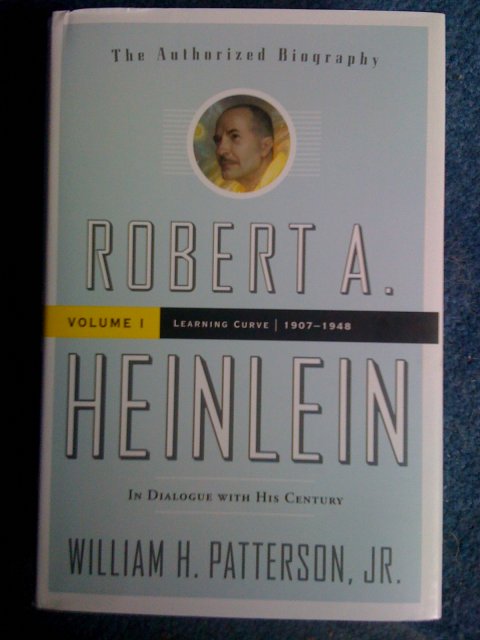
RAH by PattersonI finished reading the first volume last night, and I can’t wait for volume two. Cory Doctorow summarizes John Clute’s review with his own observations (Clute compared Heinlein’s work to Doctorow’s):

Heinlein was notoriously recalcitrant about his early life and the two wives he was married to before his epic marriage to Virginia Heinlein. He repeatedly burned correspondence and other writings that related to that period. Clute suggests that this is partly driven by Heinlein’s desire to be Robert A Heinlein, titan of the field, without having to cope with his youthful embarrassments. It’s a good bet — lots of the stuff that drives young people to write science fiction also makes them a pain in the ass to be around until they work some of the kinks out of their system (I wholeheartedly include myself in this generalization).

It’s interesting to see his own growth, from his early priggishness (he was nicknamed “the boy general” as a plebe at the Naval Academy) which undoubtedly was not helped by his health issues and tendency to stammer. He was in the shadow of his older brother Rex Ivar for most of his youth, even following him to the Academy three two years later. Rex Ivar was the favourite child in the family and Robert never seemed to be able to do as well in his parents’ eyes as the older boy.

Robert Heinlein was probably a pretty toxic individual as a teenager, based on the evidence Patterson presents — it’s pretty clear even after most of the information was sanitized by Heinlein’s third wife Virginia. Patterson never met Heinlein, and by the time he took on the biography, most of the people who knew Heinlein were fading from the scene. I think he did a very good job with the information available to him, but the biography definitely improves after the Academy years.

Patterson also puts forward a pretty comprehensive case for the idea that Heinlein’s fiction generally conveys Heinlein’s own political beliefs. This is widely acknowledged among Heinlein fans, save for a few who seem distressed by the idea that the blatant racism and sexism (especially in the earlier works) are the true beliefs of the writer at the time of writing and would prefer to believe that Heinlein didn’t write himself into his works. I got into a pretty heated debate with one such person at the Heinlein panel at the 2007 Comicon, who maintained the absurd position that Heinlein’s views could never be divined by reading his fiction — after all, his characters espouse all manner of contradictory beliefs! (To which I replied: “Yes, but the convincing arguments are always for the same set of beliefs, and the characters who challenge those beliefs are beaten in the argument.”) Not that I fault Heinlein for this — it’s an honorable tradition in SF and the mainstream of literature, and I find Heinlein’s beliefs to be nuanced and complex, anything but the reactionary caricature with which he is often dismissed.

It should be no surprise to anyone over 30 that Robert Heinlein’s political and philosophical views changed over his lifetime. This is discussed in some depth in the book, frequently from Heinlein’s own letters to friends at various points. He lost his religious views very early on (if he ever really had them, other than for conforming to familial expectations), and after leaving the Navy he was deeply involved in Upton Sinclair’s EPIC movement.

His belief in world government must have been hard to sustain, given that he had a great deal of experience of the political process, both in Kansas City during the Pendergast years, and in California with EPIC. Corruption, dirty dealing, and backroom bargaining were the way things got done, and it would be hard to believe that things would be better with a single world-wide government.

What seems to have gotten him involved in EPIC was his first-hand experience of poverty and seeing the plight of the “Okies” who’d come to California after the dust bowl wiped out so many farms in the central states. There were not enough jobs for them, even displacing the Mexican migrant labourers, and they were ineligible for state assistance until after they’d been in California for a year. Sinclair appeared to be the only politician with any plan other than oppressing the Okies enough to force them to move on.

August 10, 2010

QotD: The Finnish intelligentsia

Filed under: Education, Europe, History, Quotations — Tags: , , , — Nicholas @ 00:02

I added a whole bunch of Finnish blogs to my Google Reader list that now stands at a hefty 421 subscriptions. Recalling the news back in the end of the year 2008, the Finnish intelligentsia was ecstatic for . . . well, you know why, but as Hannu Visti points out, they have recently been mysteriously quiet about their high hopes of how America will any day now abandon the free market capitalism and turn into a European-style social democratic welfare state. Now, we wingnuts sure like to laugh at the intelligentsia, but the Finnish intelligentsia has always truly been a class of its own, since as Hannu notes, they have been utterly wrong about literally everything over the past fifty years. Whereas their American colleagues merely hinted at the superiority of socialism and communism and took their marching orders and talking points from them only indirectly, the Finnish intelligentsia was proudly a stooge for the Soviet Union, worshipping its raw and brutal power that had no respect for all those pesky individual rights holding back the better world. And since they never really had any ideas of their own, these days this puppet just switched onto a new master that has his hand deep up its ass to move its grimacing mouth . . . or I don’t know if I should rather say two masters, both incidentally wearing the same colour green.

Ilkka, “Dead souls”, The Fourth Checkraise, 2010-07-23

July 29, 2010

Symbols matter, but not as much as reality

Filed under: Education, Government, Politics, USA — Tags: , , , , , — Nicholas @ 20:49

Ace puts his finger on one of the key differences between “the masses” and the “governing class”:

That’s why the “Political Class” — the Gee Aren’t I Terribly Enlightened? crowd — opposes this. They talk about that a lot — the symbolism of the thing.

[. . .]

I’m noting this because a few weeks ago I saw a guy at the riots in Toronto who complained that the police barricades were a symbol representing a division between the protesters and the G-20 representatives.

And I thought, “Gee, no, actually it’s not a symbol of a division; it really is, in fact, a physical division.” Because, see, you’re rioting. (And not symbolically in riot, either.) You can tell it’s a real-world division because now you can’t get to the G-20 conference center and throw rock-metaphors through the window-symbols.

I think there is a type of person — well-represented in the “Political Class” and in progressive politics — that has learned, from college, that the Abstract is everything, that Real Smart People are always focused on the Abstract, on metaphors, on symbols.

And they seem to disregard the concrete, the real, almost as a dirty thing, something of concern to the plebians, who cannot of course grasp the subtleties of high representational thinking like they can. You know, with their “symbolic” barricades and all.

June 9, 2010

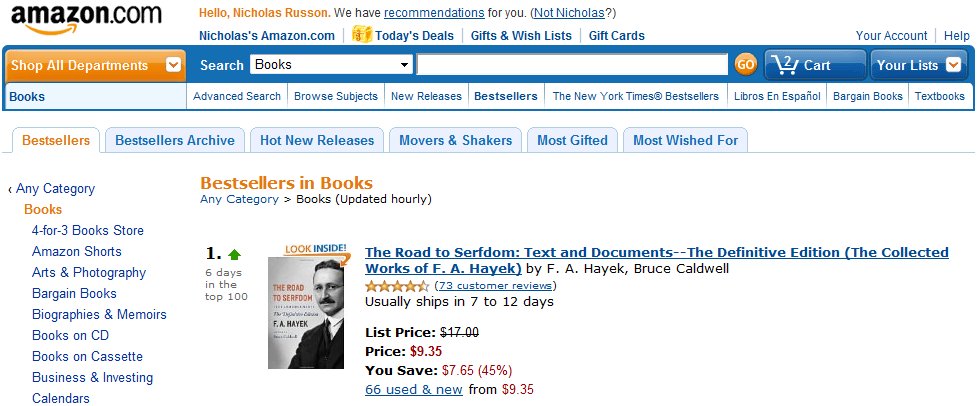
Book written in 1944 tops Amazon bestseller list

Filed under: Books, Economics, Government, Media, Politics — Tags: , , — Nicholas @ 07:57

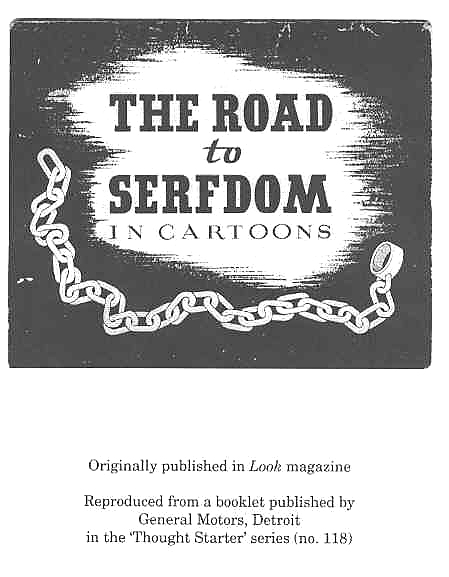
Admittedly, this is an updated and supplemented version of the original text, but it’s still impressive to see it selling so well.

Update: American Digest has pages from the picture book version:

A Canadian Liberal-Democrat party?

Filed under: Cancon, Politics — Tags: , , , , — Nicholas @ 07:43

Andrew Potter pokes fun at the widely rumoured merger discussions that may or may not result in a combination of the Liberals and the New Democrats:

So here’s what I think, for what it matters to anyone: It’s a stupid idea. Not just stupid as in don’t-eat-that-fifth-taco stupid, but deeply, profoundly, moronic. If it were to come to pass, the only, and I mean only, beneficiaries would be the Conservatives. The NDP would lose, the Liberals would lose, and, more than anything, Canadians would lose.

[. . .]

The problem with the Liberals is not that their voter base it is divided, it is that their voter base has left them. And the reason their voter base has left them is because the Liberals have been acting like humungeous bozos for most of this decade. It is really not much more complicated than that. The former Natural Governing Party transformed itself into the Party of Humungeous Bozos, and if there is one thing Canadians have shown over the years is that you can’t get elected if you are a humungeous bozo. You can be an arrogant jerk (Trudeau), a slimeball (Mulroney), a gangster (Chretien) or a paranoid control freak (Harper), but the Canadian body politic is powerfully immune to bozos.

While I wouldn’t say it’s impossible, I’d expect the NDP rank-and-file to object strenuously to anything more than a tactical agreement to avoid running directly against the Liberals. The NDP, although I disagree with much of what they stand for, at least do believe in something. The only thing the Liberals stand for is their belief that they should be running the country.

Update: Steve Janke thinks it could be an ugly, ugly scenario indeed:

And there are plenty of senior Liberals utterly appalled at the idea of a merger, I think because they realize the NDP, though smaller, is more ideologically pure, and that the NDP would pull the merging Liberals leftward (though the NDP purity would itself be diluted, something the NDP membership would be worried about, and would probably struggle hard against). The new party would be much more NDP than Liberal.

These appalled Liberals would fight hard against a merger at a Liberal convention, and it seems to me that the Liberal Party could tear itself apart in a very ugly and public way.

Let’s say the merger amendment fails. What then? We could see a chaotic abandonment of the Liberal Party by disaffected Liberals (remember, I dialled the chaos way up on the scenario-a-tron). As of yesterday, the existence of Liberal-NDP merger talks is public knowledge. Even if it isn’t true, people now believe it to be true. The pro-merger Liberals in the rank-and-file might not accept a failure of those talks or a failure to accept a constitutional amendment to make a merger official. If they see their dream snatched away, we could see large numbers of Liberals tearing up their membership cards and switching parties, especially if they are led by someone like Bob Rae tearing up his membership card first.

April 30, 2010

QotD: A notable unintended consequence

Filed under: Economics, Quotations, Space, USA — Tags: , , , — Nicholas @ 09:14

Hardly a day seems to go by nowadays without somebody with approximately the same kind of political attitude as me scratching his head, publicly, in writing, about President Obama’s bafflingly sensible space policy, which sticks out like a healthy thumb in an otherwise horribly mutilated hand of policies.

Critics are disturbed by the large and unprecedented role Mr. Obama sees for the private sector in space exploration. For a president who is often accused of being a socialist, he has more faith in the ingenuity of the private sector than his detractors do.

Brian Micklethwait, “On the unintended consequences of President Obama”, Samizdata, 2010-04-28

April 1, 2010

Sequel to Atlas Shrugged in planning stages

Filed under: Books, Humour, Media — Tags: , , , — Nicholas @ 07:16

An official announcement this morning at Locus magazine has the brilliant duo of Charles Stross and Cory Doctorow (both of whom I’ve quoted on the blog more than once) teaming up to write an authorized sequel to Ayn Rand’s Atlas Shrugged:

Stross, author of the Prometheus Award-winning novel Glasshouse, said that he and Doctorow (author of the Prometheus Award-winning novel Little Brother) were hesitant at first. “But then we realized that both of us shared one important trait with Ayn Rand: all three of us really, really like money. That made it much easier for Cory and I to cash the seven figure check.”

The sequel, Atlas Rebound, features the teenage children of the founders of Galt’s Gulch rebelling against their elders and traveling out into a world devastated by John Galt’s strike, where they develop their own political philosophy with which to rebuild. That philosophy, called Rejectivism, features a centralized bureau to rebuild and control the new economy, socialized medicine, compulsory labor unions, universal mass transportation and a ban on individual automobiles, collectivized farms, a tightly planned industrial economy, extensive art subsidies, subsidized power, government control of the means of production, public housing, universal public education, a ban on personal ownership of gold and silver (as well as all tobacco products), government-issued fiat money, the elimination of all patents and copyrights, and a cradle-to-grave social welfare system.

“Plus strong encryption!” added Doctorow.

After 1,200 pages (80 of which consist of Supreme Leader Karla Galt-Taggart’s triumphant address), a new Utopia is born. The final scene of the novel features the grateful citizens of the new world order building a giant statue of Atlas with the globe restored to his shoulders, upon the base of which is chiseled “From Each According to His Ability/To Each According To His Needs.”

January 8, 2010

Great satire . . . at least, I’m assuming it’s satire

Filed under: Economics, Education, History, Humour — Tags: , , , — Nicholas @ 08:47

In the comments to this post at the Library of Economics and Liberty site:

I think American econ textbooks were pro-Soviet for the simple reason that the Soviet system was indisputably superior to the unforgiving ‘free market’ American system.

Make whatever claims about ‘economic growth’ or ‘relative poverty’ or ‘lack of freedom’ you want but the Soviet Union created a large-scale, modern nation state dedicated to providing everyone with a solid, equitable lifestyle. Everyone had access to food, clothing, shelter, health-care, education, meaningful work and other necessities of life. It was guaranteed right there in their constitution. That is still not the case in the US, though with the recent passage of the landmark Health Care Reform bills we have at least made the first tentative steps towards correcting one of those desperate problems.

The thing that economists need to realize is that life is not all about economics & money. Having a satisfying life planned for you with no uncertainty and no crucial needs left unfulfilled is necessary too. The Soviet Union went a good a way towards providing that.

Someday we will realize what a loss it was when the vile, venal capitalists of the West arranged its downfall. After all, no amount of material wealth provided in the willy-nilly, dog-eat-dog, all-against-all ‘free market’ will ever be able to match the simple pleasures of a life dedicated to the betterment of the community, guided by the best & brightest from their commanding perch in the government.

That was commenter “blighter” either doing a pitch-perfect parody or showing that the textbook wars were won by Soviet intelligence services.

December 22, 2009

PJTV visits Detroit

Filed under: Bureaucracy, Economics, Government, USA — Tags: , — Nicholas @ 07:53

December 9, 2009

“There is no app for that”

Filed under: History, Technology — Tags: , , , , , — Nicholas @ 13:06

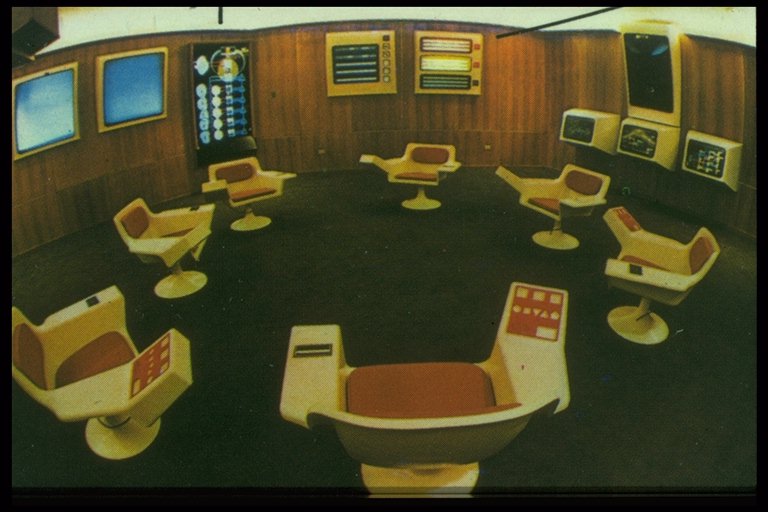
Alex Tabarrok looks at the Chilean “Cybersyn” project:

Cybersyn was a project of the socialist government of Salvador Allende (1970-1973) and British cybernetic visionary Stafford Beer; its goal was to control the Chilean economy in real-time using computers and “cybernetic principles.” The military regime that overthrew Allende dropped the project and probably for this reason when the project is periodically rediscovered it is often written about in a romantic tone as a revolutionary “socialist internet,” decades ahead of its time that was “destroyed” by the military because it was “too egalitarian” or because they didn’t understand it.

Although some sources at the time said the Chilean economy was “run by computer,” the project was in reality a bit of a joke, albeit a rather expensive one, and about the only thing about it that worked were the ordinary Western Union telex machines spread around the country. The IBM 360 two computers supposedly used to run the Chilean economy were IBM 360s (or machines on that order). These machines were no doubt very impressive to politicians and visionaries eager to use their technological might to control an economy [. . .] Today, our perspective will perhaps be somewhat different when we realize that these behemoths were far less powerful than an iPhone. Run an economy with an iPhone? Sorry, there is no app for that.

Cybersyn_stage

[. . .] The control room is like the bridge of the Starship Enterprise in another respect–both are stage sets. Nothing about the room is real, even the computer displays on the wall are simply hand drawn slides projected from the other side with Kodak carousels.

December 6, 2009

What if Ron Paul were taken seriously by the GOP?

Filed under: Government, Liberty, Politics, USA — Tags: , , — Nicholas @ 00:47

Howard Fineman tries to analyze the Ron Paul phenomenon:

I have to admit that I kind of like Rep. Ron Paul. Partly it’s that we’re both from Pittsburgh, and both began our careers as paperboys for the Pittsburgh Press. More important, Paul is something unusual in politics. He appears to believe in something. His fundamental views have not changed since 1971, when he decided to run for Congress in Texas because President Nixon abandoned the gold standard.

I don’t like labels, but in this case I’ll use some. Paul, a Duke-trained physician, is an angry, apocalyptic, populist, hard-currency libertarian. He is against paper money, the Federal Reserve, the income tax, and most of the federal government’s role in our lives, from fighting in Afghanistan to printing Social Security checks. Paul never saw an establishment he didn’t loathe. Many of his ideas are unworkable, some are dangerous, and some of his supporters are conspiracy theorists so paranoid, they probably think this column is part of the Plot. But, as odd as it seems, Paul has become a player in Washington and at the grassroots. His emergence should be a lesson to rudderless Republicans. They don’t want to scare away independent voters, but they need to find a way to emulate Paul’s outsider’s anger and his commitment to conservative essentials.

How much of a condemnation of American politics is it that you can tar someone by alleging that they “appear to believe in something”? Politicians are often portrayed as believing in nothing — except that it is critical that they be re-elected — but when it’s a smear to say that they hold any philosophical belief at all? Perhaps we really do deserve the governments we elect . . . as punishment.

« Newer Posts — Older Posts »

Powered by WordPress