
Welsh, Irish and Scottish nationalism have points of difference but are alike in their anti-English orientation. Members of all three movements have opposed the war while continuing to describe themselves as pro-Russian, and the lunatic fringe has even contrived to be simultaneously pro-Russian and pro-Nazi. But Celtic nationalism is not the same thing as anglophobia. Its motive force is a belief in the past and future greatness of the Celtic peoples, and it has a strong tinge of racialism. The Celt is supposed to be spiritually superior to the Saxon — simpler, more creative, less vulgar, less snobbish, etc. — but the usual power hunger is there under the surface. One symptom of it is the delusion that Eire, Scotland or even Wales could preserve its independence unaided and owes nothing to British protection.
George Orwell, “Notes on Nationalism”, Polemic, 1945-05.
December 28, 2018
QotD: Celtic nationalism
December 8, 2018
Will the West want in again this time?
The last time Albertan sensibilities were being regularly assaulted by federal politicians, the response was the Reform Party with their slogan “The West Wants In”. This time, Lawrence Solomon suggests, the Albertan response might not be so congenial:
Canadians don’t value our fossil fuel economy, which explains why so many are OK to trash pipelines and see Alberta tank. Only 19 per cent think it more important to pursue oil and gas development than to go green and regulate oil, according to EKOS polling. That 19 per cent figure shrinks to eight per cent for Canadians who consider themselves Liberals, six per cent for NDPers and two per cent for those who vote Green, meaning that politicians of most stripes have no interest in alienating their supporters to help Alberta’s energy economy recover.
Those figures also explain why Alberta’s sense of alienation is on the rise. According to Ipsos, fully 62 per cent believe Alberta “does not get its fair share from Confederation” (up from 45 per cent two decades ago), 46 per cent feel more attached to their province than to their country (up from 39 per cent) and 34 per cent “feel less committed to Canada than I did a few years ago” (up from 22 per cent). Just 18 per cent of Albertans believe “the views of western Canadians are adequately represented in Ottawa.”
One-quarter of Albertans now believe Alberta “would be better off if it separated from Canada,” a number that may well rise if the provincial economy founders, and would certainly rise if Albertans realized that they need Canada a lot less than Canada needs them. Without Alberta’s wealth and foreign-exchange earnings, the living standard of Canadians outside Alberta would drop and the Canadian dollar would plummet, likely leading to inflation as the cost of imports rose. Albertans, in contrast, would see their affluence rise and, because oil sales are denominated in U.S. dollars, Alberta would be largely insulated from the inflation to its east and west.
Those pooh-poohing independence claim Alberta, being land-locked, would be held hostage if it were an independent state. Those scoffers have it backwards. Alberta is today held hostage, its pipelines east and west kiboshed by its fellow Canadians. If Alberta were independent, its newfound bargaining power would certainly cause the Rest of Canada to capitulate, and speed to completion any and all pipelines Alberta needed to either ocean.
An independent Alberta would control access to its land mass as well as the skies above it, requiring Canada’s federal government to negotiate rights for, say, Vancouver-to-Toronto flights over Alberta airspace. Canada would also need Alberta’s agreement to have trains and trucks cross its now-international borders. Threats of tolls and tariffs could abound as needed to chasten those perceived to be wronging Alberta, whether Quebec, which exports dairy to B.C., grain interests that now commandeer rail to the detriment of Alberta’s oil shippers, or the B.C. ports that depend on commodities going to and from points east. Anyone thinking that Alberta would be unable to police its borders needs to be reminded that, for the past 70 years, Alberta’s patrols have made it the continent’s only rat-free jurisdiction.
October 23, 2018
California (secessionist) dreaming
In the latest Libertarian Enterprise, L. Neil Smith suggests that the kindest thing to do to California is to allow it to secede from the Union:
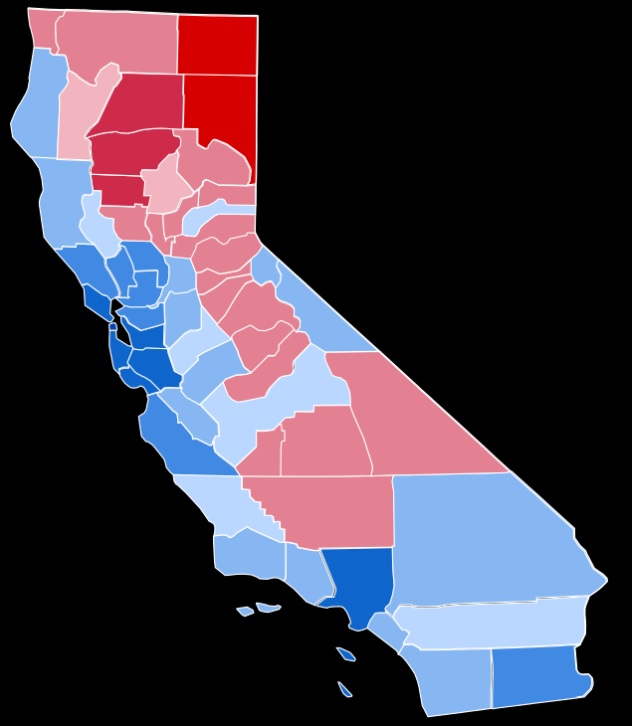
… some Californians bleat that they want to secede from a United States that threatens to make them straighten up and fly right. Superficially, that might be a workable idea: on paper, California has one of the largest, most powerful economies in the world — bigger than that of many independent nations. It has a long, wonderful coastline and a couple of really good natural ports. Its agricultural sector is second to none. There is oil and gas within easy reach. It has no real military defenses, but I’m sure they’d be more than willing to leech off America’s defenses, our Navy, our Air Force, and our nuclear umbrella, like the deadbeat pajama boys they resemble, living in their mothers’ basements.
But wait. On the reasonable assumption that the California secession movement is limited to people in the counties that voted for Hillary Clinton, and that people in the counties who voted for Donald Trump do not want to secede, I consulted a California county-by-county election map for 2016. Blue counties dominate all but a tiny spot on the northern coast, which is too bad; most of the interior — the most productive part of the state — is bright red.
So here’s my brilliant idea. Instead of fighting another bloody, stupid, senseless War of Secession like the one we had in 1865, let’s grandly and magnanimously permit the state of California to secede — even insist on it — one county at a time. Those counties that vote to secede may do so and create the People’s Republic of Californistan, or whatever.
In exchange for defending this dog’s breakfast of a polity, we will keep all of our military bases and installations, somewhat like Guantanamo Bay Naval Air Station in Cuba. I believe the legal term is “adverse possession”. Those counties that do not vote to secede — we wouldn’t want them to become like the captive peoples and nations of Europe during the Cold War — may remain in the Union, joining the adjacent state (mostly Nevada) or forming their own. To paraphrase the Borg, “We will add their productiveness to our own.”
However the trouble (for California, anyway), if you look at the map, is that county-by-county secession leaves the people’s Republic without visible means of support, a vagrant state, as it were, full of pencil-neck politicos and other worthless parasites, guilty of loitering on our Left Coast. They’re already bankrupt, after decades of Leninist-Stalinist policies. Now they will never recover with their productive counties gone — and we get their avocados!
Let them eat software.
October 4, 2018
QotD: Gandhi in World War One
We are therefore presented with the seeming anomaly of a Gandhi who, in Britain when war broke out in August 1914, instantly contacted the War Office, swore that he would stand by England in its hour of need, and created the Indian Volunteer Corps, which he might have commanded if he hadn’t fallen ill with pleurisy. In 1915, back in India, he made a memorable speech in Madras in which he proclaimed, “I discovered that the British empire had certain ideals with which I have fallen in love …” In early 1918, as the war in Europe entered its final crisis, he wrote to the Viceroy of India, “I have an idea that if I become your recruiting agent-in-chief, I might rain men upon you,” and he proclaimed in a speech in Kheda that the British “love justice; they have shielded men against oppression.” Again, he wrote to the Viceroy, “I would make India offer all her able-bodied sons as a sacrifice to the empire at this critical moment …” To some of his pacifist friends, who were horrified, Gandhi replied by appealing to the Bhagavad Gita and to the endless wars recounted in the Hindu epics, the Ramayana and the Mahabharata, adding further to the pacifists’ horror by declaring that Indians “have always been warlike, and the finest hymn composed by Tulsidas in praise of Rama gives the first place to his ability to strike down the enemy.”
This was in contradiction to the interpretation of sacred Hindu scriptures Gandhi had offered on earlier occasions (and would offer later), which was that they did not recount military struggles but spiritual struggles; but, unusual for him, he strove to find some kind of synthesis. “I do not say, ‘Let us go and kill the Germans,’” Gandhi explained. “I say, ‘Let us go and die for the sake of India and the empire.’” And yet within two years, the time having come for swaraj (home rule), Gandhi’s inner voice spoke again, and, the leader having found his cause, Gandhi proclaimed resoundingly: “The British empire today represents Satanism, and they who love God can afford to have no love for Satan.”
The idea of swaraj, originated by others, crept into Gandhi’s mind gradually. With a fair amount of winding about, Gandhi, roughly, passed through three phases. First, he was entirely pro-British, and merely wanted for Indians the rights of Englishmen (as he understood them). Second, he was still pro-British, but with the belief that, having proved their loyalty to the empire, Indians would be granted some degree of swaraj. Third, as the home-rule movement gathered momentum, it was the swaraj, the whole swaraj, and nothing but the swaraj, and he turned relentlessly against the crown. The movie to the contrary, he caused the British no end of trouble in their struggles during World War II.
Richard Grenier, “The Gandhi Nobody Knows”, Commentary, 1983-03-01.
October 3, 2018
Quebec election results – Coalition Avenir Québec (CAQ) majority
Global News rounds up the final poll results from Monday’s Quebec election:
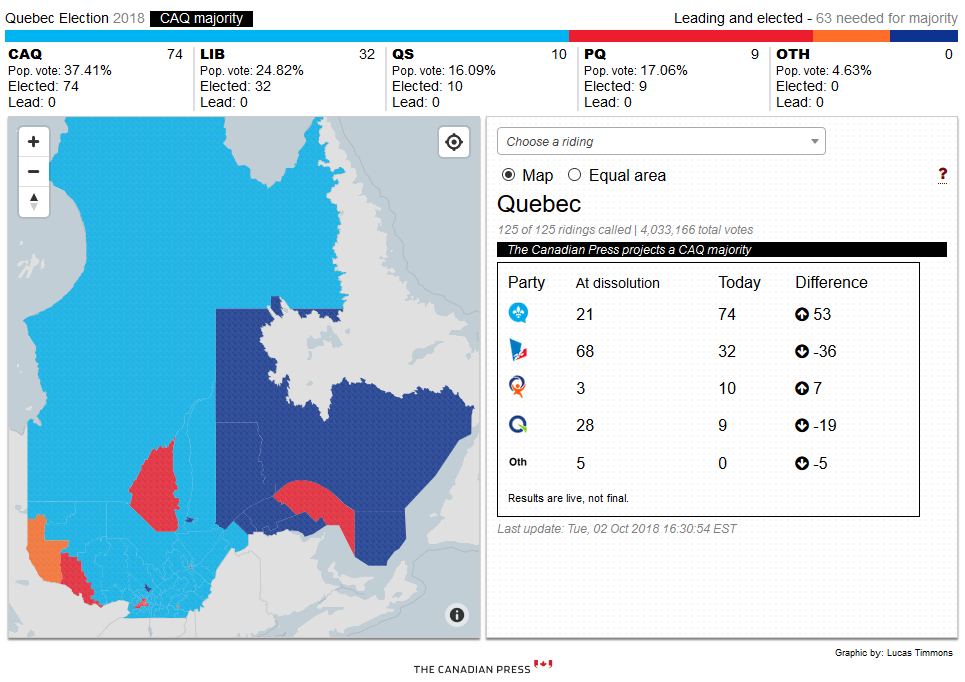
After a 39-day election campaign, voters in Quebec headed to the polls Monday and elected the Coalition Avenir Québec (CAQ) to power.
The CAQ, headed by François Legault, won a majority of seats delivering a crushing blow to the Quebec Liberal Party, who had held power for 13 of the last 15 years.
The CAQ was elected in 74 of the province’s 125 ridings, compared to 32 for the Liberals.
The Parti Québécois (PQ) suffered a double blow going from 28 seats to 9 and is once again without a leader, after Jean-François Lisée announced he was stepping down after losing his riding of Rosemont.
I really haven’t been following Quebec politics at all, so I didn’t know much about the CAQ’s stance on the issues. Here, cribbed from the Wikipedia page are some of their issues gleaned from the party platform (selective emphasis mine):
- CAQ Leader François Legault has promised to reduce the tax burden of Quebecers. A CAQ government, he says, will further harmonize school taxes across the province, a tax cut valued at $700 million.
- A long-standing party proposal is to create a Quebec version of Silicon Valley, which they’ve dubbed “The Saint-Laurent Project”. It envisions turning the Saint-Lawrence Valley into a hub of innovation and entrepreneurship, with the collaboration of universities.
- Hoping to eliminate tens of thousands of jobs from the province’s civil service.
- As premier, Legault says he would temporarily reduce the number of immigrants Quebec accepts annually from 50,000 to 40,000.
- To qualify for a Quebec selection certificate, the CAQ wants immigrants to pass a values and language test. Immigrants would also have to prove they have been looking for employment. Some experts have questioned the legality of the plan.
- The party favours decentralizing health-care administration, while maintaining a universal free public health care system, Legault was quoted saying “The important thing is the universality of care. … I do not want more private. Our public [health care] is a jewel of Quebec.”
- Like the PQ, the CAQ also vowed to renegotiate with the Quebec’s medical specialists in order to cut their compensation by an average of $80,000 per year. Legault believes the specialists will be open to striking a new deal.
- Would overhaul the province’s longterm care system (CHSLDs) with a new network of smaller, more “humane” homes at an initial cost of $1 billion.
- Wants to abolish school boards and replace them with service centres that would provide administrative support to schools. The party believes this would give schools greater autonomy and make the education system cheaper to run.
- Wants to increase the mandatory age of staying in school to 18, to reduce the drop out rate.
- Wants added homework help, extracurricular activities (sport and culture), additional funding for career guidance and tutors assigned to more vulnerable students.
- The CAQ is also proposing to do away with progressive daycare pricing, though over a period of four years. All Quebec parents would be charged the same daily rate, regardless of their annual income.
- Opposes the wearing of religious symbols, including the hijab, by police officers and others who wield coercive state power. The party would also ban school teachers from wearing religious symbols.
- Would pass a “Secularism Charter” to reduce the scope of religious accommodations available to civil servants.
- Calls itself nationalist. It wants more power for Quebec, but within Canada. Legault, a former PQ cabinet minister, has promised a CAQ government will never hold a referendum on Quebec sovereignty.
- Legault wants to seek additional powers for Quebec, including control over immigration, increased fiscal capacity and a say in the nomination of Supreme Court justices. Some of these measures would require re-opening the Constitution.
- Supports international greenhouse gas reduction targets and would promote “technological innovations to ensure their achievement”.
October 1, 2018
The rebirth of Quebec separatism?
Conrad Black wants to provoke clinical depression in anyone who was around for the last round of Quebec separatism, and warns that we’ve been ignoring the issue while it’s been reviving in La Belle Province:
Canada is very late and very laconically beginning to consider the implications of the Quebec election on Oct. 1. If, on Monday night, as polls indicate, 40 per cent of Quebecers have voted for overtly separatist parties (Québec solidaire and the Parti Québécois) and 30 per cent for a party that declines to say separation is undesirable, only that it will not hold a referendum (Coalition Avenir Québec, or CAQ), no one should imagine that this is not a threat to this country. I have written here before that Canada would regret the refusal of Stephen Harper and Justin Trudeau to discuss methods of reintegrating Quebec into the Constitution, which would not have solved the problem permanently, but would have greatly strengthened federalism.
The issue of separatism appeared to die, but that is the nature of Quebec nationalism: it never dies, it just becomes comatose for a time. And though almost no one yet describes this Quebec election in these terms, the governing Liberals of Premier Philippe Couillard seem to be about even at 30 per cent with François Legault’s moderate left, constitutionally ambiguous CAQ. Legault was long an explicit separatist, and has not renounced that view (and his wife, Isabelle Brais, thinks English Canada has no culture and should have no status in Quebec). The Quebec Liberal party, like the British Columbia Liberal party, is really a Liberal-Conservative coalition. It governed very efficiently these past four years, but became an ecologically obsessed and eccentric regime. While it retains the support of most of the non-French, it is now pulling only a very unfeasible 17 per cent of the French Quebec vote.
Though the CAQ has been slipping, it has been losing ground to Québec solidaire, a rabidly separatist party that proposes immediate, unconditional secession. It is led by a declared Marxist who opposes the right of the State of Israel to exist, and, astonishingly, it may hold the balance of power in the National Assembly. It threatens to pass the original separatist PQ of former premiers René Lévesque, Jacques Parizeau and Lucien Bouchard, which hasn’t changed its tune but is whistling it more softly. The independence of Quebec has not been much raised in the campaign, but the implications of the emerging voting patterns assure that it will re-emerge.
And no discussion of the separatism question is complete without at least a nod in the direction of the Charlatan Accord:
The Charlottetown agreement on a substantial decentralization, put to a countrywide referendum in 1992, was defeated by 54 per cent of Canadians, though it had been approved by the federal parliament and all the provincial legislatures. Bouchard, Mulroney’s most prominent Quebec MP, deserted the government, founded the separatist Bloc Québécois, and led the 1995 referendum campaign in Quebec after Parizeau was elected premier. It was a slightly more explicit separatist question than Lévesque had posed 15 years before. Chrétien was over-confident, mishandled the campaign, and gave a slightly panic-stricken appeal to Quebec voters on referendum-eve. It was 50.6 to 49.4 per cent for the federalists, a clear separatist victory for the French Quebecers, and the turnout was 93.4 per cent.
Chrétien somewhat redeemed himself with the Clarity Act of 1999, based on the results of a Supreme Court referral, which held that any secession had to be on the basis of a substantial majority supporting a clear referendum question to secede. (I was one of those who urged that the Act also provide that any county in a seceding province that had voted not to secede and was contiguous to another province, should secede from the province and remain in Canada. My precedents, though I never got to cite them, were West Virginia and Ulster.) Lucien Bouchard lost interest in the idea of independence, and the Liberal party has governed in Quebec for 13 of the past 15 years. The present premier, Couillard, is the most unambiguously federalist Quebec premier since Jean-Jacques Bertrand in 1970, and it will not be long before he is missed by those in Ottawa who declined to discuss these issues with him. If he is out on Monday night, Couillard’s successors will blow a cold wind on Ottawa and across Canada just as the Trudeau government appears to be set to break up the relationship with the United States, and our automobile industry prepares to repatriate to the U.S. Justin might do better as the next leader of the Quebec Liberals.
September 18, 2018
A case to keep Theresa May in power … at least until March, 2019
Sean Gabb offers about the only possible justification for the British Tories to keep Theresa May on as Prime Minister:
Let us imagine that there is a vote of no-confidence in Mrs May as Leader of the Conservative Party. Let us imagine what is not certain — that someone more committed to leaving then becomes the Prime Minister. We can suppose that Anna Soubry and Damian Green will resign the Conservative whip — they and perhaps several dozen others of their kind. They are held from doing this at the moment because the ghostly electoral mandate Mrs May has gives them no excuse for splitting. A new Prime Minister without any mandate would give them their excuse. This would leave the Government with no majority. But there is worse.
Between a third and half the Parliamentary Labour Party would like an excuse to peel away and form a new party. So far, they have not found this excuse. A Conservative split would be their excuse. I can imagine a “centrist” block of 150 Members in the House of Commons. Add the Scottish Nationalists and the Liberal Democrats — that would be enough to form a new coalition government. Whether this new government then called a second referendum or found some less honest method, there would be no departure of any kind from the European Union. And, thanks to the Fixed Term Parliaments Act, they would keep their seats until 2022. After that, they could look forward to a shower of corporate sinecures.
Bearing this in mind, I call on the Conservative leavers not to allow a vote of no-confidence in Mrs May. Instead, let them focus on making it impossible for the Government we have to offer new concessions to the European negotiators. I call on the relevant Jewish organisations to keep up their pressure on the Labour leadership — but not to try for any killing blow. They can have Mr Corbyn’s head on a plate after next March. In short, I pray for no change in any direction in British politics until after we have left the European Union. Then, we can have blood on the moon — the more, the better. Until then, let the May Government continue shuffling towards departure on whatever terms they can get or want to get.
September 14, 2018
A sensible post-Brexit farming policy
Tim Worstall linked to his 2016 post at the Adam Smith Institute that nicely summarizes the best post-Brexit farm policy for Britain:
We have an alternative policy framework to suggest. Let’s just not have a policy. No subsidies, no payments, no department, no Minister, nothing, nowt, zippedy dooh dah. The New Zealand option. You’ve had it good for a century or more now there’s yer bike and have a nice ride.
We would not swear that this is true but we have heard that it is so — British farming has long passed Parkinson’s Event Horizon. There are now more bureaucrats “managing” farming than there are farmers farming. Let’s not pay the farmers anything and thus we don’t need the bureaucrats paying it — a double saving. Instead of £2 to £3 billion a year in taxes going to the farmers, plus whatever the amount again to pay it to them, we could just keep that what, £5 billion? And go and buy food from whomever.
Sounds like a plan really and we recommend it to all. Let’s use Brexit to right some of the wrongs of our current system. One of those wrongs being the incessant whining and demands for bribery from the farming sector.
The correct design of the new domestic agriculture policy is that there isn’t one. And nor is there any funding for either it or its absence. In short Meurig, go away.
August 1, 2018
British Labour Party continues to sideline pro-Brexit MPs
Fraser Myers on the most recent pro-Brexit Labour MP deselected by local party activists:
Labour Party activists have passed votes of no confidence in two of Labour’s Brexit-backing MPs, and called for their deselection. Frank Field and Kate Hoey were censured by their local parties for voting with the government against an amendment that would have kept the UK in a customs union with the EU after Brexit. If passed, it would have killed off any prospect of Britain having an independent trade policy after Brexit, and would have kept us under the jurisdiction of the European Court of Justice. Recognising this as a betrayal of the Leave vote, Labour Brexiteers had no other choice but to vote with the government to defeat the amendment. Now, for defending the democratic choice of 17.4million voters, Field and Hoey stand accused of ‘betraying’ the Labour movement and ‘siding with the reactionary Tory establishment’.
This sends a disastrous message to voters and pits Labour against the Leave vote, the largest democratic mandate in British history. Labour’s better-than-expected result at the 2017 General Election depended on retaining Brexit-voting seats. Two thirds of Labour MPs represent Leave-backing constituencies, with some of the largest Leave votes in Labour-held seats. Labour needs to win 64 seats at the next election to form a majority government, 42 of which are dotted around blue-collar, Leave-voting England. To attack the few Labour MPs who are on the side of the Leave majority is an astonishing act of self-harm for a party that claims to represent ordinary people.
While some Blairite MPs have long feared the prospect of deselection campaigns launched by the Corbyn-backing Momentum, the no-confidence motion against Kate Hoey was initiated by members of the Blairite pressure group, Progress. And rather than stand up for Hoey, a defender of Corbyn’s leadership, Momentum sided with its erstwhile rivals against the Brexiteer MP. As Owen Jones revealingly writes in the Guardian: ‘Self-professed Blairites, soft lefties and Corbynites were united in this vote.’ While the Blairite and Corbynite wings of the party claim to agree on very little, they appear to be united in their contempt for the electorate and for democracy.
These activists seem to forget that Labour has a long history of Euroscepticism. Labour’s much-celebrated postwar prime minister, Clement Attlee, and the architect of the NHS, Nye Bevan, were against Britain joining the EU’s predecessor, the European Economic Community (EEC). When the left-winger Michael Foot led Labour into the 1983 General Election, the party’s manifesto pledged to withdraw Britain from the EEC. Tony Benn – Corbyn’s hero – opposed the anti-democratic tendencies of the EU all his life. Would Benn, Foot and Bevan face a similar fate to Hoey and Field in Labour today?
July 31, 2018
The anti-Brexit propaganda machine of “Project Fear”
Brendan O’Neill on the never-ending whinge by the Remoaners emphasizing the potential negatives of Brexit:
I can’t remember a time when the elitist politics of fear has been as cynically wielded as it has been over the past week. It wasn’t even this bad when schoolkids of my generation were made to watch The Day After, a nuclear-disaster movie in which a wholesome American family slowly die from radiation after the Soviets go mental and bomb the US. Also, at least that dread-laden propaganda was only designed to make us fear the Ruskies – the even more unhinged Project Fear of elitist Remoaners is an attempt to make us fear ourselves and our friends and family and our collective electoral stupidity that has allegedly propelled Britain to the brink of ‘self-immolation’, in the words of the increasingly bizarre figure of David Lammy, the Member of Parliament for Brussels.
Every day the fearful propaganda intensifies. One wakes wondering what unearthly horror our vote against the EU 25 months ago might now have unleashed. Gonorrhoea is the latest. If we leave the EU with No Deal, Britain will apparently become a 15th-century-style hotbed of such sexual malaise. ‘Brexit could lead to spread of infectious diseases such as super-gonorrhoea’, says a headline in the London Evening Standard, which was once a newspaper but is now a score-settling sheet for its current editor: arch Remainer and former chancellor George Osborne, who we turfed out of office with our vote for Brexit. Medical officials fear that a shortage of medicine in the event of No Deal will mean we won’t be able to treat knob rot. It’s almost Biblical. ‘Defy me and your genitals shall wither.’ Up next: plagues of locusts? Floods?
Yes, floods. Brexit could ‘water down [the UK’s] environment laws’, says a piece in the Guardian, complete with a photo of a flooded English village. We could see more ‘severe flash floods’ if we leave the EU without boosting eco-laws. Perhaps we should build arks, get some animals on board? If you don’t drown, you might be poisoned. If there’s No Deal, Britain will become a ‘dumping ground for chemicals’, claim green groups. There won’t be much food, either. Remoaners are stoking up fears of food shortages if we change our trade arrangements with the EU. Because we will struggle to import ingredients and therefore won’t be able to make bread and other essentials. Why won’t be able to do this? They never say. They just know starvation is on the cards.
In the words of chief Remoaner Alastair Campbell, ‘No deal Brexit means no food Brexit and no medicines Brexit…’. Imagine being Alastair Campbell. Imagine giving the green light to the destruction of a foreign country and the deaths of tens of thousands of people in the name of delivering democracy, only to decide 15 years later that you don’t believe in democracy after all and so you devote your entire life to overthrowing the largest democratic vote in British history. Scientists should study Mr Campbell to discover how such a human being manages to sleep at night. Also, no one is saying there will be ‘no food’ after Brexit. Campbell is lying now as surely as he was when he said Saddam could bomb Britain in 45 minutes.
June 8, 2018
The British political scene has all the horrific fascination of a slow-motion car crash
Colby Cosh says that anyone who claims to be shocked and appalled at the Ontario political mess need only glance across the pond to put things into proper perspective:
The one thing everyone seems to agree upon about Ontario’s provincial election is that it has been all kind of horrid, strange and exhausting; if there is another thing they agree upon, it is that Ontario politics will probably continue to be horrid, strange and exhausting for a while even when it’s over. I have one word for these people: Brexit. Try following U.K. politics for a while in the era of British secession from the European Union. You will scurry, shrieking, back to Queen’s Park soon enough.
The Brexit drama is a mesmerizing blend of jargon and impotence, frustration and confusion; it is a vivisection of democracy from which Britain cannot avert its gaze. In Ontario you still have distinguishable political parties: in Britain now, familiar entities have been altogether dissolved into underlying tendencies, shades and conspiracies. So-and-so is a “soft Brexiter.” How soft? Oh, not as soft as Mr. Whatnot, but distinctly softer than Miss How-Do-You-Do. Mysterious verbal puzzles — do you favour the “single market” or the “internal market”? — become theatres of struggle.
A bonus of Brexit-watching for us is that, over the past six months or so, you have often been able to get the brief neurochemical pop that Canadians all receive when Canada is mentioned abroad. The Canada-EU free-trade deal CETA, which you may remember being signed in October 2016 after some obscure trouble with Walloons, has turned out to be an important anchoring concept in the Brexit debate. CETA is the European Union’s most liberal and comprehensive trade deal with an offshore non-member — and that is just what Britain voted to become.
Advocates of a “hard” Brexit, with no judicial, bureaucratic or fiscal ties to the continent, began pointing to CETA as a readymade model for Britain-EU relations almost before the ink was dry. Problem: CETA broadly allows free movement of goods between Canada and Europe, but services are not included. Britain doesn’t make much physical stuff anymore, and it quit digging coal; it depends especially heavily on providing financial services to the world.
May 21, 2018
The five tribes of the Scottish Nationalist Party
Stephen Daisley explains the five main groupings within the overall SNP and why they aren’t getting along:
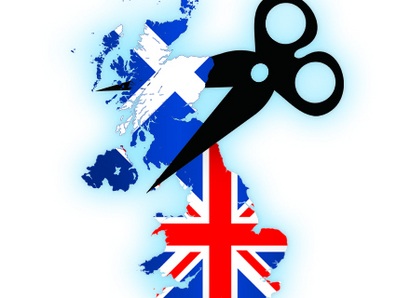
Fractiousness is nothing new in Scottish Nationalism. For most of its history, the only thing SNP members could agree on was the merit of a good rammy. Gradualists declared sovereignty would come in increments; while fundamentalists insisted independence yesterday would still be independence too late. Conference was an annual pitched battle where each faction schemed, cajoled and manoeuvred against the other. The gradualists came to dominate the leadership and party machine, but the fundies consoled themselves that the members were really with them.
After 11 years in government, a lost independence referendum and an explosion in membership, the battle lines in Scottish nationalism have been redrawn into five main camps. These are the Deciders, the New Establishment, the Separatist Spoilers, the Social Media Chauvinists and the Reluctant Reformers.
At the top sit the Deciders – First Minister Nicola Sturgeon, husband Peter Murrell and select advisers. This is the most exclusive club and it runs the party (and the country) almost singlehandedly. Consultation outwith the clique is rare and once a course of action has been decided, the chances of an outsider successfully challenging it are next to none. The Deciders decide; everyone else exists to nod along and applaud as instructed.
The New Establishment is the nomenklatura of SNP Scotland; dutiful courtiers, stenographers and political enforcers for the Nationalist elite. Among them are financially canny third sector executives, on-message opinion formers and the professional class who were conscientious Labour until the polls told their conscience to back the other horse.
The New Establishment rates itself highly and bristles when shown insufficient deference – a daily hazard when the rest of the movement sees them as useful idiots.
One such impatient class is the Separatist Spoilers. Many have arrived at the doors of the SNP megachurch after September 2014, emptying their pockets into the collection box and singing the hymns one syllable behind everyone else.
Others will be regular attendees and even elders, who are heartened by the new congregants and their fervour, even if they are a little brash, a bit Central Belt, a touch too socially and culturally Labour.
What unites the Separatist Spoilers is unwavering devotion to the catechism of independence. Separation is their chiefest joy. Nothing – no biased BBC reporting, no Unionist-infiltrated GERS office, no ‘facts’ from the London-based IFS – will dissuade them from the path of righteousness.
They are spoilers insofar as the ruination of Scotland’s schools, hospitals, and economy are deemed a price worth paying for her freedom.
Beyond these lie the Social Media Chauvinists, who combine belligerent nationalism with online invective and intimidation. The category is not limited to obscure keyboard warriors; it includes elected Nationalists for whom abusing the enemy – they do not see mere opponents – is intrinsic to their politics.
Social Media Chauvinists whip up cybernat pile-ons, keep the worst of the grassroots ginned up and target journalists and critics sceptical of the regime. They have constructed their own reality from an echo chamber of antagonistic bloggers and unhinged conspiracy theorists. Their indoor voice is a howl and paranoia their idea of equanimity; they are often to be found in a tizz over British-branded foodstuffs and unpatriotic weather maps.
[…]
Most pitiful of all are the Reluctant Reformers. They are no less committed to independence but accept the constraints of economics and public opinion. They are willing to make a go of devolution but alarmed by how quickly colleagues tire of discussing the attainment gap and NHS performance. Opponents are to be engaged with and compromise found in the common interest. Reluctant Reformers are in tune with SNP voters but treacherously off-key to the rest of the movement.
Separatist Spoilers hate the New Establishment; Reluctant Reformers hate the Social Media Chauvinists; everybody hates the Deciders.
H/T to Colby Cosh for the link.
May 1, 2018
Sikh separatists (and even terrorists) are being protected by the federal government
There’s no reason that Canadian Sikhs can’t agitate for their fellow Sikhs in India to create a separate country in the Punjab, but that freedom must not include active support for terrorists. The Canadian government is looking particularly bad on this front, and it isn’t just because of Justin Trudeau’s farcical adventures on his recent trip to India. None of the major federal parties want to appear to be anti-Sikh, as Sikh voters cluster in several key swing ridings around the country, and any criticism of the terrorists is spun as an attack on all Sikhs. At Quillette Terry Milewski details the government’s unwillingness to deal with the problem:
The Sikh faith, created in what is now northern India by the 15th-century Guru Nanak, remains obscure to many in the West. Turbaned Sikh men are sometimes confused with Muslims, and some have been assaulted by confused thugs following Islamist terrorist attacks. Like the United States, Britain and other Western countries, Canada has been home to emigrant Sikhs for generations—the vast majority of them living peaceably in their adopted homeland.
In the 1980s, however, a powerful spasm of separatist militancy shook India and spread to the Sikh diaspora. In June, 1984, two months before the Madison Square Garden convention, Prime Minister Gandhi and her government set out to end a killing spree by Sikh militants who had turned the Sikhs’ holiest site — the Golden Temple at Amritsar — into an armed camp. The Indian army wrecked the temple complex and took many lives. Revenge came on October 31, 1984, when Gandhi was gunned down in her garden by two of her Sikh bodyguards. Hindu mobs immediately took revenge for the revenge, slaughtering thousands of Sikhs in hellish reprisals that were aggravated by official complicity. The police looked the other way. The horrors of 1984 won’t be forgotten by either side.
Soon, Canada and its Sikh community were dragged into the thick of the struggle. In June of 1985, Parmar’s Babbar Khalsa placed suitcase bombs on two planes leaving Vancouver. One brought down Flight 182, a massacre that remained, until 9/11, the deadliest terrorist attack in the history of aviation. The second bomb, intended to destroy another Air India plane simultaneously, exploded on the ground at Narita Airport in Japan, killing two baggage handlers. The reverberations from the attack were so profound in Canada that even today, 33 years later, a striking emblem of the Khalistani dream survives: a large “martyr” poster honouring Talwinder Parmar, sword in hand, permanently fixed to the exterior of an important Sikh gurdwara in Surrey, British Columbia. Tens of thousands gather beneath it each spring for an annual Sikh parade. In American terms, the poster is equivalent to a public veneration of Osama Bin Laden.
[…]
Today, the parents who lost their children [on Air India Flight 182] are old, the orphaned children have their own children and the Sikh struggle for independence is moribund in India. Last year, in fact, Sikh voters overwhelmingly supported a united India and were key to the election of the Congress Party — the party of Indira Gandhi — to govern the Sikh homeland of Punjab. Support for Congress was especially strong in majority-Sikh districts. And Punjab’s Chief Minister is a strongly pro-unity Sikh, Amarinder Singh, who has alleged separatist influence in the Canadian government.
Harjit Sajjan, a Sikh who is Canada’s Minister of National Defence, firmly denied the claim. And on Justin Trudeau’s visit to India this year, Singh agreed to a photo-op including Sajjan. But the Chief Minister let it be known that he’d handed over a list of Canadians he suspects of fundraising for Punjab’s few remaining separatist Sikh militants.
The listed suspects amount to a tiny subculture among Canada’s 450,000 Sikhs, the vast bulk of whom seek no return to the bloody 1980s and 1990s, when the battle for Khalistan took some 20,000 lives in India, most of them Sikh. But the hardliners are a well-organized political force, still raising the cry of “Khalistan Zindabad!” — long live Khalistan — in some Canadian gurdwaras where “martyred” Sikh assassins are memorialized as models for the young. These include the two bodyguards who machine-gunned Indira Gandhi. Khalistani fervour is alive on social media and a 2018 tweet from “George” (@PCPO_Brampton) declared: “Indira’s assassins are HEROES. Sikhs should glorify them.”
The endurance of such attitudes in Canada reflects the weak record of its justice system in deterring violence. For years, it seemed, Canadian courts were where terrorism cases went to die.
April 15, 2018
Rise of the Nations I BETWEEN 2 WARS I 1918 1 of 2
TimeGhost
Published on 14 Apr 2018After the War to End All Wars, there’s more of two things. More nations and more wars. Wars of independence, civil wars, ethnic wars, ideological wars and just plain old wars. In the first Prelude to the Between 2 Wars series, covering the years 1919-1939 from WWI to WWII chronologically, we look at the rise of nationalism out of the ruins of The Great War. Indy Neidell and Spartacus take you on a historical journey through 20 years of dawn, light, and dusk back into the darkness of war.
Join the TimeGhost Army on : http://timeghost.tv
Or on Patreon: https://www.patreon.com/TimeGhostHistoryHosted by: Indy Neidell
Written by: Spartacus Olsson & Indy Neidell
Produced by: Astrid Deinhard
Executive Producers: Bodo Rittenauer, Astrid Deinhard, Indy Neidell, Spartacus Olsson
Camera and Edit by: Spartacus OlssonA TimeGhost chronological documentary produced by OnLion Entertainment GmbH
From the comments:
TimeGhost
20 hours ago (edited)PLEASE READ BEFORE YOU COMMENT (AVOIDS REPEATING FEEDBACK): The first episode of Between 2 Wars focuses on what happened after The Great War. Out of respect for those of you that are anxiously waiting for the TGW series finale later this year, we’ve avoided any references to WWI as far as possible. This episode is a prologue to future episodes that go into more detail of the actual events starting in 1919. The episode focuses in broad strokes on the rise of nationalism and the conflict that this creates, as well as the situation in Germany and Russia at the end of 1918. Here some notes on feedback we have already received:
1. We will avoid text and pictures at the same time when Indy speaks in the future.
2. There is an error in the map on the Balkan peninsula, we missed to turn off the country layer for modern Macedonia, this country does not exist at the time as it is part of Serbia, Bulgaria and Greece in 1919. Our apologies. [Iceland is also labelled as “Island”.]
3. Some borders are drawn as the modern countries (e.g. Finland) although this is not correct at the time. This is a conscious decision to avoid an impossible dilemma. As pointed out in the video borders are in a state of flux in 1919, or even more often; just recently created. In cases where there is border contention that is not relevant to the current events of the video we have to choose between the following scenarios: A) Draw the border as one or the other side saw it – leads to controversy that we would like to avoid. B) Draw the contended area in as contended – doing that for one place leads to us having to do that for the rest of the world, we don’t have the capacity for that. C) Accept that we can’t solve this as the basis is not an exact fact base, but political problems that are way out of our program scope. We have tried other solutions, but C was the only one that worked (B would be the right thing to do, but we just can’t afford to invest the time it requires).
4. Some borders are not exactly right even when they are drawn for the events we speak of. This is due to 3. as well, but also because borders shift even within the year we speak of so that it becomes impossible to choose exactly the right line. We try our best to hit the least erroneous approximation, but it won’t always be perfect.
April 8, 2018
Brexit: Why Britain Left the European Union
PragerU
Published on 12 Mar 2018Is the European Union good for Europe? Or would Europeans be better off without it? Nigel Farage, a leader of the United Kingdom’s Brexit movement, shares his view.
Script:
If one big government is bad, imagine how much worse two big governments would be. But that’s what people living in Europe have had to deal with: their own nation’s bloated government and the super-national government of Europe, now known as the European Union. Bureaucracy times two! How’s that for a horror show?
Well, actually, you’ve no idea. It’s worse than you think. Believe me — I know, because for seventeen years, I’ve represented South East England as a member of the European Parliament, the EU’s legislative body. I was also leader of the UK Independence Party, or UKIP, where I lead Britain’s efforts to leave the European Union. To their everlasting credit, that’s just what happened on June the 23rd, 2016: The United Kingdom left the European Union. The world knows it as “Brexit.”
Brexit is a statement of national sovereignty. Don’t misunderstand me: I like nations. I like borders. I like the people that live within those borders making their own laws. But I don’t like it when faceless bureaucrats make laws for nations they don’t even live in.
But that’s what they do in the European Union.
Imagine a Belgian telling a Brit how much he can charge his customers — or the reverse. The EU bureaucrats do this in a myriad of different ways, all day, every day. It is a conspiracy of the elites.
Who are those elites? Well, they’re a bunch of self-important, overpaid, social engineers with useless college degrees who have never done a proper day’s work in their lives and have no connection with ordinary, decent people. I’ll take the good sense of an Italian farmer or a French baker over the arid intellectualism of an EU bureaucrat any day.
And I say these things not as an anti-European; I love Europe! It’s a fantastic, exciting, great continent: different peoples, languages, and cultures. But these peoples, with their languages and cultures, have effectively been hijacked by a giant, ever-expanding bureaucracy: the European Union.
People will say, “but isn’t there a parliament, a European parliament, that represents the people of Europe?” Well, yes, but this body has got no real power; it can’t make its own laws. Rather, the power resides with the European Commission. They’re unelected and they can’t be removed, and that’s how absurd the whole thing is.
The European Parliament meets in Brussels. At least, that’s what I thought when I was elected there. But once a month, do you know what happens? They load the contents of our offices and papers into big, plastic trunks, and they put those trunks on lorries, and they drive them nearly 400 miles down Europe’s motorways to a French city called Strasbourg where, for four days, the contents of our offices, and our papers, are put into a new office, and the parliament then sits there. Twelve times a year this back-and-forth happens, and this from an organization who say they want to reduce their level of carbon footprint! This, from an organization whose accounts have not been given a clean bill of health by the auditors for the last twenty years!
This…a parliament? It’s more like a traveling circus.
For the complete script, visit https://www.prageru.com/videos/brexit-why-britain-left-european-union


