… I’d also argue that the office [of Dictator as created by Sulla and then by Caesar] didn’t work for the goals of either of the men that recreated it.
For Sulla, the purpose of using the dictatorship was to offer his reforms to the Republic some degree of legitimacy (otherwise why not just force them through purely by violence without even the fig leaf of law). Sulla was a reactionary who quite clearly believed in the Republic and seems to have been honestly and sincerely attempting to fix it; he was also a brutal, cruel and inhuman man who solved all of his problems with a mix of violence and treachery. While we can’t read Sulla’s mind on why he chose this particular form, it seems likely the aim here was to wash his reforms in the patina of something traditional-sounding in order to give them legitimacy so that they’d be longer lasting, so that Sulla’s own memory might be a bit less tarnished and to make it harder for a crisis like this to occur again.
And it failed at all three potential goals.
When it comes to the legitimacy of Sulla’s reforms and the memory that congealed around Sulla himself, it is clear that he was politically toxic even among many more conservative Romans. A younger Cicero was already using Sulla’s memory to tarnish anyone associated with him in 80, casting Chrysogonus, Sulla’s freedman, as the villain of the Pro Roscio Amerino, delivered in that year. In the sources written in the following decades at best Sulla is a touchy subject best avoided; when he is discussed, it is as a villain. Our later sources on Sulla are uniform in seeing his dictatorship as lawless. Moreover, his own reforms were picked apart by his former lieutenants, with key provisions being repealed before he was even dead (in 78 BC so that’s not a long time).
Finally, of course, far from securing the Republic, Sulla’s dictatorship provided the example and opened the door for more mayhem. Crucially, Sulla had not fixed the army problem and in fact had made it worse. You may recall one benefit of the short dictatorship is that no dictator – indeed, no consul or praetor either – would be in office long enough to secure the loyalty of his army against the state. But in the second and early first century that system had broken down. Gaius Marius had been in continuous military command from 107 to 100. Moreover, the expansion of Rome’s territory demanded more military commands than there were offices and so the Romans had begun selecting proconsuls and propraetors (along with the consuls and praetors) to fill those posts. Thus Sulla was (as a result of the Social War in Italy) a legate in 90, a propraetor in 89, and consul in 88 and so had been in command for three consecutive years (albeit the first as a legate) when he decided to turn his army – which had just, under his command, besieged the rebel stronghold of Nola – against Rome in 88, precisely because his political enemies in Rome had revoked his proconsular command for 87 (by roughing up the voters, to be clear). And then Sulla has that same army under his command as a proconsul from 87 to 83, so by the time he marches on Rome the second time with the intent to mass slaughter his enemies, his soldiers have had more than half a decade under his command to develop that ironclad loyalty (and of course a confidence that if Sulla didn’t win, their service to him might suddenly look like a crime against the Republic).
Sulla actually made this problem worse, because one of the things he legislated by fiat as dictator was that the consuls were now to always stay in Italy (in theory to guard Rome, but guard it with what, Sulla never seems to have considered). That, along with Sulla having butchered quite a lot of the actual experienced and talented military men in the Senate, left a Senate increasingly reliant on special commands doled out to a handful of commanders for long periods, leading (through Pompey‘s unusual career, holding commands in more years than not between 76 and 62) to Julius Caesar being in unbroken command of a large army in Gaul from 58 to 50, by which point that army was sufficiently loyal that it could be turned against the Republic, which of course Caesar does in 49.
For Caesar, the dictatorship seems to have been purely a tool to try to legitimate his own permanent control over the Roman state. Caesar is, from 49 to 44, only in Rome for a few months at a time and so it isn’t surprising that at first he goes to the expedient of just having his appointment renewed. But it is remarkable that his move to dictator perpetuo comes immediately after the “trial balloon” of making Caesar a Hellenistic-style king (complete with a diadem, the clear visual marker of Hellenistic-style kingship) had failed badly and publicly (Plut. Caes. 61). Perhaps recognizing that so clearly foreign an institution would be a non-starter in Rome – unpopular even among the general populace who normally loved Caesar – he instead went for a more Roman-sounding institution, something with at least a pretense of tradition to it.
And if the goal was to provide himself with some legitimacy, the effort clearly catastrophically backfired. The optics of the dictatorship were, at this point, awful; as noted, the only real example anyone had to work with was Sulla, and everyone hated Sulla. Many of Caesar’s own senatorial supporters had probably been hoping, given Caesar’s repeatedly renewed dictatorship, that he would eventually at least resign out of the office (as Sulla had done), allowing the machinery of the Republic – the elections, office holding and the direction of the Senate – to return. Declaring that he was dictator forever, rather than cementing his legitimacy clearly galvanized the conspiracy to have him assassinated, which they did in just two months.
It is striking that no one after Caesar, even in the chaotic power-struggle that ensued, no one attempted to revive the dictatorship, or use it as a model to institutionalize their power, or employ its iconography or symbolism in any way. Instead, Antony, who had himself been Caesar’s magister equitum, proposed and passed a law in 44 – right after Caesar’s death – to abolish the dictatorship, make it illegal to nominate a dictator, or for any Roman to accept the office, on pain of death (App. BCiv, 3.25, Dio 44.51.2). By all accounts, the law was broadly popular. As a legitimacy-building tool, the dictatorship had been worse than useless.
So what might we offer as a final verdict on the dictatorship? As a short-term crisis office used during the early and middle republic, a tool appropriate to a small state that had highly fragmented power in its institutions to maintain internal stability, the dictatorship was very successful, though that very success made it increasingly less necessary and important as Rome’s power grew. The customary dictatorship withered away in part because of that success: a Mediterranean-spanning empire had no need of emergency officials, when its military crises occurred at great distance and could generally be resolved by just sending a new regular commander with a larger army. By contrast, the irregular dictatorship was a complete failure, both for the men that held it and for the republic it destroyed.
The real problem wasn’t the office of dictator, but the apparatus that surrounded it: the short duration of military commands, the effectiveness and depth of the Roman aristocracy (crucially undermined by Sulla and Marius) and – less discussed here but still crucial in understanding the collapse of the Republic – the willingness of the Roman elite to compromise in order to maintain social cohesion. Without those guardrails, the dictatorship became dangerous, but without them any office becomes dangerous. Sulla and Caesar, after all, both marched on Rome not as dictators, but as consuls and proconsuls. It is the guardrails, not the office, that matter.
Bret Devereaux, “Collections: The Roman Dictatorship: How Did It Work? Did It Work?”, A Collection of Unmitigated Pedantry, 2022-03-18.
September 16, 2025
QotD: The Dictatorship in the late Roman Republic
September 15, 2025
HBO’s Rome – Ep 11 “The Spoils” – History and Story
Adrian Goldsworthy. Historian and Novelist
Published 23 Apr 2025This time we look at episode 11 — and only this episode as there is more to talk about when it comes to the historical background. Some of the plot doesn’t fit too well to the actual history, but there are some nice details that crop up and make it worthwhile. In the main, I get excited about a coin and a court.
September 12, 2025
Ancient Roman Table Manners & Etiquette
Tasting History with Max Miller
Published 8 Apr 2025Spiral-shaped fritters drizzled with honey and sprinkled with white poppyseeds
City/Region: Rome
Time Period: 2nd Century B.C.E.These fritters are kind of like a mix between globi and jalebi. The batter is simple like the globi, made of just spelt flour and ricotta, but they’re piped into hot fat in spiral shapes like jalebi. The technique can be a little tricky to get right so that the spirals hold together, but you should get about 12 to 15 tries out of the amount of batter this recipe makes.
The encytum are delicious and kind of remind me of a healthy pancake, but with honey instead of maple syrup. They don’t stay crispy for very long, so plan on serving them right away if you’d like to retain maximum crispness.
Make encytum the same way as globi, except that you use a vessel with a hole in the bottom which you can stream through into hot fat, and shape like the spira, coiling and turning it with two sticks. Spread and color with honey while still warm. Serve with honey or mulsum.
— De Agri Cultura by Cato the Elder, 2nd century B.C.E.
August 30, 2025
HBO’s Rome – Ep 9 “Utica” and Ep 10 “Triumph” – History and Story
Adrian Goldsworthy. Historian and Novelist
Published 26 Mar 2025This time we look at Episode 9, which begins with the aftermath of the Battle of Thapsus in 46 BC and also Episode 10 which focuses on Caesar’s Triumph — one rather than the four he celebrated over the course of several weeks in 46 BC. There is less history and more character-driven elements in these two episodes, so to make the video the same sort of length as the others in the series, I have combined the two.
00:00 Episode 9 “Utica”
19:48 Episode 10 “Triumph”
August 23, 2025
QotD: The background of Tiberius Gracchus
Meanwhile, as D.J. Gargola has noted, Appian is also bending his account of Tiberius Gracchus’ reforms, in particular by presenting the Lex Sempronia Agraria as an entirely traditional, conventional response to a pressing crisis.1 But in fact, the provisions of the Lex Sempronia Agraria were not traditional: no similar law (save for a re-enactment by Gaius Gracchus) – had ever or would ever be passed in Rome and the legal precedent that Appian presents as providing the foundation for Tiberius’ law appears to be at least substantially an anachronistic invention. Meanwhile, the crisis Appian thinks Tiberius Gracchus thought he was addressing probably didn’t exist in the form he understood it.
But that’s what we have, so it is what we must work with. And we should note that both Plutarch and Appian are quite favorable to the Gracchi, even though both men were clearly very controversial in their day. So in a sense this is a reverse of the situation we had with Cleopatra, where we had to contend with relentlessly negative sources: here the sources are broadly positive.
So, on with what we know.
Tiberius Gracchus was elected tribune in 133. His election was already unusual in that he seems to have run on something like a program (land reform, which we’ll get to); Romans generally ran on character and background rather than promising specific political actions if elected, so this was unusual. Part of the reason for it was doubtless that Tiberius Gracchus’ political fortunes were in difficulties. Now we should note here that while Tiberius Gracchus was a plebian (that is, not a patrician) that doesn’t make him a political outsider: Tiberius Gracchus was not remotely a political outsider or poor man or lacking in influence. His father (also Ti. Sempronius Gracchus) had been consul in 177 and 163 and censor in 169; his father (or grandfather) was consul in 215 and 213. Our Tiberius Gracchus’ mother, Cornelia, was the daughter of P. Cornelius Scipio Africanus, the man who defeated Hannibal. Tiberius Gracchus was born into substantial wealth and influence, the sort of man whose eventual political ascent was almost guaranteed.
(Indeed, it was so guaranteed that he gets to bend the rules and hold many of his offices early. He’s quaestor at just 26, which implies that he started his military service at 15 or 16 instead of the normal 17, doing so as a military tribune, not a common soldier. I do think this is relevant to understanding Tiberius Gracchus: this was a man born with a silver spoon and a carefully paved, flat-and-easy road to power and influence laid out for him by his family and his political backers, the most notable among whom was his key supporter Scipio Aemilianus (destroyer of Carthage and shortly Numantia).)
Except. Except he got wrapped up in something of a nasty foreign policy scandal during his year as quaestor, when he was assigned to the amazingly named but less amazingly capable C. Hostilius Mancinus who as consul in 137 was supposed to deal with Numantia in Spain. Mancinus blew it and got his army effectively trapped and sent Tiberius – his quaestor and the next highest ranking Roman present – to negotiate to get his army out. Tiberius did this, but the whole thing caused a great stink and a scandal at Rome (Roman armies are supposed to go down fighting, not negotiate shameful retreats!). Indeed, the Senate was so enraged they rejected the treaty and instead sent Mancinus, bound in chains, to the Numantines as part of a ritual process by which his treaty was disowned. Tiberius doesn’t get packed off to Numantia, but some of the political stink does rub off on him, so while he’s connected enough to get elected as a plebeian tribune in 133, he must know he needs a big second act to get his political career back on track, or he may never reach the consulship. That context – a political insider who had a golden ticket but must now win it back, rather than an outsider without connections – is important for understanding the reaction he is going to get.
Bret Devereaux, “Collections: On the Gracchi, Part I: Tiberius Gracchus”, A Collection of Unmitigated Pedantry, 2025-01-17.
- 1. D.J. Gargola, “The Gracchan Reform and Appian’s Representation of an Agrarian Crisis” in People, Land and Politics, eds. L. De Ligt and S.J. Northwood (2008).
August 8, 2025
The Rise and Fall of Books in Ancient Rome
toldinstone
Published 21 Mar 2025This video explores how books were published and distributed in ancient Rome.
Chapters
0:00 Introduction
0:30 Literacy and texts
1:19 Libraries
2:09 Scrolls and codices
3:13 Bookstores and booksellers
4:07 Helix
5:13 Publication
6:17 Luxury and vintage books
7:14 Bestsellers
8:10 The end of the book trade
August 5, 2025
QotD: Fighting a Middle Republic Legion
As you approach the velites, they scatter back to their lines and now the first real trial comes: when you are about twenty meters out from the enemy line, a storm of those heavy pila come in, thick and all at once. Each one masses around 1.3kg (just short of three pounds) so even if the tip doesn’t bite, one of these things clanging off of armor or a shield is going to hurt, the impacts stagger men near you as you struggle to keep formation (and for a Hellenistic army, get and keep those sarisa-points down). The impact of the massed volley, especially against close-order infantry with tight fighting-width, is going to be chaotic as some men are killed, others disabled, still more suddenly staggered. The volley is followed almost immediately by the on-rush of the hastati. These guys don’t have a long spear for keeping you at a distance, they’re all brandishing swords and aim to get in close, using their large body-shields to absorb any blows you might throw while they get right up in your face, where their swords can stab and slash viciously over or under your shield. These hastati are aggressive and they’re probably better armored than you are.
And of course an engagement in contact like this is unpredictable. Perhaps in some areas, your lines push forward, whereas in other places it bends back. For large maneuver units (like taxeis!) this can be a real problem, but Roman maniples are small, so one maniple can advance if it finds the opportunity while others hold position or are even forced back (we actually see a general give, essentially, an “advance at your own discretion” order at Pydna, Plut. Aem. 20.8).
After a short and terrifying experience – these moments of shock combat probably didn’t last all that long, perhaps as little as just a few minutes – the hastati fall back. The front of your line is already physically and mentally exhausted. Many men are wounded and certainly some have been killed or disabled. I don’t want to oversell the casualties aspect of this: armies don’t annihilate each other in stand-up engagements (instead more casualties happen in pursuit), but wounds and exhaustion matter. Latin has this phrase, of being confectus vulneribus, “exhausted by wounds” or perhaps “worn down by wounds” (Liv. 24.26.14, 31.17.11, Caes. BGall. 5.45) to describe how the accumulation of a lot of little wounds can sap soldiers of their ability to resist effectively, even if no one wound is lethal. And just as important, all of the emotional impetus of your initial attack is spent. And there’s a decent chance that, as you try to breath, you still have these light velites‘ javelins (the hasta velitaris) thudding into your line every few seconds, because – again – they carry seven of them. They’re not out.
And then, as you are getting your bearings, trying desperately to catch your breath, the principes come up. They’re not physically tired or emotionally exhausted, but eager (like you were a half an hour ago when you advanced), they’ve been waiting all this time. Worse yet, these are probably the most combat-effective soldiers the Romans have, in the prime of their life, with years of combat experience. Now the second volley of pila comes in, creating yet more chaos. And then more angry, heavily armored Romans, behind their big shields, stabbing and cutting with their deadly gladii.
Now the men at the back of your single line may be relatively fresh, but you have no real way to get them to the front, so the wrath of the principes falls on men who are already exhausted, already wounded, already tired and already out of fight. Your line isn’t advancing so stridently; the men in the back, if the formation is deep, don’t know why the advance is slowed, why the line seems to be wavering, only that it seems to be wavering. And meanwhile, everyone is hoping that, at any moment, the victorious cavalry on the flanks is going to show up and win the battle, but they can’t see it anywhere in the confusion. Maybe your cavalry has won and is moments away – or perhaps Antiochus III charged it off the field again and no help is coming. Or perhaps the enemy cavalry has tied it up or worse yet, the Romans’ highly skilled Numidian allies might have mastered the flanks. You have no idea, you only know that help isn’t here, you are tired and more Romans are upon you. And somewhere, the thin thread of human courage snaps, either from the exhausted men in front or the confused men behind and the formation begins to collapse.
As the collective defense of lapped shields or serried pikes gives way, the Romans are now truly in their element: their large shields function just fine in individual combat and their versatile swords do as well. Lead by their centurions, the principes, with practiced and experienced skill, are finding the gaps, cutting as they go. As the formation crumbles, the velites can pursue – lightly armored, but well enough armed, backed up by the equites if there are any left.
You can see thus how this is a formation designed to wear down an enemy’s main battle line. It isn’t that the Romans are set massively deeper than a Hellenistic army, either. Assuming a base-3 set of file-depths (which seems to me the most likely), the Roman ranks are probably six, six and three men deep (hastati, principes, triarii), for a total depth over each file of 15, one less than the normal Macedonian formation. And with the wider fighting intervals the Romans use, they won’t normally have much of a problem matching the fighting width of the enemy army, unless substantially outnumbered (as, for instance, at Magnesia).
It’s not the Roman formation is deeper, it’s that its successive battle lines avoid exposing the entire army to exhaustion, attrition and friction all at once. In effect, it uses the same principles as defense-in-depth, exploiting the effect of friction on the enemy line to wear it down, but does so on the offensive. I don’t think it is an accident that when the Romans do lose, it tends to be because this model battle was spoiled in some way, either because the army was ambushed, enveloped, something disrupted the triplex acies or because the enemy was able to carry the field with just the momentum of the first charge – the Roman lines essentially failing like a building undergoing controlled demolition, as each floor pancakes the next without slowing.
But an army that isn’t able to decisively win the battle either at the first onset or somewhere else on the line is going to find itself in quite a lot of trouble as the Romans almost inevitably sandpaper away the morale and stamina of the main line of resistance until it collapses.
Now many of you may already be realizing that this kind of force is going to present a Hellenistic army with a lot of problems, both because it is set up for a different kind of fight than they are, but also because it may end up matching much heavier troops against the lighter parts of a Hellenistic army. But before we jump into battles, we need to zoom up to the upper levels of military analysis – operations and strategy – and talk about the advantages the Romans have there.
Because if all the Romans had was an edge in their tactical system, we might expect them to win battles but sometimes lose wars. Instead, while the Romans sometimes lose battles, they seemingly always win the war.
Bret Devereaux, “Collections: Phalanx’s Twilight, Legion’s Triumph, Part IIa: How a Legion Fights”, A Collection of Unmitigated Pedantry, 2024-02-09.
August 4, 2025
HBO’s Rome – Ep 8 “Caesarion” – History and Story
Adrian Goldsworthy. Historian and Novelist
Published 19 Feb 2025Continuing series looking at the HBO/BBC co production drama series ROME. We will look at how they chose to tell the story, at what they changed and where they stuck closer to the history.
August 2, 2025
The Bloody Battle of Cannae | Animated(ish) Episode
The Rest Is History
Published 5 Jun 2025This is the final episode of our series on Hannibal, which is the second season on Carthage, the whole series is here: Rome Vs Cathage
Part 1 of our series on Hannibal is here: Hannibal: The Rise of Rome’s Greatest Nemesis
How did the Battle of Cannae — one of the most important battles of all time for Ancient Rome, with a whole Empire at stake, and a reputation that had reverberated across the centuries — in 216 BC, unfold? What brilliant tactics did Hannibal adopt in order to overcome the Roman killing machine, with its vast numbers and relentless soldiers? Why did so many men die in such horrific circumstances? And, what would be the outcome of that bloody, totemic day, for the future of both Carthage and Rome?
Join Tom and Dominic for the climax of their epic journey through the rise of Hannibal, and his world-shaking war against Rome, in one of the deadliest rivalries of all time.
00:00 Context to the battle
08:30 Prelude to the battle and their plans of attack
37:28 The battle
(more…)
July 30, 2025
QotD: Meetings of the Roman Republican Senate
We may begin with place: the Senate had no single fixed meeting spot, though the curia in the Forum was the most common location, however the place the Senate met had to be religiously prepared via inauguration (the taking of the auspices by the augurs) and by sacrifices in order to make sure the gods approved of the proceedings and its results. Consequently, the Senate always met in a templum in the sense of a consecrated space, but also it tended to meet literally in temples, with meetings in the temples of Jupiter Optimus Maximus, the temple of Fides, the temple of Concord, and so on. Notably, two locations, the temple of Bellona and the temple of Apollo were also used and these sat outside the pomerium, enabling the Senate to meet with magistrates who, because of their active command of an army, could not cross the pomerium; they were also sometimes used to meet with foreign dignitaries the Senate did not wish to let into the city. Later added to this number of sites outside the pomerium was Pompey’s theater, which included a temple of Venus Victrix and a curia as part of the overall complex.
In order to meet, the Senate had to be called or more correctly “driven together” (cogere, often translated adequately as “summoned”, but as Lintott notes, it has an element of compulsion to it) by a magistrate. There were a few standard dates on which this would effectively always happen, particularly the first day of the consular year, but beyond that it was expected that magistrates in Rome could call the Senate at any time to discuss any issue on relatively short notice. There was initially no requirement that Senators live in the city of Rome, but it was clearly assumed. Early on in the second century, we get regulations requiring Senators to stay close to Rome unless they had an official reason to be elsewhere, though Senators might be permitted to leave if they needed to fulfill a vow. In the Late Republic it seems to have been common also for Senators to leave the city during the spring res prolatae, a sort of recess from public business (literally “the deferring of business”), but these informal breaks did not mean the Senate was truly “out of session” and it could still be summoned by a magistrate.
Generally, meetings of the Senate began at dawn, though they could begin later, and they proceeded either until the business was concluded or to dusk. Because of the ritual preparations required, no meeting of the Senate could last more than a day, much like the assemblies, so if the business was not finished, a new meeting would need to be called and the process begun from scratch. While it seems that magistrates generally tried to avoid calling the Senate during festival days, dies nefandi (days unsuited for public business) and meetings of the popular assemblies, there was no requirement to do so and the Senate might be called for any day for most of the Republic, with laws restricting the Senate’s meeting days only coming midway through the first century.
Beyond this, Senators were expected to show up and we hear of threats of fines or other censure for failure to show up, but it also seems like no meeting of the senate was ever very close to the full body and quorums for the Senate were fairly low, 100 or 150. For the Sullan Senate, notionally of 600 members, the highest attendances we know of, as noted by Lintott, are 415, 417 and 392. Of course some significant number of Senators will, at any time, have been active magistrates overseas, or serving as military tribunes, or as senatorial legati, but it seems clear that even beyond this attendance was not universal even if it was in theory supposed to be.
Bret Devereaux, “Collections: How to Roman Republic 101, Part IV: The Senate”, A Collection of Unmitigated Pedantry, 2023-09-22.
July 26, 2025
QotD: The accumulated friction of bureaucratic growth
[…] In the early Republic, raising a legion was as simple as a patrician calling his clients to service, or the Senate issuing a conscription decree. One task: the summoning of free men, with their own equipment, and there you go — Legio I Hypothetica.
By the late Empire, though, all those freeholds had been turned into slave-worked Latifundia, so the effort of raising a legion increased enormously. Now the bureaucracy had to go out and hire freemen (if it could even find them), equip them at State expense, train them (again at State expense), and so on. In itself, the number of tasks isn’t that large — we’ve identified three — and they only increase at the rate of n+1.
But the effort each task requires increases to the power of n, such that if you could somehow express the effort expended in physical terms — joules or kilowatts or whatever — you’d see that the creation of Legio I Hypothetica under Scipio Africanus took 10 kilowatts, while raising the same legion under Diocletian took 10,000,000.
This isn’t (just) corruption. Sure, everyone at every level of the Imperial Bureaucracy was getting his beak wet, that goes without saying, but it’s the nature of bureaucracy itself that’s most to blame.
Severian, “Collapse II”, Founding Questions, 2021-12-09.
July 23, 2025
QotD: The legion of the Middle Republic
With that said, we reach the first and arguably most important thing to know about the legion: the Roman legion (and socii ala) of the Middle Republic is an integrated combined arms unit. That is to say, unlike a Hellenistic army, where different “arms” (light infantry, heavy infantry, cavalry, etc.) are split into different, largely homogeneous units, these are “organic” to the legion, that is to say they are part of its internal structure (we might say they are “brigaded together” into the legion as well). Consequently, whereas the Hellenistic army aims to have different arms on the battlefield in different places doing different things to produce victory, the Roman legion instead understands these different arms to be functioning in a fairly tightly integrated fashion with a single theory of victory all operating on the same “space” in the enemy’s line.
And you may well ask, before we get to organization, “What is that theory of victory?” As we saw, the Hellenistic army aims to fix the enemy with its heavy infantry center, hold the flanks with lighter, more mobile infantry (to protect that formation) and win the battle with a decisive cavalry-led hammer-blow on a flank. By contrast, the Romans seem to have decided that the quickest way to an enemy’s vulnerable rear was through their front. The legion is thus not built for flanking, its cavalry component – while ample in numbers – is distinctly secondary. Instead, the legion is built to sandpaper away the enemy’s main battle line in the center through attrition, in order to produce a rupture and thus victory.
To do that, you need to create a lot of attrition and this is what the manipular legion is built to do.
The legion of the Middle Republic is built out of five components: three lines of heavy infantry (hastati, principes and triariivelites), and a cavalry contingent (the equites). Specifically, a normal legion has 1200 each of velites, hastati and principes, 600 triarii and 300 equites, making a total combined unit of 4,500. Organizationally, the light infantry velites were packaged in with the heavy infantry (Polyb. 6.24.2-5) for things like marching and duties in camp, but in battle they typically function separately as a screening force thrown forward of the legion.
So to take the legion as an enemy would experience them, the first force were the velites. These seem to have been deployed in open order in front of the legion to screen its advance. These fellows had lighter javelins, the hasta velitaris (Livy notes they carried seven, Livy 39.21.13), no body armor and a “simple headcovering” (λιτός περικεφάλαιος, Polyb. 6.22.3), possibly hide or textile; they also carried a smaller round shield, the parma, and the gladius Hispaniensis for close-in defense (Livy 38.21.13). These are, all things considered, fairly typical ancient javelin troops, aiming to use the mobility their light equipment offers them to stay out of close-combat.
Behind the velites was the first line of the heavy infantry, the hastati. These fellows were organized into units called maniples (lit: “a handful”) of 120, which in turn are divided into centuries of 60 each. The maniples are their own semi-independent maneuvering units (note how much smaller they are than the equivalent taxeis in the phalanx, this is a more flexible fighting system), each with its own small standard (Polyb. 6.24.6) to enable it to maintain coherence as it maneuvers. That said, they normally form up in a quincunx (5/12ths, after a Roman coin with the symbol of five punches, like on dice) formation with the rear ranks, as you can see above.
The hastati (and the principes, who are equipped the same way) have the large Roman shield, the scutum, two heavy javelins (pila), the gladius Hispaniensis sword, a helmet (almost always a Montefortino-type in bronze in this period) and body armor. Poorer soldiers, we’re told, wore a pectoral, wealthier soldiers (probably post-225, though we cannot be certain) wore mail. That is, by the standards of antiquity, quite a lot of armor, actually – probably more armor per-man than any other infantry formation on their contemporary battlefield. That relatively higher degree of protection – big shield, stout helmet (Montefortino’s in this period range from 1.5-2.5kg, making them unusually robust), and lots of body armor – makes sense because these fellows are going to aim to grind the enemy down.
Note that a lot of popular treatments of this assume that the hastati were worse equipped than the principes; there’s no reason to assume this is actually true. The principes are older than the hastati, but the way to understand this formation is that the velites are young or poor, whereas for the upper-classes of the infantry (probably pedites I-IV) after maybe the first year or so, they serve in the heavy infantry (hastati, principes, triarii) based on age, not on wealth (and then the equites are the truly rich, regardless of what age they are; the relevant passage here is Polyb. 6.21.7-9, which is, admittedly, not entirely clear on what is an age distinction and what is a wealth distinction).
We’ve discussed the combat width these guys fight with already – somewhat wider spacing than most, so that each man covers the other’s flanks but they all have room to maneuver. It seems like the standard depth in the Middle Republic was either base-3 (so 3 deep on close order, 6 deep for “fighting” open order) or base-4 (so 4 and 8). Even in open-order with the maniples stretched wide (possibly by having rear centuries move forward), there would have been open intervals (10-20m) between maniples, which reinforces the role of a maniple as a potentially independent maneuvering unit – it has the space to move.2
Behind the hastati are the principes, with the same equipment and organization, slightly off-set to cover the intervals between the hastati, with a gap between the two lines (we do not know how large a gap). These men are slightly older, though not “old”. The whole field army generally consists of iuniores (men under 46) and given how the Romans seem to like to conscript, the vast majority of men will be in their late teens and 20s. So we might imagine the velites to be poorer men, or men in their late teens (17 being the age when one become liable for conscription) or so, while the hastati are early twenties, the principes mid-twenties and the handful of triarii being men in their late twenties or perhaps early 30s. The positioning of the principes isn’t to spare older men the rigors of combat, but rather to put more experienced veterans in a position where they can steady the less experienced hastati.3
Finally, behind them are the triarii, who trade the pila for a thrusting spear, the hasta, the Roman version of the Mediterranean omni-spear. These men are, as noted, the oldest and so likely the calmest under pressure and thus form a reserve in the rear. The three-line system here is what the Romans call a triplex acies (“three battle lines”). This wasn’t the only way these armies engaged and they could sometimes be formed up into a single solid line, but the triplex acies seems to have been the standard. We don’t know exactly how deep such a formation would run, but we have fairly good evidence that a legion might occupy a space around 400m wide (with some variation), meaning a whole Roman army’s core heavy infantry component (the two legions and two alae) might be some 1.6km (about a mile) across.
The equites, while organic to the legion organizationally, will be tactically grouped in battle to form cavalry screens on the edges of the army, not as a grand flanking cavalry “hammer”, but as flank-protection for the advancing infantry body (as a result, they tend to fight more cautiously). The equites in this period are heavy cavalry, with armored riders (after c. 225, that would be mail), using a shield and a hasta, along with a gladius as a backup weapon and thus serving as “shock” cavalry. Roman cavalry, if we look at their deployments, is generally ample in numbers, but the Romans seem to have been well aware it wasn’t very good, and sought allied cavalry (especially non-Italian allied cavalry) whenever they could get it. But the cavalry, Roman or not, was almost never the decisive part of the army.
Polybius tells us that the socii supplies more cavalry than the Romans and implies that there was a standard rule of three socii cavalrymen to every Roman equites, while socii infantry matched Roman infantry numbers (Polyb. 6.26.7). Looking at actual deployments though, we see that the socii tend to outnumber the Romans modestly, on about a 2:3 ratio, with socii cavalry only modestly outnumbering Roman cavalry.4 Consequently a normal Roman consular field army (of which the Romans generally had at least two every year) was 8,400 Roman infantry, around 12,600 socii infantry, 600 Roman cavalry and perhaps a thousand or so socii cavalry, for a combined force of 21,000 infantry (c. 5,000 light 16,000 heavy, so that’s a lot of heavy infantry) and 1,600 cavalry. That somewhat undersells the cavalry force the Romans might bring, as Roman armies also often move with auxilia externa (allied forces not part of the socii), which are very frequently cavalry-heavy (especially, after 203, that really good Numidian cavalry).5 By and large, it’s not that the Romans bring a lot less cavalry (as a percentage of army size), but that Italian cavalry tends to perform poorly and the as a result the Romans do not built their battle plans around their weakest combat arm.
Perhaps ironically, the Romans used their cavalry like Alexander and Hellenistic armies used their light infantry: holding forces designed to keep the flanks of the battlefield busy while the decisive action happened somewhere else.
Bret Devereaux, “Collections: Phalanx’s Twilight, Legion’s Triumph, Part IIa: How a Legion Fights”, A Collection of Unmitigated Pedantry, 2024-02-09.
1. On this, see Burns, M. T. “The Homogenisation of Military Equipment under the Roman Republic”. In Romanization? Digressus Supplement I. London: Institute of Archaeology, University College London, 2003.
2. On this, M.J. Taylor, “Roman Infantry Tactics in the Mid-Republic: A Reassessment”, Historia 63.3 (2014): 301-322.
3. To expound at some length on my own thoughts on how I think the wealth/age issue was probably managed, Dionysius (4.19.2) claims that the Romans recruited by centuries in the comitia centuriata such that the wealthy, divided into fewer voting blocks, served more often, and we know from Polybius that the maximum period of service for the infantry was sixteen years and from some math done by N. Rosenstein in Rome at War (2004) that the average service must have been around seven years. My suspicion, which I cannot prove is that the very poorest Roman assidui (men liable for conscription) might have only been serving fewer years on average and so it wasn’t a problem having them do all of their service as velites (the only role they can afford), whereas wealthier Romans (my guess is pedites IV and up) are the ones who age into the heavy infantry, with pedites I, whose members probably serve more than the seven-year average (perhaps around 10?) might make up close to 40% of the actual heavy infantry body (which is their balance in the comitia centuriata). The velites thus serves two important functions: a place to “blood” wealthier young Roman men to prepare them to stand firm in the heavy infantry line, as well as a place for poorer Romans to contribute militarily in a way they could afford. But I think that, once in the heavy infantry, the division between hastati, principes and triarii was – as Polybius says (6.21.7-9 and 6.23.1) – an age division, not a wealth division. Instead, the next wealth line is for the equites.
4. The data on this is compiled by Taylor, Soldiers & Silver (2020), 26-28.
5. Taylor, op. cit., 54-7 compiles examples.

July 17, 2025
HBO’s Rome – Ep 7 “Pharsalia” – History and Story
Adrian Goldsworthy. Historian and Novelist
Published 22 Jan 2025
Half way through the first season, we take a look at Episode 7, set during the summer of 48 BC amid the campaign between Pompey and Julius Caesar in Macedonia. For once, most of the action takes place away from Rome. Central is the Battle of Pharsalus, where in reality 80,000 or more men clashed in August and Caesar decisively defeated Pompey and his supporters. So today we talk about the reality of the campaign and battle, its political context, and then consider how this is presented for TV in a series where they did not have the option of vast numbers of extras and big set piece battle scenes.
QotD: War elephants in India
This may seem a strange approach to use to end a discussion of war elephants – after all, these are war elephants – but as will soon become apparent, war elephants are almost impossible to fully understand outside of the social and political context in which they are most useful.
First, we are going to look at how elephants fit into the ancient and medieval political systems which used them as weapons of war. I want to stress very strongly here that what I am presenting is essentially the main argument of Trautmann’s Elephants and Kings (2015), not something I dreamed up. For the sake of brevity, I am leaving out a lot of detail here – but you know where to go to find the argument in full.
Last time, we introduced a problem: while awesome, war elephants were very expensive and relatively easy to counter on the battlefield. This answered the question of why the Romans and Chinese mostly ignored the elephant as a weapon-system despite having access to it, but it raised a second question: if the elephant was at best a limited weapon, why did its use persist in India? After all, if the Romans could figure out how to beat these things, surely the Indians could too!
Part of the answer, of course, is that some of the logistical problems that existed for states located at the edges of elephant’s natural range simply don’t apply to states closer to the source. Indian kings could (and did!) deploy elephants in far greater numbers than Seleucid or Roman armies could. In particular, North Indian rulers, rather than relying on long distance trade, could acquire elephants through trade relations with “forest peoples” in their own hinterland. We have reports of armies with not hundreds but thousands of elephants from, for instance, the Nanda or Maurya empires. Nevertheless, while these factors simplified elephant logistics, they hardly made the use of the animals cheap.
What Trautmann instead observes is that the rise of war elephants occurred specifically in the context of kingship in India. Indeed, elephants were associated with kingship through royal elephant hunts and domesticated elephants kept for show even before war elephants were developed. Around 1400 B.C. the chariot arrives in India, bringing with it a military aristocracy where the nobles – and the noblest of all nobles is, of course, the king – rode into battle.
(I keep finding myself recommending it, but I’ll again note – for a good rundown of the value of chariots as royal symbols more than battlefield weapons, check out chapter 2 of Lee, Waging War (2016).)
That was the context the war elephant emerged into. By the fifth century or so, the war elephant seems to be displacing the chariot as the quintessential vehicle of the warrior-aristocrat (and thus the ultimate warrior-aristocrat, the king). Interestingly, the Mahabharata (fourth century B.C., but with components that may date as early as the ninth) preserves some of this shift, with a mix of aristocrats on chariot and aristocrats on elephant. As chariots faded (they were tactically inferior to true cavalry which was arising at this time), elephants progressively became the vehicle for the important warriors.
It’s not hard to see the appeal. For the warrior-aristocrat, battle isn’t just about winning, but is also about social status and position. Put another way: why does anyone put up with warrior-aristocrats, who get to live in luxury and boss everyone around? The implicit reason (sometimes explicit) across cultures is that it is the martial prowess – typically the personal, physical combat skill – that justifies the existence of the military aristocrat. You need Sir-Better-Than-You (to use a European framing) because you need someone who has mastered a difficult combat art (mounted combat) and is very, very good at it.
The warrior-aristocrat needs to be seen being a warrior aristocrat. For this purpose the elephant (much like its chariot forerunner) is perfect. Fighting from the back of an animal is a difficult skill which requires a lot of training the common folk do not have time to do. It also requires being able to afford and maintain a very expensive military asset commoners cannot afford. And not only does it allow the warrior-aristocrat to have an out-sized impact on the battle, but it literally elevates him over his fellow men so he can be seen (and it could not have escaped anyone that this was a physical realization of his actual high status). So long as the elephant remained even moderately militarily valuable, it was a perfect vehicle for a warrior-aristocrat to display his power and prowess.
And even more so for the king. Not only can the king ride his own elephant, but with his vast resources, he can procure elephants for his retainers. What is more impressive than a warrior aristocrat who has his own elephant? A warrior-king who has hundreds or thousands of elephants and his own warrior aristocrats to mount them. The thing is, a king’s actual power derives from the perception of his power – showing off the king’s military might makes him more likely to be obeyed (in ways – like tax collection – which allow him to further enhance his military might). This isn’t just a vanity project for the king (though it is that too) – extravagant displays of royal power are a key component of remaining king (the key big-word idea here is legitimacy).
This pattern in turn becomes self-reinforcing: as kings use elephants to show off (and thus reinforce) their power, elephants become symbols of royal power all on their own. Trautmann (2015) tracks this spread, particularly in South-East Asia – as the Indian model of kingship spreads into that region, war elephants spread with it. Whereas in places where there is plenty of contact, but the institution of Indian-style kingship doesn’t spread, war elephants are used rarely, if at all.
This in turn answers another quandary: why war elephants appealed to Hellenistic (that is, the heirs of Alexander) monarchs. Macedonian monarchy was not a form of Indian kingship – it had grown up in Macedon and been influenced by exposure to the Great Kings of Persia all on its own – but it was very similar in many ways. Compatible, we might say. Macedonian monarchs did not ride elephants (they rode horses), but they did need to be seen demonstrating martial excellence before their armies, just like Indian kings. In that context, the display of wealth and royal power implied by fielding a large elephant corps could be powerful, even if the king himself didn’t ride on an elephant. This is, perhaps most vividly demonstrated with Seleucus I Nicator, who earned himself the nickname “The Elephant King” and even produced coins advertising that fact […] This tie between elephants and kings seems to have been quite strong. Trautmann (2015) notes that even within India, states without kings (oligarchies, independent tribes and cities, etc) only rarely acquired elephants and never in the same sort of numbers as kings. So even when elephants are cheaper – because they are close by – unless you need elephants as physical symbols of the power and legitimacy of the king and his warrior-aristocrats, they are largely not worth the effort to procure.
The one great exception is Carthage – by the time it was using war elephants, Carthage was a mixed republic (much like Rome), and yet employed elephants extensively. Unfortunately, we have no sense of if Carthage – like Rome – would have abandoned elephants given time. The earliest attestation we have of Carthaginian war elephants is 262 B.C. (although they would have encountered them earlier from Pyrrhus of Epirus) and Carthage is completely gone in 146 B.C. It is possible Rome simply caught Carthage in the same “trying them out” phase of elephant use Rome would undergo in the second century B.C. and that Carthage may too have largely abandoned war elephants had it not been destroyed.
Bret Devereaux, “Collections: War Elephants, Part III: Elephant Memories”, A Collection of Unmitigated Pedantry, 2019-08-09.
July 11, 2025
QotD: Pyrrhus arrives in Magna Graecia to support the Tarantines
There are a few reasons I think this is unlikely. First, sources enlarging armies to fit the narrative magnitude of battles is a very common thing. But more to the point, Pyrrhus has crossed to Italy with 28,500 men total and – as Plutarch notes – hasn’t had a chance to link any of his allies up to his army. That may mean he hasn’t even reabsorbed his scouting force of 3,000 and he may well have also had to drop troops off to hold settlements, secure supplies and so on. Pyrrhus’ initial reluctance to engage (reported by Plutarch) is inconsistent with him wildly outnumbering the Romans, but his decision to wait for reinforcements within reach of the Romans is also inconsistent with the Romans wildly outnumbering him. So a battle in which Pyrrhus has perhaps 20-25,000 men and the Romans a standard two-legion, two-alae army of 20,000 give or take, seems the most plausible.1
The two forces met along the River Siris at Heraclea on the coastal edge of Lucania, Laevinius having pushed deep into southern Italy to engage Pyrrhus. As usual for these battles, we have descriptions or partial descriptions from a host of sources (in this case, Plutarch, Dionysius of Halicarnassus, Zonaras, Florus) which don’t always agree, leaving the modern historian in a bit of a pickle. Generally, we assume that a lot of the later Roman narratives of a famous defeat are likely to have been tailored to try and minimize the embarrassment, either by implying the battle was closer than it was or that Pyrrhus was a very impressive foe (or both) or other “face-saving” inventions. Worse yet, all of our sources are writing at substantial chronological distance, the Romans not really having started to record their own history until decades later (though there would have been Greek sources for later historians to work with). Generally, Patrick Kent tends to conclude that – somewhat unusually – Plutarch’s moralizing focus renders him more reliable here: Plutarch feels no need to cover for embarrassing Roman defeats or to embellish battle narratives (which he’d rather keep short, generally) because his focus is on the character of Pyrrhus. Broadly speaking, I think that’s right and so I too am going to generally prefer Plutarch’s narratives here.
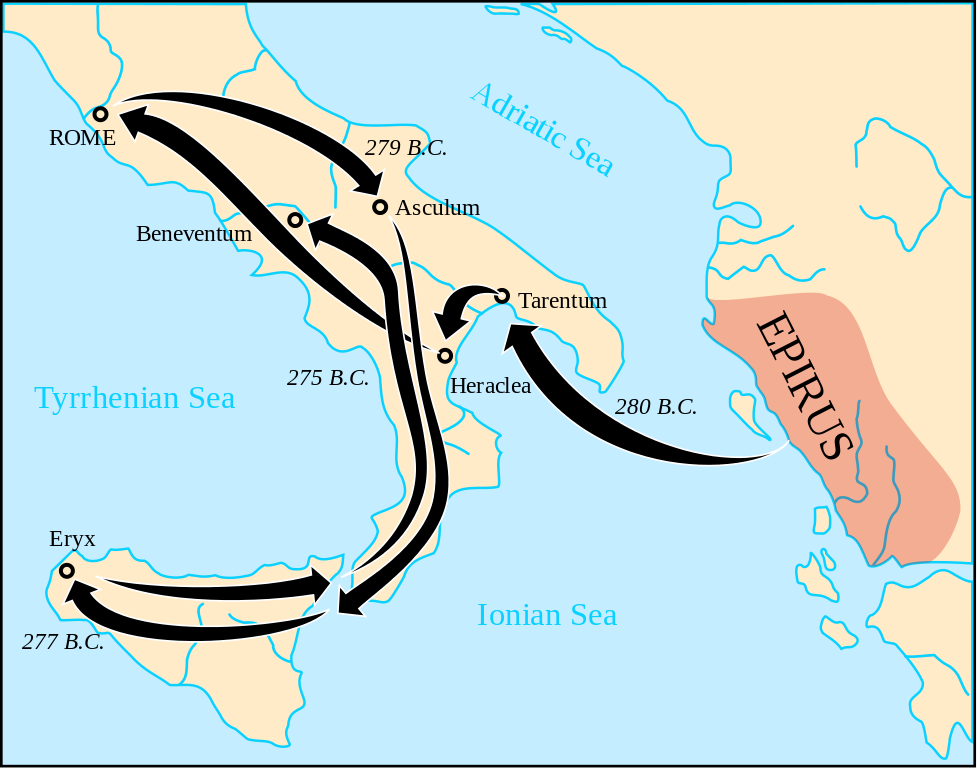
A fairly handy map of Pyrrhus’ campaigns (though some of the detail is lost in the big sweeping arrows). What is notable is, apart from Pyrrhus’ lightning raid into Latium in 280, he is almost invariably fighting in “friendly” territory, either in Lucania (Heraclea), Apulia (Asculum) or Samnium (Beneventum), the lands of his allies. Pyrrhus never fights an actual pitched battle on Roman-controlled territory, which I think speaks to his strategic intent: to carve out a kingdom in Greater Greece, not to conquer the whole of Italy.
Wikimedia Commons.The battle was defined by Pyrrhus’ use of terrain – Pyrrhus thought delay might be wiser (to link up with his allies) but left a blocking force on the river (the Romans being on the other side). The Romans responded by forcing the river – typical Roman aggression – but Plutarch at least thinks it caught Pyrrhus by surprise (he hadn’t fought Romans before) and so it leaves him in a scramble. He charges his cavalry (Plut. Pyrrh. 16.5) to give his main phalanx time to form up for battle resulting in what seems like a cavalry engagement near the river. Pyrrhus nearly gets himself killed in the fighting, but survives and falls back to his main infantry force, which then met the Romans in an infantry clash. The infantry fighting was fierce according to Plutarch and Pyrrhus, still shaken from being almost killed, had to come out and rally his troops. In the end, the Romans are described as hemmed in by Pyrrhus’ infantry and elephants before some of his Greek cavalry – from Thessaly, the best horse-country in Greece – delivers the decisive blow, routing the Roman force.
It is, on the one hand, a good example of the Hellenistic army “kit” using almost all of its tactical elements: an initial – presumably light infantry – screen holding the river, followed by a cavalry screen to enable the phalanx to deploy, then a fierce and even infantry fight, finally decided by what seems to be flanking actions by cavalry and elephants. Plutarch (Pyrrh. 17.4) gives two sets of casualty figures, one from Dionysius and another from Hieronymus; the former says that the Romans lost 15,000 to Pyrrhus’ 13,000 killed, the latter that the Romans lost 7,000 to Pyrrhus’ just a bit less than 4,000 killed. The latter seems almost certainly more accurate. In either case, the Roman losses were heavier, but Pyrrhus’ losses were significant and as Plutarch notes, his losses were among his best troops.
Even in the best case, in victory, Pyrrhus had lost around 15% of his force (~4,000 out of 28,000), a heavy set of losses. Indeed, normally if an army loses 15% of its total number in a battle, we might well assume they lost. Roman losses, as noted, were heavier still, but as we’ve discussed, the Romans have strategic depth (in both geography, political will and military reserves) – Pyrrhus does not. By contrast, Alexander III reportedly wins at Issus (333) with just 150 dead (and another 4,802 wounded or missing; out of c. 37,000) and at Gaugamela (331) with roughly 1,500 losses (out of c. 47,000). The Romans will win at Cynoscephelae (197) with just 700 killed.
This isn’t, I think, a product of Pyrrhus failing at all, but rather a product of the attritional nature of Roman armies: even in defeat they draw blood. Even Hannibal’s great victory at Cannae (216) costs him 5,700 men, according to Polybius (more, according to Livy). But the problem for Pyrrhus is that his relatively fragile Hellenistic army isn’t built to repeatedly take those kinds of hits: Pyrrhus instead really needs big blow-out victories where he takes few losses and destroys or demoralizes his enemy. And the Roman military system does not offer such one-sided battles often.
Nevertheless, Pyrrhus shows that a Hellenistic army, capable handled, could beat a third-century Roman army, albeit not cleanly, and that is well worth noting.
Bret Devereaux, “Collections: Phalanx’s Twilight, Legion’s Triumph, Part IIIb: Pyrrhus”, A Collection of Unmitigated Pedantry, 2024-03-08.
1. I should note, this is Kent’s assessment as well.