
Theory-of-mind is our intuitive model of how the mind works. It has no relation to intellectual theories about how the mind is made of cognitive algorithms or instantiated on neurons in the brain. Every schoolchild has a theory-of-mind. It usually goes like this: the mind is an imaginary space containing things like thoughts, emotions, and desires. I have mine and you have yours. I can see what’s inside my mind, but not what’s inside your mind, and vice versa. I mostly choose the things that are in my mind at any given time: I will thoughts to happen, and they happen; I will myself to make a decision, and it gets made. This needs a resource called willpower; if I don’t have enough willpower, sometimes the things that happen in my mind aren’t the ones I want. When important things happen, sometimes my mind gets strong emotions; this is natural, but I need to use lots of willpower to make sure I don’t get overwhelmed by them and make bad decisions.
All this seems so obvious to most people that it sounds like common sense rather than theory. It isn’t; it has to be learned. Very young children don’t start out with theory of mind. They can’t separate themselves from their emotions; it’s not natural for them to say “I’m really angry now, but that’s just a thing I’m feeling, I don’t actually hate you”. It’s not even clear to them that people’s minds contain different things; children are famously unable to figure out that a playmate who has different evidence than they do may draw different conclusions.
And the learning isn’t just a process of passively sitting back observing your own mind until you figure out how it works. You learn it from your parents. Parents are always telling their kids that “I think this” and “What do you think?” and “You look sad” and “It makes me feel sad when you do that”. Eventually it all sinks in. Kids learn their parent’s theory-of-mind the same way they learn their parents’ language or religion.
When in human history did theory-of-mind first arise? It couldn’t have been a single invention – more like a gradual process of refinement. “The unconscious” only really entered our theory-of-mind with Freud. Statements like “my abuse gave me a lot of baggage that I’m still working through” involves a theory-of-mind that would have been incomprehensible a few centuries ago. It’s like “I’m clicking on an icon with my mouse” – every individual word would have made sense, but the gestalt would be nonsensical.
Still, everyone always assumes that the absolute basics – mind as a metaphorical space containing beliefs and emotions, people having thoughts and making decisions – must go back so far that their origins are lost in the mists of time, attributable only to nameless ape-men.
Scott Alexander, “Book Review: Origin Of Consciousness In The Breakdown Of The Bicameral Mind”, Slate Star Codex, 2020-06-01.
June 2, 2021
QotD: The evolution of theory-of-mind
May 31, 2021
QotD: Contemporary architecture hates you
Another thing you will often hear from design-school types is that contemporary architecture is honest. It doesn’t rely on the forms and usages of the past, and it is not interested in coddling you and your dumb feelings. Wake up, sheeple! Your boss hates you, and your bloodsucking landlord too, and your government fully intends to grind you between its gears. That’s the world we live in! Get used to it! Fans of Brutalism — the blocky-industrial-concrete school of architecture — are quick to emphasize that these buildings tell it like it is, as if this somehow excused the fact that they look, at best, dreary, and, at worst, like the headquarters of some kind of post-apocalyptic totalitarian dictatorship.
Brianna Rennix and Nathan J. Robinson, “Why You Hate Contemporary Architecture”, Current Affairs, 2017-10-31.
May 30, 2021
The Stanford Prison “Experiment”
In another of the anonymous book reviews at Scott Alexander’s Astral Codex Ten, a look at the infamous Stanford Prison Experiment:
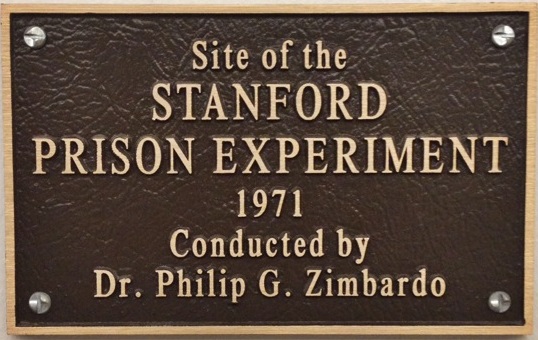
The second most famous psychology experiment in history is the Stanford Prison experiment. Philip Zimbardo split a group of undergrads at random into prisoners and guards. The guards were left free to choose how they would manage the prisoners, and within days the whole thing had to be called off as it had descended into a sadistic torture camp. At least that’s how Zimbardo has described it for the last 50 years. In fact, everything I just said is completely false. The undergrads were not split at random — the scheme had actually been dreamt up by an undergrad called David Jaffe who had run a previous experiment himself on abusing prisoners in a fake jail. He was carefully placed into the guards group. Nor were the guards left to choose their methods, instead they were briefed by Zimbardo and Jaffe that the purpose of the experiment (for which they were being well renumerated) was to see how people cracked under pressure. The experiment would be a failure unless they could put the prisoners under terrible stress. Even Douglas Korpi’s prisoner breakdown on day two, which, captured on camera, became the cinematic face of the experiment, was a fake he put on after discovering he wouldn’t be able to spend the time in jail revising, and being told he would only be allowed to quit if he suffered some sort of serious mental or physical breakdown.
Despite the pressure from Zimbardo and Jaffe, two thirds of the guards refused to take part in sadistic games, and much to their frustration a third continued to treat the prisoners with kindness. Nonetheless when Zimbardo came to write up the experiment about the effects on the prisoners, he realised it would be a much more compelling story if he turned it on its head, and made it about the guards instead. The truth of guards carefully drilled to be sadistic was swept away with a lie of ordinary people spontaneously becoming cruel when dressed in a uniform and given a position of power.
For years no one replicated the experiment — given the results first time round it was thought unethical, but in 2001 the BBC in search of new reality television commissioned a repeat (turns out reality television runs to different ethics than the average psychology department). Now unlike normal reality TV they didn’t bother manipulating the participants to be at each other’s throats — there was no need, in days it was going to be a bloodbath.
The result is the four most boring hours of television ever recorded. Nothing happens. The guards sit around chatting. When tensions arise with the prisoners, they defuse them by talking to them nicely. On day 6 some prisoners escaped. They headed over to the guards’ canteen and all had a smoke together. On day 7 they voted in favour of turning the whole thing into a commune.
May 25, 2021
QotD: Doctors and individual freedom
Brian Micklethwait, “Curbing liberty — except when they should”, Samizdata, 2005-10-10.
May 23, 2021
QotD: The psychological impact of extended lockdowns
Theodore Dalrymple (TD): The first thing to say is that I do not like the term “mental health.” Was Isaac Newton mentally healthy, or Michelangelo? I think part of the problem is very concept of mental health. It implies that there is some state or condition of mind deviation from which is analogous to illness. Once this idea takes hold, it is clearly up to an expert to cure the person, or better still prevent him from getting ill in the first place. This expectation cannot be met, but the idea that it can be makes people more fragile.
Second, people clearly vary much in their response to confinements, lockdowns, closures of resorts of entertainment, etc. For myself, I have reached the age of misanthropy or self-sufficiency when these things make comparatively little difference to my life. I have plenty of space and plenty of things to do, in essence reading and writing. But that does not make me mentally healthier than a young man who is frustrated because he cannot play football with his friends and becomes ratty – moreover living in a very confined space.
Depression is so loosely defined a term that it has become almost valueless as a diagnosis. How often have you heard someone say “I’m unhappy” rather than “I’m depressed?” The semantic shift is very important. The proper response to someone who says that he is depressed is to give him antidepressants, even though these don’t work in the majority of cases, except as a placebo, and have potential side-effects. It is always tempting for people who are unhappy to drink alcohol – to drown their sorrows, as we say. Of course, if you drink too much, you might become really and truly depressed. A person who did not respond to the current situation with a little gloom would be odd.
Claudio Grass, “Theodore Dalrymple: Self-Control And Self-Respect Have Become Undervalued”, The Iconoclast, 2021-02-17.
May 21, 2021
QotD: Avoid situations that can “escalate fast”
Also, this is an answer to the question “You mean you carry a gun when you’re just doing yard work or shoveling snow?” Oh hell yes I do.
Also also, this is why I generally try and avoid getting involved in anyone else’s crazy day.
If someone’s acting up in public, I can apologize and disengage from the situation. If I really feel the need to, I can go complain about them on social media in private later and nobody’s gonna pop off and trigger a gunfight if I do.
If you carry a gun, any altercation can escalate into a gunfight. Deescalate. Avoid altercations.
Lastly, there is a problem experienced by people who haven’t been exposed to interpersonal violence of any type; they have no experience in reading the differences between bluffing and the real deal. It’s why you see these “You ain’t gonna shoot me!” situations.
People waving a gun just to let you know they have a gun is a very real phenomenon and doesn’t necessarily mean violence is imminent; they’re just letting you know that certain off-ramps from the situation are closed. Okay, you have a gun and I need to stop pushing. Cool, cool.
This guy? He was not that guy.
People say “You wouldn’t…” to people who are practically lighting off signal rockets to tell you that oh, yes the fuck they would and are, in fact, fixin’ to.
Tamara Keel, “Finding Out”, View From the Porch, 2021-02-05.
May 19, 2021
QotD: School is prison for kids
School is child prison. It’s forcing kids to spend their childhood — a happy time! a time of natural curiosity and exploration and wonder — sitting in un-air-conditioned blocky buildings, cramped into identical desks, listening to someone drone on about the difference between alliteration and assonance, desperate to even be able to fidget but knowing that if they do their teacher will yell at them, and maybe they’ll get a detention that extends their sentence even longer without parole. The anti-psychiatric-abuse community has invented the “Burrito Test” — if a place won’t let you microwave a burrito without asking permission, it’s an institution. Doesn’t matter if the name is “Center For Flourishing” or whatever and the aides are social workers in street clothes instead of nurses in scrubs — if it doesn’t pass the Burrito Test, it’s an institution. There is no way school will let you microwave a burrito without permission. THEY WILL NOT EVEN LET YOU GO TO THE BATHROOM WITHOUT PERMISSION. YOU HAVE TO RAISE YOUR HAND AND ASK YOUR TEACHER FOR SOMETHING CALLED “THE BATHROOM PASS” IN FRONT OF YOUR ENTIRE CLASS, AND IF SHE DOESN’T LIKE YOU, SHE CAN JUST SAY NO.
I don’t like actual prisons, the ones for criminals, but I will say this for them — people keep them around because they honestly believe they prevent crime. If someone found proof-positive that prisons didn’t prevent any crimes at all, but still suggested that we should keep sending people there, because it means we’d have “fewer middle-aged people on the streets” and “fewer adults forced to go home to empty apartments and houses”, then MAYBE YOU WOULD START TO UNDERSTAND HOW I FEEL ABOUT SENDING PEOPLE TO SCHOOL FOR THE SAME REASON.
I sometimes sit in on child psychiatrists’ case conferences, and I want to scream at them. There’s the kid who locks herself in the bathroom every morning so her parents can’t drag her to child prison, and her parents stand outside the bathroom door to yell at her for hours until she finally gives in and goes, and everyone is trying to medicate her or figure out how to remove the bathroom locks, and THEY ARE SOLVING THE WRONG PROBLEM. There are all the kids who had bedwetting or awful depression or constant panic attacks, and then as soon as the coronavirus caused the child prisons to shut down the kids mysteriously became instantly better. I have heard stories of kids bullied to the point where it would be unfair not to call it torture, and the child prisons respond according to Procedures which look very good on paper and hit all the right We-Are-Taking-This-Seriously buzzwords but somehow never result in the kids not being tortured every day, and if the kids’ parents were to stop bringing them to child prison every day to get tortured anew the cops would haul those parents to jail, and sometimes the only solution is the parents to switch them to the charter schools THAT FREDDIE DEBOER WANTS TO SHUT DOWN.
I see people on Twitter and Reddit post their stories from child prison, all of which they treat like it’s perfectly normal. The district that wanted to save money, so it banned teachers from turning the heat above 50 degrees in the depths of winter. The district that decided running was an unsafe activity, and so any child who ran or jumped or played other-than-sedately during recess would get sent to detention — yeah, that’s fine, let’s just make all our children spent the first 18 years of their life somewhere they’re not allowed to run, that’ll be totally normal child development. You might object that they can run at home, but of course teachers assign three hours of homework a day despite ample evidence that homework does not help learning. Preventing children from having any free time, or the ability to do any of the things they want to do seems to just be an end in itself. Every single doctor and psychologist in the world has pointed out that children and teens naturally follow a different sleep pattern than adults, probably closer to 12 PM to 9 AM than the average adult’s 10 – 7. Child prisons usually start around 7 or 8 AM, meaning any child who shows up on time is necessarily sleep-deprived in ways that probably harm their health and development.
School forces children to be confined in an uninhabitable environment, restrained from moving, and psychologically tortured in a state of profound sleep deprivation, under pain of imprisoning their parents if they refuse. The only possible justification for this is that it achieves some kind of profound social benefit like eliminating poverty. If it doesn’t, you might as well replace it with something less traumatizing, like child labor. The kid will still have to spend eight hours of their day toiling in a terrible environment, but at least they’ll get some pocket money! At least their boss can’t tell them to keep working off the clock under the guise of “homework”! I have worked as a medical resident, widely considered one of the most horrifying and abusive jobs it is possible to take in a First World country. I can say with absolute confidence that I would gladly do another four years of residency if the only alternative was another four years of high school.
Scott Alexander, “Book Review — The Cult of Smart”, Astral Codex Ten, 2021-02-17.
May 18, 2021
QotD: The imaginary problem of having “too much” choice
A famous scene in the film Moscow on the Hudson has Robin Williams as a Soviet immigrant collapsing at the sight of an American coffee aisle, circa 1984. Imagine what would happen in Starbucks.
A free economy multiplies variety, the better to serve buyers with different tastes and different needs and to give people the chance to experience different goods at different times. Arguing that this plenitude is inefficient went out decades ago. The problem with markets, the detractors now say, is that all these choices make us unhappy.
Virginia Postrel, “I’m Pro-Choice”, Forbes, 2005-03-28.
May 16, 2021
Gambling machines have come a long way from the “one-armed bandit” days
This is another reader book review for Scott Alexander’s Astral Codex Ten, looking at Addiction by Design: Machine Gambling in Las Vegas by Natasha Dow Schüll. I’m incredibly risk-averse, so I’ve never even set foot in a casino, but from this review I do not regret my aversion one tiny little bit:

“Hiking the Las Vegas casinos” by davduf is licensed under CC BY-ND 2.0


Sometimes employees at Netflix think, “Oh my god, we’re competing with FX, HBO, or Amazon” … [W]e actually compete with sleep.
Reed Hastings
Randomness is addictive, in rats. B. F. Skinner learned that when he created his eponymous rat boxes. The boxes had levers that, when pressed, dispensed food pellets. Rats in boxes where one press resulted in one pellet pressed the lever when hungry. But rats in boxes where one press randomly resulted in no, one, or many pellets, became addicted to pressing the lever. That mammalian attraction to randomness lies at the heart of all gambling.
But machine gambling is not like other kinds of gambling. The book overflows with metaphors straining to describe how machine gambling is the supercharged version of table games like poker, blackjack, and roulette. Machine gambling is deforestation ruining the rainforest of diverse table games. Machines are invasive kudzu outcompeting and killing the native table games. Machine gambling is the crack cocaine to table games’ cocaine.
In about two decades, machine gambling went from being a side attraction to keep wives busy while their husbands played table games to the source of 85% of casino profits. You know how shopping malls have benches for husbands to sit on while their wives shop in stores? Imagine that those benches became the mall. (If you’re reading this in 2025, shopping malls were, uh, a collection of permanent pop-up stores under the same roof.)
The first time I went to Vegas, I knew a few tricks casinos would use to encourage me to gamble too much. I knew the hotel rooms were purposefully cheap, to entice me to visit Vegas. I knew casinos would have neither windows nor clocks, to help me lose my sense of time. I knew they would be full of bright lights and loud sounds, to overstimulate me. I knew nothing. Those tricks are old hat, as quaint as doilies. Machine gambling is a brave new world.
Machine gambling comes in the form of many games, but one example is enough to illustrate the pattern, so let’s discuss slot machines. Slot machines are games with reels with a variety of symbols on them, like cherries, diamonds, or the number 7. (Fun fact: fruit symbols were initially used on slot machines during the prohibition era to disguise them as gum vending machines.) The game is simple. The player spins the reels. If they land to show symbols in a row, the player wins. Because of their simplicity, these machines are favored by new gamblers and tourists.
Back when Moore’s Law was just Moore’s Prediction, slot machines were mechanical devices. The player would pull on a mechanical lever, which caused reels to spin. The reels would eventually slow down and then stop. The symbols in the middle of the screen when the reels stopped dictated whether the player won or lost.
Now, slot machines are digital. The lever, the reels, the symbols — they are all ones and zeros untethered from reality. This gives machine designers a terrifying amount of flexibility. They can optimize the game to maximize its addictivity.
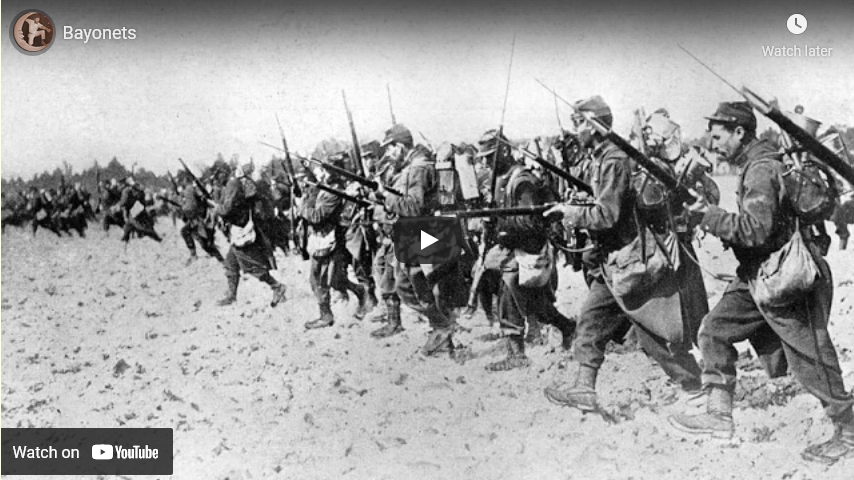
Bayonets
Lindybeige
Published 26 Feb 2011A weapon can be very effective even if it never actually kills anyone.
Support me on Patreon: https://www.patreon.com/Lindybeige
Lindybeige: a channel of archaeology, ancient and medieval warfare, rants, swing dance, travelogues, evolution, and whatever else occurs to me to make.
▼ Follow me…
Twitter: https://twitter.com/Lindybeige I may have some drivel to contribute to the Twittersphere, plus you get notice of uploads.
website: www.LloydianAspects.co.uk
May 11, 2021
QotD: The (disappointing) sex lives of the rich and famous
Severian, “Junkies”, Rotten Chestnuts, 2021-01-18.
May 6, 2021
QotD: Bureaucracy and “Dunbar’s Number”
Dunbar’s number is a suggested cognitive limit to the number of people with whom one can maintain stable social relationships — relationships in which an individual knows who each person is and how each person relates to every other person … By using the average human brain size and extrapolating from the results of primates, [Dunbar] proposed that humans can comfortably maintain 150 stable relationships.
Wikipedia
Let’s stipulate that the “leader” of a “Dunbar Group” can effectively manage ALL of the group’s affairs. In our hypothetical community, “Dunbarville” (note that we’re doing a very Hobbesian “thought experiment” here), our leader – let’s call him Steve – can grasp the essentials of every issue facing the town. He doesn’t need to be an expert without portfolio. He doesn’t have to know all the ins-and-outs of, say, farming to be the effective leader of Dunbarville. However, he has to know that farming is a thing, the basics of how it’s done, understand the importance of well-maintained farms to the community, etc. Steve can delegate the management of Dunbarville’s kolkhoz to an experienced expert farmer, but Steve knows enough to be able to intervene effectively if the farm expert gets too big for his overalls.
Now consider what happens if Steve is any good at his job. Because Dunbarville’s kolkhoz is so well-managed, it can support a much larger population than 150. What does Steve do? Well, he knows that a population greater than 150 will be beyond his capacity to handle 100% effectively … but he also knows that forcing population restrictions on Dunbarville is the fastest way to get himself exiled, after which they’re going to have a baby boom anyway, so Steve does the best he can. In a few years he’s operating at 90% efficiency, then 70%, then 55%, because the community is simply growing too large for any one man to handle.
Now he has to delegate, and the delegation has to be permanent. Steve simply can’t keep up with everything that’s going on in the kolkhoz. So he delegates “kolkhoz management” to Gary. Gary’s not a bad guy – in fact, he’s the dude who managed the kolkhoz so well in the first place. But that task is, itself, now too big for even Gary to handle, so Gary hires some assistants. Worse, Gary knows he’s getting on in years, so to make sure the kolkhoz will keep working at peak, baby-boom-causing efficiency even after he’s gone, he sets up the Gary School of Farm Management …
And so forth, you get the point, we don’t have to run through the whole thing. That’s what I mean by “irreducible complexity” (IC). Once you clear the Dunbar Number, certain tasks have to be independently managed by cadres of experts who are only nominally answerable to the central authority. That’s where bureaucrats come in, and that’s where bureaucrats are good. Steve can’t manage ALL of Dunbarville’s affairs anymore, since it’s now a bustling community of 1,500, but he can manage the 150 bureaucrats who report to him. And since those bureaucrats are supervising only 150 people themselves …
Bureaucrats are, in effect, the re-imposition of a Dunbar Number on an increasingly complex society. When I say that the Roman Empire, for example, was under-bureaucratized, that’s what I mean. Maybe the Emperor had the good sense to limit his high officials to 150, but they had to manage 400 lower officials each, and each of those 400 were responsible for 20,000 peasants, or whatever the numbers actually were. That’s “irreducible complexity,” org-charts version. Unless you’ve got a perfectly balanced ratio of managers to managed, things are going to get very fuzzy at the edges, very fast … and that’s of course assuming complete competence on everyone’s part.
Severian, “Anticipations and Objections (I)”, Founding Questions, 2020-12-16.
April 25, 2021
The causes and effects of “ostrich parasitic syndrome”
Barbara Kay on Canadian academic Gad Saad, who sometimes lets his “inner honey badger” get out on social media:

Gad Saad 2010 JMSB Faculty Portrait
Saad, 57, is a professor of marketing at the John Molson School of Business at Montreal’s Concordia University. His domain is evolutionary psychology as applied to business — a niche field, to be sure. He’s written such papers as “Gender differences in information search strategies for a Christmas gift,” and “Menstrual cycle effects on prosocial orientation, gift giving and charitable giving,” which provide valuable information to guide marketing strategies.
You’d be hard pressed to find any academic in Canada who’s more deeply steeped in knowledge about the ineluctable differences between the sexes. (Speaking of “the sexes,” business schools may be the last places left in academia to use those words to designate men and women and acknowledge their differences. Perhaps because their students want to succeed in the real world.)
[…]
Since then, Saad has understood the absolute necessity for critical thinking and freedom of speech. In the present, unhealthy climate, feelings rule, while critical thinking’s value declines daily. Just as our immune systems are designed to cope with novel intruders or atrophy, if we live in an intellectual bubble — as university students do now, rarely confronting opposing views — our cognitive immune systems atrophy, Saad says.
The consequence is what Saad calls “ostrich parasitic syndrome” (OPS). This disorder, in his words, “causes a person to deny realities that are otherwise as clear as the existence of gravity.” Science, reason, infinite data, common sense — all are rejected.
Cognitively disarmed, OPS sufferers accept alternate realities: climate change is “related to terrorism” (Bill Nye, the “science guy”); it is “gross and racist” to suggest Islam is connected to Islamism (Ben Affleck); the Israeli military “dehumanizes” Palestinian women by choosing not to rape them (not a typo: this was the thrust of an award-winning thesis by a radically leftist Israeli sociologist); men can literally be women (nearly everyone says this now, for fear of being labelled transphobic).
It used to be that you could “stand off on the sidelines” when you called out postmodern BS. No longer. There’s no middle ground anymore. You call out the BS or you keep schtum. If you choose the former, as Saad’s writing and actions demonstrate, you need to cultivate your own inner honey badger. Nothing else works.
April 1, 2021
QotD: Mistakes
Herman Lincoln Wayland
March 22, 2021
QotD: Signalling
These days, you will hear guys on the alt-right talk about counter-signalling. The easiest example of this is the newly minted rich guy going out and buying expensive display items, like cars or gaudy homes. NBA players are prone to this. They want to signal their wealth by acquiring highly visible, expensive items. An old money guy, in contrast, counter-signals by living in an old farmhouse that has been in the family for generations and driving a 40 year old Saab. He’s the sort of rich that feels no need to advertise it.
Signalling is a basic human trait. We all do it to one degree or another. Walk into a prison and you will see an array of tattoos on the inmates. These will signal gang affiliations, time served in the system, facilities in which the inmate has served and the individual’s violence capital. That last part is an important part of keeping the peace. To civilians, a face tattoo is always scary, but in jail, the right neck tattoo can tell other inmates that they are in the presence of an accomplished killer for a particular prison gang.
Virtue signalling and danger signalling are the easiest to understand, but people also use verbal and non-verbal signals to indicate trust or test the trustworthiness of others. A criminal organization, for example, will have a new member commit a pointless crime to demonstrate their trustworthiness. This is not just to sort out police informants, as is portrayed on television. It’s mostly to ascertain the willingness of the person to commit to the life of the organization. It’s hard to be a criminal if you will not commit crimes.
Outlaw biker culture is a good example of the use of signalling to establish trust relationships. Bikers have always, for example, adopted Nazi symbols as part of their display items. Bikers are not sitting around reading Julius Evola. What they are doing is signalling their complete rejection of the prevailing morality. By adopting taboo symbols and clothing, the outlaw biker is letting other bikers know his status, as much as he is letting the squares know he is a dangerous guy, who should be avoided.
The Z Man, “Codes of the Underworld”, The Z Blog, 2017-07-26.


