
There’s a clichéd history of civilization which goes something like: once upon a time all human beings lived in wandering hunter-gatherer bands where everybody was directly involved in food production. Then while sojourning through a fertile river valley, some of these groups discovered agriculture. The relative predictability and reliability of farming, coupled with the much higher caloric yield per hour of labor,1 made it possible to support a denser population, and for only a portion of it to be directly involved in food production. The rest of them could become soldiers, artisans, priests, and scribes. They could develop technology, pass on their knowledge through writing, and develop complex systems of taxation, bureaucracy, and forced labour. Along the way, they made picturesque little walled farming villages […]
This is not their story. Instead it’s the story of the people who live in the hills behind that village. Without knowing anything at all about the place that picture depicts, you can probably tell me a lot about the people in those hills. Hill people are hill people, the world over. What are the odds that they’re clannish? Xenophobic? Backwards! Unusual family structures. Economically immiserated (probably due to their own paranoia and indolence). Deviant in their religious, commercial, and sexual practices. Illiterate, or at best poorly-read. They also probably talk funny. Basically they’re barbarians, but not the impressive kind who ride out of the steppe to massacre and enslave the soft city-dwellers. No, something more like living fossils — our ancestors were once like that, but then they got with the program. Well if they could do it, why don’t those hill dwellers move down here too, like normal people?2 They’re up to no good up there.
That’s certainly been the traditional view from the valleys, and there’s some truth to it, but there’s one important detail that we valley-dwellers get wrong. Far from being aboriginal holdovers of some previous phase of humanity, it’s relatively easy to determine from genetic, linguistic, and archaeological evidence that the hill people are largely descended from … the valley people!3 But … that would mean that there are people who look around at our beautiful civilization and reject its fruits — you know, art, technology, fusion cuisine, and uh … taxation, conscription, epidemic disease, corvée labour … How dare they!
You would never know it from reading the reports of the valley-bureaucrats, but the great agricultural civilizations of classical antiquity were in a near-constant state of panic over people wandering away from their farms and becoming barbarians.4 There are estimates that over the course of the empire something like twenty-five percent of the inhabitants of Roman border provinces quietly slipped across the limes for the proud life of the savage. In Ancient China, the movement was more cyclical — in times of war, or epidemic, or famine, entire villages might give up rice agriculture and vanish into the hills. Then, when the situation had stabilized, the human tide would reverse, and the hills would disgorge barbarians eager to be Sinicized (or really re-Sinicized, as their parents and grandparents had been). In both these cases and more, the boundary between “civilized” and “savage” was a great deal more porous, and the flow a great deal more bi-directional than we might realize. Like a single substance in two phases, now boiling, now condensing, changing back and forth in response to changes in the temperature.
So why then is it that hill people5 the world over have so much in common? Scott argues pretty convincingly that something like convergent cultural evolution for ungovernability is at work — that is, the qualities we stereotypically associate with backwards and barbarous peoples are precisely the traits that make one difficult to administer and tax. Some examples of this are very obvious to see — for instance physical dispersal in difficult terrain makes it harder to be surveilled, measured, or conscripted. Scott also talks a lot about the crops that hill people like to grow, and how the world over they tend to be either crops that are amenable to swiddening and don’t require irrigation, or things like tubers that mature underground and can be harvested at irregular times. Both patterns make it easy to lie about how much food you’ve planted and where, hence difficult for others to tax or control you.
What about illiteracy? Scott finds that many hill people around the world have oral legends about how they once had writing, but no longer do. Of course this is exactly what we would expect if, contrary to the usual story, the hill people are not the ancestors of the valley people, but their descendants. Yet the question remains, why give up writing? Scott posits several benefits of illiteracy: one is just that the inability to write removes any temptation to keep written records of anything, and written records are the kind of thing that can be used against you by a tax collector or an army recruiter.
But more fundamentally, a reliance on oral history and genealogy and legend is powerful precisely because these things are mutable and can be changed according to political convenience. Anybody who’s read ancient Chinese accounts of the steppe peoples or Roman discussions of Germanic barbarians has probably recoiled from the confusing profusion of tribes, peoples, and nations; the same ethnonyms popping in and out of existence over a vast area, or referring to a band of a few hundred one year and a nation of millions a decade later. Scott argues that the reason we see this is that the very notion of stable ethnic identity is a fundamentally “valley” conceit. Out in the hills or on the far wild plains, people exist in more of a quantum superposition of identities, and the nonsensical patterns you see in the histories come from imperial ethnographers feverishly making classical measurements in a double-slit experiment and trying to jam the results into a sensible form.
John Psmith, “REVIEW: The Art of Not Being Governed by James C. Scott”, Mr. and Mrs. Psmith’s Bookshelf, 2023-01-16.
1. Scott has yet another book about how this important detail of the stock story is totally false. In Scott’s telling, early agriculture produced fewer calories per hour of work than hunting and foraging. The entire increase in social complexity associated with primitive agriculture came not from a food surplus, but from the fact that it was easier to measure how much food everybody was producing and confiscate a portion of it.
2. Maybe then one of their descendants can go to Yale Law School and write a book about it.
3. Next time you’re driving through Montana, try to count how many people are transplants from New York or California.
4. Once you know this fact, you can go back and read those classical texts esoterically, and nervous panic over people defecting from civilization is practically all you will see.
5. I’ve used “hill people” throughout this review as a synecdoche for groups that have rejected a life-pattern involving settled agriculture and tax-paying, but as Scott points out there are many kind of terrain unsuitable or difficult for state administration. Marshes have historically been another magnet for those rejecting polite society, as have deserts and open plains.
September 10, 2023
QotD: The hill people and the valley people
September 2, 2023
QotD: Ancient DNA
The wonderful thing about ancient DNA is it gives us an extreme case of this. Basically, the first serious attempt at creating a scientific field of archaeology was done by 19th century Germans, and they looked around and dug some stuff up and concluded that the prehistoric world looked like the world of Conan the Barbarian: lots of “population replacement”, which is a euphemism for genocide and/or systematic slavery and mass rape. This 19th century German theory then became popular with some 20th century Germans who … uh … made the whole thing fall out of fashion by trying to put it into practice.
After those 20th century Germans were squashed, any ideas they were even tangentially associated with them became very unfashionable, and so there was a scientific revolution in archaeology! I’m sure this was just crazy timing, and actually everybody rationally sat down and reexamined the evidence and came to the conclusion that the disgraced theory was wrong (lol, lmao). Whatever the case, the new view was that the prehistoric world was incredibly peaceful, and everybody was peacefully trading with one another, and this thing where sometimes in a geological stratum one kind of house totally disappears and is replaced by a different kind of house is just that everybody decided at once that the other kind of house was cooler. The high-water mark of this revisionist paradigm even had people saying that the Vikings were mostly peaceful traders who sailed around respecting the non-aggression principle.
And then people started sequencing ancient DNA and … it turns out the bad old 19th century Germans were correct about pretty much everything. The genetic record is one of whole peoples frequently disappearing or, even more commonly, all of the men disappearing and other men carrying off the dead men’s female relatives. There are some exceptions to this, but by and large the old theory wins.
I used to have a Bulgarian coworker, and I asked him one day how things were going in Bulgaria. He replied in that morose Slavic way with a long, sad disquisition about how the Bulgarian race was in its twilight, their land was being colonized by others, their sons and daughters flying off to strange lands and mixing their blood with that of alien peoples. I felt awkward at this point, and stammered something about that being very sad, at which point he came alive and declared: “it is not sad, it is not special, it is the Way Of The World”. He then launched into a lecture about how the Bulgarians weren’t even native to their land, but had been bribed into moving there by the Byzantines who used them as a blunt instrument to exterminate some other unruly tribes that were causing them trouble. “History is all the same,” he concluded, “we invaded and took their land, and now others invade us and take our land, it is the Way Of The World.”
Even a cursory study of history shows that my Bulgarian friend was correct about the Way Of The World. There’s a kind of guilty white liberal who believes that European colonization and enslavement of others is some unique historical horror, a view that has now graduated into official state ideology in America. But that belief is just a weird sort of inverted narcissism. I guess pretending white people are uniquely bad at least makes them feel special, but white people are not special. Mass migration, colonization, population replacement, genocide, and slavery are the Way Of The World, and ancient DNA teaches us that it’s been the Way Of The World far longer than writing or agriculture have existed. It wasn’t civilization that corrupted us, there are no noble savages, “history is all the same”, an infinite history of blood.
Land acknowledgments always struck me as especially funny and stupid: like you really think those people were the first ones there? What about acknowledging the people that they stole it from? Sure enough one of the coolest parts of Reich’s book is his recounting the discovery that there were probably unrelated peoples in the Americas before the ancestors of the American Indians arrived here, and that a tiny remnant of them might even remain deep in Amazonia. So: what does it actually mean to be “indigenous”? Is anybody anywhere actually “indigenous”?
Jane Psmith and John Psmith, “JOINT REVIEW: Who We Are and How We Got Here, by David Reich”, Mr. and Mrs. Psmith’s Bookshelf, 2023-05-29.
August 26, 2023
QotD: The psychological value of “making”
This makes perfect sense, of course: I don’t have a deep and intimate knowledge of these things because I don’t need one. Still, though, it’s important to have a certain very basic familiarity with how the things around you work — enough, say, to know what to Google when something breaks and how to put the results into practice, or to turn fifteen feet of arching blackberry cane into an actual bush — because it gives you power over your world. The particular powers don’t really matter (it’s easy enough to pay someone else to fix your plumbing or grow your berries); the key is the patterns of thought they engender. There are, for example, apparently some enormous number of people who don’t change the batteries in their beeping smoke detectors. I have no idea whether it’s drug-induced apathy, ignorance of how things work (in the same way that drilling a hole in your wall to hang something seems scary if you don’t know that your wall is
a liejust painted drywall in front of empty space between the studs), or simply a pathological lack of personal agency, but it’s hard to believe you can change anything dissatisfactory about your life if you can’t change a 9V battery.Making and doing things, even when you don’t have to, is practice in believing that you can change your own world. It’s weightlifting for agency. You can outsource the making of your physical world, but social worlds — the arrangement of your family life, your personal relationships, the organizations and institutions you’re involved in — must be created by the participants themselves. A good society would be one where the default “builder-grade” scripts lead to human flourishing, but unfortunately that isn’t ours, so you have to be able to decide on your own changes. Start practicing now: find one little thing about your physical environment that annoys you and fix it. Put the new toilet paper roll actually on the holder. Replace the burned-out lightbulb. Hang the artwork that’s listing drunkenly against the wall. Pull some weeds. And then, once you’ve warmed up a little bit, go and make something new.
Jane Psmith, “REVIEW: The Domestic Revolution by Ruth Goodman”, Mr. and Mrs. Psmith’s Bookshelf, 2023-05-22.
1. They’re oak dining chairs, probably (judging by the construction) about a hundred years old, and they looked a lot better on Facebook Marketplace than in real life. When I showed up to buy them, the sellers turned out to be an elderly couple moving to assisted living in six hours; they admired my baby and showed me pictures of their grandchildren and explained they had inherited the chairs from the wife’s mother, who in turn had gotten them from her friend’s mother, and by this point I couldn’t really say “yeah I can tell” and leave, so home they came. When I took apart the seats to recover them I discovered the original horsehair padding and some extremely questionable techniques applied over the years, but anyway now my chairs have eight-way hand-tied springs and I have some new calluses.
August 23, 2023
From “hunter-gatherer” to “settled farmer” as a Just-so story
The latest book review at Mr. and Mrs. Psmith’s Bookshelf is James C. Scott’s Against the Grain: A Deep History of the Earliest States by Jane Psmith:
Okay, stop me if you’ve heard this one already. So, there are these hunter-gatherers, right, and one of the things they like to gather, while they’re roaming around the hilly flanks of Anatolia following herds of gazelles, is the large, carbohydrate-rich seeds of local grasses. Then one day some bright soul gets the idea of planting the seeds on purpose, people selectively replant the ones that have exciting mutations like “have really big seeds” and “don’t shatter your stalk and scatter your really big seeds everywhere when they’re ripe, just hang out and wait to be reaped,” and they all start staying in one place to tend their fields. They quickly discover that agriculture can create a lot more calories than foraging, so all of a sudden they have a nice surplus that can go towards supporting non-food-producing specialists like dedicated craftsmen, priests, bureaucrats (but I repeat myself) and kings to expedite and organize all that agricultural labor, and, hey presto! you have civilization.
Oh, cool, you read Guns, Germs, and Steel in high school too?
Only James C. Scott is here to tell you that’s not how it happened. And while you might be excused for thinking (especially if you’ve read our review of The Art of Not Being Governed) that this is Scott doing his contrarian “ooh, look, I’m turning the accepted narrative on its head” thing, you would be wrong. (Don’t worry, though, we definitely will get to the point where he does that.) He’s just offering a summary of the new scholarly consensus: the transition from mobile bands of hunter-gatherers to sedentary agriculturalists didn’t follow that neat logical progression, and it was far patchier, more tenuous, and more bidirectional than generally assumed. In fact, practically since the moment in the late 1920s that V. Gordon Childe coined the term “Neolithic revolution“, archaeological evidence has been accumulating that complicates every aspect of the story I just told you, from agriculture to sedentism to state formation.
To begin with, what constitutes agriculture? Back in the 1960s, paleobotanist Jack Harlan used a flint sickle to harvest enough wild Anatolian wheat in just three weeks to feed a family for an entire year. Now, we can probably agree that just harvesting a stand of wild wheat and storing the grain doesn’t really count as agriculture, but what about pulling up the non-wheat interlopers from a half-ripe stand you hope to harvest later in the year? What about saving some seeds and tossing them on a welcoming plot of soil next spring? What about digging up or burning other plants to make that welcoming plot? And then it turns out that all the harvesting and processing tools — those sickles, winnowing baskets, grindstones, and even purpose-built granaries — seem to have existed before there was any intentional cultivation, suggesting wandering tribes who came together only at harvest time but spent most of the year apart. Also, it seems all like those exciting morphological changes that make grain agriculture so efficient (big seeds and non-brittle rachis) come hundreds and hundreds of years after agriculture was established.1 Our simple story is already getting complicated! But it gets worse.
Archaeologists used to assume that sedentism — that is, people staying in one place year-round — and agriculture necessarily went together. In one direction this is obvious, because once you’re feeding your family from a particular plot of ground you probably want to stick around to weed and water it and keep away any animals (or other people) who might swoop in at the last minute and take your harvest. But it goes the other way, too: we generally assume that pickings as a hunter-gatherer are slim enough that your group needs to keep moving around to find more food. (Or, in the immortal words of the Minnesota Educational Computing Consortium: “if you continue to hunt in this area, game will become scarce.”) This is actually true at higher trophic levels: large animals tend to migrate throughout the year, so people whose subsistence strategies depend heavily on hunting them will follow the herds. But hunter-gatherer mobility is a tendency, not an iron law, and the archaeological (and even historical) record is full of non-agricultural peoples who lived in one place year-round because their environment was rich enough to support it. This was common among the tribes of the Pacific Northwest, who created quite socially and materially complex cultures without agriculture, but it also shows up plenty of other places. The earliest sedentary culture we know about, the Natufians, flourished along the coast of what is now Israel more than thirteen thousand years ago, largely by gathering wild grains and hunting gazelles.
Do note, though, that it would be a mistake to call these non-agricultural environments “natural”, because humans have been actively managing our landscapes for at least a million years. The main tool before the widespread adoption of agriculture was fire, which can be used to stampede prey animals into a trap or to remove unwanted vegetation and make way for the grasses and shrubs that we, or our preferred prey, like to eat. “The game they subsequently bagged,” Scott writes, “represented a kind of harvesting of prey animals they had deliberately assembled by carefully creating a habitat they would find enticing”. It’s even been suggested that the Little Ice Age of the early modern period was due to the sudden cessation of burning activity (and its CO2 emissions) in the Americas when newly-introduced Old World pathogens killed off most of the people who did the burning.
Against the Grain focuses on the region archaeologists call Southwest Asia, people who like reading books about archaeology call the Fertile Crescent, and everyone else calls the Near and Middle East, but it zeroes in specifically on southern Mesopotamia. This wasn’t the first place to host year-round settlements, nor was it the site of the original crop domestications, but it is the home of the third element of the traditional story of the birth of civilization: the state. Scott is unwilling to define the state precisely, describing it instead as an “institutional continuum” where something can be more or less state-like, but he writes that “a polity with a king, specialized administrative staff, social hierarchy, a monumental center, city walls, and tax collections and distribution is certainly a ‘state’ in the strong sense of the term”. It was here, near the mouth of the Euphrates on the Persian Gulf, that the earliest “statelets” arose, and it’s here, once again, that Scott brings up recent archaeological evidence that undermines the usual narrative. This time, the abandoned theory is that the region was as arid at the dawn of agriculture as it is today; an agricultural population might have succeeded in the oases and river valleys, but as numbers swelled they would need to undertake massive irrigation projects, which would in turn require “the mobilization of labor to dig and maintain the canals, which implied the existence of a public authority capable of assembling and disciplining that labor force”. In short, agriculture was assumed to have required a state. But it didn’t.
Scott’s argument draws heavily on the work of Jennifer Pournelle, who reconstructed the landscape of the southern Mesopotamian alluvium in the seventh and sixth centuries BC using a combination of remote sensing, ancient sediments, and climatological history, and concluded that, far from the arid landscape of today, the land between the rivers was in fact an “intricate deltaic wetland.”
The inhabitants of these marshes lived on what are called “turtlebacks,” small patches of slightly higher ground, comparable to cheniers in the Mississippi delta, often no more than a meter or so above the high-water mark. From these turtlebacks, inhabitants exploited virtually all the wetland resources within reach: reeds and sedges for building and food, a great variety of edible plants (club rush, cattails, water lily, bulrush), tortoises, fish, mollusks, crustaceans, birds, waterfowl, small mammals, and migrating gazelles that provided a major source of protein. The combination of rich alluvial soils with an estuary of two great rivers teeming with nutrients, dead and alive, made for an exceptionally rich riparian life that in turn attracted huge number of fish, turtles, birds, and mammals — not to mention humans! — preying on creatures lower on the food chain.
Moreover, the first settlements in the area were right on the border between the brackish water of the coastal estuary and the freshwater ecology upstream, and on the incredibly flat floodplain of the lower Euphrates (the gradient is less than two inches per mile) that seam moved great distances with the tides. “Thus,” Scott writes, “for a large number of communities, the two ecological zones moved across the landscape while they remained stationary, taking sustenance from both”. They didn’t need to roam in search of new food sources; the food came to them. Agriculture — of the flood-retreat form, where seeds are sown in nutrient-rich new soils deposited by the retreating river, and which is the least labor-intensive type possible — was just another of their many diverse and overlapping subsistence strategies. The shift between wet and dry season, with its pulse of migrating animals and harvest of whatever seeds they had sown, can be considered moving zones on a longer timescale: a new habitat arriving on their doorstep to be added to the mosaic of available options. By 6000 BC, Scott says, they were “already agriculturalists and pastoralists as well as hunter-gatherers. It’s just that so long as there were abundant stands of wild foods they could gather and annual migrations of waterfowl and gazelles they could hunt, there was no earthly reason they would risk relying mainly, let along exclusively, on labor-intensive farming and livestock rearing.”
Thus do we, with James C. Scott, reject the old model in which agriculture leads almost at once to both sedentism and the state. Instead, we see sedentism arise in particularly favorable ecological niches as early as 12,000 BC, with most of the main founder crops and animals domesticated between 8000 and 6000 BC, and then a gap of almost four thousand years before the appearance of the state. A naively Whiggish view of history might ask, “What took so long?” But James C. Scott, being James C. Scott (yes, here we’re coming to the “turn it on its head” bit), thinks the more accurate question might be, “What went wrong?”
1. For more on this, Scott suggests this 2013 paper.
August 17, 2023
“… the Chinese invented gunpowder and had it for six hundred years, but couldn’t see its military applications and only used it for fireworks”
John Psmith would like to debunk the claim in the headline here:
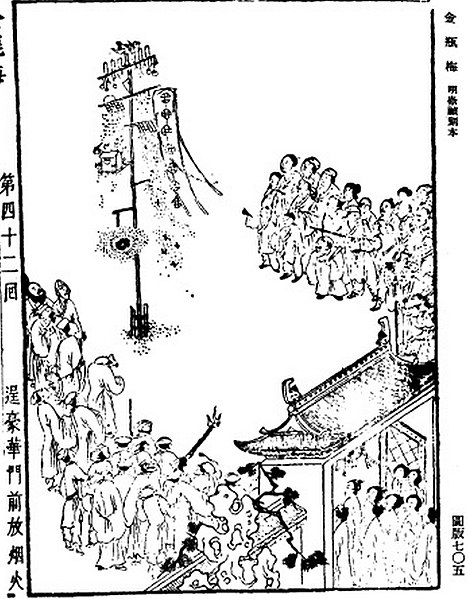
An illustration of a fireworks display from the 1628-1643 edition of the Ming dynasty book Jin Ping Mei (1628-1643 edition).
Reproduced in Joseph Needham (1986). Science and Civilisation in China, Volume 5: Chemistry and Chemical Technology, Part 7: Military Technology: The Gunpowder Epic. Cambridge University Press. Page 142.
There’s an old trope that the Chinese invented gunpowder and had it for six hundred years, but couldn’t see its military applications and only used it for fireworks. I still see this claim made all over the place, which surprises me because it’s more than just wrong, it’s implausible to anybody with any understanding of human nature.
Long before the discovery of gunpowder, the ancient Chinese were adept at the production of toxic smoke for insecticidal, fumigation, and military purposes. Siege engines containing vast pumps and furnaces for smoking out defenders are well attested as early as the 4th century. These preparations often contained lime or arsenic to make them extra nasty, and there’s a good chance that frequent use of the latter substance was what enabled early recognition of the properties of saltpetre, since arsenic can heighten the incendiary effects of potassium nitrate.
By the 9th century, there are Taoist alchemical manuals warning not to combine charcoal, saltpetre, and sulphur, especially in the presence of arsenic. Nevertheless the temptation to burn the stuff was high — saltpetre is effective as a flux in smelting, and can liberate nitric acid, which was of extreme importance to sages pursuing the secret of longevity by dissolving diamonds, religious charms, and body parts into potions. Yes, the quest for the elixir of life brought about the powder that deals death.
And so the Chinese invented gunpowder, and then things immediately began moving very fast. In the early 10th century, we see it used in a primitive flame-thrower. By the year 1000, it’s incorporated into small grenades and into giant barrel bombs lobbed by trebuchets. By the middle of the 13th century, as the Song Dynasty was buckling under the Mongol onslaught, Chinese engineers had figured out that raising the nitrate content of a gunpowder mixture resulted in a much greater explosive effect. Shortly thereafter you begin seeing accounts of truly destructive explosions that bring down city walls or flatten buildings. All of this still at least a hundred years before the first mention of gunpowder in Europe.
Meanwhile, they had also been developing guns. Way back in the 950s (when the gunpowder formula was much weaker, and produced deflagarative sparks and flames rather than true explosions), people had already thought to mount containers of gunpowder onto the ends of spears and shove them in peoples’ faces. This invention was called the “fire lance”, and it was quickly refined and improved into a single-use, hand-held flamethrower that stuck around until the early 20th century.1 But some other inventive Chinese took the fire lances and made them much bigger, stuck them on tripods, and eventually started filling their mouths with bits of iron, broken pottery, glass, and other shrapnel. This happened right around when the formula for gunpowder was getting less deflagarative and more explosive, and pretty soon somebody put the two together and the cannon was born.
All told it’s about three and a half centuries from the first sage singing his eyebrows, to guns and cannons dominating the battlefield.2 Along the way what we see is not a gaggle of childlike orientals marvelling over fireworks and unable to conceive of military applications. We also don’t see an omnipotent despotism resisting technological change, or a hidebound bureaucracy maintaining an engineered stagnation. No, what we see is pretty much the opposite of these Western stereotypes of ancient Chinese society. We see a thriving ecosystem of opportunistic inventors and tacticians, striving to outcompete each other and producing a steady pace of technological change far beyond what Medieval Europe could accomplish.
Yet despite all of that, when in 1841 the iron-sided HMS Nemesis sailed into the First Opium War, the Chinese were utterly outclassed. For most of human history, the civilization cradled by the Yellow and the Yangtze was the most advanced on earth, but then in a period of just a century or two it was totally eclipsed by the upstart Europeans. This is the central paradox of the history of Chinese science and technology. So … why did it happen?
1. Needham says he heard of one used by pirates in the South China Sea in the 1920s to set rigging alight on the ships that they boarded.
2. I’ve left out a ton of weird gunpowder-based weaponry and evolutionary dead ends that happened along the way, but Needham’s book does a great job of covering them.
August 2, 2023
You say you want a revolution …
The latest book review from the Psmiths is Bernard Yack’s The Longing for Total Revolution: Philosophic Sources of Social Discontent from Rousseau to Marx and Nietzsche, by John Psmith:
This is a book by Bernard Yack. Who is Bernard Yack? Yack is fun, because for a mild-mannered liberal Canadian political theorist he’s dropped some dank truth-bombs over the years. For example, check out his short and punchy 2001 journal article “Popular Sovereignty and Nationalism” if you need a passive-aggressive gift for the democratic peace theorist in your life.1 The subject of that essay is unrelated to the subject of the book I’m reviewing, but the approach, the method, and the vibe are similar. The general Yack formula is to take some big trendy topic (like “nationalism”) and examine its deep philosophical and intellectual substructure while totally refusing to consider material conditions. He’s kind of like the anti-Marx — in Yack’s world not only do ideas have consequences, they’re about the only things that do. Even when this is unconvincing, it’s usually very interesting.
The topic of this book is radicalism in the ur-sense of “a desire to get to the root”. What Yack finds interesting about radicalism is that it’s so new. It’s a surprising fact that the entire idea of having a revolution, of burning down society and starting again with radically different institutions, was seemingly unthinkable until a certain point in history. It’s like nobody on planet Earth had the idea, and then suddenly sometime in the 17th or 18th century a switch flips and it’s all anybody is talking about. We’re used to that sort of pattern for scientific discoveries, or for very original ways of thinking about the universe, but “let’s destroy all of this and try again” isn’t an incredibly complex or sophisticated thought, so why did it take so many millennia for somebody to have it?
Well, first of all, is this claim even true? One thing you do see a lot of in premodern history is peasant rebellions, but dig a little deeper into any of them and the first thing you notice is that (sorry vulgar Marxists)2 there’s nothing especially “revolutionary” in any of these conflagrations. The most common cause of rebellion is some particular outrage, and the goal of the rebellion is generally the amelioration of that outrage, not the wholesale reordering of society as such. The next most common cause of rebellions is a bandit leader who is some variety of total psycho and gets really out of control. But again, prior to the dawn of the modern era, these psychos led movements that were remarkably undertheorized. The goal was sometimes for the psycho to become the new king, sometimes the extinguishment of all life on earth, but you hardly ever saw a manifesto demanding the end of kings as such. Again, this is weird, right? Is it really such a difficult conceptual leap to make?
Peasant rebellions are demotic movements, but modern revolutions are usually led by frustrated intellectuals and other surplus elites. When elites did get involved in pre-modern rebellions, their goals were still fairly narrow, like those of the peasants — sometimes they wanted to slightly weaken the power of the king, other times they wanted to replace the king with his cousin. But again this is just totally different in kind from the 18th century onwards, when intellectuals and nobles are spending practically all of their time sitting around in salons and cafés, debating whose plan for the total overhaul of society, morality, and economic relations is best.
The closest you get to this sort of thing is the tradition of Utopian literature, from Plato’s Republic to Thomas More, but what’s striking about this stuff is how much ironic distance it carried — nobody ever plotted terrorism to put Plato’s or More’s theories into practice. Nobody ever got really angry or excited about it. But skip forward to the radical theorizing of a Rousseau or a Marx or a Bakunin, and suddenly people are making plans to bomb schools because it might bring the Revolution five minutes closer. So what changed?
Well this is a Bernard Yack book, so the answer definitely isn’t the printing press. It also isn’t secularization, the Black Death, urbanization, the Reformation, the rise of industrial capitalism, the demographic transition, or any of the dozens of other massive material changes that various people have conjectured as the cause of radical political ferment. Instead Yack points to two abstract philosophical premises: the first is a belief in the possibility of “dehumanization”, the idea that one can be a human being and yet be living a less than human life. The second is “historicism” in the sense of a belief that different historical eras have fundamentally different modes of social interaction.
Both views had some historical precedent (for instance historicism is clearly evident in the writings of Machiavelli and Montesquieu), but it’s their combination that’s particularly explosive, and Rousseau is the first person to place the two elements together and thereby assemble a bomb. Because for Rousseau, unlike for any of the ancient or medieval philosophers, merely to be a member of the human species does not automatically mean you’re living a fully-human life. But if humanity is something you can grow into, then it’s also something that you can be prevented from growing into. Thus: “that I am not a better person becomes for Rousseau a grievance against the political order. Modern institutions have deformed me. They have made me the weak and miserable creature that I am.”
But what if the qualities of social interaction which have this dehumanizing effect are inextricably bound up with the dominant spirit of the age? In that case, it might be impossible to really live, impossible to produce happy and well-adjusted human beings, without a total overhaul of society and all of its institutions. This also clarifies how the longing for total revolution is distinct from utopianism — utopian literature is motivated by a vision of a better or more just order. Revolutionary longing springs from a hatred of existing institutions and what they’ve done to us. This is an important difference, because hate is a much more powerful motivator than hope. In fact Yack goes so far as to say (in a wonderfully dark passage) that the key action of philosophers and intellectuals upon history is the invention of new things to hate. Can you believe this guy is Canadian?
1. Of course, if my reading of MITI and the Japanese Miracle is correct, popular sovereignty may not be around for that much longer.
2. I say “vulgar” Marxists, because for the sophisticated Marxists (including Marx himself) it’s already pretty much dogma that premodern rebellions by immiserated peasants aren’t “revolutionary” in the way they care about.
July 19, 2023
Infohazards on the internet of lies lead us into the clutches of “egregores”
The latest review at Mr. and Mrs. Psmith’s Bookshelf from John Psmith, is on the 1872 novel Demons by Fyodor Dostoevsky”. I didn’t read the post immediately, as Russian literature and I aren’t even nodding acquaintances. I should have remembered that both of the Psmiths have an amazing ability to tell you a lot more than a “review” would normally contain, and this one certainly lived up to expectations, including a brief discussion of philosopher Charles Taylor’s ideas about pre-modern versus modern concepts of the self. Most pre-modern cultures believed in external influences having disproportional impact on the person, while most modern cultures believe the influences arise internally within the mind. Most pre-modern cultures also feared the self could be taken over, or possessed, by malevolent external entities, ideas, or thoughts:
Dostoevsky obligingly gives us a character who’s clearly possessed in exactly this sense — a dissolute nobleman around whom the various radical conspiracies swirl. He is, simultaneously, a subversion of the brooding Byronic hero archetype that was so popular in 19th century European literature, and an eerie anticipation of the modern concept of the serial killer. How did he get this way? Remember the modern view of our desires is that they come from within us, and indulging them leads to inner harmony. But the older and truer view is that they can come from outside, force their way into our skulls through an opening, set their hooks in our brains, lay their eggs. These fledgling desires start out small and weak, but to indulge them is to feed them, grow them, until they take over their host and move its mouth and limbs around like a puppet. In this sense the porn addict, the drug addict, and the rage addict are all alike: sensual dissipation gets boring eventually, and you need harder and harder stuff to feel the same thrill, until one day you reach for something so hard you lose yourself forever.
The Dostoevskian twist to all this is that the proto-serial killer is far more sympathetic, and ultimately more redeemable, than the revolutionaries. The radicals’ motivations spring from the same emotional source as his, theirs are just sublimated into politics, which is why the form of the dystopia doesn’t really matter to them, all that matters is that there be a boot stomping on a human face. The sexual sadism of the serial killer is unflinchingly portrayed as less disordered and less socially destructive than its political equivalent and, ultimately, as rather basic. It’s actually quite easy to miss all of this because it’s so deeply at odds with modern sensibilities. Not just “serial killers are better than communists actually,” but also “serial killers are really pretty boring actually,” and all from the guy who just invented serial killers.1
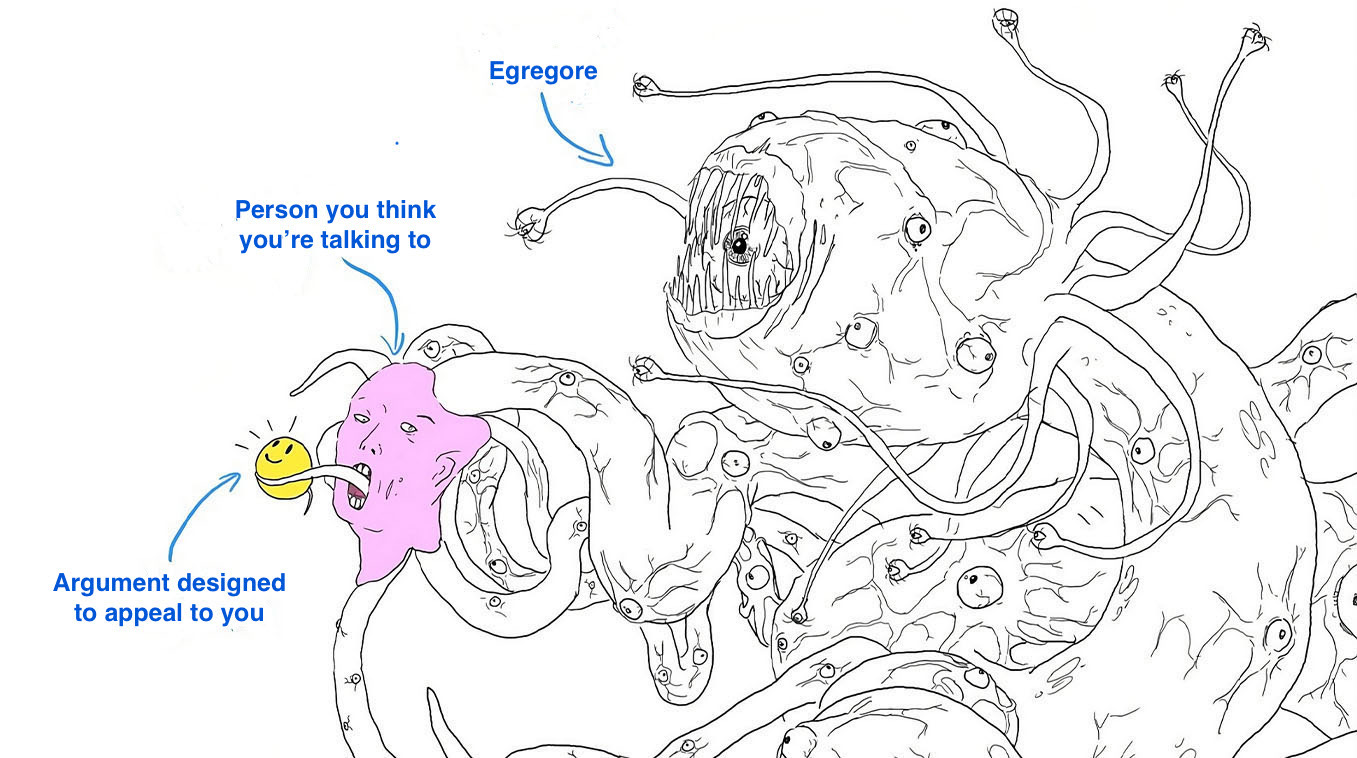
But what if the radicals aren’t sublimating anything at all? What if there’s another kind of demon, another kind of infohazard, another kind of meme, which rather than infecting or possessing individuals, instead tries to do that to entire societies? Such a being might still work through individuals, the way a Haitian voodoo spirit speaks through a chwal, but here the individual puppet is not a target, but rather an instrument or a transmission vector. The internet jargon for such a being is an “egregore,” and you’ve encountered them before: the bizarre fad that sweeps through a middle school class like a wildfire, the war fever that grips a nation and turns it overnight into a basket of bloodthirsty lunatics. Dance crazes, viral TikTok challenges, internet-mediated mental illnesses. There’s a classic Futurama gag involving the Brain Slug Party, but the real joke is that every party is the Brain Slug Party, they’re all egregores. Have you ever spoken with somebody who had hashtags in their Twitter bio? If you looked carefully, you may have seen the slender, silvery proboscis emerging from the back of their neck and vanishing into the ether. If you listened carefully, you may have heard the alien metallic clacking of the egregore’s mandibles, as it sent messages down that tube for the meat puppet to vocalize.
Sometime in the mid-19th century, an egregore was born in the Russian Empire. It went by a thousand different names — among them: anarchism, communism, nihilism, democracy. What’s that? Those four ideologies are completely opposed to one another? That’s the entire point! It wasn’t actually any of those things, it was an egregore, its true name was something like Melkhorbalai or Uztaa-Binoreth. It wore those other names like skins when it was convenient to do so, which is why in the real life history of 19th century Russia we see countless examples of individuals switching between communism, anarchism, and democracy like they were flavors of ice cream.
The egregore wanted none of these things: it wanted to grow, to spread, to manifest itself into this reality. Madly, it willed destruction, and the more destruction it caused the stronger it got, and the easier further destruction became, a runaway exothermic reaction endlessly feeding on itself. So the reformist zeal of the 1840s became Nechayev’s insane nihilism of the 1870s, then the even more insane terrorism of 1900-1917 with which I opened this review, until finally, strengthened by half a century of blood sacrifice, that rough beast slouched towards St. Petersburg to be born. The trauma of that birth ripped apart first Russia, then Europe, then it almost ate the rest of the world too.
Could anything have stopped it sooner? In Dostoevsky’s story there’s one character who tries lamely to stand in the way of the swirling, coalescing, immaterial malevolence. He is a reactionary, a newly-freed former serf,3 and (like Dostoevsky himself) a repentant former revolutionary. He’s young and hip, but has old and edgy views, a perfect stand-in for online “trads”. Given Dostoevsky’s own views it would be easy to make him the hero of the story, but Dostoevsky is too great a writer for that, and instead makes him a pathetic LARPer:
“I only wanted to know, do you believe in God, yourself?”
“I believe in Russia … I believe in her orthodoxy … I believe in the body of Christ … I believe that the new advent will take place in Russia … I believe …” Shatov muttered frantically.
“And in God? In God?”
“I … I will believe in God.”
How great a description is that of all the crusader-avatar twitter accounts named “DeusVult1571”? Imagine one of them blubbering: “I believe in based aesthetics … I believe in Western civilization … I believe in the Hajnal line … I believe …” Ah, but do you believe in God? Probably some of them do, but for many others it’s a pose, or a meme, or a philosophical premise that they must accept in order to turn the rest of the brand they’ve assumed into a self-consistent whole.2 For these, the god they worship is just another egregore — one small and weak for now, less threatening perhaps than some others, but feed it, let it grow, and see how fast it turns on you.
The other force that could have resisted the growing darkness is the parents’ generation, the liberals of 1848, Turgenev’s boomers. We already know how that turned out in real life, but while Dostoevsky didn’t live to see it happen, he had these peoples’ number. Once so bold in condemning their government and sneering at their civilization, they are suddenly timid in the face of their children, terrified of being seen as uncool or conservative or just not with it. That’s a good way to raise a psycho, and Dostoevsky more than hints that everything which follows is ultimately their fault. And it’s a bad way to face down an egregore. Doing that requires boldness and … well:
“But this is premature among us, premature,” he pronounced almost imploringly, pointing to the manifestoes.
“No, it’s not premature; you see you’re afraid, so it’s not premature.”
“But here, for instance, is an incitement to destroy churches.”
“And why not? You’re a sensible man, and of course you don’t believe in it yourself, but you know perfectly well that you need religion to brutalise the people. Truth is honester than falsehood …”
“I agree, I agree, I quite agree with you, but it is premature, premature in this country…” said Von Lembke, frowning.
“And how can you be an official of the government after that, when you agree to demolishing churches, and marching on Petersburg armed with staves, and make it all simply a question of date?”
“Premature, premature”, is what the useless normies will bleat when our own radicals are blowing up Mt. Rushmore and pulling down statues of George Washington. Who are these radicals? I have no idea what the egregore will call itself this time. It doesn’t matter. Its true name sounds to human ears like a high-pitched mechanical screeching and clicking, a sound calculated to drive men mad, and to drive madmen into making it real.
1. I’m told that the internet jargon for this is an “unbuilt trope.”
2. Dostoevsky positions a former serf as the defender of “Holy Russia,” Orwell suggests that if there is hope it lies in the proles, Bismarck believed the poor would serve as a reactionary bulwark against liberalism, and MAGA believes that various dispossessed and subaltern groups will keep America great. Are they all correct? No. They’re all wrong. The lower classes have no special compass for political or religious truth, they’re just almost definitionally slightly behind the times. When an egregore is rapidly accumulating strength, they’re likely to oppose it out of inertia, but they’re as vulnerable as anyone to its blandishments, and will just as vigorously defend the new thing once it has taken over.
3. Look, I have a lot of sympathy for these guys. Like the Russian radicals of the 1870s, they correctly observe that there’s something insane and rotten about our society, but unlike those radicals they’re attracted to something that’s really out there and really true and good. “Fake it til you make it” is not the worst strategy ever invented for securing a mature and authentic faith in a supreme being. But once you’re in that state, there’s a clock running, your time is limited, there are other things out there in the night, attracted by the smell of lost and receptive souls.
July 11, 2023
“Howard hit upon an ingenious solution: take the coolest parts of history, file off the serial numbers, and do with them as you will”
Jane Psmith reviews Robert E. Howard’s The Coming of Conan the Cimmerian:
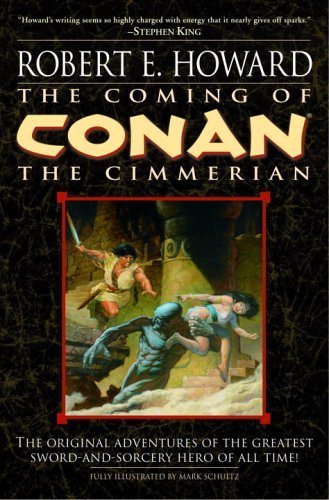
Know, oh prince, that between the years when the oceans drank Atlantis and the gleaming cities, and the years of the rise of the Sons of Aryas, there was an Age undreamed of, when shining kingdoms lay spread across the world like blue mantles beneath the stars — Nemedia, Ophir, Brythunia, Hyperborea, Zamora with its dark-haired women and towers of spider-haunted mystery, Zingara with its chivalry, Koth that bordered on the pastoral lands of Shem, Stygia with its shadow-guarded tombs, Hyrkania whose riders wore steel and silk and gold. But the proudest kingdom of the world was Aquilonia, reigning supreme in the dreaming west. Hither came Conan, the Cimmerian, black-haired, sullen-eyed, sword in hand, a thief, a reaver, a slayer, with gigantic melancholies and gigantic mirth, to tread the jeweled thrones of the Earth under his sandalled feet.
Robert E. Howard’s Conan stories are everything I have ever wanted in fantasy literature — decadent cities bowed under the weight of the ages, wicked sorcerers, gushing arterial blood, lurking antediluvian horrors, red-handed buccaneers, strange magics that have slumbered beneath the sands for untold centuries, glorious cavalry charges into the teeth of death, arcane jewels the size of ostrich eggs, monstrous ape-like demons with slavering jaws, captive princesses, steely thews — and this is the way to read them. For years they were only available in heavily-edited versions, interspersed with “posthumous collaborations”,1 and, worst of all, presented in chronological order (has Narnia taught us nothing?). These editions, though — there are two more volumes — give us Howard’s texts, in the order Howard wrote them, and beautifully illustrated.2 They’re a great pleasure to read, and you should, so I promise not to spoil any major plot points.
Howard got his professional start with boxing stories, but his great authorial love was historical fiction. “There is no literary work, to me, half as zestful as rewriting history in the guise of fiction,” he wrote in 1933. “I wish was I able to devote the rest of my life to that kind of work.” He published stories set during the Crusades (see, for example, Hawks of Outremer, which has some notable similarities to his later work on Conan) and the eras of Mongol and Islamic conquest, and failed to sell tales of ancient Irish warriors. Unfortunately, the markets were slim (more or less only Oriental Stories, which only ran for four years) and the demands of research high: “I could never make a living writing such things, though,” he went on. “[I]t takes me so long to complete one. I try to write as true to the actual facts as possible, at least, I try to commit as few errors as possible. I like to have my background and setting as accurate and realistic as I can …” In his Hyborian Age, the setting for his Conan stories, Howard hit upon an ingenious solution: take the coolest parts of history, file off the serial numbers, and do with them as you will. As a bonus, it means you can combine eras and civilizations that could never have coexisted (or, indeed, existed at all) in real history: the Hyborian Age has 13th century France (or its imagined version of Charlemagne and his Paladins) in the streaming banners of Aquilonia, the Old Kingdom of Egypt in the necromantic rituals of Stygia, warring Assyrian city-states in the lands of Koth, the hill tribesmen of Afghulistan and the tent-dwelling Shemite nomads and the wild pillaging Picts, all immediately recognizable. Howard paints in broadest of strokes, with none of the specifics that would obsess, say, me — there’s no fussing about why classical Greece is next door to the Timurids or why you have the Bronze Age one place and the Middle Ages elsewhere — but it works. Here’s a sweeping picture of rumor spreading across his world in Black Colossus:
Rumors drifted up through the meadowlands, into the cities of the Hyborians. The word ran along the caravans, the long camel-trains plodding through the sands, herded by lean hawk-eyed men in white kaftans. It was passed on by the hook-nosed herdsmen of the grasslands, from the dwellers in tents to the dwellers in the squat stone cities where kings with curled blue-black beards worshipped round-bellied gods with curious rites. The word passed up through the fringe of hills where gaunt tribesmen took toll of the caravans. The rumors came into the fertile uplands where stately cities rose above blue lakes and rivers: the rumors marched along the broad white roads thronged with ox-wains, with lowing herds, with rich merchants, knights in steel, archers and priests.
You know immediately what he’s gesturing at with all these peoples and places. H.P. Lovecraft, Howard’s friend and frequent correspondent, complained about his “incurable tendancy to devise names too closely resembling actual names,” but that was precisely the point. Why waste pages establishing the culture and character of an imaginary people with no emotional valence to anyone but the author when you can simply call a real people to mind in a few choice words? We already have a wealth of associations and baggage with the real world; it just makes sense to use them when you can. This is true on the small scale — as game designer and writer Kenneth Hite points out, your reader will have a much more powerful reaction to the shocking revelation that the queen is a vampire if it’s Elizabeth I rather than Lots’apostrae’fiis VII, to whom they were introduced three pages ago3 — but it’s even more useful when your fictional world has a wide scope. And indeed, Howard’s strategy works so well that it’s been copied by a great deal of subsequent fantasy literature: A Song of Ice and Fire is full of it, as is the world of Warhammer Fantasy. Even Tolkien, widely considered the master of secondary world fiction, works best for me when he draws most directly on the real world: on a recent re-read of Lord of the Rings, I cheered for the Rohirrim but had trouble caring about the Dúnedain and the line of Elendil until I started mentally substituting “Atlantis” for Númenor.
1. This is what they call it when you’re dead and someone else writes a story based on your notes, because they think “raping a corpse” isn’t very catchy.
2. They make wonderful audiobooks, too, if that’s your jam, but do take a peek at the illustrations if you can.
3. Actually, Elizabeth II would be even more fun.
June 28, 2023
“I’ll forgive Dartnell for not writing ‘Lest Darkness Fall’ For Dummies“
Jane Psmith reviews The Knowledge by Lewis Dartnell, despite it not being quite what she was hoping it would be:
This is not the book I wanted to read.
The book I wanted to read was a detailed guide to bootstrapping your way to industrial civilization (or at least antibiotics) if you should happen to be dumped back in, say, the late Bronze Age.1 After all, there are plenty of technologies that didn’t make it big for centuries or millennia after their material preconditions were met, and with our 20/20 hindsight we could skip a lot of the dead ends that accompanied real-world technological progress.
Off the top of my head, for example, there’s no reason you couldn’t do double-entry bookkeeping with Arabic numerals as soon as you have something to write on, and it would probably have been useful at any point in history — just not useful enough that anyone got really motivated to invent it. Or, here, another one: the wheelbarrow is just two simple machines stuck together, is substantially more efficient than carrying things yourself, and yet somehow didn’t make it to Europe until the twelfth or thirteenth century AD. Or switching to women’s work, I’ve always taken comfort in the fact that with my arcane knowledge of purling I could revolutionize any medieval market.2 And while the full Green Revolution package depends on tremendous quantities of fertilizer to fuel the grains’ high yields, you could get some way along that path with just knowledge of plant genetics, painstaking record-keeping, and a lot of hand pollination. In fact, with a couple latifundia at your disposal in 100 BC, you could probably do it faster than Norman Borlaug did. But speaking of fertilizer, the Italian peninsula is full of niter deposits, and while your revolutio viridis is running through those you could be figuring out whether it’s faster to spin up a chemical industry to the point you could do the Haber-Bosch process at scale or to get to the Peruvian guano islands. (After about thirty seconds of consideration my money’s on Peru, though it’s a shame we’re trying to do this with the Romans since they were never a notably nautical bunch and 100 BC was a low point even for them; you’ll have to wipe out the Mediterranean pirates early and find Greek or Egyptian shipwrights.) And another question: can you go straight from the Antikythera mechanism to the Jacquard machine, and if not what do you need in between? Inquiring minds want to know.3
But I’ll forgive Dartnell for not writing “Lest Darkness Fall” For Dummies, which I’ll admit is a pretty niche pitch, because The Knowledge is doing something almost as cool.4 Like my imaginary book, it employs a familiar fictional conceit to explain how practical things work. Instead of time travel, though, Dartnell takes as his premise the sudden disappearance (probably plague, definitely not zombies) of almost all of humanity, leaving behind a few survivors but all the incredible complexity of our technological civilization. How would you survive? And more importantly, how would you rebuild?
1. I read the Nantucket Trilogy at an impressionable age.
2. Knitting came to Europe in the thirteenth century, but the complementary purl stitch, which is necessary to create stretchy ribbing, didn’t. If you’ve ever wondered why medieval hosen were made of woven fabric and fit the leg relatively poorly, that’s why. When purling came to England, Elizabeth I paid an exorbitant amount of money for her first pair of silk stockings and refused to go back to cloth.
3. Obviously you would also need to motivate people to actually do any of these things, which is its own set of complications — Jason Crawford at Roots of Progress has a great review of Robert Allen’s classic The British Industrial Revolution in Global Perspective that gets much deeper into why no one actually cared about automation and mechanization — but please allow me to imagine here.
4. Please do not recommend How To Invent Everything, which purports to do something like this. It doesn’t go nearly deep enough to be interesting, let alone useful. You know, in the hypothetical that I’m sent back in time.
June 27, 2023
QotD: Nelson Mandela, Thabo Mbeki, and the ANC
The impression Johnson gives is very much that of a man in way over his head, and when Mandela did try to assert himself, the results were usually buffoonish:
He declared that the solution to continuing violence in KwaZulu-Natal was for everyone to join the ANC … In 1995 he told a May Day rally that if the IFP continued to resist the ANC he would cut off all funding to KwaZulu-Natal, the most populous province. This was a completely unconstitutional threat which had to be quickly retracted. Similarly, when he dismissed Winnie from government he failed to read the constitution and thus had to reappoint her and later dismiss her again. Visiting Tanzania, he announced that: “We are going to sideline and even crush all dissident forces in our country.”
Mandela also made a lot of genuinely very big-hearted speeches pitching a “rainbow nation” vision of South Africa and begging whites not to flee the country, but every time the interests of justice conflicted with those of the ANC, he showed himself to be a party man first and foremost. The most revolting examples of this are two incidents in which independent prosecutors were investigating ANC atrocities (in one case a massacre of dozens of protestors, the other case an incident where some Zulus were kept in a cage inside a local ANC party HQ and tortured for months), and Mandela staked the full power of his moral authority on blocking the inquiries. In the case of the massacre, Mandela went so far as to declare that he had ordered the gunmen to shoot, which everybody knew to be a lie, but which meant that any attempt to pursue the coverup would mean taking down Mandela too. Nobody had the stomach to face that prospect, so the prosecutors dropped the case.
If Mandela was a figurehead, then who was really in charge? The answer is the main character of this book: Thabo Mbeki, the deputy president. Mbeki is a villain of almost Shakespearean proportions — paranoid, controlling, obsessive, bad with crowds yet charming in person. Even before Mandela was out of prison, he was already angling for the number two spot, shaping the narrative, quietly interposing himself between the charismatic Nobel peace prize winner and the true levers of power.
This was bad news for South Africa, because in contrast to Mandela’s “rainbow nation” optimism, Mbeki was a committed black nationalist who immediately set about purging whites from the government and looting white wealth, with little regard for whether this might kill the goose that lays the golden eggs. Johnson ascribes a psychological motivation to all this, asserting that Mbeki suffered from a crushing inferiority complex vis-a-vis the white elites, and quoting several truly bizarre and unhinged public speeches in support of his diagnosis. A more prosaic explanation would just be that like many tyrants in the making, Mbeki sought to create and elevate “new men”, men who owed him everything and whose loyalty could thereby be assured.
Whatever the case, Mbeki quickly began to insist that South Africa’s military, corporations, and government agencies bring their racial proportions into exact alignment with the demographic breakdown of the country as a whole. But as Johnson points out, this kind of affirmative action has very different effects in a country like South Africa where 75% of the population is eligible than it does in a country like the United States where only 13% of the population gets a boost. Crudely, an organization can cope with a small percentage of its staff being underqualified, or even dead weight. Sinecures are found for these people, roles where they look important but can’t do too much harm. The overall drag on efficiency is manageable, especially if every other company is working under the same constraints.
John Psmith, “REVIEW: South Africa’s Brave New World, by R.W. Johnson”, Mr. and Mrs. Psmith’s Bookshelf, 2023-03-20.
June 21, 2023
“Luttwak tweets with unparalleled Boomer energy, primarily in a write-only mode, at times seemingly oblivious to the waves he causes”
John Psmith reviews the second edition of Edward Luttwak’s Coup d’État: A Practical Handbook. I read the first edition in the mid-70s, when it seemed like coup attempts were an almost weekly news item from any number of exotic tropical locations:
First things first: you need to get the revised, second edition of this book. Why? Because the introduction to the second edition is an excuse for the author to brag about all the bloodstained and bullet-riddled copies of the first edition that have been found among the personal effects of palace security chiefs, spymasters, and air force officers. Perhaps, he gloats, they should have read it more carefully, or perhaps they should have waited for the second edition.
None of this should come as a surprise if you follow Edward Luttwak on Twitter, where his account is characterized by a judicious degree of irascibility and gloating. Yes, I regret to inform you that he’s on Twitter. But unlike some of my other favorite authors who succumbed to the analgesic call of the Great Blue Bird, the medium has not totally destroyed him yet. Luttwak tweets with unparalleled Boomer energy, primarily in a write-only mode, at times seemingly oblivious to the waves he causes. This is good, because it means we get to read his internal monologue, but without the reward loop of social media hacking his amygdala and progressively turning him into a self-parody.
Or perhaps his descent into self-parody was arrested by the fact that he was already a bit of a self-parody. Luttwak came from a Jewish family in communist Romania, spent some time in Palermo where he totally wasn’t involved in the war between the authorities and the mob,1 and provided “consulting services to multinational corporations and government agencies, including various branches of the U.S. government and the U.S. military”, before retiring to the life of gentleman scholar and cattle rancher (and prolific Twitter poaster) in rural Argentina. Along the way he picked up a PhD and wrote a massive pile of books about history, war, diplomacy, and political theory, all while pissing off the authorities in those fields with his epistemic trespassing.
But all of that was still far in the future when he wrote this book about coups. When the non-recommended first edition came out, Luttwak was a tender twenty-six years old, and working tenderly as a consultant for the energy industry in Africa and the Middle East. This raises some questions, questions that Luttwak absolutely refuses to answer, sometimes coyly and sometimes vehemently. Were I concerned about my reputation as a third-world fixer for oil companies, I would simply not write a practical guide to launching coups, but to each his own.
What is a coup? Also known as a putsch, a palace rebellion, or my personal favorite, a pronunciamiento; there are a lot of words for it, many of them in Spanish (you know what they say about Eskimos and their words for snow). The basic definition is a bloodless or almost bloodless extrajudicial transfer of power whereby a group of conspirators is able to turn the machinery of the state against itself, seizing control quickly and cleanly and without triggering a civil war. Note how different this is from other sorts of exceptional transfers of power. In a revolution, all of the institutions in a society are burned down and replaced. A coup is the opposite — only the very top level of the system is swapped out, and the new boss quickly and seamlessly resumes ruling through the machinery of the old regime. Ideally, citizens who aren’t especially politically engaged wouldn’t even notice.
This leads us to a guess as to the most coup-friendly sorts of polities: ideally they should be highly centralized and efficient bureaucratic states, but with very low democratic engagement or popular investment in politics. The first half is important, because without an efficient government machine, there’s nothing for the coup plotters to grab onto. A coup is an action by a tiny group of people who would lose instantly in any fair fight — the only chance they have is to magnify their power by hijacking a system that was already pretty good at controlling the country. It also helps that soldiers, policemen, and citizens in a bureaucratized society are already conditioned to obey impersonal authority, and therefore are more likely to do what the new guy says if he’s careful to use the old, familiar forms. Anarchists love to talk about how anarchy is like a vaccination against foreign occupation, because occupiers generally lack the state capacity to administer newly acquired territories without existing state machinery to co-opt, and that argument is even more true for coups.
1. Also unclear: which side he was not-involved on.
June 10, 2023
Do you also dream of apocalypse?
John Psmith certainly does, as he explains before plunging into a review of a book on Chinese warfare between 300 and 900 AD:
I have a secret confession to make. Late at night, when Mrs. Psmith and the Psmithlets are all tucked away in their beds, I like to stay up in my study and fantasize about … the end of the world. But not just any end of the world, because most apocalypses are very boring. For example: “AI unleashes killer nanobots that turn everybody into paperclips.” Yawn. How dull. Where’s the drama in that? No, like all disordered fantasies, mine are fun, and ever-so-conveniently constructed to push the bounds of plausibility while still being technically possible. I’m mostly fantasizing about apocalypses where almost everybody dies, but where one dashing and well-prepared man with pluck and determination and a giant pile of book reviews can restore an island of order and civilization. Hey come on, it could happen!
Most apocalypses would be awful — we would all die instantly, or else we would all die slowly and painfully, but somewhere perfectly balanced in the middle are the apocalypses that would be very exciting, and those are the emotional driver that lead me to engage in a mild degree of prepping. Now like all potential addicts, I have some hard and fast rules, clear lines that prevent me from spending all my family’s savings on refurbishing an old missile silo. My main rule is that any prepping I do has to have a dual use in some less exciting but more likely scenario.
So I store a lot of water in my basement because, look the US government tells me it could be useful in the event of a regional or local disaster. We have emergency bags pre-packed that include a list of rendezvous locations a day’s walk from our house because, hey, there are all kinds of reasons we might need that, okay? I own this tool so I can shut off my gas in the event of an earthquake and totally not because it looks handy for bludgeoning feral packs of marauders, so stop judging me. I have precious metals buried in the ground in a secret location because, uhhh … it’s good to have a tail-risk hedge in your portfolio, all right? What’s that? Why is there ammo in there too? Look, a good portfolio should be anti-fragile …
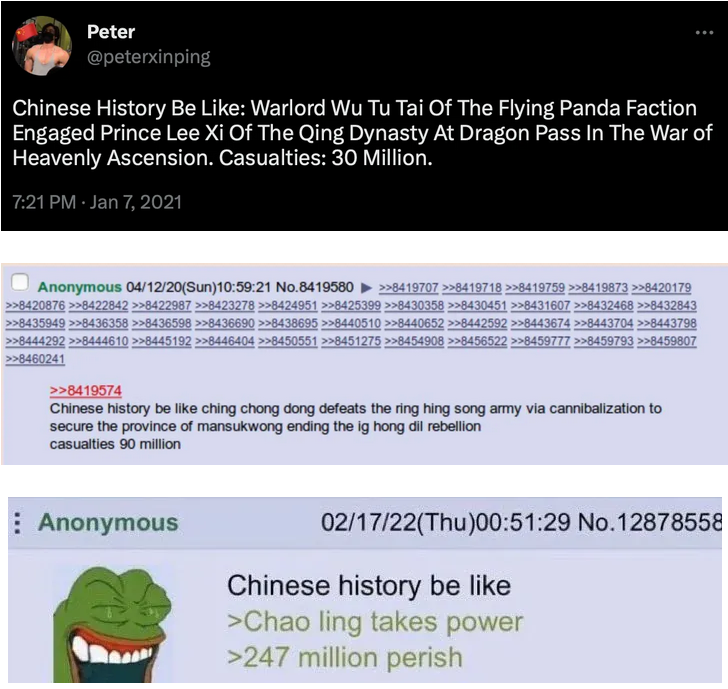
I think all of this is why I like Chinese history so much, because it’s just way crazier, bloodier, and more apocalyptic than the history of most other places. In Western Europe civilization collapsed once (okay fine, twice (okay, fine, three times)), and we’re still ruminating over it and working through this unending cultural psychodrama like some civilization-scale therapy addict. Meanwhile, in China, civilization collapsing is like Tuesday. The history of China is an endless cycle of mini-apocalypses in which the entire political, economic and moral order gets razed to the ground and Mad Max conditions prevail for a few decades or centuries, until somebody gathers enough power in his hands to establish a new dynasty and all is peaceful and harmonious under heaven. A few hundred years later, that new regime grows tired and old, the Mandate of Heaven slips away, and the cycle repeats.
June 1, 2023
Recent discoveries in ancient DNA
The Psmiths, John and Jane, decided to jointly review a book by David Reich called Who We Are and How We Got Here: Ancient DNA and the New Science of the Human Past. This is Jane’s first contribution to an extended email thread between the Psmiths:
The problem with history is that there just isn’t enough of it. We’ve been around for, what, fifty thousand years? Conservatively.1 And we’ve barely written things down for a tenth of that. Archaeological excavation can take you a little farther back, but as the archaeologists always like to remind us, pots are not people. If you get lucky with a society that made things out of durable materials in a cold and/or dry environment (or you get very lucky with anaerobic preservation of organic materials, like in ice or bogs), maybe you can trace a material culture’s expansion and contraction across time and space. But that won’t tell you whether it’s a function of people moving and taking their stuff with them, or people’s neighbors going “ooh, using string to make patterns on your pots, that’s cool” and copying it. It certainly doesn’t tell you what their descendants were doing several thousand years later, potentially in an entirely different place and probably using an entirely different suite of technologies. Trying to understand what happened in the human past based on the historical and archaeological records is like walking into a room where a bomb has gone off and trying to reconstruct the locations of all the objects before the explosion. You can get some idea, but it’s all very broad strokes. And actually it’s worse than that, because it wasn’t just one explosion, it was lots, and we wouldn’t even know how many if we didn’t have a way of winding the clock back. But these days we do, and it’s ancient DNA.
Sometime between when my grandfather gave me a copy of Luca Cavalli-Sforza’s Genes, Peoples, and Languages for my birthday and when you and I decided to read Reich’s book together, two big things happened: humans got really, really good at sequencing and reading genomes, and Svante Pääbo’s lab in Leipzig got really, really good at extracting DNA from ancient bones. (How they developed their procedures is actually a really interesting story, which Pääbo retells in his book, but Reich — whose lab uses the same techniques on an industrial scale — gives a good, brief summary of how it works.) Together, these two advances unlocked … well, not quite everything about the deep past, but an absolutely enormous amount. Suddenly we can track the people, not just the pots, and the story is more complicated and fascinating than anything we might have expected. I’ve written elsewhere about some of the aDNA discoveries about human evolution (Neanderthal admixture, the Denisovans, etc.), but I’m even more excited about what ancient DNA reveals about our more recent past. Luckily, that’s what Reich spends most of the book on, with discussion of ancient ghost populations who now exist only in admixture and then chapters on the specific population genetic histories of Europe, India, North America, East Asia, and Africa, each of which contains some discoveries that would make (at least the more sensible) archaeologists and historical linguists go “well, duh” and others that are real surprises.
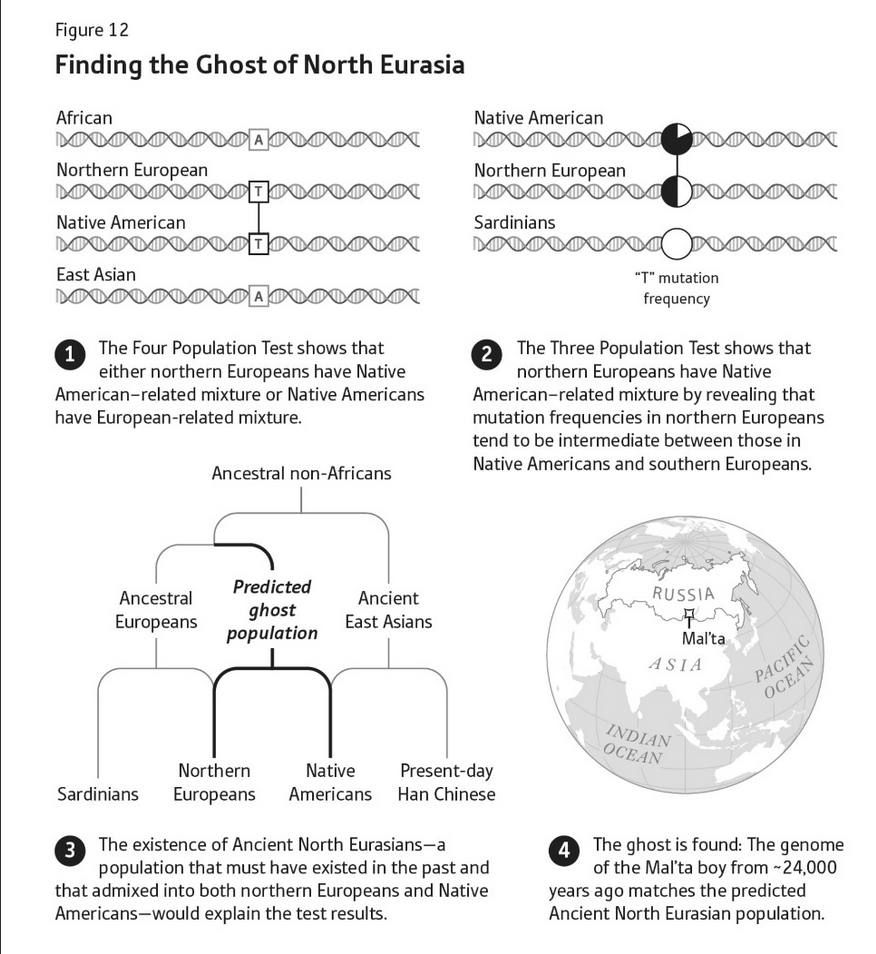
One of the “duh” stories is the final, conclusive identification of the people who brought horses, wagons, and Indo-European languages to Europe with the Yamnaya culture of the Pontic Steppe and their descendants. (David Anthony gives a very good overview of the archaeological case for this in The Wheel, the Horse, and Language, including some very cool experimental archaeology about horse teeth; you have my permission to skim the sections on pots.) My favorite surprising result, though, comes from a little farther north. People usually assume that Native Americans and East Asians share a common ancestor who split from the ancestors of Europeans and Africans before dividing into those two populations, but when Reich’s lab was trying to test the idea they found, to their surprise, that in places where Northern European genomes differ from Africans’, they are closer to Native Americans than to East Asians. Then, using a different set of statistical techniques, they found that Northern European populations were the product of mixture between two groups, one very similar to Sardinians (who are themselves almost-unmixed descendants of the first European farmers) and one that is most similar to Native Americans. They theorized a “ghost” population, which they called the “Ancient North Eurasians”, who had contributed DNA both to the population that would eventually cross the Bering land bridge and to the non-Early European Farmer ancestors of modern Northern Europeans. Several years later, another team sequenced the genome of a boy who died in Siberia 24kya and who was a perfect match for that theorized ghost ANE population.
But we’ve already established that I’m the prehistory nerd in this family; were you as jazzed as I was to read about the discovery of the Ancient North Eurasians?
1. That’s the latest plausible date for the arrival of full “behavioral modernity” in Africa, though our genus goes back about two million years, tool use probably three million, and I think there’s a good case that Homo was meaningfully “us” by 500kya. (That’s “thousand years ago” in “I talk about deep history so much I need an acronym”, fyi.)
May 26, 2023
How domestic use of coal transformed Britain
Jane Psmith reviews The Domestic Revolution: How the Introduction of Coal into Victorian Homes Changed Everything by Ruth Goodman:
… Even today, few people record the mundane details of their daily lives; in the days before social media and widespread literacy it was even more dramatic, so anyone who wants to know how our ancestors cleaned, or slept, or ate has to go poking through the interstices of the historical record in search of the answers — which means they need to recognize that there’s a question there in the first place. When they don’t, we end up with whole swathes of the past we can’t really understand because we’re unfamiliar with the way their inhabitants interacted with the physical world.
The Domestic Revolution is about one of these “unknown unknowns”, the early modern English transition from burning wood to coal in the home, and Ruth Goodman may be the only person in four hundred years who could have written it. With exactly the kind of obsessive attention to getting it right that I can really respect, she turned an increasingly intensive Tudor reënactment hobby into a decades-long career as a “freelance historian”, rediscovering as many domestic details of Tudor-era life as possible and consulting for museums and costume dramas. Her work reminds me of the recreations of ancient Polynesian navigational techniques, a combination of research and practical experiments aimed at contextualizing what got remembered or written down, so of course I would love it. (A Psmith review of her How To Be a Tudor is forthcoming.) She’s also starred in a number of TV shows where she and her colleagues live and work for an extended time in period environs, wearing period costume and using period technology1, and because she was so unusually familiar with running a home fired by wood — “I have probably cooked more meals over a wood fire than I have over gas or electric cookers”, she writes — she immediately noticed the differences when she lived with a coal-burning iron range to film Victorian Farm. A coal-fired home required changes to nearly all parts of daily life, changes that people used to central heating would never think to look for. But once Goodman points them out, you can trace the radiating consequences of these changes almost everywhere.
The English switched from burning wood to burning coal earlier and more thoroughly than anywhere else in the world, and it began in London. Fueling the city with wood had become difficult as far back as the late thirteenth century, when firewood prices nearly doubled over the course of a decade or two, and when the population finally recovered from the rolling crises of the fourteenth and fifteenth centuries the situation became dire once again. Wood requires a lot of land to produce, but it’s bulky and difficult to transport by cart: by the 1570s the court of Elizabeth I found it cheapest to buy firewood that had been floated more than a hundred miles down the Thames. Coal, by contrast, could be mined with relative ease from naturally-draining seams near Newcastle-upon-Tyne and sailed right down the eastern coast of the island to a London dock. It already had been at a small scale throughout the Middle Ages, largely to fuel smithies and lime-burners, but in the generation between 1570 and Elizabeth’s death in 1603 the city had almost entirely switched to burning coal. (It had also ballooned from 80,000 to 200,000 inhabitants in the same time, largely enabled by the cheaper fuel.) By 1700, Britain was burning more coal than wood; by 1900, 95% of all households were coal-burning, a figure North America would never match. Of course the coal trade itself had consequences — Goodman suggests that the regular Newcastle run was key in training up sailors who could join the growing Royal Navy or take on trans-Atlantic voyages — and it certainly strengthened trade networks, but most of The Domestic Revolution is driven by the differences in the materials themselves.
The most interesting part of the book to me, a person who is passionately interested in all of human history right up until about 1600, were the details of woodland management under the wood-burning regime. I had, for instance, always assumed that early modern “woodcutters” like Hansel and Gretel’s father were basically lumberjacks chopping down full-grown trees, but actually most trees aren’t killed by removing their trunks. Instead, the stump (or roots, depending on the species) will send up new, branchless shoots, which can be harvested when they reach their desired diameter — anywhere from a year or two for whippy shoots suitable for weaving baskets or fences to seven years for firewood, or even longer if you want thick ash or oak poles for construction. This procedure, called coppicing, also extends the life of the tree indefinitely: an ash tree might live for two hundred years, but there are coppiced ash stools in England that predate the Norman Conquest. (My ignorance here wasn’t entirely chronological provincialism: the pines and other conifers that make up most North American timberland can’t be coppiced.)2 The downside to coppicing is that the new shoots are very attractive to livestock, so trees can also be pollarded — like a coppice, but six or eight feet up the trunk,3 quite a dramatic photo here — which is harder to harvest but means you can combine timber and pasture. This made pollarded “wood pasture” a particularly appealing option for common land, where multiple people had legal rights to its use.4 The woodcutters of the Grimms’ tales probably had a number of fenced coppiced patches they would harvest in rotation, ideally one fell for each year of growth it took to produce wood of the desired size, though a poor man without the upfront capital to support planting the right kind of trees could make do with whatever nature gave him.
There’s plenty more, of course: Goodman goes into great but fascinating detail about the ways different woods behave on the fire (hazel gets going quickly, which is nice for starting a fire or for frying, but oak has staying power; ash is the best of both worlds), the ways you can change the shape and character of your fire depending on what you’re cooking, and the behavior of other regional sorts of fuel like peat (from bogs) and gorse (from heathland). But most of the book is devoted to the differences between burning wood and burning coal, of which there are three big ones: the flame, the heat, and the smoke. Dealing with each one forced people to make obvious practical changes to their daily lives, and in turn each of those changes had second- and third-order consequences that contributed to the profound transformations of the modern period.
The most obvious difference is the fire itself. The flames of wood fires merge together to form a pyramid or spire shape, perfect for setting your pot over: the flames will curl around its nicely rounded bottom to heat it rapidly. Coal, on the other hand, forms “a series of smaller, lower, hotter and bluer flames, spaced across the upper surface of the bed of embers,” suitable for a large flat-bottomed pot. More importantly, though, burning coal requires a great deal more airflow: a coal fire on the ground is rapidly smothered by its own buildup of ash and clinker (and of course it doesn’t come in nice long straight bits for you to build a pyramid out of). The obvious solution is the grate, a metal basket that lifts the coal off the ground, letting the debris fall away rather than clogging the gaps between coals, and drawing cold air into the fire to fuel its combustion. This confines the fire to one spot, which may not seem like a big deal (especially for people who are used to cooking on stoves with burners of fixed sizes) but is actually quite a dramatic change. As Goodman explains, one of the main features of cooking on a wood fire is the ease with which you can change its size and shape:
You can spread them out or concentrate them, funnel them into long thin trenches or rake them into wide circles. You can easily divide a big fire into several small separate fires or combine small fires into one. You can build a big ring of fire around a particularly large pot stood at one end of the hearth while a smaller, slower central fire is burning in the middle and a ring of little pots is simmering away at the far end. You can scrape out a pile of burning embers to pop beneath a gridiron when there is a bit of toasting to do, brushing the embers back into the main fire when the job is done.
In other words, the enormous fireplaces you may have seen in historical kitchens aren’t evidence of equally enormous fires; they were used for lots of different fires of varying sizes, to cook lots of different dishes at the same time. The iron grate for coal, on the other hand, is a fixed size and shape, like a modern burner — though unlike a modern burner the heat is not adjustable. The only thing you can do, really, is put your pot on the grate or take it off.
1. Several of them are streaming on Amazon Prime; I don’t much TV, but I did watch Tudor Monastery Farm with my kids and we all loved it.
2. Some firs can be regrown in a related practice called “stump culture“, which is particularly common on Christmas tree farms, but it’s much more labor-intensive than coppicing.
3. If you live in the southern United States, you’ve probably seen pollarded crape myrtles.
4. Contrary to the impression you may have gotten from the so-called tragedy of the commons, the historical English commons had extremely clearly delineated legal rights. More importantly, these rights all had fabulous names like turbary (the right to cut turves for fuel), piscary (the right to fish), and pannage (the right to let your pigs feed in the woods). I’m also a big fan of the terminology of medieval and early modern tolls, like murage (charged for bringing goods within the walls), pontage (for using a bridge), and pavage (using roads). Since the right to charge these tolls was granted to towns and cities individually, a journey of any length was probably an obnoxious mess of fees (Napoleon had a point with the whole “regulating everything” bit), but you can’t help feeling that “value added tax” is pretty boring by comparison. I suggest “emprowerage”, from the Anglo-Norman emprower (which via Middle English “emprowement” gives us “improvement”) as a much more euphonious name for the VAT. Obviously sales tax should “sellage”. I can do this all day.
April 6, 2023
Japan is weird, example MCMLXIII
John Psmith reviews MITI and the Japanese Miracle by Chalmers Johnson:
I’ve been interested in East Asian economic planning bureaucracies ever since reading Joe Studwell’s How Asia Works (briefly glossed in my review of Flying Blind). But even among those elite organizations, Japan’s Ministry of International Trade and Industry (MITI) stands out. For starters, Japanese people watch soap operas about the lives of the bureaucrats, and they’re apparently really popular! Not just TV dramas; huge numbers of popular paperback novels are churned out about the men (almost entirely men) who decide what the optimal level of steel production for next year will be. As I understand it, these books are mostly not about economics, and not even about savage interoffice warfare and intraoffice politics, but rather focus on the bureaucrats themselves and their dashing conduct, quick wit, and passionate romances … How did this happen?
It all becomes clearer when you learn that when the Meiji period got rolling, Japan’s rulers had a problem: namely, a vast, unruly army of now-unemployed warrior aristocrats. Samurai demobilization was the hot political problem of the 1870s, and the solution was, well … in many cases it was to give the ex-samurai a sinecure as an economic planning bureaucrat. Since positions in the bureaucracy were often quasi-hereditary, what this means is that in some sense the samurai never really went away, they just hung up their swords — frequently literally hung them up on the walls of their offices — and started attacking the problem of optimal industrial allocation with all the focus and fury that they’d once unleashed on each other. According to Johnson, to this day the internal jargon of many Japanese government agencies is clearly and directly descended from the dialects and battle-codes of the samurai clans that seeded them.
This book is about one such organization, MITI, whose responsibilities originally were limited to wartime rationing and grew to encompass, depending who you ask, the entire functioning of the Japanese government. Because this is the buried lede and the true subject of this book: you thought you were here to read about development economics and a successful implementation of the ideas of Friedrich List, but you’re actually here to read about how the entire modern Japanese political system is a sham. This suggestion is less outrageous than it may sound at first blush. By this point most are familiar with the concept of “managed democracy,” wherein there are notionally competitive popular elections, culminating in the selection of a prime minister or president who’s notionally in charge, but in reality some other locus of power secretly runs things behind the scenes.
There are many flavors of managed democracy. The classic one is the “single-party democracy”, which arises when for whatever reason an electoral constituency becomes uncompetitive and returns the same party to power again and again. Traditional democratic theory holds that in this situation the party will split, or a new party will form which triangulates the electorate in just such a way that the elections are competitive again. But sometimes the dominant party is disciplined enough to prevent schisms and to crush potential rivals before they get started. The key insight is that there’s a natural tipping-point where anybody seeking political change will get a better return from working inside the party than from challenging it. This leads to an interesting situation where political competition remains, but moves up a level in abstraction. Now the only contests that matter are the ones between rival factions of party insiders, or powerful interest groups within the party. The system is still competitive, but it is no longer democratic. This story ought to be familiar to inhabitants of Russia, South Africa, or California.
The trouble with single-party democracies is that it’s pretty clear to everybody what’s going on. Yes, there are still elections happening, there may even be fair elections happening, and inevitably there are journalists who will point to those elections as evidence of the totally-democratic nature of the regime, but nobody is really fooled. The single-party state has a PR problem, and one solution to it is a more postmodern form of managed democracy, the “surface democracy”.
Surface democracies are wildly, raucously competitive. Two or more parties wage an all-out cinematic slugfest over hot-button issues with big, beautiful ratings. There may be a kaleidoscopic cast of quixotic minor parties with unusual obsessions filling the role of comic relief, usually only lasting for a season or two of the hit show Democracy. The spectacle is gripping, everybody is awed by how high the stakes are and agonizes over how to cast their precious vote. Meanwhile, in a bland gray building far away from the action, all of the real decisions are being made by some entirely separate organ of government that rolls onwards largely unaffected by the show.


