Quotulatiousness

June 1, 2023

Recent discoveries in ancient DNA

Filed under: Africa, Americas, Asia, Books, Europe, History — Tags: , , , — Nicholas @ 04:00

The Psmiths, John and Jane, decided to jointly review a book by David Reich called Who We Are and How We Got Here: Ancient DNA and the New Science of the Human Past. This is Jane’s first contribution to an extended email thread between the Psmiths:
The problem with history is that there just isn’t enough of it. We’ve been around for, what, fifty thousand years? Conservatively.1 And we’ve barely written things down for a tenth of that. Archaeological excavation can take you a little farther back, but as the archaeologists always like to remind us, pots are not people. If you get lucky with a society that made things out of durable materials in a cold and/or dry environment (or you get very lucky with anaerobic preservation of organic materials, like in ice or bogs), maybe you can trace a material culture’s expansion and contraction across time and space. But that won’t tell you whether it’s a function of people moving and taking their stuff with them, or people’s neighbors going “ooh, using string to make patterns on your pots, that’s cool” and copying it. It certainly doesn’t tell you what their descendants were doing several thousand years later, potentially in an entirely different place and probably using an entirely different suite of technologies. Trying to understand what happened in the human past based on the historical and archaeological records is like walking into a room where a bomb has gone off and trying to reconstruct the locations of all the objects before the explosion. You can get some idea, but it’s all very broad strokes. And actually it’s worse than that, because it wasn’t just one explosion, it was lots, and we wouldn’t even know how many if we didn’t have a way of winding the clock back. But these days we do, and it’s ancient DNA.

Sometime between when my grandfather gave me a copy of Luca Cavalli-Sforza’s Genes, Peoples, and Languages for my birthday and when you and I decided to read Reich’s book together, two big things happened: humans got really, really good at sequencing and reading genomes, and Svante Pääbo’s lab in Leipzig got really, really good at extracting DNA from ancient bones. (How they developed their procedures is actually a really interesting story, which Pääbo retells in his book, but Reich — whose lab uses the same techniques on an industrial scale — gives a good, brief summary of how it works.) Together, these two advances unlocked … well, not quite everything about the deep past, but an absolutely enormous amount. Suddenly we can track the people, not just the pots, and the story is more complicated and fascinating than anything we might have expected. I’ve written elsewhere about some of the aDNA discoveries about human evolution (Neanderthal admixture, the Denisovans, etc.), but I’m even more excited about what ancient DNA reveals about our more recent past. Luckily, that’s what Reich spends most of the book on, with discussion of ancient ghost populations who now exist only in admixture and then chapters on the specific population genetic histories of Europe, India, North America, East Asia, and Africa, each of which contains some discoveries that would make (at least the more sensible) archaeologists and historical linguists go “well, duh” and others that are real surprises.

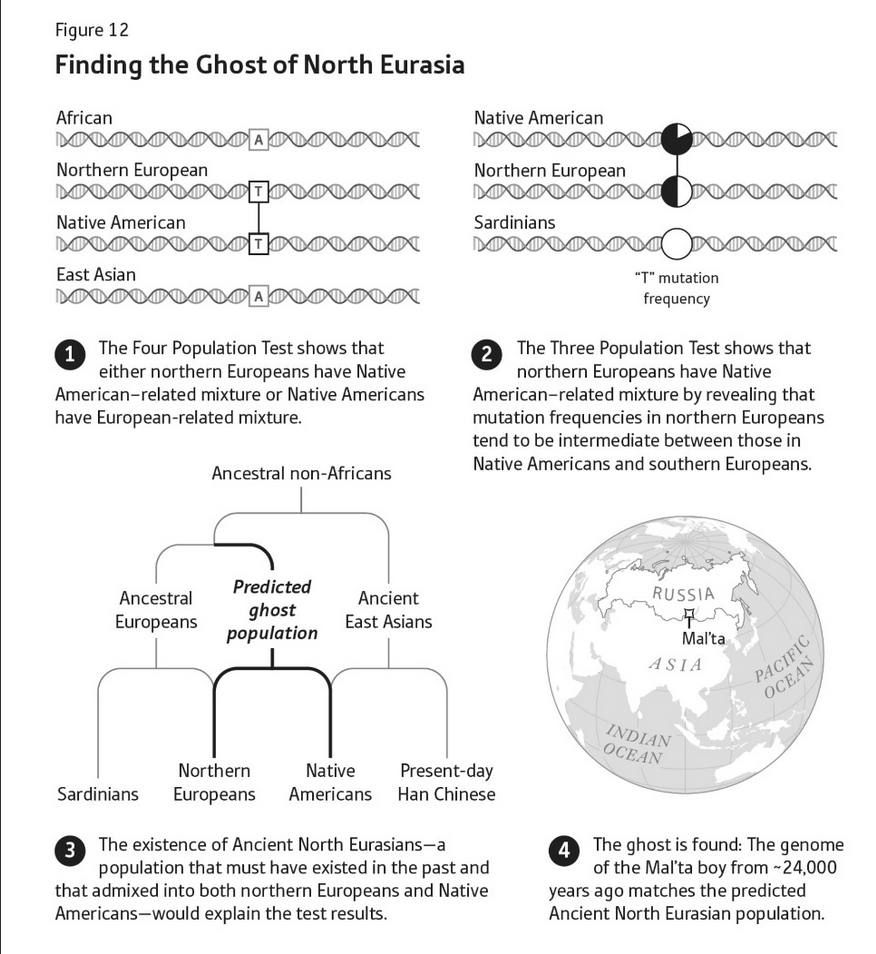
One of the “duh” stories is the final, conclusive identification of the people who brought horses, wagons, and Indo-European languages to Europe with the Yamnaya culture of the Pontic Steppe and their descendants. (David Anthony gives a very good overview of the archaeological case for this in The Wheel, the Horse, and Language, including some very cool experimental archaeology about horse teeth; you have my permission to skim the sections on pots.) My favorite surprising result, though, comes from a little farther north. People usually assume that Native Americans and East Asians share a common ancestor who split from the ancestors of Europeans and Africans before dividing into those two populations, but when Reich’s lab was trying to test the idea they found, to their surprise, that in places where Northern European genomes differ from Africans’, they are closer to Native Americans than to East Asians. Then, using a different set of statistical techniques, they found that Northern European populations were the product of mixture between two groups, one very similar to Sardinians (who are themselves almost-unmixed descendants of the first European farmers) and one that is most similar to Native Americans. They theorized a “ghost” population, which they called the “Ancient North Eurasians”, who had contributed DNA both to the population that would eventually cross the Bering land bridge and to the non-Early European Farmer ancestors of modern Northern Europeans. Several years later, another team sequenced the genome of a boy who died in Siberia 24kya and who was a perfect match for that theorized ghost ANE population.

But we’ve already established that I’m the prehistory nerd in this family; were you as jazzed as I was to read about the discovery of the Ancient North Eurasians?

    1. That’s the latest plausible date for the arrival of full “behavioral modernity” in Africa, though our genus goes back about two million years, tool use probably three million, and I think there’s a good case that Homo was meaningfully “us” by 500kya. (That’s “thousand years ago” in “I talk about deep history so much I need an acronym”, fyi.)

May 26, 2023

How domestic use of coal transformed Britain

Filed under: Books, Britain, History — Tags: , , , , , — Nicholas @ 03:00

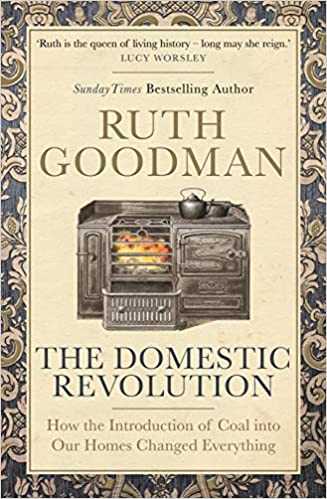
Jane Psmith reviews The Domestic Revolution: How the Introduction of Coal into Victorian Homes Changed Everything by Ruth Goodman:

… Even today, few people record the mundane details of their daily lives; in the days before social media and widespread literacy it was even more dramatic, so anyone who wants to know how our ancestors cleaned, or slept, or ate has to go poking through the interstices of the historical record in search of the answers — which means they need to recognize that there’s a question there in the first place. When they don’t, we end up with whole swathes of the past we can’t really understand because we’re unfamiliar with the way their inhabitants interacted with the physical world.

The Domestic Revolution is about one of these “unknown unknowns”, the early modern English transition from burning wood to coal in the home, and Ruth Goodman may be the only person in four hundred years who could have written it. With exactly the kind of obsessive attention to getting it right that I can really respect, she turned an increasingly intensive Tudor reënactment hobby into a decades-long career as a “freelance historian”, rediscovering as many domestic details of Tudor-era life as possible and consulting for museums and costume dramas. Her work reminds me of the recreations of ancient Polynesian navigational techniques, a combination of research and practical experiments aimed at contextualizing what got remembered or written down, so of course I would love it. (A Psmith review of her How To Be a Tudor is forthcoming.) She’s also starred in a number of TV shows where she and her colleagues live and work for an extended time in period environs, wearing period costume and using period technology1, and because she was so unusually familiar with running a home fired by wood — “I have probably cooked more meals over a wood fire than I have over gas or electric cookers”, she writes — she immediately noticed the differences when she lived with a coal-burning iron range to film Victorian Farm. A coal-fired home required changes to nearly all parts of daily life, changes that people used to central heating would never think to look for. But once Goodman points them out, you can trace the radiating consequences of these changes almost everywhere.

The English switched from burning wood to burning coal earlier and more thoroughly than anywhere else in the world, and it began in London. Fueling the city with wood had become difficult as far back as the late thirteenth century, when firewood prices nearly doubled over the course of a decade or two, and when the population finally recovered from the rolling crises of the fourteenth and fifteenth centuries the situation became dire once again. Wood requires a lot of land to produce, but it’s bulky and difficult to transport by cart: by the 1570s the court of Elizabeth I found it cheapest to buy firewood that had been floated more than a hundred miles down the Thames. Coal, by contrast, could be mined with relative ease from naturally-draining seams near Newcastle-upon-Tyne and sailed right down the eastern coast of the island to a London dock. It already had been at a small scale throughout the Middle Ages, largely to fuel smithies and lime-burners, but in the generation between 1570 and Elizabeth’s death in 1603 the city had almost entirely switched to burning coal. (It had also ballooned from 80,000 to 200,000 inhabitants in the same time, largely enabled by the cheaper fuel.) By 1700, Britain was burning more coal than wood; by 1900, 95% of all households were coal-burning, a figure North America would never match. Of course the coal trade itself had consequences — Goodman suggests that the regular Newcastle run was key in training up sailors who could join the growing Royal Navy or take on trans-Atlantic voyages — and it certainly strengthened trade networks, but most of The Domestic Revolution is driven by the differences in the materials themselves.

The most interesting part of the book to me, a person who is passionately interested in all of human history right up until about 1600, were the details of woodland management under the wood-burning regime. I had, for instance, always assumed that early modern “woodcutters” like Hansel and Gretel’s father were basically lumberjacks chopping down full-grown trees, but actually most trees aren’t killed by removing their trunks. Instead, the stump (or roots, depending on the species) will send up new, branchless shoots, which can be harvested when they reach their desired diameter — anywhere from a year or two for whippy shoots suitable for weaving baskets or fences to seven years for firewood, or even longer if you want thick ash or oak poles for construction. This procedure, called coppicing, also extends the life of the tree indefinitely: an ash tree might live for two hundred years, but there are coppiced ash stools in England that predate the Norman Conquest. (My ignorance here wasn’t entirely chronological provincialism: the pines and other conifers that make up most North American timberland can’t be coppiced.)2 The downside to coppicing is that the new shoots are very attractive to livestock, so trees can also be pollarded — like a coppice, but six or eight feet up the trunk,3 quite a dramatic photo here — which is harder to harvest but means you can combine timber and pasture. This made pollarded “wood pasture” a particularly appealing option for common land, where multiple people had legal rights to its use.4 The woodcutters of the Grimms’ tales probably had a number of fenced coppiced patches they would harvest in rotation, ideally one fell for each year of growth it took to produce wood of the desired size, though a poor man without the upfront capital to support planting the right kind of trees could make do with whatever nature gave him.

There’s plenty more, of course: Goodman goes into great but fascinating detail about the ways different woods behave on the fire (hazel gets going quickly, which is nice for starting a fire or for frying, but oak has staying power; ash is the best of both worlds), the ways you can change the shape and character of your fire depending on what you’re cooking, and the behavior of other regional sorts of fuel like peat (from bogs) and gorse (from heathland). But most of the book is devoted to the differences between burning wood and burning coal, of which there are three big ones: the flame, the heat, and the smoke. Dealing with each one forced people to make obvious practical changes to their daily lives, and in turn each of those changes had second- and third-order consequences that contributed to the profound transformations of the modern period.

The most obvious difference is the fire itself. The flames of wood fires merge together to form a pyramid or spire shape, perfect for setting your pot over: the flames will curl around its nicely rounded bottom to heat it rapidly. Coal, on the other hand, forms “a series of smaller, lower, hotter and bluer flames, spaced across the upper surface of the bed of embers,” suitable for a large flat-bottomed pot. More importantly, though, burning coal requires a great deal more airflow: a coal fire on the ground is rapidly smothered by its own buildup of ash and clinker (and of course it doesn’t come in nice long straight bits for you to build a pyramid out of). The obvious solution is the grate, a metal basket that lifts the coal off the ground, letting the debris fall away rather than clogging the gaps between coals, and drawing cold air into the fire to fuel its combustion. This confines the fire to one spot, which may not seem like a big deal (especially for people who are used to cooking on stoves with burners of fixed sizes) but is actually quite a dramatic change. As Goodman explains, one of the main features of cooking on a wood fire is the ease with which you can change its size and shape:

    You can spread them out or concentrate them, funnel them into long thin trenches or rake them into wide circles. You can easily divide a big fire into several small separate fires or combine small fires into one. You can build a big ring of fire around a particularly large pot stood at one end of the hearth while a smaller, slower central fire is burning in the middle and a ring of little pots is simmering away at the far end. You can scrape out a pile of burning embers to pop beneath a gridiron when there is a bit of toasting to do, brushing the embers back into the main fire when the job is done.

In other words, the enormous fireplaces you may have seen in historical kitchens aren’t evidence of equally enormous fires; they were used for lots of different fires of varying sizes, to cook lots of different dishes at the same time. The iron grate for coal, on the other hand, is a fixed size and shape, like a modern burner — though unlike a modern burner the heat is not adjustable. The only thing you can do, really, is put your pot on the grate or take it off.


    1. Several of them are streaming on Amazon Prime; I don’t much TV, but I did watch Tudor Monastery Farm with my kids and we all loved it.

    2. Some firs can be regrown in a related practice called “stump culture“, which is particularly common on Christmas tree farms, but it’s much more labor-intensive than coppicing.

    3. If you live in the southern United States, you’ve probably seen pollarded crape myrtles.

    4. Contrary to the impression you may have gotten from the so-called tragedy of the commons, the historical English commons had extremely clearly delineated legal rights. More importantly, these rights all had fabulous names like turbary (the right to cut turves for fuel), piscary (the right to fish), and pannage (the right to let your pigs feed in the woods). I’m also a big fan of the terminology of medieval and early modern tolls, like murage (charged for bringing goods within the walls), pontage (for using a bridge), and pavage (using roads). Since the right to charge these tolls was granted to towns and cities individually, a journey of any length was probably an obnoxious mess of fees (Napoleon had a point with the whole “regulating everything” bit), but you can’t help feeling that “value added tax” is pretty boring by comparison. I suggest “emprowerage”, from the Anglo-Norman emprower (which via Middle English “emprowement” gives us “improvement”) as a much more euphonious name for the VAT. Obviously sales tax should “sellage”. I can do this all day.

April 6, 2023

Japan is weird, example MCMLXIII

Filed under: Books, Bureaucracy, Business, Government, History, Japan — Tags: , , — Nicholas @ 03:00

John Psmith reviews MITI and the Japanese Miracle by Chalmers Johnson:

I’ve been interested in East Asian economic planning bureaucracies ever since reading Joe Studwell’s How Asia Works (briefly glossed in my review of Flying Blind). But even among those elite organizations, Japan’s Ministry of International Trade and Industry (MITI) stands out. For starters, Japanese people watch soap operas about the lives of the bureaucrats, and they’re apparently really popular! Not just TV dramas; huge numbers of popular paperback novels are churned out about the men (almost entirely men) who decide what the optimal level of steel production for next year will be. As I understand it, these books are mostly not about economics, and not even about savage interoffice warfare and intraoffice politics, but rather focus on the bureaucrats themselves and their dashing conduct, quick wit, and passionate romances … How did this happen?

It all becomes clearer when you learn that when the Meiji period got rolling, Japan’s rulers had a problem: namely, a vast, unruly army of now-unemployed warrior aristocrats. Samurai demobilization was the hot political problem of the 1870s, and the solution was, well … in many cases it was to give the ex-samurai a sinecure as an economic planning bureaucrat. Since positions in the bureaucracy were often quasi-hereditary, what this means is that in some sense the samurai never really went away, they just hung up their swords — frequently literally hung them up on the walls of their offices — and started attacking the problem of optimal industrial allocation with all the focus and fury that they’d once unleashed on each other. According to Johnson, to this day the internal jargon of many Japanese government agencies is clearly and directly descended from the dialects and battle-codes of the samurai clans that seeded them.

This book is about one such organization, MITI, whose responsibilities originally were limited to wartime rationing and grew to encompass, depending who you ask, the entire functioning of the Japanese government. Because this is the buried lede and the true subject of this book: you thought you were here to read about development economics and a successful implementation of the ideas of Friedrich List, but you’re actually here to read about how the entire modern Japanese political system is a sham. This suggestion is less outrageous than it may sound at first blush. By this point most are familiar with the concept of “managed democracy,” wherein there are notionally competitive popular elections, culminating in the selection of a prime minister or president who’s notionally in charge, but in reality some other locus of power secretly runs things behind the scenes.

There are many flavors of managed democracy. The classic one is the “single-party democracy”, which arises when for whatever reason an electoral constituency becomes uncompetitive and returns the same party to power again and again. Traditional democratic theory holds that in this situation the party will split, or a new party will form which triangulates the electorate in just such a way that the elections are competitive again. But sometimes the dominant party is disciplined enough to prevent schisms and to crush potential rivals before they get started. The key insight is that there’s a natural tipping-point where anybody seeking political change will get a better return from working inside the party than from challenging it. This leads to an interesting situation where political competition remains, but moves up a level in abstraction. Now the only contests that matter are the ones between rival factions of party insiders, or powerful interest groups within the party. The system is still competitive, but it is no longer democratic. This story ought to be familiar to inhabitants of Russia, South Africa, or California.

The trouble with single-party democracies is that it’s pretty clear to everybody what’s going on. Yes, there are still elections happening, there may even be fair elections happening, and inevitably there are journalists who will point to those elections as evidence of the totally-democratic nature of the regime, but nobody is really fooled. The single-party state has a PR problem, and one solution to it is a more postmodern form of managed democracy, the “surface democracy”.

Surface democracies are wildly, raucously competitive. Two or more parties wage an all-out cinematic slugfest over hot-button issues with big, beautiful ratings. There may be a kaleidoscopic cast of quixotic minor parties with unusual obsessions filling the role of comic relief, usually only lasting for a season or two of the hit show Democracy. The spectacle is gripping, everybody is awed by how high the stakes are and agonizes over how to cast their precious vote. Meanwhile, in a bland gray building far away from the action, all of the real decisions are being made by some entirely separate organ of government that rolls onwards largely unaffected by the show.

March 28, 2023

WEIRD World – basing all our “assumptions about human nature on psych lab experiments starring American undergraduates”

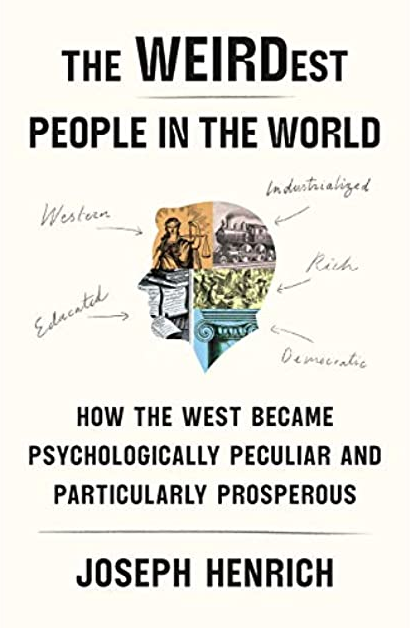
Jane Psmith reviews The WEIRDest People in the World: How the West Became Psychologically Peculiar and Particularly Prosperous by Joseph Henrich:

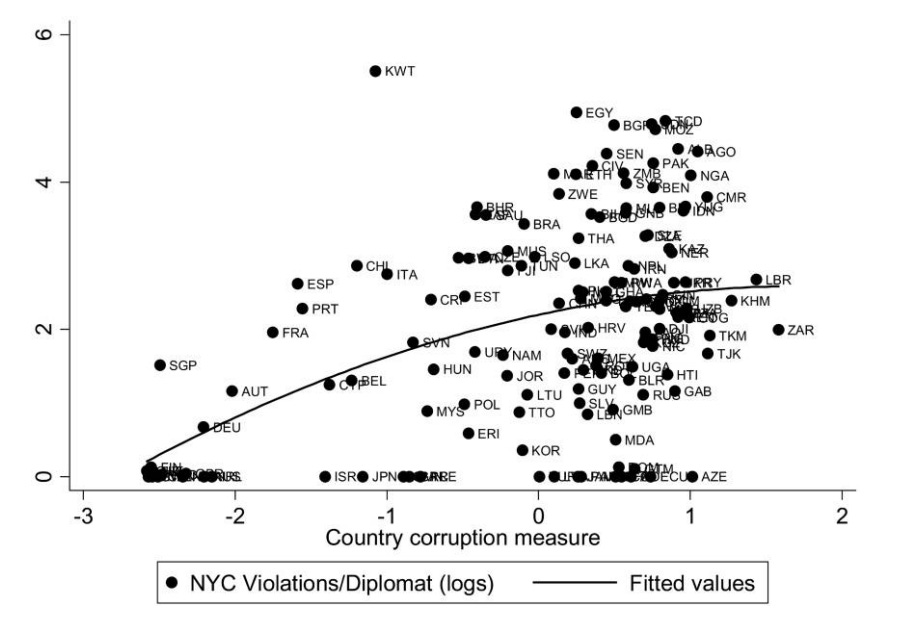
Until 2002, diplomats at the United Nations didn’t have to pay their parking tickets. Double-parking, blocking a fire hydrant, blocking a driveway, blocking an entire midtown Manhattan street — it didn’t matter; when you have diplomatic plates, they let you do it. In the five years before State Department policy changed in November 2002, UN diplomats racked up a whopping 150,000 unpaid parking tickets worth $18 million in fines. (Among other things, the new policy allowed the city to have 110% of the amount due deducted from the US foreign aid budget to the offending diplomats’ country. Can you believe they never actually did it? Lame.) Anyway, I hope you’re not going to be surprised when I say that the tickets weren’t distributed evenly: the nine members of Kuwait’s UN mission averaged almost 250 unpaid tickets apiece per year (followed by Egypt, Chad, Sudan, Bulgaria, and Mozambique, each between 100 and 150; the rest of the top ten were Albania, Angola, Senegal, and Pakistan). The UK, Canada, Australia, Denmark, the Netherlands, Sweden, and Norway had none at all. The rest of the rankings are more or less what you’d expect: for example, Italy averaged three times as many unpaid tickets per diplomat as France and fifteen times as many as Germany.

What did the countries with the fewest unpaid parking tickets have in common? Well, they generally scored low on various country corruption indexes, but that’s just another way of saying something about their culture. And the important thing about their culture is that these countries are WEIRD: western, educated, industrialized, rich, and democratic. But they’re also, in the grand scheme of human history, weird: their inhabitants think differently, behave differently, and value different things than most humans. Among other things, WEIRD people are individualistic, nonconformist, and analytical. They — okay, fine, we — are particularly hard-working, exhibit low time preference, prefer impersonal rules we apply universally, and elevate abstract principles over contextual and relationship-based standards of behavior. In other words, WEIRD people (as Joseph Henrich and his colleagues pointed out in the influential 2010 paper where they coined the phrase) are outliers on almost every measure of human behavior. Wouldn’t it be silly for an entire academic discipline (and therefore an entire society ideologically committed to Trusting The Experts) to base all its assumptions about human nature on psych lab experiments starring American undergraduates? That would give us a wildly distorted picture of what humans are generally like! We might even do something really dumb like assume that the social and political structures that work in WEIRD countries — impersonal markets, constitutional government, democratic politics — can be transplanted wholesale somewhere else to produce the same peace and prosperity we enjoy.

Ever since he pointed out the weirdness of the WEIRD, Henrich has been trying to explain how we got this way. His argument really begins in his 2015 The Secret of Our Success, which I reviewed here and won’t rehash. If you find yourself skeptical that material circumstances can drive the development of culture and psychology (unfortunately the term “cultural Marxism” is already taken), you should start there. Here I’m going to summarize the rest of Henrich’s argument fairly briefly: first, because I don’t find it entirely convincing (more on that below), and second, because I’m less interested in how we got WEIRD than in whether we’re staying WEIRD. The forces that Henrich cites as critical to the forging of WEIRD psychology are no longer present, and many of the core presuppositions of WEIRD culture are no longer taken for granted, which raises some thought-provoking questions. But first, the summary.

Henrich argues that the critical event setting the West on the path to Educated, Industrialized, Rich, and Democratic was the early medieval western Church’s ban on cousin marriage. That might seem a little odd, but bear in mind that most of the humans who’ve ever lived have been enmeshed in incredibly dense kin networks that dictate obligations, responsibilities, and privileges: your identity is given from birth, based simply on your role as a node in an interdependent network. When societies grow beyond the scale of a family, it’s by metaphorically extending and intensifying these kinship bonds (go read our review of The Ancient City for more on this). These kinship networks perpetuate themselves through marriage, and particularly through marriage to relatives, whether blood or in-laws, to strengthen existing connections. Familial or tribal identities come first, before even the claims of universal religions, as when Wali Khan, a Pakistani politician, phrased his personal allegiances as “I have been a Pashtun for six thousand years, a Muslim for thirteen hundred years, and a Pakistani for twenty-five.” You could imagine Edwin of Northumbria or Childeric saying something pretty similar.

Then, beginning in the 4th century, the western Church began to forbid marriages to relatives or in-laws, the kinship networks began to wither away, and alternative social technologies evolved to take their place. In place of the cousin-marriers’ strong tight bonds, conformity, deference to traditional authority, and orientation toward the collective, you get unmoored individuals who have to (or get to, depending on your vantage point) create their own mutually beneficial relationships with strangers. This promotes a psychological emphasis on personal attributes and achievements, greater personal independence, and the development of universalist social norms. Intensive kinship creates a strong in-group/out-group distinction (there’s kin and there’s not-kin): people from societies with strong kinship bonds, for instance, are dramatically more willing to lie for a friend on the witness stand. WEIRD people are almost never willing to do that, and would be horrified to even be asked. Similarly, in societies with intensive kinship norms, you’d be considered immoral and irresponsible if you didn’t use a position of power and influence to benefit your family or tribe; WEIRD people call that nepotism or corruption and think it’s wrong.

March 25, 2023

South Africa – from bad to indescribably worse

John Psmith reviews South Africa’s Brave New World: The Beloved Country Since The End Of Apartheid by R.W. Johnson. It isn’t a pretty picture at all:

    The whole world had come to Pretoria to see the inauguration of Nelson Mandela as the first democratically elected South African President. It was the greatest assemblage of heads of state since John F. Kennedy’s funeral … But it was the flight of nine SAAF [South African Air Force] Mirages overhead, dipping their wings in salute, which brought tears to many eyes. It said so many things: the acceptance of, indeed, the deference to, Mandela by the white establishment, the acknowledgement that he was fully President, able to command all the levers of power — and, for many black people in the crowd, it meant that for the first time the Mirages’ awesome power and white pilots were on their side, part of the same nation … All the products of that white power, including South Africa’s sophisticated economy and infrastructure, were being handed over intact.

A little over a decade later and that same South African Air Force was no longer able to fly. It wasn’t for lack of planes: new ones were procured from European arms manufacturers in an astonishingly expensive and legendarily corrupt deal. But once purchased the planes rotted from lack of maintenance and languished in hangers for lack of anybody able to fly them. Most of the qualified pilots and technicians had been purged, and most of the remainder had resigned. The air force did technically still have pilots, after all it would be a bit embarrassing not to, but those pilots were chosen for patronage reasons and didn’t technically have any idea how to fly a fighter jet.

It isn’t just the air force. That whole “sophisticated economy and infrastructure” that got “handed over intact” now by and large no longer exists. Consider something as basic as running water: in 1994, South Africa had some of the most sophisticated water infrastructure on earth, with a whole system of dams, reservoirs, and long-distance inter-basin conduits working together to conquer the geographical challenges of having several major cities and mining centers located on an arid plateau. All of this water was safe, drinkable, and actually came out of the tap when you turned the handle. This picture was marred of course by poor delivery to black rural communities and squatter camps, but in the early 90s the government was making rapid progress towards serving more of those people too.

Like the air force, that water system is now basically non-functional. It’s estimated that something like 10 million people no longer have reliable access to running water. When the water does run, it’s frequently filthy and contaminated with human sewage. South Africa had its first urban cholera outbreak in the year 2000, and they are now a regular occurrence. Again, like the air force, this isn’t for lack of money or effort. The state has spent billions on trying to fix the water problems, and the government’s water bureaucracy has tripled in size since 1994. Something else has gone wrong.

Neither of these examples is cherry-picked. Ask about literally any of the necessities for human life, and the picture is the same: basically first-world quality under the apartheid Nationalist government, and basically post-apocalyptic today. The electric grid is failing, with rolling blackouts consuming the country on a daily basis. The rail network, once one of the finest on earth, is now so degraded that mines in the North of the country prefer to truck their products overland to ports in Mozambique rather than risk the rail journey to Durban. The medical system was once the jewel of Africa and now teeters on the brink of collapse, with qualified doctors and nurses fleeing the country in droves. As for education, one South African author notes: “When Anthony Sampson’s authorized biography of Mandela appeared one of its more embarrassing asides was that all the educational institutions which had nourished Mandela had since collapsed. A Mandela could be produced in colonial times, but no longer.”

Had enough yet? At last count between a third and a half of the population is unemployed. Public order is non-existent outside gated communities and tourist areas patrolled by private security. The murder rate in South Africa exceeds that of many active war zones. Every major city in South Africa is among the most dangerous cities on earth, and the countryside is much worse than the cities. The reported cases of rape alone establish South Africa as the worst country on earth for rape, and the vast majority of cases are likely unreported, since the police have essentially stopped prosecuting this crime.

Something has gone very wrong. What happened? That’s the subject of this book by R.W. Johnson, an ultra-detailed examination of the 10 or so years following the end of apartheid in 1994. Johnson is the right guy to write this book — he’s lived in South Africa since the 1960s, and was active in the movement against apartheid from its earliest days, so he personally knows most of the players who’ve been running the country. And now he has the bittersweet task of writing a book documenting how what happened is “just what white racists predicted and what white radicals like myself scorned”.

« Newer Posts

Powered by WordPress