
As I have pointed out myself, the more one knows about a subject, the more conservative one becomes towards it. Conversely, the less one knows, the more liberal he becomes, and inclined to embrace “progress” and “reforms.” Even a Communist may prove a very conservative stamp collector, once he learns something about philately. It’s only economics he knows nothing about.
This is a universal principle. Everyone knows something about something, and is very backward on that which he knows. The one exception may be journalists, who know nothing about anything, and are therefore liberal all round.
David Warren, “I’ll be a Welshman”, Essays in Idleness, 2018-03-01.
June 13, 2020
QotD: The liberal media
Comments Off on QotD: The liberal media
June 12, 2020
An unwelcome return to the 1960s
David Warren reflects on how many parallels we’re seeing in the current year to the worst aspects of the 1960s:
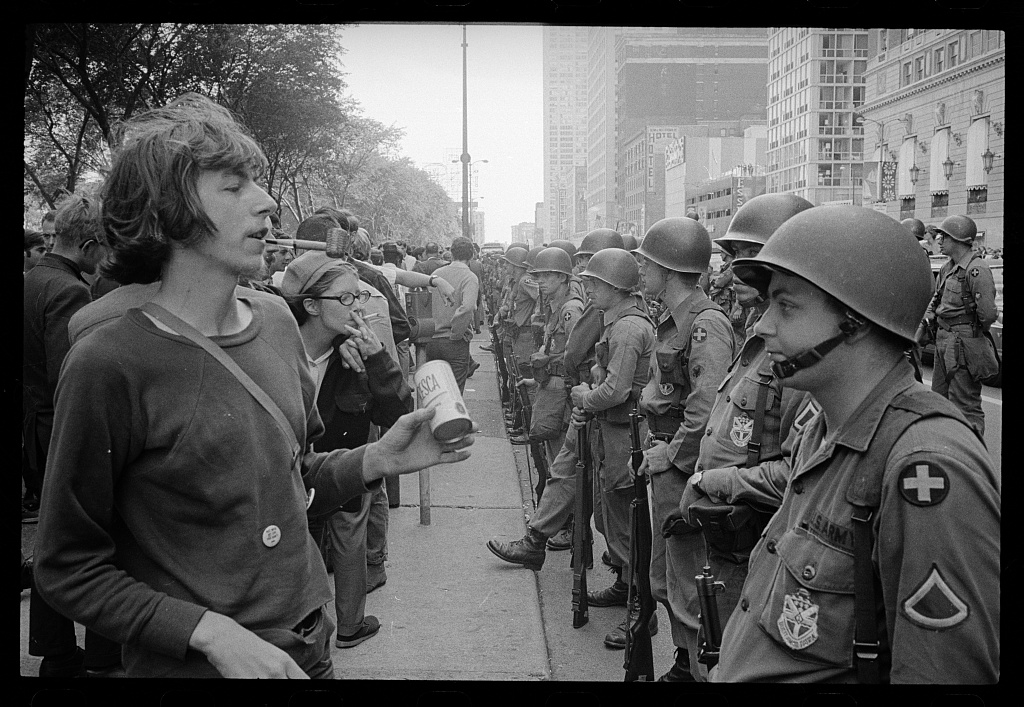
Young “hippie” standing in front of a row of National Guard soldiers, across the street from the Hilton Hotel at Grant Park, at the Democratic National Convention in Chicago, August 26, 1968. Photo by Warren K. Leffler for US News & World Report via Wikimedia Commons.
As an old Cold Warrior, and once “science kid,” whose childhood developed through the 1960s, there is nothing that ought to surprise me. We have Antifa today; we had the Weather Underground then. We have parallels to every event I witnessed through the idiot box of adolescence, and vice versa. Even the destruction of American cities by riots and crime isn’t new; nor the supine response of our liberal leaders. The obvious left bias of news and entertainment was the same then as now, only less shrieking. The replacement of flatfoot journalists, with malicious ideological clowns from the universities, then a work in progress, was by the end of the last century, complete. The poison spread, through all media of information. We’ve reached an Age of Unreason to match Robespierre’s, and seem now to be waiting for a Napoleon.
Charlatans are the handmaids of paganry. That the charlatans slide into violent insurrection, even against the better pagan customs, is not something historically new.
The alternative is improbable: another Age of Faith. This would necessarily include a subsidiary restoration of faith in science — in the modest belief that if we follow the facts where they lead, as opposed to where we want them to go, a lost perception of cosmological order will also be, willy-nilly, restored. “Modern science” — an unambiguously Christian construct — depends entirely on one assumption. It is, that a universe God created will make sense. Logic, or the principle of non-contradiction, will hold up, and where it doesn’t seem to be doing so, it is not God, but we, who have got it wrong.
By the inversion of “values,” at the present day, the sane views are labelled as “psycho.” The truth is not the true, but what we (or our masters) want to call true. This “truth” is “settled,” from one moment to another; and is not to be discovered, but imposed.
Comments Off on An unwelcome return to the 1960s
June 9, 2020
It was scientifically inevitable for the Communists to win the Cold War – as foretold in the prophecies
Sarah Hoyt on the “script” that progressives operated under during the Cold War and almost unchanged in detail to the present day, too:
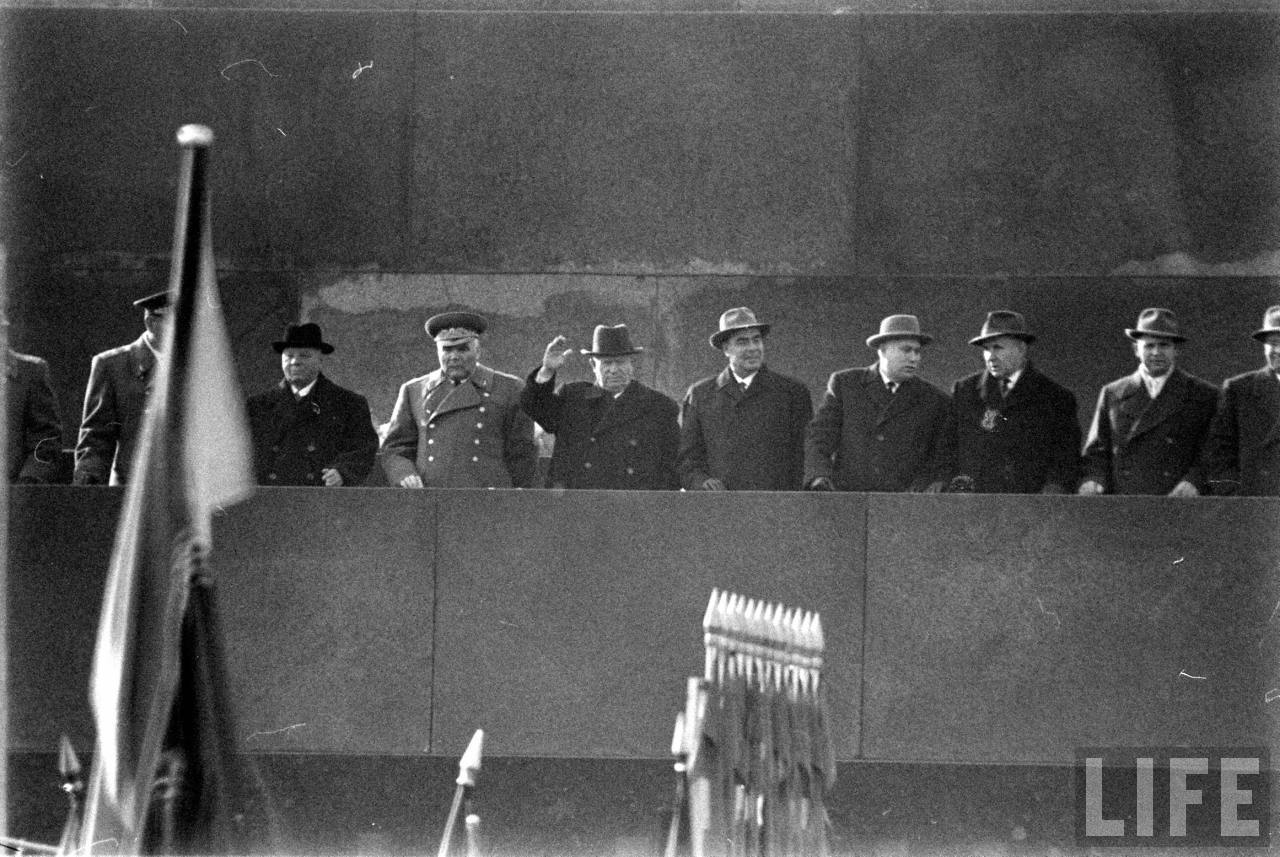
Krushchev, Brezhnev and other Soviet leaders review the Revolution parade in Red Square, 1962.
LIFE magazine photo by Stan Wayman.
… the Cold War had two sides: the USSR and our elites, who had been corrupted and taken over for a long time thanks to the communist agents who had long-marched through our media, our entertainment and our bureaucracy.
Heinlein claimed the Democrats had been taken over by communists, secretly, by the 40s. I have no reason to doubt him. I’m sure most of the bureaucracy and governments in Europe had been taken over that way also.
Even so called conservatives assumed communism would eventually win, because according to the numbers coming out of the USSR and the reporters visiting the USSR — anyone know where Duranty is buried? there should be a line to piss on his grave — they were just so much more efficient. Scientific governance, you know? And anyway, technology was going to be so advanced that most humans would be unemployable, and by the way, there were more and more humans every year, so it was impossible to have all these bourgeois luxuries. So communism, efficient, compassionate, communism was the future, the only way.
The realists who saw it was the only way were willing to do anything to bring it about. Because the people who weren’t as intelligent/well informed would otherwise destroy the world and bring about unimaginable catastrophe.
“Conservatives” were merely those who wanted communism to arrive slower and be a little less violent. Communism with a human face. Socialism on the way to communism. Easing us into our role as cogs in the machinery of the future — where there was no room for personal frills or really emotions — with gentle pneumatic shocks, instead of with the excesses of the Russian and Soviet revolution.
All of this btw is based on three glaring fallacies (phaluscies, since you have to be a dickhead to believe them particularly now.)
1- People are a drain not an asset. They are also a sort of robot incapable of changing behavior in response to changing circumstances.
2- Wealth can’t grow, nor can the carrying capacity of the Earth improve. So since humans can’t respond to reduced infant mortality by having fewer children, the only way to feed everyone is to reduce everyone’s rations. Forever.
3- It is possible for “the best”, properly educated people to be utterly selfless and to administer everyone’s wealth equally and for the common good. They will not revel in power, nor will they avail themselves of any excess. Because, they are absolutely moral and all seeing.
Note the left is still running this script. And some on the right too (Hello, Pierre Delecto!) not to mention all of Europe, left and right. Also note #1 conflicts with the left idea that they can bring about a future in which humans change to be all selfless, etc. But that’s actually complicated and tied in to their myths, which honestly are a Christian heresy, complete with paradise lost.
I know when they started out, the USSR thought it could “engineer” a new human. Homo Sovieticus. But I don’t know enough of Soviet myth to know what underlay that. Maybe it was a behaviorist thing and they thought humans could be trained into being completely selfless automatons. I know by the time I was reading communist theorists (no, I didn’t buy their arguments, but I was required to read them, given when and where I grew up) in the seventies, the philosophy had fallen prey to the agitprop notion that people in madhouses in the US were political prisoners just as in the USSR. (BTW this is part of what underlay the closing of the madhouses.) And that was part of a push in the seventies, as the malfeasance of USSR was starting to be glaring, amid escaped dissidents and escaping information. The push was to “prove” that both systems were equally bad. (The left is still flogging that dead equine, too. So Cubans and Venezuelans are starving? So how many people die of anomie and not being loved enough under capitalism? REEEEE.) So, since Soviets put dissidents in mad houses, so did we. But that necessitated that people who widdled on themselves and/or thought they were a lampshade with a set of dishes thrown in be completely sane “political dissidents”. The only way to do this was to attribute anything communists don’t like to “insanity brought about by capitalism.” This led to crazier byways of thought. For instance, it led to the idea of the pre-historic, pre-agriculture paradise, where everyone was equal, there was no poverty, need, greed, or the heartbreak of psoriasis. A sub-branch of the church believed women were in charge and everyone worshiped the mother goddess. And some of these “scientific, atheist socialists” also believe the goddess actually exists, though G-d doesn’t.
David Friedman had a different formulation for the utopian world many progressives wish for the rest of us:
In the ideal socialist state power will not attract power freaks. People who make decisions will show no slightest bias towards their own interests. There will be no way for a clever man to bend the institutions to serve his own ends. And the rivers will run uphill.
Comments Off on It was scientifically inevitable for the Communists to win the Cold War – as foretold in the prophecies
How we are supposed to view the rioting protests in major US cities
David Thompson shares the essential parts of a Vice article, telling us insufficiently woke dullards how to think about the ongoing civil unrest in many American cities after the death of a man at the hands (well, technically the knees) of Minneapolis police:

A building burning in Minneapolis following the death of George Floyd.
Photo by Hungryogrephotos via Wikipedia.
In the pages of Vice, a moral lecture, delivered from on high:
How to Talk to Relatives Who Care More About Looting Than Black Lives.
As an exercise in question-begging and dense, self-satisfied presumption, it’s quite a thing, that headline. It’s very now.
Among those of us deemed insufficiently woke and therefore suspect, questions may arise. For instance, in what way will those “black lives” be improved by the destruction of local infrastructure, local businesses, and the subsequent, perhaps dramatic, reduction in trust and goodwill? And what if the stores and homes in question — the ones being smashed, stripped of their contents and set ablaze — are owned by people who happen to be black, as has often been the case? What if the places being looted and vandalised with abandon, indeed exultation, are depended on by people who also happen to be black, whether as customers or employees? Given the levels of material, social and economic destruction, should these people be content, indeed pleased, to be former employees? Unemployed people who now have no local grocer, or garage, or pharmacy?
Alas, such considerations appear to have eluded the keen mental processes of the article’s author, Ms Rachel Miller, a young woman who dutifully declares her pronouns and boasts of being a “Buzzfeed alum.”
If you’re not Black but want to support BLM, having fraught conversations with your kinda (or definitely) racist loved ones will likely not be fun, but it’s a very worthy undertaking.
Right from the off we’re informed, firmly, that any perceptible reservations about looting and rioting, or reservations about the Black Lives Matter movement — say, regarding its demented far-left agenda, its racial tribalism, and the stated goal of abolishing capitalism, prisons and the police — must be taken as an indicator of being “kinda (or definitely) racist.” Wokeness is not, it seems, a recipe for cognitive subtlety. “Some people,” we’re told, “appear to be far more worried about the fate of a Nordstrom or Target store than that of the actual human lives of protesters.” Again, one might deduce that only those protesting with, shall we say, physical enthusiasm have “actual human lives,” unlike their victims, whose hopes and livelihoods can be gleefully destroyed as an act of righteous liberation. From local amenities.
Comments Off on How we are supposed to view the rioting protests in major US cities
May 26, 2020
“No more pencils, no more books…”
In the latest edition of the Libertarian Enterprise, Sean Gabb considers the demands from the British government to quickly re-open the schools over the concerns of the educational unions and administrations:

The latest turn in an increasingly dull coverage of the Coronavirus panic is a proposed reopening of the schools. The Government wants them open as soon as possible for at least some of their students. The teaching unions are bleating that no one should go back until their members can be sure of not catching anything. The headmasters are worried about compliance with the social distancing rules. As a conservative of sorts, I think I am supposed to side with the Government and the pro-Conservative journalists — denouncing the teachers as a pack of idlers where not cowards, and insisting that those factories of essential skills must be set back in full production before the summer holidays. Of course, my settled view as a libertarian is that the teaching unions deserve all the support I have never so far given them. The schools must remain closed until no one is in any danger of so much as an attack of hay fever. The schools have been largely closed since the end of March. The longer they stay largely closed, the better. Best of all if they never reopen — or never reopen as they have been since attendance was made compulsory at the end of the nineteenth century.
I quote John Stuart Mill on compulsory schooling:
A general State education is a mere contrivance for moulding people to be exactly like one another: and as the mould in which it casts them is that which pleases the predominant power in the government, whether this be a monarch, a priesthood, an aristocracy, or the majority of the existing generation; in proportion as it is efficient and successful, it establishes a despotism over the mind, leading by natural tendency to one over the body.
(On Liberty, 1859, Chapter 5, “Applications.”)This has always been the case in some degree. The spread of state schooling in England after 1870, and particularly after it was made compulsory in 1880, and then extended in 1902, is probably inseparable from the nationalist hysteria that drove our participation in the Great War. It also may explain the perverse belief, general until the 1970s, in the unique goodness and honesty of our ruling class. This being said, reasonable patriotism is to be encouraged; and, compared with others, our ruling class was not until recently so bad. A further point is that compulsory state schooling used to be reasonably effective at giving the mass of people a basic education. By 1960, most people were literate and numerate. They could spell and write grammatical prose. They had some exposure to the English classics, and the means of exploring these to greater depth if they wished. They had some understanding of history and the sciences. You can tell much about the quality of a people by examining what is read and watched. Looking at the popular arts in England during much of the twentieth century explains why this passage in On Liberty was less often discussed than his arguments for freedom of speech. Mill was right in the abstract. He could be shown to be right in certain particulars. But the evils of compulsory state schooling were mostly potential.
All this, however, is in the past. Since about 1980, schooling of all kinds has been made into a concerted means of indoctrination. The cultural leftists have captured both the classrooms and the curriculum. I will not elaborate on this claim. Some will argue over terminology, some over the merits of the capture, but hardly anyone denies the broad fact. One of the main functions of modern schooling is to bring about and to protect a radical departure from the old intellectual culture of this country.
Much of this departure has been achieved by preaching in the classroom. But it is supplemented by a growing bureaucracy of surveillance. The teachers themselves are watched, and they can be punished for dissenting from the established discourse. There is, for example, the Government’s Prevent strategy, which applies to the whole state machinery. Its purpose is to identify and root out anyone defined as a “political extremist.” Anyone identified as such is effectively banned from working with children and young people, and probably in the state sector as a whole.
Comments Off on “No more pencils, no more books…”
May 24, 2020
Zuby on why Joe Biden’s “you ain’t black” comment is one of the most racist things said by any US politician recently
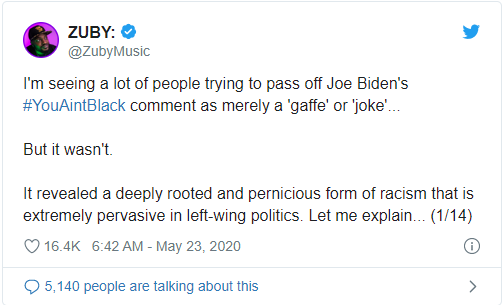
I’d embed all the tweets here, but the page loading speed would be monumentally slow, so here’s the initial tweet and I’ve scraped the text from the rest and put it in blockquotes:
I'm seeing a lot of people trying to pass off Joe Biden's #YouAintBlack comment as merely a 'gaffe' or 'joke'…
But it wasn't.
It revealed a deeply rooted and pernicious form of racism that is extremely pervasive in left-wing politics. Let me explain… (1/14)
— ZUBY: (@ZubyMusic) May 23, 2020
Every black person is aware of the power and pain of being considered an ‘outsider’ within one’s own ‘race’.
This happens everywhere, but it is a common phenomenon particularly amongst Black Americans, due to history and culture. (2/14)
—
You are probably familiar with terms like ‘Uncle Tom’, ‘coon’, ‘house n*gga’, ‘coconut’, ‘Bounty’ and ‘race traitor’.
These slurs are used to demean black people by stripping them of their ‘Blackness’. (3/14)
—
ALL black conservatives, libertarians, centrists, or even moderate liberals have been on the receiving end of at least one of these slurs.
Usually levied by another black person, but occasionally by a particularly bold ‘woke white progressive’ type. (4/14)
—
This form of ostracisation is particularly painful for Black Americans. Who are largely disconnected from their African roots due to the horrors of slavery.
As a substitute, many cling to a fuzzy concept of ‘Blackness’. For the sake of identity and community. (5/14)
—
So, to be considered ‘not black’ is like being an outcast of a community that often already feels alienated… (6/14)
—
I am not American and I do not speak on behalf of anybody but myself. These are my own thoughts.
My name is Nzubechukwu and my heritage is of the Igbo tribe in Anambra state in Nigeria 🇳🇬
So NOBODY can take my ‘Blackness’ from me! They will look foolish trying! (7/14)
—
Most Black Americans don’t have this SOLID sense of heritage.
People (of all colours) know this and weaponise it against them to prevent individuals from stepping out of the ‘groupthink’.
Anyone who is perceived to go ‘against’ ‘The Black Community’ must be punished. (8/14)
—
Left-wing politicians, activists and professional race hustlers have used this psychological warfare to keep black people ‘in check’ and voting for them for many decades.
It’s demeaning, discriminatory, and it strips black people of our agency. (9/14)
—
So, when Biden suggested that ‘you ain’t Black’ if you consider voting for Trump instead of him, he exposed a much deeper form of racism.
The sense of ‘ownership’ of Black people. Unearned allegiance and entitlement.
It was a vile statement… (10/14)
—
But it was also honest. Because that’s how a lot of these politicians and ‘progressives’ really feel about black people.
Like they own us. (11/14)
—
If you were born black, then you will die black. There is no such thing as being ‘politically black’. This is nonsense designed to CONTROL you and keep you needy.
NOBODY can take away your ‘Blackness’. Your ‘Black Card’ is your birthright. Regardless of who you vote for. (12/14)
—
I would never dream of telling anyone who they must vote for, based on their skin colour nor genitalia.
That would be extremely arrogant, condescending and discriminatory.
Be VERY suspicious of anybody who talks like that. They want to control your mind. (13/14)
—
That is all. I hope you enjoyed my TED talk.
Much love. 👊🏾
Zuby
#ImStillBlack
H/T to Darleen for posting the link to David Thompson’s blog.
Comments Off on Zuby on why Joe Biden’s “you ain’t black” comment is one of the most racist things said by any US politician recently
May 19, 2020
The Karenist coup
L. Neil Smith on our current self-inflicted plight:
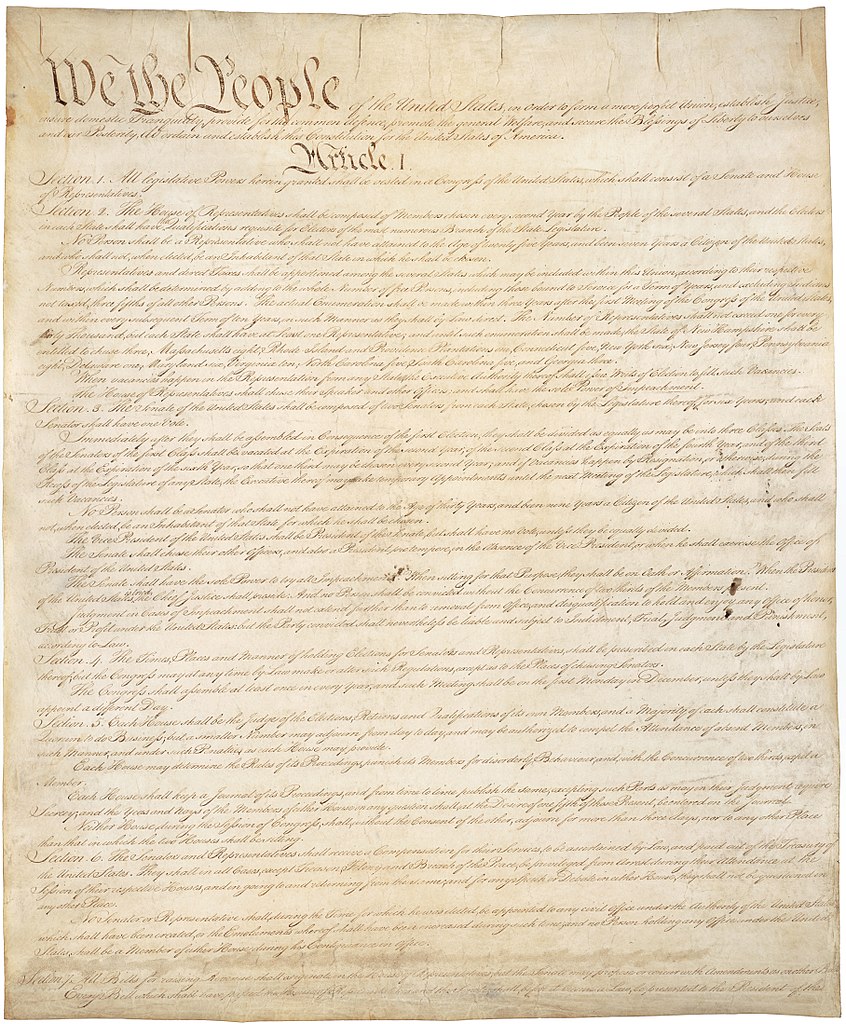
We find ourselves here, in this particular time and this particular place in the history of our republic, because of a 239-year-old oversight made by the Founding Fathers, in that the first ten amendments to the United States Constitution, commonly known as the Bill of Rights (the name itself is a mistake), contain no penalty clause for those — politicians, bureaucrats, policemen — who violate them. I’m not entirely sure it was accidental, but, as a result, they are violated daily, hourly, as a matter of course, and this Corona Virus farce — many others come to mind — is simply the most recent and most preposterous example.
(The name itself is an error because this document is not a mere list of privileges that the government generously lets the people exercise. Quite the opposite, it is a list of things that the government is absolutely forbidden to do It should have been called the “Bill of Limits”. And if the Founders, who had just fought and won a desperate, bloody war against the world’s most brutal and rapacious super-power, hadn’t meant them to be absolute, then why — for all you “living document” idiots out there — would they have even bothered to write them down?)
All over this bruised and battered country, a flock of mean, moronic, petty tyrants have issued illegal orders to those they clearly regard as the peasantry: stay home, avoid your fellow human beings, and above all, shut down the Machinery of Freedom which we know as capitalism. If it’s ever allowed to start up again, it must strictly be on terms that are essentially Marxist in character. No mere individual can ever again scratch his ass without written government approval and permission. In effect, the left has the revolution — as usual, achieved by somebody else — it has wanted for 180 years, since the days of Pierre-Joseph Proudhon.
What’s more, many otherwise decent and intelligent folks are out there begging for their rulers to let them be free again. I find that repulsive and unAmerican. And to those boobies (including Sean Hannity and Joy Behar) blubbering about patriots bring their weapons to demonstrations, listen up: the Founders meant the government to be intimidated by the people, you hapless buffoons.
My bottom line, here, is that, in the short run, we must free ourselves — now — from what we have to call Faucism. Scientific pleaders like the dictatorial doctor must be made painfully aware that when their pronouncements have clear political and economic consequences, their protests of innocence sound a bit too much like “I was just following orders”.
Comments Off on The Karenist coup
May 17, 2020
QotD: The egalitarian model of bias
Bo Winegard, “‘Equalitarianism’ and Progressive Bias”, Quillette, 2018-02-07.
Comments Off on QotD: The egalitarian model of bias
May 4, 2020
QotD: The eternal “now” of Progressive stasis
None of that matters to the cultural marxist, though. How could it? As I wrote yesterday, to the fanatic, the past is one long catalog of freely chosen error. Nor is there any meaningful future to a fanatic. That seems wrong, I realize, but consider that time passes through contrast. People will be born and die in the Communist Utopia, but since everyone will always have everything, human activity will be exquisitely pointless …
Ignore what Leftists say. Watch what they do, and it’ll soon be obvious that what they long for above all things is stasis. They want everyone and everything to be one way, and one way only, forever. Homosexuals are the most flamboyant example. Imagine that — having your entire life defined by your sexual attraction. I like blondes, but you know, if the right brunette came along I’d go for her. Heck, I’d even go for a ginger (I know, I know, I’m a monster). But according to the Left, that’s not allowed. I like blondes, and therefore I’m only allowed to like blondes. Oh, and I can only vote for Bernie Sanders, because he’s the attracted-to-blondes candidate, and I must support abortion, and use the word “cisgendered,” and …
Thus, to the Leftist there’s no past, and no future either. There’s only now, and the only thing that matters now is power. How could it be otherwise?
Severian, “The Endless Now”, Rotten Chestnuts, 2020-01-23.
Comments Off on QotD: The eternal “now” of Progressive stasis
May 2, 2020
Gabriel Over the White House – “the most unapologetic celebration of fascism ever put on film”
Jack Cashill found this “gem” while watching Turner Classic Movies during the Wuhan Coronavirus lockdown and was amazed:
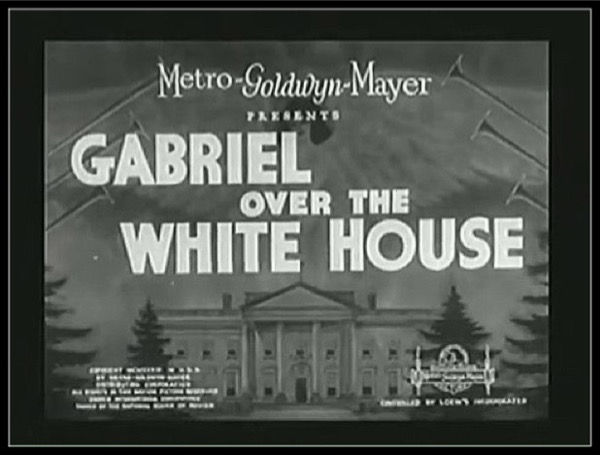
By now, I have seen most of TCM’s movies, but one aired this past week I had not even heard of. On a whim, I DVR’ed it. Good move. Called Gabriel Over the White House, this 1933 liberal wet dream proved to be the most unapologetic celebration of fascism ever put on film.
I watched it wide-eyed. The movie opens with the inauguration of Jud Hammond. A laissez-faire back-slapper, Hammond sees the White House as a way to enrich himself and reward his cronies, Depression be damned. The audience assumes Hammond is a Republican.
Out joyriding one day, Hammond crashes his car and lapses into coma. While still comatose, the Angel Gabriel visits Hammond and turns him into a committed and caring progressive. Is there another kind?
Upon waking, Hammond convenes his cabinet of corrupt self-servers and rejects their plea that the party must come first. Instead, Hammond insists their first priority be the American people. He refuses to use the U.S. Army against a marching mass of the unemployed and fires the secretary of state when he objects.
“I suggest you read the Constitution of the United States. You’ll find the President has some power,” Hammond warns his cabinet members. Some power? Fully indifferent to the Constitution, Hammond grabs all the power that can possibly be grabbed.
When the cabinet objects to his usurpation of power, Hammond fires the cabinet. When Congress threatens to impeach Hammond, he declares martial law and dispenses with Congress. When accused of being a dictator, Hammond argues that his is a dictatorship based on some imagined Jeffersonian principle of Democracy, namely the greatest good for the greatest number of people.
Now with total power, Hammond enacts a national banking law, stops foreclosures, provides direct aid to some 55 million farmers, circumvents private industry and launches his own “Army of Construction.”
A young aide, Hartley Beekman, and his female counterpart, Pendie Molloy, serve as something of a progressive chorus. “The way he thinks is so simple and honest that it sounds a little crazy,” says Beekman of Hammond.
“He’s doing the things you wanted,” Molloy answers. “And If he’s mad, it’s a divine madness. Look at the chaos and catastrophe sane men have brought about.”
The divine madness includes the creation of a Federal Police force, a subset of the Army, with young Beekman at its head. When the nation’s chief racketeer refuses to go back to his unnamed home country, Hammond warns him that the government is about to “muscle in on his racket” and federalize the sale of alcohol.
The racketeer fights back, and Beekman employs a legion of tanks Waco-style against the racketeers. When captured, the racketeers are all hauled before a three-man court martial headed by Beekman, promptly declared guilty, and executed en masse by a firing squad.
Several years ago, the movie was brought to my attention and I found this clip on YouTube that I suspect captures the essence of the film:
James Lileks describes it as “a remarkable movie. And I don’t mean ‘astonishingly good, technically superb, visually ingenious.’ I mean utterly insane.”
Comments Off on Gabriel Over the White House – “the most unapologetic celebration of fascism ever put on film”
April 25, 2020
QotD: The entitlement mindset of intellectuals
Robert Nozick, “Why Do Intellectuals Oppose Capitalism?”, Cato Policy Report, 1998-01-01.
Comments Off on QotD: The entitlement mindset of intellectuals
April 23, 2020
QotD: Idiotarianism
Glenn Reynolds, Instapundit, 2005-01-31.
Comments Off on QotD: Idiotarianism
April 18, 2020
QotD: Distorting the history of science
The historian of science David Wootton has remarked on the mores of his own field: “In the years since Snow’s lecture the two-cultures problem has deepened; history of science, far from serving as a bridge between the arts and sciences, nowadays offers the scientists a picture of themselves that most of them cannot recognize.” That is because many historians of science consider it naïve to treat science as the pursuit of true explanations of the world. The result is like a report of a basketball game by a dance critic who is not allowed to say that the players are trying to throw the ball through the hoop.
Many scholars in “science studies” devote their careers to recondite analyses of how the whole institution is just a pretext for oppression. An example is a 2016 article on the world’s most pressing challenge, titled “Glaciers, Gender, and Science: A Feminist Glaciology Framework for Global Environmental Change Research,” which sought to generate a “robust analysis of gender, power, and epistemologies in dynamic social-ecological systems, thereby leading to more just and equitable science and human-ice interactions.”
More insidious than the ferreting out of ever more cryptic forms of racism and sexism is a demonization campaign that impugns science (together with the rest of the Enlightenment) for crimes that are as old as civilization, including racism, slavery, conquest, and genocide.
This was a major theme of the Critical Theory of the Frankfurt School, the quasi-Marxist movement originated by Theodor Adorno and Max Horkheimer, who proclaimed that “the fully enlightened earth radiates disaster triumphant.” It also figures in the works of postmodernist theorists such as Michel Foucault, who argued that the Holocaust was the inevitable culmination of a “bio-politics” that began with the Enlightenment, when science and rational governance exerted increasing power over people’s lives. In a similar vein, the sociologist Zygmunt Bauman blamed the Holocaust on the Enlightenment ideal to “remake the society, force it to conform to an overall, scientifically conceived plan.”
In this twisted narrative, the Nazis themselves are somehow let off the hook (“It’s modernity’s fault!”). Though Critical Theory and postmodernism avoid “scientistic” methods such as quantification and systematic chronology, the facts suggest that they have the history backwards. Genocide and autocracy were ubiquitous in premodern times, and they decreased, not increased, as science and liberal Enlightenment values became increasingly influential after World War II.
Steven Pinker, “The Intellectual War on Science”, Chronicle of Higher Education, 2018-02-13.
Comments Off on QotD: Distorting the history of science
April 12, 2020
QotD: The Gini coefficient
The redistributionist impulse has brought to the fore metrics such as the Gini coefficient, named after the ur-redistributor, Corrado Gini, an Italian social scientist who developed an early statistical measure of income distribution a century ago. A society where a single plutocrat earns all the income ranks a pure “1” on the Gini scale; one in which all earnings are perfectly equally distributed, the old Scandinavian ideal, scores a “0” by the Gini test. The Gini Index has been renamed or updated numerous times, but the principle remains the same. Income distribution and redistribution seem so crucial to progressives that French economist Thomas Piketty built an international bestseller around it, the wildly lauded Capital.
Through Gini’s lens, we now rank past eras. Decades in which policy endeavored or managed to even out and equalize earnings — the 1930s under Franklin Roosevelt, the 1960s under Lyndon Johnson — score high. Decades where policymakers focused on growth before equality, such as the 1920s, fare poorly. Decades about which social-justice advocates aren’t sure what to say — the 1970s, say — simply drop from the discussion. In the same hierarchy, federal debt moves down as a concern because austerity to reduce debt could hinder redistribution. Lately, advocates of economically progressive history have made taking any position other than theirs a dangerous practice. Academic culture longs to topple the idols of markets, just as it longs to topple statutes of Robert E. Lee.
But progressives have their metrics wrong and their story backward. The geeky Gini metric fails to capture the American economic dynamic: in our country, innovative bursts lead to great wealth, which then moves to the rest of the population. Equality campaigns don’t lead automatically to prosperity; instead, prosperity leads to a higher standard of living and, eventually, in democracies, to greater equality. The late Simon Kuznets, who posited that societies that grow economically eventually become more equal, was right: growth cannot be assumed. Prioritizing equality over markets and growth hurts markets and growth and, most important, the low earners for whom social-justice advocates claim to fight. Government debt matters as well. Those who ring the equality theme so loudly deprive their own constituents, whose goals are usually much more concrete: educational opportunity, homes, better electronics, and, most of all, jobs. Translated into policy, the equality impulse takes our future hostage.
Amity Shlaes, “Growth, Not Equality”, City Journal, 2018-01-21.
Comments Off on QotD: The Gini coefficient


