
World War Two
Published 2 Dec 2023The bulk of the fight for Hürtgen Forest is now over, and today we look at the results. We also look at Soviet plans for their January offensive. In the field this week, the Red Army is still fighting in Hungary, the Allies are still trying to reach the Roer River in the west, and in the Pacific Theater the kamikaze menace is wreaking havoc with Allied scheduling.
00:00 INTRO
01:06 Soviet Offensive Plans for 1945
03:12 Red Army attacks in Hungary
06:19 The Port of Antwerp is clear for use
07:23 The Battle of Hurtgen Forest is Over
12:20 Allied advances to the Roer
14:19 Tension builds in Greece
15:32 The aerial situation in the Philippines
21:36 CONCLUSION
(more…)
December 3, 2023
Was Hürtgen Forest Worth it? WW2 – Week 275 – December 2, 1944
Comments Off on Was Hürtgen Forest Worth it? WW2 – Week 275 – December 2, 1944
November 19, 2023
How Himmler Learned to Love the Russians – WW2 – Week 273 – November 18, 1944
World War Two
Published 18 Nov 2023Heinrich Himmler wants to build an Army of Soviet POWs, but that has some problems; Patrick Hurley becomes US Ambassador to China, but even before that he’s in hot water with Chiang Kai-Shek; and in the field in the west, the Allies launch Operation Queen to try to cross the Roer River and reach the Rhine.
(more…)
Comments Off on How Himmler Learned to Love the Russians – WW2 – Week 273 – November 18, 1944
November 12, 2023
The Futile Fight in Hurtgen Forest – WW2 – Week 272 – November 11, 1944
World War Two
Published 11 Nov 2023The struggle for Hurtgen forest, one tiny piece at a time, continues. The Allies have, however, secured Walcheren Island, and also launch Operation Queen to try and reach and cross the Roer River, and further south even launch a new offensive aiming for Metz. Things are not going well for the Americans on Leyte, though, but they’re even worse for the Chinese as both Guilin and Liuzhou fall to the Japanese. As for the Soviets, they are busy making big plans for a gigantic offensive to drive in to Germany when the new year comes.
(more…)
Comments Off on The Futile Fight in Hurtgen Forest – WW2 – Week 272 – November 11, 1944
October 29, 2023
The Battle of Leyte Gulf – WW2 – Week 270 – October 28, 1944
World War Two
Published 28 Oct 2023This is it — the big showdown between US and Japanese Navies, and the largest naval battle ever fought in terms of total tonnage. American landings on Leyte itself are still in progress, and the Soviets’ Debrecen Operation comes to its end.
(more…)
Comments Off on The Battle of Leyte Gulf – WW2 – Week 270 – October 28, 1944
October 22, 2023
SS Commando Coup in Hungary – WW2 – Week 269 – October 21, 1944
World War Two
Published 21 Oct 2023The Germans engineer a coup in Hungary to keep the Hungarian army in the war, but the Allies have finally entered Germany in force, taking Aachen in the west. The Soviets liberate Belgrade in the east, and launch new attacks in Baltics, and at the other end of the world come American landings in the Philippines, and the recall of Vinegar Joe Stilwell from China.
00:00 Intro
01:00 Recap
01:21 Raids on the Philippines
04:42 The Invasion of Leyte
06:11 Joe Stilwell is recalled from China
08:12 The Battle of Aachen
12:24 Battle of the Scheldt
14:03 Soviet attacks in the Baltics
16:23 Horthy’s fall- a coup in Hungary
19:45 Germans close in on Slovakia
21:55 Belgrade Liberated
24:47 Summary
25:01 Conclusion
(more…)
Comments Off on SS Commando Coup in Hungary – WW2 – Week 269 – October 21, 1944
October 15, 2023
The Isolation of Army Group North – WW2 – Week 268 – October 14, 1944
World War Two
Published 14 Oct 2023Churchill, Stalin, and Roosevelt meet at the Moscow Conference and talk about future “spheres of influence” in the Balkans. They also make plans for the future of Poland. In the field the Soviet Red Army completes the isolation of Army Group North and also advances in Hungary and Yugoslavia. The Allies enter Aachen in the west and cross the Rubicon in Italy. The Americans are still fighting the Japanese on Peleliu, and this week also make raids against Japanese airfields ahead of next week’s invasion of the Philippines.
01:00 Recap
01:22 The Moscow Conference begins
03:43 Isolating Army Group North
06:29 Soviet advances toward Belgrade
08:14 The Debrecen Operation
13:20 Horthy and Hungary
14:30 Chiang Kai-shek accuses Joe Stilwell
16:19 American raids on Formosa
19:29 The fight for Peleliu continues
20:01 Antwerp and Aachen
22:01 The Allies cross the Rubicon
(more…)
Comments Off on The Isolation of Army Group North – WW2 – Week 268 – October 14, 1944
September 10, 2023
Bulgaria at War with Everyone – WW2 – Week 263 – September 9, 1944
World War Two
Published 9 Sep 2023This week the USSR invades Bulgaria … who’ve also declared war on Germany, and who are still at war with the US and Britain, so Bulgaria is briefly technically at war with all four at once. Finland signs a ceasefire, the Germans are pulling out of Greece, the Warsaw and Slovak Uprisings continue, Belgium is mostly liberated, and across the world, the Japanese enter Guangxi, and there are American plans to liberate the Philippines.
(more…)
Comments Off on Bulgaria at War with Everyone – WW2 – Week 263 – September 9, 1944
June 25, 2023
The Greatest Pincer Movement in Military History – WW2 – Week 252 – June 24, 1944
World War Two
Published 24 Jun 2023The Red Army surges forward in Operation Bagration, a mighty new offensive to destroy German Army Group Centre. Fighting continues in Normandy, Italy, and Finland. The United States Navy tears the heart out of the Imperial Japanese Navy in the Philippine Sea even as the Imperial Japanese Army has success in China. The British and Indian armies lift the siege of Kohima.
(more…)
Comments Off on The Greatest Pincer Movement in Military History – WW2 – Week 252 – June 24, 1944
April 3, 2023
Goodbye Manstein… Hello Model – WW2 – Week 240 – April 1, 1944
World War Two
Published 1 Apr 2023As the Allies prepare to close in on Germany from all fronts, a shake up of the German military leadership can only achieve so much…
(more…)
Comments Off on Goodbye Manstein… Hello Model – WW2 – Week 240 – April 1, 1944
February 14, 2023
China’s awkward actions on the world stage do not charm the neighbours
CDR Salamander explains why the BRIC (Brazil-Russia-India-China) “coalition” is as unlikely to occur in the real world as any other opium pipe-dream:
Yes, the USA and Canada had our Balloons of February, but in the last year or so, what has China been doing to seem like a pleasant alternative to the United States to the rest of the world?
Her largest neighbor? They get sticks:
The root cause is an ill-defined, 3,440km (2,100-mile)-long disputed border.
Rivers, lakes and snowcaps along the frontier mean the line can shift, bringing soldiers face to face at many points, sparking a confrontation.
The two nations are also competing to build infrastructure along the border, which is also known as the Line of Actual Control. India’s construction of a new road to a high-altitude air base is seen as one of the main triggers for a deadly 2020 clash with Chinese troops.
How bad is the situation?
Despite military-level talks, tensions continue. In December 2022 troops clashed for the first time in more than a year.
It happened near the Tawang sector of Arunachal Pradesh state, the eastern tip of India. Some soldiers suffered minor injuries.
De-escalation work has taken place since a major clash in June 2020. The Galwan Valley battle — fought with sticks and clubs, not guns — was the first fatal confrontation between the two sides since 1975.
At least 20 Indian and four Chinese soldiers died.
Another face-off in January 2021 left troops on both sides injured. It took place near India’s Sikkim state, between Bhutan and Nepal.
The “I” and “C” in the B.R.I.C. are not going to be close friends, ever — one of the reasons I roll my eyes at those who propose the BRIC nations as some kind of power block — something only slightly sillier than the Cold War “Non Aligned Movement.”
With the “B” being the basket case Brazil (always the nation of the future, and always will be), and the “R” being Russia, I mean, child please.
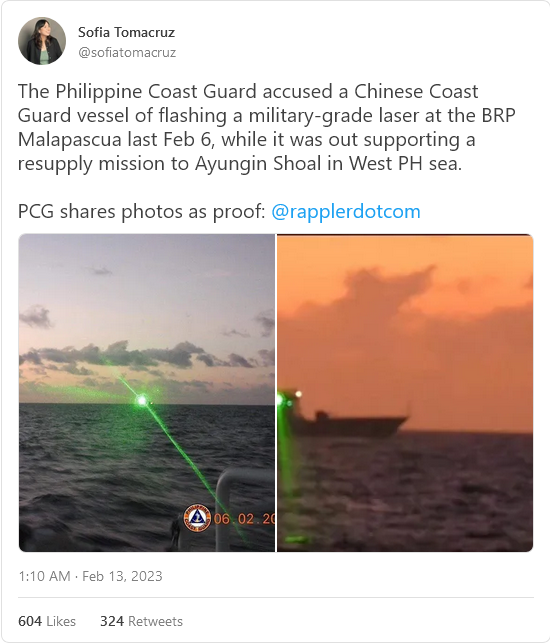
Another nation that if the PRC was just slightly more subtle and less arrogant they might have a chance to make things more difficult for the USA-Japan-Australia defense concerns is The Philippines. They had a window in the last couple of decades, but … if they’re doing this;
The PRC Wolf Warrior Lack of Charm Campaign perhaps may play well internally — and that may be all they care about — but there was a window not long ago that the PRC was playing smart on the world stage — making significant impact in Australia and having the USA happy to let them set up Confucius Institutes at our major universities, etc … but the last decade or so they somehow decided to play a different game.
Comments Off on China’s awkward actions on the world stage do not charm the neighbours
February 10, 2023
When “Taffy 3” kicked the ass of the pride of the Imperial Japanese Navy
Chris Bray isn’t a milblogger, but I thought his summary of the Battle of Leyte Gulf was pretty darned good:
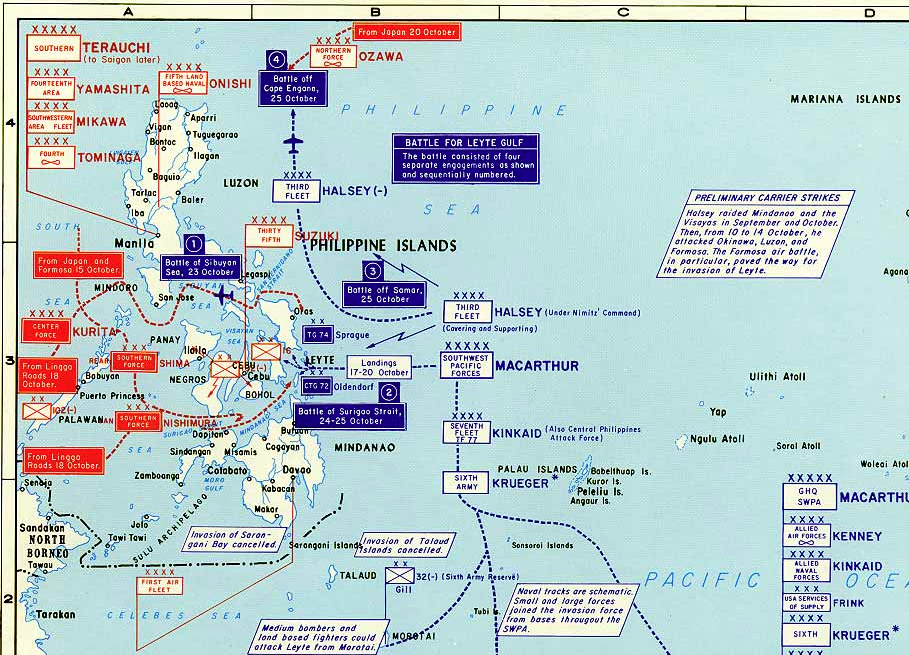
In October of 1944, US troops landing on Leyte Island in the Philippines were menaced from the sea by an enormous Japanese naval fleet that was divided into three separate attack forces.
Detail of the West Point Military Atlas: World War II: Asia-Pacific Invasion of Leyte, October 1944 map.
https://www.westpoint.edu/sites/default/files/inline-images/academics/academic_departments/history/WWII%20Asia/ww2%2520asia%2520map%252029.jpgSummarizing aggressively, the American ground forces were protected against an attack from the sea by the US Navy’s Third Fleet, commanded by Bull Halsey. But Halsey suddenly wasn’t there anymore, taking the bait of a decoy attack force [of de-planed Japanese carriers] and chasing it out into the sea. The Third Fleet’s departure uncovered Leyte Gulf, and the largest of the Japanese attack forces sailed in. Disaster became likely.
There were two American naval task forces in the path of the Japanese attack force, Taffy 2 and Taffy 3, but neither were meant for serious naval combat. They were supporting forces, designed to help the troops on the ground: a few escort carriers, a few lightly armed destroyer escorts, a very few destroyers. Aircraft on the American escort carriers were armed with 100-pound bombs to provide close air support to the infantry. The Japanese First Task Force had four battleships, eight cruisers, and eleven destroyers. One of the Japanese battleships was the Yamato, armed with 18-inch guns. The Japanese attack force sailed directly into contact with Taffy 3, which didn’t realize they were about to face the main Japanese attack force until they were already within range of its guns.
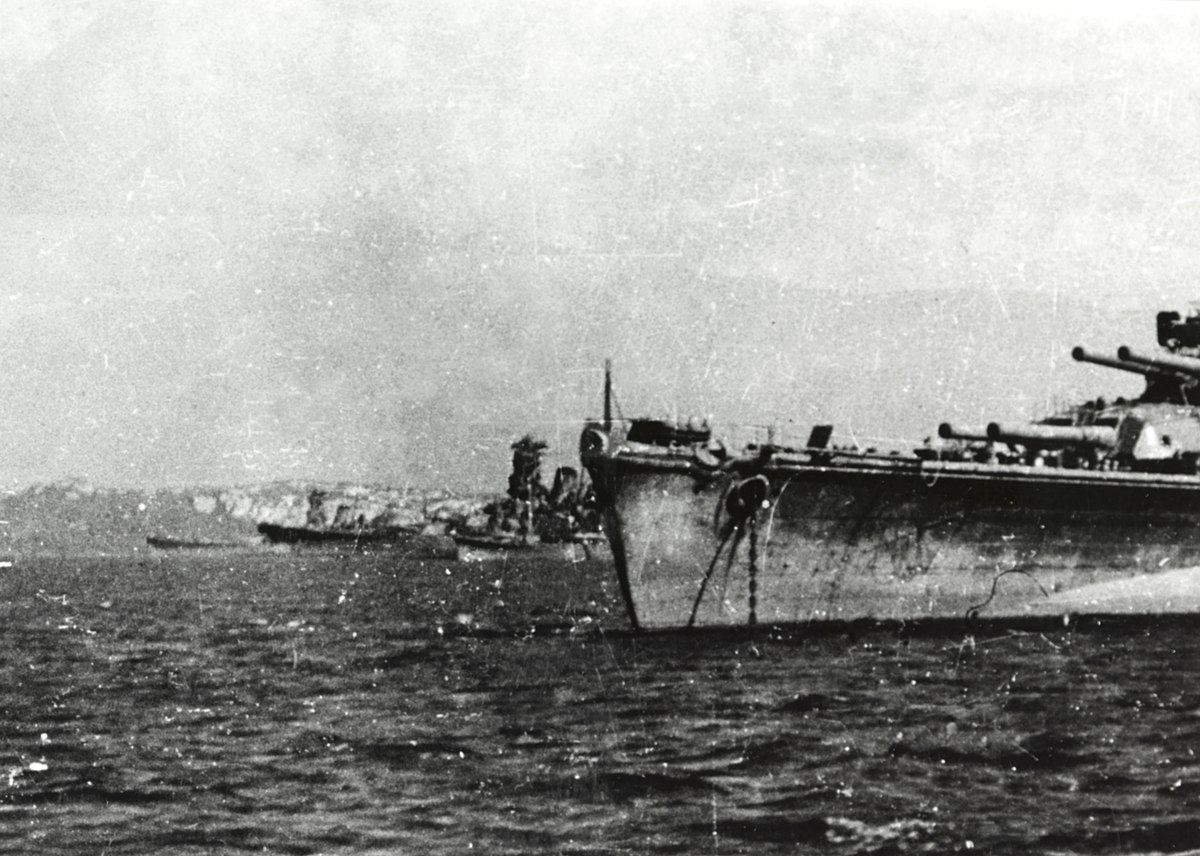
Imperial Japanese Navy ships at anchor in Brunei, Borneo shortly before the Battle of Leyte Gulf. Left to right, Musashi, Yamato, an unidentified cruiser, and Nagato.
Photo by Kazutoshi Hando from the US Naval History and Heritage Command collection.The commander of Taffy 3, Rear Admiral Clifton Sprague, saw immediately that his task force couldn’t survive the engagement, so he tried to salvage what he could: He ordered his destroyers and destroyer escorts to attack, to cover the hoped-for withdrawal of the escort carriers. The resulting battle is one of the best-known in naval history — and one of the least plausible, because Taffy 3 kicked the everloving shit out of that much larger Japanese attack force, compelling the Japanese to withdraw in the panicked belief that they’d sailed into the bulk of Halsey’s Third Fleet.
If you haven’t read [the late] James Hornfischer’s magnificent book about the battle, The Last Stand of the Tin Can Sailors, you should read it. The details are far beyond anything that could be summarized in a single short piece. But the battle was won by a remarkable combination of disciplined obedience, independent audacity, and a paradoxically disciplined disobedience — by men aggressively refusing to obey orders that threatened their cause.
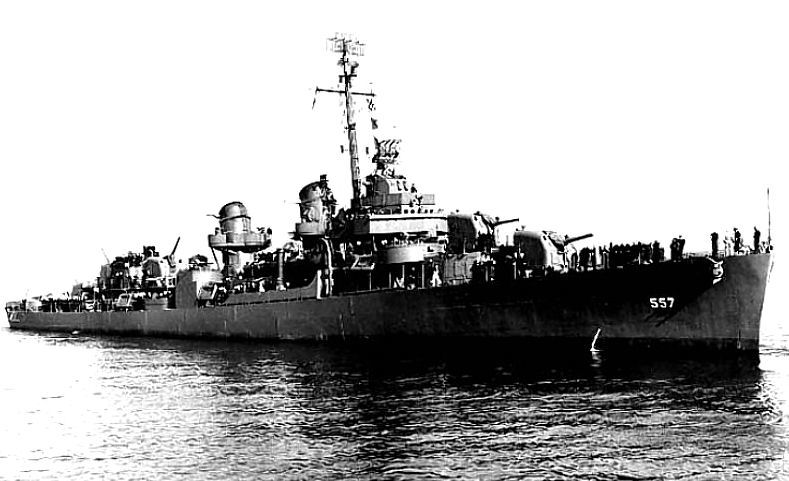
The Fletcher-class destroyer USS Johnston (DD-557), sunk in the Battle off Samar, 25 October, 1944.
US Navy photo with enhancement work by Wild Surmise via Wikimedia Commons.The battle began with one of the US Navy’s most famous moments. Before Sprague had time to order anyone to do anything, the captain of the Johnston, one of Taffy 3’s few destroyers, turned to attack the Japanese fleet. We have confused and contradictory accounts of the orders given by Cmdr. Ernest Evans, because the man who gave them, and most of the men who heard them, died soon afterward, but he is supposed to have said something like this:
1.) We’re under the guns of a much larger Japanese fleet.
2.) Survival is not to be expected.
3.) Hard left rudder, all ahead flank.
We’re all going to die; attack. The Johnston sank, and Evans died, but his first torpedo run blew the bow off a Japanese cruiser — setting the tone of the fight.
Comments Off on When “Taffy 3” kicked the ass of the pride of the Imperial Japanese Navy
December 23, 2022
A Jungle Miracle – War Against Humanity 092
World War Two
Published 22 Dec 2022Two escapes, one from the Nazis in Kovno (Kaunas) Lithuania, from the prison at Fort IX, and one from Japanese terror on Panay in the Philippines this week, will help to document the crimes of the Axis powers.
(more…)
Comments Off on A Jungle Miracle – War Against Humanity 092
December 10, 2022
United States Empire – The Spanish-American War
The Great War
Published 9 Dec 2022The Spanish-American War (fought in Cuba and the Philippines) kickstarted US global ambitions and expanded their influence far beyond the borders of the United States. At the same time the war marked the endpoint of the decline of Spain as a global power.
(more…)
Comments Off on United States Empire – The Spanish-American War
August 17, 2022
Amazing Money Heist by Polish Resistance – WAH 073 – August 14, 1943
World War Two
Published 14 Aug 2022The reality of war finally seeps through to the majority of Germans, and it didn’t match up with the propaganda. Meanwhile resistance is increasing, and part of that is a classic money carriers when the Polish Home Army robs a money transport.
(more…)
Comments Off on Amazing Money Heist by Polish Resistance – WAH 073 – August 14, 1943
October 8, 2021
The case for defending Taiwan
Roberto White explains why the west should help protect the Republic of China from the People’s Republic of China:
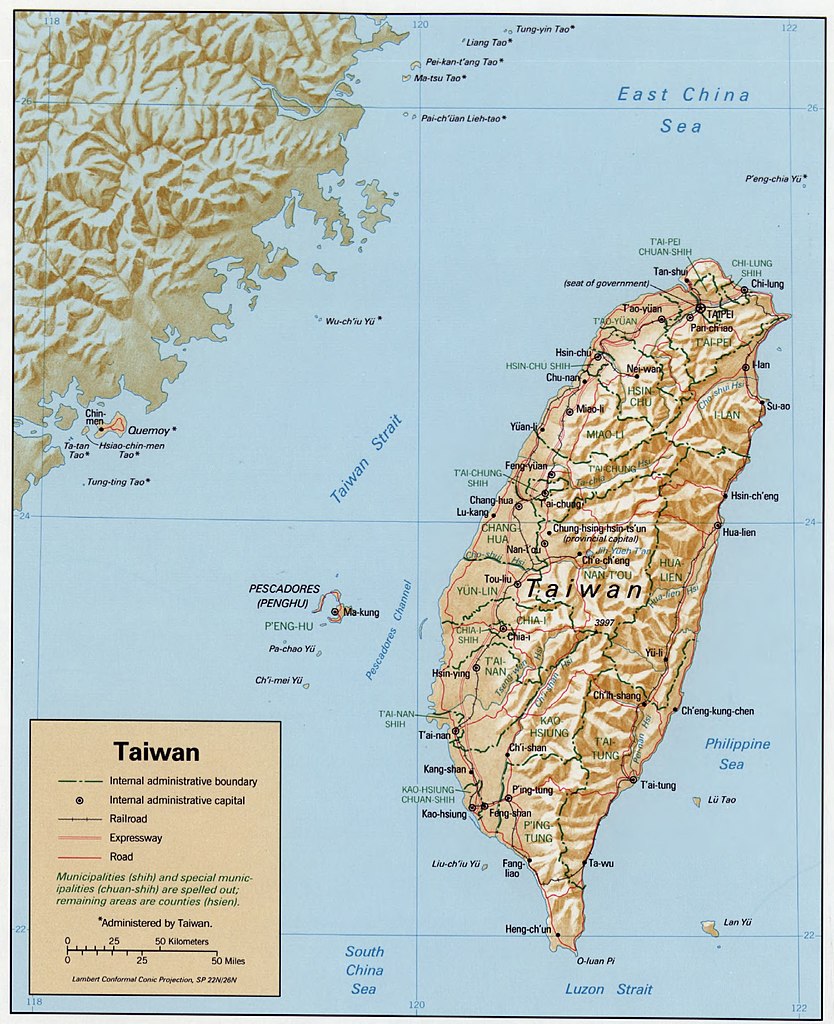
Taiwan relief map.
Library of Congress Geography & Map Division via Wikimedia Commons.
The past few days have seen Taiwan subjected to another wave of continuous harassment by China. Of course this is nothing new; China has violated Taiwan’s airspace since at least 2014. But, on Monday, a record 34 fighter jets were dispatched to Taiwan. Beijing’s increasingly erratic behaviour towards Taiwan brings to the fore why the West must defend them.
Taiwan is a free-market democracy that, despite its overbearing northern neighbour, has managed to create a vibrant economy that ranks as the sixth freest economy in the world. Crucially, it is a major producer of semiconductors (a device that helps power everything from cars to satellites), accounting for 92 per cent of all production of the world’s most sophisticated and important chips. Thus, from both an ideological and strategic standpoint, defending Taiwan is a mutually beneficial move.
The case for Taiwan’s defence is further strengthened when we look at what could happen in Asia should China take Taiwan by force.
With Taiwan’s ports and air bases, the People’s Liberation Army (PLA) could extend its maritime militia northwards through the Ryukyu (the chain of islands between Taiwan and Japan) and the Senkaku Islands (disputed by China and Japan). This would give China increased leverage over Japan in a time of crisis by, for example, restricting its maritime commerce.
The CCP could further use Taiwan as a base for tighter control of the South China Sea by blocking the Luzon Strait (between Taiwan and the Philippines) and the Balintang channel, which would cut off the traditional route used by the US Navy to navigate regional waters. In essence, China would immediately become the foremost power in the Indo-Pacific that could eventually kick the US and its allies out of the region. Unfortunately, the threat of a Chinese invasion is not a distant reality. In March of this year Admiral Philip Davidson, the United States’ top military officer in the Asia-Pacific, warned that China could invade Taiwan by 2027.
Given the perilous scenario that would emerge from a Chinese invasion of Taiwan, it is vital that, should an invasion happen, the West comes to Taiwan’s defence. However, until such a time, Western allies should aim to help Taiwan by promoting its participation in international forums. The first step would be to allow diplomats and other officials with Taiwanese passports to enter UN buildings, which they currently cannot do. This would most likely provoke a backlash from China, yet it would also confer Taiwan the dignity and respect that officials from every other state have.
The West should also stand firm against Chinese attempts to exclude Taiwan from international organisations. Between 2008-2016, Taiwan was invited to be an observer at the World Health Organization (WHO) under the name “Chinese Taipei”. In 2016, after Tsai Ing-Wen was elected Taiwan’s President, Beijing rescinded the invitation and Taiwan has not been allowed to participate since.
Comments Off on The case for defending Taiwan


