
Back in the bad old days, before Pierre Trudeau saved Canada from the horrors of fiscal solvency and smallish government, school children, mostly girls, were taught something called home economics. The theory, terrible quaint though it sounds, is that since most women would become homemakers they should be prepared for that role. Some, no doubt, came from good homes where dutiful mothers ensured that their daughters knew how to cook, sew and deal with troublesome infants. Some did not come from good homes. Part of the point of public education was to make sure that all girls knew how to cook nutritious food for their families. More broadly it was to ensure that all children acquired life skills along with whatever algebra and Shakespeare they could pick up.
That was one of the goals of public education. Educating a self reliant, sober and decent citizenry. Not rationalizing every vice and undermining the founding tenets of Canadian society. There was plenty of propaganda, but it was mostly propagating positive values. A tad parochial and silly by our standards, but not without its merits. It was not a platform for allowing anti-capitalist and anti-industrial zealots like David Suzuki to pontificate.
If there is a problem with “food insecurity” it’s because many Canadians, especially among the lower classes, lack basic life skills. That, not incidentally, is why most are in the lower class. If the Pakistani cab driver with a scant English vocabulary can feed and cloth his family with some decency, what does that say about the Mackenzies who have been here since Simcoe? Some of the poor are poor because they’re physically or mentally incapable of fending for themselves. In an advanced society they comprises only a small fraction of the working age population. Much of the poor in Canada are poor because they exhibit poor behaviour.
Most of the long-term poor, this excludes those who are simply suffering from temporary misfortune, think in a much different way than those in the middle class. The long-term poor are short-range in their thinking. Their savings rate is close to non-existent. They can’t resist instant gratification, like junk food or gambling. This also extends to their sexual lives. They exhibit a strong tendency toward highly unstable short-term relationships based on fleeting desire. The notion of a long-term, emotionally stable relationship is either alien or absurd.
Richard Anderson, “Thinking of the Children”, Gods of the Copybook Headings, 2013-10-21
October 22, 2013
QotD: They We were better people in those days…
October 6, 2013
Nostalgic Doctor Who fans rejoice
According to a report in the Mirror, over 100 lost Doctor Who episodes have turned up in the most unlikely spot:
A group of dedicated Doctor Who fans tracked down at least 100 long-lost episodes of the show gathering dust more than 3,000 miles away in Ethiopia.
It was feared the BBC programmes from the 1960s — featuring the first two doctors William Hartnell and Patrick Troughton — had vanished for all time after the Beeb flogged off a load of old footage.
But after months of detective work the tapes have been unearthed at the Ethiopian Radio and Television Agency.
A television insider said: “It is a triumph and fans everywhere will be thrilled.
“This is a really big deal for the BBC and is set to make them millions from the sale of the DVDs.”
H/T to Tabatha Southey for the link.
October 1, 2013
Candy-coat my world and keep me safe from my trouble and pain
I linked to an entertaining rant by Ace last week that talked about the “nummification” of modern life. At risk of being identified with the “get off my lawn you [26-year-old] kids” bracket, here’s another tale of western society’s almost complete flight from adulthood by Christopher Taylor:
But the culture has become a bit too childish and cutesy for me. If you look around you can see what’s happening easily enough. Adam Carolla recently went on a rant about Starbucks “coffee” and how childish its all become. I won’t link it here because it gets pretty foul and sexualized, but the basic gist is this: you didn’t have a coffee before work, you had a shake. That Caramel Moccachino with whipped cream and sprinkles on top wasn’t a coffee, it was candy in a cup.
You can extend this further. I saw an ad recently on TV for adult vitamins, clearly targeted at men. The selling point? They’re gummy vitamins. Multi-Vites! They’re chewable and sweet! Take a few of those in the morning before your coffee shake. And for lunch? A “power bar” which is a candy bar with vitamins in it.This isn’t adult behavior, its Halloween all day long. Remember when you were 11 and mom wouldn’t let you gorge yourself out of the plastic pumpkin bucket you filled on Halloween night? And you kicked the side of the bed vowing that when you grew up you’d eat all the candy you wanted?
You’re supposed to grow out of that stage.
[…]
I’ve written about the annoyance of frat boy culture here many times, where men are perpetually the party boy they imagined themselves being in college. Never grow up, never get serious, always avoid responsibility. Your hair getting gray? Return it to your “natural” color with dye! Hey, idiot, gray is your natural color. Put away the Viagra, you’re old. Deal with it.
Except that’s not even the problem any more. We’re being told that adolescence now extends to age 25 by sociologists. Yes, I know sociology is about as much science as astrology, but this isn’t a suggestion, its a diagnosis.
Taylor also links to this BBC News Magazine article from last week, which advances the notion that expecting young people to become adults at 18 or even 25 is no longer realistic:
Frank Furedi, professor of sociology at the University of Kent, says we have infantilised young people and this has led to a growing number of young men and women in their late 20s still living at home.
“Often it’s claimed it’s for economic reasons, but actually it’s not really for that,” says Furedi. “There is a loss of the aspiration for independence and striking out on your own. When I went to university it would have been a social death to have been seen with your parents, whereas now it’s the norm.
“So you have this kind of cultural shift which basically means that adolescence extends into your late twenties and that can hamper you in all kinds of ways, and I think what psychology does is it inadvertently reinforces that kind of passivity and powerlessness and immaturity and normalises that.”
Furedi says that this infantilised culture has intensified a sense of “passive dependence” which can lead to difficulties in conducting mature adult relationships. There’s evidence of this culture even in our viewing preferences.
“There’s an increasing number of adults who are watching children’s movies in the cinema,” says Furedi. “If you look at children’s TV channels in America, 25% of the viewers are adults rather than children.”
He does not agree that the modern world is far more difficult for young people to navigate.
“I think that what it is, is not that the world has become crueller, it’s just that we hold our children back from a very early age. When they’re 11, 12, 13 we don’t let them out on their own. When they’re 14, 15, we hover all over them and insulate them from real-life experience. We treat university students the way we used to treat school pupils, so I think it’s that type of cumulative effect of infantilisation which is responsible for this.”
September 26, 2013
Selling things by amping up the “numminess” factor
I think Ace is making a good point here … modern culture is being retuned to a younger, less adult-oriented default:
A moccachino, topped with lots of nummy whipped cream, is not a sophisticated taste. We emerge from the womb craving the sweetness of sugar, after all.
Again, it’s one thing to indulge in a treat. But it’s another thing to decide to simply revert to one’s childhood self.
Now when he was on this rant, I thought he was full of shit and just being annoyed because Being Annoyed is how Adam Carolla makes his rent.
He also, I’m sure, went off on his typical rant about adult men watching Super Hero Movies, which does in fact hurt my butt. And I’m sure he connected that to the New Nummy.
[…]
We are indeed becoming a more childlike people. We are more and more shirking the expected obligations of adulthood, such as marriage and procreation, and even more basically, we’re rejecting the obligation of adults to actually think, in terms of numbers, and of best outcomes, and so forth.
The national mode of thinking is now Nummy. “We” — and by we I mean Americans, not “we” meaning us here right now — increasingly think in terms of cute, and easy, and glib, and dumb, and fun.
[…]
Why, Yes, actually. Because having all of your trivial cultural preferences flattered by impersonal corporations at every turn is itself Very Nummy Indeed. All little girls want to be told that they’re the Best and Prettiest Little Girl there is, and all little boys want to be told they will play for the Yankees when they Get Big.
To have one’s head patted and cheeks pinched by Admiring Grown Ups at all possible times is the Nummiest Nummy Thing there is.
[…]
Now I have to caveat this: Prior to Tweener Girls becoming the default National Tastemakers, our national culture was determined by the tastes of 19 year old boys, per the Zanuck Postulate.*
So this isn’t just a sexist thing. It’s about losing at least those seven years of maturation, too.
We are drowning in nostalgia and crushing debt and we can’t see the latter because we’ve checked out into our Happy Place to chase the former.
I can’t blame the White House or BuzzFeed for these trends. They’re pushers, but they didn’t create the sad addiction. This stuff works in America.
But why? Why does it work?
When did we all check out of adulthood to revert to tweenerhood? And when did we stop thinking that might be a little indulgent and shameful?
August 22, 2013
Sixties TV – it was different if you were under 12
James Lileks looks at a few Gerry Anderson productions:

Gerry Anderson! You’re going to get everything you need for crackerjack adolescent-satisfying sci-fi: spaceships, shuttlecrafts, computers, control rooms, crisp commanding officers, futuristic gadgets, and a big score. And none of it will work half as well as you hoped. The spaceships will look great, though. The computers will blink and there will be switches, but nothing makes Star Trek Sounds. The control rooms are clean but everyone is talking in a British accent for some reason, like they have their own NASA that’s just as big. The gadgets are okay. The score has a trademark echoey quality you found in soundtracks, particularly British ones, from the late 60s to the early 70s. It should be good! Why isn’t it great?
I’ve pondered that mystery for a long time. Sometimes you have a revelation — hey, the founding concept of “Space: 1999 was really stupid” — or you carp about the details, wondering why the UFO interceptors went hunting with one (1) missile that required a direct hit to be effective, instead of just blowing the hell out of the area. Then you realize it’s not great because it’s all the work of someone who made horribly grinning square-headed puppets, that’s why, and never stopping thinking he was making entertainment for 8 years olds.
[…]
The title theme is here, complete with oddly romantic piano interlude. It’s every Barry Grey piece that ever left me cold, right there. In general I just don’t feel Barry Grey’s music — except for the opening of the “Space 1999” theme before it goes full whacka-chicka, and of course that other theme. Here’s a guy who wrote miles and miles of scores for things like “Supercar,” for heaven’s sake, and he turns around and knocks off the tightest, sharpest theme of the 70s.
Still, Laurie Johnson was better.
July 17, 2013
Matchbox cars at 60
While my childhood toys revolved more around Airfix 1/72nd scale soldiers and Lego blocks (to provide the necessary terrain for the soldiers to fight over), I had a modest collection of Matchbox cars. After reading this article, I realize that if I’d only had the foresight to keep them in their original packaging and never actually playing with them I’d have the core of an expensive collection on my hands (I’d also have completely missed the whole notion of “fun”, but that’s a separate issue):
The concept of these tiny die-cast models was the response of a father, Jack Odell, to a rule at his daughter’s school stating that pupils were only allowed to bring in toys that would fit inside a matchbox. Odell, a school dropout who later joined the Royal Army Service Corps, was by this time working for a die-casting company, Lesney Products (itself set up by two British ex-servicemen, Leslie Smith and Rodney Smith in 1947). Working out of a bombed-out Tottenham pub called The Rifleman, Lesney spent the early Fifties moving away from producing small products for industrial use towards making die-cast toys. Believing this direction to be a lost cause, Rodney Smith quit the company in 1951, leaving it in the hands of Leslie Smith and Odell, who was by then a partner.
A year later Odell had his brainwave, creating a scaled-down version of an existing Lesney toy, the model road roller, packaging it in a matchbox and sending it with his daughter to school. It was an instant hit: with his little toys, Odell was on to something big.
[…]
Matchbox, along with Corgi and Dinky, turned Britain into the dominant force in die-cast models. In the Sixties, Lesney would become the fourth largest toy company in Europe, with 14 factories in and around London producing more than 250,000 models a week. By the end of the decade Matchbox was the biggest-selling brand of small die-cast models in the world.
To date, there have been more than 12,000 individual model lines, and total production exceeds three billion. If placed bumper-to-bumper they would circle the Earth more than six times — assuming they could be prized from the possessive fingers of their owners.
H/T to Blazing Cat Fur for the link.
July 9, 2013
Does Britain need a “big army”?
Sir Humphrey refutes the call for a bigger army in the United Kingdom:
Humphrey has a very personal view that when people call for the military to be changed, it usually involves change to try and make it reflect the military that they served in. For decades people have been complaining bitterly that the UK military doesn’t do what we want it to do, and that only deep change can possibly solve the problem. Meanwhile the British Armed Forces carry on deploying and succeeding on their missions, despite this lack of a ‘wonder weapon ORBAT’. It is very easy to look at an order of battle and decide that somehow the UK lacks a real army – indeed anything can be proved with statistics, and it’s easy to say that because the UK plans a relatively small force with only limited numbers of equipment relative to other powers, it somehow lacks a real army. The problem with such a simplistic argument is that it ignores several issues.
[. . .]
So, when we hear demands that the UK has to have a ‘real army’ the question must be ‘what does a real army look like’? We cling to a view that somehow because the British Army doesn’t possess thousands of tanks and legions of artillery batteries it somehow doesn’t have the same impact as other nations which possess much larger military forces. But to the authors mind there are two very different types of armed force out there – those which exist on paper, and those which have genuine capability to meet their missions. One only has to look across the world to see a plethora of nations who on paper possess large reserves of troops, weapons and equipment which theoretically place them at the top of whatever table one looks at. The problem is though that they are often poorly trained, funded and their equipment lacks support or maintenance – the ‘shiny toy in the shop window’ syndrome. When one reads accounts of large armies, it is often striking how they are in reality unable to deploy and effectively use more than a small fraction of their overall strength, or deploy at any distance. The author still shudders when he hears tales of various UN peacekeeping forces where nations with statistically large militaries deployed sizable contingents, only for them to arrive with next to no equipment, logistics or food, and then to have next to no effect on the job at hand. The other category of army is the one that is funded and equipped properly to do the job at hand. This is a much smaller category of nations, and the UK firmly falls into this category. It involves providing a force which may not be numerically large, but where the equipment – both first line and support, is of a good quality, and which works well together.
[. . .]
The reality for the British Army is that it is a force which does not have a likely opponent, nor an existential threat to defeat. It is all very well calling for it to grow, but at a time of very constrained budgets, and ever more expensive equipment, the question is where is the money to support this? The challenge for the UK in the next SDSR and beyond is perhaps to better justify why it warrants a regular British Army of 82,000 people at all – an island nation with no existential threats, and any likely deployments to be small in nature, perhaps the question is whether we need an Army that large in the first place? Given the Royal Navy and RAF are better suited for the type of expeditionary warfare that is so in vogue at present, does the Army warrant being the size it does? To the author at least the answer is a qualified ‘yes’. The current force provides sufficient personnel to be able to support coalition operations (for we are highly unlikely to deploy an armoured force in isolation), and to meet all likely outputs required of it. But, it is not just about numbers – the UK could do what the French does and pay smaller salaries, invest in front line equipment to the detriment of support equipment and put a numerically larger force in the field which struggles to support itself. This would not be sensible – rather the current structure means that the UK can afford some very useful ‘enabling capabilities’ which mean it seen as being an ally of value to other nations. Investing in ISTAR, in logistics and in other key but ‘unsexy’ assets makes the UK well placed to be able to maintain a force which other nations want to work with – one of the so-called benefits of soft power, as nations seek UK troops for training and support.
In conclusion then, Humphrey remains confused as to what exactly the benefit would be of the UK changing course and trying to fund a vastly larger army. The money doesn’t exist for such a course of action, and the infrastructure to support such a force no longer exists (even in BAOR days the majority of the Army wasn’t based in the UK, so we’d need to build it from scratch), and the costs associated with recruiting and equipping a large force are enormous. Given the lack of existential threats, and the reality that there is no real desire for sustained overseas operations for at least the next few years, it is hard to escape the view that the UK not only possesses a reasonably sized army proportionate to its current strategic position, but that by keeping it relatively small, it retains the funds to keep it well trained and well equipped, and in turn enabling it to punch above its weight as a partner of choice for other nations.
June 19, 2013
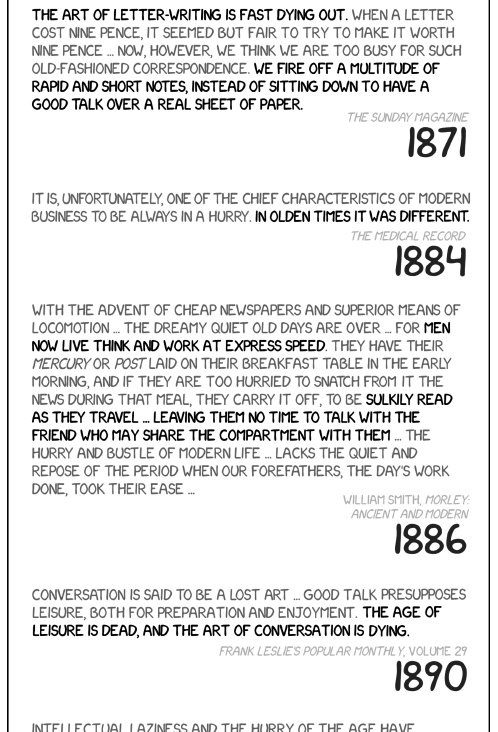
Nostalgia for an imaginary better past
I love this:
March 28, 2013
“Gaming in the 1970 and 80s felt a little like being into punk rock”
Explanation of the headline: gaming in the 70’s was like being into punk because it was very much an outsider interest, you had to go well out of your way to find it, and it was cool (at least to you, not so much to your family and non-gaming friends). Peter Bebergal finds online caches of some of the classic gaming magazines of the day:
The Internet Archive is one of the great treasures of the internet, housing content in every media; texts, video, audio. It’s also the home of the Wayback Machine, an archive of the Internet from 1996. I thought I had explored the site pretty thoroughly — at least according to my own interests — but recently came across runs of some of the great gaming magazines of the 1970s and 80s; The Space Gamer, Ares, Polyhedron, The General, and — temporarily — Dragon Magazine. These magazines represent not only the golden age of gaming, but expose the thrill and excitement of gaming when it was still new, still on the margins. It was a time when gaming still felt a little, dare I say, punk.
Today, finding members of your particular community of interest is a Google search away, but in the 1970s the only way to be in contact with others who shared interests was through magazines. For many gamers, even finding the games could be difficult. Discovering the gaming magazines revealed an active gaming industry that still maintained a sense of being on the vanguard.
The earliest issues show off their newsletter origins. The Space Gamer and The General started off on plain paper in black and white. Even the first issues of Dragon look like a teenager’s fanzine, but the enthusiasm and energy are infectious. Who couldn’t love the introduction of new monsters for your campaign such as the Gem Var, a creature composed entirely of gemstone and that cannot take damage from bladed weapons. The artists, editors and letter writers were the best friends you had never met. Gaming in the 1970 and 80s felt a little like being into punk rock. You knew it was offbeat, knew that outsiders didn’t get it, but you also knew that this was cool. Even the advertisements and listings of conventions expanded the universe of gaming a thousandfold. Not unlike ordering 45s of unknown bands from punk zines, was sending away for microgames, miniatures and supplements from tiny game publishers.
While I wasn’t as much into the early roleplaying games, I was very much into wargaming and that was in the “respectable” part of the gaming ghetto until the boom in RPGs pretty much took all the oxygen out of the room. Of course, even in the “respectable” area, there were the Napoleonic grognards and the frisson-of-insanity East Front fanatics…
December 29, 2012
Your past will indeed come back to haunt you
Long ago, in the days before personal computers were ubiquitous, there were “zines” (short for magazines, correctly reflecting both non-professional status and less-than-totally-serious content). There was a wide variety of zines for all sorts of interests — rather like the back corners of the internet today, except they were physically distributed using the post office (and therefore had to stay within certain boundaries to be safe). Clive and I used to publish a zine for postal Diplomacy:
 Download PDF |
 Download PDF |
If you want to read ’em — and I wouldn’t blame you in the slightest if you didn’t — you can download a PDF of each issue from Doug’s Diplomacy and Eternal Sunshine. You’ll note that it was a much more innocent time then, as we not only listed our own contact information, but that of many others through the game listings and other parts.
Doug only has issues 11 and 12 available, but they’re a generous representation of what the rest of the production run was like: amateur, laboriously assembled, totally ignorant of both copyright and appropriate credits, and full of in-jokes that nobody aside from the production team would hope to understand (except the “Skulking Cavorter” column: even the publisher and editor had head-scratching moments over that, but it had a noisy fan club among the subscribers). It was a lot of fun to do, and once we ceased production I found I missed it a lot (but not enough to get back into doing it again). I published a few other zine-like things over the next few years, but didn’t get back into a regular publication schedule until I started the blog.
So, thanks to William Plante for digging up these musty relics and bringing them to my attention.
December 16, 2012
Origins of ten Christmas traditions
A lot of the “traditional” Christmas things don’t have an obvious link to the season (aside from long usage):
It’s the Christmas season again, and before we get sick of the eggnog, fruitcake, and Christmas music played ad nauseum, we get to enjoy it for a couple weeks. But have you ever wondered where some of our weird Christmas traditions come from? I mean, we tell our kids that a fat man is coming into our house at night; we bring in trees in to shed all over the carpet; and we kiss under parasitic plants – all in the holiday spirit. How the hell are these even related to Jesus, whose birthday we’re supposed to be celebrating?
Well, sit back, pull in some eggnog and gingerbread, and take a ride on the 10-entry, Listverse sleigh!
H/T to Ian Geldard for the link.
December 11, 2012
This’ll take you back
The Verge on a 1960s interpretation of Google search:
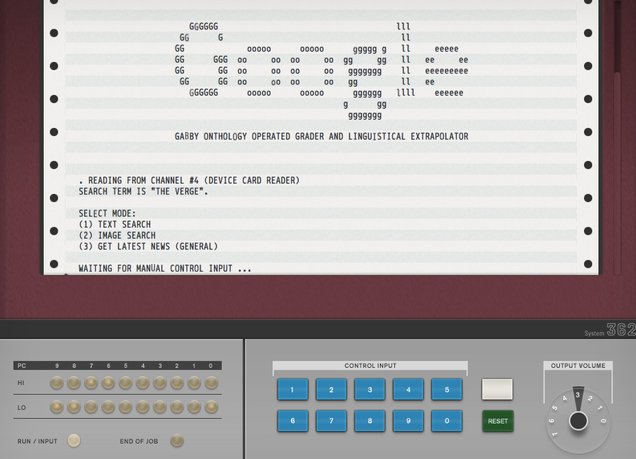
Google didn’t exist during the 1960s, but if it did, it may have looked a lot like Google60. Described as “an art project to explore distances and heroism in user interfaces,” Google60 is the latest creation from designer and developer Norbert Landsteiner, who earlier this year released Google BBS — a project that allowed users to conduct Google searches from within a 1980s bulletin board-style interface. The idea behind Google60 is largely similar, except here, Landsteiner replaces the Google front end with a virtual IBM 360-like interface, replete with punch cards and a “Mad Men style,” 1960s aesthetic.
November 5, 2012
Commemorating the “Great War”
“Sir Humphrey” is on what he terms as his “very late Summer Holidays”, but left a thoughtful-as-always post on the British government’s recently announced World War 1 commemoration program:
It was announced that over £50 million of public funding will be provided to commemorate the 100th anniversary of the start of the First World War in 2014. This high profile event will include commemoration, remembrance, and a chance for every school in the country to send students to the battlefields of the Western Front in order to see first-hand ‘Flanders Fields’.
Rarely do wars have such a dramatic impact on a national psyche, but the First world War continues to occupy a place in the heart of the British consciousness which will take generations to reduce. It is sobering to contemplate that across the whole of the UK, there were fewer than 50 ‘Thankful villages’ (locations where everyone who served came back alive). Even today, as a nation we have only just seen the last veterans of the conflict pass on, and there are still plenty of people alive who were born in this time. In Government, it is often forgotten that Lord Astor, who acts as the spokesman for Defence in the House of Lords, is the grandchild of Field Marshal Haig. Even now, almost a century on, our current links to the war remain tangible.
Humphrey has long been a ‘revisionist’ when it comes to WW1, and believes that what should be remembered as not only a violent and bloody war, also represented many of the finest feats of arms in British history. While the conventional view of the 1960s and beyond was of a war that comprised senseless slaughter, where legions of troops were thrown into battle by an uncaring General Staff, the reality is far different. Arguably WW1 represented a supreme accomplishment by the General Staff, who had to take a tiny professional army, expend it and buy time using the TA to mould a new citizen based force, which within five years became the world’s most accomplished fighting force. They did this in a backdrop of expanding the military far beyond what any would have thought possible, while adapting to technological changes at a vast rate. By the start of the One Hundred Days campaign in 1918, there is no doubt that the British Army was probably the best trained equipped and operationally effective army in the world.
This is not to diminish the slaughter or the losses felt, but it often feels that the emphasis is too greatly placed on the hellish experiences of the trenches, and not that of understanding the war, nor decision making as a whole. It is perhaps telling that the most popular public memory of WW1 comes not from primary sources, but from the comedy ‘Blackadder Goes Fourth’, clips of which to this day brighten up innumerable MOD presentations.
The Canadian memories of WW1 are a bit different from those of Britain, although shaped by the same forces: before the war started, Canada was still psychologically a colony of the Mother Country. At the end of the war, Canada stood as a recognized independent entity from Britain (though still recognizing the importance of Britain and the Empire and a proud member of the Empire), with a very hard-earned military reputation. The legalities of full independence still lay in the future (the Statute of Westminster, 1931), but the Canada of 1918 was not the same place it had been in 1914. It saw itself as a nation, not a colony.
September 10, 2012
Guaranteed headline in Canadian papers: mention the Avro Arrow
Today it’s the National Post (actually, it’s just a Canadian Press wire piece) chumming the waters with a report on an “Avro Arrow redesign pitched as alternative to controversial F-35”:
A Canadian company is seeking to go back in time to help fly Canada’s air force into the future.
Documents obtained by the Global News program “The West Block” indicate an update to the storied CF-105 Avro Arrow was put forward as an alternative to the purchase of F-35 stealth fighter jets.
And among the project’s champions is one of Canada’s top soldiers, retired Maj.Gen. Lewis MacKenzie.
The Arrow was an advanced, all-weather supersonic interceptor jet that was developed in the 1950s. Several prototypes were built and flight tests were conducted, but the project was abruptly shut down in 1959 and the aircraft never went into production.
Even people who care less than nothing about aircraft or military technology seem to have opinions about the Avro Arrow (usually allowing them to take free shots at former Prime Minister John Diefenbaker for the decision to scrap the plane). It’s far enough in the past that the facts are more than obscured by the myths of the cottage conspiracy theory industry (artisanal Canadian myth-making, hand-woven, fair-trade, and 100% organic).
The Avro Arrow is the story that never dies in Canadian papers.
https://twitter.com/InklessPW/statuses/245128243458478080
https://twitter.com/InklessPW/statuses/245128551479791616
https://twitter.com/InklessPW/statuses/245130995072897024
August 31, 2012
The Northlander “was like northern Ontario on wheels”
Chris Selley remembers Ontario Northland’s The Northlander, which the Ontario government will be phasing out next month:
Long-distance rail travel for real folks, as opposed to wealthy tourists, took another sad hit recently with the announced cancellation of the Northlander — the Ontario Northland Railway’s leisurely 11-hour putter from Toronto’s Union Station to Cochrane, Ont., whence the more legendary Polar Bear Express will still take you to Moosonee, on James Bay.
It’s not sad in any commercial sense: The provincial government claims each ticket sold was subsidized to the tune of $400 (though other mathematical interpretations are available). And it’s not sad because senior citizens will now be crammed on to buses to go to their far-flung medical appointments. That’s unfortunate, no question: Trains are fundamentally more civilized than buses. But many communities the size of those served by the Northlander don’t even have buses anymore. This is the age we live in.
I find it sad, firstly, because I have fond childhood memories of that trip. There used to be a train that ran past Cochrane, all the way to Kapuskasing, where we had family friends, and it used to run overnight. There was something wonderfully odd about getting ready for bed while trundling up the Don Valley. In the winter, the train was like a strange, slow teleportation to a different planet: You went to sleep in Toronto’s grey-brown approximation of the season and awoke, after a night of groggily perceived stopping and starting, horn blasts and various crashes and bangs, to a blinding white, empty snowscape. Stumbling to the dining car — well, the box-of-cereal-and-milk car — you would find the spaces between the cars encased in snow and ice, like the inside of an old freezer.
It wasn’t fast, or slick. It was a bit ramshackle. But it was folksy. It was like northern Ontario on wheels.
The earlier post on the cancellation.


