Quotulatiousness

January 17, 2012

The media angle on the Costa Concordia wreck

Filed under: Europe, Italy, Media — Tags: , , , — Nicholas @ 09:17

Tim Black points out the most common media memes about the Costa Concordia have much more to do with snobbery and disdain than with human interest or concern about the actual causes of the shipwreck:

The sequence of events that led to the sinking of the luxury cruise liner, the Costa Concordia, is now pretty much established. But facts have not got in the way of a variety of commentators who are using the accident to parade their prejudices about too-big ships and ignorant passengers.

[. . .]

These are the tragic facts so far. What no one knows exactly is why it happened. Explanations have been mooted, of course: a power blackout affecting the ship’s steering; inaccurate navigation charts failing to show the rocks; or human error, in particular by the ship’s captain, Francesco Schettino. Yet while the exact reason for the ship straying off course remains unclear, that has not stopped another object of blame coming to the fore in some of the coverage. That is, the real, underlying reason for the Costa Concordia accident is to be sought not in the actual events of Friday evening but rather in the profit-driven, build-‘em-high cruise industry and, by association, in the sea-faring ignorance of all those who sailed aboard her.

This is why so much of the coverage seems obsessed with the size of the Costa Concordia. Over the past few days, we have been repeatedly told that cruise ships have doubled in size over the past decade. While this is true — and as the twenty-sixth-largest liner in the world, the Costa Concordia is far from the most impressive of this new breed of ships — the Concordia’s size does not actually tell us why it was three miles off course. Nor does it explain why the ship’s crew was unaware of the rock outcrop despite having navigation equipment. Yes, perhaps ship size does affect manoeuvrability, but would a smaller vessel not have suffered a similar fate that befell the Concordia? In fact, the obsession with the ship’s size sheds very little light on what happened to the Concordia on Friday evening.

What the convenient obsession with size draws upon, rather, is an antipathy towards the cruise industry, a sense that it is little more than the ocean-going equivalent of that other right-thinking person’s bête noire, Dubai. In other words, a vulgar testament to profit and sky-high consumption. So although size here is not really relevant as a cause of the Concordia’s capsizing, it appears relevant to certain commentators as a symbol of commercial hubris, of complacent materialism.
January 16, 2012

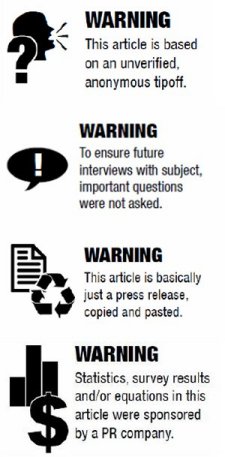
Journalism warning stickers

Filed under: Britain, Humour, Media — Tags: , — Nicholas @ 10:50

A timely addition to your media toolkit from Tom Scott:

It seems a bit strange to me that the media carefully warn about and label any content that involves sex, violence or strong language — but there’s no similar labelling system for, say, sloppy journalism and other questionable content.

I figured it was time to fix that, so I made some stickers. I’ve been putting them on copies of the free papers that I find on the London Underground. You might want to as well.

H/T to Tim Harford for the link.

Cory Doctorow recommends a book on English libel law

Filed under: Books, Britain, Law, Media — Tags: , , , , — Nicholas @ 10:17

There’s a reason that individuals and organizations try to sue for libel under English law, rather than their own national legal system:

The Guardian published a long excerpt from Nick Cohen’s forthcoming You Can’t Read This Book: Censorship in an Age of Freedom, a fantastic-looking book that reveals the dirty truth of English libel law, where “money buys silence” for some of the world’s most notorious dictators, thieves, and bad guys. English libel law is so broad that it allows, for example, Russian oligarchs to sue Russian newspapers for punitive sums (“the cost of libel actions in England and Wales is 140 times higher than the European average”) in an English court, merely by demonstrating that someone, somewhere in England looked at the paper’s website. And yet, the libel law in England and Wales doesn’t actually protect people from the most common forms of libelous publication: false declarations of criminal suspicion by the police, false claims of financial irregularities from credit reporting bureaux and false statements in former employers’ reference letters are protected unless they can be shown to have been malicious and negligent.

January 15, 2012

What’s next, allowing only “registered journalists” to report the news?

Filed under: Government, Media, Technology, USA — Tags: , , , , , — Nicholas @ 09:14

A brief item that should send a frisson down the spine of anyone who collects and disseminates information from the web and social media outlets:

Under the National Operations Center (NOC)’s Media Monitoring Initiative that emerged from the Department of Homeland Security in November, Washington has written permission to collect and retain personal information from journalists, news anchors, reporters or anyone who uses “traditional and/or social media in real time to keep their audience situationally aware and informed.”

According to DHS, the definition of personal identifiable information can consist of any intellect “that permits the identity of an individual to be directly or indirectly inferred, including any information which is linked or linkable to that individual.”

H/T to Chris Myrick for the link.

January 14, 2012

Rex Murphy: “Big Environment” finally gets a bit of critical attention

Filed under: Cancon, Environment, Media, Politics — Tags: , , , , — Nicholas @ 12:27

The western world’s largest secular religion may finally be given a bit of balanced coverage — a big change from the automatic deference it has received from the media up to now:

The greatest advantage the greens have had is the relative absence of scrutiny from the press. Generally speaking, it’s thought to be bad manners to question self-appointed environmentalists. Their good cause, at least in the early days, was enough of a warrant in itself. And when it was your aunt protesting the incinerator just outside town, well that was enough. But when it’s some vast congregation of 20,000 at an international conference, or thousands lining up to present briefs protesting a pipeline, well, let’s just say this is not your aunt’s protest movement anymore.

There is no such thing as investigative environmental reporting — or rather very precious little of it in the established media. Environmental reporters rarely question the big environmental outfits with anything like the fury they will bring to questioning politicians or businesspeople. Advocacy and reportage are sometimes close as twins.

And so the great thing I see about Resource Minister Joe Oliver’s little rant against Northern Gateway pipeline opponents a few days ago — asking whether some groups are receiving “outside money” or if they are proxies for other interests — is not so much the rant itself, but rather the fact that at last some scrutiny, some questions are being asked of these major players. Big environment, however feebly, is being asked to present its bona fides. And that’s a good thing: The same rigor we bring to industry and government, in looking to their motives, their swift dealing, must also apply to crusading greens.

Where does their money come from? What are their interests in such and such a hearing? What other associations do they have? Are they a cat’s paw for other interests? Do they have political affiliations that would impugn their testimony? In hearings as important as the ones over the Northern Gateway pipeline, with the jobs and industry that are potentially at stake, the call to monitor who is participating in those hearings is a sound and rational one.

In a media environment where anyone who questions the green orthodoxy is accused of being in the pay of “Big Oil”, it’s refreshing to have at least a bit of the same medicine being forced on the other side of the debate.

January 2, 2012

Presenting the good news as bad news, New York Times-style

Filed under: Africa, Environment, Media — Tags: , , , — Nicholas @ 12:17

Walter Russell Mead has a textbook example of finding the cloud to every silver lining in the pages of the New York Times:

A worthless desert in South Africa, largely inhabited by drought-stricken sheep and a handful of marginal farmers, turns out to contain rich natural gas reserves that could bring a new wave of economic growth to South Africa and provide huge numbers of well paying jobs for poorly educated workers.

The New York Times, of course, is wringing its elegantly manicured hands. And why not? The soil of the Karoo desert is “fragile,” and the extraction of the natural gas will involve fracking. What will happen to the sheep?

The Times finds a local farmer who is worried about exactly that.

    “If our government lets these companies touch even a drop of our water,” [the farmer] said, “we’re ruined.”

Ruined! By wicked natural gas companies feeding the world’s hydrocarbon addiction. The farmer in question has a herd of 1400 sheep. (It was 2000 last year before a drought forced the slaughter of 600.) One somehow suspects that the farmer will find some other way to make money when the district becomes a major gas producing center. And, worst case, roughnecks eat a lot of meat.

That the Times chooses the lonesome shepherd to lead off one of the best good news stories around these days speaks volumes about the gloomy Gus mindset at the Paper of Record. Why can’t this be a good news story? Will a gas boom save South African democracy, for example? Will new economic opportunities transform the lives of tens and possibly hundreds of thousands of poor black South Africans? Will the huge increase in South Africa’s natural gas supply reduce the country’s carbon footprint? Is there anything in the geology to suggest that other poverty stricken parts of Africa might also be similarly blessed? How are local leaders planning the spend the windfall: better schools? better hospitals?

December 20, 2011

The kind of folks who make up the bulk of the “Occupy” movement

Filed under: Liberty, Media, USA — Tags: , , , , , — Nicholas @ 13:49

Charles Cooke reports on a recent study of the membership of the “Occupy” groups:

The report, Shortselling America, reveals that, below the surface, there is a lot more going on than meets the eye, and most of it has very little to do with “social justice.” Its author, Frontier Lab takes an interesting approach, applying techniques of market research to political science. The group’s aim is to move away from the short-term model employed by political pollsters — which, although valuable, essentially provides just a fleeting snapshot — and instead to conduct a more thorough assessment of participants’ values. From these data, they then seek to predict future behavior. An example: Surface-level polling will see consumers tell us that the reason they buy a particular dish soap is because it is green, or cheap, or conveniently sized. But research shows the deeper truth is that, overwhelmingly, people buy the same brand as their mother did. (Nobody will write that on a survey.)

What did Frontier Lab discover? First, that many of the rank-and-file occupiers feel isolated in their lives, and appear to lack basic community ties such as are provided by participation in clubs, churches, and strong families. Indeed, much of the report could have come from the early chapters of Robert Putnam’s Bowling Alone. They thus attach to their political causes with something like a religious fervor. For many, a commitment to “social justice” is “not the end, but rather a means to an inflated sense of self and purpose in their own lives.” Crucially, involvement with others who agree with them provides an “overwhelming feeling of being part of a family.” I noticed this on my first trip down to Zuccotti Park, when I saw a telling sign adorning the entrance to the tent city: “For the first time in my life, I feel at home.” On subsequent visits I was struck by the importance of the commune to the project. As much as anything else, vast swathes of occupiers were simply looking for a new club. This group, Frontier Lab dubs the “Communitarians.”

The second group, which to all intents and purposes forms the leadership, is less existentially lost, and derives its fulfillment from the “prestige,” “validation,” and “control” afforded by the movement’s coverage in the media. Frontier Lab calls this group the “Professionals.” Its members fill the ranks of the professional Left and boast long histories of attending and organizing protests. For them, indignation is quotidian, “community action” is a career, and they feel “validated by the fame and attention” and “rewarded for their life choices.” Unlike the Communitarians, the Professionals actually want tangible change, or a “win,” but politics is still playing second fiddle to self. There is nothing spontaneous or organic about the movements they lead. They are waiting for the revolution and hope to be in its vanguard. Their careers depend upon it.

H/T to Ace, who added this post-script to the quote: “Testing on the Myers-Briggs personality profile consistently put the rank-and-file in the Stunted Weakling category, and the leadership in the Gigantic Colossal Douchebag group”

December 14, 2011

Revolt in a Chinese fishing village

Filed under: China, Government, Media — Tags: , , , — Nicholas @ 13:08

Local unrest is hardly uncommon in China, but unrest of this nature is almost unheard of:

For the first time on record, the Chinese Communist party has lost all control, with the population of 20,000 in this southern fishing village now in open revolt.

The last of Wukan’s dozen party officials fled on Monday after thousands of people blocked armed police from retaking the village, standing firm against tear gas and water cannons.

Since then, the police have retreated to a roadblock, some three miles away, in order to prevent food and water from entering, and villagers from leaving. Wukan’s fishing fleet, its main source of income, has also been stopped from leaving harbour.

The plan appears to be to lay siege to Wukan and choke a rebellion which began three months ago when an angry mob, incensed at having the village’s land sold off, rampaged through the streets and overturned cars.

Of course, one of the reasons we rarely hear about protests of this nature is that the Chinese government actively suppresses media coverage. This is only coming to our attention because western journalists are there and able to communicate with their employers.

H/T to Jon, my former virtual landlord, who commented “You have to admire these 20,000 future organ donors for their intestinal fortitude”.

Eurosceptics described as “bunch of insular snobs who seem to have a hard time restraining their inner fascist”

Filed under: Britain, Europe, Media, Politics — Tags: , , , , — Nicholas @ 09:06

Frank Furedi exposes the real reasons behind the chattering classes’ abuse of David Cameron:

It is one thing to accuse Cameron of committing a diplomatic faux pas or the Foreign Office of ineptitude. But the criticisms currently being made of Cameron verge on the hysterical. When I listen to the hyperbole about what will apparently be the consequences of his destructive behaviour, it almost sounds as if he has committed an act of political betrayal in order to appease a handful of incorrigible reactionary Eurosceptics.

Why this over-the-top reaction to what could turn out to be a relatively minor case of diplomatic miscommunication?

Outwardly, the anger of the cosmopolitan clerisy is directed at Cameron’s alleged appeasement of Tory Eurosceptics. The term Eurosceptic has a special meaning for the adherents to cosmopolitan policymaking. In their view, Euroscepticism is associated with values they abhor: upholding national sovereignty, Britishness and a traditional way of life. The moralistic devaluation of these values was vividly communicated by the New York Times columnist Roger Cohen, who this week characterised Tory Eurosceptics as the ‘pinstriped effluence of an ex-imperial nation’. He seeks to dehumanise these people by arguing that this ‘specimen’s ascendancy’ was reflected in Cameron’s behaviour during the treaty negotiations. Cohen’s moral devaluation of Eurosceptics, his dismissal of them from the ranks of humanity, is captured in his description of them as a ‘bunch of insular snobs who seem to have a hard time restraining their inner fascist’.

The intemperate language suggests that the venomous anger directed at Eurosceptics cannot simply be driven by the clerisy’s love affair with the European ideal. Rather, what is at issue here is the clerisy’s preference for the technocracy-dominated and cosmopolitan-influenced institutions of Brussels. From their standpoint, the main virtue of the EU is that its leaders and administrators speak the same language as the UK clerisy. They read from the same emotional and cultural script, which they believe to be superior to the script and values associated with national sovereignty. That is why it isn’t surprising that a BBC journalist can casually ask the Estonian prime minister to have a go at her own national leader. The UK-based communications clerisy has a greater affinity with the outlook of EU technocrats and political administrators than it does with the outlook of its own people.

December 13, 2011

Gary Johnson has been “hung out to dry” by the RNC

Filed under: Liberty, Media, Politics, USA — Tags: , , , , — Nicholas @ 12:02

A profile of Gary Johnson in the St. Petersburg Times:

The wildly popular former two-term governor of New Mexico, who lost part of his toe to frostbite climbing Mount Everest on a broken leg, has been excluded from 15 of 17 presidential debates.

The 58 year old who was elected governor in a state where Democrats outnumber Republicans 2 to 1 has virtually disappeared from major political polling. The governor who got rid of 1,200 state employees, vetoed 750 bills and left New Mexico with a billion-dollar budget surplus is not Republican enough for the GOP.

“They won’t return my calls,” he said.

That’s why he thinks you’ve probably never heard of Gary Johnson. Even if he grew a handyman business in Albuquerque from scratch to 1,000 employees. Even if he has ridden his bike across mountain ranges. Even if some see him as an electable version of Ron Paul.

“The Republican National Committee has turned their backs on a message that appeals more and more to the American public,” he said.

That message?

Less government is the best government. He wants to cut federal spending by 43 percent. He advocates throwing out the entire U.S. tax system in favor of a 23-percent fair tax on consumption that he says would create thousands of jobs overnight. He wants to abolish the Department of Education and the IRS, and he promises to submit a balanced budget in 2013.

Maybe those are ideas many Republicans can swallow. But his stance on social issues, Johnson knows, rub many the wrong way.

He thinks building a fence between the United States and Mexico is an awful idea; better to have a smooth and easy work-visa program. He supports gay marriage. He is fully in favor of a woman’s right to choose. He wants to legalize marijuana (and yes, he has smoked pot for pleasure and for medical purposes, but quit several years ago) and decriminalize drug use.

December 8, 2011

Health advocates argue in advance of the data in new cancer study

Filed under: Britain, Health, Media — Tags: , , , , — Nicholas @ 08:36

Rob Lyons on the latest cancer study, which makes unsubstantiated claims about the “lifestyle” causes of cancer:

The essential idea we are being sold here is that medical experts know that certain behaviours — like smoking, drinking alcohol, eating read meat and not eating enough fruit and vegetables — increase your risk of developing cancer by a certain percentage. So, all we need to do is work out how many people would have got cancer if no one did any of those things, take that number away from the number of people who do get cancer, and the remainder is how many people that ‘unhealthy living’ is killing. Simple, right?

According to the report, If you do all the ‘right’ things — if you are a cigarette-dodging, skinny teetotaller who avoids all red meat, barely goes out in the sun (except, perhaps, to take the prescribed 30-minute sessions of exercise five times per week), gets lashings of fibre, cuts down on salt, avoids infectious diseases and ionising radiation, and so on — then you can cut your cancer risk by over 40 per cent. On that basis, you may avoid cancer but die of boredom instead.

More specifically, even in this report there’s a huge gulf between the widely acknowledged risk of smoking — which is estimated here to cause 19.4 per cent of all cancers — and other risk factors. Smoking accounts for nearly half the lifestyle risk of 43 per cent claimed in the report. The next biggest factors suggested are overweight and obesity (5.5 per cent), lack of fruit and veg (4.7 per cent), alcohol (4.0 per cent), occupation (3.7 per cent) and sunlight (3.5 per cent). No other single factor, according to the report, is responsible for more than three per cent of cancers. Some oft-quoted examples like salt (0.5 per cent) and physical exercise (one per cent) have little effect at all. Even avoiding red meat altogether would only avoid 2.5 per cent of cancers, says the report.

December 6, 2011

The GOP field, in brief

Filed under: Media, Politics, USA — Tags: , , , , , — Nicholas @ 09:24

Really, it’s no wonder that GOP voters are seriously unimpressed with the field of candidates they’ve got to put up with. L. Neil Smith sums up the “front-runners” on the way to explaining why Herman Cain’s bid was quashed:

I don’t write about race very often, because it’s unimportant to me. But allow me to preface this by admitting I never liked Herman Cain.

Not as a presidential candidate. It had nothing to do with his color, of course. I can think instantly of three black men (Walter Williams, Thomas Sowell, and Richard Boddie) who would make excellent candidates, and Cain, for all his mercantilist baggage, would have made a better President than that crypto-Democrat Mitt Romney, or America’s answer to Benito Mussolini, Il Douchebag himself, Newt Gingrich.

I leave Rick Perry undescribed only because I can’t summon up an adjective adequate to deal with this dull-witted second-rate George Bush imitation, a walking, talking violation of the Law of Natural Selection.

Cain, however, did not find himself jettisoned from the American electoral process because of his opinions on policy (at least not directly), his past association with the Evil Menace of Fast Food, or even because of the naughty things he was accused of having done with women by three specimens of highly questionable believability and a million braying jackasses of the government-approved news-generating industry.

Cain got the boot because—well, let me tell you a story …

Guardian study finds that August rioters were motivated by Guardian editorials

Filed under: Britain, Economics, Government, Law, Media — Tags: , , , — Nicholas @ 09:16

Brendan O’Neill on the recent study, carried out by the London School of Economics and the Guardian:

Well, that’s convenient, isn’t it? A four-month Guardian/London School of Economics study into the riots that rocked English cities in August has found that the rioters were pretty much Guardian editorials made flesh. Concerned about government cuts, annoyed by unfair policing, shocked by social inequality and outraged by the MPs’ expenses scandal, it seems the young men and women who looted shops and burnt down bus stops weren’t Thatcher’s children after all — they were Rusbridger’s children, the moral offspring of those moral guardians of chattering-class liberalism.

This is a blatant case of advocacy research, of researchers finding what they wanted to find, or at least desperately hoped to find. For months now, the Guardian has been publishing articles arguing that the rioters were politically motivated, under headlines such as ‘These riots were political’ and with claims such as ‘the looting was highly political’ and the riots were a protest against ‘brutal cuts and enforced austerity measures’. And now, lo and behold, a Guardian study, Reading the Riots, has discovered that the rioters were indeed ‘rebels with a cause’, with 86 per cent of the 270 rioters interviewed claiming the violence was caused by poverty, 85 per cent arguing that policing was the big issue, and 80 per cent saying they were riled by government policies. Reading this study, we are left to marvel either at the extraordinary perspicacity of Guardian writers, or at their ability to carry out research in such a way that it confirms their own political preconceptions.

This study looks less like a cool-headed, neutral piece of sociology, and more like a semi-conscious piece of political ventriloquism, where rioters have been coaxed to mouth the political beliefs of the middle-class commentariat. This is not to say the Guardian and LSE researchers have been purposely deceitful, inventing evidence to suit a political thesis. Advocacy research is more subtle and less conscious than that. It involves a kind of inexorable pursuit of facts that fit and evidence that helps bolster a pre-existing conviction. So mental-health charities keen to garner greater press coverage always find high levels of mental illness, children’s charities that want to raise awareness about child abuse always find rising levels of child neglect, and now Guardian researchers who want to show that they’re right to fret about Lib-Con policies and outdated policing have found that these are burning issues amongst volatile English yoof, too.

December 2, 2011

Biggest general strike since 1926 becomes a “damp squib”

Filed under: Britain, Government, History, Media — Tags: , , , , , , — Nicholas @ 08:07

Some sense the evil hand of . . . Jeremy Clarkson?

It was to be the biggest strike in a generation. People were openly and unabashedly comparing Wednesday’s day of action over public sector pensions to the general strike of 1926. It was to bring Britain to a standstill. Mark a turning point in the battle against the cuts instigated by the spawns of the evil Iron Lady. Become a talking point that would strike fear into the cold heart of Cameron and pave the way to bigger, more decisive action.

Except, erm, the very next morning it had been almost completely forgotten. It barely registered as a blip on BBC Radio 4’s flagship Today programme. Newspaper coverage was on the whole sympathetic, but slight. None of the predicted chaos came to pass. Prime minister Cameron could quite safely dismiss the strike as a ‘damp squib’ and provoke few comments except from the usual suspects. People shrugged and went back to work. Far from being a Great Event like the 1926 strike that people would draw inspiration from in 85 years time, it was barely discussed. As my colleague Brendan O’Neill had anticipated, it all felt more like a ‘loud and colourful PR stunt ultimately designed to disguise the fact that, in truth, trade unions are a sad shadow of their former selves’.

Just as the PR flames were beginning to dim, however, enter Jeremy Clarkson, the cartoonish presenter of Top Gear, who sped to the rescue with a particularly naff joke about the strikers being shot in front of their families. Of course, he didn’t actually mean it. In the context of the programme, BBC1’s The One Show, his remarks were actually more a dig at the BBC: he had in fact been praising the strikers (‘London today has just been empty. Everybody stayed at home, you can whizz about… it’s also like being back in the 70s. It makes me feel at home somehow.) but then said, as it was the Beeb, he had to provide ‘balance’, making his now notorious quip: ‘Frankly, I’d have them all shot. I would take them outside and execute them in front of their families. I mean, how dare they go on strike when they have these gilt-edged pensions that are going to be guaranteed while the rest of us have to work for a living?’

Update: James Delingpole said he’s been flooded with interview requests since the strike began, largely because of the public’s reaction to the strike:

I got my answer from a chance remark made by Jeremy Vine after our interview. He was telling me about the phone-in he’d done the day before during the public sector workers’ strike and what had astonished him was the mood of the callers. If I remember what he said correctly, one of his studio guests was a nurse on a £40,000 PA salary, with a guaranteed £30,000 pension, and this had not gone down well with the mother-of-three from Northern Ireland struggling as a finance officer in the private sector on a salary of £14,000 and no pension to speak of. The callers were very much on the side of the private sector. In fact, they were on the whole absolutely apoplectic that privileged, relatively overpaid public sector workers with their gold-plated pensions should have the gall to go out on strike when the people who pay their salaries – private sector workers – have to go on slogging their guts out regardless.

[. . .]

After all, as Fraser Nelson reports, the strike itself was a massive flop. Only a minority of union members voted it for it; the turn-out was so poor that the unions felt compelled to send out hectoring letters accusing their membership of being “scabs”; the hospitals – and many schools – stayed open, Heathrow’s immigration queues actually got shorter. This was not the glorious day of action (or inaction) that the militants had hoped for. Nor did it fit into the BBC’s ongoing narrative that Osborne’s vicious cuts (what cuts, we ask) are causing such hardship and misery among the saintly frontline public sector workers who bravely rescue our cats from trees and smilingly change our bed pans that really a Labour government run by Ed Balls is the only option.

Not only were the strikes a failure in numbers terms, though, but more damagingly they were a failure in propaganda terms. As both Fraser Nelson and Jeremy Vine have noted, there really has been a shift in public mood. I remember not more than a year ago going on Vine’s show to state, somewhat provocatively that I’d rather toss my children out on the street than have them sponging off the taxpayer in the public sector, and of course the mainly left-leaning BBC audience went apoplectic. I think if I’d gone on and said the same thing today they would probably have been demanding a statue erected in my honour in Parliament Square.

November 25, 2011

“[Fill-in-the-blank] is now a clear and present danger”

Filed under: Environment, Health, Media, Science — Tags: , , , , — Nicholas @ 12:07

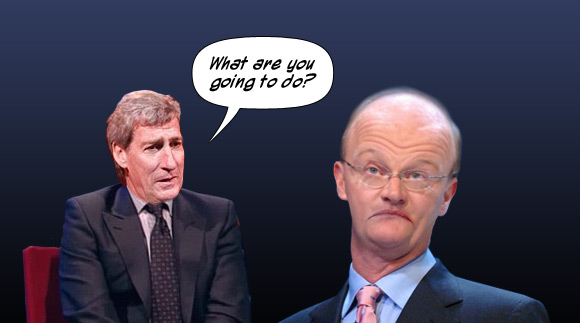
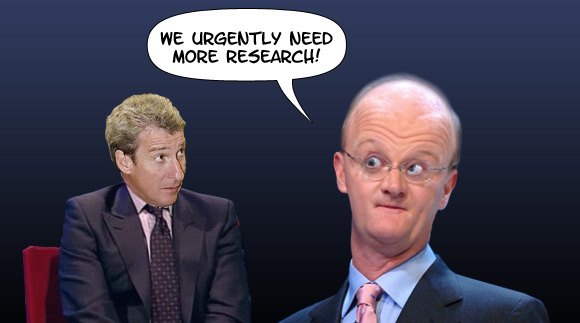
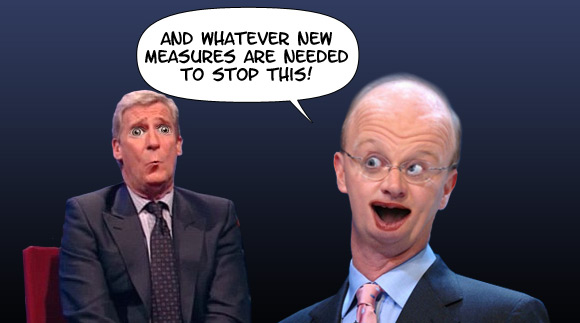
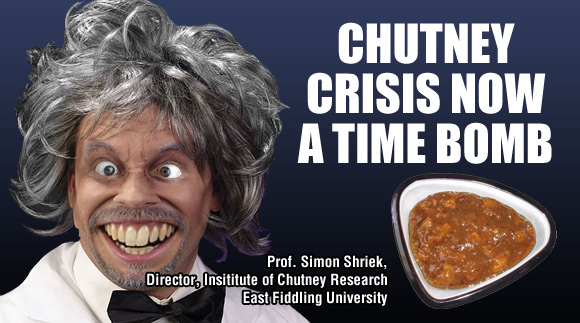
Andrew Orlowski explains how we keep falling for junk science through media exposure:

Firstly. An obscure researcher or scientist will make a dramatic claim.

The media picks up on this, and a reporter is assigned to the story. The reporter will have no scientific background — but looks to the state and the bureaucracy to do something. Anything.

The hapless minister is then hauled on to explain the inaction. He will be intelligent — he is likely to have a PPE from Oxford, like the presenter — but no specialist knowledge. He, too, trusts the scientists.

A pledge is then made to increase funding for the scientist who makes the claim.

A pledge is also made to act — by introducing legislation or other regulations. Perhaps a task force or committee will also be involved:


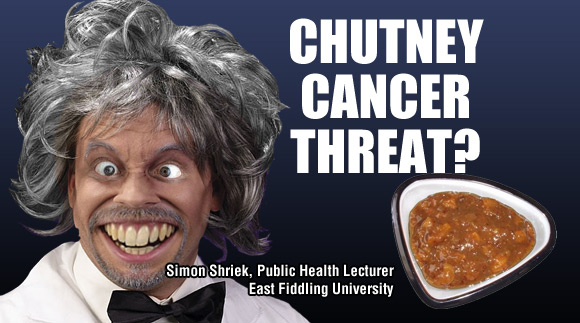
Illustrations: Andy Davies

The bandwagon is now rolling.

« Newer PostsOlder Posts »

Powered by WordPress