Quotulatiousness

October 1, 2022

Johann Hari’s unlikely career resurrection

Filed under: Books, Britain, Media, Technology — Tags: , , , — Nicholas @ 05:00

I have to admit that Johann Hari was pretty much just a British media personality I had a vague awareness of, but I hadn’t paid much attention to him (his Wikipedia sockpuppeting came to my attention in 2011, and I quoted from an article he wrote for the Los Angeles Times in 2019). As this post by Ben at Ben’s Comedy News outlines, I’d largely missed the rest of his fall and rise:

Nowadays, Johann Hari is known as a pop psychology expert. He does TED talks and writes books with simplistic messages like:

  • your smartphone is ruining your attention span! (Stolen Focus)
  • you should cure your depression by throwing away your medication and joining a book club! (Lost Connections)
  • the war on drugs is bad! (Chasing the Scream)

His books get positive blurbs from distinguished thinkers, such as the comedian and twink admirer Stephen Fry, the listicle entrepreneur Arianna Huffington, the feminist and sex offender’s wife Hillary Clinton, the comedian and fake revolutionary Russell Brand, and the TV doctor Doctor Rangan Chatterjee.

But when you look at how actual experts assess his work, it’s not so positive. The neuroscientist Dean Burnett responded to an extract of Lost Connections in his Guardian column, under the title Is everything Johann Hari knows about depression wrong? Burnett points out that:

    despite Hari’s prose suggesting he’s uncovered numerous revelations, pretty much everything he “reveals” is well known already

Hari, in pursuit of an anti-anti-depressant narrative, makes the claim that you can be diagnosed with depression and put on medication immediately after a traumatic event like losing a child, which Burnett (who teaches psychiatry) describes as:

    at best a staggering exaggeration, at worst an active fabrication to support a narrative.

But this article isn’t about what Johann Hari has been doing recently. It’s about what Hari was up to before he reinvented himself as some kind of expert, back when he was a journalist who ended up being disgraced.

It’s about how Hari has somehow rounded allegations of serious fabrication down to a record of minor plagiarism. It’s about how in trying to attack his critics, he seems to have inadvertently revealed his penchant for little brother incest fantasies with a troubling racial dimension. It’s about how I tried to fix the record on Wikipedia, and ran into trouble as Wikipedia’s policies collided with the sorry state of British journalism.

Back in 2010, Johann Hari was a star newspaper columnist (if you’re a millennial that means he wrote hot takes that got lots of clicks; if you’re Gen Z, think of him as a viral TikTok star but with words on paper).

In 2011 he was disgraced and kicked out of the profession.

Now if you look at the articles that were written about his comeback, like this New Statesman piece or this Guardian piece you’d conclude that he was disgraced for two things:

    plagiarism – specifically, taking quotes from text someone had written in a book or article, and pretending that the person had said it directly to him

    abuse of Wikipedia – in particular, using a fake identity to edit the pages of professional rivals with false allegations

I followed the whole Hari affair pretty closely at the time (I didn’t like him because he had been a cheerleader for the Iraq War, so I enjoyed watching his career go down in flames).

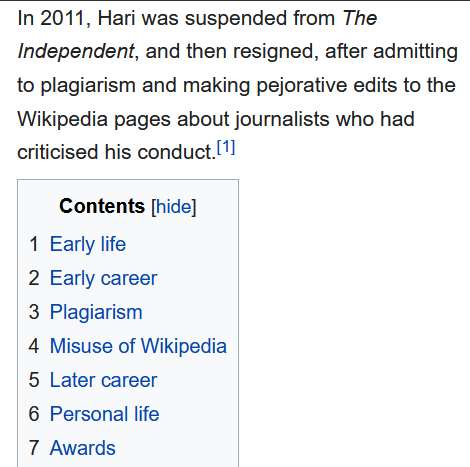
When his latest book came out a month ago, I looked at his Wikipedia entry. Wikipedia saves the history of all the different versions of each page, so here is a link to what I saw when I did that.

And here’s part of the summary and the table of contents:

The whole article struck me as weird because it didn’t mention two things I clearly remembered:

  1. Hari got in trouble, not just for minor plagiarism, but for allegedly making things up completely.
  2. Even more memorably, the fake identity he used to edit Wikipedia, “David Rose”, was also used to author an incest kink porn story with a hilarious title.

You can see why Hari (and whatever reputation management consultants he has working for him) would want to focus on the “plagiarism” angle. It’s not good to pass off a quote you got from someone’s book as something they told you directly, but it’s not as serious as completely inventing something. I suppose technically it’s plagiarism because you’re pretending you elicited the quote in an interview and you’re not citing the original book; but it’s a lot better than the typical case of plagiarism that involves passing off someone else’s work as your own. Hari’s defence is that he was “cutting corners” because he was under so much pressure due to his meteoric success at young age, etc. etc.

September 30, 2022

QotD: Many media people are folks “who Don’t Read Shit” about the stories they “report” on

Filed under: Media, Quotations, USA — Tags: , , — Nicholas @ 01:00

Without wading back into the exceptionally complicated details of that long controversy, I learned two things from the experience that have never left me.

First, as I traveled to Boston to go to court, and as I wracked up PACER charges downloading legal briefs and judicial orders, I would have email exchanges with newspaper reporters who wanted me to tell them what had happened. I would shoot back an email message that said, “Judge’s ruling attached,” and they would reply, “Yeah, saw the attachment, what does it say?”

Over two years, through events in a trial court and in an appellate court, with multiple parties pursuing complicated and divergent courses, reporters would not read. They wouldn’t read the 40-page legal briefs filed by the lawyers for all the competing sides, but they also wouldn’t read a three-page order from a judge. They would not read, period. They wanted the tl;dr, in a sentence or two. “Yeah, what’s it say?”

In our own moment, I remain extremely confident that the flood of bullshit like this […] is being slopped out by people who DRS — who Don’t Read Shit — about the topic they cover. Somebody in a government agency shot this dude an email message that said COVID VACCINES ARE MIRACLE DRUGS EVERYONE SHOULD GET THEM, and he said to himself, “Miracle drugs, got it!” We’re plagued by an army of people who pour “information” into the world based on two Twitter posts and a text message, after a full three to five seconds of deep thought …

Chris Bray, “Chris Bray is Stupid and Evil”, Tell Me How This Ends, 2022-04-07.

September 26, 2022

Did D-Day win WW2? – a WW2 expert discussion

Filed under: Britain, Europe, France, Germany, History, Media, Military, USA, WW2 — Tags: , , , , , — Nicholas @ 04:00

World War Two
Published 25 Sep 2022

WW2 historians Indy Neidell, Spartacus Olsson, and Paul Woodadge moderated by Ryan Socash discuss the meaning and significance of D-Day from historical, current, and future perspectives. Recorded on the road while shooting in Normandy for TimeGhost’s 24-hour documentary on the events of June 6, 1944.
(more…)

September 17, 2022

Is it still a conspiracy theory if more than 50% of Canadians believe it?

Filed under: Cancon, Government, Media, Politics — Tags: , , , , , , , — Nicholas @ 05:00

Chris Selley posted a link to this rather eye-opening Abacus Data poll summary by Bruce Anderson and David Coletto:

We recently completed nationwide surveying among 1500 Canadians. The focus was on the levels of trust people have in institutional sources of information, and belief in conspiracy theories. This is the first in a series called “Trust & Facts: What Canadians Believe”

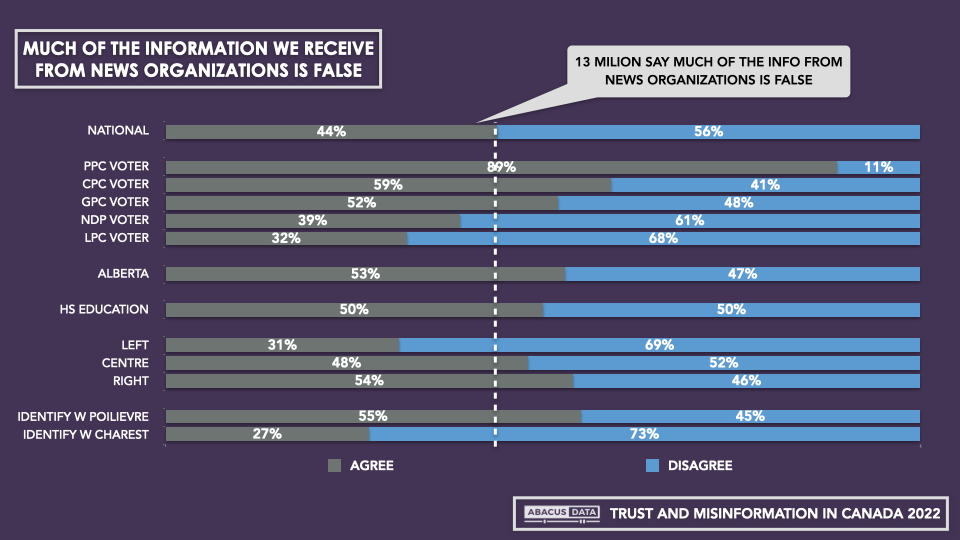
44% THINK MUCH OF THE INFORMATION FROM NEWS ORGANIZATIONS IS FALSE

Almost half of those interviewed found themselves agreeing with the statement “much of the information we receive from news organizations is false”.

While this means a majority of Canadians have some trust in news organizations, more than 13 million adults (extrapolating 44% to an adult population of 29.5 million) don’t.

Those with no post-secondary education, Alberta residents and those on the right show greater mistrust. But by far the biggest differences are visible when we look at party affinity. The vast majority of People’s Party supporters don’t trust news organizations and a (smaller) majority – 59% – of Conservative voters feel the same way.

Among those who think Pierre Poilievre is the Conservative leadership candidate who best reflects their views, 55% don’t trust media information, while among those who identify with Jean Charest the proportion is much lower, at 27%.

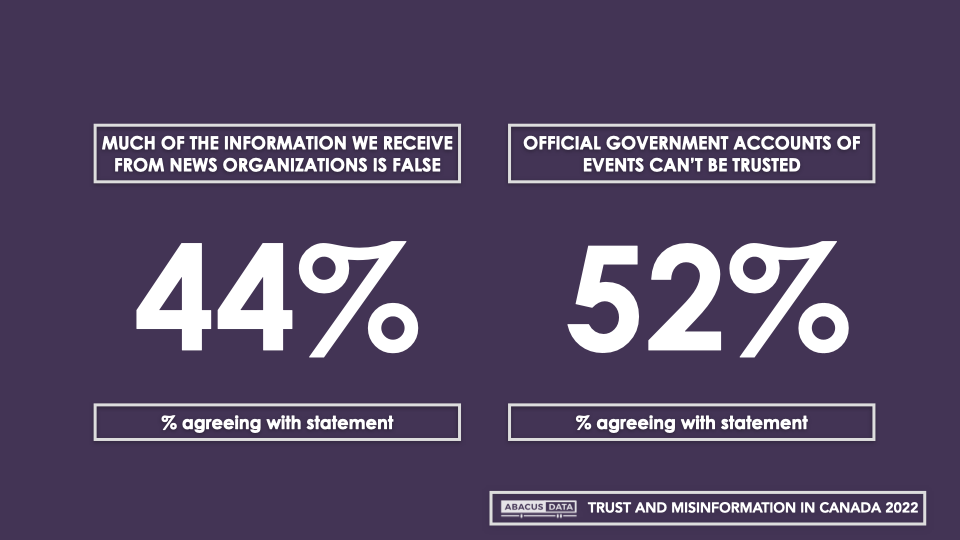
52% THINK OFFICIAL GOVERNMENT ACCOUNTS OF EVENTS CAN’T BE TRUSTED

More than half of those interviewed found themselves agreeing with the statement “official government accounts of events can’t be trusted”

As with trust in news organizations, those with no post-secondary education, Alberta residents and those on the right showed markedly higher levels of mistrust in government.

Majorities of People’s Party, Conservative and Green Party voters indicate mistrust. Those on the left and Liberal voters show higher levels of trust.

September 12, 2022

As of Saturday night, Pierre Poilievre is now “Hitler” to most of Canada’s legacy media

Filed under: Cancon, Media, Politics — Tags: , , , , , , — Nicholas @ 05:00

Of course, he was already well on the way to being “Hitler” even before the landslide voting results were announced:

New Conservative Party of Canada leader Pierre Poilievre at a Manning Centre event, 1 March 2014.
Manning Centre photo via Wikimedia Commons.

First, this was a completely lopsided blowout victory for the Poilievre team. The Jean Charest people, God bless them, had been telling anyone who would listen these last few weeks that their campaign had a strategy to win on points, thanks to their strong support in Quebec. So yeah, that didn’t happen. Poilievre won on the first ballot with almost 70 per cent of the vote; Charest came in second with … not quite 17 per cent. (Leslyn Lewis came in a distant third with less than 10 per cent, which she’ll probably attribute to the WEF controlling the process using mind-controlling nano-bots hidden COVID-19 vaccines or something similarly totally normal and reasonable.)

But yeah. Sixty eight point one five per cent on the first ballot. That’s a pretty clear signal.

To be honest, we at The Line saw that signal being sent pretty clearly many months ago. As Line editor Matt Gurney wrote almost exactly a year ago here, the only thing that was going to stop the Conservatives taking a real turn to the right was going to be a good showing by former leader Erin O’Toole in the 2021 federal election. He failed to deliver, and discredited the notion of success-via-moderation in the process. Conservatives now want the real thing: a big hunk of conservative red meat on their plate. And we never had any doubt that Poilievre was going to be the guy to serve that up for them.

Poilievre now has something that neither of his last two predecessors had. He has the support of the party behind him. Andrew Scheer needed 13 ballots to win in 2017, and even then only barely edged out Maxime Bernier. O’Toole won a more decisive victory against Peter MacKay, but as soon as he tacked back toward the centre, much of the party became palpably angry and uncomfortable with his leadership. Poilievre will not have these problems. The Conservative Party of Canada is his now.

In terms of our federal politics generally, we repeat a point we have been making here and in other places for many months. We think many Canadians, particularly those of the Liberal persuasion, may be shocked by how well Poilieivre will come across to Canadians. We believe there are a lot of people out there, who don’t have blue checkmarks and don’t spend all their time microblogging angrily at each other, who will like a lot of what Poilievre has to say and won’t find him nearly as scary as those who #StandWithTrudeau.

Poilievre has a nasty streak, and a temper, and we’re not sure that he will be able to control either. He could easily destroy himself. He has baggage too, and maybe get too close to the fringe. But if he doesn’t, we think he has a real shot.

And we think he will be helped by the weakness of the Liberals. This government seems exhausted and increasingly overtaken by events. It is also overly reliant on a few tricks. We suspect Canadians are growing tired of a Justin Trudeau smile and vague non-answer. Some Liberal baggage is just the inevitable consequence of a government aging in office. Some of it seems to be more specific to modern Canadian Liberalism, its leader and their unique, uh, quirks. Too many Liberals are blind to these problems, or least pretend to be — probably because they’re not great at admitting they have any problems at all, least not any posed by someone they find as repugnant as Pierre Poilievre. To them, we say this: Hillary thought she’d beat Trump.

It’s been fixed opinion among “mainstream” “conservatives” in Canada that the only way to get elected is to be more like Justin Trudeau. The obvious problem with this notion is that it’s going to be difficult to persuade Canadians to vote for a blue-suited Trudeau — or even an orange-tie-wearing Trudeau — if the original item is still on offer. I personally think Trudeau is a terrible PM, but a lot of people in downtown Toronto, Montreal, and Vancouver clearly disagree with me, and thanks to the Liberals’ hyper-efficient voting pattern, that’s been enough to keep Trudeau in power.

September 10, 2022

In a stormy and uncertain world, at least the New York Times remains consistent

Filed under: Britain, Media, USA — Tags: , , , , — Nicholas @ 05:00

Ed West on hearing the news that the Queen had died:

“Her Majesty Queen Elizabeth II” by Tinker Sailor Soldier Spy is licensed under CC BY-NC-ND 2.0 .

Unusually for me, being a cold-blooded Englishman whose emotional range is somewhere between Peter Cushing in Star Wars and Tywin Lannister, I found myself crying over the news yesterday evening. I cry more as I get older – presumably it’s all the testosterone draining away – and I shed tears for the Queen.

Her Majesty’s death was announced around 6.30 GMT. Soon after 9pm the New York Times pops up on Twitter, in its usual sanctimonious, scolding told, telling us that “We should not romanticize her era”, because, according to a Harvard professor “The queen helped obscure a bloody history of decolonization whose proportions and legacies have yet to be adequately acknowledged.”

Our Queen has died, a deeply-loved, politically-neutral figure who many saw as being like another grandmother. She was someone we all knew throughout our lives, who felt like a protective figure, associated with the political stability that our island has enjoyed for so long.

Yet for some inexplicable reason, the voice of America’s progressive establishment thought it appropriate to immediately publish this article, with the headline “Mourn the Queen, Not Her Empire”, something literally no one even considered or thought about. The British Empire may be long dead but it lives on, timeless and immortal, in the minds of New York Times editors.

Much has been written about the changing social mores of the Queen’s reign, but I think it’s still generally accepted that you wait until a person is buried before launching criticisms of their legacy; at the very least a couple of days. Yet while even the Kremlin managed to send some kind words on Queen Elizabeth’s passing, the New York Times went straight in with the yes-she-will-be-mourned-but.

As head of the Commonwealth, the Queen “put a stolid traditionalist front over decades of violent upheaval. As such, the queen helped obscure a bloody history of decolonization whose proportions and legacies have yet to be adequately acknowledged.”

“We may never learn what the queen did or didn’t know about the crimes committed in her name,” the historian concludes, but “xenophobia and racism have been rising, fueled by the toxic politics of Brexit. Picking up on a longstanding investment in the Commonwealth among Euroskeptics (both left and right) as a British-led alternative to European integration, Mr. Johnson’s government (with the now-Prime Minister Liz Truss as its foreign secretary) leaned into a vision of ‘Global Britain’ steeped in half-truths and imperial nostalgia.”

Andrew Sullivan found himself similarly moved at the news (after a bit of mandatory Trump-bashing to start the column):

[In the 2016 TV show The Crown] I found myself watching the life of an entirely different head of state: a young, somewhat shy woman suddenly elevated to immense responsibilities and duties in her twenties, hemmed in by protocol, rigidified by discipline. The new president could barely get through the day without some provocation, insult, threat or lie. Elizabeth Windsor was tasked as a twenty-something with a job that required her to say or do nothing that could be misconstrued, controversial, or even interestingly human — for the rest of her life.

The immense difficulty of this is proven by the failure of almost every other member of her family — including her husband — to pull it off. We know her son King Charles III’s views on a host of different subjects, many admirable, some cringe-inducing. We know so much of the psychological struggles of Diana; the reactionary outbursts of Philip; the trauma of Harry; the depravity of Andrew; the agonies of Margaret. We still know nothing like that about the Queen. Because whatever else her life was about, it was not about her.

Part of the hard-to-explain grief I feel today is related to how staggeringly rare that level of self-restraint is today. Narcissism is everywhere. Every feeling we have is bound to be expressed. Self-revelation, transparency, authenticity — these are our values. The idea that we are firstly humans with duties to others that will require and demand the suppression of our own needs and feelings seems archaic. Elizabeth kept it alive simply by example.

With her death, it’s hard not to fear that so much she exemplified — restraint, duty, grace, reticence, persistence — are disappearing from the world. As long as she was there, they were at the center of an idea of Britishness that helped define the culture at its best. Perhaps the most famous woman in the world, she remained a sphinx, hard to decipher, impossible to label. She was not particularly beautiful or dashing or inspiring. She said nothing surprising. She was simply the Queen. She showed up. She got on with it. She was there. She was always there.

Whatever else happened to the other royals, she stayed the same. And whatever else happened in Britain — from the end of Empire to Brexit — she stayed the same. This is an achievement of nearly inhuman proportions, requiring discipline beyond most mortals. Think of a year, 1992, in which one son, Andrew, divorced, a daughter-in-law, Sarah Ferguson was seen cavorting nude in the tabloids, a daughter, Anne, separated, another son’s famously failed marriage, Charles’, dominated the headlines, and your house burns down. Here is how Her Majesty “vented”:

    1992 is not a year on which I shall look back with undiluted pleasure. In the words of one of my more sympathetic correspondents, it has turned out to be an “Annus Horribilis“.

Dry, understated, with the only vivid phrase ascribed to a correspondent. Flawless.

She was an icon, but not an idol. An idol requires the vivid expression of virtues, personality, style. Diana was an idol — fusing a compelling and vulnerable temperament with Hollywood glamor. And Diana, of course, was in her time loved far more intensely than her mother-in-law; connected emotionally with ordinary people like a rockstar; only eventually to face the longterm consequences of that exposure and crumble under the murderous spotlight of it all.

Elizabeth never rode those tides of acclaim or celebrity. She never pressed the easy buttons of conventional popularity. She didn’t even become known for her caustic wit like the Queen Mother, or her compulsively social sorties like Margaret. The gays of Britain could turn both of these queens into camp divas. But not her. In private as in public, she had the kind of integrity no one can mock successfully.

August 14, 2022

QotD: The 2016 US election was a rejection of the media

Filed under: Media, Politics, Quotations, USA — Tags: , , , , — Nicholas @ 01:00

Here’s a surprising report: President Trump’s support is actually rising after his attack on “The Squad”.

The rise in support isn’t the surprising part. The surprising part is that the Media still find this surprising.

Not to toot my own horn too much here, but I’ve been writing about this since 2015 … “Make America Great Again” was the Trump campaign’s official slogan, but unofficially — and much, much more effectively — it was: “Fuck the Media”. The 2016 election is known far and wide as “The Great Fuck You”, but somehow, some way, almost everyone still fails to grasp that it wasn’t the Democrats who got told to fuck off. It wasn’t even the “Progressives”. It was The Media. The Great Fuck You was aimed entirely at the Media.

Severian, “Which Hand Holds the Whip?”, Rotten Chestnuts, 2019-07-17.

July 23, 2022

QotD: “The New Journalism” and “narrative journalism”

Filed under: History, Media, Quotations, USA — Tags: , , , — Nicholas @ 01:00

Most of what we consider public life in modern societies is public reactions to things done by the powerful. The New York Times makes up a new hoax and the week is spent on the hoax. The usual suspects swear by the obvious lies and normal people spend days picking apart the lies. Occasionally, we get the reverse where some uncomfortable truth gets loose and the usual suspect go bananas trying to “debunk” it while normal people cling to it as blessed relief.

This is the news cycle in a nutshell. There is very little news. It has been at least a generation since the major news outlets in America have done reporting. Most of it is just stenography. The “journalist” copies what a government spokesbot has sent to them and dresses it up with some commentary. Then there are the narratives that are designed to give the public a way to repeat the official truth that sounds convincing to them and their acquaintances.

The source of this is the “new journalism” that emerged in the 1960’s. The late British reporter Chris Munnion chronicled this in his book Banana Sunday. He spent most of his life covering Africa for the Telegraph. In the 1960’s he noticed Americans showing up with pre-written narratives. They would seek out quotes and pictures to fill out the story they had prepared for the trip. Even if the facts contradicted the narrative, they stuck with the narrative because that was the new journalism.

Narrative journalism is just accepted these days. The “news” has always been a form of passive-aggressive political activism so its evolution into story telling on behalf of powerful interests seems natural. When you think of the New York Times, Washington Post and Wall Street Journal as propaganda arms of their respective clients in the managerial elite, it all makes sense. Instead of the Ministry of Truth we have the mainstream media “speaking truth to power”.

That last bit gets mocked by normal people on this side of the great divide because they have woken up to the reality of this age. As if often the case, however, there is a kernel of truth locked in this media fabrication. The people inside these disinformation operations genuinely fear the public. When they say “speak truth to power” they mean broadcast their truth to you in the hopes that you will buy it. Modern mass media is mostly a defensive weapon of the elites.

The Z Man, “The Lying Liars”, The Z Blog, 2022-04-20.

July 20, 2022

Book Review: The Wipers Times

Filed under: Books, Britain, Europe, History, Humour, Military, WW1 — Tags: , , , , — Nicholas @ 02:00

Forgotten Weapons
Published 6 May 2018

Get your copy here: https://amzn.to/2jzWnkI
Or here: https://amzn.to/2JOpMm3

The Wipers Times was a satirical trench newspaper printed from February 1916 until December 1918 by British Captain F.J. Roberts and a crew of assistants. Such papers were not particularly uncommon, but the Wipers Times was particularly successful, well written, and long-lived, and it has survived in reprints today to a greater extent than any other similar work. A total of 23 issues were printed, and they consist of poetry, commentary, mock advertisements, advice columns, and short stories. While much of the humor is still quite accessible to us today, much of it also includes references, abbreviations, and inside jokes that are inscrutable to those who are not quite knowledgeable about life in the trenches.

Roberts and his cohorts were legitimate front-line soldiers, not writing as visiting journalists or from the safety of the rear echelons. Beyond its basic entertainment value, their writings also provide a rare and interesting view into the minds of men who were truly living the Great War.

Note that a book about the newspaper has also been printed, titled The Wipers Times, and with a very similar cover. If you want to buy a copy of the reprinted original issues, make sure you are not buying that book.

The BBC made a 90 minute program based on the Times, which is available in its entirely on YouTube here:

https://www.youtube.com/watch?v=SKPXu… [The original channel has been deleted, but I believe this is the same video: https://www.youtube.com/watch?v=juZBxhUYRpg]
(more…)

July 13, 2022

Joe Biden’s age and health can suddenly be discussed in the New York Times

Filed under: Media, Politics, USA — Tags: , , — Nicholas @ 05:00

In the free-to-cheapskates portion of Matt Taibbi’s TK News article on “The New Kremlinology”, he discusses the sudden change of policy for the New York Times regarding Joe Biden’s physical and cognitive condition:

After reading his formal remarks from the teleprompter, Joe Biden walks away from reporters without answering questions, August 2021.

On Monday, the New York Times ran a story pegged to a new poll, showing Joe Biden dragging a sub-Trumpish 33% approval rating into the midterms. The language was grave:

    Widespread concerns about the economy and inflation have helped turn the national mood decidedly dark, both on Mr. Biden and the trajectory of the nation… a pervasive sense of pessimism that spans every corner of the country …

The article followed another from the weekend, “At 79, Biden Is Testing the Boundaries of Age and the Presidency”. That piece, about Biden’s age — code for “cognitive decline” — was full of doom as well:

    Mr. Biden looks older than just a few years ago, a political liability that cannot be solved by traditional White House stratagems like staff shake-ups … Some aides quietly watch out for him. He often shuffles when he walks, and aides worry he will trip on a wire. He stumbles over words during public events, and they hold their breath to see if he makes it to the end without a gaffe.

Biden’s descent was obvious six years ago. Following the candidate in places like Nevada, Iowa, and New Hampshire, I listened to traveling press joke about his general lack of awareness and discuss new precautions his aides seemed to be taking to prevent him engaging audience members at events. Biden at the time was earning negative headlines for doing things like jamming a forefinger into the sternum of a black activist named Tracye Redd in Waterloo, Iowa, one of several such incidents just on that trip.

My former editor at Rolling Stone John Hendrickson, a genial, patient person whom I like a great deal, insisted from afar that Biden’s problems were due to continuing difficulties with a childhood stutter, something John had also overcome. He went on to write a piece for the Atlantic called “Joe Biden’s Stutter, and Mine” that became a viral phenomenon, abetting a common explanation for Biden’s stump behavior: he was dealing with a disability. The Times added op-eds from heroes like airline pilot Captain “Sully” Sullenberger with titles like, “Like Joe Biden, I Once Stuttered, Too. I Dare You to Mock Me”.

But I’d covered a much sharper Biden in 2008 and felt that even if the drain of overcoming a stutter had some effect, the problems were cognitive, not speech-related. He struggled to remember where he was and veered constantly into inappropriateness, challenging people physically, telling crazy-ass stories, and angering instantly. He’d move to inch-close face range of undecideds like Cedar Rapids resident Jaimee Warbasse and grab her hand (“we’re talking minutes”, she said) before saying, “If I haven’t swayed you today, then I can’t.” I called the mental health professionals who were all too happy to diagnose Donald Trump from afar for a story about the effort to remove Trump under the 25th amendment, and all declined to discuss Biden even off the record for “ethical” reasons.

This week, all that changed. Add stories like “Biden Promised to Stay Above the Fray, but Democrats Want a Fighter” and Michelle Goldberg’s “Joe Biden is Too Old to Be President Again”, and what we’ve got is a newspaper that catches real history spasmodically and often years late, but has the accuracy of an atomic clock when it comes to recording the shifting attitudes of elite opinion.

July 3, 2022

QotD: The US media when Donald Trump “happened”

Filed under: Media, Politics, Quotations, USA — Tags: , , , , , — Nicholas @ 01:00

[The 2008 election was] where the split between Party and Media really became obvious — the Party desperately wanted the only “adult” (by 21st century Democratic Party standards) in the room to be the nominee, but The Media wouldn’t hear of it. It seemed as though the struggle for the whip hand was finally over …

But then Donald Trump happened, as my students would’ve written. Though it’s only a few years in the past, we’ve already forgotten just how much The Media loved Bernie Sanders when the Republican nomination was still in doubt. Trump, of course, made The Media lose their shit so egregiously that what they did to W. looked like the happy ending to an Oriental massage, but virtually nobody was cheerleading for Hillary qua Hillary. It took the specter of The Donald as president to get them all on the same page.

Which brings us to now. The Democratic Party can read a poli-sci textbook. They know how difficult it is to beat an incumbent president in a good economy. Hell, it’s almost impossible to beat an incumbent president in a bad economy — see 2004 and 2012. It takes a major systemic shock to turf out an incumbent in the modern era — a catastrophe on the magnitude of a serious third party challenge (Ross Perot in ’92), or the incumbent being Jimmy Carter. The poli-sci textbooks say that the Dems’ only hope is to run the closest thing to the Antimatter Donald Trump they can find. That is to say: the blandest, SWPL-iest Goodwhite on their roster.

Alas for them, The Media will be having none of that. Trump somehow triggers them even more than he did in 2016 — don’t ask me how; it violates several important laws of thermodynamics — so they’re going all-in on goofballs like AOC and her “Squad.” The Media loves “the Squad,” and since The Media have convinced themselves that theirs is the whip hand, they’re ordering us to love “the Squad” too. To which Trump replies with a version of “lol get fucked,” and since “you’re free to leave this country if you hate it so much” seems forehead-slappingly obvious to anyone without a journalism degree, Trump’s poll numbers rise. Which prompts another stern lecture from The Media, which receives another “lol get fucked,” and around and around and around we go …

But here’s the thing: The battle for the whip is a battle royale. There are more than just two combatants. The Party still thinks it’s in charge. The Media, with 2008, 2012, and 2016 in its pocket, think they’re in charge. Nobody bothered to ask “the Squad,” though, and that’s the truly terrifying thing: “The Squad” thinks they’re in charge, and they might actually be right.

We’ve already got Congress voting to condemn Trump’s tweets. Set aside how brain-bogglingly infantile that is — and how petty and retarded it appears to the American public. Consider just how badly Nancy Pelosi et al, aka The Party, had to screw up to find themselves in this situation.

Severian, “Which Hand Holds the Whip?”, Rotten Chestnuts, 2019-07-17.

June 16, 2022

QotD: The Guardian and “capitalism”

Filed under: Britain, Economics, Humour, Media, Quotations — Tags: , — Nicholas @ 01:00

The displacement of responsibility is a Guardian staple, with society or capitalism (or “late capitalism”, or “neoliberalism” or whatever) being blamed for the columnist’s own hang-ups and incontinence. Tanya Gold did it two or three times during her time at the paper, as did Madeleine Bunting, Oliver James, VJD Smith and God knows how many others. Diane Abbott once claimed that capitalism is the reason she got fat, and still is.

It’s practically a rule. If a Guardian contributor drinks too much, eats too much, buys too many shoes … well, obviously, they’re the victim because consumerist peer pressure somehow made them do it against their will, such as it is. The premise is generally “capitalism made me fat”, followed by “capitalism made me anxious about being fat”, followed by “tax such-and-such to buggery, or ban it altogether, and then I’ll be thin”.

David Thompson, from the comments to “Reheated (55)”, DavidThompson.com, 2019-04-01.

June 4, 2022

Bill C-18 might as well be called the “Keep legacy media alive at all costs, even if nobody wants it anymore” act

The Line‘s Jen Gerson lays out the case against the federal government’s plans for permanent corporate welfare for the big Canadian legacy media organizations:

How Jen Gerson might visualize Torstar and Postmedia during the lobbying effort for Bill C-18.
“Zombie nuns” by Michael Cavén is licensed under CC BY-NC-SA 2.0

This week, The Line signed on to a campaign put together by a coalition of independent media publishers calling for amendments to the panda trash fodder piece of legislation known as C-18. To be fair, I mostly signed on; my co-founder Matt Gurney had some reservations, and I figured it would be best to hash them out in full here.

The bill is a hot mess created by a clearly well-intentioned government that appears to have been bamboozled by a group of media industry lobbyists helmed by organizations like Postmedia and Torstar — companies that despite extraordinary history and resources have largely failed to sustainably transition to a digital media environment. These large outlets are now using the last of their dying power and influence to champion legislation that will force big technology companies like Facebook and Google to compensate them for linking to their content.

This is a straightforward case of regulatory capture, the very thing we would condemn in any other industry; big media companies are using their credibility and political power to pressure the government into forcing “Big Tech” to sustain their dying business models — the very “Big Tech” that they’ve spent years deriding and defaming in their very own newspapers and outlets.

This whole process is corrupt. I don’t say that lightly. Perhaps inevitably, I’ve grown totally disillusioned with the industry to which I have devoted all of my adult life. We used to consider journalism a calling or a vocation — manipulative terms that justified the low pay, harassment, and sometimes abusive management. How can the church of journalism and its holy mandate to preserve democracy continue to take itself seriously when the very catechism of the craft are nowhere present in its own self-created lobbying arm, New Media Canada?

I think the leaders of this initiative have convinced themselves that the business model they enjoyed in the ’80s and ’90s is so totally central to the survival of democracy and liberal values that they’ve committed to keeping it afloat by any means necessary regardless of the ethical and philosophical cost. In doing so, I believe that they’re only ensuring their own failure.

By driving legislation in this way, they are not proving their worth to the broader public. Rather, they are conceding that what they produce has so little value that they need to evolve into parasites of the state. It demonstrates that commitment to democracy and accountability is secondary to their primary functions; running a business. They have stockholders to please and interest on loans to pay. Big loans.

Meanwhile, the legacy media they have managed is little more than a zombie in nun’s drag. It is in a state of terminal decline, and keeping it alive poisons the earth for the generations to come after.

May 28, 2022

Scott Alexander on the “Hearing Voices Movement”

Filed under: Health, Media, USA — Tags: , , — Nicholas @ 05:00

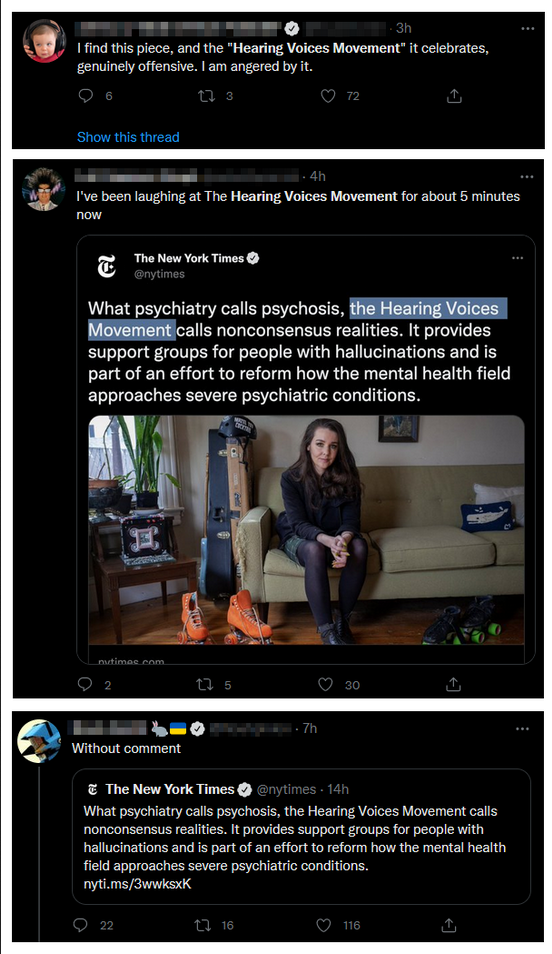
I’d never heard of the Hearing Voices Movement, but I don’t read the [spit] New York Times [spit]. Scott Alexander almost certainly also avoids reading the NYT, but he responds to a recent article there on the phenomenon that some of his psychiatric patients have reported:

The New York Times has an article out on the Hearing Voices Movement — ie people with hallucinations and delusions who want this to be treated as normal and okay rather than medicalized. Freddie deBoer has a pretty passionate response here. Other people have differently passionate responses:

I’ve met some Hearing Voices members. My impression is that everyone on every side of this discussion is a good person trying to make the best of a bad situation (except of course New York Times journalists, who are evil people destroying America). Some specific thoughts:

2:

Plenty of people hear voices. Some of these people are your typical homeless schizophrenic, but many aren’t. One of my patients was a successful computer programmer who had near-daily auditory hallucinations. He realized they weren’t real, did his best to ignore them, and got on with his successful life — just like he had been doing for the past twenty years. He was seeing me for unrelated depression.

This guy kept his condition secret from his friends and co-workers. I don’t blame him for this choice at all. But when everybody who can hide it does, we only hear about the people who can’t keep it hidden, who are usually worst-case scenarios. Also (as a bunch of 1980s gay people can tell you) keeping a basic fact about yourself hidden from everyone you know sucks.

I recommended Hearing Voices Movement to this guy. I can’t remember whether he took me up on it or not. But I thought it would be helpful for him to have people he could talk to about his situation who wouldn’t think he was crazy, or try to get him locked up.

3:

People hate admitting that some cases are mild, and others are severe. Especially the kind of people who work at the New York Times

I talked about this a while back in the context of the autism rights movement. Many autistic people live great lives, enjoy the beneficial parts of their condition, and find it annoying or oppressive when psychiatrists keep trying to medicate them. Many other autistic people can’t live outside of institutions and constantly try to chew off their own body parts. A reasonable conclusion might be “the first group seem mild and should be left alone, the second group seem severe and probably need intensive treatment”, but it’s surprisingly hard to convince people of this.

Calling some cases “mild” sounds trivializing. Calling other cases “severe” sounds stigmatizing. Whatever your criteria for a mild case are, there will be someone who fits those criteria, but says the condition ruined their life and you are dismissing their pain. Whatever your criteria for a severe case are, there will be someone who fits those criteria but is thriving and living their best life and accuses you of wanting to imprison them in a hospital 24-7.

And that’s just the activists! We psychiatrists have the same problem from a different direction: we have seen some crazy @#!$. No matter how mild your case is, we’ve seen some case that looked like that at first glance, then slowly descended into a horror movie premise. Our instinct is naturally to round off the person who uses Xanax once a month to the lifetime drug abuser, the mildly depressed housewife to the gory suicide victim, and the occasional voice-hearer to the guy who needs to be in a straitjacket.

Still, some cases are mild and others are severe. People with mild psychosis — like my patient the programmer — probably don’t need to be on really strong medications with severe side effects. They probably just need support. In a perfect world, expert psychiatrists would have a major role in providing that support. In the real world, a lot of these patients expect their psychiatrist to freak out, overmedicate them, and maybe even commit them to a hospital. This being the real world, many of those patients are right. So they look elsewhere.

May 17, 2022

The Canadian government has a much more expansive view of “use of journalistic content” than most Canadians do

Filed under: Cancon, Government, Media, Technology — Tags: , , , — Nicholas @ 03:00

Michael Geist continues looking at the differences between what the Canadian government says they’re trying to do with their Online News Act (Bill C-18) and how the actual wording of the bill will operate:

Parliament Hill in Ottawa.
Photo by S Nameirakpam via Wikimedia Commons.

But is it reasonable to legislate that posting a news headline constitutes making that news content available? Can Canada even do that and still remain compliant with international copyright laws under the Berne Convention which require countries to feature an exception for quotation? Indeed, international copyright law recognizes the critical importance of enabling quotation free from limitations as an essential element of expression, yet Bill C-18 adopts an approach that may violate that principle by requiring compensation for quotation.

Sub-section (b) moves far beyond reproduction into a realm that bears little resemblance to use or a reasonable definition of “making available”. It covers facilitating access to news by any means. In what way is facilitating access to news the same as making it available (much less using it)? A facilitating access to news standard is virtually limitless: newsstands, news screens in elevators or taxis, television manufacturers, or newspaper box makers can all be said to be facilitating access to news. The bill limits its scope to DNIs, but the policy principle that this bill is simply compensating for the use of content is twisted beyond all recognition.

In fact, it is clear that this extreme approach is precisely what the government intends. By citing examples such an indexing, aggregation or ranking of news content it is saying that virtually anything that a platform does – linking to news articles or merely to news organizations, indexing content at the request of the news organization (even if the actual content is not openly available as is the case with paywalled sites), or creating a list of news articles on a given topic are all “facilitating access to news content” which requires compensation.

Would Canadians agree that this link to the front page of the Globe and Mail is making the Globe‘s available? If this link appears on Google or Facebook, the government says that it is. If someone searches for newspapers in Montreal to learn more about developments in the city, is the list of newspapers in that city making the content available? Once again, the government says that it is.

The initial debate on Bill C-18 featured several interventions about the problems of misinformation. In light of the actual provisions in the bill, claims that it simply requires compensation for use might ironically be fairly characterized as misinformation. Unfortunately, the problematic claims associated with the bill don’t stop there as tomorrow’s post on market intervention will illustrate.

« Newer PostsOlder Posts »

Powered by WordPress