Quotulatiousness

November 16, 2009

Harrier replacement moves to next stage

Filed under: Britain, Military, Technology, USA — Tags: , , , , — Nicholas @ 13:28

The F-35B has been delivered to an American base for testing of its vertical take-off and hover capabilities:

The F-35 “Lightning II” B model will, like other versions of the same aircraft, offer supersonic performance and stealth technology – a combo so far offered in only one aircraft in the world, the famous F-22 Raptor ultrasuperfighter. But the F-35B, unlike its tailhook and normal-runway counterparts, is also equipped with a central lift fan mounted in a shaft through the fuselage and can swivel its jet exhaust downwards too.

This means that an armed and fuelled F-35B should be able to make a very short takeoff run to get airborne and then, having burned fuel and perhaps released weapons, make a vertical landing supported entrirely by engine thrust. This Short Takeoff and Vertical Landing (STOVL) capability has so far been offered in the Western-aligned world only by the famous Harrier, originally developed in Britain and now in service with the RAF, the Royal Navy and the US Marines.

Of course, Britain’s interest is moving toward being purely intellectual . . . the bookies are offering long odds on Britain ever commissioning even one of those two new aircraft carriers, never mind both of them. Back story here, here, and here.

November 11, 2009

In memorium

Filed under: Britain, History, Military, WW1, WW2 — Tags: , , — Nicholas @ 11:00

A simple recognition of some of our family members who served in the First and Second World Wars:

The Great War

  • Private William Penman, Scots Guards, died 1915 at Le Touret, age 25
    (Elizabeth’s great uncle)
  • Private David Buller, Highland Light Infantry, died 1915 at Loos, age 35
    (Elizabeth’s great grandfather)
  • Private Walter Porteous, Northumberland Fusiliers, died 1917 at Passchendaele, age 18
    (my great uncle)
  • Corporal John Mulholland, Royal Tank Corps, died 1918 at Harbonnieres, age 24
    (Elizabeth’s great uncle)

The Second World War

  • Flying Officer Richard Porteous, RAF, survived the defeat in Malaya and lived through the war
    (my uncle)
  • Able Seaman John Penman, RN, served in the Defensively Equipped Merchant fleet on the Murmansk Run (and other convoy routes), lived through the war
    (Elizabeth’s father)
  • Private Archie Black (commissioned after the war and retired as a Major), Gordon Highlanders, captured at Singapore (aged 15) and survived a Japanese POW camp
    (Elizabeth’s uncle)

In Flanders fields the poppies blow
Between the crosses row on row,
That mark our place; and in the sky
The larks, still bravely singing, fly
Scarce heard amid the guns below.

We are the Dead. Short days ago
We lived, felt dawn, saw sunset glow,
Loved and were loved, and now we lie
In Flanders fields.

Take up our quarrel with the foe:
To you from failing hands we throw
The torch; be yours to hold it high.
If ye break faith with us who die
We shall not sleep, though poppies grow
In Flanders fields.

Lieutenant Colonel John McCrae, MD (1872-1918)

November 10, 2009

Korean War flare-up at sea

Filed under: Asia, Military — Tags: , , — Nicholas @ 08:25

The technically still-at-war Korean navies had a brief sea battle yesterday:

Warships from North and South Korea exchanged fire in disputed waters off the western coast of the Korean peninsula on Tuesday, leaving one North Korean vessel engulfed in flames, South Korean officials said.

The two Koreas accused each other of violating their territorial waters to provoke the two-minute skirmish. It was the first border fighting in seven years between the two countries, which remain technically at war.

[. . .]

North Korea appeared to have intended the clash to highlight its long-standing argument: the 195-53 Korean War never officially ended and the United States must negotiate a peace treaty with it if it wants the North to give up its nuclear weapons program, according to analysts in Seoul.

“Our high-speed patrol boat repelled the North Korean patrol boat,” the South Korean Office of the Joint Chiefs of Staff said in a statement following the skirmish. “We are fully prepared for further provocations from the North Korean military.”

South Korea said it suffered no casualties. Speaking in Parliament, Prime Minister Chung Un-chan said the North Korean boat limped back to its waters “enveloped in flames.”

October 30, 2009

“Then we seize Canadian power plants near Niagara Falls, so they freeze in the dark”

Filed under: Cancon, History, Military, USA — Tags: , , , — Nicholas @ 13:53

OMG! US invasion plans target Halifax, Montreal, Winnipeg . . . and Sudbury?

The United States government does have a plan to invade Canada. It’s a 94-page document called “Joint Army and Navy Basic War Plan — Red,” with the word SECRET stamped on the cover. It’s a bold plan, a bodacious plan, a step-by-step plan to invade, seize and annex our neighbor to the north. It goes like this:

First, we send a joint Army-Navy overseas force to capture the port city of Halifax, cutting the Canadians off from their British allies.

Then we seize Canadian power plants near Niagara Falls, so they freeze in the dark.

Then the U.S. Army invades on three fronts — marching from Vermont to take Montreal and Quebec, charging out of North Dakota to grab the railroad center at Winnipeg, and storming out of the Midwest to capture the strategic nickel mines of Ontario.

Meanwhile, the U.S. Navy seizes the Great Lakes and blockades Canada’s Atlantic and Pacific ports.

At that point, it’s only a matter of time before we bring these Molson-swigging, maple-mongering Zamboni drivers to their knees! Or, as the official planners wrote, stating their objective in bold capital letters: “ULTIMATELY TO GAIN COMPLETE CONTROL.”

Old news indeed, but still of historical interest. The plans in the other direction were held in Defence Scheme No. 1:

Lt. Colonel Brown himself did reconnaissance for the plan, along with other lieutenant-colonels, all in plainclothes. These missions took place from 1921 and 1926. As historian Pierre Berton noted in his book Marching as to War, these investigations had “a zany flavour about it, reminiscent of the silent comedies of the day.” To illustrate this, Berton quoted from Brown’s reports, in which Brown recorded, among other things, that in Burlington, Vermont the people were “affable” and thus unusual for Americans; that Americans drink significantly less alcohol than Canadians (this was during Prohibition), and that upon pointing out that to Americans, one responded “My God! I’d go for a glass of beer. I’m going to ‘Canady’ to get some more”; that the people of Vermont would only be serious soldiers “if aroused”; and that many Americans might be sympathetic with the British cause.

October 26, 2009

An alternative spending plan for Britain’s MoD

Filed under: Britain, Economics, Military — Tags: , , , , — Nicholas @ 12:16

Lewis Page looks at the Ministry of Defence and comes up with innovative ways to both save money and increase military capabilities:

Under the plan as laid out in the Times, the Ministry of Defence would still buy the two planned new carriers, to be dubbed HMS Queen Elizabeth and Prince of Wales. However the Prince of Wales would not be operated as a strike carrier with a force of jets; instead she would be a “commando carrier”, a floating forward-mounting airbase full of marines, helicopters and drones. This would mean no need to replace HMS Ocean, the navy’s current helicopters’n’marines ship — which would, according to the Thunderer, cost £600m in the 20-teens. (That seems pretty steep as Ocean herself only cost £150m in the mid ’90s).

This is the same story I linked to yesterday, although I said I suspected that the MoD had probably decided that their best plan was to scrap the carriers altogether. Part of the problem is that the Royal Navy can’t depend on the Royal Air Force to join with them in the larger purchase of aircraft:

It has long been known that the RAF doesn’t want to replace its own Harrier force — it would rather spend that money upgrading as many of its Eurofighter Typhoons as it can. The horrifyingly expensive Typhoon was designed as a pure air-to-air fighter, and at the moment it mostly still is — though a few RAF ones have been given an “austere” bombing capability.

The RAF would like to rebuild and re-equip as many of its largely irrelevant Typhoons as possible, giving them such things as trendy electronically-scanned radars and air-launched cruise missiles of various sorts. This would, perhaps, enable the Typhoon force to tackle tough enemy air-defence networks of the sort possessed by nations such as Iran and Russia.

There’s another over-priced item on the MoD budget that could be cut without seriously impacting military capabilities:

But there are many better ways to cut money from the MoD than crippling our new carrier force. To give just one example, our new fleet of refurbished De Havilland Comet subhunters (sorry, “Nimrod MRA4s”) will cost at least £700m a year to operate. If we put the whole Nimrod force on the scrapheap for which they are so long overdue right now, by the year 2019 we will have saved the £7bn needed to buy the missing eighty-odd JSFs for our second carrier — and the Prince of Wales isn’t actually going to be afloat much before then, so that’s not a problem.

[. . .]

There are many, many other such stories. We could buy cheap Sky Warrior auto-drones off the shelf rather than expensive Watchkeepers. We could equip the carriers properly and so buy cheaper F-35 C tailhook planes rather than pricey B-model jumpjets — this would save money straight off, and save a fortune on the vital carrier radar planes. Indeed, we could buy much cheaper Super Hornets to begin with, if we wanted to save a lot of cash. We could bin the expensive, feeble A400M transport and buy nice cheap C-17s instead. Rather than upgrading squadrons of Eurofighters into superbombers at a cost of billions we could buy a force of vastly more cost-effective turboprop strike planes to back our troops in Afghanistan. The list goes on.

I rather agree about the A400M . . . although Britain isn’t paying as much as South Africa for their planes.

Related: Strategy Page looks at the costs involved in refitting current USN aircraft carriers, and in designing and building the next generation of CVNs.

October 25, 2009

Royal Navy carrier plans: going, going . . .

Filed under: Britain, Military — Tags: , , — Nicholas @ 20:34

A report in The Guardian walks a bit further down the road to the increasingly likely end of aircraft carrier operations in the Royal Navy:

Defence chiefs are considering scrapping plans to have two large aircraft carriers equipped with fast jets, a move that could save billions of pounds, Whitehall officials said today.

The idea would be to have just one carrier holding US-made joint strike fighters, with the second, more basic, ship, being used only as a platform for helicopters and possibly unmanned drones equipped with missiles and cameras.

The two proposed carriers, the Queen Elizabeth, due to go into service in 2016, and the Prince of Wales, to follow in 2018, are already running £1bn over budget. The original estimated cost was £3.9bn.

Consideration is being given to cutting the number of joint strike fighters to be flown from the carriers, from 138 to about 50, saving more than £7bn.

The head of the Royal Navy last month conceded that the decision to build two large aircraft carriers could be overturned. Admiral Sir Mark Stanhope said that though contracts had been signed to build the carriers, next year’s defence review could cause those plans to change.

Personally, I suspect that the final decision to cancel the carriers has already been taken, the government is just waiting for an opportune moment to make the announcement. Given that the rest of the fleet has been shrinking for years, eliminating the two carriers would allow the government to “save” an even-more-reduced Royal Navy from further cuts . . . until next budget period.

October 23, 2009

Wreck of WW1 British submarine found in Baltic

Filed under: Britain, History, Military — Tags: , , , — Nicholas @ 12:48

BBC News reports on a recent discovery by the Australian descendent of the only survivor of the sinking:

The wreck of a British naval submarine lost for more than 90 years has been found in the Baltic Sea off the coast of Estonia.

HMS E18 – with its complement of three officers and 28 ratings – went out on patrol in May 1916 and was never seen again.

The submarine was one of a handful sent to the Baltic during World War I by Winston Churchill, the First Lord of the Admiralty, to disrupt German shipments of iron ore from Sweden and support the Russian navy.

E18 left its base in the Russian port of Reval – now Tallinn, the capital of Estonia – on the evening of 25 May 1916 and headed west.

The following day she was reported to have engaged and torpedoed a German ship.

A few days later, possibly 2 June, she is believed to have struck a German mine and sunk with all hands.

October 9, 2009

Army beats Navy and Airforce

Filed under: Britain, Military — Tags: , , , — Nicholas @ 12:11

Following up on yesterday’s post about the British Ministry of Defence directive to find savings to support the ongoing (primarily army) efforts in Afghanistan, Strategy Page calls the winner:

British Army Sinks The Navy And Grounds The Air Force

After several months of debate, the British Royal Navy and Royal Air Force have been ordered to cut back on spending, so that money and resources may be used to support army operations in Afghanistan. Among other things, the army has been pointing out that only ten percent of spending on new equipment goes to the army (based on actual and planned spending between 2003-18). This, despite the fact that it’s the army that is doing most of the fighting during this period. Although the army recently pulled out of Iraq (where it had been since 2003), it is still in Afghanistan, and more troops are headed there. The Royal Navy and Royal Air Force have not been fully involved in a major operation since the Falklands in 1982, although they have been involved in several more limited efforts. The point is that they face nothing like what the army is dealing with in Afghanistan.

The British armed forces have 191,000 troops on active service. Of those, 38,000 are in the Royal Navy, 109,000 in the Army, 41,000 in the Royal Air Force, and the rest in joint staffs and operations. The annual defense budget is about $58 billion.

Those aircraft carriers are looking less and less likely to be ever in service . . .

October 8, 2009

British military establishment facing cuts under next government?

Filed under: Britain, Bureaucracy, Military — Tags: , , — Nicholas @ 07:36

It would be too glib of me to suggest that the Ministry’s preferred way to respond to the Conservative opposition’s call “to cut MoD costs by 25%” would be to abandon the Royal Navy (or ground the Royal Air Force), but it’s hard to imagine them voluntarily cutting their own numbers:

Shadow defence secretary Liam Fox is expected to tell the party’s conference: “Some things will have to change and believe me, they will.”

The BBC’s Laura Kuenssberg said Mr Fox had asked for savings in bureaucracy – the MoD has 85,000 civil servants.

The Tories have pledged to cut overall Whitehall budgets by a third.

In his speech to party members in Manchester, Dr Fox will accuse Labour of having creating “a black hole” in defence budgets, which are affecting the war in Afghanistan and threatening to create an “on-going defence crisis for years to come”.

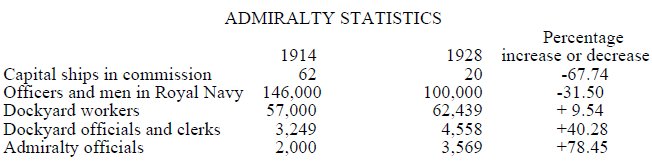
Of course, there’s nothing new about the administrative “tail” of the armed forces growing . . . C. Northcote Parkinson documented the phenomenon (PDF) back in 1955:

The accompanying table is derived from Admiralty statistics for 1914 and 1928. The criticism voiced at the time centered on the comparison between the sharp fall in numbers of those available for fighting and the sharp rise in those available only for administration, the creation, it was said, of “a magnificent Navy on land.” But that
comparison is not to the present purpose. What we have to note is that the 2,000 Admiralty officials of 1914 had become the 3,569 of 1928; and that this growth was unrelated to any possible increase in their work. The Navy during that period had diminished, in point of fact, by a third in men and two-thirds in ships. Nor, from 1922 onwards, was its strength even expected to increase, for its total of ships (unlike its total of officials) was limited by the Washington Naval Agreement of that year. Yet in these circumstances we had a 78.45 percent increase in Admiralty officials over a period of fourteen years; an average increase of 5.6 percent a year on the earlier total. In fact, as we shall see, the rate of increase was not as regular as that. All we have to consider, at this stage, is the percentage rise over a given period.

Parkinson_Admiralty_Statistics

September 25, 2009

Operation Nanook

Filed under: Cancon, Military — Tags: , , — Nicholas @ 10:21

You wouldn’t say they go out of their way to glorify the military in this video . . .

September 22, 2009

More on the ABM decision

Filed under: Europe, Military, USA — Tags: , , — Nicholas @ 11:50

Following up from last week’s post on cancelling ABM systems for Poland and the Czech Republic, Jon sent the following comment:

I was wondering about this sort of thing when the announcements were first made, but thought that “No, Obama is indeed evil enough to do this just for kicks.” Is is possible, thought, that the Polish and Czech installations are being cancelled as they are being replaced with something else?

Have you read anything to that effect anywhere?

I assumed colossal ignorance and ineptitude, rather than deliberate provocation, but maybe I’m just too naive. I had read something about the SM-3 BMD at Taylor Empire Airways (yes, this time I’m sure it was Chris Taylor). He indicates that it does have a better track record than competing systems and it can be deployed much faster, but that there are also some caveats.

September 11, 2009

Visiting HMCS Toronto

Filed under: Cancon, Military — Tags: , , — Nicholas @ 12:04

The Economist reports on a visit to HMCS Toronto during Operation Nanook:

Thursday

A BLAST of the bosun’s whistle at 7am starts the day on the HMCS Toronto. Footsteps echo through the metal hull as the day watch makes their way to breakfast. We journalists lag behind. It is not easy to climb out of the bunks (or racks, in navy slang) stacked three high in areas kept permanently dark because someone is always sleeping. It was even harder to get into our racks the night before, as there were no ladders and no obvious way to get up to the middle or top racks.

Yesterday we were warned that we might have to climb a rope ladder to board the frigate from the Zodiacs. This threat was withdrawn and a set of steep metal steps with handrails was provided. Perhaps they took pity on the sedentary hacks that normally spend their days staring at computer screens. More likely, it was because the Canadian prime minister, the defence minister, and the top military brass are joining us.

While having the leaders assembled in one place appears risky — one well-aimed torpedo from an enemy submarine could cripple the Canadian government and wipe out its military command — we are assured that there is no conventional military threat in the Canadian arctic.

A true cynic might say something like “it’s a good thing the Liberals don’t have any submarines . . .”

September 9, 2009

Operation Nanook

Filed under: Cancon, Military — Tags: , , — Nicholas @ 13:13

I was surprised that they chose this particular name for the exercise, as I’d have assumed it would provoke mild symptoms of offensensitivity. Apparently not:

Ostensibly, we’re here to witness Canada asserting its control of the Arctic, which is attracting increased military and commercial interest due to the melting polar ice cap. But a political motive lurks behind the PR: Stephen Harper, the Conservative prime minister of a minority government, may well be facing an election in the autumn. He has made the Arctic one of his signature issues, and will drop by for grips and grins.

We are told to be at Apex Beach, a five-minute drive from central Iqaluit, at 5:30am to witness the first part of the exercise. Around 140 soldiers and their guides, known as Canadian Rangers, will land from the frigate HMCS Toronto and icebreaker CCGS Pierre Radisson. Midway through the two-month arctic summer, the waters of Frobisher Bay are glass-smooth and ice-free.

Although the sun has already been up for an hour, the weather is cool, more like a crisp autumn day than a midsummer morning. The military has thoughtfully provided a tent stocked with coffee and muffins for the journalists. Those who forgot their hats and gloves shelter there as the first of the Zodiac boats zip across the calm waters to the beach. Aside from the Sea King helicopter circling overhead, there is little drama in the landing. The soldiers, clad in green camouflage, calmly disembark and march off in groups of four to assemble at the top of a rocky hill.

The Canadian Rangers may be the least well-known of Canada’s military:

Rangers reflect the communities they are drawn from, says Mr Buzzell. In the western Arctic, where he is from, they are a mix of white, Indian, Métis and Inuit. In Nunavut, where Inuit make up 85% of the territory’s population, they are mainly Inuit. In any exercise on land, the regular forces would be lost without the Rangers’ survival skills, as would the numerous expeditions from all over the world that set out each year for the North Pole.

The Inuit are usually too polite to make a point of this. But a video I picked up in Iqaluit called “Quallunat: Why white people are funny” provides a rare glimpse of how Inuit view hapless southerners. The scene in which an Inuit on a snowmobile rescues two so-called explorers, equipped with the latest gear but little sense, makes for funny, if uncomfortable viewing.

August 6, 2009

More threats to Royal Navy’s carrier plans

Filed under: Britain, Military — Tags: , , , , — Nicholas @ 12:03

An interesting report in The Register discussing the possibility of abandoning the planned STOVL variant of the F-35 and switching to the more traditional catapult-launch and tailhook-landing variant being developed for the US Navy:

The UK Ministry of Defence (MoD) is set to make a major change to the design of the new aircraft carriers for the Royal Navy, according to a newspaper report. It’s suggested that the ships will now be equipped with catapults and arrester wires, allowing them to operate normal carrier aircraft rather than the complex, expensive jump-jets which had been planned.

According to the Daily Telegraph today “the MoD has indicated that it will drop the jump-jet… The Daily Telegraph has learnt from senior defence officials that an announcement is due this autumn.”

There would definitely be advantages to going with a more traditional aircraft: less mechanical complexity, greater weapons-carrying capability, and (probably most important in the MoD) lower per-aircraft costs. It’s not a slam-dunk decision, however:

Catapults and arrester gear aren’t a significant expense in themselves, but current catapults are powered by steam from the ship’s engines. The planned new Royal Navy ships will be propelled by gas turbines, however, and so have no steam (US and French carriers use nuclear propulsion, which can easily furnish steam from their associated turbines).

Adding powerful auxiliary steam boilers for catapults or upgrading the ships to nuclear propulsion would significantly increase their cost. There is an alternative option, the use of electrically-powered catapults, but these don’t yet exist. They are being developed in the States for the next US carrier, but as a new technology there is naturally some risk that they won’t pan out, or may be subject to delays and cost increases.

Of course, there’s always the risk that the MoD, under pressure from the government of the day would cancel the ships altogether, as a cost-saving measure (see this post from last year for further grim speculation on that topic).

July 29, 2009

Another lost WW2 combat aircraft discovered

Filed under: History, Military — Tags: , , , — Nicholas @ 20:28

This time it’s a US Navy carrier plane:

On May 28, 1945, the SB2C-4 Helldiver was on a practice bombing run from a nearby aircraft carrier. The crew members survived the emergency landing.

At the time, the Navy opted not to recover the plane.

Yesterday, Raia said she couldn’t comment on how long it will take Navy officials to decide whether to salvage the plane. Typically, the Naval Aviation Museum in Pensacola, Fla., plays a major role in the evaluation process.

One of the pilots is believed to be 90 years old and living in Michigan, but the Navy hasn’t provided his name.

“Wouldn’t that be something to fly him out here and have him standing on the shoreline when they lift the plane out?” Manville said.

That’d be cool . . . as long as they don’t make him pay for the recovery of the plane.

« Newer PostsOlder Posts »

Powered by WordPress


