Quotulatiousness

July 29, 2010

Replacing one impossible ideal with another

Filed under: Britain, Health, Media — Tags: , , , — Nicholas @ 09:23

Colby Cosh linked to this Guardian article, saying “I’m afraid she’s right. ‘Thin’ is something every girl can at least strive for. Only God can make Christina Hendricks.”

When it comes to the ideal female body-shape the pipe cleaner is out, the hourglass is in — or at least it will be if the new equalities minister, Lynne Featherstone, manages to chisel out her will on the perfect body image.

“In the autumn the minister will convene the first of a series of roundtable discussions with members of the fashion industry, including magazine editors, models and advertisers, to discuss how to boost body confidence among the young,” the Sunday Times reported yesterday.

One might think that one of the first steps to boost such confidence might be to abolish school weigh-ins and make puppy fat a normal rite of passage rather than the subject of a health warning via the National Child Measurement Programme. (Can any woman think of anything more likely to have produced a fear of being on the chunky side than turning up to school one morning and being plonked on a set of scales?)

While I’m happy to have any excuse to post a photo of the delightful “YoSaffBridge”, this is another example of Nanny State thinking: (some) women have body image issues, therefore we must spring into action and fix it.

Rather than replacing the old impossible images with new impossible images (as the creative director of Harper’s Bazaar pointed out, the fashion industry exists to create the fantasy you’ll never live up to) an equalities minister should throw out all notions of obsessing about feminine beauty and concentrate on helping young girls think about the size of their achievements rather than the flatness of their navels, and the scale of their ambitions rather than — in Joanie’s case — the rather spectacular power of their bosoms.

An end to ASBOs in sight?

Filed under: Britain, Law, Liberty, Media — Tags: , , , — Nicholas @ 09:01

BBC News thinks that the much-maligned ASBO may be going away.

Home Secretary Theresa May has signalled the possible end of Asbos in England and Wales, saying it is “time to move beyond” the orders, first introduced by Labour 11 years ago.

They have been imposed on 10-year-old boys and 80-year-old women, used to sober up persistent drunks and mute noisy neighbours.

Of course, one of the more useful aspects of the ASBO has been to allow the media an easy way to find stories to run in the quiet times, like this one:

A 60-year-old man from Northampton was banned from dressing as a schoolgirl.

Peter Trigger’s Asbo stopped him from wearing skirts or showing bare legs on school days between 0830 and 1000 and 1445 and 1600.

The authorities acted after parents complained he was waiting near a primary school dressed in clothes similar to school uniform. He then breached this in December last year by bending over in front of his neighbours repeatedly.

You see, without the ASBO, reporters would have to dig up gems like that themselves, instead of having the local police blotter highlight the most newsworthy items for them.

I often wondered, when reading some of the weird and whacky things that people were hit with ASBOs over, why existing laws weren’t applied (lots of these violations were clearly against the law before ASBOs were created). The intent may have been to give judges more flexibility in sentencing, but in practice it appears to have created a “market” in unusual sentences and distorted the notion of equality before the law.

July 26, 2010

The American class system

Filed under: Bureaucracy, Education, Government, Media, Politics, USA — Tags: — Nicholas @ 09:01

Unlike the British class system, which notoriously has three classes, the American system has only two:

. . . the United States today is divided into (a) a ruling class, which dominates the government at every level, the schools and universities, the mainstream media, Hollywood, and a great deal else, and (b) all of the rest of us, a heterogeneous agglomeration that Codevilla dubs the country class. The ruling class holds the lion’s share of the institutional power, but the country class encompasses perhaps two-thirds of the people.

Members of the two classes do not like one another. In particular, the ruling class views the rest of the population as composed of ignoramuses who are vicious, violent, racist, religious, irrational, unscientific, backward, generally ill-behaved, and incapable of living well without constant, detailed direction by our betters; and it views itself as perfectly qualified and entitled to pound us into better shape by the generous application of laws, taxes, subsidies, regulations, and unceasing declarations of its dedication to bringing the country — and indeed the entire world — out of its present darkness and into the light of the Brave New World it is busily engineering.

This class divide has little to do with rich versus poor or Democrat versus Republican. At its core, it has to do with the division between, on the one hand, those whose attitudes are attuned to the views endorsed by the ruling class (especially “political correctness”) and whose fortunes are linked directly or indirectly with government programs and, on the other hand, those whose outlooks and interests derive from and focus on private affairs, especially the traditional family, religion, and genuine private enterprise. Above all, as Codevilla makes plain, “for our ruling class, identity always trumps.” These people know they are superior in every way, and they are not shy about letting us know that they are. Arrogance might as well be their middle name.

July 12, 2010

Another ploy to save the British ID card system

Filed under: Britain, Bureaucracy, Government, Liberty — Tags: , , , — Nicholas @ 12:06

Even though they’re no longer in government, Labour is still trying to save their ID card system:

The latest group lucky enough to enter their sights just happens to be the transgendered. The Identity Documents Bill, which is intended to assert the Coalition’s new position vis-à-vis matters like identity cards is currently at the Committee stage in the House of Commons.

On Tuesday, Labour MP and one-time Identity Minister Meg Hillier was on her feet proposing an amendment, which stated: “Any ID card issued to a transgendered person, which is valid immediately before the day on which this Act is passed, shall continue to be valid until the Secretary of State has laid before both Houses of Parliament a report to the effect that the Secretary of State is satisfied that an identity document in the assigned gender is available for issue to a transgendered person.”

And the down side for transitioning transsexuals?

While the amendment was intended to prevent a particular group being “outed”, the fact that this amendment would make the transgendered the only group of UK citizens in the country still carrying identity cards would be a de facto outing by the government.

He also introduced an intriguing notion and marker for future debate, suggesting that maybe the simplest solution was not more bureaucracy, but the removal of gender identity from any documents unless it was absolutely necessary.

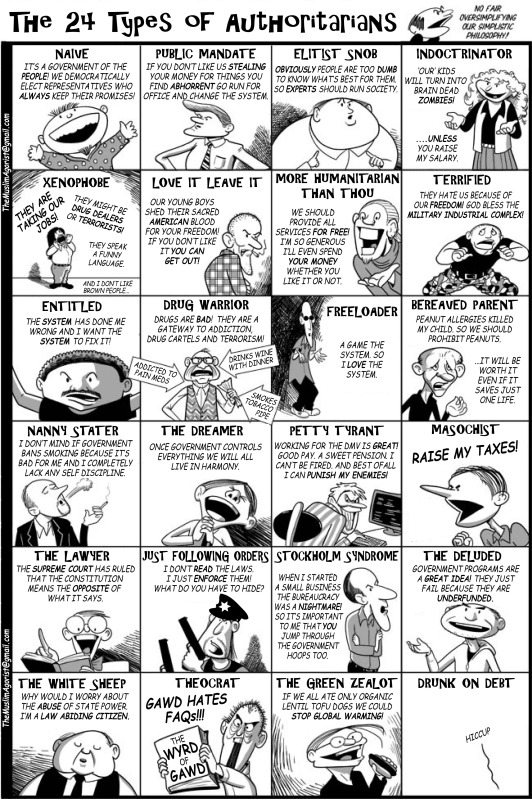
Remixed anti-Libertarian cartoon

Filed under: Government, Humour, Liberty — Tags: , , — Nicholas @ 09:15

A post at the Mises Economics blog remixes this anti-Libertarian cartoon from leftycartoons.com with equally amusing results:

June 11, 2010

What could possibly go wrong?

Filed under: Government, Liberty, Politics, Technology, USA — Tags: , , , — Nicholas @ 09:30

The US Senate is considering a bill that would give the President an internet “kill switch”. Funny how the one area most open to the widest possible spectrum of opinion and belief might be shut down at will, leaving only the regular propaganda outlets uncontrolled:

Under PCNAA, the federal government’s power to force private companies to comply with emergency decrees would become unusually broad. Any company on a list created by Homeland Security that also “relies on” the Internet, the telephone system, or any other component of the U.S. “information infrastructure” would be subject to command by a new National Center for Cybersecurity and Communications (NCCC) that would be created inside Homeland Security.

The only obvious limitation on the NCCC’s emergency power is one paragraph in the Lieberman bill that appears to have grown out of the Bush-era flap over warrantless wiretapping. That limitation says that the NCCC cannot order broadband providers or other companies to “conduct surveillance” of Americans unless it’s otherwise legally authorized.

Lieberman said Thursday that enactment of his bill needed to be a top congressional priority. “For all of its ‘user-friendly’ allure, the Internet can also be a dangerous place with electronic pipelines that run directly into everything from our personal bank accounts to key infrastructure to government and industrial secrets,” he said. “Our economic security, national security and public safety are now all at risk from new kinds of enemies — cyber-warriors, cyber-spies, cyber-terrorists and cyber-criminals.”

For those of you who think this is a super-cool neat idea (because Obama wouldn’t ever abuse this new rule), just try the mental image of George Bush or Sarah Palin with this kind of power. Still seem like a good notion?

June 9, 2010

QotD: The transition curve of higher taxes

Filed under: Britain, Economics, Government, Quotations — Tags: , , — Nicholas @ 17:21

The point where things start to go wrong seems to be about 50%. Above that people get serious about tax avoidance. The reason is that the payoff for avoiding tax grows hyperexponentially (x/1-x for 0 < x < 1). If your income tax rate is 10%, moving to Monaco would only give you 11% more income, which wouldn't even cover the extra cost. If it's 90%, you'd get ten times as much income. And at 98%, as it was briefly in Britain in the 70s, moving to Monaco would give you fifty times as much income. It seems quite likely that European governments of the 70s never drew this curve.

Paul Graham, “Why Startups Condense in America”, 2006-05

June 8, 2010

Questions of basic economics

Filed under: Economics, Education, Government, Politics, USA — Tags: , — Nicholas @ 17:25

Daniel Klein surveyed nearly 5,000 voting-age Americans on their basic comprehension of the political trade-offs on economic issues. He also asked them to identify themselves on the political spectrum. There were some interesting correlations:

Consider one of the economic propositions in the December 2008 poll: “Restrictions on housing development make housing less affordable.” People were asked if they: 1) strongly agree; 2) somewhat agree; 3) somewhat disagree; 4) strongly disagree; 5) are not sure.

Basic economics acknowledges that whatever redeeming features a restriction may have, it increases the cost of production and exchange, making goods and services less affordable. There may be exceptions to the general case, but they would be atypical.

Therefore, we counted as incorrect responses of “somewhat disagree” and “strongly disagree.” This treatment gives leeway for those who think the question is ambiguous or half right and half wrong. They would likely answer “not sure,” which we do not count as incorrect.

In this case, percentage of conservatives answering incorrectly was 22.3%, very conservatives 17.6% and libertarians 15.7%. But the percentage of progressive/very liberals answering incorrectly was 67.6% and liberals 60.1%. The pattern was not an anomaly.

[. . .]

The other questions were: 1) Mandatory licensing of professional services increases the prices of those services (unenlightened answer: disagree). 2) Overall, the standard of living is higher today than it was 30 years ago (unenlightened answer: disagree). 3) Rent control leads to housing shortages (unenlightened answer: disagree). 4) A company with the largest market share is a monopoly (unenlightened answer: agree). 5) Third World workers working for American companies overseas are being exploited (unenlightened answer: agree). 6) Free trade leads to unemployment (unenlightened answer: agree). 7) Minimum wage laws raise unemployment (unenlightened answer: disagree).

H/T to Ghost of a Flea.

June 1, 2010

This is a solution in search of a problem

Filed under: Cancon, Soccer — Tags: , , , , — Nicholas @ 12:09

The wise heads at the Gloucester Dragons Recreational Soccer league have decided to stamp out all the evils of competitive soccer once and for all:

In yet another nod to the protection of fledgling self-esteem, an Ottawa children’s soccer league has introduced a rule that says any team that wins a game by more than five points will lose by default.

The Gloucester Dragons Recreational Soccer league’s newly implemented edict is intended to dissuade a runaway game in favour of sportsmanship. The rule replaces its five-point mercy regulation, whereby any points scored beyond a five-point differential would not be registered.

Kevin Cappon said he first heard about the rule on May 20 — right after he had scored his team’s last allowable goal. His team then tossed the ball around for fear of losing the game.

I coached children’s soccer for more than a decade, and my teams sometimes lost by more than five goals (and occasionally won by similar margins). That’s inevitable, given that recreational soccer teams are not balanced for skill or experience, just for age level. Sometimes random selection puts together three or four very good players (who are not, for whatever reason, playing competitive soccer). Sometimes, otherwise good teams have bad games.

As a parent and as a coach, you know within the first few minutes of a game whether the kids are “in to the game” or if they’re just counting the minutes ’til the final whistle. There’s one thing worse than being beaten by an opposing team by lots of goals . . . and that’s the other team obviously, ostentatiously, not scoring the goals.

I’ve only had it happen against my team once, about six years ago. We were the last-place team in the division and we were facing one of the top teams. It was late in the season, and my kids didn’t have much hope to win, but were still trying. The other team had a higher proportion of bigger players, in addition to having a few really good players. We were down six goals by halftime, and although we were still playing hard, they were out-playing us.

If the second half had gone the same way, it would have been just a bad loss. But the other coach decided to “take it easy” on my team, and loudly and repeatedly directed his players not to score. My players were humiliated for another 30 minutes of “play”. I was surprised we didn’t have fights breaking out on the field: it was that bad.

Next week, I barely had enough players show up for the game. Ironically, even with the few we had, we won that game handily.

Update, June 11: The league has decided to modify the rule:

In response to the feedback, the league decided to get rid of the rule, which will be rescinded starting June 14.

In its place, a new mercy rule will be instituted under which a game will be called once one team has a lead of eight goals. Whichever team is ahead at that time will be credited with the win, Cale said. Teams can then play on if they wish for player development, wrote Cale.


May 28, 2010

Is it too late to cancel?

Chris Selley rounds up the (almost unanimous) pundits’ opinions about the billion-dollar-boondoggle-summit-set:

Is it too late to cancel the G8 and G20 summits?

The National Post‘s Don Martin for the win: “No amount of righteous government bluster about living in post-9/11 protection paranoia, last week’s bank firebombing in Ottawa or the precedent of hosting two back-to-back summits can explain how an $18-million security tab for the G20 in Pittsburgh last September, which involved 4,000 police, must balloon to a billion dollars in Toronto requiring 10,000 cops on the ground.” Yup. It’s outrageous, and the government seems very oddly . . . proud of it. We can hardly wait for the Auditor-General and Parliamentary Budget Officer to find out just where this money went. Especially in a climate where Canadians are thoroughly cheesed off about government spending in the first place, it’s not too much of a stretch to say this is the sort of issue that might bring down a government.

“A case of bureaucracy gone wild,” is Jeffrey Simpson‘s uncontroversial verdict in The Globe and Mail, “or planning gone crazy, of fear sinking itself into every official’s and security person’s heart.” Imagine what we could have bought with that $1-billion! A bunch more Canada Research Chairs, or a whack of “clean-energy projects,” or assistance for “cultural groups” — so sleepy — or, hey, now we’re talking, a massive injection of cash for infrastructure on aboriginal reserves. Or, as Simpson says, “whatever.” Almost literally anything would be better. We’d arguably be better off flushing the $1-billion down the john.

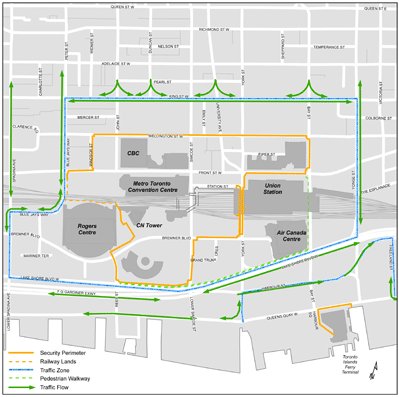
For those of you looking forward to suffering through the event, here’s the official map of the restricted area around the Metro Convention Centre:

The best advice — unless you’re hoping for a run-in with the police — is to avoid Toronto for that weekend (plus a few days in either direction).

May 17, 2010

QotD: Standing up for freedom

Filed under: Cancon, Liberty, Quotations, USA — Tags: , , , , — Nicholas @ 17:19

The Drug Wars in general, and the case of Marc Emery in particular, are a litmus test for those who say they believe in freedom. Everyone is for freedom, their own. It’s everyone else’s that makes them uncomfortable. It is easy to be for low taxes and light government regulation, when you run a business. It is easy to be for freedom of speech, when your livelihood depends on your keypad and fingers. It is easy enough to feel sympathetic for those whose freedom is taken away, when they are like you, when you can see yourself in their position. There, but by grace, go I. But this is not advocacy of freedom. It is nothing more than special pleading. The businessman who demands low taxes, and government subsidies, is not for freedom. The journalist who cries out when some powerful politician tries to silence him, then turns around and supports the Human Rights Tribunals, is not for freedom. The ordinary citizen, who is also the member of a minority ethnic group, who becomes indignant when the rights of his group are threatened, but shrugs his shoulders when those of other groups are trampled upon, he is not for freedom.

Publius, “Martyr to Freedom”, Gods of the Copybook Headings, 2010-05-17

Ontario: North America’s most weed-friendly jurisdiction

Filed under: Cancon, Environment — Tags: , , , — Nicholas @ 17:07

Having spent several hours this weekend gouging dandelion roots out of my lawn, I found this article to be timely, reminding me just who I have to thank for the back-ache I’m feeling today:

It’s been a year and a month since the McGuinty government introduced legislation banning the use of pesticides everywhere except golf courses and farms. As a result weeds, primarily dandelions, have become the dominant ground cover for lawns, parks, school yards and sports fields across the province.

It took a while for the full impact of this ban to become apparent. Last year, many lawns seemed to retain vestigial protection against weeds due to previous pesticide treatments. Now, however, the weeds are here to stay. Forever. Residential streetscapes have switched from green to yellow. To white and fluffy. And back to yellow again.

It’s important to remember this effort was entirely political. There’s no reliable scientific evidence that regulated pesticides, when used correctly, pose any threat to human health. Ignoring the work of the federal government’s Pest Management Regulatory Agency, McGuinty blithely declared a sweeping ban was necessary for “our childrens’ health.” No other jurisdiction in North America went so far in forbidding chemical weed control.

May 12, 2010

Welcome to the new British PM: “Dick Clameron”

Filed under: Britain, Government, Liberty, Politics — Tags: , , , , , — Nicholas @ 12:19

The Register‘s guide to the new British government:

The people have spoken — and party leaders Nick Clegg and David Cameron, henceforth to be known as Dick Clameron, have filled in the details.

A document released this afternoon reveals what Lib Dems and Tories have been talking about for the last four days, and what our new coalition overlords have in store for us over the next four years.

As with every political stitch-up, it’s going to be a Curate’s Egg, but there are some positive things being promised:

On civil liberties, there is much to please (most) Reg readers, including

A Freedom or Great Repeal Bill

* The scrapping of the ID card scheme, the National Identity register, the next generation of biometric passports and the Contact Point Database
* Outlawing the finger-printing of children at school without parental permission
* The extension of the scope of the Freedom of Information Act
* Adopting the protections of the Scottish model for the DNA database
* A review of libel laws to protect freedom of speech
* Safeguards against the misuse of anti-terrorism legislation
* Further regulation of CCTV
* An end to storing internet and email records without good reason
* A mechanism to prevent the proliferation of unnecessary new criminal offences

As with any coalition, there’s no guarantee that any of their announced plans will be carried through, but this list of improvements would be a very good thing.

The full text of the agreement between the Conservatives and the Liberal Democrats is at The Times. On reading through the document I’m actually rather pleasantly surprised: more of the sensible policies from each party appears to have slipped into the mix and rather fewer of the authoritarian (Tory) or redistributionist (Lib-Dem) ideas. Yes, it’s only a temporary agreement, but it’s better than I expected.

May 6, 2010

That “no fly list” keeps getting worse

Filed under: Bureaucracy, Liberty, USA — Tags: , , , , , — Nicholas @ 07:42

It’s not bad enough that the list is filled with names of people who should never have been added, and that it’s incredibly difficult to get off the list, but now it’s proposed to restrict the rights of those people even more:

Seems Bloomberg (and Keith Olbermann, more about that in a moment) are on board with the idea the government should be able to take away people’s rights simply by putting them on a list. I don’t think they’d like that idea if say, George W. Bush were president and it was a right they liked. Hey maybe people on the list shouldn’t be able to exercise their First Amendment rights and post to Youtube. Why no Youtube? It’s a jihadi recruitment tool. Surely that’s a danger too.

Now, I’m not a legal expert but I’m pretty sure the 14th Amendment mentions something about “due process” before taking away a person’s rights. Again, not a legal expert but I’m thinking the mere act of the government putting your name on a list is not in fact “due process”.

Notice that Bloomberg calls people on the list “suspects”. Again, I wasn’t aware that rights could be taken away from people simply because the government “suspects” you’ve done something wrong without any notice or opportunity for redress.

May 1, 2010

Call out the inspectors

Filed under: Bureaucracy, Health, USA — Tags: , , , , , — Nicholas @ 07:50

A busybody manages to create a lot of new jobs in San Diego County with one little phone call:

On Tuesday, we were surprised inspected by the San Diego County Department of Environmental Health. The two inspectors were sent out to visit our facilities (and other breweries in San Diego) as a patron had lodged a complaint about local tasting rooms. So I’d like to take a moment to thank that one person who felt it was important to lodge a complaint about brewery tasting rooms all over San Diego. Apparently they were concerned that we didn’t have a GIANT BLUE “A” on our cold boxes!

Thank you from the bottom of my heart.

You see, my fellow brewers and brewery owners are now having our hands forced (in the name of public safety) to go through the plan check and approval phase so that all of us can earn Health Permits for our tasting rooms.

What’s even better and the reason we’re all so thankful for your efforts today is that Port Brewing and The Lost Abbey has been issued a cease and desist for the sampling of beer in our tasting room. Because, as we all know, beer is a public nuisance laced with nasty things that can kill you!

I personally want to extend my gratitude to that consumer who felt this industry needed more regulatory agencies knocking on our doors. (The Health Department has never been interested in us before this call) Muchas Gracias Amigo (or Amiga) wherever you might be. There are breweries all over the City of San Diego who are now going to have to spend thousands of dollars on repairs that at best are “marginally justified.”

What follows is a long list of local businesses that will be seeing more income from San Diego breweries, as they all scramble to get into compliance with regulations they didn’t have to worry about until now. Before you consider this is a good thing, make sure you read up on the broken window fallacy (scroll down to paragraph 1.6).

« Newer PostsOlder Posts »

Powered by WordPress