
September 23, 2010
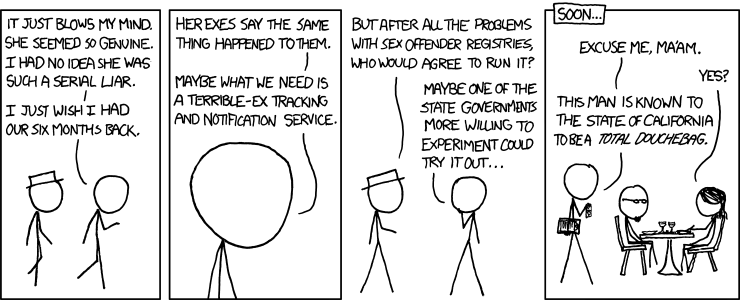
xkcd on a useful, but unlikely, public service agency
Comments Off on xkcd on a useful, but unlikely, public service agency
September 13, 2010
QotD: An alternate history we might have suffered
Thought experiment: imagine an Internet in which email and web addresses were centrally issued by government agencies, with heavy procedural requirements and no mobility — even, at a plausible extreme, political patronage footballs. What kind of society do you suppose eventually issues from that?
I was there in 1983 when a tiny group called the IETF prevented this from happening. I had a personal hand in preventing it and yes, I knew what the stakes were. Even then. So did everyone else in the room.
Thought experiment: imagine a future in which everybody takes for granted that all software outside a few toy projects in academia will be closed source controlled by managerial elites, computers are unhackable sealed boxes, communications protocols are opaque and locked down, and any use of computer-assisted technology requires layers of permissions that (in effect) mean digital information flow is utterly controlled by those with political and legal master keys. What kind of society do you suppose eventually issues from that?
Remember Trusted Computing and Palladium and crypto-export restrictions? RMS and Linus Torvalds and John Gilmore and I and a few score other hackers aborted that future before it was born, by using our leverage as engineers and mentors of engineers to change the ground of debate.
[. . .]
Did we bend the trajectory of society? Yes. Yes, I think we did. It wasn’t a given that we’d get a future in which any random person could have a website and a blog, you know. It wasn’t even given that we’d have an Internet that anyone could hook up to without permission. And I’m pretty sure that if the political class had understood the implications of what we were actually doing, they’d have insisted on more centralized control. ~For the public good and the children, don’t you know.~
So, yes, sometimes very tiny groups can change society in visibly large ways on a short timescale. I’ve been there when it was done; once or twice I’ve been the instrument of change myself.
Eric S. Raymond, “Engineering history”, Armed and Dangerous, 2010-09-12
Comments Off on QotD: An alternate history we might have suffered
September 10, 2010
Clarifying the clarification
It’s going to scroll off the front page soon, so I thought I’d better put in a link to this post about the ongoing confusion in Britain over photography and the right of the police to confiscate images or recordings in certain circumstances. I’ve updated the post twice with more information from The Register.
Comments Off on Clarifying the clarification
September 8, 2010
New Police policy: photography not illegal, but we’ll safeguard it for you
British police forces may be starting to accept that photography is legal in public spaces, but the Sussex police have come up with a new and sneaky way to get between photographers and their equipment:
According to a statement by Sussex Police: “Under Section 19 of the Police and Criminal Evidence Act [1984], an officer policing the event seized a video tape from a member of the public. Section 23 of the Act states that this can take place in ‘any place’, providing the officer is lawfully there and has reasonable grounds to believe it provides evidence of a criminal offence.
“The officer reasonably believed the tape contained evidence of a protester being assaulted by someone taking part in the march. It has been seized temporarily to ensure that evidence cannot be inadvertently lost or altered and will be returned, intact, to the owner as soon as possible.”
See, the very worst people to leave in charge of the camera or the storage media are the photographers: those people always take photos just to delete them, out of spite. The plod are totally within their rights to confiscate safeguard it, just to preserve the evidence.
Good luck on getting it back in working order, of course.
Update, 9 September: Jane Fae Ozimek updates the original story with a bit of additional information:
The police officer taking the film claimed legal justification under Section 19 of the Police and Criminal Evidence Act 1984, which permits the police to seize film or memory sticks discovered “under lawful search” and where there are reasonable grounds to believe they provide evidence of a criminal offence.
So far, so straightforward. However, under s.14 of the same legislation, police may not remove “special procedure material” of a journalistic nature without a warrant. The question therefore arises whether Williams’ filming efforts, even though he does not describe himself as “a journalist”, is nonetheless of a journalistic nature.
The waters are further muddied by a letter sent out just four days earlier by Andy Trotter, Chair of ACPO’s Media Advisory Group to all Chief Constables. In it, Mr Trotter reminds police chiefs that there are no powers to prevent the public from taking photographs in a public place. Significantly, he goes on: “We must acknowledge that citizen journalism is a feature of modern life.”
“Once an image has been recorded, the police have no power to delete or confiscate it without a court order.”
Update, 10 September: Clarifying the clarification to the declaration, or something. The Register is still on the case:
It would appear that at this point alarm bells started ringing at ACPO HQ, and late yesterday afternoon we received a further communication from ACPO. A spokeswoman told us: “We have clarified our guidance note to forces, however, as this does not affect the legal right of officers to seize photographic equipment in certain circumstances, such as during the course of a criminal investigation.
“While it is the job of police officers to be vigilant, to keep an eye out for any suspicious behavior and to act accordingly, we have been very clear in expressing our view that the taking of photographs is not normally a cause for concern. Whether s.19 PACE was used appropriately in the case in question would ultimately be a matter for Sussex.”
More to the point, Trotter’s freshly updated advice has been re-issued and now reads: “Once an image has been recorded the police have no power to delete it without a court order; this does not however restrict an officer’s power to seize items where they believe they contain evidence of criminal activity.”
For those readers too busy to play compare and contrast, the original guidance stated that the police have no power to confiscate recorded images, whereas the clarified guidance explains that they have. Clear?
Austrian economics? That’s crazy talk
As has been observed over and over again, we’re all Keynsians now. It’s usually meant in the economic sense, but perhaps it’s a reflection of Keynes’ other famous dictum: in the long run, we’re all dead. A different school of economics deserves a longer look:
Common sense is the crux of Austrian theory economics. Austrians look at how individuals act, not how “economies” or “nations” act or behave. Ludwig von Mises, the greatest Austrian thinker, and in my opinion the greatest economist, entitled his great work, Human Action not National Action. The Austrian School was referred to by the Germans as the Psychological School because its analysis started with individual action and how those actions would either attain or fail to attain the goals sought by individuals. In other words, it involves a lot of the “common sense” that guides human behavior most of the time. It’s comforting to know there’s a philosophy of economics that conforms to what human beings actually do rather than how some economist thinks we ought to behave.
Examples of economic Newspeak flourish, especially if you listen to President Obama’s economic team. My favorite example is the present conflict between consumer spending and consumer saving. Since the crash, consumers have cut back on spending and are increasing their savings. Most economists are saying this is bad for the economy; they urge us to spend, spend, spend to save the economy.
Actually, it’s just the opposite: Saving is the road to recovery.
It seems rather obvious that during a downturn of the economy it would be natural for people to save more and spend less: They’re uncertain about their jobs; the values of their homes have plummeted (about 30% since the peak in 2006); their stocks have declined, and their debts are high. Isn’t it common sense that people are doing the rational thing by saving? This is something our parents and grandparents understood well.
Comments Off on Austrian economics? That’s crazy talk
September 5, 2010
Craigslist surrenders, problem totally resolved
Dan Tynan recounts the glorious moral victory scored by unhappy state legislators against the final bastion of sin and decadence, Craigslist:
Bowing to pressure from 17 state attorneys general, Craigslist has begun censoring its Adult Services ads. Visitors coming to any of the 400+ Craigslist sites will encounter a big black CENSORED tab where Adult Services used to be.
As we all know, the scourge of prostitution had been entirely eradicated from modern society before Craigslist came along. And now that Adult Service ads are banned, you can expect all those hard-working gals to pack up their condoms and lubricants and enroll in secretarial school.
Alas, we fear that — despite the best intentions of 17 state attorneys general desperately trying to get re-elected — a ban on Adult Services won’t quite put an end to adult-oriented advertising on Craigslist.
Comments Off on Craigslist surrenders, problem totally resolved
September 4, 2010
When you’ve lost the Globe, you’ve lost the argument
At least it means you’ve lost the argument to keep the long-gun registry:
The Canadian Association of Chiefs of Police cannot be faulted for their recent unanimous vote in support of the national long-gun registry. Police will understandably always want as much information about those they investigate as they can lay their hands on. It is in the nature of their business. A national fingerprint registry of Canadians would no doubt also be seen as an aid to police work. But just because police chiefs would like a long-gun registry does not make it good public policy or a wise public expenditure.
[. . .]
If passed, a vote in Parliament on a Conservative MP’s bill to end the long-gun registry would not represent the end of gun control in Canada. Stringent and necessary requirements will remain in place for handguns, and restricted weapons such as automatic rifles. A process that already requires gun owners to be licensed before obtaining a firearm would remain, with safety and background checks required for gun owners. Rules for safe handling and storage of guns will remain in place. What will end is the cost, the red tape and the stigmatization of the “law-abiding duck hunters and farmers,” often cited by Prime Minister Stephen Harper. In the absence of any meaningful evidence of the long-gun registry’s efficacy, the program should be ended.
I can’t possibly emphasize how unlikely an editorial like this from the Globe and Mail would have seemed just days ago. Did we enter an alternate universe with that New Zealand earthquake? Does Spock not only have a beard, but also a Mohawk and body piercings?
Comments Off on When you’ve lost the Globe, you’ve lost the argument
August 27, 2010
Uncertain economic conditions mean weak growth
As I’ve argued before, the economy won’t start to really recover until the political situation stabilizes. In an article from earlier this year, Robert Higgs makes this point very well:
The explosion of the federal government’s size, scope, and power since the middle of 2008 has created enormous uncertainties in the minds of investors. New taxes and higher rates of old taxes; potentially large burdens of compliance with new energy regulations and mandatory health-care expenses; new, intrinsically arbitrary government oversight of so-called systemic risks associated with any type of business — all of these unsettling possibilities and others of substantial significance must give pause to anyone considering a long-term investment, because any one of them has the potential to turn what seems to be a profitable investment into a big loser. In short, investors now face regime uncertainty to an extent that few have experienced in this country — to find anything comparable, one must go back to the 1930s and 1940s, when the menacing clouds of the New Deal and World War II darkened the economic horizon.
Unless the government acts soon to resolve the looming uncertainties about the half-dozen greatest threats of policy harm to business, investors will remain for the most part on the sideline, protecting their wealth in cash hoards and low-risk, low-return, short-term investments and consuming wealth that might otherwise have been invested. If this situation continues for several years longer, the U.S. economy may well suffer its second “lost decade” for much the same reason that it suffered its first during the 1930s.
Unfortunately, the incentives for politicians are biased toward meddling, so don’t anticipate a slowing down of political “fixes” any time soon. If the US mid-term elections later this year return a “gridlocked” government, the economy might start to adapt to the current conditions and only then will any significant growth begin to take place. Given a relatively static political situation, businesses can at least make some plans based on their regulatory/legislative conditions as they are. Until some kind of stability is established, no businessperson in their right mind will take on major new plans: entrenching your existing business is far safer, while trying to do something radically different incurs too much risk. Risk, that is, over and above the “ordinary” risk of expansion, launching new products, or entering new markets.
Comments Off on Uncertain economic conditions mean weak growth
August 25, 2010
Bans on texting while driving have not measurably improved highway safety
This report should come as no real surprise to anyone who’s been paying attention:
The two biggest highway-safety issues right now, as far as Washington is concerned, are runaway Toyotas and distracted driving. But what if these aren’t the most important factors driving the nation’s annual highway death toll, which averages about 100 fatalities a day?
That’s the view of Adrian Lund, president of the Insurance Institute for Highway Safety, who says the U.S. Transportation Department, Congress and the media have gotten sidetracked by issues like texting while driving.
“There’s nothing rational about the way we set highway safety priorities,” Mr. Lund says in the Insurance Institute’s Aug. 21 “Status Report” newsletter.
Mr. Lund’s organization is the safety research and advocacy arm of the insurance industry. The IIHS has been critical of the government’s highway safety policies over the past few years, usually arguing that the government wasn’t moving fast enough to require better crash-prevention technology from auto makers.
Mr. Lund and the Insurance Institute also say recent laws banning motorists from using mobile phones behind the wheel don’t correlate with a significant reduction in accidents.
“You’d think from the media coverage, congressional hearings, and the U.S. Department of Transportation’s focus in recent months that separating drivers from their phones would all but solve the public-health problem of crash deaths and injuries,” he wrote. “It won’t.”
Comments Off on Bans on texting while driving have not measurably improved highway safety
“How can I buy the kind of food I want without supporting dangerous delusions?”
Eric S. Raymond has qualms over what some of his food preferences are actually going to support:
My mouth watered. “Oh Goddess,” I muttered in her direction, “it’s packaged crack for me . . .”
Ah, but then came the deadly disclaimers. “VEGAN GLUTEN-FREE NO GMOs NO TRANS FAT.” and “We support local and fair-trade sources growing certified organic, transitional, and pesticide-free products.” Aaaarrrgggh! Suddenly my lovely potential snack was covered with an evil-smelling miasma of diet-faddery, sanctimony, political correctness, and just plain nonsense. This, I find, is a chronic problem with buying “organic”.
So, what specific parts of those fluffy pro-foodie marketing terms bother ESR?
Take “no GMOs” for starters. That’s nonsense; it’s barely even possible. Humans have been genetically modifying since the invention of stockbreeding and agriculture; it’s what we do, and hatred of the accelerated version done in a genomics lab is pure Luddism. It’s vicious nonsense, too; poor third-worlders have already starved because their governments refused food aid that might contain GMOs.
[. . .]
Vegan? I’ve long since had it up to here with the tissue of ignorance and sanctimony that is evangelical veganism. Comparing our dentition and digestive tracts with those of cows, chimps, gorillas, and bears tells the story: humans are designed to be unspecialized omnivores, and the whole notion that vegetarianism is “natural” is so much piffle. It’s not even possible except at the near end of 4000 years of GMOing staple crops for higher calorie density, and even now you can’t be a vegan in a really cold climate (like, say, Tibet) because it’ll kill you.
[. . .]
Who could be against “fair trade”? Well, me . . . because the “fair trade” crowd pressures individual growers to join collectives with “managed” pricing. If you’re betting that this means lazy but politically adept growers with poor resource management and productivity at the expense of more efficient and harder-working ones, you’ve broken the code.
I share a lot of ESR’s concerns — and tastes. I don’t go out of my way to buy organic produce, but we do tend to buy local produce (in season) and our local butcher shop has been a great source of slightly-more-expensive but definitely-better-tasting meat and chicken. As I’ve mentioned in an earlier post, we have to pay more attention to food labels than most folks, but we’re looking for specific ingredients, not for the marketing bumph.
Comments Off on “How can I buy the kind of food I want without supporting dangerous delusions?”
August 24, 2010
“One of the few thrills of working as a bylaw enforcement officer is making people cry”
Ezra Levant looks at the bylaw enforcement regime in Clarington, just east of Toronto:
It’s not a lemonade crime wave that the brave city elders of Clarington are combating. It’s the menace of backyard barbecues.
Peter Jaworski has been holding backyard barbecues at his parents’ property there for 10 years. It’s a house in the country on 40 secluded acres. Once a year, Peter invites a few dozen of his friends to spend the weekend eating his mom’s cooking and camping next to the swimming hole. I’ve been there: it’s one part family reunion, one part picnic and one part political talk.
So clearly, the Jaworski family must be stopped.
First came the health department. They poked and prodded, and even took water samples. No one has ever got sick at a Jaworski barbecue — the opposite; everyone comes for the food — but the government ordered that no home cooking would be allowed. The Jaworskis complied with these costly and ridiculous demands, catering the whole weekend and serving only bottled water, at great cost.
But bureaucrats travel in packs. A local bylaw enforcement officer waited until the barbecue itself, and marched right onto the property — no search warrant needed! — and started peppering the guests with questions.
He wasn’t a health officer; he was a bylaw officer. Yet he demanded to know what the guests had for lunch. In the name of the law!
Armed with this devastating information, the officer charged Peter’s parents with running an illegal “commercial conference centre,” which carries a fine of up to $50,000. The officer, a burly, tattooed, six-foot-something man, told Peter’s mom to “be very careful.” She burst into tears.
Why do people get this insane idea that they should be able to do what they want on their own property? If we wanted that to happen, we wouldn’t appoint bylaw officers and arm them with bylaws to quash your fun and destroy your ability to enjoy your own property!
This scourge of backyard entertainment must be defeated, and Clarington is leading the way!
Comments Off on “One of the few thrills of working as a bylaw enforcement officer is making people cry”
August 10, 2010
Hey kids, are your parents uptight about you having sex?
That’s to be expected. They’re even more uptight about their parents having sex:
Over the last few months there have been numerous headlines about the sex lives of the over-50s — almost all negative. The HIV infection rate in this group has doubled, we are told. The numbers of over-50s suffering from chlamydia, syphilis, gonorrhoea, herpes and genital warts is growing. One doctor even wrote about his shock at treating the sexual diseases of what he called “cheerfully promiscuous” baby boomers.
It is true there are probably some people at middle age who mistakenly think their sexual partners are above suspicion, and others who did not enter their dating lives using condoms. Safer sex practices may not come so easily for them, yet the prominence and style of these articles underscores the sexual ageism that pervades our society. Where are the positive messages about the sex lives of people in their 50s, 60s, 70s and beyond? Do we ever hear the truth about how sexually vibrant they can be — without an attached warning about physical dangers and moral pitfalls? Sex among elders is surely one of the greatest sexual taboos in western society.
Comments Off on Hey kids, are your parents uptight about you having sex?
August 6, 2010
Tide turning on porn prosecutions in the UK?
After the US government’s prosecution of a pornography company owner collapsed last month, the British anti-porn campaign has suffered a setback. The Register reports on the case:
A stunning reversal for police and prosecution in North Wales may herald the beginning of the end for controversial legislation on possession of extreme porn.
The case, scheduled to be heard yesterday in Mold Crown Court, was the culmination of a year-long nightmare for Andrew Robert Holland, of Coedpoeth, Wrexham, Clwyd as the CPS declined to offer any evidence, and he left court a free man. The saga began last summer when, following a tip-off, police raided Holland’s home looking for indecent images of children. They found none, but they did find two clips, one involving a woman purportedly having sex with a tiger, and one which is believed to have depicted sado-masochistic activity between adults.
Despite Holland’s protests that he had no interest in the material, and that it had been sent to him unsolicited “as a joke”, he was charged with possessing extreme porn. In a first court appearance in January of this year, the “tiger porn” charge was dropped when prosecuting counsel discovered the volume control and at the end of the action heard the tiger turn to camera and say: “That beats doing adverts for a living.”
The laws are seriously skewed when the potential punishment for simple possession of “extreme” pornography approaches the actual punishment for serious violent crime.
August 5, 2010
US governments still finding this “free speech” thing annoying
If you support the notion of free speech, it is most important to support it during elections . . . but not everyone feels this way:
The Associated Press reports that California’s Fair Political Practices Commission (FPPC) is considering “how to regulate new forms of political activity such as appeals on a voter’s Facebook page or in a text message.
Not whether to regulate these new forms of political speech, but how.
The recommendations apparently include “requiring tweets and texts to link to a website that includes . . . full disclosures, although some people feel the disclosure should be in the text itself no matter how brief . . . .”
To paraphrase Chief Justice John Roberts, this is why we don’t leave our free speech rights in the hands of FPPC bureaucrats. To bureaucrats like those at the FPPC, the Federal Election Commission or their analogues, there seems to be no need to show any evidence that Twitter, Facebook or text messages actually pose any threat to the public. It is enough that they these new forms of low-cost media aren’t currently regulated, but could be. Their primary concern, apparently, is that the regulation of political speech be as comprehensive as possible.
Free speech can be a messy thing — but censorship is worse.
July 31, 2010
QotD: Take experts’ advice with a pinch of salt
More and more, the history of dietary guidelines that our public-health authorities promulgate resembles the Woody Allen comedy Sleeper, in which the main character, awaking from a centuries-long slumber, learns that every food we once thought bad for us is actually good, starting with steak and chocolate. But you wouldn’t know that from government experts’ increasing efforts to nudge us into their approved diets. In 2006, New York City passed the nation’s first ban on the use of trans fats by restaurants, and other cities followed suit, though trans fats constitute just 2 percent of Americans’ caloric intake. Now the Bloomberg administration is trying to push food manufacturers nationwide to reduce their use of salt — and the nutrition panel advising the FDA on the new guidelines similarly recommends reducing salt intake to a maximum of 1,500 milligrams daily (down from 2,300 a day previously). Yet Dr. Michael Alderman, a hypertension specialist at Albert Einstein College of Medicine, observed in the New York Times that because sodium is an essential component of our diets, the city’s effort amounts to a giant uncontrolled experiment with the public’s health that could have unintended consequences. And in 2006, Harvard Medical School professor Norman Hollenberg concluded that while some people benefit from reduced salt intake, the evidence “is too inconsistent and generally too small to mandate policy decisions at the community level.”
Steven Malanga, “Egg on Their Faces: Government dietary advice often proves disastrous”, City Journal, 2010-07


