Quotulatiousness

October 8, 2020

Fallen Flag — The Pacific Electric Railway

Filed under: Business, History, Railways, USA — Tags: , , , — Nicholas @ 03:00

This month’s Classic Trains featured fallen flag is southern California’s iconic Pacific Electric Railway Company, whose streetcars, interurbans, and buses served the vast area in and around Los Angeles and San Bernardino from 1901 until the passenger services were sold off in 1953. The electric service was converted to bus and the last electric rail line was discontinued in 1961. At its peak in the 1920s the “Red Cars” service was said to be the largest electric railway system in the entire world.

G. Mac Sebree covers the origins of the line in the late nineteenth century:

The story begins in 1895, when a line was completed from Los Angeles to Pasadena; a mere 10 years later, the system was virtually complete. To a great degree, PE was the brainchild of Henry Huntington, nephew of one of the Central Pacific’s “Big Four,” Collis P. Huntington. An active real-estate promoter, Henry needed the Big Red Cars and the transportation they provided to help sell lots and homes in the hinterlands.

His uncle’s Southern Pacific took control of the PE in 1911 in a deal that left the Los Angeles Railway, the narrow-gauge intracity system, in the nephew’s hands. The PE was built to standard gauge, and SP saw a brilliant future in freight for the interurban.

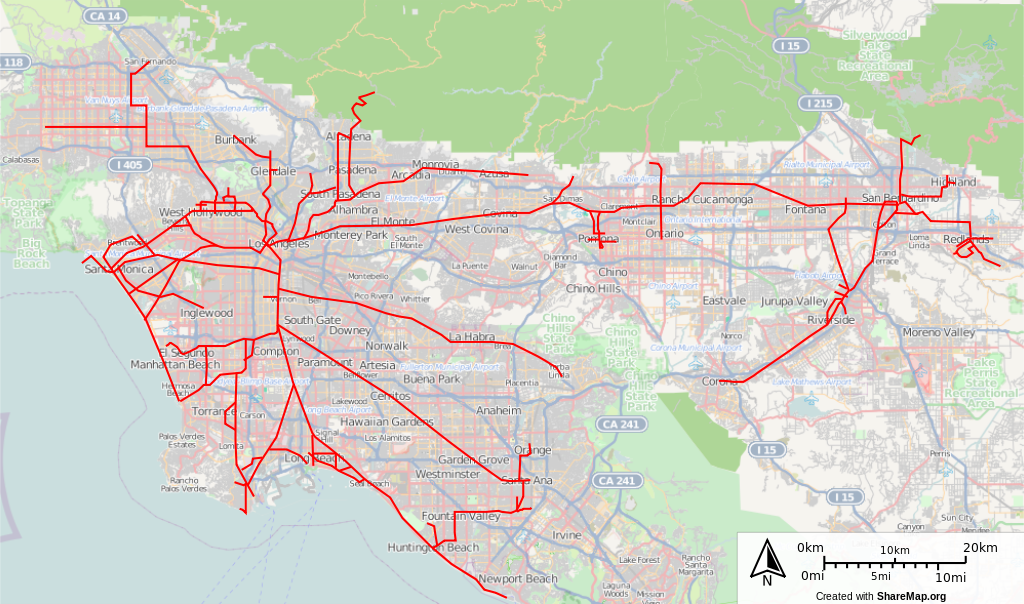
Pacific Electric route map.
Original data from http://sharemap.org/public/Los_Angeles_Pacific_Electric_Railways_(Red_Cars) via Wikimedia Commons.

Interurbans were not considered Class I railroads (or any other class — they were not “steam railroads”), but from the very start, PE was big business. The California Railroad Commission said the property was worth $100 million in Depression dollars. Atypically for an interurban, the system served as a gathering network for carload freight shipments from citrus groves, manufacturing plants, oil refineries, warehouses, and the harbor at San Pedro. The three line-haul railroads serving southern California — Santa Fe, Union Pacific, and especially SP — depended on the Pacific Electric to some degree.

Yet in its heyday, PE carried huge numbers of passengers. As late as 1953, 50 percent of its revenue came from riders — but absolutely none of its profit. An all-time list shows that PE operated 143 distinct passenger routes. Despite the so-called “Great Merger of 1911,” in which local and interurban services were supposedly separated, the heaviest PE passenger lines largely served the L.A. urban area. An example was the street-running L.A.–Hollywood–Beverly Hills line, in which two-car trains rumbled down Hollywood Boulevard at 10-minute intervals.

At one time or another, PE single-truck Birney cars plied local lines in Pasadena, Long Beach, Santa Monica, Redlands, Santa Ana, and San Pedro, although the 1920s were not far along before management sought to sell off or abandon these albatrosses.
After World War 2, the writing was on the wall for the Red Cars, as urban expansion and greatly increased car ownership cut at the economic basis for rail passenger service in southern California, especially as the new freeways were built.

After the war, though, things went downhill rapidly. As soon as buses were available, Pacific Electric began wholesale rail passenger-service abandonments. The new freeways were regarded as the rapid transit of the future. PE President Oscar Smith saw one possibility for saving rail service — if the state would pay. Just before the war, a short section of freeway between Hollywood and the San Fernando Valley had been built, with the PE tracks relocated to the center of the new highway.

Why not replicate this all over the basin? The PE would cooperate, but public officials turned a deaf ear, and that was that. Freight service, meanwhile, prospered, but by the mid-1950s, PE began replacing its electric locomotives and box motors with diesels (a few steam locomotives also had been used during the war). Over the years, PE rostered about 100 electric locomotives and at least 75 box motors — big business, indeed.

In 1953, PE sold its passenger service (four rail lines out of the 6th and Main station, two out of Subway Terminal, and many bus lines) to Metropolitan Coach Lines. The Metropolitan Transit Authority, first formed in 1951, bought MCL on March 3, 1958, and the end for electric passenger service came in 1961. SP continued the freight work with diesels, and merged PE away on August 13, 1965. Today under the Union Pacific shield, a good bit of the old PE freight lines remain in service, unique survivors, busier than ever.

A veteran Pacific Electric “Big Red Car” already lettered for successor Metropolitan Coach Lines in the 1950s.
Photo by Voogd075 via Wikimedia Commons.
September 27, 2020

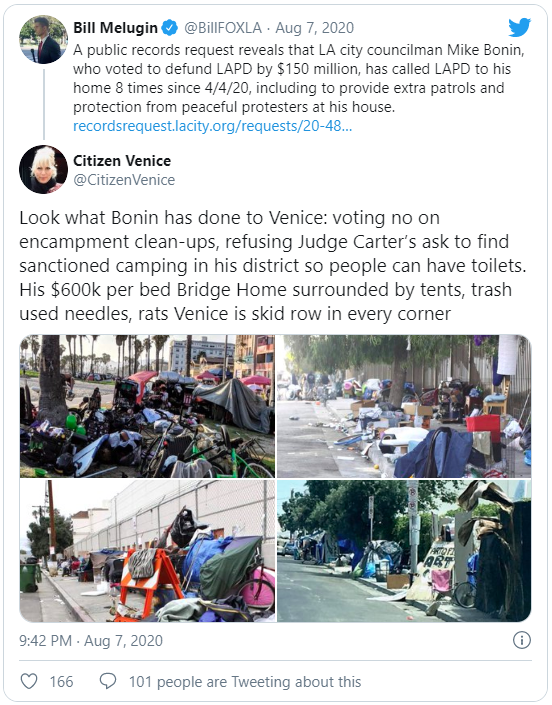
Homelessness in Los Angeles

In Quillette, Amy Alkon talks about the homeless crisis in LA, particularly her own immediate experience with a couple who “camped out” in front of her house.

Throughout [Los Angeles Mayor Eric] Garcetti’s seven years as Mayor, Los Angeles has witnessed a shocking explosion of homelessness. When he took office in 2013, the city had about 23,000 residents classified as homeless, two thirds of whom were unsheltered, living on the streets. By mid-2019, the figure was about 36,000, and three-quarters of them were living on the streets. Currently, there are 41,000 homeless. Garcetti’s pet plan to alleviate the homelessness crisis was the construction of permanent supportive housing. In 2016, compassionate voters approved $1.2 billion in new spending to fund these units. Three years later, only 72 apartments had been built, at a cost of about $690,000 apiece. Meanwhile, an El Salvador-based company has come up with nifty $4,000 3D-printed houses that look like great places to live and can be put up in a single day.

There’s also been a failure to admit that housing alone isn’t the solution. As urban-policy researcher Christopher Rufo explains, only about 20 percent of the homeless population are people down on their luck, who just need housing and a few supportive services to get back on their feet. Approximately 75 percent of the unsheltered homeless have substance-abuse disorders and 78 percent have mental-health disorders. Many have both.

As a bleeding-heart libertarian, I feel personally compelled to try to help people who are struggling. I do this by volunteering as a mediator, doing free dispute resolution to provide “access to justice” to people who can’t afford court. And since about 2009, I personally have given support to one of those easily helpable 20 percent Rufo refers to, getting him paying work and a bank account, and storing his stuff in my garage. He is a good man and a hard worker — sober for many years — who simply seems to have issues in the “front-office” organizational parts of his brain that help most of us get our act together to, say, pay bills on time. He just needs somebody to back him up on the bureaucratic aspects of life. I’m happy to say he now has a roof over his head. He lives in a motel across the country, and all I still do for him is provide him with a permanent address. I receive his Veterans Administration and Social Security mail at my house, which I mail to him with smiley faces and hearts on the envelopes, colored in with pink and orange highlighter.

This success story would not be possible for most homeless people, the nearly 80 percent who are addicted and/or mentally ill. As Rufo writes:

    Progressives have rallied around the slogan “Housing First,” but haven’t confronted the deeper question: And then what? It’s important to understand that, even on Skid Row, approximately 70 percent of the poor, addicted, disabled, and mentally ill residents are already housed in the neighborhood’s dense network of permanent supportive-housing units, nonprofit developments, emergency shelters, Section 8 apartments, and single room-occupancy hotels.

    When I toured the area with Richard Copley, a former homeless addict who now works security at the Midnight Mission, he explained that when he was in the depths of his methamphetamine addiction, he had a hotel room but chose to spend the night in his tent on the streets to be “closer to the action.” Copley now lives … at the Ward Hotel — which he calls the “mental ward” — where he says there are frequent fights and drugs are available at all hours of the day. The truth is that homelessness is not primarily a housing problem but a human one. Mayors, developers, and service providers want to cut ribbons in front of new residential towers, but the real challenge is not just to build new apartment units but to rebuild the human beings who live inside them.

The situation is especially tragic for those who are so mentally ill that they cannot take care of themselves, and are often a danger to both themselves and others. And I sometimes wonder which movie star or other famous person needs to be stabbed or bludgeoned before politicians take meaningful action.

It’s fashionable in progressive circles to demonize law enforcement, but Rufo explains that in 2006, then-L.A. police chief Bill Bratton implemented a “Broken Windows” policing initiative on Skid Row. It led to a 42 percent reduction in felonies, a 50 percent reduction in deaths by overdose, and a 75 percent reduction in homicides. The overall homeless population was reduced from 1,876 people to 700 — a huge success. Activists filed lawsuits and ran publicity campaigns, slowly killing Bratton’s program, on the grounds that it “criminalizes homelessness.” As a libertarian, I’m opposed to drug laws and forced behavior — but only to a point. It is not compassion to leave people to be victimized by criminals simply because they are unhoused, nor is leaving mentally and physically disabled people strewn across the streets amidst piles of garbage a form of freedom.

Mayor Garcetti, in lieu of admitting the real challenges — the first step to taking meaningful action to alleviate the homelessness crisis — has simply ignored the human results of his failed policy. As a result, whole sections of the city, including formerly livable streets in my beloved Venice, have been turned into Skid Row by the Sea.

December 16, 2019

Minnesota Vikings defeat Los Angeles Chargers 39-10 in turnover-fest

Filed under: Football — Tags: , , , , — Nicholas @ 03:00

The 9-4 Vikings headed to the west coast for a game against the San Diego Chargers at (I kid you not) Dignity Health Sports Park (I realize that naming rights can be lucrative, but that moniker hardly rolls off the tongue, does it?). It’s a very small stadium (less than 26,000 seats), and visiting teams have often had nearly as many of their fans attend games in Los Angeles as the Chargers manage. You could say that the Chargers don’t really play any home games, based on fan support at the stadium.

The first quarter was relatively uneventful, but the end of the second quarter more than made up for that lack of excitement, as both teams notched interceptions and then the Chargers lost the ball on a pass attempt that was picked up by Vikings backup defensive tackle Ifeadi Odenigbo and run back for a touchdown. Up to that point, the Chargers were looking to take the lead on a strong passing game (with Xavier Rhodes out, Mike Hughes was matched up against a taller receiver (Mike Williams at 6’3″) and Philip Rivers was able to get passes over Hughes for consistent early gains). Matthew Coller:

To open the second quarter, future Hall of Fame quarterback Philip Rivers put on a clinic in anticipation and accuracy, hitting receivers all over the field and converting third down after third down on a 10-play, 75-yard drive to put the Chargers up 10-9.

Along the way, Rivers hit Keenan Allen for 19 yards on third-and-7, and then Allen again for 14 on third-and-8 and delivered a beautiful ball to running back Austin Ekeler for a 27-yard wheel route. The drive was capped off on a fade to 6-foot-3 Mike Williams, who jumped over cornerback Mike Hughes for a touchdown.

At that point you would have put your money on a shootout — maybe one that favored the future Hall of Famer.

But the next three Chargers drives would prove the game to be exactly the opposite — partly because of their own wild incompetence but equally because of the Vikings’ pure talent on defense.

Over the past three-and-a-half months we have not seen the type of stingy defense that the Vikings have normally brought to the table under Mike Zimmer especially against the pass but they still have Pro Bowlers and record setters on the defensive side along with some players who have been developing for a few years. All of them showed up and defined Sunday’s win.

After the Vikings took back the lead with a field goal, Rivers felt like his hot streak on third down would continue. He flung a ball up in the air on third-and-17 and Harrison Smith jumped in for his 23rd career interception.

Giving the offense the ball near mid-field gave the Vikings a shot at picking up a two-score lead but instead Kirk Cousins threw an interception on a screen pass, putting the Chargers in a spot to take back the lead with under a minute remaining in the first half.

An LA touchdown would have been huge considering they were set to get the ball back to start the second half. That’s when Danielle Hunter — who is making his case for defensive MVP — slapped the ball out of Rivers’ hands. It was picked up by improving young D-linemen Ifeadi Odenigbo, who used Hunter as a lead blocker to take the ball back 56 yards for a touchdown.

Early in the third quarter, Vikings running back Dalvin Cook re-aggravated the shoulder injury he’d been nursing for the last few weeks and was declared out for the rest of the game. Backup Alexander Mattison was inactive with an ankle injury, so running back duties devolved to Mike Boone, Ameer Abdullah, and C.J. Ham, who were certainly up to the task — Boone scored his first and second NFL touchdowns. Overall, the teams were far better matched than the final score indicated, but no team can win when you turn the ball over as often as San Diego Los Angeles did (seven … which is six more than the Vikings gave up).

At the Daily Norseman, Ted Glover describes it as not so much a game as a “MurderDeathKill”:

When the Minnesota Vikings took the field against the Los Angeles Chargers, they knew that any realistic hope of winning the NFC North was all but gone, as the Green Bay Packers beat the Chicago Bears 21-13. They still controlled their playoff destiny with the sixth seed, but to ensure a playoff spot they needed to keep winning and keep one game clear of the other Los Angeles team, the Rams.

While the Vikings were taking care of business in Los Angeles, the other LA team was getting their collective ass handed to them by Dallas…

With the win, the Vikings move to 10-4 on the year and hold on to the sixth seed in the NFC. Combined with the Rams losing big to the Cowboys (they were down 34-7 in the fourth quarter at the time of this writing), Minnesota moves to the cusp of securing a playoff spot, as they would lead the Rams by two games with two to play, if that score holds up. A Minnesota win or a Los Angeles loss gives the Vikings the sixth seed, and they still have an outside chance at the NFC North with the Packers coming to town next week. The Rams will head to San Francisco.

In the longer-term view, we may have our future defensive co-ordinator picked out:

Andy Carlson offers his list of the game’s winners and looo-hooo-hooo-sers:

November 10, 2018

Remy: I Love L.A. (Parody)

Filed under: Humour, Media, USA — Tags: , , , — Nicholas @ 04:00

ReasonTV
Published on 9 Nov 2018

Remy updates the iconic Randy Newman anthem for 2018.

Parody written and performed by Remy
Camera and editing by Austin Bragg
Music tracks, background vocals, and mastering by Ben Karlstrom

Reason is the planet’s leading source of news, politics, and culture from a libertarian perspective. Go to reason.com for a point of view you won’t get from legacy media and old left-right opinion magazines.
—-
LYRICS

Nice fall day
In L.A. County
Sitting watching all the leaves change
Temperature dipping into the low 70’s
I dress accordingly

Roll down the window
Put down the top
You know what
Maybe roll it up on second thought
That guy was higher
Than the pension of a state employee

Can’t use straws here
No fois gras here
You can’t park here
Lots of laws here

Every toilet
Barely flushing
But the sun is shining all the time
Looks like another bill to pay

I love L.A.
We Love it

“Definitely recommend this crystal here.
Oh and this one is our number one seller.”
“What’s that for? Anxiety?”
“No. Typhus.”
“Ah”

Public school graduates
Can barely read
And when they try to park
Well this is what they see

Sweet regulations
Ain’t nothing like em nowhere

Beachside
We love it

Mountainside
We love it

Riverside
We…eh….

Fixed streets
We love em
We love L.A.

“Unfortunately I’ll have to fail your restaurant.
I found a rat in the kitchen.”
“That wasn’t a rat that was my, uh,
emotional support rodent.”
“Well why didn’t you say so!”

“And this right here is a great hemorrhoidal crystal.
Uranus is in retrograde.”

I love L.A.
We love it

November 20, 2017

Vikings beat Rams 24-7 after a slow start

Filed under: Football — Tags: , , , , — Nicholas @ 03:00

The Los Angeles Rams took the opening kickoff and marched down the field to score the opening touchdown of the game, and (probably like a lot of Vikings fans) I thought “Oh, no, here we go again.” Yet that was it for Rams scoring for the rest of the day. The Vikings were slow to start, but eventually reeled off 24 unanswered points (plus two missed field goals) to advance their record to 8-2 on the year.

(more…)

May 16, 2017

Terry Teachout remembers Dragnet

Filed under: History, Media, USA — Tags: , , , , — Nicholas @ 04:00

I vaguely remember watching Dragnet on TV, but the version I watched is apparently just a pale imitation of the original series:

If you’re fifty or older, you won’t need to be told the source of these half-recalled phrases: “The story you are about to see is true.” “This is the city.” “I carry a badge.” “My name’s Friday.” If you’re much younger than that, though, I doubt that you’ll remember Dragnet with any clarity. In the early days of network television, Dragnet was the most successful of all cops-and-robbers TV shows, as well as the most influential. It’s still influential — every episode of Law and Order bears its indelible stamp — but TV has since moved in flashier directions, and I doubt that the narrative conventions brought into being by Jack Webb, the director, producer, and star of Dragnet, will remain conventional for much longer.


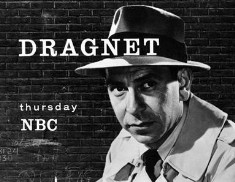
For baby-boom TV viewers, Dragnet is both iconic and ironic. The version of the show that ran on NBC from 1967 to 1970, in which Webb was partnered by Harry Morgan, was an exercise in unintended self-parody, full of hippy-dippy druggies and the earnest cops who locked them up and threw away the key. A few of the episodes remain effective in their quaint way, but most are embarrassingly stiff. Part of the problem was that Sergeant Joe Friday, Webb’s character, was the squarest of squares, and it was already chic to smirk at such straight-arrow types by the time I reached adolescence. My father watched Dragnet religiously, though, so I did, too, little knowing that what I was seeing each week was a recycled, watered-down simulacrum of the real thing.

The real Dragnet was the black-and-white version that aired from 1951 to 1959. That series, in which Webb was partnered by Ben Alexander, was pulled out of syndication long ago and has never been legitimately reissued on DVD, nor is any “official” version, so far as I know, currently in the works. Fortunately, a few dozen episodes were inadvertently allowed to go out of copyright, and it’s easy to track down copies of them. […]

Like the later color version, the Dragnet of the Fifties was a no-nonsense half-hour police-procedural drama that sought to show how ordinary cops catch ordinary crooks. The scripts, most of which were written by James E. Moser, combined straightforwardly linear plotting (“It was Wednesday, October 6. It was sultry in Los Angeles. We were working the day watch out of homicide”) with clipped dialogue spoken in a near-monotone, all accompanied by the taut, dissonant music of Walter Schumann. Then and later, most of the shots were screen-filling talking-head closeups, a plain-Jane style of cinematography that to this day is identified with Jack Webb.

The difference was that in the Fifties, Joe Friday and Frank Smith, his chubby, mildly eccentric partner, stalked their prey in a monochromatically drab Los Angeles that seemed to consist only of shabby storefronts and bleak-looking rooms in dollar-a-night hotels. Nobody was pretty in Dragnet, and almost nobody was happy. The atmosphere was that of film noir minus the kinks — the same stark visual grammar, only cleansed of the sour tang of corruption in high places. But even without the Chandleresque pessimism that gave film noir its seedy savor, Dragnet was still rough stuff, more uncompromising than anything that had hitherto been seen on TV. In 1954 Time called the series “a sort of peephole into a grim new world. The bums, priests, con men, whining housewives, burglars, waitresses, children and bewildered ordinary citizens who people Dragnet seem as sorrowfully genuine as old pistols in a hockshop window.”

September 2, 2016

Vikings beat L.A. Rams 27-25 in final preseason game

Filed under: Football — Tags: , , — Nicholas @ 11:45

In a game where neither team played their starters for any significant stretch, the key to the result was turnovers, with the Vikings scoring most of their points as a result of Ram turnovers. Unsurprisingly, the game wasn’t telecast outside the two teams’ local areas, so I followed the play on Twitter.

Given the quarterback situation in Minnesota and the need to ensure that 36-year-old Shaun Hill was healthy for the regular season, the starter for the Vikings was Joel Stave and he was backed up by recently waived-then-re-signed Brad Sorenson. C.J. Ham and Jhurell Pressley got most of the work at running back, and the starting wide receivers were Jarius Wright and rookie Laquon Treadwell.

The Rams opened the scoring with an early touchdown that the Vikings didn’t answer until nearly the two-minute warning with a Blair Walsh field goal. On special teams, safety Jayron Kearse recovered a muffed punt that put the Vikings on the Rams’ 19 yard line. Midway through the next series, Joel Stave left the game with a reported hand injury (although he was also put through the NFL’s concussion protocol) and was replaced by Sorenson.

On the next series, Stephen Weatherly recovered a dropped snap by Rams quarterback Jared Goff to give the Vikings great field position near the goal line. Unable to punch the ball in, the Vikings settled for a second Walsh field goal to move the score to 7-6 before the half.

On the next series, Toby Johnson dived to intercept a tipped Jared Goff pass and puts the Vikings back in potential scoring position.

Jhurell Pressley takes a Sorenson pass 28 yards for the Vikings’ first touchdown of the night.

The Rams opened the scoring in the second half with a field goal to cut the Vikings lead to 13-10, but on the ensuing kickoff, Jhurell Pressley put on a great effort to return the kick 106 yards for a touchdown. He may not make the 53-man roster but he’s almost certainly going to make the practice squad (or some other team’s roster) based on his work tonight.

On yet another special teams play, Jayron Kearse hit the Rams’ punt returner forcing a fumble that tight end David Morgan was able to recover on the 6-yard line. C.J. Ham ran the ball in for the final Vikings score of the night. I almost shut down my Twitter feed and went to bed at this point, but the Rams did their best to make the game interesting, scoring a touchdown and two-point conversion to move the score to 27-18 in the fourth quarter. They added another touchdown with less than two minutes in the game, but that was their last chance to score. Given that the Rams gave up five turnovers, the score was amazingly close at the end.

December 5, 2015

Los Angeles comes up with a new way to use technology to make life worse

Filed under: Government, Law, USA — Tags: , — Nicholas @ 02:00

Nick Selby on a new Los Angeles initiative to come up with the worst possible use of technology:

… the monumentally over-reaching idea posed by Nury Martinez, a 6th district Los Angeles city councilwoman, to access a database of license plates captured in certain places around the city, translate these license plates to obtain the name and address of each owner, and send to that owner a letter explaining that the vehicle was seen in, “an area known for prostitution.”

Councilwoman Martinez feels that prostitution is not a “victimless” crime, and that by discouraging johns, the incidence of the crime can be reduced. Martinez told CBS Los Angeles, “If you aren’t soliciting, you have no reason to worry about finding one of these letters in your mailbox. But if you are, these letters will discourage you from returning. Soliciting for sex in our neighborhoods is not OK.”

The Los Angeles City Council voted Wednesday to ask the office of the City Attorney for their help implementing the plan.

Have Ms. Martinez and the Los Angeles City Council taken leave of their senses? This scheme makes, literally, a state issue out of legal travel to arbitrary places deemed by some — but not by a court, and without due process — to be “related” to crime in general, not to any specific crime.

There isn’t “potential” for abuse here, this is a legislated abuse of technology that is already controversial when it’s used by police for the purpose of seeking stolen vehicles, tracking down fugitives and solving specific crimes.

June 3, 2015

The great Los Angeles minimum wage experiment

Filed under: Business, Economics, USA — Tags: , , , , , — Nicholas @ 02:00

I missed this post a few weeks back from Kevin Drum at Mother Jones, pointing out that we won’t really know the full impact of the Los Angeles experiment with significantly higher minimum wages:

So my near neighbor of Los Angeles is poised to raise the minimum wage to $15. How should we think of that?

Personally, I’m thrilled. Not because I think it’s a slam-dunk good idea, but because along with Seattle and San Francisco it will give us a great set of natural experiments to figure out what happens when you raise the minimum wage a lot. We can argue all we want; we can extrapolate from other countries; and we can create complex Greek-letter models to predict the effects — but we can’t know until someone actually does it.

So what do I think will happen? Several things:

In the tradeable sector, such as clothing piece work and agriculture, the results are very likely to be devastating. Luckily, LA doesn’t have much agriculture left, but it does have a lot of apparel manufacture. That could evaporate completely (worst case) or perhaps migrate just across the borders into Ventura, San Bernardino, and other nearby counties. Heavier manufacturing will likely be unaffected since most workers already make more than $15.

In the food sector, people still need to eat, and they need to eat in Los Angeles. So there will probably be little damage there from outside competition. However, the higher minimum wage will almost certainly increase the incentive for fast food places to try to automate further and cut back on jobs. How many jobs this will affect is entirely speculative at this point.

Other service industries, including everything from nail salons to education to health care will probably not be affected much. They pretty much have to stay in place in order to serve their local clientele, so they’ll just raise wages and pass the higher prices on to customers.

Likewise, retail, real estate, the arts, and professional services probably won’t be affected too much. Retail has no place to go (though they might be able to automate some jobs away) while the others mostly pay more than $15 already. The hotel industry, by contrast, could easily become less competitive for convention business and end up shedding jobs.

While I’m certainly in favour of people being able to afford to live on their base income, I’m afraid that this experiment is going to hurt a lot of already at-risk poor people who will have few other options if their jobs go away. I’m especially amused that LA-area union reps are now reported to be pushing to exempt the businesses where their members work (so that unions will have an effective monopoly on low-wage jobs because non-unionized companies would have to pay a higher wage). That, after putting all their organizational muscle behind getting the minimum wage raised in the first place. That’s a high grade of cynicism.

March 25, 2015

Reason.tv – Sports Stadiums Are Bad Public Investments. So Why Are Cities Still Paying for Them?

Filed under: Business, Economics, Government, Sports — Tags: , , , , , — Nicholas @ 04:00

Published on 17 Mar 2015

“Anybody that drives around Southern California can tell you the infrastructure is falling apart,” says Joel Kotkin, a fellow of urban studies at Chapman University and author of the book The New Class Conflict. “And then we’re going to give money so a bunch of corporate executives can watch a football game eight times a year? It’s absurd.”

When the Inglewood City Council voted unanimously to approve a $1.8 billion stadium plan on February 24th, hundreds of football fans in attendance cheered for the prospect of a team finally returning to the Los Angeles area.

On it’s face, the deal for the city of Inglewood is unprecedented — Rams owner Stan Kroenke has agreed to finance construction of the stadium entirely with private funds. The deal makes the stadium one of the most expensive facilities ever built and is an oddity in the sports world, where most stadiums require millions in public dollars to be constructed.

And while the city still waits to hear if it will indeed inherit an NFL team, the progress on the new privately-funded Inglewood stadium has set off a bidding war between other cities that are offering up millions in public subsidies to keep (or attract) pro-sports franchises to their area.

St. Louis has proposed a billion dollar waterfront stadium financed with $400 million in tax money to keep the Rams in Missouri. And the San Diego Chargers and Oakland Raiders have unveiled a plan to turn a former landfill in Carson, California, into a $1.7 billion stadium to keep the Rams from encroaching on their turf. While full details of the plan have yet to be released, it’s been reported that the financing would be similar to the San Francisco 49er’s deal in Santa Clara, which saw the team receive $621 million in construction loans paid for with public money.

Even the fiscally conservative Scott Walker is not immune to the stadium spending craze. The Wisconsin governor wants to allocate $220 million in public bonds to keep the Milwaukee Bucks basketball franchise in the area. Walker has dubbed the financing scheme as the “Pay Their Way” plan, but professional sports teams rarely pay their fair share when it comes to stadiums and instead use public money to generate private revenue.

Pacific Standard magazine has reported that in the last 20 years, the U.S. has opened 101 new sports facilities and stadium finance experts say that almost all of them have received public funding totaling billions of dollars. Politicians generally rationalize this expense by stating that stadiums will generate economic revenue and job opportunities for the city, but Kotkin says those promises are rarely realized.

“I think this is sort of a fanciful approach towards economic development instead of building really good jobs. And except for the construction, the jobs created by stadia are generally low wage occasional work.”

“The important thing that we’ve forgotten is ‘What is the purpose of a government?'” asks Kotkin. “Cities instead of fixing their schools, fixing their roads or fixing their sewers or fixing their water are putting money into ephemera like stadia. And in the end, what’s more important?”

June 11, 2014

LA court delivers a major blow against tenure for teachers in California

Filed under: Bureaucracy, Education, Law, USA — Tags: , , , — Nicholas @ 07:14

The Los Angeles Times on yesterday’s decision:

Teachers union officials denounced a ruling Tuesday by a Los Angeles County Superior Court judge deeming job protections for teachers in California as unconstitutional as a misguided attack on teachers and students.

The ruling represents a major loss for the unions and a groundbreaking win by attorneys who argued that state laws governing teacher layoffs, tenure and dismissals harm students by making them more likely to suffer from grossly ineffective instruction.

If the preliminary ruling becomes final and is upheld, the effect will be sweeping across California and possibly the nation.

Judge Rolf M. Treu ruled, in effect, that it was too easy for teachers to gain strong job protections and too difficult to dismiss those who performed poorly in the classroom. If the ruling stands, California will have to craft new rules for hiring and firing teachers.

[…]

The Silicon Valley-based group Students Matter brought the lawsuit on behalf of nine students, contending that five laws hindered the removal of ineffective teachers.

The result, attorneys for the plaintiffs said, is a workforce with thousands of “grossly ineffective” teachers, disproportionately hurting low-income and minority students. As a result, the suit argued, the laws violated California’s constitution, which provides for equal educational opportunity.

The laws were defended by the state of California and the two largest teacher unions — the California Teachers Assn. and the California Federation of Teachers. Their attorneys countered that it is not the laws but poor management that is to blame for districts’ failing to root out incompetent instructors.

March 13, 2013

Follow-up on the LAPD’s pickup truck shooting spree

Filed under: Law, Liberty, USA — Tags: , , , , , — Nicholas @ 12:16

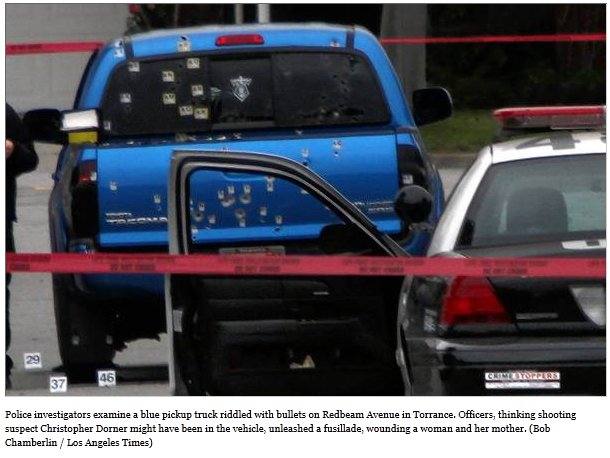
Remember this gem of a story from last month? At the time, Jon (my former virtual landlord) strongly suggested I park my Toyota Tacoma in the garage just to avoid being targeted by random police “marksmen”.

Pickup shooting by LAPD

Here’s the follow-up that only makes the story that much more ridiculous:

“LAPD and Galpin Ford wanted [the women] to pose for a photo opportunity and pay income tax on the truck,” the NBC report reads, citing Jonas. “The women no longer want the truck after they were told they needed to fill out a 1099 form for the donation.”

For those of you who don’t know that a 1099 form is, it’s for tax form for “miscellaneous income.”

“You tried to murder the woman, now you’re telling her she can’t have a four-wheel drive, you’re telling her she can’t sell it and you’ve got to be taxed on it?” Jonas said. “How would anyone react to that?”

“Jonas plans on filing a government claim, which is a precursor to any lawsuit filed against a government agency. He said he felt the truck was being touted as a ‘reward or prize’ instead of a sincere gesture by the LAPD,” NBC 4 News notes:

I can’t improve on the comment Jon sent along with this link: “At this rate, I am surprised that the LAPD has not tried to bill the women for the 100+ rounds of ammunition.”

January 5, 2013

LA terminates luxury option for electric car owners

Filed under: Environment, Technology, USA — Tags: , , , , , — Nicholas @ 12:43

It’s telling that one of the folks quoted in this article clearly identified the free parking at the airport as a primary reason for buying an electric vehicle:

On a recent morning, Jack Luu parked his plug-in Toyota Prius in one of the most expensive lots at Los Angeles International Airport before flying off to a film shoot in Canada. The lot, where Mr. Luu leaves his car as many as 10 times a month for business trips, normally charges $30 a day.

But when Mr. Luu returned home three weeks later, he drove out, as usual, without paying a dime.

“That was a huge reason why I bought the car in the first place,” says the 35-year-old Santa Monica, Calif., postproduction company executive, whose car qualifies for free parking for up to a month at a time in two of LAX’s most convenient—and costly—short-term lots.

Other than that, he says his ride is “expensive, underpowered and not really all that green,” because it can run just 12 miles on electricity before switching to gas.

For years, LAX has offered electric-vehicle owners one of the most generous incentives of its kind in the country: free parking for 30 days in two of its terminal lots, which contain, altogether, 38 charging stations. The rule was meant to encourage people to buy greener cars, but lately it has turned the lots into a mob scene, with some electric-vehicle drivers circling the stations desperately for electricity or running extension cords while others hog the charging spaces for weeks at a time.

December 6, 2012

“Yeah, uhhh … I don’t think driving around with 20 pounds of drugs in my car is really a good idea”

Filed under: Law, USA — Tags: , , — Nicholas @ 12:23

What do you do when you find $175,000-worth of drugs stashed on your property?

I am standing chest-deep in a dank, muddy concrete-lined hole in Silver Lake, staring eye-level into a duffel bag full of high-grade drugs.

It smells strongly of marijuana — despite the fact that someone sealed it tightly into jars, Ziplocs and professionally vacuum-sealed pouches before THEY HID IT IN MY BACK YARD.

I am starting to panic.

I already did the full Tex-Avery-wolf AOOOOGAH! upon discovering the mammoth sackful of dope — estimated to be worth somewhere north of $175,000. My jaw already dropped. My eyes already bugged out. Now my heart is thumping my gullet. Breathing is getting iffy.

I try to speak. I think my exact words to the solar-panel technician standing equally open-mouthed next to me are something to the effect of “Holy. Fucking. SHIT!”

H/T to Matt Welch:

September 18, 2012

Jaywalking in LA County: a capital offence

Filed under: Law, Liberty, USA — Tags: , , , — Nicholas @ 11:06

A very disturbing story at the Simple Justice blog:

Jonathan Cuevas was a jaywalker. That’s right, a jaywalker. And jaywalking is an offense. This means that those who are of the view that the simple solution to whatever stems from the commission of an offense is, by definition, justified. After all, Cuevas chose to jaywalk. He chose to commit the offense. So he has no one to blame for his killing than himself.

And if this is what you think, then you have lost any shred of humanity.

[. . .]

The gun is a red herring. Notwithstanding the fact that the video fails to show anything remotely suggesting that Cuevas pulled it on the unnamed deputy, and despite the absurdity of such a claim, he was shot, again and again, in the back as he ran away. There is no theory to explain an officer in fear from a person’s back as he ran away. This, of course, didn’t stop the police from asserting with absolute certainty that it happened.

Yet, there is not only a lack of focus on what is clearly shown in the video, but the possibility that it was wrong to execute Jonathan Cuevas for the heinous offense of jaywalking was dismissed because the police and district attorney “investigated.” After all, if they investigated and decided that this was a righteous shoot, what more is there to say?

« Newer PostsOlder Posts »

Powered by WordPress