
The Korean War by Indy Neidell
Published 9 Jul 2024American troops have arrived in Korea and engage the KPA — the forces of the North — in the field this week for the first time. It does not go well for them. In fact, it’s hard to imagine it going worse. The Americans are outnumbered and outgunned and are routed. In fact, the KPA are advancing all over the country, though they are taking heavy casualties themselves.
(more…)
July 10, 2024
The Korean War – Never Fear, MacArthur’s Here! – Week 003 – July 9, 1950
Comments Off on The Korean War – Never Fear, MacArthur’s Here! – Week 003 – July 9, 1950
July 3, 2024
The Korean War Week 002 – The Fall of Seoul – July 2, 1950
The Korean War by Indy Neidell
Published 2 Jul 2024The North Korean forces are advancing all over, and this week they take Seoul, the South’s capital city, after just a few days of the war. There is another tragedy for the South when the Han River Bridge is blown while thousands of people are crossing it, resulting in hundreds of civilian deaths. The world responds to the invasion — condemning it everywhere, and the Americans decide to send in ground forces to help the South.
(more…)
Comments Off on The Korean War Week 002 – The Fall of Seoul – July 2, 1950
June 26, 2024
The Korean War Begins – Week 1 – June 25, 1950
The Korean War by Indy Neidell
Published 25 Jun 2024Despite the fact that there have been clear signs that they might soon invade South Korea, when the North actually does in force on June 25th, 1950, it comes as a complete shock to the world. But is this a full invasion, or just cross border raids such as there were in 1949? And is there something more behind this? Stalin’s Soviets? Mao’s Chinese? And how will the world react? Find out this week as our week by week coverage of the war begins!
(more…)
Comments Off on The Korean War Begins – Week 1 – June 25, 1950
May 21, 2024
“Modern pop music is to the West what speeches by [Dear Leader] are to North Korea, namely inescapable”
Poor Theodore Dalrymple is finding that everyone around him seems to be actively imposing their questionable music choices on him no matter how he tries to decline the offer:
Whenever I try to escape pop music relayed in public places at high volume — which is often, though considerably less often with success — the thought comes into my mind that the harnessing of electricity was a disaster, if not for humanity, at least for civilization if good taste be part of that much-derided entity.
Modern pop music is to the West what speeches by North Korea’s greatest scientist, composer of operas, huntsman, industrial chemist, engineer, poet, agronomist, philosopher, economist, military strategist — in short, its present leader — are to North Korea, namely inescapable. If I were an absolute dictator, which fortunately for me among others I am not, I would forbid the public relay of such music under pain of death by deprivation of sleep.
Unnecessary noise should be regarded in the same way as cigarette smoke now is, a pollutant that infringes the rights of anyone subjected involuntarily to it. My sensitivity to cigarette smoke, incidentally, is now very acute: The other day, in the open street, there was a man sitting on a low wall smoking a cigarette a few yards from me, and I began to cough. This was not merely a psychosomatic reaction; I began to cough before I saw the source of what caused me to do so.
I must have grown up in a world that smelt like an ashtray, so great was the proportion of the population that smoked, but I did not notice it, any more than I noticed the air itself. Every curtain, every carpet, must have been saturated with such smoke, now stale, to say nothing of the fug created by cigarettes under current use. I remember the days when you could smoke on trains and airplanes. At the back of the cabin of the planes were the seats for smokers, not separated off from the rest of the fuselage, and if you were a nonsmoker such as I, you were often (so it seemed) allocated the row just in front of the first of the smokers’ seats, such that you might as well have been in the midst of them. Cigarette smoke on flights was as inescapable as crying babies now seem to be.
February 16, 2024
Regional Power: North Korea
Army University Press
Published Feb 13, 2024This film examines the current political and military situation in North Korea. Subject matter experts discuss Korean history, DPRK current affairs, and KPA military doctrine. Topics include the rise of the Kim family to political leadership of the DPRK, its influence in the region, and how the U.S. works in partnership with the Republic of Korea.
Comments Off on Regional Power: North Korea
February 11, 2024
QotD: Learning and re-learning the bloody art of war
The values composing civilization and the values required to protect it are normally at war. Civilization values sophistication, but in an armed force sophistication is a millstone.
The Athenian commanders before Salamis, it is reported, talked of art and of the Acropolis, in sight of the Persian fleet. Beside their own campfires, the Greek hoplites chewed garlic and joked about girls.
Without its tough spearmen, Hellenic culture would have had nothing to give the world. It would not have lasted long enough. When Greek culture became so sophisticated that its common men would no longer fight to the death, as at Thermopylae, but became devious and clever, a horde of Roman farm boys overran them.
The time came when the descendants of Macedonians who had slaughtered Asians till they could no longer lift their arms went pale and sick at the sight of the havoc wrought by the Roman gladius Hispanicus as it carved its way toward Hellas.
The Eighth Army, put to the fire and blooded, rose from its own ashes in a killing mood. They went north, and as they went they destroyed Chinese and what was left of the towns and cities of Korea. They did not grow sick at the sight of blood.
By 7 March they stood on the Han. They went through Seoul, and reduced it block by block. When they were finished, the massive railway station had no roof, and thousands of buildings were pocked by tank fire. Of Seoul’s original more than a million souls, less than two hundred thousand still lived in the ruins. In many of the lesser cities of Korea, built of wood and wattle, only the foundation, and the vault, of the old Japanese bank remained.
The people of Chosun, not Americans or Chinese, continued to lose the war.
At the end of March the Eighth Army was across the parallel.
General Ridgway wrote, “The American flag never flew over a prouder, tougher, more spirited and more competent fighting force than was Eighth Army as it drove north …”
Ridgway had no great interest in real estate. He did not strike for cities and towns, but to kill Chinese. The Eighth Army killed them, by the thousands, as its infantry drove them from the hills and as its air caught them fleeing in the valleys.
By April 1951, the Eighth Army had again proved Erwin Rommel’s assertion that American troops knew less but learned faster than any fighting men he had opposed. The Chinese seemed not to learn at all, as they repeated Chipyong-ni again and again.
Americans had learned, and learned well. The tragedy of American arms, however, is that having an imperfect sense of history Americans sometimes forget as quickly as they learn.
T.R. Fehrenbach, This Kind of War: A Study in Unpreparedness, 1963.
Comments Off on QotD: Learning and re-learning the bloody art of war
January 23, 2024
The Korean War: The First Year
Army University Press
Published Jan 22, 2024Created for the Department of Command and Leadership and the Department of Military History at the US Army Command and General Staff College, The Korean War: The First Year is a short documentary focused on the major events of the Forgotten War. Designed to address the complex strategic and operational actions from June 1950 – June 1951, the film answers seven key questions that can be found in the timestamps below. Major events such as the initial North Korean invasion, the defense of the Pusan Perimeter, the Inchon landing, and the Chinese intervention are discussed.
Timestamps:
1. Why are there Two Koreas? – 00:25
2. Why did North Korea Attack South Korea? – 02:39
3. How did the UN stop the Communist invasion? – 06:30
4. Why did MacArthur attack at Inchon? – 10:24
5. Why did the UN attack into North Korea? – 14:27
6. Why did China enter the Korean War? – 18:51
7. How did the UN stop the Communist invasion … again? – 21:44
Comments Off on The Korean War: The First Year
November 24, 2023
More than 1,500 new jobs thanks to federal and provincial subsidies … except the jobs are for South Koreans
Tristin Hopper applauds the great job creation scheme that the federal and Ontario governments have put in place … if you ignore the inconvenient fact that most of the newly created jobs aren’t even going to Canadians:
When the Ontario and federal governments greenlit one of the biggest corporate subsidy payouts in Canadian history last summer, their main pitch was the deal would create jobs.
“The governments of Canada and Ontario are partnering to attract once-in-a-generation projects that will anchor our auto manufacturing sector and keep good jobs in Canada,” reads the opening line of a July 6 joint statement announcing a record-breaking $28 billion in government “performance incentives” to secure two foreign-owned EV battery factories in Southern Ontario.
The subsidy-per-job ratio was never great. Even according to the most optimistic estimates of government spokespeople, the two factories — one operated by Volkswagen, the other by Stellantis — would create about 5,500 jobs. Per job, that’s roughly $5 million in lifetime subsidies and tax credits.
But now, it appears that many of those jobs may not even go to Canadians.
Last week, during a visit by South Korean Ambassador Woongsoon Lim to Windsor, Ont., a social media post by the Windsor Police casually mentioned that “1,600 South Koreans” would soon be arriving in the community to staff the Stellantis plant, which is set to open next year.
With the new LGEngergy Solutions battery plant being built, we expect approximately 1,600 South Koreans traveling to work and live in our community in 2024.
— Windsor Police (@WindsorPolice) November 16, 2023
The CEO of NextStar — the Stellantis joint venture operating the factory — hasn’t confirmed the 1,600 figure, but said in a statement that the “equipment installation phase of the project requires additional temporary specialized global supplier staff”. He added that the company was “committed” to hiring Canadians to fill the 2,500 full-time jobs at the completed plant
The revelation has sparked a wave of confusion and finger-pointing among the very officials who, mere months ago, were championing the plant as an unalloyed triumph for Canadian manufacturing jobs.
When the subsidy arrangement was first announced in July, Ontario Economic Development Minister Vic Fedeli called it a “historic deal” and “a great agreement” that “protects the thousands of jobs quite frankly that were at stake”.
Comments Off on More than 1,500 new jobs thanks to federal and provincial subsidies … except the jobs are for South Koreans
September 28, 2023
North Korea’s special train for “Dear Leader”
In The Critic, Peter Caddick-Adams discusses the North Korean leader’s special train, used to transport Kim Jong Un to destinations within North Korea and further afield to Russia, China, and other rail-accessible destinations:
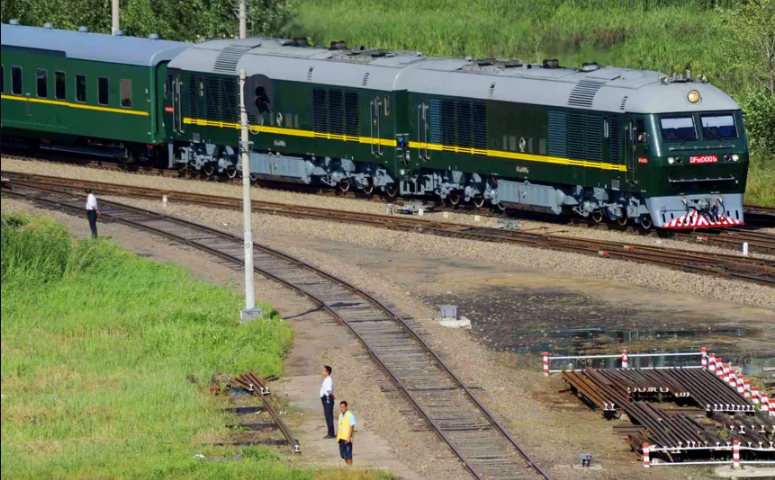
North Korean leader Kim Jong Un’s private train in China in 2010.
It was pulled by two heavy locomotives. Next an armoured anti-aircraft wagon. After the baggage car came the leader’s steel-plated Pullman, followed by a command coach containing a conference room and communications centre. Connected to them, the 22-man security detail travelled in their own rolling stock. Beyond was a dining car, two coaches for guests, and of all things a bathing wagon, then a second dining car. Bringing up the rear were two sleeping cars, a press wagon for the news hounds, another baggage car and finally another anti-aircraft wagon. The coachwork was of the finest materials, hardwoods and high-grade leather, armour-plated, and bristling with guns and radio antennae. Outside in all weathers, day and night, other protective guards swept along the tracks.
There was something charmingly old fashioned about the decision of Kim Jong Un, leader of North Korea, to travel by train to meet his fellow dictator, Vladimir Putin. Over here, even when buffered by a railcard, Network Rail can sometimes fail spectacularly as an ambassador for this effortless mode of transport. Yet, we forget how important journeying by train was and remains. Important figures frequently opt for the smooth clickety-clack over air or road for their expeditions. The method is discreet, away from prying eyes, yet connected to a nationwide network that avoids congestion. Passengers can wine and dine, sleep, relax, study, converse and think. Rail lines are easy to guard, whereas the boulevards are full of threatening traffic and potential ambush points. Franz Ferdinand, Reinhard Heydrich, Charles de Gaulle and John F. Kennedy found this out to their cost between 1914 and 1963. Fatally in three out of four cases.
Some leaders have a phobia about flying. Stalin was one, which was why the only summit meetings he attended, at Tehran, Yalta and Potsdam, were ones connected to Moscow by rail. Perhaps President Putin, a known fancier of custom-built rolling stock, will now fear a weird kind of Karma for having arranged the eternal flight of his former chef, Yevgeny Prigozhin. The president has several trains, each containing an identical office to those in his state dacha, the Kremlin and St Petersburg. All look the name, making it impossible for the viewer, and potential assassin, to know where he is. Maybe his long-distance travel plans will be dictated by iron roads from now on?
[…]
The North Korean’s father, Kim Jong Il, hated taking to the air, instead relying on his old green-and-yellow-liveried rolling stock to convey him around his hermit kingdom. Loaded with extravagant foods, fine wines and attended by glamorous staff, the elder Kim used it on the last state visit of a North Korean to Russia in 2002. “It was possible to order any dish of Russian, Chinese, Korean, Japanese or French cuisine,” remembered one journalist. “Live lobsters were taken to stations along the route, with cases of Bordeaux and Burgundy”. However, the size, opulence and weight of this upmarket rolling McDonald’s restricted its speed to a graceful 40mph. Kim Senior’s Great Continental Railway Journey took one month. Michael Portillo, eat your heart out.
Paranoid about their personal security, the Kim family have traditionally relied on around 90 special carriages, usually made into three trains. The first handles advance security; the next carries the Kim entourage; whilst the last houses bodyguards and other personnel. The middle train, with its wall-mounted lighting, beds, sofas and armchairs reupholstered in “tasteful” reddish-pink leather (I know), was the one in which the current Kim lounged on his way to summits in Beijing and Hanoi, and travelled south in 2019 to meet President Trump in the Korean Demilitarised Zone.
The recent state visit of Kim aboard the twenty-hour Pyongyang to Vladivostok Express, no stops, should give us pause for thought. With him travelled officials closely connected with his weapons development and military science teams, and his younger sister, Kim Yo Jong. In addition to being the regime’s propagandist-in-chief, she acts as gatekeeper to her overweight, chain-smoking brother, who became leader after the sudden death of their father in 2011. Kim’s North Korean Night Mail carried a significant assembly of his regime’s inner circle.
Comments Off on North Korea’s special train for “Dear Leader”
April 30, 2023
North Korean Type 70 Pistol
Forgotten Weapons
Published 8 Apr 2015The “Hermit Kingdom” of North Korea has a number of somewhat unusual military firearms that are not quite direct copies of anything else, but we very rarely get to see examples of them up close. The Type 70 was intended for high-ranking officers, replacing the Type 64 (which was a copy of the Browning 1900). The Type 70 shows features from the PPK and Makarov, as well as other elements not taken directly from existing designs. The hammer is an exposed single-action type, and the muzzle profile is very reminiscent of the Makarov. The action is simple blowback (in .32 ACP, despite the 7.62mm marking on the slide), but the barrel is set in the side and easily removed, instead of being fixed to the frame as is typical of blowback pistols. The safety is a cross-bolt button which doubles as the block holding the barrel in place. The Type 70 is quite comfortable in the hand, and probably nice to shoot given its .32ACP chambering.
Comments Off on North Korean Type 70 Pistol
April 15, 2023
Type 68 North Korean Tokarev/High Power Hybrid
Forgotten Weapons
Published 18 May 2020The Type 68 is a North Korean hybrid of the Tokarev and the High Power, used as a military service pistol until replaced by the Beak-Du-San copy of the CZ75. The general outline of the gun is a copy of the Tokarev, with a modular removable fire control group, lack of manual safety, and tall thin sights. It is chambered for 7.62x25mm, and uses a magazine identical to the standard Tokarev except for not having a magazine catch cut, as the Type 68 has a heel magazine release.
Internally, the High Power elements include a detent-retained barrel pin, use of a solid barrel cam instead of a 1911/Tokarev swinging link, and a fixed barrel bushing. Two patterns of markings exist, one with a date and North Korean marking, and one (like this example) with only a serial number.
North Korean guns of all types are very rare in the United States. A very small number of Type 68s have come into the US, generally through Central America (probably via Cuba) and South Africa (via Rhodesia/Zimbabwe).
Update: It appears that the original design work for these was done by an independent engineering firm in Yugoslavia. The design (a TT33 with High Power type locking and angled slide serrations) was not completed in time for the trials that would lead to adoption of the Yugoslav M57, and the drawings were transferred to “another country” — probably North Korea.
(more…)
Comments Off on Type 68 North Korean Tokarev/High Power Hybrid
February 14, 2023
Are you not a PATRIOT? Do you hate FREEDOM?
I sometimes wonder if any bill ever gets passed in the United States without a catchy acronym anymore. Rob Henderson notes the anti-patriotic PATRIOT act and the anti-freedom FREEDOM act as examples of bills named in a way to almost exactly invert the true purpose of the legislation:
Many fully-grown adults have never developed the ability to think beyond words. Others are keenly aware of how easily people fall for this language game. And tactically exploit this mental weakness.
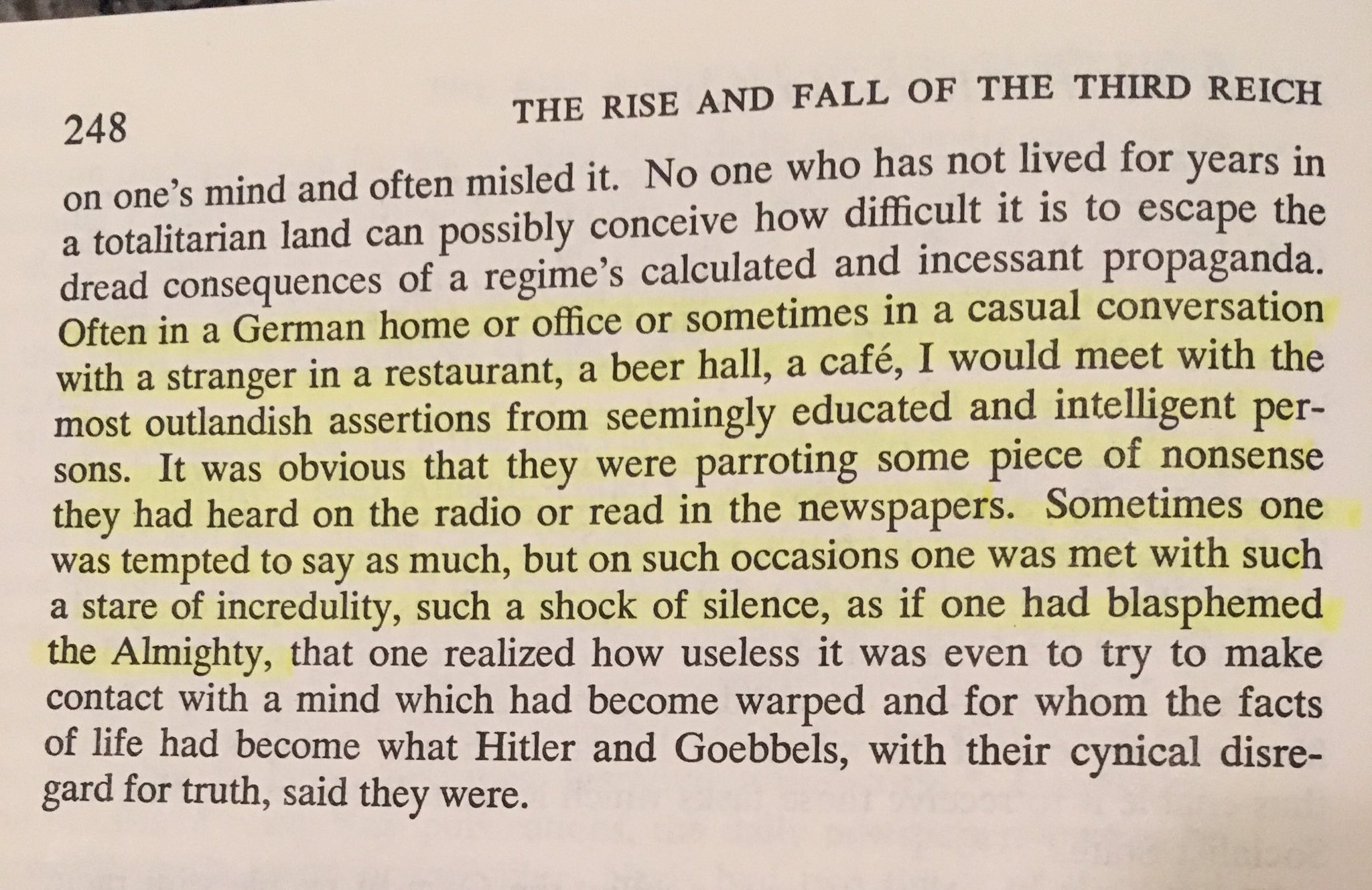
This isn’t a new phenomenon. William Shirer, the American journalist and author of The Rise and Fall of the Third Reich, described his experiences as a war correspondent in Nazi Germany:
The strangest variant of this way of thinking is the belief that just because a word or a term sounds good, the reality behind it is also unquestionably good.
In October of 2001, the Bush Administration famously decided to expand state surveillance. This allowed federal agencies to monitor domestic telephone conversations, online activity, email, and financial records, among other intrusions, without a court order.
And what did they call this decision? The Uniting and Strengthening America by Providing Appropriate Tools Required to Intercept and Obstruct Terrorism Act.
USA PATRIOT Act.
Better known as the PATRIOT Act. And if you were against it, what did supporters say that your criticisms implied?
In June of 2015, the PATRIOT Act expired. The Obama Administration then restored most of the provisions under the title Uniting and Strengthening America by Fulfilling Rights and Ensuring Effective Discipline Over Monitoring Act.
USA FREEDOM.
Better known as the FREEDOM Act. And if you were against it, what did supporters say that your criticisms implied?
There’s a country in which the first three names are “Democratic”, “People’s”, and “Republic”. The first and third words essentially mean the same as the middle — this state belongs to the people, and represents them.
In the modern era, government legitimacy is derived from this concept — representation of the people.
So the name of this particular country basically begins: “Legitimate Legitimate Legitimate”. Officially it known as the Democratic People’s Republic of Korea (DPRK). Sounds like a lovely place. It’s more commonly known as North Korea.
The Soviet Union was officially the Union of Soviet Socialist Republics.
China today is officially known as the “People’s Republic of China”.
Who could be against entities with names containing words like Republic, Democratic, People’s, and Union? They sound so nice. Even socialist is cleverly named — who could be against anything with the word “social” in it?
There’s a violent organization that calls themselves Antifa. Short for antifascist.
There are people who will say with a straight face that if you criticize Antifa, then you are a fascist. Or they will imply that you harbor fascist sympathies.
Interestingly, as William Shirer notes in the book referenced above, Antifa collaborated with the Nazis to help elect Adolf Hitler. Antifa has its origins in Germany, and, as a communist organization, their primary goal was to accelerate the forces of history. Antifa in the 1930s aimed to bring forth the revolution. They partnered with the Nazis to overthrow the Social Democrats who controlled the Weimar Republic. Antifa supporters believed that a fascist regime was a necessary step to end capitalism and usher in a communist utopia.
During this period, fascist was used as an epithet against capitalist society and anyone opposed to communism. They used this term to describe the center-left party in control of the Weimar Republic. As Stalin put it, “Fascism and social democracy are twin brothers, social democracy is only a wing of fascism.”
Comments Off on Are you not a PATRIOT? Do you hate FREEDOM?
December 6, 2022
The coming of the Korean War
In Quillette, Niranjan Shankar outlines the world situation that led to the outbreak of the Korean War in 1950:
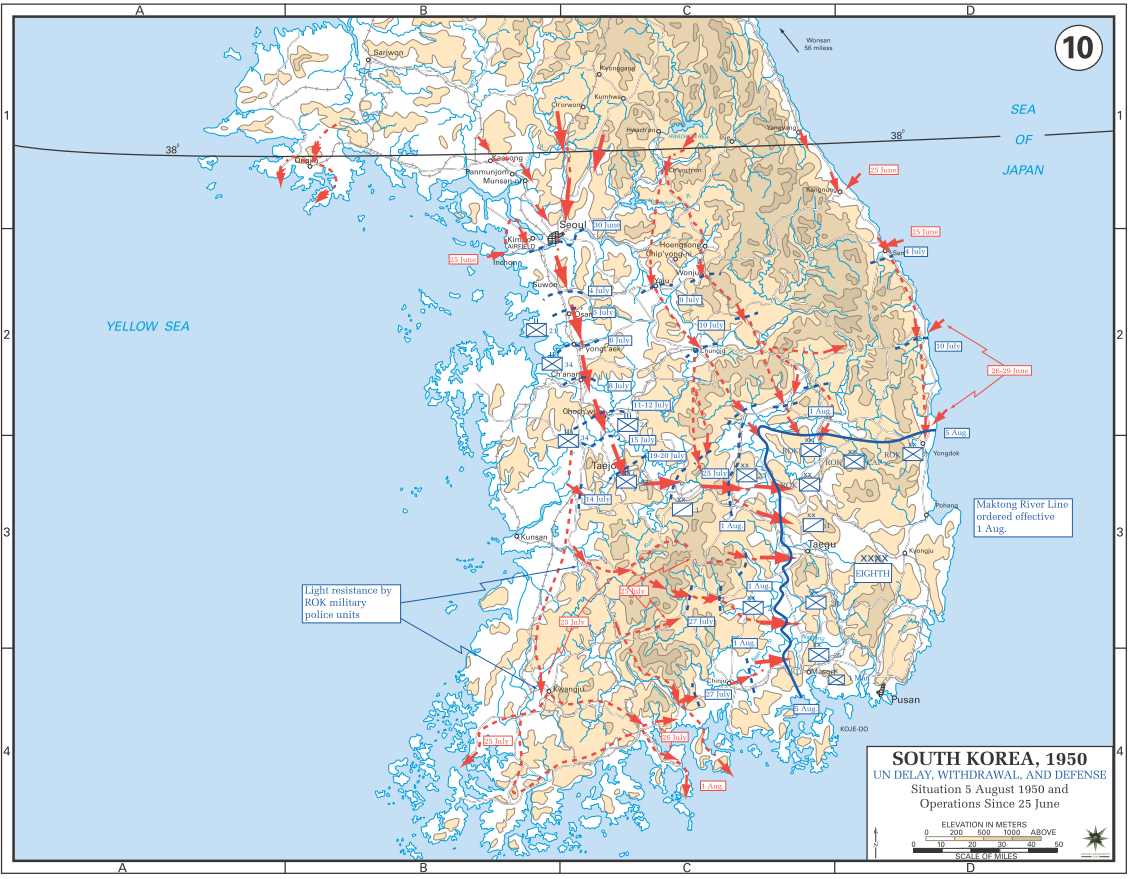
Initial phase of the Korean War, 25 June through 5 August, 1950.
Map from the West Point Military Atlas — https://www.westpoint.edu/academics/academic-departments/history/korean-war
The Korean War was among the deadliest of the Cold War’s battlegrounds. Yet despite yielding millions of civilian deaths, over 40,000 US casualties, and destruction that left scars which persist on the peninsula today, the conflict has never received the attention (aside from being featured in the sitcom M*A*S*H) devoted to World War II, Vietnam, and other 20th-century clashes.
But like other neglected Cold War front-lines, the “Forgotten War” has fallen victim to several politicized and one-sided “anti-imperialist” narratives that focus almost exclusively on the atrocities of the United States and its allies. The most recent example of this tendency was a Jacobin column by James Greig, who omits the brutal conduct of North Korean and Chinese forces, misrepresents the underlying cause of the war, justifies North Korea’s belligerence as an “anti-colonial” enterprise, and even praises the regime’s “revolutionary” initiatives. Greig’s article was preceded by several others, which also framed the war as an instance of US imperialism and North Korea’s anti-Americanism as a rational response to Washington’s prosecution of the war. Left-wing foreign-policy thinker Daniel Bessner also alluded to the Korean War as one of many “American-led fiascos” in his essay for Harper’s magazine earlier this summer. Even (somewhat) more balanced assessments of the war, such as those by Owen Miller, tend to overemphasize American and South Korean transgressions, and don’t do justice to the long-term consequences of Washington’s decision to send troops to the peninsula in the summer of 1950. By giving short shrift to — or simply failing to mention — the communist powers’ leading role in instigating the conflict, and the violence and suffering they unleashed throughout it, these depictions of the Korean tragedy distort its legacy and do a disservice to the millions who suffered, and continue to suffer, under the North Korean regime.
Determining “who started” a military confrontation, especially an “internal” conflict that became entangled in great-power politics, can be a herculean task. Nevertheless, post-revisionist scholarship (such as John Lewis Gaddis’s The Cold War: A New History) that draws upon Soviet archives declassified in 1991 has made it clear that the communist leaders, principally Joseph Stalin and North Korean leader Kim Il-Sung, were primarily to blame for the outbreak of the war.
After Korea, a Japanese imperial holding, was jointly occupied by the United States and the Soviet Union in 1945, Washington and Moscow agreed to divide the peninsula at the 38th parallel. In the North, the Soviets worked with the Korean communist and former Red Army officer Kim Il-Sung to form a provisional “People’s Committee”, while the Americans turned to the well-known Korean nationalist and independence activist Syngman Rhee to establish a military government in the South. Neither the US nor the USSR intended the division to be permanent, and until 1947, both experimented with proposals for a united Korean government under an international trusteeship. But Kim and Rhee’s mutual rejection of any plan that didn’t leave the entire peninsula under their control hindered these efforts. When Rhee declared the Republic of Korea (ROK) in 1948, and Kim declared the Democratic People’s Republic of Korea (DPRK) later that year, the division was cemented. Each nation threatened to invade the other and began preparing to do so.
What initially prevented a full-scale attack by either side was Washington’s and Moscow’s refusal to provide their respective partners with support for the military reunification of the peninsula. Both superpowers had withdrawn their troops by 1949 to avoid being dragged into an unnecessary war, and the Americans deliberately withheld weapons from the ROK that could be used to launch an invasion.
However, Stalin began to have other ideas. Emboldened by Mao Zedong’s victory in the Chinese Civil War and frustrated by strategic setbacks in Europe, the Soviet premier saw an opportunity to open a “second-front” for communist expansion in East Asia with Beijing’s help. Convinced that Washington was unlikely to respond, Stalin gave Kim Il-Sung his long-sought “green-light” to reunify the Korean peninsula under communist rule in April 1950, provided that Mao agreed to support the operation. After Mao convinced his advisers (despite some initial difficulty) of the need to back their Korean counterparts, Red Army military advisers began working extensively with the Korean People’s Army (KPA) to prepare for an attack on the South. When Kim’s forces invaded on June 25th, 1950, the US and the international community were caught completely off-guard.
Commentators like Greig, who contest the communists’ culpability in starting the war, often rely on the work of revisionist historian Bruce Cumings, who highlights the perpetual state of conflict between the two Korean states before 1950. It is certainly true that there were several border skirmishes over the 38th parallel after the Soviet and American occupation governments were established in 1945. But this in no way absolves Kim and his foreign patrons for their role in unleashing an all-out assault on the South. Firstly, despite Rhee’s threats and aggressive posturing, the North clearly had the upper hand militarily, and was much better positioned than the South to launch an invasion. Whereas Washington stripped Rhee’s forces of much of their offensive capabilities, Moscow was more than happy to arm its Korean partners with heavy tanks, artillery, and aircraft. Many KPA soldiers also had prior military experience from fighting alongside the Chinese communists during the Chinese Civil War.
Moreover, as scholar William Stueck eloquently maintains, the “civil” aspect of the Korean War fails to obviate the conflict’s underlying international dimensions. Of course, Rhee’s and Kim’s stubborn desire to see the country fully “liberated” thwarted numerous efforts to establish a unified Korean government, and played a role in prolonging the war after it started. It is unlikely that Stalin would have agreed to support Pyongyang’s campaign to reunify Korea had it not been for Kim’s persistent requests and repeated assurances that the war would be won quickly. Nevertheless, the extensive economic and military assistance provided to the North Koreans by the Soviets and Chinese (the latter of which later entered the war directly), the subsequent expansion of Sino-Soviet cooperation, the Stalinist nature of the regime in Pyongyang, Kim’s role in both the CCP and the Red Army, and the close relationship between the Chinese and Korean communists all strongly suggest that without the blessing of his ideological inspirators and military supporters, Kim could not have embarked on his crusade to “liberate” the South.
Likewise, Rhee’s education in the US and desire to emulate the American capitalist model in Korea were important international components of the conflict. More to the point, all the participants saw the war as a confrontation between communism and its opponents worldwide, which led to the intensification of the Cold War in other theaters as well. The broader, global context of the buildup to the war, along with the UN’s authorization for military action, legitimized America’s intervention as a struggle against international communist expansionism, rather than an unwelcome intrusion into a civil dispute among Koreans.
Comments Off on The coming of the Korean War
November 25, 2022
Our old, comfortable geopolitical certainties are becoming less comfortable and less certain
In The Line, Matt Gurney discusses a few of the things he heard at the recent Halifax International Security Forum:

First, though, I wanted to explore that grim feeling that swept over me as Forum president Peter Van Praagh stepped up to the lectern and opened the formal proceedings with a review of the geopolitical situation, and how we got here.
From his prepared remarks (slightly trimmed):
Last year … we marked the 20th anniversary of 9/11. It was not an auspicious anniversary. Just months earlier, the United States and its allies withdrew their troops from Afghanistan and discarded the hopes and dreams of so many Afghans … [it] was a low point for Afghanistan and indeed, for all of us. … It was the culmination of 20 years of good intentions. And bad results:
The decisions made in the immediate aftermath of 9/11, North Korea going nuclear, Russia’s invasion of Georgia, the Great Recession, Iran, the Arab Spring and the Syrian civil war, the surge of refugees — more than at any time in human history, the successful rise of populist politics, the higher than necessary death toll from coronavirus, Hong Kong losing its freedoms, January 6 and its wake, climate-change disasters, and our withdrawal from Afghanistan …
It was a tragic end to a 20-year tragic era.
That’s a pretty depressing list. Right?
As a student of history, I always strive to avoid too much recency bias. Most of the things you hear described as “unprecedented” aren’t anything remotely close to that. The general public has a memory of a few years — maybe a generation. We definitely do face some novel challenges today, but we are still better off than most generations in human history, and it’s not even close.
Still. Van Praagh offered a bleak if concise catalogue of tragedy and struggle. And there are some notable absences. The Iraq War, for instance, is probably worth noting as a specific event, not just part of the Sept. 11th fallout. Perhaps the Libyan intervention as well. Some of China’s more aggressive actions, especially at home, also come to mind.
But as I mulled over that terse version of early-21st-century history, something else jumped out at me: most of those threats were things that happened far away and to other people.
I mentioned recency bias above, so it’s only fair to note a different bias: “far away” and “other people” depends on the vantage point, doesn’t it? Every event listed above was a direct and local tragedy for the people caught in the middle of it, who don’t have the luxury of viewing these events at a comfortable remove, the way the West generally has.
The pandemic, of course, did not spare the West. Nor did the Great Recession, the toll of a changing climate and the populist upheavals roiling the democracies. Those are local problems for us all.
The military challenges, though, are getting more and more local, aren’t they? North Korea seemed far away once; today it’s using the Pacific Ocean’s vital sealanes for target practice and providing some of the munitions being used against civilians in Europe. Libya, Syria and the other migration crises posed real societal and political challenges for Europe, but nothing like what the continent has been bracing for in the event of either crippling energy shortages or an outright escalation into a military conflict, potentially nuclear conflict, with Russia. China’s growing ambitions and willingness to use force pose direct challenges to the West and its prosperity; American financier Ken Griffin recently made the headlines when he observed that if Chinese military action were to cut off or disrupt American access to Taiwanese semiconductor chips, the immediate impact on the U.S. economy would be between five and 10 per cent of GDP. That would be a Great Depression-sized bodyblow, and it could happen almost instantly and without much warning.
Pondering Van Praagh’s list later on, it occurred to me that the more remote threats to core Western security and economic interests were also more remote in time. The closer Van Praagh’s summation of crises came to the present, the more immediate and near to us they became.
Comments Off on Our old, comfortable geopolitical certainties are becoming less comfortable and less certain
July 27, 2022
Poland and South Korea Ink Huge Arms Deal
Ed Nash’s Military Matters
Published 26 Jul 2022Poland and South Korea are apparently on the verge of signing a huge arms deal that will replace much of the heavy frontline equipment of the Polish Army.
Sources for this video can be found at the relevant article on:
https://militarymatters.online/
(more…)
Comments Off on Poland and South Korea Ink Huge Arms Deal


