
Dealing with the problem of pure staff accumulation, all our researches so far completed point to an average increase of 5.75 per cent per year. This fact established, it now becomes possible to state Parkinson’s Law in mathematical form: In any public administrative department not actually at war, the staff increase may be expected to follow this formula —
x=(2km + l) / n
k is the number of staff seeking promotion through the appointment of subordinates; l represents the difference between the ages of appointment and retirement; m is the number of man-hours devoted to answering minutes within the department; and n is the number of effective units being administered. x will be the number of new staff required each year. Mathematicians will realize, of course, that to find the percentage increase they must multiply x by 100 and divide by the total of the previous year, thus:
100 (2km + l) / y n %
where y represents the total original staff. This figure will invariably prove to be between 5.17 per cent and 6.56 per cent, irrespective of any variation in the amount of work (if any) to be done.
The discovery of this formula and of the general principles upon which it is based has, of course, no political value. No attempt has been made to inquire whether departments ought to grow in size. Those who hold that this growth is essential to gain full employment are fully entitled to their opinion. Those who doubt the stability of an economy based upon reading each other’s minutes are equally entitled to theirs. It would probably be premature to attempt at this stage any inquiry into the quantitative ratio that should exist between the administrators and the administered. Granted, however, that a maximum ratio exists, it should soon be possible to ascertain by formula how many years will elapse before that ratio, in any given community, will be reached. The forecasting of such a result will again have no political value. Nor can it be sufficiently emphasized that Parkinson’s Law is a purely scientific discovery, inapplicable except in theory to the politics of the day. It is not the business of the botanist to eradicate the weeds. Enough for him if he can tell us just how fast they grow.
C. Northcote Parkinson, “Parkinson’s Law, or the rising pyramid”, Parkinson’s Law (and other studies in administration), 1957.
June 13, 2014
QotD: Mathematical formula describing bureaucratic growth
June 4, 2014
A real-life experiment – does a higher minimum wage cause job losses?
Seattle just changed their minimum wage to $15 per hour (that’s the city, but not the surrounding suburbs). Tim Worstall outlines what we may see in this handy real world economic experiment:
The first and most obvious effect of a $15 an hour minimum is that there are going to be job losses. Don’t forget that the message from the academic literature is that “modest” increases in the minimum don’t seem to have “much” effect on employment levels. And we’d all agree that a $100 minimum would have rather large effects. So our puzzle here is to try to decide what is the definition of “modest”. Clearly $100 an hour isn’t. But also we can dismiss something like $1 an hour as being problematic. Since no one at all gets paid a sum that small making the minimum $1, or $1.50, has no effect on anything whatsoever.
The best result we have from the academic literature is that a minimum wage in the 40-45% region of the median wage has little to no effect on unemployment. The reason being similar to that of a $1 one. So few people get paid so little that it just doesn’t affect the wages of anyone very much. The same research tells us that once we get to 45-50% of the median wage then we do start to see significant unemployment effects.
This $15 an hour in Seattle will be around 60% of the local median wage. We would therefore expect to see reasonably large unemployment effects.
We would also expect to see unemployment among high school graduates rise very much more than the rate in general. For this minimum applies only inside the City of Seattle: it doesn’t apply to the surrounding counties or suburbs that aren’t part of that political jurisdiction. Imagine that you were a college graduate having to do some basic work to make ends meet while you were waiting for that career opening. If you’re going to get $7.25 outside Seattle and $15 inside it you’d probably be willing to make the trip each day to earn that extra. Of course, as a high school graduate you would too. But now think of yourself as the employer. You’ve got the choice of a college graduate or a high school graduate, both willing to do the same job at the same price. Who are you going to hire? Logically, the higher grade worker, that college grad.
So we would expect minimum wage jobs within Seattle to be colonised by those college grads at the expense of those high school ones. We would therefore expect to see a much larger rise in the unemployment rate of those high school grads as against the general unemployment rate. In fact, we’d expect to see this happening so strongly that we’d take the empirical evidence of that widening unemployment gap to be evidence that it was this minimum wage rise causing it.
June 3, 2014
QotD: Parkinson’s Law
Work expands so as to fill the time available for its completion. General recognition of this fact is shown in the proverbial phrase “It is the busiest man who has time to spare.” Thus, an elderly lady of leisure can spend the entire day in writing and dispatching a postcard to her niece at Bognor Regis. An hour will be spent in finding the postcard, another in hunting for spectacles, half an hour in a search for the address, an hour and a quarter in composition, and twenty minutes in deciding whether or not to take an umbrella when going to the mailbox in the next street. The total effort that would occupy a busy man for three minutes all told may in this fashion leave another person prostrate after a day of doubt, anxiety, and toil.
C. Northcote Parkinson, “Parkinson’s Law, or the rising pyramid”, Parkinson’s Law (and other studies in administration), 1957.
May 28, 2014
The “servant problem” of post-Victorian England
Before the widespread availability of electricity, no middle class household in England could get by without at least one servant. Even as modern labour-saving appliances (along with proper plumbing) started to take their place in the home, servants were still deemed an essential part of being middle- or upper-class. It may account for some of the fascination with TV shows like Downton Abbey or the earlier Upstairs, Downstairs to modern audiences — they give at least a bit of a glimpse into a very different domestic world. At Bookforum, Daphne Merkin reviews a books that look at the “servant problem”:
Servants is chockablock with incredulous-making details about the exploitative conditions in which household help lived and worked (these included cramped, chilly, and spartan sleeping quarters, endless hours, and the overriding assumption of inferiority), as well as anecdotes of supreme helplessness on the part of the coddled rich, such as the following: “Lord Curzon, whose intellect was regarded as one of the glories of the Empire, was so baffled by the challenge of opening a window in the bedroom of the country house in which he was staying (no servants being available so late at night), that he simply picked up a log from the grate and smashed the glass.” Even after World War II, when homes had begun to be wired for electricity despite the gentry’s insistence on the vulgarity of such improvements and the ideal of the 1950s self-contained (and servantless) housewife was hoving into view, so otherwise gifted a chap as Winston Churchill was unable, according to his valet John Gibson, to dress himself without assistance: “He was social gentry … He sat there like a dummy and you dressed him.” As easy as it is to snicker at such colossal ineptitude on the part of the cultural elite, it is also intriguing to consider how this kind of infantilizing treatment might have facilitated their performance in demanding grown-up roles — like someone playing with rubber ducks in the bath before going out to lead men in a military campaign.
Servants takes the reader from the days of Welbeck Abbey, the home of the eccentric and reclusive Duke of Portland, where upper servants had their own underservants to wait on them, to the gradual erosion of the older forms of domestic service and on up through the new world of do-it-yourself home comforts as devised by technology and a greater show of equality between employer and servant. This world, ushered in with the 1950s, shunned the “badge of servitude” that was conveyed by uniforms, surreal daily routines (whether it meant Ladyships who couldn’t sleep with creases on a pillowcase or Ladyships who insisted on cutting their boiled eggs with a letter opener), and a feudal attitude that took no more cognizance of domestics than it did of the furniture. “It was in the best houses considered quite unnecessary (in fact poor form),” Lethbridge notes, “for servants to knock before entering a room. This was partly because they lived in such everyday familiarity with the family that there was nothing to hide from them and partly because … their presence made no difference whatsoever to whatever was being said or going on.”
[…]
There’s much to think about in both these books — not least the particularly British style of treating domestics, both less casually sadistic and less casually amorous than, say, white Americans’ attitude toward black slaves. Indeed, I suspect that one of the reasons American audiences delight in the travails and triumphs of the gaggle of domestics on Downton Abbey is out of a sense of superiority that the “servant problem” in such acute, institutionalized form isn’t ours. Much as we may envy them all that pampering, we also like to look down our noses at it as going against the democratic and independent Yankee ethos. To this point it’s worth noting that Betty Friedan in The Feminine Mystique referred precisely to “the servant problem” as one of the besetting woes of the upper-middle-class housewives she was looking to liberate, and that our habit of befriending those who clean our kitchens and bathrooms and look after our children can’t disguise the fact that we value their hourly labor less than we value a twenty-minute haircut and that we live largely in ignorance of their thoughts and feelings.
May 22, 2014
Here’s a suddenly topical idea that (if implemented) will increase the gender wage gap
I don’t know why the topic of menstrual sick leave is suddenly a topic of discussion at many media sites, but it’s a bad idea for womens’ equality as Tim Worstall explains:
Standard theory tells us that if we raise the cost to employers of employing a certain class or group of people then the wages paid to that class or group will fall relative to those groups that have not had the extra costs loaded onto their employment. For the employer is paying to get a job done. If we mandate free lunches, or impose employment taxes (like the employer side of social security), or a certain amount of sick leave, then the cost of providing those will be coming from that gross amount that the employer is willing to pay to get that job done. The more we insist that some of those costs be spent on not wages then the less there is that will be paid in wages.
And if we insist that one group or another has an extra set of costs associated with their employment then we’ll end up seeing the wages of that group fall relative to groups that don’t have those associated costs. The provision of paid menstrual leave will act in exactly this manner. Sure, whatever the allowance is not all women will take it. Say that it’s one day a month out of a standard 22 or 23 day working month. If all women religiously took it we would expect female wages to fall by 1/22 or 1/23 relative to those of men (or of post-menopausal women). Not all women would take it, undoubtedly, so the effect would probably be less than this.
[…]
As above, if we formalised this arrangement then we don’t think that all women would take all of those sick days. But we do have evidence that part of the gender pay gap is already caused by this very problem. And formalising the arrangement will lead to more women taking the sick leave than happens currently. That’s just a natural human reaction. All of which means that, if we did institute formal paid menstrual leave then we’d expect to see a widening of the gender pay gap.
As more women entered the formal work force over the last century or so, many governments and regulators have imposed additional costs on businesses by mandating different treatment for women: while they often claimed they were acting out of concern, the typical result was to make women’s work proportionally more expensive than that of men. If women are limited — by law — to a shorter working day, or to have additional breaks, or to be entitled to extra sick days, then the rational response of businesses will be to hire more men and fewer women (even for work that does not require more physical strength). The push for a new category of special treatment for women will have exactly the same effect: making women more expensive as employees than men.
May 3, 2014
QotD: The educational machinery that produces the modern twenty-something
When conservatives complain that children are not being taught anything in public schools, they’re half right: They’re not being taught anything useful. They’re taught how to conform. That’s really the point of so many of the stupid rules in modern schooling, people learn to obey the irrational.
This translates into the corporate world in two ways. Those leaving the educational system are outwardly rebellious and undisciplined, even slovenly. Inwardly they’re perfect conformists. They haven’t the slightest notion of principles or integrity, it’s been beaten out of them by the public schools. They are desperate to fit in and conform in a way that is common among teenagers, but used to fade away as people entered their twenties and thirties. As a cranky old executive once observed to me, the young people aren’t so much soft as weak. Passionate about trivia and indifferent toward the fundamentals of life and work.
Richard Anderson, “In Praise of Grumpy Men”, The Gods of the Copybook Headings, 2014-05-01
April 30, 2014
Disturbing US unemployment figures
Michael Snyder says the official unemployment rate actually conceals more than it reveals:
According to shocking new numbers that were just released by the Bureau of Labor Statistics [PDF], 20 percent of American families do not have a single person that is working. So when someone tries to tell you that the unemployment rate in the United States is about 7 percent, you should just laugh. One-fifth of the families in the entire country do not have a single member with a job. That is absolutely astonishing. How can a family survive if nobody is making any money? Well, the answer to that question is actually quite easy. There is a reason why government dependence has reached epidemic levels in the United States. Without enough jobs, tens of millions of additional Americans have been forced to reach out to the government for help. At this point, if you can believe it, the number of Americans getting money or benefits from the federal government each month exceeds the number of full-time workers in the private sector by more than 60 million.
[…]
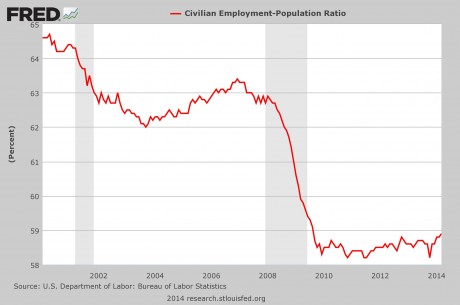
A number that I find much more useful is the employment-population ratio. According to the employment-population ratio, the percentage of working age Americans that actually have a job has been below 59 percent for more than four years in a row…
That means that more than 41 percent of all working age Americans do not have a job.
When people can’t take care of themselves, it becomes necessary for the government to take care of them. And what we have seen in recent years is government dependence soar to unprecedented levels. In fact, welfare spending and entitlement payments now make up 69 percent of the entire federal budget.
April 24, 2014
You can’t say the IRS isn’t caring and generous
Tim Cavanaugh explains that your jaundiced view of the Internal Revenue Service is clearly contradicted by the IRS’s approach to helping people with tax troubles:
Sometimes it seems like you only hear the bad news about the Internal Revenue Service: the targeting of the president’s enemies; the padding of union bosses’ hours.
But sometimes the federal tax collector is there to lend a hand.
During 26 of the darkest months of the post-recession, 1,100 persons in the United States had “substantiated Federal tax compliance problems.”
Yet during that same time period, from October 2010 through December 2012, the IRS showed mercy, even charity. It gave those 1,100 people more than $1 million in cash awards, as well as other considerations of value.
The other considerations included 69 workplace promotions and 10,000 hours worth of what California public employees call “air time.”
That is to say: All of those 1,100 were IRS employees.
March 30, 2014
In which Tim Worstall admits that Karl Marx was right
Well, right in this particular analysis, anyway:
Which is where we can bring Karl Marx into the discussion. Wrong as he was on many points he was at times a perceptive analyst. And he noted that what determined the wages of the workers wasn’t some calculation of a “fair wage”, nor some true value of their production (although he had much to say on both points), but in a market economy the wages that were paid were a reflection of what other people were willing to pay for access to that labour.
If, for example, there were a large number of unemployed (that “reserve army of the unemployed”) then a capitalist didn’t have to raise the wages of his workers however far productivity grew. If anyone tried to capture a bit more of the value being created, say through a strike or other activity, then the capitalist could simply fire them and bring in some of those unemployed. No profits needed to be shared with the workers. However, when we get to a situation of full employment then the dynamic changes. It’s not possible to simply hire and fire to keep wages low. For the other capitalists are competing for access to that labour that makes those profits. The higher profits go the higher all capitalists will be willing to bid up wages to continue making some profit at all.
The obverse of this is if the employers collude in order to artificially suppress the wages of the workers which is why that case involving Apple, Google and so on is going to trial. That’s monopoly capitalism that is and we really don’t like it at all.
But in this case with Yahoo trying to challenge Google’s YouTube, it will be the workers who benefit. For the two companies are vying with each other for access to the content being made and thus the profits that can be made. Of whatever revenue can be made a larger portion will go to the producers of the content and a smaller one to the owners of the platforms. Which is excellent, this is exactly what we want to happen.
State occupational licensing is out of control
Ramesh Ponnuru discusses some examples of ridiculous state occupational license requirements:
Melanie Armstrong wanted to be an African hair braider, practicing a skill passed down from generation to generation. In Tupelo, Mississippi, where she lived, government licensing rules meant she had to take 300 hours of course work to start her salon: 300 hours, she notes, “none of which covered hair braiding.”
In testimony before a U.S. House subcommittee on Wednesday, Armstrong explained that her “ultimate goal” was to teach others how to braid. Getting the needed licenses to do that would have taken 3,200 hours. None of them taught students how to braid hair, either. That’s more hours than it would have taken her to get licenses to become a firefighter, emergency medical technician, hunting instructor, ambulance driver or real estate appraiser. It’s longer than it would have taken her to get licenses for all those things combined.
The subcommittee — led by New Yorkers Richard Hanna, a Republican, and Grace Meng, a Democrat — was considering the excesses of state occupational licensing. More and more jobs fall under these regulations. In the 1950s, according to one study, only about one in 20 jobs required a license. By 2006, about 29 percent did.
While Armstrong helped get her state to scale back the requirements for hair braiders, the trend is toward more stringent regulation. Patti Morrow, who runs an organization fighting licensing for interior designers, says, “These bills come back year after year like zombies.”
March 26, 2014
Minimum-wage jobs becoming more likely to be replaced by robots
Everyone seems to want to raise the minimum wage right now (well, everyone in the media certainly), but it might backfire spectacularly on the very people it’s supposed to help:
It’s become commonplace for computers to replace American workers — think about those on an assembly line and in toll booths — but two University of Oxford professors have come to a surprising conclusion: Waitresses, fast-food workers and others earning at or near the minimum wage should also be on alert.
President Obama’s proposal to increase the federal minimum wage from $7.25 to $10.10 per hour could make it worthwhile for employers to adopt emerging technologies to do the work of their low-wage workers. But can a robot really do a janitor’s job? Can software fully replace a fast-food worker? Economists have long considered these low-skilled, non-routine jobs as less vulnerable to technological replacement, but until now, quantitative estimates of a job’s vulnerability have been missing from the debate.
Based on a 2013 paper by Carl Benedikt Frey and Michael A. Osborne of Oxford [PDF], occupations in the U.S. that pay at or near the minimum wage — that’s about one of every six workers in the U.S. — are much more susceptible to “computerization,” or as defined by the authors, “job automation by means of computer-controlled equipment.” The researchers considered a time frame of 20 years, and they measured whether such jobs could be computerized, not whether these jobs will be computerized. The latter involves assumptions about economic feasibility and social acceptance that go beyond mere technology.
The minimum-wage occupations that Frey and Osborne think are most vulnerable include, not surprisingly, telemarketers, sales clerks and cashiers. But also included are occupations that employ a large share of the low-wage workforce, such as waiters and waitresses, food-preparation workers and cooks. If the computerization of these low-wage jobs becomes feasible, and if employers find it economical to invest in such labor-saving technology, there will be huge implications for the U.S. labor force.
H/T to Colby Cosh, who said “McDonald’s is going to turn into vending machines. Can’t say this enough. McDonald’s…vending machines.”
March 23, 2014
The march of technology and the future of work
Matt Ridley on the perpetual fretting that technological change will eliminate jobs and leave many permanently without work:
Bill Gates voiced a thought in a speech last week that is increasingly troubling America’s technical elite — that technology is about to make many, many people redundant. Advances in software, he said, will reduce demand for jobs, substituting robots for drivers, waiters or nurses.
The last time that I was in Silicon Valley I found the tech-heads fretting about this in direct proportion to their optimism about technology. That is to say, the more excited they are that the “singularity” is near — the moment when computers become so clever at making themselves even cleverer that the process accelerates to infinity — the more worried they are that there will be mass unemployment as a result.
This is by no means a new worry:
In the 1700s four in every five workers were employed on a farm. Thanks to tractors and combine harvesters, only one in fifty still works in farming, yet more people are at work than ever before. By 1850 the majority of jobs were in manufacturing. Today fewer than one in seven is. Yet Britain manufactures twice as much stuff by value as it did 60 years ago. In 1900 vast numbers of women worked in domestic service and were about to see their mangles and dusters mechanised. Yet more women have jobs than ever before.
Again and again technology has disrupted old work patterns and produced more, not less, work — usually at higher wages in more pleasant surroundings.
The followers of figures such as Ned Ludd, who smashed weaving looms, and Captain Swing, who smashed threshing machines (and, for that matter, Arthur Scargill) suffered unemployment and hardship in the short term but looked back later, or their children did, with horror at the sort of drudgery from which technology had delivered them.
Why should this next wave of technology be different? It’s partly that it is closer to home for the intelligentsia. Unkind jibe — there’s a sort of frisson running through the chatterati now that people they actually know might lose their jobs to machines, rather than the working class. Indeed, the jobs that look safest from robots are probably at the bottom of the educational heap: cooks, gardeners, maids. After many years’ work, Berkeley researchers have built a robot that can fold a towel — it takes 24 minutes.
February 13, 2014
“Minimize your therbligs”, or Taylor versus Gilbreth
Sippican Cottage makes a strong case for Frank Bunker Gilbreth being the greatest man ever produced by Maine (republishing an older post from 2012):
Frank Gilbreth was born in Fairfield, Maine, in 1868. He never went to college except to teach at Purdue eventually. He’s famous, in a way, and anonymous in another. He’s the father portrayed in the original Cheaper By The Dozen, using a stopwatch to figure out how to make his family more efficient. That was his thing — efficiency.
He was a bricklayer. Built houses. He got to wondering if the repetition of laying one oblong slug of fired clay atop two others in a bed of mortar could be improved by observing the motions of skilled persons, breaking these exertions down into their component movements, and eliminating the wasted motions in the routines. It can, and he did. I’ve been a hod carrier and mason tender, and I can tell you that working off the ground or a platform the same height as your feet would be backbreaking and slow way to assemble masonry. We always used the footing form boards and leftover planks to assemble ad hoc shelves just lower than waist height behind the mason so that they could turn and pick up a brick and some mortar and go back to the next slot in the wall. I had no idea Clifton Webb, er, Frank Gilbreth came up with the idea less than a century before. It would be literally impossible to calculate how much time, money, effort, and how many worker’s backs Frank Gilbreth (and his wife, who was his partner and carried on after his early death) saved anonymously. His method is now universal and uncontroversial. How many people are incalculably useful to their fellow men?
I first heard of Gilbreth in my first college semester, and while the biographical detail is new to me, the basic idea is the same as my (post-strike replacement) instructor described. So who’s the “Taylor” of my title?
Frederick Taylor is the progenitor of so many things that are in the common language today that he deserves to be discussed with the most influential people of his time. That’s not necessarily a good thing. Almost all the fruit of Taylor’s tree is rotten.
Taylor is the guy standing behind dehumanized workers with a stopwatch, keeping track of bathroom breaks, and generally treating all work as a series of unrelated steps that any unskilled human could do, and constantly finding new ways of measuring it and subdividing it to harangue a little more out of the continually less and less skilled worker. “Scientific Management,” they called it. The Soviet Union loved it. They thought all people were just cogs in a big machine anyway. Most of the terms for malingering in dead-end jobs come from Taylorism. Goldbricking. Dogging it. Taylor observed that when normal people are in a group and everyone has the same duties, it is human nature for everyone in the group to devolve and perform at the level of the least capable and energetic member. His solution was a big expansion of management. He is the busted idol of micromanagement, and by extension, big government.
I have a lovely leather-bound copy of Taylor’s The Principles of Scientific Management that I’ve never actually opened … it was on the used book charity fundraising table at my local bank branch, so I paid $1 for it. From Sippican’s description, I may not bother to read it, as I think I’ve encountered most of the content in the working world.
Minimize your therbligs until it becomes automatic; this doubles your effective lifetime — and thereby gives time to enjoy butterflies and kittens and rainbows.
That’s Robert Heinlein in his “Lazarus Long” character voice. What the heck is a therblig, and why is it in this post? Therbligs are Gilbreth’s basic motions of physical work; the essential parts of any manual task. Minimize them to make the work more efficient. The name is derived, as my college instructor put it, by spelling Gilbreth sideways.
February 5, 2014
NYT – reducing full-time employment by 2.5 million is a good thing
This New York Times editorial tries valiantly to make the case that the recent prediction by the Congressional Budget Office of 2.5 million full-time job losses is a good thing for the affected workers and the economy as a whole:
The Congressional Budget Office estimated on Tuesday that the Affordable Care Act will reduce the number of full-time workers by 2.5 million over the next decade. That is mostly a good thing, a liberating result of the law. Of course, Republicans immediately tried to brand the findings as “devastating” and stark evidence of President Obama’s health care reform as a failure and a job killer. It is no such thing.
The report estimated that — thanks to an increase in insurance coverage under the act and the availability of subsidies to help pay the premiums — many workers who felt obliged to stay in a job that provided health benefits would now be able to leave those jobs or choose to work fewer hours than they otherwise would have. In other words, the report is about the choices workers can make when they are no longer tethered to an employer because of health benefits. The cumulative effect on the labor supply is the equivalent of 2.5 million fewer full-time workers by 2024.
[…]
The new law will free people, young and old, to pursue careers or retirement without having to worry about health coverage. Workers can seek positions they are most qualified for and will no longer need to feel locked into a job they don’t like because they need insurance for themselves or their families. It is hard to view this as any kind of disaster.
Despite all the whistling as we stroll along the cemetery fence, the editorial does correctly point out that insurance benefits that are tied to particular employers do limit choices for many workers. I’ve made the argument a few times that this is something that unions should be pushing very hard for: to make benefits more portable for both unionized and non-unionized workers. The rest of the editorial isn’t quite as helpful … two and a half million current workers no longer working (and not through a voluntary switch to self-employment or retirement) isn’t the wonderful thing they claim it is. Those people and their families will still need income to provide themselves with food, shelter, and all the other necessities of modern life. Tough to do that without visible means of support.
Update: At the National Journal, James Oliphant rallies to the White House’s defence during what he calls “the worst day that Obamacare has had in weeks — and that’s saying something.”
To debate that point, the White House supplied as its first responder Jason Furman, the chairman of the Council of Economic Advisers, an academic and policymaker schooled in the intricacies of the labor market. Furman disputed any reading of the report that said the ACA was a net drag on the economy — but often doing so in head-scratching language of a Washington insider.
At one point, a reporter at Tuesday’s briefing asked Furman in frustration, “What the heck do you mean?”
Furman’s presence, however, outlined in neon the problem the Obama administration has been having since the ACA became law: a persistent inability to detail its benefits in language that resonates with the public. And in its defense, the ACA’s multiple mechanisms are not the easiest to explain. To that end, its critics, who often have relied upon hyperbole and scare tactics, have always held the political advantage.
But sometimes you just have to punch the bully in the nose — and Furman wasn’t the person for the job. That was the case Tuesday. The first takeaway from a complex CBO report was that the office had concluded that Obamacare is going to be a job-killer. Period. Full stop. It fell upon Furman — along with liberal bloggers — to attempt to explain that, no, it’s more complicated than that.
Follow along: The report doesn’t say that the ACA will result in 2 million jobs lost by 2017, but projects there will be 2 million fewer workers in the workforce, the White House says (a number it doesn’t necessarily agree with). It’s the difference, Furman underscored, between labor supply and labor demand. And they aren’t “jobs,” he reiterated, they are “FTEs.” (Full-time equivalents, if you are scoring at home.)
In other words, he explained, businesses will still want as many workers as ever, but the ACA will result in an increasing number of workers deciding to take themselves either entirely out of the job market or working fewer hours. Why? Because they may decide to keep their income below a certain level in order to qualify for government help to buy health insurance on the exchanges.
This is a good thing, Furman said, because the ACA will give workers more flexibility, whether they want to become entrepreneurs or take another, lower-paying job. And again, the press corps had some trouble with this concept. It’s good for someone to take a lower-paying job? And it’s good that the law encourages them to take it?


