Quotulatiousness

June 24, 2018

Berlin protest planned against EU’s proposed copyright changes

Filed under: Europe, Law, Liberty, Media, Technology — Tags: , , , , — Nicholas @ 03:00

If you’re a regular internet user and you’re anywhere near Berlin, you might want to consider supporting this protest:

On Wednesday, the Legislative Committee of the European Union narrowly voted to keep the two most controversial internet censorship and surveillance proposals in European history in the upcoming revision to the Copyright Directive — as soon as July Fourth, the whole European Parliament could vote to make this the law of 28 EU member-states.

The two proposals were Article 11 (the link tax), which bans linking to news articles without paying for a license from each news-site you want to link to; and Article 13 (the copyright filters), requiring that everything that Europeans post be checked first for potential copyright infringements and censored if an algorithm decides that your expression might breach someone’s copyright.

These proposals were voted through even though experts agree that they will be catastrophic for free speech and competition, raising the table-stakes for new internet companies by hundreds of millions of euros, meaning that the US-based Big Tech giants will enjoy permanent rule over the European internet. Not only did the UN’s special rapporteur on freedom of expression publicly condemn the proposal; so did more than 70 of the internet’s leading luminaries, including the co-creators of the World Wide Web, Wikipedia, and TCP.

We have mere days to head this off: the German Pirate Party has called for protests in Berlin this Sunday, June 24 at 11:45h outside European House Unter den Linden 78, 10117 Berlin. They’ll march on the headquarters of Axel-Springer, a publisher that lobbied relentlessly for these proposals.

If you use the Internet to communicate, organize, and educate it’s time to speak out. Show up, stand up, because the Internet needs you!

Original post, with embedded links, at BoingBoing.

June 23, 2018

“An extraordinary thing happened in internet culture this week: Godwin repealed Godwin’s Law”

Filed under: Liberty, Media, Politics, Technology, USA — Tags: , , , , , — Nicholas @ 05:00

Mike Godwin obliterates his own legacy:

An extraordinary thing happened in internet culture this week: Godwin repealed Godwin’s Law. Godwin’s Law is the idea that the longer an internet discussion thread drags on, the more likely it is that one of the discussants will mention Hitler. Rashly and inappropriately. They’ll compare their opponent to Der Fuhrer or say, ‘This is how Nazism started!!!!’. Reductio ad Hitlerum, as some call it. The law was invented by Professor Mike Godwin, an American attorney. And this week he scrapped it. To the delight of virtual leftists and Trump-bashers who are chomping at the bit to say ‘TRUMP IS LITERALLY A NAZI’, Godwin tweeted in relation to the Trump administration and its child-migrant policy: ‘By all means, compare these shitheads to Nazis. Again and again. I’m with you.’

The response was one of glee. ‘Godwin has officially suspended Godwin’s Law’, tweeters crowed. The ‘actual, literal creator of Godwin’s Law’ has okayed Hitler comparisons, they whooped. They could now crack on with their hysterical likening of Trump to Hitler, and everything he does to what happened in 1930s Europe, without having to worry about someone shouting, ‘Godwin’s Law!’ at them. It so perfectly sums up the arrogance of the Twitterati and opinion-forming set: for years they mocked the Hitler-obsessed ‘below the line’ (BTL) commenters on their Tumblr blogs or Guardian columns, and even instituted an internet law to paint them as vulgar idiots, and now they themselves embrace mad Hitler blather and have scrapped the law that said such online talk was wrong. One online law for thee, another for me.

They can dress up their adoption of the Reductio ad Hitlerum worldview as a legitimate political position as much as they like. They can carry on saying, ‘Ah, but Trump’s policies really are like Hitler’s, which means my Nazi comparisons carry more weight than those of the non-Oxford-educated blowhard I had to block on Twitter because he kept saying “Hillary is Hitler”’. But they’re not fooling anyone. Except themselves. The rest of us know they are now just like the BTL people they once slagged off: confused, angry, rash and willing to exploit the greatest crime in history if it helps them to register and advertise their emotional fury with political developments. They are BTL people now, though they’re above the line, still all over the media, busily making it acceptable to talk shit about the Holocaust in public.

This week, with the controversy over Trump’s separation of families arriving illegally from Mexico, has represented a turning point in their popularisation of the Hitler comparisons they once chided. They refer to the places in which the children of illegal migrants are being housed as ‘concentration camps’. The former director of the CIA, Michael Hayden, tweeted a photo of Auschwitz with the words, ‘Other governments have separated mothers and children’. Pre-empting the suspension of Godwin’s Law, a writer for the New Statesman said: ‘Stop talking about Godwin’s Law – real Nazis are back.’ Twitter buzzes with Trump-as-Hitler talk. ‘This is how the Holocaust started’, they all say.

I’m not a Trump fan … for the first few months of his administration (and during the election campaign), I labelled him as Il Donalduce, but I mostly meant that as a visual reference: watch any of Mussolini’s speeches and you’ll see some resonances with how Donald Trump speaks. The Hitler equivalence is wish-fulfilment by those who oppose him … it’s not an accurate or useful way to portray him, unless your goal is to make Adolf Hitler seem less demonic. I literally do not understand why anyone in pursuit of a modern political goal would try to make Hitler’s crimes seem more acceptable in an attempt to blacken the reputation of a living politician, unless you are clinically insane.

As a libertarian, Trump is far, far from my ideal of the “leader of the free world” (as the western media tends to portray the US president), but he’s not even close to the evil genius that created the “Thousand-year Reich“, and any attempt to portray him that way is historically illiterate and politically tone-deaf.

June 20, 2018

Kids might interact more with the real world if parents weren’t so afraid to let them engage with it

Filed under: Gaming, Health, Liberty, Technology — Tags: , , , , — Nicholas @ 03:00

Frank Furedi on the unintended consequences of too much parental protection from the real world:

Every summer, parents are confronted with new threats to their children to obsess about. We used to worry about our children being outdoors and being abducted. This year, we’re told that keeping them indoors will mean they become addicted to the internet.

In recent months, children’s digital activities have become a key focus of adult anxiety. Last month a Pew survey on the ‘silent addiction’ found that 45 per cent of American teenagers admit to using the internet ‘almost constantly’. In the UK, the idea of internet addiction has also become mainstream. Stories of kids becoming addicted to videogames, especially to a hugely popular online shoot-em-up called Fortnite, are everywhere.

[…]

My research has led me to the conclusion that the compulsive attachment of children to their online worlds is down to the fact that adult society has made it very difficult for them to engage with the offline world. Risk-averse child-rearing has created a climate in which children are constantly discouraged from experiencing life outdoors. During the past three decades, a culture of fear has enveloped childhood. Alarmist accounts of stranger danger, bullying or the likelihood of traffic accidents have made parents reluctant to allow their children to go out and explore.

Today, parents frequently accompany children on their way to school. They hover over them when they play in the park. Many children are actively discouraged from playing on their own outdoors. Schools forbid pupils from playing conkers or having snowball fights. No wonder that the simple delights of climbing trees and building dens have been replaced by hours spent in front of screens.

Surveys indicate that young children would rather be playing with their mates outdoors than cooped up in their digital bedrooms. But children are inventive creatures, who will take any opportunity to create their own world and try to establish a measure of independence from parental control. Young people are highly motivated to construct their own space where they can engage with their peers and develop their personality. Indeed, one of the reasons Fortnite has become so popular is that it allows children to join groups and talk live to one another, thus offering the illusion of forging relationships with other gamers – a sense of community.

May 29, 2018

Us vs Millennials

Filed under: Humour — Tags: , , — Nicholas @ 02:00

Owen Benjamin
Published on 7 Mar 2017

If you’re like me you’ve felt very alienated by how fast the world changes and how different each generation becomes. Hopefully this video helps you understand what’s happening.

hugepianist.com for tour dates and podcasts
@owenbenjamin twitter
@owenbenjam instagram
whydidnttheylaugh@gmail.com
write to me! I get very lonely. Feed the bear.

May 5, 2018

Canada is #1 in the world! In the ripping-off-the-wireless-user sweepstakes!

Filed under: Business, Cancon, Technology — Tags: , , , — Nicholas @ 05:00

This is the sort of thing that isn’t really surprising — if you’re a Canadian wireless data user — but puts it into a sad, sad perspective:

The sad state of Canadian wireless pricing is old news for consumers and the government, but a new report graphically demonstrates how Canadians face some of the least competitive pricing in the developed world. The Rewheel study measured pricing in EU and OECD markets by examining how many gigabytes of 4G wireless data consumers get for the equivalent of 30 euros. This chart from Rewheel says it all:

Canada is at the far left of the chart with consumers getting less for their money than anyone else. While many countries offer unlimited mobile data at that price, the report says Canadian carriers offer a measly 2 GB. The smartphone data plans aren’t much better, with nearly all countries offering better deals and many shifting to unlimited data at that price.

[…]

In addition to outrageously expensive wireless data plans, Canadians also face huge overage charges (more than a billion dollars per year generated in the wireless overage cash grab) and steadily increasing roaming charges. Yet when it came to introducing greater resale competition, the CRTC rejected new measures that it admitted could result in some improvement to affordability.

April 19, 2018

The mis-measurement of the digital economy

Filed under: Economics, Technology — Tags: , , , , — Nicholas @ 05:00

In the Continental Telegraph, Tim Worstall explains why our current statistical model does not adequately reflect the online world’s contribution to our economy:

To give my favourite current example. WhatsApp is used by some billion people around the world for some to all of their telecoms needs. It turns up in economic statistics as a reduction in productivity.

That’s mad.

In more detail, WhatsApp is free to use and carries no advertising. That means there’s no sale associated with it. We measure consumption at market prices – a price of $0 means no consumption. Consumption is one of the three ways we measure GDP – each of the three should be the same as the other two but isn’t because lying about taxes.

The other two calculations are all incomes, or all production. Things that are sold at no price do not add to production given that we measure it at market prices.

Income, well, there’re 200 or so engineers at Facebook who work on it (I checked with Facebook itself). Say their salary is $250k a year each. Probably too low but we’ve got to use some number or other. $50 million then. That’s incomes added to GDP.

So, in our three methods of calculating GDP – they should all be the same but that doesn’t matter here – we’ve value of WhatsApp (more accurately, WhatsApp adds value of $x each year to the global economy) of $50 million. Or $0 or $0.

March 6, 2018

Playboy‘s extortion attempt against Boing Boing dismissed

Filed under: Law, Liberty, Media, Technology, USA — Tags: , , , — Nicholas @ 05:00

Back in January, I linked to the bizarre story of Playboy attempting to sue Boing Boing for the terrible crime of … linking. On the web. I’m not making this up. Thankfully, common sense finally did triumph as reported on Monday:

In January, we let you know that Playboy had sued us. On Valentine’s Day, a court tossed their ridiculous complaint out, skeptical that Playboy could even amend it. Playboy didn’t bother to try.

We are grateful this is over. We are grateful for the wonderful work of the EFF, Durie Tangri, and Blurry Edge, our brilliant attorneys who stood up to Playboy‘s misguided and imaginary claims. We are glad the court quickly saw right through them.

Playboy damaged our business. This lawsuit cost our small team of journalists, artists and creators time and money that would otherwise have been focused on Boing Boing‘s continued mission to share wonderful things.

February 11, 2018

Bay area food entrepreneurs shut down by local health authorities

Filed under: Business, Food, Government, Health, Technology, USA — Tags: , , — Nicholas @ 03:00

In Reason, Baylen Linnekin recounts the rise and fall of Josephine, an online operation intended to connect home cooks with willing buyers:

A dozen or so years ago, as my friend Dave was planning a move from Washington, D.C., to Philadelphia, he used the need to clean out his fridge before the move as an excuse to offer a half-empty jar of homemade kimchi for sale on Craigslist. While I don’t think the kimchi sold, Dave’s effort opened my eyes to the seemingly limitless possibilities of homemade online food sales.

The truth is that while those possibilities are limited theoretically only by imagination, they very often bump up in the real world against — to paraphrase Waylon Jennings — the limits of what the law will allow.

That truth was evident last week, when Bay Area food startup Josephine announced it will close its doors in March.

As I described in a Sacramento Bee op-ed in support of Josephine last year, the company launched nearly four years ago with a mission to provide cooks who are typically underrepresented in restaurant leadership — including women and immigrants — with a platform by which to sell home-cooked meals with their neighbors.

It’s a cool idea. And it worked quite well for a time. That is, as I noted, until local health officials “sent cease-and-desist letters to several Josephine cooks.”

Josephine responded by trying to work with lawmakers and regulators, pushing a bill in the state legislature that would provide some legal avenue for its cooks. Despite the fact that the bill is now moving through the California legislature, the company decided its passage would be too late for Josephine and its funders.

Josephine didn’t have to die. The regulations that have made it impossible for the company to operate should have died instead. But its fate mimics that of other similar home-food startups. A similar New York-based startup, Umi Kitchen, flamed out last year after just four months of operations. I wrote an appreciation of Forage Underground Market, the inventive San Francisco food swap that was shuttered by California state and local health authorities, way back in 2012. And I predicted at the time the food underground movement was just beginning to blossom.

February 9, 2018

John Perry Barlow, RIP

Filed under: Liberty, Media, Technology — Tags: , , , , , — Nicholas @ 05:00

Gareth Corfield on the death of John Perry Barlow, author of the Declaration of the Independence of Cyberspace:

John Perry Barlow, a co-founder of the US Electronic Frontier Foundation, and also a lyricist for the Grateful Dead, has died aged 70.

Barlow passed away “quietly in his sleep” yesterday, according to the EFF, which he helped set up in 1990.

“It is no exaggeration to say that major parts of the Internet we all know and love today exist and thrive because of Barlow’s vision and leadership. He always saw the Internet as a fundamental place of freedom, where voices long silenced can find an audience and people can connect with others regardless of physical distance,” said the foundation’s executive director, Cindy Cohn.

The BBC reported that Barlow had been ill for several years but “few details were given about his medical problems”.

In the history of the Internet, Barlow will be forever remembered for his 1996 Declaration of the Independence of Cyberspace.

“I declare the global social space we are building to be naturally independent of the tyrannies you seek to impose on us. You have no moral right to rule us nor do you possess any methods of enforcement we have true reason to fear,” wrote Barlow, a bold vision of the future that, sadly, did not come to pass.

The EFF defended Barlow against the inevitable criticisms of the Declaration, with Cohn acknowledging that he was “sometimes held up as a straw man for a kind of naive techno-utopianism” but insisting that he understood “new technology could create and empower evil as much as it could create and empower good”.

I wasn’t a fan of the Grateful Dead, but I read his Declaration soon after it was released and found it inspiring (if not particularly realistic, even then). Few people can have a significant role in a single endeavour, but Barlow was undeniably prominent in the music scene and the early internet community. We’re all poorer for his passing.

January 27, 2018

Burger King swings and misses in their first attempt at entering political discussions

Filed under: Business, Food, Politics, Technology, USA — Tags: , , , — Nicholas @ 03:00

Tho Bishop explains why the second-rate burger business fails to convince:

For one, Burger King does not have a “Whopper neutrality” policy – and for good reason. If a family of five places a large order, while the next customer simply orders an ice cream cone, most Burger King employees will not refuse to serve up the dessert until after they fulfill the first order. The aim is to serve as many customers, as quickly as possible.

Similarly, a Whopper meal comes in various sizes – all with different prices – all so that customers have more flexibility based on having their food desires met. Imagine if a government regulator decided that since Americans have a right to have their thirst quenched – no matter its size – all fast food restaurants had to price all drink sizes the same? The result would be the prices for small drinks going up, while restaurants having to submit to occasional inspections by government agents to make sure no one was violating beverage neutrality laws. (This of course would still manage to not be the worst soda-related policy that’s been proposed.)

Additionally, Burger King certainly has the right to not prioritize delivering their customers food in a timely matter, just as customers have a right to avoid their services as a result. Whether or not the customers in the video were authentic or not, their reaction to the absurd fictional policy is how you’d expect someone to act. The video suggests that none of them would be excited about returning to Burger King if this had become actual franchise operating procedure. Once again, the market has its own ways of punishing bad actors.

Which is precisely why I will be avoiding Whoppers myself for the foreseeable future.

At Reason, Nick Gillespie comments on the video:

The joke in the video is that customers must pay $26 to get a Whopper “hyperfast.” If they go with the standard price, it takes forever. Because you know, Net Neutrality rules that were formalized in 2015 somehow magically altered the way internet service providers (ISPs) delivered data to their customers. Before 2015, the internet was a morass of shakedown artists who forced all of us to pay extra for this or that site. And now that Net Neutrality has been repealed, the ‘net has reverted to a Hobbesian world in which access is nasty, brutish, and metered.

Oh wait, in fact, the average speed and number of internet connections kept growing regardless of the regulatory regime. The FCC’s most recent Internet Access Services Report counted 104 million fixed internet connections, a new high. That number doesn’t count mobile or satellite connections. Eighty percent of census tracts had at three or more ISPs offering connections of 10 Mbps downstream and 1 Mbps upstream and another 17 percent had two ISPs doing the same (figure 4). So 97 percent of America can go elsewhere when it comes to basic internet connections that allow the sort of streaming, surfing, and gaming we want. Just as customers do with Burger King, we can say, “Screw it, I’m going to McDonald’s.” In 2016, 56 million residential connections offered at least 25 Mbps upstream speeds. That’s up from about 22 million in 2013 (figure 8). How did that progress happen before the 2015 open internet order?

Watching the responses by customers helps explain why Net Neutrality rules as mandated by the FCC under Tom Wheeler were unnecessary. After all, for all the hysteria kicked up around the need for such rules, proponents went begging for examples of ISPs throttlng traffic or blocking sites in systematic ways. ISPs don’t actually enjoy pure-monopoly conditions, but even if they did, customers would raise holy hell if they were treated as poorly as Burger King acts in this video.

January 26, 2018

British sex workers create a “National Ugly Mugs” database to avoid sketchy customers

Filed under: Britain, Business, Technology — Tags: , , , , , — Nicholas @ 03:00

At The Register, Iain Thomson reports on a study of professional sex workers in Britain:

A study into the effect of the internet on professional sex workers has shown the online world keeps them safer, happier in their job, and more able to weed out creepy customers.

Researchers at the universities of Leicester and Strathclyde in the UK interviewed 641 courtesans – with a roughly 80/20 per cent female to male split – and found [PDF] more than three quarters found using online channels to find and vet punters made them safer in their trade. Online forums also gave then a valuable tool in staying safe and countering loneliness or depression.

“Girls are very open because obviously we started talking about the safety from the very get-go,” Milena, 32, an independent escort providing BDSM services. “If you didn’t have that internet … everything would have been underground and everybody would be scared.”

[…]

“I’d say the worst bit of the job is constantly feeling like you’ve got to look over your shoulder,” said Jane, 40, a BDSM specialist. “Even though I’m working legally, I’m constantly worried.”

Sex workers in the UK have also set up a National Ugly Mugs database, whereby abusive punters are flagged up by their email addresses or social media handles, which 85 per cent of the respondents used. Sharing this information between themselves made is much less likely that the workers would come to harm.

Support groups for people in the business have been greatly enabled by the online world.

Prostitution is legal in the UK, but not in a brothel or via a pimp. Going online meant that 89 per cent of respondents used online communications to eliminate the need for a third party to manage their affairs, 82 per cent went online to make sure they weren’t breaking the law, and 78 per cent said it had improved the quality of their lives.

January 19, 2018

Playboy sues Boing Boing for … linking?

Filed under: Law, Liberty, Media, Technology, USA — Tags: , , , — Nicholas @ 05:00

I thought this sort of legal stupidity went out with the 90s …

A few weeks ago we were shocked to learn that Playboy had, without notifying us, sued us over this post (we learned about it when a journalist DM’ed us on Twitter to ask about it). Today, we filed a motion to dismiss, asking the judge to throw out this baseless, bizarre case. We really hope the courts see it our way, for all our sakes.

Playboy’s lawsuit is based on an imaginary (and dangerous) version of US copyright law that bears no connection to any US statute or precedent. Playboy — once legendary champions for the First Amendment — now advances a fringe copyright theory: that it is illegal to link to things other people have posted on the web, on pain of millions in damages — the kinds of sums that would put us (and every other small publisher in America) out of business.

Rather than pursuing the individual who created the allegedly infringing archive, Playboy is pursuing a news site for pointing out the archive’s value as a historical document. In so doing, Playboy is seeking to change the legal system so that deep-pocketed opponents of journalism can shut down media organizations that displease them. It’s a law that they could never get from Congress, but which they hope the courts will conjure into existence by wiping us off the net.

It’s not just independent publishers who rely on the current state of copyright law, either. Major media outlets (like Playboy!) routinely link and embed media, without having to pay a lawyer to research the copyright status of something someone else posted, before discussing, explaining or criticizing it.

The world can’t afford a judgment against us in this case — it would end the web as we know it, threatening everyone who publishes online, from us five weirdos in our basements to multimillion-dollar, globe-spanning publishing empires like Playboy.

As a group of people who have had long associations with Playboy, reading the articles (really!) and sometimes writing them, we hope the judge sees it our way — for our sakes… and for Playboy‘s.

January 13, 2018

The common factor of the Net Neutrality fight and the EpiPen price gouging scandal

Filed under: Bureaucracy, Economics, Government, Health, Technology, USA — Tags: , , , , — Nicholas @ 05:00

Lili Carneglia explains what these two examples of “capitalist excess” are actually the result of regulatory failures:

Without net neutrality, regulations that prevent internet service providers (ISPs) from charging more for priority speeds and higher bandwidth-use sites would disappear. Most Americans are pretty confused by the revised rules but highly skeptical that this action could have any benefits. Many people, especially those living in the rural south where choices are limited, feel like these companies have been taking advantage of their customers for years, and loosening regulatory constraints on these companies seems like a terrible idea.

Net neutrality was a regulatory policy set under the Obama administration in 2015 that mandated ISPs to treat the internet like other utilities, such as highways and railroads, under laws established before most people had TVs. Under these rules, companies must act as neutral gateways to the internet without controlling the content or the speed of the content that passes through that gateway. Supporters of the rule argue that these regulations ensure the free flow of information, while those against the policy see net neutrality as a misapplication that stifles an industry that is more dynamic than other public utilities.

[…]

Yes, a handful of industry giants can and have abused their market power. Most consumers have limited ISPs to choose from in a given area, and options are more limited outside of big cities, where “three-quarters of American homes have no competitive choice for the essential infrastructure for 21st-century economics and democracy,” according to the former FCC chairman Tom Wheeler. It is important to consider how these circumstances came about before deciding that federal regulation might help consumers.

Governments, by and large, prefer to have fewer players in a given market as it makes that market easier to regulate, and the easiest market to regulate is a monopoly. When cable networks were beginning to spread across North America, many local governments were persuaded that a single cable provider would be the best option for their jurisdiction and the broadband internet market that came later was heavily shaped by the already carved-up markets for cable TV. For many, there were no competitive options because the local government had precluded the chance of competition for their already entrenched cable monopoly (or, in a few cases, tight oligopoly).

Competition is the best answer to monopolistic abuse of customers … if you get shitty service from the Blue Cable Company, you’ll be more likely to switch to the Red Cable Company. If you only have Red and Blue to choose from, your leverage is small, but if you have a full rainbow of competing options, Red and Blue are forced to make their services at least comparable to what Orange and Pink and Magenta are offering, or they lose too many customers. If there’s no threat of a competitor scooping up unhappy customers, there’s no incentive for the existing company to do more than the absolute minimum to keep customer complaints down to a dull roar. The customer’s only recourse — other than giving up the service or moving to a different jurisdiction — is to complain to the regulator.

The base problem with Mylan’s EpiPen price gouging is the same: an effective monopoly supported by the government:

The arguments against net neutrality repeals center around fears about what producers will do without regulation since they have significant market power and the ability to raise prices to levels that would not be sustainable under more competitive conditions. The concern about increased internet prices is similar to what happened in 2016 when a pharmaceutical company with market power, Mylan, increased the price of life-saving EpiPens by about 400 percent.

The “greedy” pharmaceutical companies were hung out to dry as Congress berated Mylan representatives in hearing after hearing. There were similar cries of outrage and demands that the federal government do something to prevent such selfish price-gouging, similar to what many consumers fear ISPs will do absent regulations.

Even (supposed) free-market advocates started supporting further regulation during the EpiPen debate. Most notably, then fiscal hawk representative and now Trump budget director Mick Mulvaney, defended further market intervention on the condition that, “If you want to come to the state capitols and lobby us to make us buy your stuff, this is what you get. You get a level of scrutiny and a level of treatment that would ordinarily curl my hair.”

However, in all of those hearings, almost no one bothered to unearth the problem that Mulvaney hinted at: Why was Mylan able to increase that price in the first place? Government intervention. Burdensome FDA regulations and other laws pressuring public schools to buy the drug essentially granted Mylan a monopoly. It was as misguided then as it is now to think that these same institutions can be trusted to clean up the mess they created.

Mylan had no effective competition, so there was nothing to stop the price gouging until it got so bad that even the regulator had to pay attention. If there were other pharmaceutical companies allowed to compete, do you think Mylan would have risked jacking up the price only to watch their competitors gaining market share?

Scott Alexander explained the Mylan monopoly quite expansively in 2016.

January 1, 2018

Blog traffic in 2017

Filed under: Administrivia, Media — Tags: , , — Nicholas @ 03:00

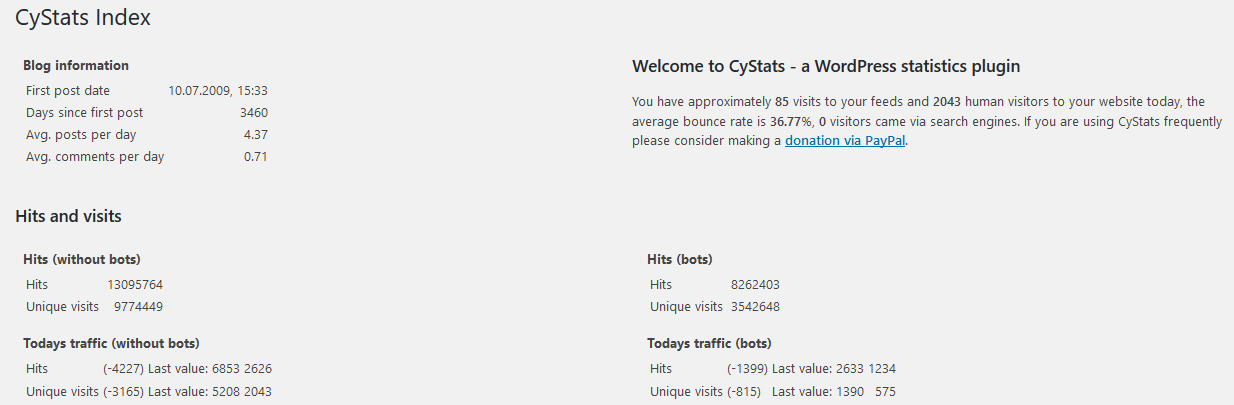
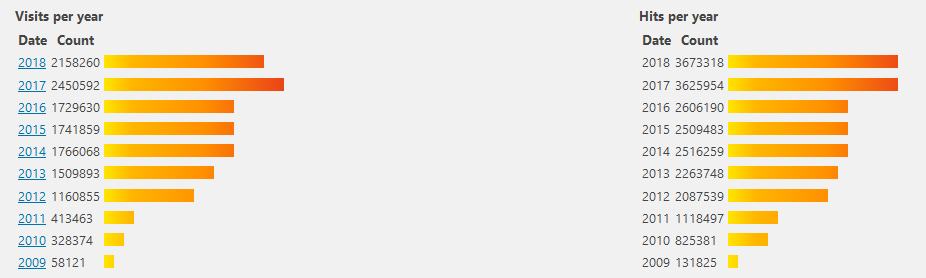
The annual statistics update on Quotulatiousness from January 1st through December 31st, 2017. The numbers will be a couple of thousand short of the full year, as I did the screen captures mid-morning on the 31st.

I stopped paying much attention to the blog stats years ago, but the jump in traffic from 2016 to 2017 is amazing! Going from a stable ~1.7 million visits per year to nearly 2.5 million last year is quite unexpected. That’s getting up toward the region where it might seem to make sense to try to monetize the blog … but I tried doing the Amazon affiliate thing earlier this year, and it generated exactly $0.00 in revenue for Amazon, and I got my full share of that revenue (as Jayne put it: “Let’s see, let me do the math: 10 per cent of nothing is, … (mumble) carry the zero …(mumble) … “)

December 14, 2017

Cognitive dissonance in action – Net Neutrality partisans want TRUMP to control the internet

Jon Gabriel on the weird position Net Neutrality fans find themselves in … demanding that Il Donalduce himself, the most hated politician in Liberal America since Richard Nixon be the one to dictate how the internet is run:

If President Trump is some kind of digital facist, he sure has a funny way of going about it.

His FCC chairman is trying to remove government from the Internet, returning it to those dark, authoritarian days of 30 months ago — you know, when pretty much every website, app and online service we use was created.

Bizarrely, these net neutrality alarmists are demanding that Trump maintain control of the Internet, planting his administration firmly between citizens and whatever content they want to view or create.

Even if Democrats were running the show in Washington, how could federal meddling improve the Internet? Do they want the Web run by the bureaucrats who spent $2 billion to build a health care website that didn’t work? Do they want our privacy assured by those behind the National Security Agency?

Nevertheless, progressives insist that Trump regulate the Internet in the name of free speech. Perhaps he can do this between his tweets bashing the press.

[…]

If the FCC approves this new proposal, the worst of federal meddling online will be retired. Instead, the commission will simply require Internet service providers to be transparent about their service offerings. That way, tech innovators will have the information they need and consumers will know which plan works best for them.

In other words, Web users and creators will be back in control of the Internet instead of lawyers and bureaucrats. Just as they were for all but the past couple of years.

To ensure transparency, Pai made all his proposals public before the FCC vote Thursday. A big departure from the Obama administration’s methods, which kept its net neutrality rules secret until after they were approved.

Before the FCC’s heavy-handed intervention, we saw the creation of Amazon, Google and Twitter. If Washington removes these unnecessary regulations as expected, we’ll see the Internet continue to blossom.

And my daughters will get to watch their favorite YouTube celebrities complain about net neutrality for years to come.

« Newer PostsOlder Posts »

Powered by WordPress