
One of the important side effects of the communications revolution is the proliferation of grifters, con men and hustlers. Things that were impossible thirty years ago, like e-mail scams, remain a constant problem. The internet has made it easy for even the crudest hustlers to reach a broad audience. As a result, the number of hustlers has increased and the types of hustles have also increased. The twitter troll, for example, is an entirely new type of hustle, made possible by the internet.
One reason for this is that the internet has turned into a big stage where anyone can try out their act on the public. In the old days, a carny bimbo would have been confined to a traveling carnival, Hollywood, New York or community theater. Maybe she would have ended up in pornography. It was not an easy way to make a living. Today, she can have a twitter account where she flashes photo-shopped pics of herself. Thirsty losers send her money through PayPal or super chats on her YouTube channel.
The low barrier to entry means every female with a desire for the carny life can get on stage from the privacy of her studio apartment. It’s not just females working the new rackets. In a prior age, Mike Cernovich would have been traveling from town to town selling his monkey mind juice to gullible townies at state fairs. Alex Jones would have been mailing people his mimeographed newsletter, where he explained how space aliens control the Federal Reserve Bank.
Most likely, it is the communications revolution that has caused the news media to commit suicide. In the old days, when the audience was fixed, the focus was on maintaining the facade of objectivity. No one was under any illusions about growing the audience, so they focused on keeping the audience. The internet promised a global market and unlimited market share. A relentless drive for eyeballs gave rise to the clickbait journalists turning the media into fake news.
The Z Man, “Carny Town”, The Z Blog, 2019-12-29.
March 31, 2020
February 12, 2020
“… perhaps the biggest Internet cash grab in the OECD with mandated payments and levies on thousands of Internet services with Canadian users”
Michael Geist refutes the claim that the recent Broadcast and Telecommunications Legislative Review Panel report does not recommend a “Netflix tax”:
The reference to a Netflix tax in the overview is the only such reference in the 235 page report. It was likely included in the overview in the hope that media coverage would jump on the claim and seek to re-assure Canadians that there was no Netflix tax or higher prices likely for consumers as a result of the report’s recommendations.
Yet the reality for anyone that reads beyond the overview is that the panel’s report not only recommends what would widely be considered a Netflix tax but proposes perhaps the biggest Internet cash grab in the OECD with mandated payments and levies on thousands of Internet services with Canadian users. This includes online streaming services, social media companies, news aggregators, and online communications services such as Skype, WhatApp, and Viber. In the view of the panel, any service or site with Canadian users is part of the “Canadian system” and should be expected to contribute to the development of Canadian content, Canadian news organizations, or building broadband connectivity. Note that all of this is above and beyond sales taxes, which the panel also recommends should be implemented with respect to foreign services.
Some of the panel’s plans are admittedly somewhat confusing. For example, the panel states:
Media curation undertakings brought under the regime – including Netflix and other online streaming services – would be required to devote a portion of their program budgets to Canadian programs.
That statement, along with chair Janet Yale’s comment at the opening press conference that there was no need for Netflix to spend additional money on Cancon but rather merely divert existing on foreign location and service production spending in Canada, has been interpreted by some to mean that Netflix would not have to increase its Canadian programming budget. But that is apparently not what the panel means. I spoke with Yale who confirmed that the panel expects the CRTC to establish a minimum Cancon spend requirement on Netflix based on its Canadian revenues. In other words, the requirement has nothing to do with its existing spending on production in Canada. For Netflix, that could certainly represent an increase in spending costs in Canada with those costs likely passed along to consumers.
Yet the panel’s plan extends far beyond just online streaming services such as Netflix. It also envisions mandatory levies against social media services and news aggregators that would be used to fund Canadian news services. It similarly targets a myriad of communications services that would pay into funds to support broadband development.
February 4, 2020
“Who could oppose such an obviously sound idea?”
A few pithy comments from Twitter on the Trudeau government’s apparent surprise that a few Canadians don’t think their regulate-the-internet plan is brilliant:
The thing to understand about this BTLR/Guilbeault fiasco is how commonplace it is. There are thousands of people in the Liberal/academic universe – the best and brightest – to whom the idea of gov’t licensing, regulating and subsidizing the media is entirely uncontroversial.
— Andrew Coyne (@acoyne) February 3, 2020
I’m sure he/they were genuinely taken aback at the response. Doesn’t *everybody* think the media should take instruction from a wise and enlightened gov’t, which would after all be run by wise and enlightened people like themselves? Who could oppose such an obviously sound idea?
— Andrew Coyne (@acoyne) February 3, 2020
Look at who’s on the panel that recommended it: law professors! People whose business It is to know about things like, say, the Charter of Rights. But then, given the courts’ appalling record on speech restrictions, perhaps they felt confident even this would be upheld.
— Andrew Coyne (@acoyne) February 3, 2020
Fellow Rush fan Matt Gurney finds the perfect lyrics for the occasion:
We’ve taken care of everything
The words you read
The songs you sing
The pictures that give pleasure
To your eye
One for all and all for one
Work together
Common sons
Never need to wonder
How or why https://t.co/OUurFwaokj— Matt Gurney (@mattgurney) February 4, 2020

Rush in concert, Milan 2004.
Photo by Enrico Frangi, via Wikimedia Commons
CRTC regulating the internet – “Nobody elsewhere is proposing anything like it, and for good reason: because it’s insane”
Ted Campbell suggests that the Canadian government most recent brainfart is a “Tea Party moment” for Canadians:
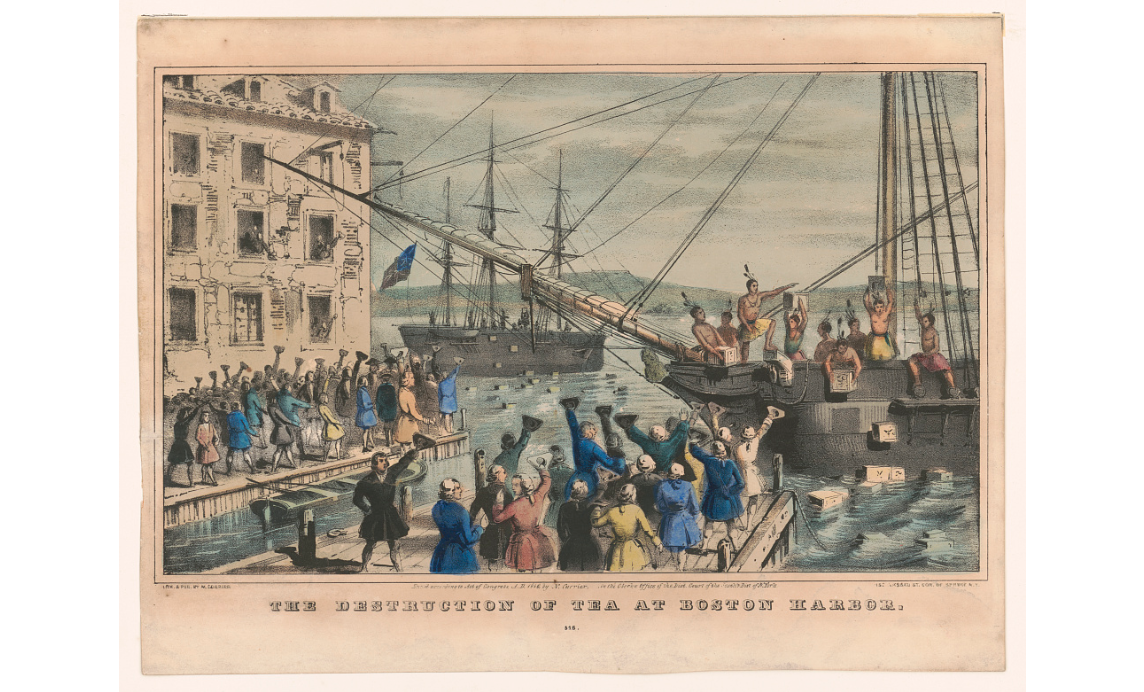
One commentator on social media dubbed this […] the moment when Heritage Minister Steven Guilbeault said that the Trudeau regime plans to license news websites as a “Boston Tea Pary moment.”
N. Currier. Destruction of tea at Boston Harbor, 1846. [New York: N. Currier]
Retrieved from the Library of Congress – https://www.loc.gov/item/91795889/She was referring to the protest, in December of 1773, when angry American colonists (many dressed as Native Americans to try and hide their true identities) dumped several hundred chests of tea, imported by the East India Company, into Boston harbour to protest the taxes, on almost everything, that had been imposed, by Westminster to pay for the Seven Years War. Westminster felt it was only fair to tax the colonists equally, along with the people of the British Isles, because much of the war, called the French-Indian War, now, by Americans, was fought to protect them and their vital commercial interests. The American colonists disagreed, many on the principle that they should not be taxed without being represented in parliament. We know where it all ended.
It’s a good question. Most commentators seem to agree with me that the Trudeau regime has seriously overreached in supporting the Broadcasting and Telecommunications Legislative Review Panel’s recommendations that, somehow, the distribution of “news” should be regulated by the government. That is a far, far greater intrusion into the liberty of free Canadian citizens than a tax on staples was to Americans in 1773.
Andrew Coyne, writing in the Globe and Mail, opines that “The whole thing is just breathtaking – a regulatory power grab without precedent, either in Canada or the democratic world. Nobody elsewhere is proposing anything like it, and for good reason: because it’s insane. This kind of bureaucratic micromanagement, with its obsession with ‘cultural sovereignty’ and ‘telling ourselves our own stories,’ would have been hopelessly outdated in 1990. In 2020, it’s just embarrassing.” He’s right to use the word “insane,” ~ the proposal is quite possibly unconstitutional, just for a start, it is, certainly based on a deeply mistaken idea of what the internet actually is ~ and he’s equally right to say that every Canadian who doesn’t, actively, protest against this must be embarrassed because each is, for no good reason at all that I can see, supporting a proposal that makes Canada less, far less, of a liberal democracy and more like Ethiopia and Senegal (both with scores below 6.0, the threshold for a Flawed Democracy in the well regarded Economist Intelligence Unit’s latest democracy index) where he will visit this week … perhaps to learn from the leaders of authoritarian regimes what his next steps should be to embarrass Canada further.
Michael Geist on the jaw-dropping performance of Trudeau’s Canadian Heritage Minister last weekend:
In June 2017, the Standing Committee on Canadian Heritage committee recommended implementing tax on Internet services in a report on media. Within minutes, Prime Minister Justin Trudeau was asked about the proposal at a press conference in Montreal. Trudeau’s answer – which literally came as committee chair Hedy Fry was holding a press conference on the report – was unequivocal: No. The government was not going to raise costs of Internet services with an ISP tax. The committee recommendation was minutes old and the government wasted absolutely no time in killing the proposal.
Last week, the Broadcasting and Telecommunications Legislative Review Panel proposed a far broader regulatory vision for the Internet. Indeed, it is difficult to give the full breadth of this plan its due. I will be posting this week on some of the most harmful aspects of the plan, including regulating media organizations around the world with penalties in the hundreds of thousands of dollars for failing to obtain licences, regulating streaming companies despite their massive investment in Canada, regulating everything from app stores to operating systems, creating liability for harmful content that violates Canada’s commitments in the USMCA, undermining net neutrality, and increasing the costs of Internet-based services for Canadian consumers.
Over the weekend, Canadian Heritage Minister Steven Guilbeault was asked about the proposal. In particular, he was asked about the proposal to licence foreign news sites (the example used was Breitbart but it could just as easily have been the New York Times, BBC, CNN, Fox or MSNBC). The answer should have been easy: no.
Instead of “no”, Minister Guilbeault’s response was that it was “no big deal.”
On Monday morning, the minister appears to have reconsidered being quite so blatant in indulging his inner authoritarian control freak:
Guilbeault walked back the comments on Monday, stating that the government had “no intention to impose licensing requirements on news organizations,” nor will the government “regulate news content.”
“… Our focus will be and always has been that Canadians have diversity to high-quality news sources,” said Guilbeault to reporters in Ottawa.
This announcement comes after deep criticism of a previous announcement by the Liberal government, where they said they would force news organizations to apply for a licence.
Guilbeault’s announcement faced intense scrutiny from across the political spectrum with some commentators suggesting that it would be a dangerous attack on the freedom of the press.
January 31, 2020
“… the report envisions unprecedented government and regulatory intervention into the delivery of news services”
Michael Geist heaps scorn on the recommendations of a panel that would empower the CRTC to regulate the internet in Canada to a very high degree:
The Broadcast and Telecommunications Legislative Review Panel released its much anticipated report yesterday with a vision of a highly regulated Internet in which an expanded CRTC (or a renamed Canadian Communications Commission) would aggressively assert its jurisdictional power over Internet sites and services worldwide with the power to levy massive penalties for failure to comply with its regulatory edicts. The recommendations should be rejected by Innovation, Science and Industry Minister Navdeep Bains and Canadian Heritage Minister Steven Guilbeault as both unnecessary to support a thriving cultural sector and inconsistent with a government committed to innovation and freedom of expression.
[…]
Yet the strengths of the telecommunications and consumer rights portions of the report are overshadowed by a stunning set of recommendations related to Internet content, some of which are unlikely to survive constitutional scrutiny, likely violate Canada’s emerging trade commitments, and rest of shaky policy grounds. If enacted, the Canadian Internet would be virtually unrecognizable with the CRTC empowered to licence or require registration from a myriad of Internet services, mandate what Canadians see on those services, and intervene in commercial negotiations. The 235 page report will require several posts to address all of its aspects and implications (including notable CBC and copyright reforms), but this post seeks to set out its broad-based content regulatory vision and make the case that the panel’s plan should be firmly rejected by the government.
The foundation of the content section of the report is the decision to regulate all media content, which includes audio, audiovisual, and news content delivered by telecom. In doing so, the report envisions unprecedented government and regulatory intervention into the delivery of news services. It argues that there are three types of services that provide this content that require regulation where they access the Canadian market:
- Curators – services that disseminate media content with editorial control (broadcasters and streaming services such as Netflix, Spotify, and Amazon Prime)
- Aggregators – cable companies, news aggregators such as Yahoo News
- Platforms for Sharing – services that allow users to share amateur and professional content such as YouTube, Facebook and other platforms
The panel recommends that all of these kinds of companies be regulated (either by way of licence or registration), be required to contribute to Canadian content through spending percentages or levies, and comply with CRTC regulations on discoverability that would include regulatory rules on how prominently Canadian content is displayed within the service. The CRTC would be empowered to decide whether to exempt services from regulation with the power to levy huge penalties for failure to comply with its decisions (described as “high enough to create a deterrent foreign undertakings”).
January 29, 2020
“CanCon” rules for internet streaming services will be “inevitable”
Yes, the federal government is serious about extending the moronic “Canadian content” regime to internet streaming companies (like Netflix). Canadians are too blind to be allowed to select all of their own viewing without the paternal hand of government jiggling those choices in a politically desired direction, as Michael Geist explains:
Later this week, a government appointed panel tasked with reviewing Canada’s broadcast and telecommunications laws is likely to recommend new regulations for internet streaming companies such as Netflix, Disney, and Amazon that will include mandated contributions to support Canadian film and television production. In fact, even if the panel stops short of that approach, Canadian Heritage Minister Steven Guilbeault and Canadian Radio-television and Telecommunications Commission chair Ian Scott have both signalled their support for new rules with Mr. Guilbeault recently promising legislation by year-end and Mr. Scott calling it inevitable.
My Globe and Mail op-ed notes that the new internet regulations are popular among cultural lobby groups, but their need rests on a shaky policy foundation as many concerns with the fast-evolving sector have proved unfounded.
[…]
Third, the not-so-secret reality of the Canadian system is that foreign location and service production and Canadian content are frequently indistinguishable. Qualifying as Canadian requires having a Canadian producer along with meeting a strict point system that rewards granting roles such as the director, screenwriter, lead actors, and music composer to Canadians.
Yet this is a poor proxy for “telling our stories”. The rules mean foreign companies can never produce Canadian content leading to the absurd outcome that revivals of Canadian programs such as Trailer Park Boys and Degrassi will not meet the qualification requirements if Netflix is the sole funder and producer. Moreover, programs such as The Handmaid’s Tale may be based on a Margaret Atwood novel, but using one of Canada’s best known novelists as the source doesn’t count in the Canadian points system.
So what is Canadian? A quick scan of Canadian Audio-Visual Certification Office data turns up Blood and Fury: America’s Civil War, The Kennedys, Murder in Paradise, Natural Born Outlaws, Who Killed Ghandi?, and dozens of other programs that are Canadian in regulation-only. Further, there are also “co-productions”, in which treaty agreements deem predominantly foreign productions such as The Borgias or Vikings as Canadian.
December 8, 2019
QotD: Web traffic
The Operator: “If you’re Amazon or Sendit, but not if you’re us. We’re a web nothing! Baby seals get more hits!”
Simon Travaglia, “BOFH tests the law of redundant supply”, The Register, 2004-10-04.
November 20, 2019
Activist court watch – Federal Court of Canada judge creates new website blocking rules
Michael Geist on the precedent-setting decision from the Federal Court of Canada:
A Federal Court of Canada judge issued a major website blocking decision late Friday, granting a request from Bell, Rogers, and Groupe TVA to block access to a series of GoldTV streaming websites. The order covers most of the Canada’s large ISPs: Bell, Eastlink, Cogeco, Distributel, Fido, Rogers, Sasktel, TekSavvy, Telus, and Videotron. The case is an important one, representing the first extensive website blocking order in Canada. It is also deeply flawed from both a policy and legal perspective, substituting the views of one judge over Parliament’s judgment and relying on a foreign copyright case that was rendered under markedly different legal rules than those found in Canada.
Perhaps most troubling is that the judge has created a substantive new policy framework for site blocking, an issue that given the many complex policy issues (including copyright enforcement, freedom of expression, net neutrality, and telecom competition) is best left to Parliament. Indeed, the activist judicial approach explicitly engages in an analysis that considers many of the policy issues but arrives at its own conclusion about how best to balance competing interests. These are issues that are best left to elected officials. The Standing Committee on Industry, Science and Economic Development, which completed the comprehensive copyright review earlier this year, heard extensive submissions from groups calling for reforms to the law to include site blocking. It instead recommended:
Following the review of the Telecommunications Act, that the Government of Canada consider evaluating tools to provide injunctive relief in a court of law for deliberate online copyright infringement and that paramount importance be given to net neutrality in dealing with impacts on the form and function of Internet in the application of copyright law.
In other words, the committee recommended holding off on a site blocking rule until further study is conducted. Moreover, it concluded that “paramount importance be given to net neutrality.” The judge in GoldTV acknowledged that there were net neutrality concerns (rejecting claims that “net neutrality is of no application where a site blocking order is sought.”), but concluded that the net neutrality issues did not tip the balance against granting the injunction. Not only is that inconsistent with the copyright review emphasis of paramountcy for net neutrality, but it represents the judge making a policy choice best left to elected officials.
The CRTC, which rejected a proposal for an administrative site blocking system in the FairPlay case, also thought the issue was best left to the government. Its ruling specifically cited the copyright review and the review of the Broadcasting and Telecommunications Act as avenues to address the issue. In other words, the appropriate venue to consider site blocking was government, not an administrative agency.

October 10, 2019
QotD: Taxonomy of the online troll
The Peevish Adolescent’s dominating emotions are all about primate posturing for status. One often gets the sense that any authority or high-status figure would do as a target for his feces-flinging and one has been chosen for the role almost at random. The Internet enables him to demonstrate belligerantly at a silverback male without fear of actual consequences; this thrills him and helps him feel marginally less inadequate.
The polar opposite of the Peevish Adolescent is the Embittered Old Fart. This type is much less common and much more interesting. Tends to be middling on the language-competency scale, and may have interesting things to say if you can mask out that 60-cycle hum.
The dominant emotions of the Embittered Old Fart are envy and resentment. The EOF fails to hide the fact that he thinks he could have been as famous and successful as you, or should have been; in order to live with his own comparative failure, he has to try to tear you down and trash your reputation. The amount of effort and intelligence an EOF may expend on this project is a very sad thing to see; one can’t help thinking he’d have much less resentment in him if he’d directed his energy more constructively in the past. Accordingly, where the Peevish Adolescent is mostly just ridiculous, the Embittered Old Fart is genuinely tragic.
Next we come to the Zealot. The Zealot thinks you are an articulate advocate of evil and must therefore be discredited at all costs. He doesn’t hate your success other than consequentially, and isn’t mainly concerned with posturing for status. No; his problem is that you have associated yourself with the wrong operating system, or the wrong political ideas, or the wrong religion, and that you commit the intolerable crime of persuading others to do likewise.
High-grade zealots are the most articulate variant of haterboy; indeed, they often run over with immaculately grammatical verbiage. Of all the haterboy types, they are most likely to try to pack a PhD thesis into a blog comment, complete with numerous hyperlinks. The thing about them, though, is that no matter what their particular idée fixe is, they all sound alike after awhile. The 60-cycle hum drowns out the idea content.
Zealots are also the least likely type to use an identity-concealing handle. Sadly, the appearance of honesty often deceives; their citations are apt to be thin and hyperpartisan, and their arguments to have gaps or even tactical falsehoods at crucial points. You are more likely to learn something useful from an Embittered Old Fart than from a Zealot.
Finally, the Iconoclast. The Iconoclast is, in his own mind, a fearless and principled speaker of truth to power. You are the idol with feet of clay, the pretender, the false god he must destroy. But note how he differs from the Peevish Adolescent; he is relatively unconcerned with his own status, and more like the Zealot in that he is mainly interested in protecting others from your baneful influence. The core of his complaint, though, is about social power and personal influence rather than ideas.
On this blog, the characteristic accusations of the Iconoclast are that (a) I’m a monster of ego, and (b) I claim a position of leadership in the hacker community that I don’t actually hold. I point these out because they’re issues that matter much less to the other haterboy types. The Peevish Adolescent and the Embittered Old Fart attack me exactly because they see me as a silverback alpha, and the Zealot is only upset by my social power insofar as it assists the infectiousness of my ideas.
Eric S. Raymond, “Taxonomy of the haterboy”, Armed and Dangerous, 2010-12-22.
August 12, 2019
News consumption in Canada according to a new report from the Digital Democracy Project
Ali Taghva summarizes some of the more interesting findings from a new study of how Canadians get their news in the internet age:
Earlier this month, the Digital Democracy Project (DDP), a joint initiative led by the Public Policy Forum and the Max Bell School of Public Policy at McGill University, published their first report in a series aimed at studying the Canadian media ecosystem in the lead up to the 2019 election.
The results are reaffirming for anyone who believes the nation’s media do not require ethically worrying government funds to continue operation.
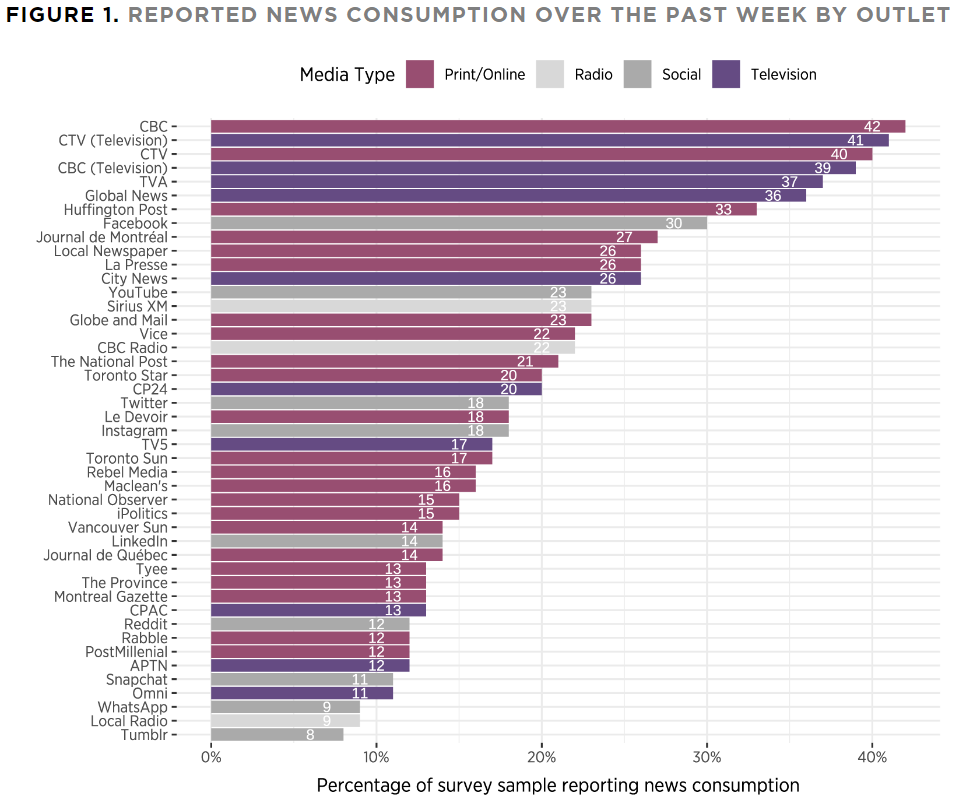
In less than two years, The Post Millennial has become one of the largest media organizations in the country. According to DDP’s survey results, roughly 12% of respondents viewed our content in the last week.
The above chart indicates that our digital viewership equates roughly to one-fourth of the reach held by CBC.
While the CBC and others continue to spend hundreds of millions to compete, we continue to grow and remain cash-flow positive on a budget less than 1/100th the size of our mainstream competitors.
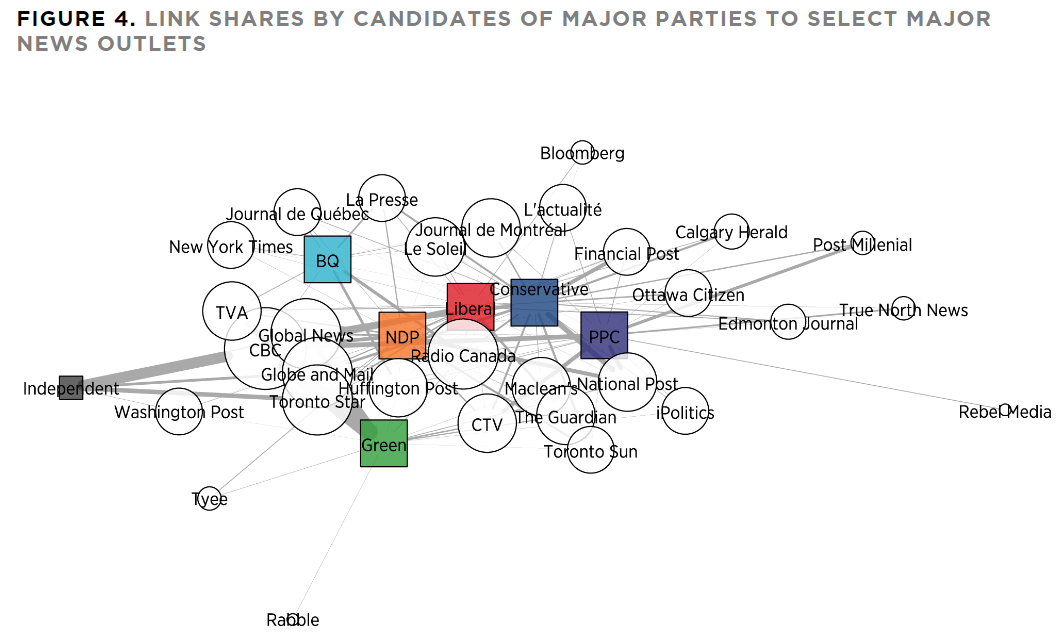
Another interesting graphic from the PDF research memo is this representation of the distribution of online link sharing by candidates of the major parties:
The following directed network graph shows the relative frequency of linked news sites among the six main parties. Each media outlet is represented by a circle, the size of which reflects the frequency at which candidates link to the site. A large circle thus indicates multiple parties frequently sharing content from that outlet. The width of the lines that the parties to the outlets is based on how often candidates from that party share content from that outlet.
Australia’s government broadband fiasco might be a useful lesson for Senator Warren
In the race for the Democratic party’s presidential nomination, Senator Elizabeth Warren recently proposed a government-provided broadband rollout across the United States to compete with or supplant the existing private ISPs. Arthur Chrenkoff suggests that looking at Australia’s experience with a very similar plan might encourage her to abandon her proposal after a brief airing on the campaign trail:

Senator Elizabeth Warren speaking at the Iowa Democrats Hall of Fame Celebration in Cedar Rapids, Iowa, on 9 June, 2019.
Photo by Lorie Shaull via Wikimedia Commons.
Maybe Senator Warren should have a pow-wow first with IT experts from Australia, who could enlighten her about our country’s 12-years-and-counting saga of the National Broadband Network, a Labor government initiative that the -then leader of the opposition, Tony Abbott, described as “a white elephant on a massive scale” but later adopted and continued while in government.
It started in 2007 as a policy for a government-rolled out broadband network, in most areas duplicating internet services already provided by private sector providers (mainly through the existing copper wire telephony network), which would be available as an option to all Australian households. In most cases it would be achieved through wired technology (fibre to the premises, later downgraded to a cheaper fibre to the node) with a satellite connection available to the most remote areas where cabling was impractical.
I remember thinking then that the project was an absurd waste of taxpayers’ money for a service of the type that telecommunication companies would be able and willing to provide in any case. At most, there was an argument that the government could step in and provide the infrastructure in some country areas where there was no commercial case for the private providers to proceed. Call me a clairvoyant but it was pretty clear to me that “broadband for all” would take a lot longer to roll out that planned, would cost significantly more than initially budgeted, and would very likely be technologically obsolete by the time it was finished.
June 5, 2019
Sensible proposals from the copyright review report
Michael Geist summarizes the — seemingly quite sensible — recommendations from the copyright review process:

Assignments of copyrights photostat copies by mollyali (CC BY-NC 2.0) https://flic.kr/p/5JbsPE
In December 2017, the government launched its copyright review with a Parliamentary motion to send the review to the Standing Committee on Industry, Science and Technology. After months of study and hundreds of witnesses and briefs, the committee released the authoritative review with 36 recommendations [PDF] that include expanding fair dealing, a rejection of a site blocking system, and a rejection of proposals to exclude education from fair dealing where a licence is otherwise available. The report represents a near-total repudiation of the one-sided Canadian Heritage report that was tasked with studying remuneration models to assist the actual copyright review. While virtually all stakeholders will find aspects they agree or disagree with, that is the hallmark of a more balanced approach to copyright reform.
This post highlights some of the most notable recommendations in the report that are likely to serve as the starting point for any future copyright reform efforts. There is a lot here but the key takeaways on the committee recommendations:
- expansion of fair dealing by making the current list of fair dealing purposes illustrative rather than exhaustive (the “such as” approach)
- rejection of new limits on educational fair dealing with further study in three years
- retention of existing Internet safe harbour rules
- rejection of the FairPlay site blocking proposal with insistence that any blocking include court oversight
- expansion of the anti-circumvention rules by permitting circumvention of digital locks for purposes that are lawful (ie. permit circumvention to exercise fair dealing rights)
- extend the term of copyright only if ratifying the USCMA and include a registration requirement for the additional 20 years
- implement a new informational analysis exception
- further study of statutory damages for all copyright collectives along with greater transparency
- adoption of an open licence rather than the abolition of crown copyright
My submission to the Industry committee can be found here. The submission and my appearance is cited multiple times in the report and I’m grateful that the committee took the submissions from all witnesses seriously.
May 22, 2019
April 11, 2019
What happens if you block access to all of Google’s IP addresses?
The answer is … not a lot, or at least not quickly. So many companies use Google’s services in the background that even if you can get a particular site to work for you, it’ll very likely be as slow as a mid-90’s dial-up connection. Stephen Green reports on someone’s live experiment with a Google-less internet:

Behind the scenes, [Gizmodo’s Kashmir] Hill’s specialty VPN blocked her devices from trying to ping Google’s servers more than 15,000 times — in just the first few hours. After a week, it had stopped more than 100,000 attempts to share data with Google. And to repeat, this is after Hill had stopped using any of Google’s apps or services. The company has its tendrils all throughout the internet.
As Hill describes the process in her report to Gizmodo:
I migrate my browser bookmarks over to Firefox (made by Mozilla).
I change the default search engine on Firefox and my iPhone from Google — a privilege for which Google reportedly pays Apple up to $9 billion per year — to privacy-respecting DuckDuckGo, a search engine that also makes money off ads but doesn’t keep track of users’ searches.
I download Apple Maps and the Mapquest app to my phone…
I switch to Apple’s calendar app.
I create new email addresses on Protonmail and Riseup.net (for work and personal email, respectively) and direct people to them via autoreplies in Gmail.
Hill did literally everything an internet-connected human being can do to disconnect themselves from Google. But you don’t have to be a Google customer in order to have the company garner 100,000 little bits of data about you every single week. Or as Hill herself says, “Google, like Amazon, is woven deeply into the infrastructure of online services and other companies’ offerings, which is frustrating to all the connected devices in my house.”
The fact is, you aren’t Google’s customer: You and your data are Google’s product, served up on an electronic platter to advertisers and God-Only-Knows-Who-Else… even if, like me, you’ve boycotted all of the company’s little data-sniffing products.
As a libertarian, I have philosophical issues with the whole idea of antitrust. But when a company grows so big and so pervasive that you can’t avoid becoming its tool — even when going to the extreme lengths Hill went through — then I can draw only one conclusion, expressed in three words.
Break. Them. Up.


