Quotulatiousness

August 10, 2024

“Heavy casualties” in a modern western army might count as “a skirmish” in earlier conflicts

Filed under: Books, History, Media, Military, USA — Tags: , , , , , — Nicholas @ 04:00

I sent a link to Severian a few weeks ago, thinking it might be an interesting topic for his audience and he posted a response as part of Friday’s mailbag post. First, my explanation to him about why I thought the link was interesting:

I know that Edward Luttwak is what the Brits call “a Marmite figure” … people love or hate him and not much in between. I’ve read several of his books and found he had interesting things to say about the Roman and Byzantine armies in their respective eras but I haven’t found his modern analysis to be anywhere near as interesting. This time, however, he might well have found that acorn … is the dramatic casualty-aversion of western nations going to be a key element of future, shall we say “adventurism”?

Clearly, [Vladimir Putin and Benjamin Netanyahu] can still get their legions moving when they feel they need to, but could [insert current US President here] get the 101st Airborne into a high-casualty environment (let’s not pretend that Rishi Sunak or Keir Starmer could or would, and Macron’s posturing is nearly as bad as Baby Trudeau’s total lack of seriousness)?

Anyway, here’s the Marmite Man’s latest – https://unherd.com/2024/06/who-will-win-a-post-heroic-war

Sev responded:

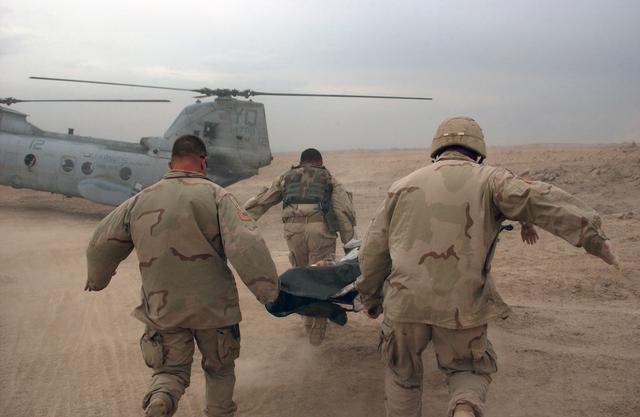
US Army soldiers assigned to 2-7 Cavalry, 2nd Brigade Combat Team (BCT),3rd battalion 1st Division, rush a wounded Soldier from Apache Troop to a waiting USMC CH-46E Sea Knight helicopter during operation in Fallujah, Iraq, during Operation IRAQI FREEDOM.
Photo by SFC Johan Charles Van Boers via Wikimedia Commons.

I’ve often said that, from what I can tell — and bearing in mind my entire military experience consists of a .500 record at Risk!AINO‘s entire force philosophy amounts to “zero casualties, ever”.

Note that this was true even in the 20th century, when America was still America. “Stupendous casualties” by American standards would hardly rate “a spot of bother” by Soviet. Wiki lists the bloodiest American battle as Eisenborn Ridge (part of the Bulge), with approximately five thousand fatalities.

A Soviet commander who didn’t come home with at least five thousand KIA could probably expect to be court-martialed for cowardice.

That same Wiki article separates “battles” from “campaigns” for some reason. There’s an entire “methodology” section I’m not going to wade into, but even looking at “campaigns”, the bloodiest (by their definitions) is Normandy — 29,204 KIA. That’s an entire campaign, which might rate “a hard week’s fighting” by Soviet, German, or Japanese standards.

Please understand, Americans’ unwillingness to take casualties was greatly to their credit. You want to know about “meat assaults”, ask the Germans, Russians, or Japanese (or the British or French in WWI). George Patton might not have been the best American commander, but he was the most American commander — the whole point of battle is to make the other stupid bastard die for his country. I am 100% in favor of minimal losses, for everyone, everywhere.

But “minimal” does not mean “none”. People die in wars. People die training for wars. People die in the vicinity of the training for war, because it’s inherently risky. It doesn’t make one some kind of monster to call these “acceptable” losses; it makes one a realist. One could just as easily say — and with the same justification — that a certain number of car crash fatalities, or iatrogenic deaths, etc. are acceptable losses, because there’s no way to have “interstate commerce” and “modern medicine”, respectively, without them.

The Fistagon seemingly denies this. Forget human losses for a moment, and consider mere equipment. You read up on, say, Air Force fighter planes, and you’re forced to conclude that their operations assume that all planes will be fully operational at all times. Again, saying nothing of the pilots, just the airframes. The Navy seems to assume that all ships everywhere will not only be serviceable, but actually in service, at all times. Just recently, they shot off all their ammo at Houthi and the Blowfish … and seemingly had no idea what to do, because as Milestone D walked us through it, it’s impossible to rearm while underway.

Think about that for a second. How the fuck is that supposed to work in a real war? Can we just put the war on pause for a few months, so all our ships can head back to port to reload?

In fact, I’d go so far as to speculate that that’s the origin of the phrase “meat assault”. What The Media are calling a “meat assault” is simply what was known to a sane age as “an assault”. No qualifiers. You know, your basic attack — go take that hill, and if you take the hill, and if enough of the attacking force survives to hold it, that’s a win. People who absolutely should know better, though, don’t see it that way.

Since we’re here … I remember having conversations with some folks in College Town re: the Battle of Fallujah, while it was happening (technically the Second Battle of Fallujah). Now, obviously quite a few of my interlocutors were ideologically committed to the position that this was senseless butchery. And in the fullness of time, I too have come around to the position that the entire Operation Endless Occupation was senseless butchery. But leaving all that aside, the point I was trying to make was a simple one: Total US casualties were 95 killed, 560 wounded.

Every one of them a senseless crime, I now believe, but considering Fallujah strictly as a military operation, that’s amazing. House-to-house fighting in a heavily urban area, against a fanatically committed opponent who was willing, indeed eager, to use every dirty trick in the book … and US forces took 655 total casualties. That’s about as well as it can possibly be done. The Red Army probably lost 655 men on the train ride getting to Stalingrad. I wouldn’t be surprised at all to learn that 655 is the daily casualty figure across the entire front in Ukraine … hell, I wouldn’t be surprised to learn that there are lots of individual sectors in Ukraine taking those kinds of daily losses. 655 is pretty damn good …

… but I was called every dirty name they could think of for suggesting it. I was called dirty names by people who called themselves conservatives, who were such ostentatious “patriots” that they’d embarrass Toby Keith.

Fallujah was fought in 2004, a time that seems like the Blessed Land of Sanity compared to now. AINO simply won’t take casualties. The Pentagram won’t — lose a tank, and you lose your job. (In battle, obviously. If you abandon it to the Taliban, no problem. And of course if you lose an entire war, it’s medals and promotions for everyone). And because the high command won’t, the field commanders won’t either. And because they won’t … well, “desertion” is an ugly word, but let’s just say Tim Walz won’t be the only guy who suddenly needs to be elsewhere right before it’s time to ship out. And as for the guys actually shanghaied into whatever foreign fuckup … well, “mutiny” is an even uglier word, but does anyone want to bet against it?

August 2, 2024

Why WW1 Turned Into Trench Warfare

Filed under: Britain, France, Germany, History, Military, WW1 — Tags: , , , , — Nicholas @ 02:00

The Great War
Published Apr 12, 2024

Trench warfare is one of the lasting symbols of the First World War, especially on the Western Front. But when the war began, the German and French armies envisioned sweeping advances and defeating the enemy swiftly. So, how and why did the Western Front in 1914 turn into the trench system we associate with WW1?
(more…)

July 18, 2024

What is a Battle Rifle?

Filed under: History, Military, Weapons — Tags: , , — Nicholas @ 02:00

Forgotten Weapons
Published Apr 10, 2024

“Battle rifle” is not a formally recognized term like “assault rifle”, but it is widely used, and I think it has a lot of utility. It is intended to differentiate between intermediate-caliber and full-power military rifles, and to that end I propose these four criteria to define a “battle rifle”:

1 – A military style or pattern rifle
2 – Intended primarily to be fired from the shoulder
3 – Self-loading (either semi- or fully automatic)
4 – Chambered for a full power rifle cartridge
(more…)

July 17, 2024

Americans Repeatedly Routed – The Korean War – Week 004 – July 16, 1950

Filed under: Asia, Britain, History, Japan, Military, USA — Tags: , , , , , , — Nicholas @ 04:00

The Korean War by Indy Neidell
Published 16 Jul 2024

Elements of the US 24th Division, the only American one that’s arrived in force in Korea so far, take on the North Korean forces aiming for Taejon, but they are badly — and easily — defeated each time. In the center and the east coast it’s the ROK- the forces of the South — that are reorganizing and getting into position to try to stop the enemy. And Douglas MacArthur is officially appointed commander of all UN forces in Korea.
(more…)

July 10, 2024

The Korean War – Never Fear, MacArthur’s Here! – Week 003 – July 9, 1950

Filed under: Asia, Britain, History, Japan, Military, USA — Tags: , , , , , , — Nicholas @ 04:00

The Korean War by Indy Neidell
Published 9 Jul 2024

American troops have arrived in Korea and engage the KPA — the forces of the North — in the field this week for the first time. It does not go well for them. In fact, it’s hard to imagine it going worse. The Americans are outnumbered and outgunned and are routed. In fact, the KPA are advancing all over the country, though they are taking heavy casualties themselves.
(more…)

July 6, 2024

Why Germany Lost the Battle of Verdun

Filed under: France, Germany, History, Military, WW1 — Tags: , , , , — Nicholas @ 02:00

The Great War
Published Mar 8, 2024

The Battle of Verdun represents the worst of trench warfare and the suffering of the soldiers in the minds of millions – and for many, the cruel futility of the First World War. But why did Germany decide to attack Verdun in the first place and why didn’t they stop after their initial attack failed?
(more…)

June 19, 2024

Why the US Lost the Tet Offensive Despite Beating the NVA

Filed under: Asia, History, Military, USA — Tags: , , , , , , — Nicholas @ 02:00

Real Time History
Published Feb 16, 2024

After years of boots on the ground and bloody combat in Vietnam, US officials are publicly confident. The strategy of eliminating the Viet Cong is working. The North Vietnamese communist forces are on their last legs and victory is only a matter of time. Or so they say. But as 1968 and the traditional lunar new year festivities begin, US and South Vietnamese troops find themselves on the receiving end of a formidable North Vietnamese surprise attack: The Tet Offensive.
(more…)

June 8, 2024

Battlefield Normandy – The battles for Norrey, Bretteville & Putot

Filed under: Cancon, France, Germany, History, Military, WW2 — Tags: , , , , , — Nicholas @ 02:00

The AceDestroyer
Published Jun 27, 2019

Hello, welcome to The AceDestroyer and welcome to the third and final episode of the Battlefield Normandy Series. In this episode we follow the Canadians defending Putot-en-Bessin, Bretteville-L’Orgueilleuse and Norrey-en-Bessin. In the two days of heavy combat with the 12th SS Hitlerjugend, the 7th Canadian Infantry brigade managed to hold on to all three towns. Find out how in this episode …
(more…)

June 6, 2024

Battlefield Normandy – The Battle of Juno Beach 6 June 1944

Filed under: Cancon, France, Germany, History, Military, WW2 — Tags: , , , , , — Nicholas @ 02:00

The AceDestroyer
Published Nov 18, 2018

Hello and welcome to the first episode of my Battlefield Normandy series. This part is all about the landings at Juno beach on June 6 1944, and what happened on the first day of the Allied landings in Normandy. In this episode we will take a look at all the landing beaches and the subsequent fighting. You can find the maps on my Facebook page. The next episode will be about the battle of Authie on June 7, when the Canadians first met the 12th SS Hitlerjugend. I hope you’ll enjoy this video and find it helpful.
(more…)

May 26, 2024

Evolution of The Churchill Tank | “No Damn Good”?

Filed under: Britain, History, Military, Weapons, WW2 — Tags: , , , , , , — Nicholas @ 02:00

The Tank Museum
Published Feb 17, 2024

Designed by a company that had never built a tank before with the Prime Minister, Winston Churchill, looking over their shoulders and plagued by mechanical teething troubles, the Churchill tank had unpromising beginnings. Despite this, it became one of the most successful British tanks of WW II: heavily armoured, not fast but with superb climbing ability, the Churchill served not only as a gun tank but the basis many of the specialised vehicles that helped the British and Canadian Armies ashore on D-Day.

00:00 | Intro
01:20 | History – What was needed?
03:38 | Design, Weaponry and Armour
08:44 | Up-gunned and Upgraded
13:59 | A Look Inside
17:51 | Combat Performance
20:23 | Multi-use Platform
23:10 | Conclusion

This video features archive footage courtesy of British Pathé.

#tankmuseum

April 21, 2024

QotD: The “omni-spear” of the Mediterranean World

Filed under: Europe, History, Military, Quotations, Weapons — Tags: , , , — Nicholas @ 01:00

So I first want to suggest a set of basic characteristics for what I am going to term the “omni-spear“, the standard kind of iron-tipped one-handed thrusting spear that almost everyone fought with in the Mediterranean world.

So let us posit a spear. Its haft is made of wood – our ancient sources tend to be particular that certain kinds of wood, particularly ash and cornelian cherry (cornel wood), are best – and about 2.5 to 3m in length and roughly 2.5cm in diameter. Obviously, on one end we’ll have our iron spear head. On the other end, we probably have a smaller iron spear butt, sometimes called a ferrule.

For our spear tip, we’re going to have a hunk of iron about 250-450g in mass. It’s going to have a circular socket, about 2 to 2.5cm in diameter (to fit the haft) at its base. That socket will then proceed upwards into the tip as a “mid-ridge”, though it generally stops being entirely hollow at some point. In two directions from the mid-ridge are going to project some “blades” – if we’re French, we’ll call them flamme, “flames”, while if we’re Spanish they’ll be hoja, “blades”, and if we’re German they’re Blätter, “sheets, leaves”. These taper at the tip and widen towards the base, usually before curving gracefully inward on the socket a few inches up from its base. Often scholars have called this a “leaf shaped” spearhead, which I always find a bit awkward in phrasing (leaves can have many shapes), but the alternatives, like “tear-drop” shaped, aren’t any less awkward. If you are having a hard time conceptualizing that picture, here is an example of what I mean.

For the bottom of the spear we could just go with nothing. We could also make a simple conical socket in iron and secure it with a rivet or, if we’re being really creative, a nail hammered into the base of the shaft. If we want to be really fancy, we might make a spear-butt that combines a circular socket with a long square-sectioned projection so that it serves better as a backup point in a pinch. If you want to see the more developed version of that, here is a Greek “sauroter“, about the most elaborate this part of the spear gets.

And there we go. We have the “omni-spear”. Basic spear-butt, “leaf-shaped” spearhead with a strong mid-ridge, both generally in iron, joined by a 2.5-3m long wooden haft, about 2.5cm thick (though the haft might be thicker, as it could taper before meeting the socket) made of hardwood, with a grip at the center of balance.

That basic description describes the famous Greek dory, the spear of the hoplite. It also describes one of the more common forms of the Roman hasta, one with what I’ve termed a “Type A” Roman spearhead. And it also describes the La Tène spear, the native name of which we don’t know.1 And it also describes common thrusting spears of the Iberian Peninsula, both those used by the Iberians living in the coastal Levante and the Celtiberian peoples living on the Meseta; the names of those spears too are lost to us.2 And it also describes the common weapon of the Persian infantry, including their elite infantry which Herodotus calls “Immortals”. Almost certainly it describes spears even further afield, but we are rapidly reaching the edge of my expertise, so I’ll stop with the Persian Empire.

Bret Devereaux, “Collections: The Mediterranean Iron Omni-Spear”, A Collection of Unmitigated Pedantry, 2023-11-10.


    1. And before you jump up to tell me “oh, it was called a gaesum“, no, that’s a javelin and we do not know what sort of javelin correlates to that name preserved in our sources.

    2. And before someone jumps up and tells me, “oh, it was called a soliferreum, no, that’s also a javelin and we do know exactly what sort of javelin that correlates to. They’re super cool, but they are throwing weapons, not thrusting spears. Interestingly, all over the Iberian peninsula it seems to have been standard for warriors to carry one javelin (often, but not always a soliferreum) and one thrusting spear. We find that pattern over and over again in burial deposits.

March 25, 2024

WWII Allied Vehicles – Universal Carrier

Filed under: Britain, Cancon, History, Military, Weapons, WW2 — Tags: , , , — Nicholas @ 02:00

Ontario Regiment Museum
Published Jan 26, 2022

This multi-part series was originally created in support of our friends at D-Day Conneaut for presentation during their live stream in 2020.

In part 5 the Museum’s Operation Manager Dan Acre details the history of a Canadian-made WWII vehicle, the Universal Carrier. (Please forgive the sound quality, it was one of the first videos we produced in the early stages of the pandemic.)
(more…)

March 9, 2024

1871 Spencer Rifle Conversion

Filed under: History, Military, USA, Weapons — Tags: , , , , , , — Nicholas @ 02:00

Forgotten Weapons
Published Nov 12, 2014

The Spencer repeating rifle was a major leap forward in infantry firepower, and more than one hundred thousand of them were purchased by the US military during the Civil War. The Spencer offered a 7-round magazine of rimfire .56 caliber cartridges in an era when the single-shot muzzle-loading rifle was still predominant. This particular Spencer is a long rifle which was one of roughly 1100 rebuilt from damaged carbines in 1871 at Springfield Arsenal.
(more…)

March 2, 2024

Crossing the Irrawaddy

Filed under: Britain, History, India, Japan, Military, WW2 — Tags: , , — Nicholas @ 03:00

Dr. Robert Lyman is on a visit to the site of a very significant event in the battle for Burma in 1945:

On 13-14 February 1945, 79-years ago this month the 7th Indian Division commanded by Major General Geoffrey Evans secured crossings over the Irrawaddy at Pakkoku and Nyaung-U/Bagan. The northern crossing (Pakkoku) was designed to allow Punch Cowan’s 17th Indian Division, and the Sherman tanks of 255 Indian Tank Brigade, to race across country to seize Meiktila. The southern ones, at Nyaung-U and Bagan (a few miles to the south still), were designed to prevent the enemy from interfering with the operations against Meiktila, and to make him believe that securing the Irrawaddy as a route to Rangoon — and not Meiktila — was Slim’s primary objective. In 2005, for the 60th anniversary of the Irrawaddy crossings, I was privileged to walk the battlefield with three veterans of these crossings, John Chiles (Probyn’s Horse), Manny Curtis (South Lancashire Regiment) and Bert Wilkins (RA, in support of the South Lancs). During that trip we travelled along the Irrawaddy from Bagan, anxiously scouring the maps in the South Lancs’ War Diary searching for B4 beach, where on the early morning of 14 February 1945 two hundred men of 2nd Battalion South Lancashire Regiment had rowed silently across the river to form the vanguard of the 7th Indian Division beachhead. I remember vividly the excitement as we found B4 — it was much easier than I had thought — disembarked from the boat and climbed to the top of the cliffs to find old trenches from the battle. It was an emotional event for the veterans as they recalled the battle and found trenches left by the defenders decades before.

At Nyaung-U the first wave of a company of the 2nd Bn South Lancs (including Manny Curtis) managed to seize the high ground above B4 in the early morning of 14 February. It was the longest opposed river crossing in any theatre of the Second World War. The beaches had been recced by a Sea Reconnaissance Unit and a Special Boat Section. However, subsequent waves of troops from the remainder of the South Lancs, the 4th Battalion 14th Punjab Regiment and the 4th Battalion 1st Gurkha Rifles were mauled by enemy machine gun fire as the leaky canvas boats and temperamental outboard motors failed to cope with the distance they had to cover and the strength of the river’s flow. The enemy? Pagan and Nyaungu were defended not by the Japanese but by three battalions of the Indian National Army’s 4th Guerrilla Regiment, some 2,000 men in well-sited positions overlooking the Irrawaddy. This was the only major engagement of the war when troops of the Indian Army fought in direct combat against the INA. To subdue the enemy positions causing casualties on the water, Sherman tanks of the Gordon Highlanders sniped the enemy positions, and an artillery bombardment by 25-pdrs and a Hurribomber strike pummelled the east bank of the river. Together these actions succeeded in forcing the INA to surrender. Further to the west, at Pagan, the INA’s 9th Battalion took a heavy toll of the assaulting 1/11th Sikh Regiment, before they withdrew to Mount Popa to the rear. River crossing are dangerous, especially for troops with little training in boatmanship, across one of the world’s greatest rivers. But this time the 7th Indian Division succeeded with little training or preparation. By the end of the day the east bank was in its hands. Amazingly, a cinematographic unit were available to film some of the crossings at Nyaung-U. An 8-minute reel of the landings can be seen in the IWM on JFU35.

Today I was able to revisit B4. Not much had changed in nearly 20-years. The size of the Irrawaddy even in the dry season is astonishing, the task given to the men of 33 Brigade enormous. In 2005 we climbed the cliffs that Manny and his friends had raced up in 1945. Looking at them again today, I realised just how Gallipoli-like was the terrain. In the hands of of better trained enemy, 33 Brigade should never have managed to get off the beachhead. Rippling rows of gullies flow behind the initial landing site: if these had all been defended, a position of great depth and near impregnability could have been achieved. These photos look down on B4 and across to the position up which the men of 2nd South Lancs scrambled.

December 28, 2023

War-winning expertise of 1918, completely forgotten by 1939

Filed under: Books, Britain, Germany, History, Military, WW1, WW2 — Tags: , , , , , — Nicholas @ 05:00

Dr. Robert Lyman writes about the shocking contrasts between the British Army (including the Canadian and Australian Corps) during the Hundred Days campaign of 1918 and the British Expeditionary Force that was driven from the continent at Dunkirk:

There was a fleeting moment during the One Hundred Days battles that ended the First World War in France in which successful all-arms manoeuvre by the British and Commonwealth armies, able to overturn the deadlock of previous years of trench stalemate, was glimpsed. But the moment, for the British Army at least, was not understood for what it was. With hindsight we can see that it was the birth of modern warfare, in which armour, infantry, artillery and air power are welded together able successfully to fight and win a campaign against a similarly-equipped enemy. Unfortunately in the intervening two decades the British Army simply forgot how to fight a peer adversary in intensive combat. It did not recognise 1918 for what it was; a defining moment in the development of warfare that needed capturing and translating into a doctrine on which the future of the British Army could be built. The tragedy of the inter-war years therefore was that much of what had been learned at such high cost in blood and treasure between 1914 and 1918 was simply forgotten. It provides a warning for our modern Army that once it goes, the ability to fight intensively at campaign level is incredibly hard to recover. The book that General Lord Dannatt and I have written traces the catastrophic loss of fighting knowledge after the end of the war, and explains the reasons for it. Knowledge so expensively learned vanished very quickly as the Army quickly adjusted back to its pre-war raison d’etre: imperial policing. Unsurprisingly, it was what many military men wanted: a return to the certainties of 1914. It was certainly what the government wanted: no more wartime extravagance of taxpayer’s scarce resources. The Great War was seen by nearly everyone to be a never-to-be-repeated aberration.

The British and Commonwealth armies were dramatically successful in 1918 and defeated the German Armies on the battlefield. Far from the “stab in the back” myth assiduously by the Nazis and others, the Allies fatally stabbed the German Army in the chest in 1918. The memoirs of those who experienced action are helpful in demonstrating just how far the British and Commonwealth armies had moved since the black days of 1 July 1916. The 27-year old Second Lieutenant Duff Cooper, of the 3rd Battalion The Grenadier Guards, waited with the men of 10 platoon at Saulty on the Somme for the opening phase of the advance to the much-vaunted Hindenburg Line. His diaries show that his experience was as far distant from those of the Somme in 1916 as night is from day. There is no sense in Cooper’s diaries that either he or his men felt anything but equal to the task. They were expecting a hard fight, but not a slaughter. Why? Because they had confidence in the training, their tactics of forward infiltration, their platoon weapons and a palpable sense that the army was operating as one. They were confident that their enemy could be beaten.

[…]

It would take the next war for dynamic warfare to be fully developed. It would be mastered in the first place by the losers in 1918 – the German Army. The moment the war ended the ideas and approaches that had been developed at great expense were discarded as irrelevant to the peace. They weren’t written down to be used as the basis for training the post-war army. Flanders was seen as a horrific aberration in the history of warfare, which no-right thinking individual would ever attempt to repeat. Combined with a sudden raft of new operational commitments – in the remnants of the Ottoman Empire, Russia and Ireland – the British Army quickly reverted to its pre-1914 role as imperial policemen. No attempt was made to capture the lessons of the First World War until 1932 and where warfighting was considered it tended to be about the role of the tank on the future battlefield. This debate took place in the public arena by advocates writing newspaper articles to advance their arguments. These ideas were half-heartedly taken up by the Army in the later half of the 1920s but quietly dropped in the early 1930s. The debates about the tank and the nature of future war were bizarrely not regarded as existential to the Army and they were left to die away on the periphery of military life.

The 1920s and 1903s were a low point in national considerations about the purpose of the British Army. The British Army quickly forgot what it had so painfully learnt and it was this, more than anything else, that led to a failure to appreciate what the Wehrmacht was doing in France in 1940 and North Africa in 1941-42.

« Newer PostsOlder Posts »

Powered by WordPress