Quotulatiousness

October 15, 2025

“Birthright citizenship” in Canada

Filed under: Cancon, Law — Tags: , , , — Nicholas @ 03:00

In the National Post, Jamie Sarkonak explains what birthright citizenship means in Canada and why it makes sense to change the rules to bring Canadian practice more in line with other Anglosphere nations:

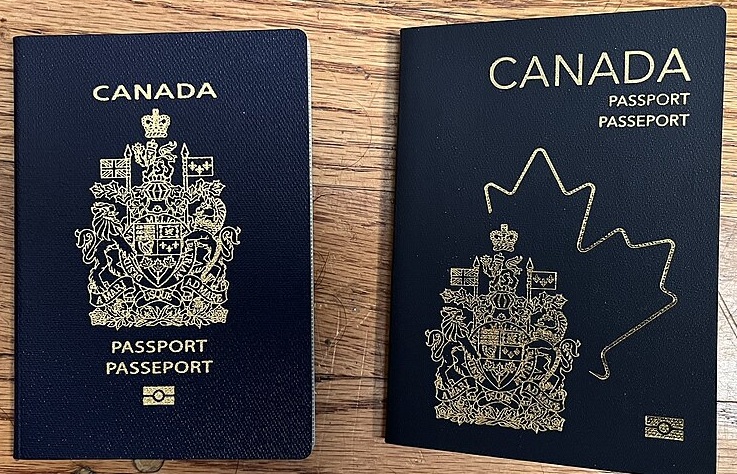
Canadian passport covers (pre-2025 on the left, current cover on the right)
Detail of a photo by Jusfiq via Wikimedia Commons

Anyone in the world can come to Canada, have a baby, and secure that child a lifetime of Canadian benefits along with a family link to this country for later chain migration. They don’t have to speak English or French; they don’t have to share our taboos against incest and rape; they don’t need to contribute anything to Canadian society. There are no guardrails.

But on Tuesday, we got a glimpse of how good things could be when Conservative immigration critic Michelle Rempel Garner proposed a simple change to the law that would prevent citizenship from being granted to children born in Canada to non-citizens — unless at least one parent has permanent residency.

This would close Canada’s widest and most longstanding chain migration entry point without being too harsh on the foreign nationals who have established a connection to the country (though we do need higher standards for PR, too). It’s about as fair as you can get. Alas, Rempel Garner’s amendment was promptly shot down by the Bloc Québécois and the Liberals, who believe in the extreme approach of handing passports out like candy at a parade.

The rest of the world has noticed our complete lack of boundaries and is taking advantage of it. Non-resident births in 2021-22 doubled to 5,698 from the previous year’s 2,245. It’s a cottage industry in B.C., and in one study of 102 birth tourists at a Calgary hospital, the most popular source country was Nigeria, but parents also came from the Middle East, India and Mexico. Keep in mind that these are just the non-residents — there are plenty of other temporary residents giving birth here, but we don’t seem to be keeping track.

Even if these children grow up and never set foot in Canada again, they’ll be entitled to all the benefits of citizenship. They’ll be able to run for office, vote, and obtain consular services if unrest engulfs whatever country their family has chosen to raise them in. If they ever join a terror organization like ISIS, Canadian officials will be expected to retrieve them.

October 12, 2025

Restricting activism from the bench

Filed under: Britain, Government, Law, Liberty, Politics, USA — Tags: , , , , , — Nicholas @ 09:05

As we’ve seen far too many times in Canadian courts, when judges become politically active, they can produce far worse situations than the politicians who cynics might say are specialists in that discipline. British judges, however, are still well ahead of their Canadian counterparts:

Until judges are replaced by robots, we will have to accept the reality of activist judges. Even the most august patriarch of the bench cannot wholly escape his innate human biases. And so perhaps there was something in Robert Jenrick’s speech at this week’s Conservative Party Conference, in which he announced that, if elected, the Tories would empower the Lord Chancellor to appoint judges and more carefully scrutinise their political activities.

Those who have supported the ideological capture of our major institutions were understandably furious. The New Statesman claimed that Jenrick had “declared war on the judiciary”. But then, the New Statesman is an activist publication which can make no serious claim to impartiality or sound journalistic standards. (Those in any doubt about its mendacity should take the time to read about its shameful treatment of Roger Scruton.)

The problem of an activist judiciary is currently preoccupying the White House, given that a number of federal judges have attempted to block executive policies or have issued nationwide injunctions. Trump himself was convicted on thirty-four felony counts by a judge who had made small political donations to Democratic-aligned causes. It seems clear that given these circumstances he ought to have recused himself. The entire case, of course, was an example of the law being twisted for politically partisan ends. (The best overview is by the senior legal analyst for CNN, Elie Honig, which can be read here.) Little wonder that Trump now appears to be seeking revenge through the courts.

In the UK, there have been a number of revelations of judges tied to political causes whose claim to impartiality seems shaky at best. During his speech, Jenrick spoke of those judges who have been associated with pro-immigration campaign groups and have “spent their whole careers fighting to keep illegal migrants in this country”. Many commentators have observed a generalised bias toward asylum applications, sometimes to an absurd extent. Who could possibly forget the Albanian criminal whose deportation was halted by an immigration tribunal on the grounds that his ten-year-old son did not like foreign chicken nuggets?

Leaving such outliers aside, most of us will have noticed patently ideological remarks occasionally uttered by judges during sentencing. In the Lucy Connolly case, the judge explicitly expressed his support for the creed of DEI before sentencing her to 31 months in prison for an offensive and hastily deleted post on social media. “It is a strength of our society that it is both diverse and inclusive”, he said. It couldn’t be much clearer than that.

That lawfare has become a major weapon in the settling of political disputes should trouble us all. Judges are not accountable to the electorate, and so any suggestion that they are exercising power for their own political ends is bound to be interpreted as a threat to democracy. Inevitably, Jenrick’s criticism of activist judges, and his call for them to be removed, has led to some commentators assuming that he would prefer judges who simply acted according to the government’s bidding. That way lies tyranny.

October 9, 2025

Enoch Powell: The Father of Brexit?

The Rest Is History
Published 6 Oct 2025

Who was Enoch Powell, the deeply controversial British conservative politician? Why is he the father of Brexit, and possibly even Reform? And, how did he come to make his inflammatory “Rivers of Blood speech”, in 1968?

00:00 Intro
00:23 Hive
01:46 Introducing Enoch Powell
07:41 A very peculiar childhood
09:19 The least clubbable man in Cambridge
13:30 War years
14:48 An imperial dream thwarted
17:02 An eccentric MP
23:26 The anti-American
24:53 Immigration in post-war Britain
31:09 Smethwick 1964: campaign, slogan, shock result
33:34 Uber
34:14 Mid-60s Britain
35:59 Powell pivots to immigration
41:44 English identity in Powell’s mind (“united people in an island home”)
44:12 Politics & ambition: differentiating from Heath
45:03 The role of US race riots in Powell’s evolving opinions
46:24 Kenyan Asians crisis; Labour’s response
49:47 Race Relations Bill setup: Powell prepares the speech
50:59 The “Rivers of Blood” speech
56:07 Immediate fallout: sacking, friends’ reactions
57:42 Public opinion divides
1:00:04 His legacy
1:04:02 Was Powell racist?
1:08:12 Long-term legacy: why politicians avoided the topic

Join Dominic and Tom as they discuss Enoch Powell — one of the most incendiary and contentious figures in all of British political history — and his enduring shadow today.
(more…)

October 6, 2025

“[Starmer’s] love of football feels like something an alien would simulate, trying to blend in with our ways”

Filed under: Britain, Media, Politics — Tags: , , , , , , — Nicholas @ 05:00

Britain’s current prime minister, Sir Keir Starmer, is not having even the echo of a political honeymoon despite the utter collapse of the Conservatives in the last general election. Andrew Sullivan, who knew Starmer in school, thinks that Starmer’s plight is a useful illustration of what might have happened in the last US federal election if Kamala Harris had won:

The other day I sat, slack-jawed, reading Kamala Harris’ book — which was not easy to do with my eyeballs permanently rolled into the back of my head. (On one issue that killed her campaign, trans policy, she still hasn’t got the slightest clue what she’s talking about.) At one point, I even tried to imagine what America would be like today if this woke lawyer had actually won last year.

Then it occurred to me that we already kind of know. We actually have a pretty good test case of exactly that: a center-left lawyer-politician coming to power last year after a massive immigration wave had discredited and ousted the previous incumbent. Enter Keir Starmer, my high school frenemy, and now prime minister.

But unlike Harris, Starmer has at least shown signs of understanding his problem: he kicked the far-left Corbynites out of the party, called out anti-semitism, and in his big speech to his party’s annual conference this week, spoke proudly of flying the Union Jack, saying “we placed too much faith in globalization”. In office, he backed Israel’s war against Hamas strongly for a year-and-a-half, followed the science by banning puberty blockers and sex changes for kids, tightened immigration rules a bit, and pursued deregulation of the private sector, especially housing.

So how is he doing?

In one recent poll, his approval rating is 18 percent, with 61 percent disapproving. His government, just a year old, is polling around 19 percent. And in his first year in office, the new anti-immigration Reform Party has doubled its support from 15 to around 31 percent. The Tories — who gave Brits a massive wave of non-white, non-European immigration after Brexit — are at a historic low of 15 percent. Boris may have done what no leftist could: destroy the most successful political party in the West.

This, to put it mildly, is an earthquake. A party barely a year old is almost more popular than the Tories and Labour combined. On paper, Starmer still has four years to right the ship. But in reality, a prime minister who is loathed by four out of five Brits is like Wile E Coyote five feet off the cliff edge. To get a flavor of the general public’s view of Keir, check out this hilarious profile. Money quote:

    Then there is the voice — a cornucopia for sketch writers. We could fill pages with descriptions of the thing — an expiring corncrake, a Dalek suffering stasis of the lower bowel, a fart in a coffin, etc. His love of football feels like something an alien would simulate, trying to blend in with our ways — “I follow the game like any other carbon-based life form”.

The fart in a coffin did his best this week — and survived. Critically, he acknowledged the centrality of mass immigration to the national discourse, the way it has undermined a sense of common culture, undercut wages, begun to replace Christianity with Islam, required ever higher levels of censorship, killed Jews, and turned the cities my grandparents knew into something they wouldn’t even recognize as British.

No vote was ever taken on this policy of making London 40 percent foreign-born, a place where English is now often not heard at all — and even where it is, is almost always in a foreign accent. But the minute anyone ever proffered the slightest objection to mass migration (around a million migrants a year for the past four years), the charge of “hate” and “racism” was instantaneous and deafening.

Elite right and left were as one, defying the public for decade after decade. The hangover, especially after Boris’ brutal betrayal, is now here. (For a single glimpse, think of yesterday when a British citizen named Jihad attacked a synagogue, with two dead, and a flash mob of Hamas supporters swarmed Downing Street.)

Update, 7 October: Welcome, Instapundit readers! Please do have a look around at some of my other posts you may find of interest. I send out a daily summary of posts here through my Substackhttps://substack.com/@nicholasrusson that you can subscribe to if you’d like to be informed of new posts in the future.

QotD: Britain’s immigration crisis

Filed under: Britain, Government, Media, Politics, Quotations — Tags: , , — Nicholas @ 01:00

One of the consequences of massive, indiscriminate immigration – equivalent to the entire population of Sheffield, every year – is that it radically alters the general mood of those on whom this demographic transformation is being imposed. One might, for instance, aspire to the role of gracious host, as it were, of making newcomers feel welcome. But this ideal presupposes an immigration policy that is limited and selective, and in which newcomers have good reason to feel lucky – and grateful.

The graciousness of the locals, the ideal, depends on the notion that the host country is regarded as something special, a desirable thing, something worthy of respect.

But massive, indiscriminate immigration undermines that ideal. If seemingly anyone can walk in and demand goodies, any ill-mannered flotsam of the world, and if they can do so with no discernible sense of gratitude, or any expectation of such, and with no apparent regard for the norms and values of the host society, as if they were unimportant, then the indigenous population may feel they have little reason to be gracious. Indeed, being gracious may be something of a struggle.

I realise that even the idea that the locals might dare to think in such terms – of being the gracious host – is, for some, anathema, a basis for tutting and scolding. But the sense that the value of one’s society – one’s home – is being pissed away, sold off cheap, is not a promising basis for coexistence.

And yet here we are.

Doubtless there are progressives who would regard the “gracious host” attitude as wickedly hierarchical and “othering”, or even racist. But I suspect it’s how quite a few people process a sudden influx of newcomers, regardless of the gasping of lefties. I suspect that something along those lines is a necessary precondition of any subsequent coexistence. A social lubricant.

And were I to relocate to, say, South Korea, I think I would feel much like a guest – and feel a corresponding obligation to be on my best behaviour. Possibly on an indefinite basis. I very much doubt I’d feel entitled to disregard queueing norms, or to, quite literally, shit on the doorsteps of the indigenous.

But hey, maybe that’s just me.

David Thompson, Explaining Civilisation”, Thompson, Blog, 2025-07-01.

October 4, 2025

What did poor Liverpool do to deserve “the worst speech in modern British political history”?

In The Conservative Woman, Sean Walsh wonders why his home city of Liverpool was chosen to be the site of a modern political crime-against-humanity in the form of a Two-Tier Keir speech to the Labour faithful:

LIVERPOOL happens to be my city of birth, and my family is generational CIA (Catholic, Irish, Alcoholic). I get back there when I can, usually for funerals family reunions. I can confirm that if you don’t mention Thatcher, the Sun, any Manchester band, the Wirral, or ask a native to pronounce the word “chicken”, you will be made to feel more than welcome as a visitor there. Scousers are rightly celebrated for a quick, if chippy, wit and unique sense of humour. Not least by ourselves.

Hopefully that last quality will help the city survive this week’s invasion by activist lawyers, Islington familiars, boilerplate career MPs, lanyard fetishists, lobbyists, and the process algorithm who was slush-funded to the Labour leadership.

For years Liverpool dodged hosting the Labour conference and was probably resentful at the snub. Now its rejuvenated docklands are the go-to venue for this annual festival of enforced fun/confected joyfulness. It’s probably resentful at that as well.

I’m not sure British politics has seen a speech as bad as the one the Prime Minister gave to this year’s wake gathering. And before you mention Enoch Powell and “rivers of blood”, that speech was “bad” only in the minds of those who never read it or were unable or unwilling to appreciate the deep truths Powell was advancing behind the veil of metaphor.

The Prime Minister was vindictive and politically maladroit in equal measure. Powell, a genuine member of the British working class, was a trained classicist who thought, spoke and wrote in the languages and metaphors of the ancient world. Powell’s lack of condescension and unwillingness to dumb down created room for bad faith and mischievous interpretation.

Starmer, who thinks and speaks the language of the petty bureaucrat, has no such defence. Where Powell made his predictions in poetry (which have proven correct, let’s not forget), Starmer rams home his malevolence in bullet points and crass soundbites.

I make this unhappy comparison partly to draw attention to the decades-long decline in the culture of political speechcraft, which TCW recently wrote about, and to affirm that even by the standards of today Starmer was awful.

We expect our political speeches to be unlovely now. Starmer’s went beyond that and managed to be offensive and yet boring all at once. As I said, the Prime Minister is an algorithm, and there are three things you can say about algorithms: they lack memory, have no sense of humour, and are unaware that they are, well, an algorithm.

On his Substack, Christopher Gage offers “A forward-thinking manifesto to deliver change for stakeholders”. That’s just the sort of bafflegab progressive thinkers think the general public wants to hear, apparently:

Alice in Wonderland by Oskar Kokoschka (1942)

This year’s Labour Party conference kicked off in the idiosyncratic style befitting its more excitable, green-haired cohort: confusion, contradiction, and faux contrition.

On Sunday, Sir Keir Starmer, our accidental prime minister, condemned Reform’s plan to deport migrants as “racist and immoral”. By Tuesday, it was Labour policy.

Politicians will say anything to keep suckling on the erect nipples of eternal power. And Labour politicians, despite their holier-than-thou affectations, are no different. They’ve seen the polls. Reform has led with room to spare in the last one hundred.

Labour has changed its spots. Starmer’s new Home Secretary, the combative and admirable Shabana Mahmood, is one foot on planet earth, at least.

At the conference, Mahmood warned the Guardian-reading element that they “won’t like the things I do”. She duly unveiled plans to ensure migrants “earn the right” to stay here: speak English, pay their way, and don’t expect their family to follow.

These once radioactive proposals are now common sense — two-thirds support immigration restrictions, whilst one-half wants not only the door welded shut but for many recent arrivals to be ushered politely through it. If Labour wants to win another election, they’d better listen to Wetherspoon Man over Performative Male.


As the week spluttered on, Starmer opted in to opting out to opting in to opting out. But Labour is listening. Nigel Farage, the Wetherspoon Man high priest, must feel his pockets lightened this week. Just glance at the swathes of Labour members waving the Union Jack, faces stretched incredulously like those masks from The Purge.

One impression emerges from this blancmange of bodily fluids: Farage has won the argument. Labour loves Britain, mate. Britain, big tits, Stella Artois, and XL Bullies.

Starmer even took it to Boris Johnson, onetime prime minister and two-time shagger of the year. The epithet “Boriswave” leapt from Starmer’s tongue with pace-sticked regularity. According to the prime minister, letting in four million people in two years — the Boriswave in Twitter slang — is an affliction so terrible that to reverse it would be, erm, even worse.

To be fair, such logic is not so much witless as it is anti-sense. And anti-sense has defined the Labour Party since I was spermatozoa.

One thing is clear. The Labour party, which presides over the sputtering, worn-out appendage known as Great Britain, needs some dire advice.

Here are a few proposals, the wholesale adoption of which would solve every problem befalling broken Britain.

September 29, 2025

Powderkeg Britain

Filed under: Britain, Government, Media, Politics — Tags: , , , , , — Nicholas @ 05:00

The ever-expanding anti-immigration protests in Britain are an unmissable flashing red alert to the British government … which seems determined to ignore it and continue to plough ahead with their MOAR immigrants policies despite the anger of the public. Spaceman Spiff characterizes it as a revolt:

Multi-ethnic and multicultural societies do not function in the way homogenous nations do. People of radically different origins, culture and beliefs often trigger conflict as incompatible aptitudes, temperaments and worldviews operate within a shared territory.

Artificial situations like this do not naturally harmonize, despite the rhetoric. Instead, competition for resources emerges. Power sharing between rival groups is fantasy. Life is winner takes all.

This can be disconcerting as reality asserts itself and the cost of large-scale migration becomes obvious.

Some in Britain already understand the dangers we now face at home. Others are waking up and looking for answers as their world declines. They are the ones who will grasp at anything to reset society.

Racists and hatemongers

Critics of mass immigration in Britain are often branded as racists and hatemongers.

We see blanket condemnation from establishment figures for even mild observations about the effects of this deeply unpopular policy.

The noticers of reality are derided as far-right extremists even when they are evidently normal people exhausted with unwanted demographic change.

The approved media and political spokespersons insist those who make observations have become radicalized by extremist writers and thinkers. Little more needs to be added. The labels do much of the work; Nazi, fascist, racist.

It doesn’t matter that many who are critical of mass immigration are not extremists calling for violence. They are just normal people who notice what is happening.

One of the unfortunate things the noticers recognize is mixing distinct cultures inside a single geographical area might be dangerous. They sometimes read material based on government statistics that tells them mass immigration infers almost no benefits on the host nation while extracting potentially catastrophic costs.

To ordinary people that sounds like something worth discussing to determine if it is true.

Normal people are revolting

Western countries have endured unexpected demographic shifts in recent years.

The only acceptable view is this is always a net positive. We are told group differences do not exist except in the minds of racists. Foreigners are already very like us and any deviation from our norms are superficial or unworthy of comment.

It is therefore all the more shocking when this is proven wrong. From dress and manners to dietary habits, to the treatment of women and children, the world beyond our borders is quite alien when seen up close.

London’s vibrantly diverse bus riders

All this alienness was once elsewhere with oceans to protect us. Now it is here in our midst.

This is becoming obvious and is at odds with all we have been told. What we see does not match the harmonious melting pot we were sold.

Inevitably this encourages people to seek out information.

September 26, 2025

“Create no-go zones for federal forces”

Filed under: Government, Media, Politics, USA — Tags: , , , , , — Nicholas @ 03:00

On the social media site formerly known as Twitter, ESR responds to a comment about his three possible futures after the Charlie Kirk assassination (linked here):

    Mike Benz @MikeBenzCyber

    Antifa websites totally open to the public explicitly call to so utterly terrorize ICE that federal agents are physically afraid to enter a city. If the Proud Boys wrote this about the FBI how fast would every single person around that website be indicted by Merrick Garland.

“Create no-go zones for federal forces.’

In one of my previous analysis postings, I outlined three possible scenarios for the future after the assassination of Charlie Kirk.

This corresponds to scenario 3, the one where insurrection edges into a simmering civil war a la Bosnia. I caught some flak in my replies at the time from people who thought an insurrection based in urban areas isn’t practical under modern conditions.

Antifa thinks it is. It’s what they’re planning for.

One of the things I have to remind myself of occasionally is that most people know essentially nothing about Communist theory and Communist revolutionary tactics.

Antifa is running the classic Communist playbook. Make the enemy fight you where you are strong and they are weak — where you have support among the people and (when possible) cover from sympathetic local officials.

Historically that has usually meant fighting from rural areas where the reach of the government is weak. But the Russian Revolution was an exception, and the revolution Antifa is trying to fight is another. Their natural home ground is large coastal cities run by left-wing Democrats.

September 25, 2025

“Intentionally elevating strangers above ourselves, xenophilia, is artificial”

Filed under: Health, Media, USA — Tags: , , , — Nicholas @ 04:00

In Aporia, Spaceman Spiff explains the function and value of what are called “dead man’s switches” both for railway locomotives and societies:

Image from Aporia

A dead man’s brake is a safety feature found in dangerous machines such as lifts or trains. With this mechanism, a brake is always on, preventing action or movement. A conscious choice or effort must be made to override it.

On a train, a human driver must be present to depress a foot pedal that disengages the brake so the train can move at all. If he is absent the train cannot move. If he withdraws his foot while the train is in motion — if he dies, for instance — the train stops. Hence the name.

The key feature of a dead man’s brake is that it requires energy to operate. Its default zero-energy position is OFF; only with energy can it go to ON.

Wariness of strangers, xenophobia, is the default position for most human beings. This is a hardwired evolutionary response to protect us. It served us well. It requires no energy to operate. Children quickly point out people who seem different.

Intentionally elevating strangers above ourselves, xenophilia, is artificial. We must be educated to make it happen, and explicitly taught to overlook differences. It must be reinforced to remain in operation as our instincts typically push against it.

This requires energy. In parts of the world not subject to Western educational norms, they do not teach it to children. Consequently, they do not usually adopt policies like mass immigration or asymmetric multiculturalism.

It is worth noting that xenophobia denotes a wariness of strangers, not hatred or disdain of them. In practice, our working assumption is people different from us may be a threat, and our actions should reflect this until proven otherwise.

Xenophobia is not the racial animosity the propaganda wishes us to believe, such as harming others based on visible differences like skin colour. Such extreme views are in fact rare. The underlying drive of xenophobia is caution, not aggression. Xenophilia attempts to ignore this sensible restraint, which is why it often fails without external pressure.

These instincts are deeply embedded within us because a cautious approach is a strong foundation upon which to preserve our lives and our cultures. It is the reason we have a nation and a culture in the first place.

Xenophilia, then, is a dead man’s brake. It requires energy applied to something that would not typically occur in nature. It makes us ignore differences in order to get along. Or so the theory goes.

Update, 26 September: Welcome, Instapundit readers! Please do have a look around at some of my other posts you may find of interest. I send out a daily summary of posts here through my Substackhttps://substack.com/@nicholasrusson that you can subscribe to if you’d like to be informed of new posts in the future.

September 21, 2025

“What do you remember of the summer when the English awoke?”

Filed under: Britain, History, Media, Politics — Tags: , , , , , , — Nicholas @ 03:00

In The Critic, David Shipley says that the rapid, visible rise in English nationalism is a new and positive thing in Britain:

“Union Jacks and crosses of St George” by Ben Sutherland is licensed under CC BY 2.0 .

What do you remember of the summer when the English awoke? The summer of arguments over what “English” means, hotel protests, and of “flagging”. Overnight the England flag was everywhere. On lampposts, on bridges over motorways, and even painted on roundabouts, the St George’s cross appeared, as a challenge to the old regime, and a threat, or promise, of something new.

For this is new, make no mistake. In my lifetime, England’s flag has only been seen in force during football tournaments and at the rugby. Political figures of the left have seized upon this novelty as they have tried to resist the challenge. The Green Party leadership candidate Ellie Chowns insisted that “it’s traditionally not part of British culture to hang flags”, while Zack Polanski, the party’s new leader, said he wouldn’t fly the flag outside of football tournaments because “of what it represents to people who worry about that problematic history”, before going on to say he’s “worried that we’re importing fascism”. Meanwhile John McTernan, former advisor to Tony Blair insisted that flag flying isn’t an expression of “national pride”, but rather “being used to other people” (my italics).

Notionally sensible centrists, The News Agents suggested that the flag should be redefined as representing “tolerance, liberalism, democracy and Shakespeare” and that would deter “right-wing thugs” from using it. The propagandists of the regime recognise that it is in danger, and seem to believe that “British Values” are enough to hold back the tide.

York Council went ever further, saying that flagging has “coincided with a rise in racist incidents” and have decided to remove hundreds of England and Union flags, to which York’s “Flag Force” responded by announcing they would promptly replace every flag which was removed.

England’s flag was everywhere at the hotel protests too — standing for resistance against a Westminster regime that continues to force migrants upon communities which do not want them.

At the end of the summer, as the Last Night of the Proms coincided with the “Unite the Kingdom” march, the flag divide could not have been wider. On the streets of London that Saturday a sea of Union and St George flags, while at the Albert Hall it seemed one could wave any nation’s flag but England’s.

A Times cartoon from July caught the year’s mood. It depicted a group of unthreatening families protesting, holding signs saying We’re not far right – we’re worried about our kids and Deport Foreign Criminals. Beneath them, buried in the earth lurks a bald, beefy man with H A T E tattooed on his knuckles, and Made in England alongside the red cross of St George tattooed on his shoulder. Here, in the favoured paper of the British establishment, we see their fear that a deeper, more dangerous Englishness threatens to rise up, and threaten, or even destroy their order.

September 15, 2025

A few thousand deplorable “gammons” disrupt the peace in London

Filed under: Britain, Media, Politics — Tags: , , , — Nicholas @ 05:00

At least, the headline is how I assume most establishment types in Britain would try to describe the Unite the Kingdom march in London over the weekend (all photos by Esmeralda Weatherwax of the New English Review):

As I said earlier I have never seen a crowd like it – the police were overwhelmed with the numbers and I think even the organisers were pleasantly surprised at the turnout.

I gave up all hope early on of getting near enough to a screen to see or hear the speakers. But you can catch them up on line. I’m sure there are already links to Katie Hopkins, Laurence Fox, Tommy himself, Elon Musk by video link and the others.

I decided I was of most use photographing the numbers and variety, talking to people and following events away from the stage.

The march was scheduled to muster at Waterloo on the south bank. Knowing the turn out would be good attendees were advised to leave at Blackfriars Station and cross Blackfriars Bridge to join the march in Stamford Street east of Waterloo Station. The route was to be along the South Bank, over Westminster Bridge and into Whitehall at the south end. Antifa and Stand up to Racism were expected to march from Russell Square and would be rallying in the north end of Whitehall by Trafalgar Square with a long corden sanitaire between. Well that worked well last time.

I went straight to Whitehall and went to greet friends who were involved as marshals. Already the area was filling up fast and there were queues for the portaloos. They had to be provided as Westminster Council had shut and locked the public ones outside Westminster Station and on Westminster Pier. I don’t know why they do this. There will be mess afterwards.

September 12, 2025

Canada’s temporary foreign worker programs

Filed under: Bureaucracy, Cancon, Education, Government, Health, Media, Politics — Tags: , , , , , , — Nicholas @ 05:00

At Acceptable Views, Alexander Brown calls for the end to the Canadian federal temporary immigration scam programs:

It’s not hyperbole to say that Canada has built an entire economy on exploiting cheap, foreign labour through TWFP, as well as the International Mobility Program (IMP). These are two slightly different programs that allow foreign nationals to work in Canada, with most going to Ontario. But contrary to its name, there is nothing “temporary” about the TFWP. Its original purpose was to remedy proven labour shortages while Canadians were hired and trained to eventually do the jobs in question. Meanwhile, the IMP allows international students to work—with or without a proven labour shortage—while they’re studying in Canada.

Between 2019 and 2023, the TFWP increased by 88 percent and the IMP increased 126 percent. They account for close to 1.58 million work permit holders, equal to roughly 7 percent of Canada’s labour force.

Taken together, the results of the TFWP and IMP are deplorable. The TFWP allows foreign nationals to be recruited abroad in vast numbers, brought to Canada, housed in degrading conditions, paid the minimum wage, forced to work long hours, pressured into not joining a union, and required to work for only one employer. Yes, the IMP is more flexible, but it’s more pernicious because it does not even pretend to address labour shortages.

Both schemes are also of course bad for Canadians themselves. The problem is especially grievous for young Canadians trying to get started in the labour market. Canada lost 40,800 jobs this past July, the unemployment rate is now 6.9 percent, and youth unemployment (those between 15 and 24 years old) is now 14.6 percent.

Both the TFWP and IMP are used as business models. Hiring foreign nationals at minimum wage keeps prices low and profits high—most notoriously in the hospitality and trucking sectors, but no industry seems untouched now.

Addicted to cheap foreign labour

The use of the TFWP in the healthcare sector, for example, has grown by an appalling 1,700 percent since 2000. That dramatic rise has no doubt been abetted by the absence of uniform standards and credential recognition among Canadian provinces. If medical personnel could move easily from one province to another, shortages could be filled by Canadians. But historically this has not been possible, and so medical institutions have had to turn to the TFWP. Ontario’s recent determination to solve this problem by speeding up recognition of 50 “in-demand” professions from other provinces is a step in the right direction, and hopefully not too little too late.

Meanwhile, the IMP is a vehicle for outright fraud, ranging from fake acceptance letters from bogus “colleges” to elaborate human-trafficking schemes. Not long ago, nearly 50,000 holders of foreign student visas were working and attempting to settle here, rather than studying at any Canadian university or college. Most were migrants from India, and some were trying to cross the border illegally into the United States. The RCMP is now working with Indian law-enforcement to investigate alleged links between dozens of “colleges” in Canada and two “entities” in India allegedly facilitating passage into the U.S. When we reflect that an astounding 4.9 million temporary visas are set to expire this year, we have reason to believe that this abuse, exploitation, and fraud are on a much larger scale that we understand.

The consequences for young Canadians

Both the TFWP and the IMP serve to keep wages artificially low and profits high, and to price Canadians out of the job market. It wouldn’t be wrong to view these programs as distortionary government subsidies or welfare for unproductive businesses. The effects disproportionately harm younger Canadians who are priced out of the labour market, given that temporary workers overwhelmingly earn less than the median wage. And yet, we’re constantly hectored about labour shortages, Canadians’ “unwillingness” to do certain jobs, and the need for foreign workers.

It shouldn’t take much intellectual effort to see that the use of foreign labour and the difficulties of employing younger Canadians are two sides of the same ugly coin. Foreign workers are more cooperative because they are bound to their employers like serfs. They face normally insurmountable barriers to joining unions and have no attachment to the community in which they’re expected to work. In comparison, the domestic population is generally better educated and rooted in the local community.

Young Canadians can afford to be discriminating and should rightly expect higher wages than foreign nationals. Employers should instead work harder to invest in and reward their domestic workforce. In any other era, this would have been obvious. But now there is little incentive for businesses to look beyond cheap, foreign labour.

To get an idea of the magnitude of our collective failure here, consider the following fact. A 2024 study by RBC Economics revealed that Canadian businesses are sitting on a stockpile of cash worth almost a third of our country’s GDP. In other words, Canadian companies have the means to invest in hiring and training Canadians, but simply refuse to do so. The results of this refusal are stagnant wages, structural unemployment, and a de-skilling of the domestic population.

September 9, 2025

Uh-oh. It’s not a good sign to see your town’s name in Not the Bee

Filed under: Cancon, Environment, Law — Tags: , , , , , , — Nicholas @ 04:00

We’ve lived in Bowmanville for ten years and in that time the demographics have changed substantially. Some of those changes have been positive, but others have definitely been negative:

Video out of Bowmanville, Ontario, shows Southeast Asian men (do with that what you will) flipping salmon out of a small stream during the annual salmon run back to their spawning locations.

Early September is peak salmon-fishing season. Fisherman across the continent catch millions of fish as they return upriver to spawn.

But it is highly illegal to catch salmon near their actual spawning sites (especially with nets), which includes Bowmanville (upriver from Lake Ontario). It is also unsafe, as the fish die off in mass numbers after spawning, making the meat inedible.

Despite this, migrants have been seen poaching fish in the area for several years (at least).

In the comment section, some people shared stories of their own, including this anecdote from Port Hope, Ontario.

Over the summer, SE Asian men went viral in Muskoka, Ontario, for filming themselves shooting up a local bridge and river. Locals say they have reported such incidents for years, but despite the danger and the leftover environmental pollution, authorities have been slow to act.

Employers insist that there are lots of high-paying “entry level” jobs that Canadians won’t do

Filed under: Bureaucracy, Business, Cancon, Government — Tags: , , , — Nicholas @ 03:00

Canada’s insanely out-of-control temporary foreign worker program hinges on employers being honest about the jobs on offer being impossible to fill with Canadian citizens or legal immigrants. The huge numbers of these jobs — often listed at much higher than minimum wage in areas with very high unemployment — strongly implies that employers are systematically gaming the system:

A selection of jobs subject to active Labour Market Impact Assessments (LMIA), meaning that an employer has applied for a temporary foreign worker on the grounds that no Canadian is available to fill the position.
Photo by Government of Canada Job Bank.

If public sentiment is turning against the TFW system, it’s partially because of a greater awareness of the conditions under which employers are claiming they cannot find Canadians for their jobs.

Any hiring of a temporary foreign worker has to first be preceded by a “Labour Market Impact Assessment”. It’s effectively a job posting laying out the basic details of the position, and carrying the disclaimer “the employer could not find a Canadian worker for this job and applied for a Labour Market Impact Assessment (LMIA) to hire a temporary foreign worker”.

What’s made many of these LMIAs so controversial is that they often describe quite desirable jobs with minimal qualifications. There are also noticeably high numbers of them being submitted in cities with high unemployment.

Last year, a viral Reddit post featured a heat map of all the Toronto-area employers who had been approved for temporary foreign workers after claiming to find no Canadian applicants. More recently, the website JobWatchCanada has launched a searchable database of active LMIAs, complete with interactive maps and guides to which employers are the heaviest users.

What really bothers a lot of Canadians about the program is the high number of jobs posted with few or no qualifications at well-above market rates at the same time that young Canadians are finding it impossible to get hired no matter how many positions they apply for:

In June, a Calgary auto shop submitted an LMIA for a “motor vehicle mechanic helper”. The job is to essentially act as a “gofer”. The starting wage for the helper job is $36.50 per hour, the employer promises to cover relocation costs, and the “experience” category contains only the words “will train”.

A Langley, B.C., drywall contractor said it can’t find any Canadian drywall installers at $36.75 per hour. A vape shop in Lloydminster, Sask., has filed an LMIA to fill a $36.05 per hour shift supervisor job in which the educational requirement is a high school diploma.

In Woodbridge, Ont., a homeowner filed an LMIA for a $38 per hour housekeeper in which the only qualification is that the applicant has to speak English. “No degree, certificate or diploma”, is listed in the space for educational requirements, and the requirement for work experience is just “will train”.

The useful site fakejobs.ca currently shows three LMIA positions in my small town each paying at least $35 per hour that supposedly can’t be filled by local applicants. The jobs — two food service supervisors and a marketing co-ordinator — can’t possibly have such exotic required qualifications that nobody in the area can match, which is why I strongly suspect they’re fakes.

September 6, 2025

The federal government’s foreign worker program is set up for abuse

Filed under: Bureaucracy, Business, Cancon, Government, Politics — Tags: , , , , — Nicholas @ 03:00

Dan Knight discusses Canada’s deliberately two-track job system, which severely disadvantages unemployed Canadians and favours temporary foreign workers instead:

Canada now has a two-track employment system. On one track, you’ve got over 1.6 million Canadians unemployed the official rate just jumped to 7.1%, the worst since 2016 outside the COVID crash. Youth joblessness? 14.5%. Alberta, supposedly an economic engine, bleeding at 8.4% unemployment. And those folks are drawing EI, funded by your tax dollars.

On the other track? The Temporary Foreign Worker pipeline. In 2024 alone, Ottawa issued over 162,000 TFW permits by October. And they’ve already budgeted another 82,000 entries in 2025. Think about that: while Canadians are struggling to find work, Ottawa is busy handing out golden tickets to foreign workers.

And let’s be honest about how this program actually works. It’s sold as a way to “fill labor shortages”. In practice, it often looks like a backdoor family reunification scheme. Business owner Abdul suddenly needs a “specialized” worker conveniently, his cousin in India just happens to fit the bill. So instead of waiting in line under the normal visa system, he comes in the side door through the TFW program. Legal? Sure. Exploitative? Absolutely. It undercuts the immigration rules that everyone else has to follow, and it keeps wages low for Canadians who should be first in line.

Here’s the part that makes you wonder if Ottawa is even trying: we’ve got two federal departments, Employment and Social Development Canada (who runs EI) and Immigration, Refugees and Citizenship Canada (who runs TFW permits). Wouldn’t a functioning government have these two agencies talk to each other? One department says, “Hey, we’ve got 1.6 million people sitting on EI“. The other says, “We’ve got 162,000 employers asking for TFWs“. The obvious solution? Connect the dots. Fill Canadian jobs with Canadian workers first.

But that would require coordination and “coordination” is a foreign concept in Ottawa. These are the same geniuses who can’t keep escalators running in Parliament Hill without a three-year feasibility study. You expect them to line up two departments, EI and Immigration … and have a five-minute conversation? Forget it. Imagine the radical idea: one arm of government saying, “Hey, we’ve got 1.6 million Canadians unemployed and drawing EI …” and the other saying, “Oh great, we’ve got 162,000 employers begging for workers. Maybe, just maybe, we could match those two groups up“. That’s not rocket science. That’s not even science. That’s called basic competence. And Ottawa can’t even spell it.

Using the fakejobs.ca website, I found three LMIA postings in my small town on the edge of the GTA … all paying well over median for pretty ordinary retail management jobs.

« Newer PostsOlder Posts »

Powered by WordPress