
Forgotten Weapons
Published on 10 Jan 2019http://www.patreon.com/ForgottenWeapons
Cool Forgotten Weapons merch! http://shop.bbtv.com/collections/forg…
How Does it Work: Blowback Action
The simplest for of firearms action is blowback, also called simple blowback. It is basically just an application of Newton’s 3rd Law; that for every action there is an equal and opposite reaction. As the bullet moves forward down the barrel, the slide or bolt of the gun moves backwards. The two move with the same energy, meaning that the light and very fast bullet is balanced out by the heavy and slow bolt or slide.
Contact:
Forgotten Weapons
PO Box 87647
Tucson, AZ 85754
February 11, 2019
How Does it Work: Blowback Action
Comments Off on How Does it Work: Blowback Action
February 10, 2019
Semiauto M2 Hyde Reproduction: The Interim US WW2 Subgun
Forgotten Weapons
Published on 9 Jan 2019http://www.patreon.com/ForgottenWeapons
Cool Forgotten Weapons merch! http://shop.bbtv.com/collections/forg…
George Hyde designed the gun that would eventually be adopted as the M2 submachine gun in the late 1930s, and it was first tested at Aberdeen Proving Grounds in October of 1939. At that time, the gun had many good traits (weight, handlings, etc) but suffered from parts breakage and unreliability. Hyde went back to work on the gun at the Inland Division of GM, and came back with a much improved version in April of 1942.
The Inland-Hyde SMG was chambered for .45 ACP ammunition and used standard Thompson magazines, and was poised to become the US Army’s new submachine gun, replacing the overly expensive Thompson. The Hyde passed a 6080 round endurance test with flying colors, and exhibited much better effectiveness in fully automatic than the Thompson. At the end of the April tests, it was formally accepted to replace the Thompson and given the designation M2.
A contract was given to the Marlin company (Inland being busy with other projects) to manufacture 164,450 of the guns, with delivery to begin in December 1942. However, Marlin had problems tooling up to produce the new gun, in particular with dies for several parts to be made using powdered metal sintering. Actual delivery of the first guns did not happen until May of 1943. In the meantime, Hyde and Inland had continued working on cheaper and simpler designs, and created the stamped sheet metal M3 “Grease Gun”. By the time the M2 was actually ready for delivery, the M3 had been tested and accepted by the Army as a better replacement than the M2. By mid-June, the M2 was declared obsolete and Marlin’s contract cancelled.
In total only about 500 M2 submachine guns were made, with (I believe) 6 surviving today. The example in this video is a semiautomatic-only reproduction made from scratch by a viewer of the channel, who graciously offered to loan it to me for this filming. Thanks, K!
Contact:
Forgotten Weapons
PO Box 87647
Tucson, AZ 85754
Comments Off on Semiauto M2 Hyde Reproduction: The Interim US WW2 Subgun
February 3, 2019
How Does it Work: Open Bolt vs Closed Bolt Firearms
Forgotten Weapons
Published on 3 Jan 2019http://www.patreon.com/ForgottenWeapons
Cool Forgotten Weapons merch! http://shop.bbtv.com/collections/forg…
How Does it Work: Open Bolt vs Closed Bolt Firearms
Most semiauto firearms fire from a closed bolt and most fully automatic firearms fire from an open bolt, but these are far from strict rules, and many exception exist. Open bolt offers better cooling and prevents any possibility of cookoff, while closed bolt offers better practical accuracy.
Contact:
Forgotten Weapons
PO Box 87647
Tucson, AZ 85754
Comments Off on How Does it Work: Open Bolt vs Closed Bolt Firearms
January 28, 2019
A Most Inauthentic Portrayal of Musketry
Brandon F.
Published on 6 Jan 2018NOTE: At one point in this video I mention lever-action rifles, but I show a Martini-Henry image. The Martini-Henry is not actually a lever-action, but a falling-block rifle. I had incorrectly assumed that the requirements for a rifle to be a ‘lever action’ were more literal- as in, that it used a lever! This is not the case, as lever action rifles are generally repeating, whereas falling block rifles see individual rounds chambered.
This is a video that I’ve wanted to make for some time, but unfortunately, I had to wait until the highly political topic which the source material discusses was less ‘relevant,’ lest my pedantic corrections be considered grossly inappropriate or offensive. That said, this commercial by the organization “States United to End Gun Violence,” features a musket being used in a criminal nature to provide a social commentary on American legislation. However, the manner in which the musket is portrayed and used in this commercial has a few problems, which I thought it would be fun to discuss here.
This is not a political video, and at no point do I express my own views on this highly contentious issue. Please treat it as what it is- historical nitpicking.
The original video: https://www.youtube.com/watch?v=LORVf…
For those who are so inclined, we have a Discord chat for the channel! Do stop by!
https://discord.gg/bJzUWxaIf you would like to support the Channel on Patreon:
https://www.patreon.com/BrandonF
From the comments:
I was originally planning to upload a ‘me standing in front of the camera,’ lecture style video today, but I’m afraid that I had to alter my schedule rather last minute, so I had to resort to a quicker voiceover video. The next one will (most likely) be in the traditional style!
Also, as you can all see, on advice from some friends I’m trying out a new approach to video thumbnails. This one was actually made by someone else for me, but if we all think it’s a good idea I’ll be trying to edit my thumbnails to include text like this more often in the future.
Also from the comments, and this was almost literally the first thing I thought of when watching the commercial:
lalucre1803
11 months ago
Mistake no. 1 – not fixing bayonet before hand. Could’ve easily finished the job.
Comments Off on A Most Inauthentic Portrayal of Musketry
January 12, 2019
Shooting the H&K MP5K Operational Briefcase
Forgotten Weapons
Published on 22 Dec 2018http://www.patreon.com/ForgottenWeapons
Heckler & Koch’s “Operational Briefcase” is a clever system for covert carry of a submachine gun without the need to conceal such a large type of weapon under bulky clothing. By putting the gun into a briefcase, they gave security personnel a way to blend right into the business and executive type of environment. Of course, the idea has become rather well known, at least in some circles. It may not have quite the same element of surprise it once did, but it is still a remarkably discreet contraption.
Thanks to H&K and Trijicon, I had the chance today to actually do some shooting with one of the briefcases. When properly used (which is to say, braced against the belly and aimed with the torso) it is quite a lot more useful and accurate than I had anticipated! It should definitely say something that H&K still sells these briefcases to law enforcement and security firms to this day…
Contact:
Forgotten Weapons
PO Box 87647
Tucson, AZ 85754
Comments Off on Shooting the H&K MP5K Operational Briefcase
January 6, 2019
WW2 Ball Turret with twin .50 cals at the Big Sandy Shoot
Gunscom
Published on 7 Dec 2018One of the highlights at this fall’s Big Sandy Shoot was a vintage WW2 ball turret with twin .50 cals that spectators could shoot.
Although it’s not uncommon to see unique and rare guns and military vehicles at the event, the fully functioning ball turret garnered a lot of attention.
Taigh Ramey, president of Vintage Aircraft, towed the Sperry A2 ball turret all the way from Stockton, California to the shoot, which takes place every April and October just outside of the town of Wikieup, Arizona.
Sperry A2 ball turrets were commonly mounted underneath either a Boeing B-17 Flying Fortress or the Consolidated B-24 Liberator. They were used to defend the bomber against aircraft attacking from below.
Ramey found the turret in a surplus shop many years ago. It took him 15 years to convince the owner to sell it, and he’s sure glad he did. Ramey fixes up and maintains vintage aircraft for the Stockton Field Aviation Museum. The ball turret has proven to be very popular with visitors.
The turret was new ‘old stock’ from the 1940’s, so it never saw service. Despite having sat on a storage skid for half a century, Ramey says he brought it back to his shop, put hydraulic fluid, fired it up, and the turret ran like a charm.
Rumored to have inspired the inside of the cockpit of the Millennium Falcon from the Star Wars films, the Sperry turret was operated by the gunner inside using two hand controls that operated two Vickers hydraulic units. It could rotate 360 degrees and tilt up up and down. Atop two control handles were fire buttons that engaged two .50 caliber light-barrel Browning AN/M2 machine guns. The guns fired 850 rounds per minute, and each gun was fed by a 500 round box of ammunition. The guns could not be reloaded in flight, so gunners had to be careful.
Contrary to popular myth, ball turrets were not always manned by tiny people. People up to six foot could fit inside comfortably. Gunners sat in a fetal-type position, and aimed the guns using a Reflector sight in front of a small circular window between their legs.
Statistically, the ball turret was one of the safest crew positions during WWII as ball turret gunners had the lowest loss rate.
Ramey was at the Big Sandy Shoot not only to live fire the turret, something he’d never done before, but also to promote Bomber Camp. It is a two-day event held on May 29 and 30 of every year at the Stockton Metropolitan Airport in California. Participants get a chance to step back in time to train for a bombing mission, and then to fly it for real.
Participants learn how to use original bomber sights and compensate for height, distance and wind. Gunnery classes familiarize them with the ball turret and other aircraft mounted guns, all of which can be fired in flight using airsoft propane ‘blanks’.
The grande finale is a flying mission in which dummy cement bombs are dropped from high altitudes on targets from a B-24 or B17 aircraft. Bomber Camp offers a once in a lifetime experience to gain a greater appreciation for the men and women of the “greatest generation”. Enrollment is tax deductible.
Comments Off on WW2 Ball Turret with twin .50 cals at the Big Sandy Shoot
January 2, 2019
Is the Stoner 63 Really So Good? Shooting the Mk23, Bren, and 63A Carbine
Forgotten Weapons
Published on 8 Dec 2018http://www.patreon.com/ForgottenWeapons
Is the Stoner 63 really as good of a gun as everyone says? Today is my first opportunity to try one out on the range, and I’m going to look at it in three different configurations: the Mk23 SEAL light machine gun, the “Bren” style automatic rifle, and the carbine. Let’s see how it handles!
I owe a tremendous thanks to Movie Armaments Group in Toronto for the opportunity to take the Stoner kit out to the range! Check them out on Instagram to see many of the guns in their extensive collection: https://instagram.com/moviearmamentsg…
Contact:
Forgotten Weapons
PO Box 87647
Tucson, AZ 85754
Comments Off on Is the Stoner 63 Really So Good? Shooting the Mk23, Bren, and 63A Carbine
December 27, 2018
Shooting the FG42: The Hype is Real
Forgotten Weapons
Published on 3 Dec 2018http://www.patreon.com/ForgottenWeapons
The hype? Yeah, it’s real. The FG42 is the nicest full-auto full-power rifle I have yet fired. This is a recut of a previous video that YouTube decided to squash.
If you enjoy Forgotten Weapons, check out its sister channel, InRangeTV! http://www.youtube.com/InRangeTVShow
Contact:
Forgotten Weapons
PO Box 87647
Tucson, AZ 85754
Comments Off on Shooting the FG42: The Hype is Real
December 13, 2018
The Israeli Galil
Forgotten Weapons
Published on 23 Nov 2018https://www.forgottenweapons.com/the-…
http://www.patreon.com/ForgottenWeapons
The Galil was the result of a program to replace the FAL in Israeli service after its somewhat disappointing performance in the Six-Day War of 1967. Israel found that while the FAL had shown reliability problems in the desert, AK rifles ran just fine despite often being badly neglected. In an initial series of tests, captured AK rifles came out superior to M16 and Stoner 63 rifles. This led to a more extensive series of tests and developmental work in which Yisrael Balashnikov developed a number of prototype rifles based on AK actions modified to 5.56mm using Stoner barrels and magazines. This second trial would ultimately compare the M16, Stoner 63, HK33, AR18, Beretta and Steyr rifles, and domestic developments by both Balashnikov and Uziel Gal. The Balashnikov rifles would prove the ultimate winner of the competition.
Balashnikov – whose name being so similar to Kalashnikov through pure coincidence, and who was originally born Mishmar Hayarden in Russia – would change his name to the more Hebrew sounding Yisrael Galili, and the new rifle pattern would be named the Galil after him. While the prototypes had been built on captured Soviet-bloc AKs, the production version would be based on the Finnish Rk-62 Valmet receiver. The Galil featured a great many improvements and additions to the AKM, including much better rear-mounted aperture sights, night sights, integral bipod (on some models), folding stock, ambidextrous safety and bolt handle, folding carry handle, and of course, a bottle opener. The Galil was formally adopted in 1972, but never did completely equip the Israeli Army, as surplus M16 rifles form the US were available for little or no cost. It was phased out by about 2000 and replaced by the Tavor series.
Prior to 1989, semiauto Galil could be imported into the US for commercial sale, and between 7000 and 9000 were brought in by a succession of importers (Magnum Research, Action Arms, and Springfield Armory). A 7.62mm NATO version of the Galil was introduced in 1983, which was not used by the Israeli military but did see adoption by Colombia as well as limited commercial sale in the US. The standard 5.56mm Galil were purchased by an array of foreign militaries including Guatemala, Nicaragua, Estonia, Portugal, and South Africa (where it served as the basis for the domestic production R4 series).
Contact:
Forgotten Weapons
PO Box 87647
Tucson, AZ 85754
Comments Off on The Israeli Galil
December 6, 2018
FAL Paratrooper 50.63
Forgotten Weapons
Published on 16 Nov 2018https://www.forgottenweapons.com/fal-…
http://www.patreon.com/ForgottenWeapons
FN introduced the paratrooper folding-stock version of the FAL rifle in the early 1960s, and it became a very popular addition to their rifle line. Since the recoil spring on the standard pattern FAL runs down the length of the buttstock, fitting a side folding stock required a redesign to the internal parts, moving the recoil spring in front go the bolt, inside the top cover. For this reason, standard and paratrooper lower receivers, top covers, springs, and bolt carriers are not interchangeable. In addition to those changes, FN developed the folding charging handle for these rifles and shortened their barrels to approximately 17 3/8 inches. The standard muzzle brake was used, and the standard handguards and folding bipod also fitted. The rear sight was fixed, with just a single 250m aperture.
A batch of 1,375 of semiauto Para FAL rifles was imported into the US before the various bans on military style rifles were instituted, and this is one of them – an all-original FN made Para!
Contact:
Forgotten Weapons
PO Box 87647
Tucson, AZ 85754
Comments Off on FAL Paratrooper 50.63
December 3, 2018
Eric Swalwell’s Kinsley gaffe
If you haven’t encountered it, a “Kinsley gaffe” is where a politician accidentally tells the truth (Wikipedia). Newly elected US member of the House of Representatives Eric Swalwell committed a classic Kinsley gaffe in an online discussion on social media, as Jeff Fullerton explains:
Democratic representative Eric Swalwell made a really provocative statement this week according to an article from Hot Air. Pretty much serving notice that: If we confiscate your guns and you fight back, we will nuke you.
Representative Swalwell sort of gives a disclaimer that he he was not actually advocating nuking Texas or some other disobedient red state or region — but merely trying to make a point in the fashion of the Borg from Star Trek; that resistance is futile and it is the lot of us all to be assimilated — against our will if necessary. The author of the article from Hot Air points out something that my friend and mentor Bruce the Historian pointed out long ago; that there are an awful lot weapons in the hands of private citizens capable of making it hell on earth for any federal troops deployed to disarm the population or engage in the collectivization of property and resources in a martial law scenario. Or forced relocation of people. That’s the real reason they want everyone disarmed. They know from experiences in Vietnam and the “Forever War” in the Middle East; that cracking down with overwhelming force has its limits and once they put off a nuke to burn a town in Texas they might have to burn every square mile of the nation to put an end to the uprising.
Talk about excessive force!
That they’d even talk at all about using a nuclear weapon to put down an internal insurrection proves beyond the shadow of doubt that power hungry politicians are a far deadlier existential threat to us all than any crazed mass shooter or terrorist could ever hope to be!
This congress creature bases his argument on a fallacy which is common assumption among the political class: that because the federal government is capable of mustering overwhelming force — the Second Amendment is obsolete anyway. He already contradicts himself for if we the people are impotent against the overwhelming fire and manpower of the Army and the bombs and missiles of the Air Force — then why are people like him so adamant about disarming the average Joe? I think I already answered that one. […]
There is also the issue of the military itself that the political class ought to take into consideration. It may be less monolithic than assumed. Many of them still believe in the validity of the Constitution and would side with the resistance while others among the loyalist factions would have problems of conscience when it comes to mass slaughter of fellow Americans. Still others might be fearful of the consequences of being held accountable for atrocities or even treason if they end up on the losing side of things. To attack and kill your own people who you swore to serve and protect is a grievous betrayal. It is treason of the highest order and the punishment for that is death. So if you choose such a course of action and loose the fight; you go down in historic infamy to be remembered like the Nazi war criminals who stood before the Nuremberg tribunals. And you will probably [be] shot or hanged in a public execution!
Comments Off on Eric Swalwell’s Kinsley gaffe
The Mini-14: A Cost-Effective Scaled-Down M14
Forgotten Weapons
Published on 10 Nov 2018https://www.forgottenweapons.com/the-…
http://www.patreon.com/ForgottenWeapons
The Ruger Mini-14 is certainly not a “forgotten” weapon, but I think there are some valuable insights to be taken from it. As a company, Ruger has an outstanding track record of making not flashy and exciting guns, but rather guns that are economical and dependable. The Mini-14 is an excellent example of that, with hundreds of thousands sold since its introduction in 1972. So today we will take a look at how Jim Sullivan simplified the M14 design when he scaled it down to 5.56mm for Ruger, and how the company used its investment casting expertise to further reduce production costs.
Contact:
Forgotten Weapons
PO Box 87647
Tucson, AZ 85754
Comments Off on The Mini-14: A Cost-Effective Scaled-Down M14
December 2, 2018
Canada’s initial WW1 infantry weapon, the Ross rifle
During the Boer War, the British were busy producing Lee-Enfield rifles for the British army and didn’t have enough extra manufacturing capacity to fulfill a modest Canadian order. The government of the day took this opportunity to try to find a distinctly Canadian weapon to equip the (tiny) Canadian militia. They ended up purchasing the Ross rifle, which is what the men of the Canadian Corps took into the field during the First World War. It didn’t go well, as the highly accurate Ross was not well-suited to the rough-and-tumble life of an infantry weapon in the trenches of Flanders. The mechanism was prone to jamming in muddy conditions and did not work well with low-quality ammunition. It became a national scandal, and eventually most of the Ross rifles were replaced with British Lee-Enfields, except for the sniper weapons (where the Ross was much better suited to the needs of the job). The National Interest has the story:
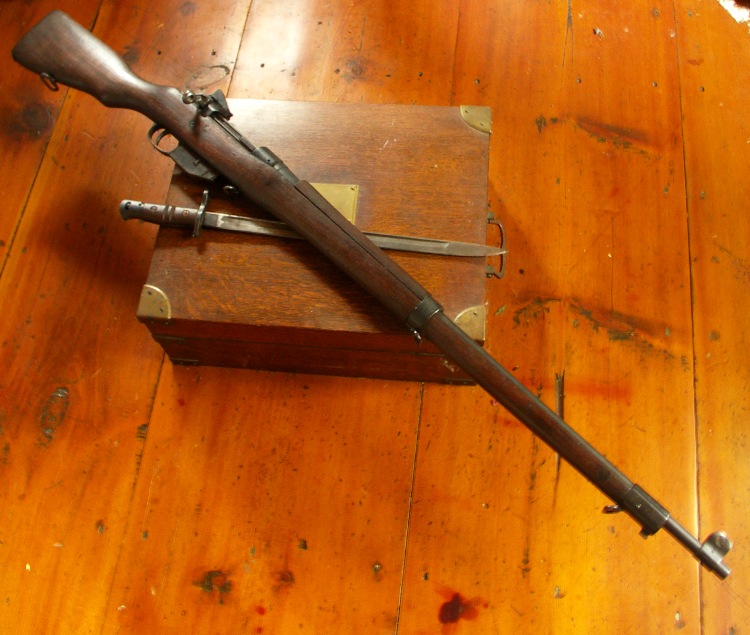
Ross rifle model 1910B
Photo by Vaarok via Wikimedia Commons.
Tested head to head with the Lee-Enfield Mark I, the Ross did well in some of the trials but came up short in other crucial ones, such as the endurance test. Some 1,000 rounds were fired through each rifle and, while the Lee-Enfield functioned well, the Ross repeatedly jammed. After the 300th round, the heat of firing melted away the foresight, which was fastened with common solder. Ross explained that prior tests had been conducted with ammunition of American and Austrian manufacture and that “the standard called for in the manufacture of British .303 cartridges is not of the same precision and quality of material hence greater limits have to be allowed.” His dubious explanation was accepted by the committee.
Already the enterprise was off on the wrong foot. Due to Borden’s choices, the investigative committee leaned in favor of the Ross. It was obvious that no accurate appraisal of anything can result from a biased investigative body. Hughes in particular championed the rifle, and his stubborn resistance to evidence that contradicted his opinions bordered on the irrational. To the end he would insist that the Ross was superior to the Lee-Enfield, even after thousands of Canadian soldiers had simply thrown theirs away on the battlefield.
If the weapon had flaws, so did the purchase contract. Under its terms, Ross was to provide 12,000 rifles during 1903 and 10,000 every year thereafter, with a 75 percent advance on all rifles ordered for the duration of the contract, which was not stipulated. The cost of the Ross was not to exceed that of a Lee-Enfield in Britain, yet the price set was $25, compared to $18.27 the War Office paid for a Lee-Enfield. The contract also stated that materials and machinery Ross needed to import to meet the manufacturing requirements were to be exempt from import taxes. Because there was no division outlined between military and sporting rifles, Ross could get all his imports duty-free, regardless of whether they were built for government contract or not. There was no guarantee Ross would provide more rifles in the event of a national emergency, only that he would provide 10,000 annually after the initial 12,000. There was also no mention in the contract of providing a bayonet.
[…]
The final verdict on the Ross was rendered in the vile ooze of mud, filth, and rotting corpses that characterized trench warfare during the Great War. From the first day of fighting, the frequent jamming of the Ross forced soldiers to strike the bolts with entrenching tools or boot heels to clear them. The problem was attributed to the British ammunition being used, which was slightly larger than Canadian- manufactured rounds, but a significant factor was faulty manufacturing that resulted in deformed firing chambers. Long and unwieldy, the Ross was also not well suited for use in narrow trenches. Soon, British Small Magazine Lee-Enfield rifles began appearing in the Canadian ranks, causing First Division commander Lt. Gen. E.A.H. Alderson to issue an order that his men were not permitted to be in possession of SMLE rifles. It was an order largely ignored.
If earlier investigations had repeatedly given the rifle a pass and rendered a skewed verdict, the Canadian soldiers in the trenches did not. In April 1915, after the bloody fight at the Second Battle of Ypres, Belgium, which also saw the first gas attacks of the war, 1,452 of the 5,000 surviving Canadian soldiers threw away their Ross rifles and picked up Lee-Enfields from British casualties. The verdict of the fighting soldier had been delivered. With confidence in the rifle badly damaged, British Commander in Chief Sir John French issued orders rearming the First Canadian Division with the SMLE.
Not all the reports from the line were negative; the superb accuracy and faster loading capability of the Ross made it an excellent sniper’s rifle, as Sergeant William Carey, one of Canada’s top snipers, discovered one morning at St. Eloi. He and a German sniper spotted each other at the same time and both fired, each missing the other. But the bolt action of the Ross gave Carey the edge; he was able to reload and fire faster than the German, and his next shot was lethal. Although it would be replaced as the standard issue service rifle, the Ross would remain a valuable sniper’s weapon.
Comments Off on Canada’s initial WW1 infantry weapon, the Ross rifle
December 1, 2018
California Arms Co 20ga “Defiance” Pistol-Shotgun
Forgotten Weapons
Published on 9 Nov 2018https://www.forgottenweapons.com/cali…
http://www.patreon.com/ForgottenWeapons
Made to compete with guns like the Ithaca Auto & Burglar, the “Defiance” form the California Arms Company is a side-by-side double barreled 20 gauge pistol. Only about 300 were made in the late 1920s – note that this was before the NFA introduced regulation of short barreled shotguns. Unlike the Ithaca and most other guns of this type, the Defiance is not simply a standard side-by-side shotgun cut down in length. Instead, it uses a cast aluminum grip assembly with two manually cocked strikers (and storage for two spare shells in the grip) and a barrel assembly with an integrated aluminum fore-end. The Defiance is nothing if not robust, despite perhaps being a bit slower to use than an Ithaca. Interestingly, the marketing for the Defiance also included a strong focus on the use of tear gas ammunition in addition to standard buckshot – the Lake Erie Chemical Company developed a 20ga tear gas cartridge in partnership with the California Arms Company. It was almost certainly too small to really be effective, though, and was not able to induce enough sales to keep the Defiance on the market long.
Contact:
Forgotten Weapons
PO Box 87647
Tucson, AZ 85754
Comments Off on California Arms Co 20ga “Defiance” Pistol-Shotgun
November 20, 2018
Book Review: Desert Sniper, by Ed Nash
Forgotten Weapons
Published on 30 Oct 2018Available from Amazon: https://amzn.to/2yy2zRf
Desert Sniper is an autobiographical account of Ed Nash’s time fighting as a volunteer with Kurdish forces against ISIS in Syria in 2015 and 2016. Nash had been working as a volunteer with the Free Burma Rangers when he decided in 2015 that the growing list of ISIS atrocities demanded action. With his background in journalism and experience as a liaison for the FBR, he thought he could do some good helping to fight one of the most starkly evil groups the 21st century has yet seen. So, he boarded a plane to the middle east.
Kurdish organization being somewhat subpar, his skills as a journalist were not exploited, and instead he went to a sniper tabor (fighting unit) with a Dragunov, which would be his primary weapon for the rest of his time in country. His book describes the experience from start to finish, including insight into Kurdish culture and politics, training, tactics, and more. He worked with both Kurdish men and women (a substantial fraction of the Kurdish fighters and commanders were female) and with other foreign volunteers like himself and various Special Forces teams from coalition nations like France, the UK, and the US.
There are several things that I particularly appreciate about Nash’s work. First is its honesty and lack of either bravado or squeamishness. Today’s popular sensibilities insist that doing violence must inevitably damage a person psychologically, but this is not true. When one believes in the rightness of one’s actions, one can survive combat without becoming a psychological victim of it. There are certainly physiological exceptions like the prolonged shelling experienced by many in WW1 and the brain injuries caused by pressure waves associated with bomb blasts, but if we are to believe Nash (and I do), one can engage in lethal violence for a just cause and sleep well at night afterward.
On a more technical side, Nash’s journalism experience shows in his writing. The book is engaging and informative, and never left me bored. He gives the reader a feel for the wide variety of situations that he found himself in and the many people we developed relationships with during his time.
Finally, Nash has a good familiarity with firearms, and writings clearly and rationally about them. The guns themselves are not the focus of the book, but when they are relevant they are explained in a way that gun nerds will appreciate. As a sniper, Nash used a Dragunov primarily, but also carried an AK as a secondary rifle. He also had experience with the Zagros and Ser heavy rifles, and cogently explains their use. His descriptions of the range limitations of his SVD will certainly spark interest in readers who are shooters. In fact, Nash provided me with the photo and video material for a video about these Kurdish arms a while back, although I did not identify him by name at that time.
Anyway, this is an inexpensive book and I found it to be an excellent read. Men and women who volunteer to fight like Nash did ought to have their stories more widely known, and recognized for seeing a bad situation and doing something extremely concrete about it, despite often facing daunting legal situations upon their return home as a result.
http://www.patreon.com/ForgottenWeapons
If you enjoy Forgotten Weapons, check out its sister channel, InRangeTV! http://www.youtube.com/InRangeTVShow
Contact: Forgotten Weapons
PO Box 87647
Tucson, AZ 85754
Comments Off on Book Review: Desert Sniper, by Ed Nash


