
History With Hilbert
Published on 23 Aug 2017The entire history of Australia from the earliest humans until somewhere after World War II where I lost interest.
October 25, 2018
The History of Australia
Comments Off on The History of Australia
September 12, 2018
QotD: Origins of India’s caste system
In India, the notion of Hindu culture as a giant conspiracy by Aryan invaders to enshrine their descendants at the top of the social order for the rest of eternity perhaps struck a little too close to home.
But Reich’s laboratory has found that the old Robert E. Howard version is actually pretty much what happened. Conan the Barbarian-like warriors with their horse-drawn wagons came charging off the Eurasian steppe and overran much of Europe and India. Reich laments:
The genetic data have provided what might seem like uncomfortable support for some of these ideas — suggesting that a single, genetically coherent group was responsible for spreading many Indo-European languages.
Much more acceptable to Indian intellectuals than the idea that ancient conquerors from the Russian or Kazakhstani steppe took over the upper reaches of Indian culture has been the theory of Nicholas B. Dirks, the Franz Boas Professor of History and Anthropology at Columbia, that the British malignantly transformed diverse local Indian customs into the suffocating system of caste that we know today.
Now, though, Reich’s genetic evidence shows that caste has controlled who married whom in India for thousands of years:
Rather than inventions of colonialism as Dirks suggested, long-term endogamy as embodied in India today in the institution of caste has been overwhelmingly important for millennia.
This is in harmony with economic historian Gregory Clark’s recent discovery in his book of surname analysis, The Son Also Rises (Clark loves Hemingway puns), that economic mobility across the generations is not only lower than expected in most of the world, but it is virtually nonexistent in India.
Steve Sailer, “Reich’s Laboratory”, Taki’s Magazine, 2018-03-28.
Comments Off on QotD: Origins of India’s caste system
May 29, 2018
ESR’s thumbnail sketch on the origins of the Indo-European language families
When you mash historical linguistics hard enough into paleogenetics, interesting things fall out:
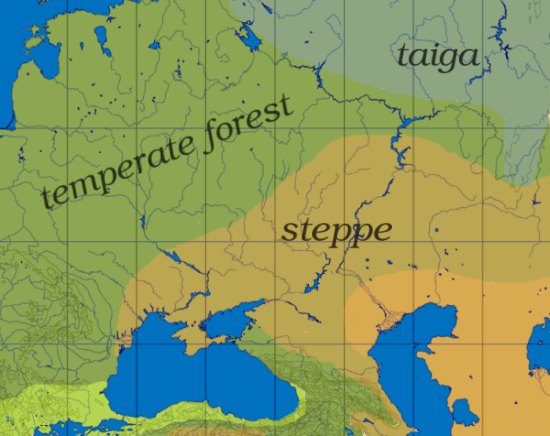
The steppe extends roughly from the Dniepr to the Ural or 30° to 55° east longitude, and from the Black Sea and the Caucasus in the south to the temperate forest and taiga in the north, or 45° to 55° north latitude.
Via Wikipedia
What we can now say pretty much for sure: Proto-Indo-European was first spoken on the Pontic Steppes around 4000 BCE. That’s the grasslands north of the Black Sea and west of the Urals; today, it’s the Ukraine and parts of European Russia. The original PIE speakers (which we can now confidently identify with what archaeologists call the Yamnaya culture) were the first humans to domesticate horses.
And – well, basically, they were the first and most successful horse barbarians. They invaded Europe via the Danube Valley and contributed about half the genetic ancestry of modern Europeans – a bit more in the north, where they almost wiped out the indigenes; a bit less in the south where they mixed more with a population of farmers who had previously migrated in on foot from somewhere in Anatolia.
The broad outline isn’t a new idea. 400 years ago the very first speculations about a possible IE root language fingered the Scythians, Pontic-Steppe descendants in historical times of the original PIE speakers – with a similar horse-barbarian lifestyle. It was actually a remarkably good guess, considering. The first version of the “modern” steppe-origin hypothesis – warlike bronze-age PIE speakers domesticate the horse and overrun Europe at sword- and spear-point – goes back to 1926.
But since then various flavors of nationalist and nutty racial theorist have tried to relocate the PIE urheimat all over the map – usually in the nut’s home country. The Nazis wanted to believe it was somewhere in their Greater Germany, of course. There’s still a crew of fringe scientists trying to pin it to northern India, but the paleogenetic evidence craps all over that theory (as Cochran explains rather gleefully – he does enjoy calling bullshit on bullshit).
Then there have been the non-nutty proposals. There was a scientist named Colin Renfrew who for many years (quite respectably) pushed the theory that IE speakers walked into Europe from Anatolia along with farming technology, instead of riding in off the steppes brandishing weapons like some tribe in a Robert E. Howard novel.
Alas, Renfrew was wrong. It now looks like there was such a migration, but those people spoke a non-IE language (most likely something archaically Semitic) and got overrun by the PIE speakers riding in a few thousand years later. Cochran calls these people “EEF” (Eastern European Farmers) and they’re most of the non-IE half of modern European ancestry. Basque is the only living language that survives from EEF times; Otzi the Iceman was EEF, and you can still find people with genes a lot like his in the remotest hills of Sardinia.
Even David Anthony, good as he is about much else, seems rather embarrassed and denialist about the fire-and-sword stuff. Late in his book he spins a lot of hopeful guff about IE speakers expanding up the Danube peacefully by recruiting the locals into their culture.
Um, nope. The genetic evidence is merciless (though, to be fair, Anthony can’t have known this). There’s a particular pattern of Y-chromosome and mitochondrial DNA variation that you only get in descendant population C when it’s a mix produced because aggressor population A killed most or all of population B’s men and took their women. Modern Europeans (C) have that pattern, the maternal line stuff (B) is EEF, and the paternal-line stuff (A) is straight outta steppe-land; the Yamnaya invaders were not gentle.
How un-gentle were they? Well…this paragraph is me filling in from some sources that aren’t Anthony or Cochran, now. While Europeans still have EEF genes, almost nothing of EEF culture survived in later Europe beyond the plants they domesticated, the names of some rivers, and (possibly) a murky substratum in some European mythologies.
The PIE speakers themselves seem to have formed, genetically, when an earlier population called the Ancient Northern Eurasians did a fire-and-sword number (on foot, that time) on a group of early farmers from the Fertile Crescent. Cochrane sometimes calls the ANEs “Hyperboreans” or “Cimmerians”, which is pretty funny if you’ve read your Howard.
Comments Off on ESR’s thumbnail sketch on the origins of the Indo-European language families
April 1, 2018
When science itself becomes politically incorrect
Andrew Sullivan discusses the unwelcome discoveries of geneticists:
Last weekend, a rather seismic op-ed appeared in the New York Times, and it was for a while one of the most popular pieces in the newspaper. It’s by David Reich, a professor of genetics at Harvard, who carefully advanced the case that there are genetic variations between subpopulations of humans, that these are caused, as in every other species, by natural selection, and that some of these variations are not entirely superficial and do indeed overlap with our idea of race. This argument should not be so controversial — every species is subject to these variations — and yet it is. For many on the academic and journalistic left, genetics are deemed largely irrelevant when it comes to humans. Our large brains and the societies we have constructed with them, many argue, swamp almost all genetic influences.
Humans, in this view, are the only species on Earth largely unaffected by recent (or ancient) evolution, the only species where, for example, the natural division of labor between male and female has no salience at all, the only species, in fact, where natural variations are almost entirely social constructions, subject to reinvention. We are, in this worldview, alone on the planet, born as blank slates, to be written on solely by culture. All differences between men and women are a function of this social effect; as are all differences between the races. If, in the aggregate, any differences in outcome between groups emerge, it is entirely because of oppression, patriarchy, white supremacy, etc. And it is a matter of great urgency that we use whatever power we have to combat these inequalities.
Reich simply points out that this utopian fiction is in danger of collapse because it is not true and because genetic research is increasingly proving it untrue. On the male-female divide, for example, Reich cites profound differences, “reflecting more than 100 million years of evolution and adaptation.” On race, he is both agnostic about what we will eventually find out with respect to the scale of genetic differences, and also insistent that genetic differences do exist: “You will sometimes hear that any biological differences among populations are likely to be small, because humans have diverged too recently from common ancestors for substantial differences to have arisen under the pressure of natural selection. This is not true. The ancestors of East Asians, Europeans, West Africans and Australians were, until recently, almost completely isolated from one another for 40,000 years or longer, which is more than sufficient time for the forces of evolution to work.” Which means to say that the differences could be (and actually are) substantial.
This will lead to subtle variations in human brains, and thereby differences in intelligence tests, which will affect social and economic outcomes in the aggregate in a multiracial, capitalist, post-industrial society. The danger in actively suppressing and stigmatizing this inconvenient truth, he maintains, is that a responsible treatment of these genetic influences will be siloed in the academic field of genetics, will be rendered too toxic for public debate, and will thereby only leak out to people in the outside world via the worst kind of racists and bigots who will distort these truths to their own ends. If you don’t establish a reasonable forum for debate on this, Reich argues, if you don’t establish the principle is that we do not have to be afraid of any of this, it will be monopolized by truly unreasonable and indeed dangerous racists. And those racists will have the added prestige for their followers of revealing forbidden knowledge. And so there are two arguments against the suppression of this truth and the stigmatization of its defenders: that it’s intellectually dishonest and politically counterproductive.
Comments Off on When science itself becomes politically incorrect
March 19, 2018
Prehistoric migrations
In a Science article from last year, Ann Gibbons discusses the ancient migrations that can now be traced using DNA analysis:
After World War II, many scholars recoiled from studying migrations, in reaction to the Nazi misuse of history and archaeology. The Nazis had invoked migrations of “foreign” groups to German territory to justify genocide. “The whole field of migration studies was ideologically tainted,” says archaeologist Kristian Kristiansen of the University of Gothenburg in Sweden. Some researchers also resisted the idea that migration helped spread key innovations such as farming, partly because that might imply that certain groups were superior.
Nor did researchers have a reliable method to trace prehistoric migrations. “Most of the archaeological evidence for movement is based on artifacts, but artifacts can be stolen or copied, so they are not a real good proxy for actual human movement,” says archaeologist Doug Price of the University of Wisconsin in Madison, who tracks ancient migration by analyzing isotopes. “When I started doing this in 1990, I thought people were very sedentary and didn’t move around much.”
Today, however, new methods yield more definitive evidence of migration, sparking an explosion of studies. The isotopes Price and others study are specific to local water and food and thus can reveal where people grew up and whether they later migrated. DNA from ancient skeletons and living people offers the “gold standard” in proving who was related to whom.
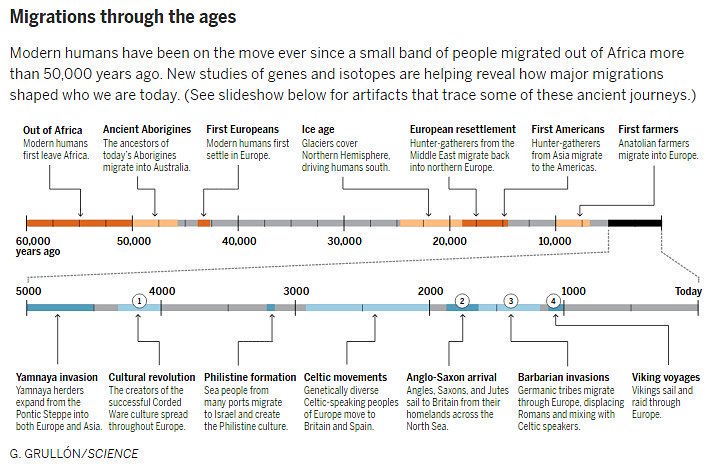
The new data confirm that humans have always had wanderlust, plus a yen to mix with all manner of strangers. After the first Homo sapiens arose in Africa, several bands walked out of the continent about 60,000 years ago and into the arms of Neandertals and other archaic humans. Today, almost all humans outside Africa carry traces of archaic DNA.
That was just one of many episodes of migration and mixing. The first Europeans came from Africa via the Middle East and settled there about 43,000 years ago. But some of those pioneers, such as a 40,000-year-old individual from Romania, have little connection to today’s Europeans, Reich says.
His team studied DNA from 51 Europeans and Asians who lived 7000 to 45,000 years ago. They found that most of the DNA in living Europeans originated in three major migrations, starting with hunter-gatherers who came from the Middle East as the glaciers retreated 19,000 to 14,000 years ago. In a second migration about 9000 years ago, farmers from northwestern Anatolia, in what is now Greece and Turkey, moved in.
That massive wave of farmers washed across the continent. Ancient DNA records their arrival in Germany, where they are linked with the Linear Pottery culture, 6900 to 7500 years ago. A 7000-year-old woman from Stuttgart, Germany, for example, has the farmers’ genetic signatures, setting her apart from eight hunter-gatherers who lived just 1000 years earlier in Luxembourg and Sweden. Among people living today, Sardinians retain the most DNA from those early farmers, whose genes suggest that they had brown eyes and dark hair.
H/T to PaleoAnthropology+ for the link.
Comments Off on Prehistoric migrations
February 27, 2018
The notion of “uploading” your consciousness
Skeptic author Michael Shermer pours cold water on the dreams and hopes of Transhumanists, Cryonicists, Extropians, and Technological Singularity proponents everywhere:
It’s a myth that people live twice as long today as in centuries past. People lived into their 80s and 90s historically, just not very many of them. What modern science, technology, medicine, and public health have done is enable more of us to reach the upper ceiling of our maximum lifespan, but no one will live beyond ~120 years unless there are major breakthroughs.
We are nowhere near the genetic and cellular breakthroughs needed to break through the upper ceiling, although it is noteworthy that companies like Google’s Calico and individuals like Abrey deGrey are working on the problem of ageing, which they treat as an engineering problem. Good. But instead of aiming for 200, 500, or 1000 years, try to solve very specific problems like cancer, Alzheimer’s and other debilitating diseases.
Transhumanists, Cryonicists, Extropianists, and Singularity proponents are pro-science and technology and I support their efforts but extending life through technologies like mind-uploading not only cannot be accomplished anytime soon (centuries at the earliest), it can’t even do what it’s proponents claim: a copy of your connectome (the analogue to your genome that represents all of your memories) is just that—a copy. It is not you. This leads me to a discussion of…
The nature of the self or soul. The connectome (the scientific version of the soul) consists of all of your statically-stored memories. First, there is no fixed set of memories that represents “me” or the self, as those memories are always changing. If I were copied today, at age 63, my memories of when I was, say, 30, are not the same as they were when I was 50 or 40 or even 30 as those memories were fresh in my mind. And, you are not just your memories (your MEMself). You are also your point-of-view self (POVself), the you looking out through your eyes at the world. There is a continuity from one day to the next despite consciousness being interrupted by sleep (or general anaesthesia), but if we were to copy your connectome now through a sophisticated fMRI machine and upload it into a computer and turn it on, your POVself would not suddenly jump from your brain into the computer. It would just be a copy of you. Religions have the same problem. Your MEMself and POVself would still be dead and so a “soul” in heaven would only be a copy, not you.
Whether or not there is an afterlife, we live in this life. Therefore what we do here and now matters whether or not there is a hereafter. How can we live a meaningful and purposeful life? That’s my final chapter, ending with a perspective that our influence continues on indefinitely into the future no matter how long we live, and our species is immortal in the sense that our genes continue indefinitely into the future, making it all the more likely our species will not go extinct once we colonize the moon and Mars so that we become a multi-planetary species.
Comments Off on The notion of “uploading” your consciousness
November 12, 2017
The great “bitter versus sweet” war
Megan McArdle is trapped behind enemy lines in the latest outbreak of the great taste war:
At this point I should put my cards on the table: Geographically and demographically, I belong in bitter country. But I am an exile-in-residence, because bitter foods make me wince.
I mean that literally. Really bitter things — a Negroni, say — produce in me a physical aversion that is close to pain. Black coffee I find merely extraordinarily unpleasant, and hoppy beer is just barely endurable. If I really had to endure it. Say, if consuming a bottle of IPA were the only way to save a busload of orphans who had been kidnapped by a beer snob.
Given where I live here in Washington, DC, and my known interest in food, the presumption of the bitter evangelists is that I must simply need re-education. I have been subjected to many hours of lectures on how I just need to clear my palate from all the sweet garbage I’m used to, so that I can appreciate the subtle joys of bitterness. I have refrained from suggesting that they hold still while I teach them to enjoy the subtle joys of being repeatedly kicked in the shins.
For over years of learning about food — and living with a bitter-loving craft cocktail enthusiast — I’ve come to realize that my aversion to bitter foods is almost certainly genetic. The Romans who coined the adage “de gustibus non est disputandum” were righter than they knew; science now tells us that there is indeed no sense arguing over taste, because you’re not going to change someone’s genome. Many seemingly mystifying divides over foods like cilantro come from the fact that some people have taste receptors that others don’t. If you have no receptors for the “soapy” compound in cilantro, this herb adds a marvelously tangy note to a dish. If you have those receptors, anything cooked with it tastes like Irish Spring en cocotte.
In my case, I probably have more bitter receptors than most people, so that a drink my husband finds intriguingly astringent would hit me like a punch to the tongue. I can no more get over my instinct to spit out bitter foods than he could get over his instinct to take his hand off a hot stove.
Comments Off on The great “bitter versus sweet” war
October 16, 2017
What Happens When You Inbreed? – Brit Lab
BBC Earth Lab
Published on 17 Dec 2015Does inbreeding really lead to deformities and nasty diseases could inbreeding actually be a good thing? Greg Foot finds out the answers.
Comments Off on What Happens When You Inbreed? – Brit Lab
August 22, 2017
QotD: Writing about the past
If you’re writing in the past — or even if you are just living in the present — you should have an idea of how the past was different, and the factors that shaped that.
If you assume the past was just like the present only less “enlightened” you’re presupposing history comes with an arrow, and that today is of course more “advanced” than the past. While this is true of science — of course — it’s not always true of what was inside people’s heads. In many ways because even the poorest of us struggle less than in the Middle Ages, it’s become easier to develop mental habits of laziness and other “rich person” vices. What you think is enlightenment might be considered sheer nonsense by your descendants. For instance the enlightened thing at one time (even Heinlein has a whiff of it) was genetic culling. Now we’re finding that what we know about genes isn’t that straightforward. Throw in epigenetics and someone with a gene to be a “moron” can turn out to be a genius. More, even overtly bad disease genes are linked to genes we need and can’t survive without. BUT the enlightened opinion in the early twentieth century was to improve humanity and save human suffering by culling out the sick and the lame and the “inferior races.” (No, Hitler didn’t invent that.)
Some of our concepts (and I’m not going to name any because it’s a fight I don’t need, but I’m sure you can think of some) will prove just as monstrous to our descendants.
If you don’t have a sense of that, you don’t have a sense of the past, which unfortunately means you don’t have a sense of the present.
If you think that there is an objective way to end poverty or stop drug use, or whatever, and it’s ONLY your way, and even your opponents think your way is right and are being villainous and “evil” by opposing it you not only shouldn’t be writing historical fiction, you definitely shouldn’t be voting. You should find the nearest kindergarten and use it as a safe space.
Because out here in the real adult world, the past and the present and complicated places, with different modes of arranging life that worked with the circumstances at that time, even if they now set our teeth (or our hair) on edge.
If you can’t accept your ancestors were different from you, thought differently and responded to different necessities, you have no business preaching multiculturalism.
Because what makes a culture different is not the hairstyles, the dresses or what they ate, but how one must live to survive. And yes, some cultures are factually worse than others at providing their people with the necessities (or the luxuries) of life. Arguably most past cultures were (barring our finding some atlantian high-developed scientific culture we’ve heard nothing about.)
That doesn’t give you the right to to stomp your feet and rewrite the past to justify your boorish self-regard in the present.
Your ancestors were both more and less enlightened than you in ways you can’t even understand, and your superimposing your beliefs on them is the act of a mental midget standing on the shoulders of giants and peeing down.
Sarah A. Hoyt, “What Has Gone Before Us”, According to Hoyt, 2015-08-03.
Comments Off on QotD: Writing about the past
June 13, 2017
Vegetable impostors on your table
The vegetable pushers are clever: they can disguise vegetables in such a way that you don’t realize where they came from. A prime set of examples are all variations of a common Mediterranean weed called Brassica oleracea:

Click to see full-size image
Brassica is also known as the wild mustard plant.
“The wild plant is a weedy little herb that prefers to grow on limestone outcroppings all around the coastal Mediterranean region,” Jeanne Osnas, a researcher at Purdue University who blogs as “The Botanist in the Kitchen,” writes of Brassica oleracea.
“It is a biennial plant that uses food reserves stored over the winter in its rosette of leaves to produce a spike of a few yellow flowers at the end of its second summer before dying. Those nutritious leaves make its domesticated derivatives important food crops in much of the world now.”
This one plant was selectively bred over hundreds of years to create dozens of wildly different vegetables.
By selecting and breeding plants with bigger leaves, or larger buds, the various cultivars were created.
[…]
The amazing evolution of Brassica oleracea goes to show that humans have been tinkering with the genetics of our food – creating what are now known as genetically modified foods, or GMOs – for a very long time.
New lab techniques just let us do that in a more precise and directed way.
Comments Off on Vegetable impostors on your table
March 30, 2017
You can now have beer brewed to your taste (as encoded in your genome)
For those with a taste for custom-brewed beer (and a very big budget), you can now have a batch of beer created to match your taste preferences, scientifically:
London-based Meantime Brewing Company, acquired a year ago by Belgian beverage multinational Anheuser-Busch InBev, wants to sell you beer tuned to your taste.
To do so, the company plans to direct willing customers to genetic testing service 23andMe – the Silicon Valley personal genomics biz that’s slowly emerging from its near death experience at the hands of US health regulators – to evaluate their genetic taste proclivities.
For a mere £25,000 (~$31,200), beer lovers who prefer entrusting purchasing decisions to science rather than self-knowledge can buy 12 hectolitres (about 2,100 Imperial pints or 2,500 US pints) of ale tailored to taste preferences encoded in their genome.
Customers supply their saliva, 23andMe sorts the genes, and Meantime crafts a beer to fit inborn affinities.
“Pioneering personal genetics company 23andMe will assess hereditary variations in your oral taste receptors (the TAS2R38 gene) to reveal the genetic variants that could explain personal preferences towards specific flavour profiles within beer, such as sweetness and bitterness,” the company explains on its website.
And if the genetically dictated balance of flavors doesn’t align with actual taste preferences, Meantime has left itself an out – customers get a consultation with Brewmaster Ciaran Giblin to adjust the flavors if necessary.
That’s almost certainly for the best since, as 23andMe points out, the role of genetics in taste preferences is uncertain. “Scientists aren’t yet sure how much of our taste preferences are genetic, but estimates are generally around 50 per cent,” the company says in the Taste report it offers subscribers.
Comments Off on You can now have beer brewed to your taste (as encoded in your genome)
March 6, 2017
QotD: Organic food “standards”
In December 1997 when USDA proposed standards for organic agricultural production, the original version was rejected by the organic enthusiasts, largely because it would have permitted the use of organisms modified with modern genetic engineering techniques (“GMOs”) – which would have been quite sensible in the view of the scientific community. In the end, modern genetic engineering, which employs highly precise and predictable techniques, was prohibited, while genetic modification with older, far less precise, less predictable and less effective techniques were waived through.
The resulting organic “standards,” which are based on a kind of “nature good, technology evil” ethic, arbitrarily define which pesticides are acceptable, but allow “deviations” if based on “need.” Synthetic chemical pesticides are generally prohibited, although there is a lengthy list of exceptions listed in the Organic Foods Production Act – while most “natural” ones are permitted. Thus, advocates of organic agriculture might be described as “pragmatic fanatics.” (Along those lines, the application as fertilizer of pathogen-laden animal manures, as compost, to the foods we eat is not only allowed, but in organic dogma, is virtually sacred.)
What, then, is the purpose of organic standards? “Let me be clear about one thing,” Secretary of Agriculture Dan Glickman said when organic certification was being considered, “the organic label is a marketing tool. It is not a statement about food safety. Nor is ‘organic’ a value judgment about nutrition or quality.”
Organic standards are wholly arbitrary, owing more to the dogma of an atavistic religious cult than to science or common sense. And whatever their merit, as a December 2014 report in the Wall Street Journal described, the standards are not being enforced very effectively: An investigation by the newspaper of USDA inspection records since 2005 found that 38 of the 81 certifying agents – entities accredited by USDA to inspect and certify organic farms and suppliers — “failed on at least one occasion to uphold basic Agriculture Department standards.” More specifically, “40% of these 81 certifiers have been flagged by the USDA for conducting incomplete inspections; 16% of certifiers failed to cite organic farms’ potential use of banned pesticides and antibiotics; and 5% failed to prevent potential commingling of organic and nonorganic products.”
[…]
The bottom line is that buying “certified organic” products doesn’t guarantee that they will be free of genetically engineered ingredients. Even so, buying organic should please those consumers who think that paying a big premium for something means that it’s sure to be better. We hope that at least they get the benefit of the “placebo effect.”
Henry I. Miller and Drew L. Kershen, “Fanaticism, Pragmatism and Organic Agriculture”, Forbes, 2015-07-08.
Comments Off on QotD: Organic food “standards”
November 26, 2016
The war on science
In City Journal, John Tierney explains why the most serious threats to science come not from the right’s creationist bitter clingers, but from the left’s highly selective “pro (some) science” activism:
I know that sounds strange to Democrats who decry Republican creationists and call themselves the “party of science.” But I’ve done my homework. I’ve read the Left’s indictments, including Chris Mooney’s bestseller, The Republican War on Science. I finished it with the same question about this war that I had at the outset: Where are the casualties?
Where are the scientists who lost their jobs or their funding? What vital research has been corrupted or suppressed? What scientific debate has been silenced? Yes, the book reveals that Republican creationists exist, but they don’t affect the biologists or anthropologists studying evolution. Yes, George W. Bush refused federal funding for embryonic stem-cell research, but that hardly put a stop to it (and not much changed after Barack Obama reversed the policy). Mooney rails at scientists and politicians who oppose government policies favored by progressives like himself, but if you’re looking for serious damage to the enterprise of science, he offers only three examples.
All three are in his first chapter, during Mooney’s brief acknowledgment that leftists “here and there” have been guilty of “science abuse.” First, there’s the Left’s opposition to genetically modified foods, which stifled research into what could have been a second Green Revolution to feed Africa. Second, there’s the campaign by animal-rights activists against medical researchers, whose work has already been hampered and would be devastated if the activists succeeded in banning animal experimentation. Third, there’s the resistance in academia to studying the genetic underpinnings of human behavior, which has cut off many social scientists from the recent revolutions in genetics and neuroscience. Each of these abuses is far more significant than anything done by conservatives, and there are plenty of others. The only successful war on science is the one waged by the Left.
Comments Off on The war on science
May 26, 2016
Eighty percent of Americans surveyed favour banning things they know nothing about
Don’t get too smug, fellow Canuckistanis, as I suspect the numbers might be just as bad if Canadians were surveyed in this way:
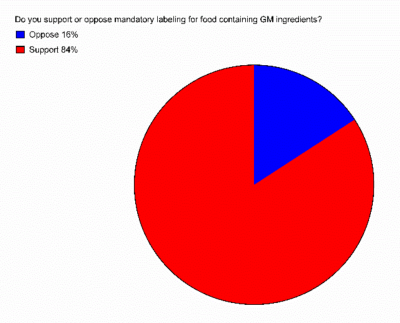
You might have heard that Americans overwhelmingly favor mandatory labeling for foods containing genetically modified ingredients. That’s true, according to a new study: 84 percent of respondents said they support the labels.
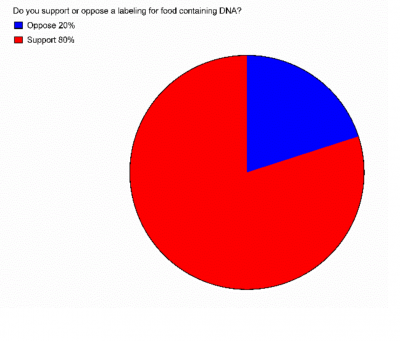
But a nearly identical percentage — 80 percent—in the same survey said they’d also like to see labels on food containing DNA.
The study, published in the Federation of American Societies for Experimental Biology Journal last week, also found that 33 percent of respondents thought that non-GM tomatoes “did not contain genes” and 32 percent thought that “vegetables did not have DNA.” So there’s that.
University of Florida food economist Brandon R. McFadden and his co-author Jayson L. Lusk surveyed 1,000 American consumers and discovered [PDF] that “consumers think they know more than they actually do about GM food.” In fact, the authors say, “the findings question the usefulness of results from opinion polls as motivation for public policy surrounding GM food.”
My summary for laymen: When it comes to genetically modified food, people don’t know much, they don’t know what they don’t know, and they sure as heck aren’t letting that stop them from having strong opinions.
Comments Off on Eighty percent of Americans surveyed favour banning things they know nothing about
December 16, 2015
Chipotle gains “green cred PR opportunities” and worse health outcomes for customers
Henry Miller on the Faustian bargain Chipotle willingly made and is now paying for:
Chipotle, the once-popular Mexican restaurant chain, is experiencing a well-deserved downward spiral.
The company found it could pass off a fast-food menu stacked with high-calorie, sodium-rich options as higher quality and more nutritious because the meals were made with locally grown, genetic engineering-free ingredients. And to set the tone for the kind of New Age-y image the company wanted, Chipotle adopted slogans like, “We source from farms rather than factories” and, “With every burrito we roll or bowl we fill, we’re working to cultivate a better world.”
The rest of the company wasn’t as swift as the marketing department, however. Last week, about 140 people, all but a handful Boston College students, were recovering from a nasty bout of norovirus-caused gastroenteritis, a foodborne illness apparently contracted while eating Chipotle’s “responsibly raised” meats and largely organic produce.
And they’re not alone. The Centers for Disease Control and Prevention has been tracking another, unrelated Chipotle food poisoning outbreak in California, Illinois, Maryland, Minnesota, New York, Ohio, Oregon, Pennsylvania and Washington, in which victims have been as young as one year and as old as 94. Using whole genome sequencing, CDC investigators identified the DNA fingerprint of the bacterial culprit in that outbreak as E. coli strain STEC O26, which was found in all of the sickened customers tested.
Outbreaks of food poisoning have become something of a Chipotle trademark; the recent ones are the fourth and fifth this year, one of which was not disclosed to the public. A particularly worrisome aspect of the company’s serial deficiencies is that there have been at least three unrelated pathogens in the outbreaks – Salmonella and E. coli bacteria and norovirus. In other words, there has been more than a single glitch; suppliers and employees have found a variety of ways to contaminate what Chipotle cavalierly sells (at premium prices) to its customers.
Comments Off on Chipotle gains “green cred PR opportunities” and worse health outcomes for customers


