
… the various divisions between human beings — communists vs. fascists vs. loyal American patriots — we have lived with all our lives are less important, less fundamental, than the basic one that Heinlein identified: “The human race divides politically into those who want people to be controlled and those who have no such desire”. Call the first group authoritarians or feudalists and the second, generic libertarians.
The first time, in the history of Western Civilization, that this became an issue, was the Renaissance/Reformation. Information suddenly came flooding, unbidden, into Europe, from North Africa, through Galileo’s telescope, out of Gutenberg’s printing press, and a dozen other undesirable, unlicensed, and deplorable sources. It must have been a nightmare for the aristocrats who considered themselves to be in charge, the kings and barons and bishops and bullies. They struggled in vain to get it back under control. They got the Church to condemn it. They intimidated and tortured its emissaries when they could. They invented universities to get a handle on it, a collar around its neck, but it was a lost cause. In just a couple of centuries (compared to the previous 500 generations), people — ordinary people; who the hell did they think they were? — came to know too much for the good of Authority.
And they soon proved it, in the American Revolution, which told 10,000 years of kings to go to hell, and the French Revolution, which cut to the chase and removed their overly-pampered heads. I have actually seen the blade. Many other revolutions followed, worldwide, and people began to learn, slowly and awkwardly, to live their own lives. The one good thing to come out of the brutal and deceitful Russian Revolution was the ultimately individualistic philosophy of refugee Ayn Rand.
Otherwise, it was a naked attempt by the authoritarians, the feudalists, to regain control of the masses that the Czar had clumsily let slip through his overly-manicured fingers. Whenever human beings have clashed over whether their lives should be controlled by others or not, it has almost certainly been a matter of who gets to be the next king, baron, bishop, commissar, etc., a battle between liberated entities and those who would restore feudalism.
L. Neil Smith, “The Deep State”, Libertarian Enterprise, 2019-04-14.
September 24, 2025
QotD: The political divisions of humanity
August 16, 2025
Britain slides further down the free speech rankings
At The Conservative Woman, Bruce Newsome reports on the parlous state of free speech in the United Kingdom:
SINCE 2021, the Index on Censorship has ranked Britain as “partially open” (the third tier). Britain ranks 20th for press freedom (worse than Trinidad and Tobago).
Just released: The US State Department concludes that in 2024, Britain’s human rights “worsened” and the British government is partial in protecting rights and freedoms: “Significant human rights issues included credible reports of serious restrictions on freedom of expression, including enforcement of or threat of criminal or civil laws in order to limit expression; and crimes, violence, or threats of violence motivated by antisemitism. The government sometimes took credible steps to identify and punish officials who committed human rights abuses, but prosecution and punishment for such abuses was inconsistent.”
There are three main categorical freedoms being routinely violated in Britain. In US Constitutional law, they are known as speech, assembly and press. British authorities need a reminder.
Let’s fully understand how this started, more than 25 years ago. In 1999, the Macpherson inquiry into the 1993 murder of Stephen Lawrence recommended that police should record hateful incidents as a matter of intelligence, even if the incidents were not criminal. Quangos led by the College of Policing encouraged police forces to record non-crime hate incidents (NCHIs). Police took it upon themselves to visit the supposed haters, to “correct your thinking“, to intimidate them with warnings of escalation, and even to strong-arm them into taking thought-correction classes with the police, at cost.
The 2006 Racial and Religious Hatred Act criminalises hatred of protected characteristics. It was once sold as a protection against violence, but was soon wielded to criminalise speech.
Police make more than 30 arrests a day (more than 10,000 per year) for online speech and record 66 non-crime hate incidents per day.
Despite several administrations claiming to review and restrict the definitions of hate speech and NCHIs, the definitions remain too vague to prevent police from repressing speech they don’t like. In 2024, the Free Speech Union submitted freedom of information (FoI) requests to all 43 police forces in England and Wales to see if recording went down since a new code of practice of June 2023. The number has actually increased. This year the current government sneakily signalled its appreciation of NCHIs in response to a petition to abolish them.
The latest statute aimed at free speech came into force on July 25: the Online Safety Act. The Bill was marketed as a necessary legislation to protect minors from harmful material such as pornography, self-harm forums, and bullying towards suicide. Like the Hatred Act, the Online Safety Act is being used to suppress politically inconvenient content.
British public authorities (and social media) are suppressing speech and the press selectively with political, religious and ethnic prejudice.
April 21, 2022
The fight for freedom of speech must continue
Chris Bray on the foundation of the US Republican Party (aka the “GOP”) and the fight for freedom of speech then and now:
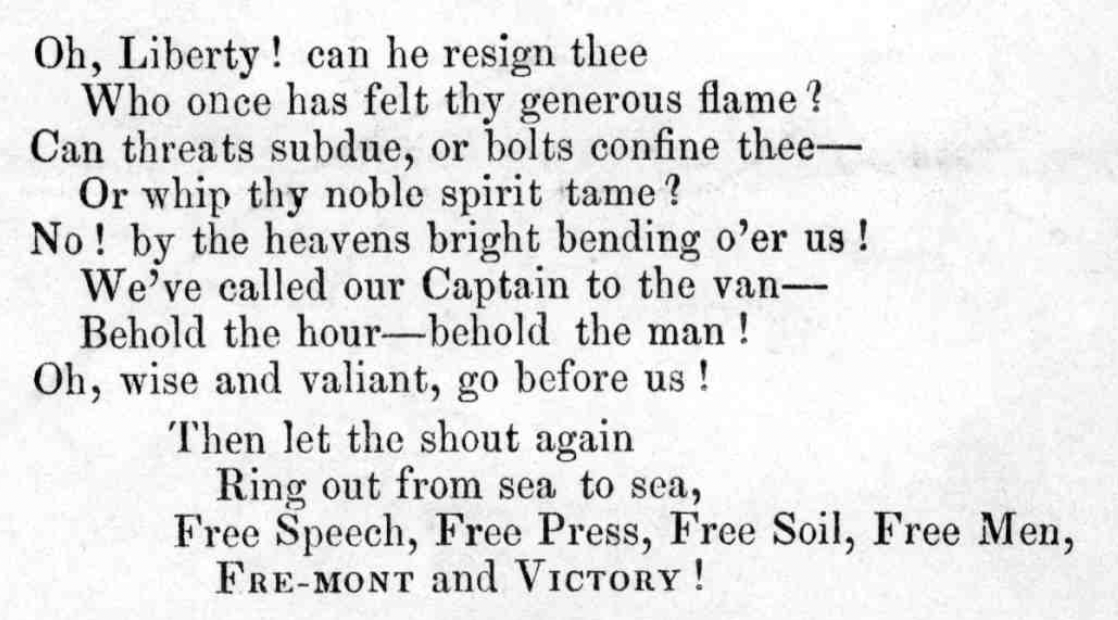
In 1854, Whig Party members disgusted by their party’s weak opposition to the westward expansion of slavery founded the Republican Party. Two years later, the new party ran its first presidential candidate, John C. Fremont, behind the slogan that appears at the bottom of these campaign rally-song lyrics:
Free Speech, Free Press, Free Soil, Free Men, Fremont!
The reason free speech and a free press were in there as political premises in 1856, as contested values a new political party was fighting for …
Okay, hold on a minute. In 2022, we’re a little baffled that we’re fighting for free speech. An army of sniveling shitweasels insists that we need guardrails around our discourse to prevent extremism, and Twitter employees gasp and sob as some horrible monster threatens to use their platform to let people just say stuff.
Stop trying to let people speak freely, you Nazis!
The whole thing is so baffling because we feel like the other side is trying to win the game as we amble out of the locker room and get on the team bus to head back to the hotel, like, game’s over, folks, we won an hour ago. Aren’t these long-settled questions? How is it that people are trying to drive us back against the powerful course of the American free speech tradition?
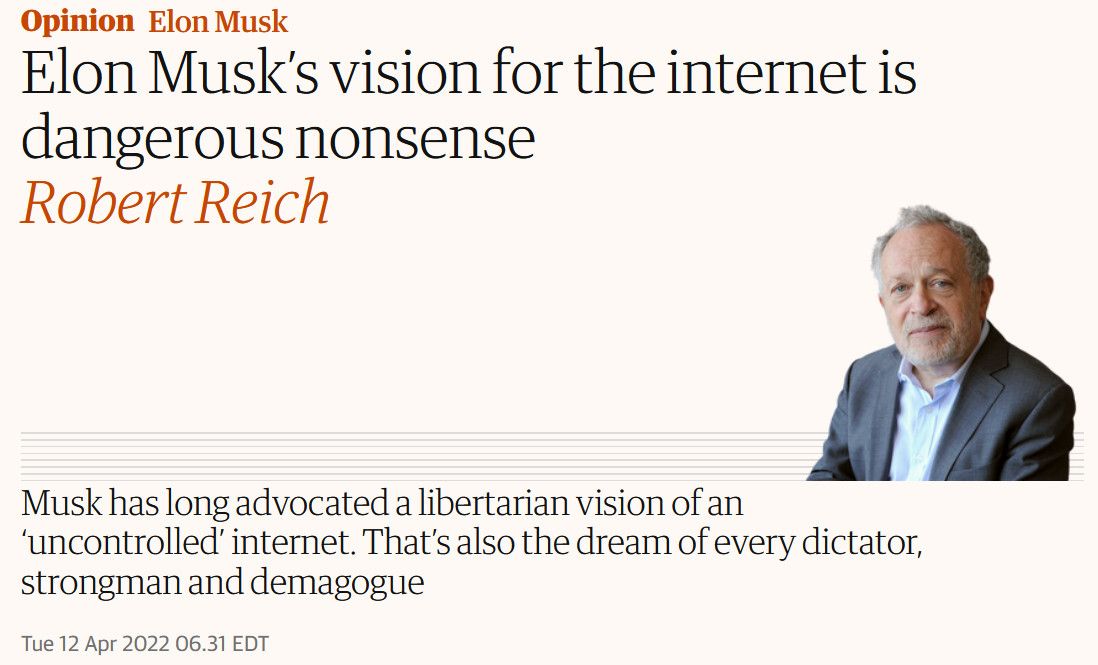
And one argument I’d like to offer, if Robert Reich will allow me to make it HITLER HITLER HITLER this content should me moderated out of existence to protect democracy, is that the argument we’re hearing right now is very much one of the American traditions regarding political speech. We buried it for a long time, but it’s real, it has been quite powerful, and it’s back.
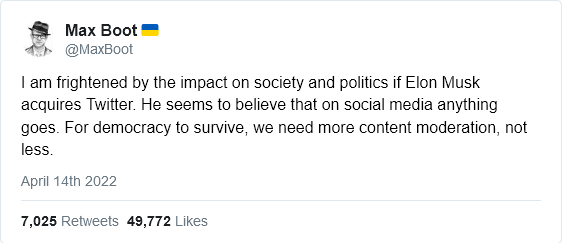
Max Fucking Boot, my God.
November 15, 2021
QotD: Britain at war
George Orwell, “The Lion And The Unicorn: Socialism and the English Genius”, 1941-02-19.
February 5, 2020
“On this issue, Canada’s two solitudes could hardly be more starkly apparent”
Chris Selley on the vastly different reaction from Quebec media to the Trudeau government’s notion to turn the country’s news organizations into a modern version of Joseph Goebbels’ propaganda apparatus, pumping out approved-by-the-Liberals story lines:
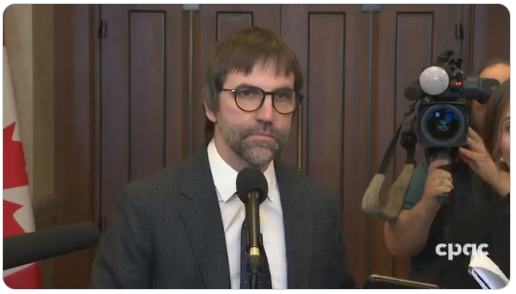
On Sunday, when CTV’s Evan Solomon pushed Heritage Minister Steven Guilbeault on the issue of issuing journalism licences to foreign media outlets, Guilbeault eventually just shrugged: “I’m not sure I see what the big deal is.”
Canadian Heritage Minister Steven Guilbeault, 3 February 2020.
Screencapture from CPAC video.The minister tried to walk it back on Monday, but the fact is many of his fellow Quebecers will also struggle to discern a big deal. There is simply much more tolerance of this sort of cultural gatekeeping among francophone Quebecers than in the Rest of Canada, and the tolerance extends well into the realm of journalism.
“In reading the (report’s) 260 pages and 97 recommendations, one word comes to mind” Sunday’s editorial in La Presse gushed: “Finally!”
Opposition to government regulation of journalism is firmly entrenched not just in anglophone Canada, but across the anglosphere. When the 2011 Leveson Inquiry proposed the British government create a powerful new press regulator, nearly every major outlet rejected the idea. Fraser Nelson, editor of The Spectator, famously vowed the magazine “will not attend its meetings, pay its fines nor heed its menaces.”
The same year, Laval University professor Dominique Payette’s report into Quebec’s struggling news media recommended the government legislate a “professional journalist” designation. The province’s largest journalists’ trade organization and the Quebec Press Council happily sat down with the government to bash out a power-sharing agreement on deciding who’s a proper journalist and who isn’t.
The English-language Montreal Gazette was dead-set against the idea, but Le Devoir called it a “logical outcome.” (The power-sharing discussions eventually fell apart, and the idea died a merciful death.)
February 4, 2020
“Who could oppose such an obviously sound idea?”
A few pithy comments from Twitter on the Trudeau government’s apparent surprise that a few Canadians don’t think their regulate-the-internet plan is brilliant:
The thing to understand about this BTLR/Guilbeault fiasco is how commonplace it is. There are thousands of people in the Liberal/academic universe – the best and brightest – to whom the idea of gov’t licensing, regulating and subsidizing the media is entirely uncontroversial.
— Andrew Coyne (@acoyne) February 3, 2020
I’m sure he/they were genuinely taken aback at the response. Doesn’t *everybody* think the media should take instruction from a wise and enlightened gov’t, which would after all be run by wise and enlightened people like themselves? Who could oppose such an obviously sound idea?
— Andrew Coyne (@acoyne) February 3, 2020
Look at who’s on the panel that recommended it: law professors! People whose business It is to know about things like, say, the Charter of Rights. But then, given the courts’ appalling record on speech restrictions, perhaps they felt confident even this would be upheld.
— Andrew Coyne (@acoyne) February 3, 2020
Fellow Rush fan Matt Gurney finds the perfect lyrics for the occasion:
We’ve taken care of everything
The words you read
The songs you sing
The pictures that give pleasure
To your eye
One for all and all for one
Work together
Common sons
Never need to wonder
How or why https://t.co/OUurFwaokj— Matt Gurney (@mattgurney) February 4, 2020
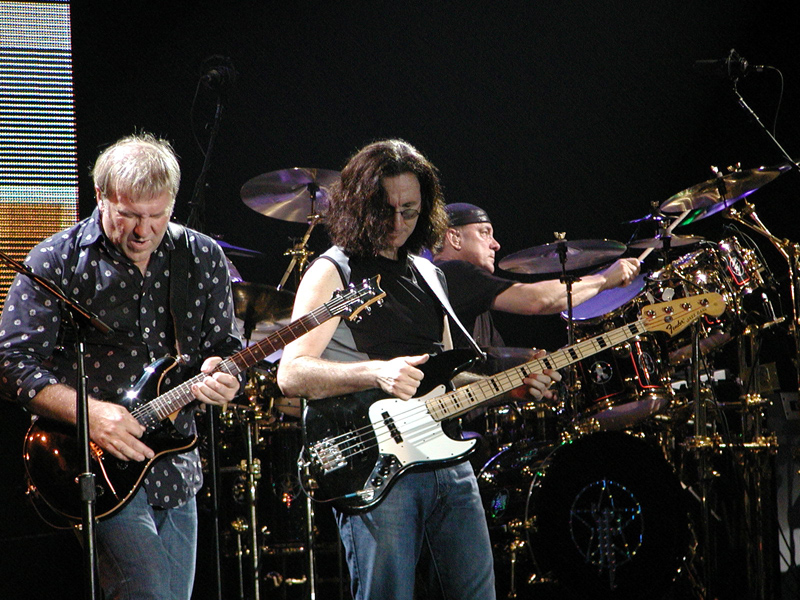
Rush in concert, Milan 2004.
Photo by Enrico Frangi, via Wikimedia Commons
CRTC regulating the internet – “Nobody elsewhere is proposing anything like it, and for good reason: because it’s insane”
Ted Campbell suggests that the Canadian government most recent brainfart is a “Tea Party moment” for Canadians:
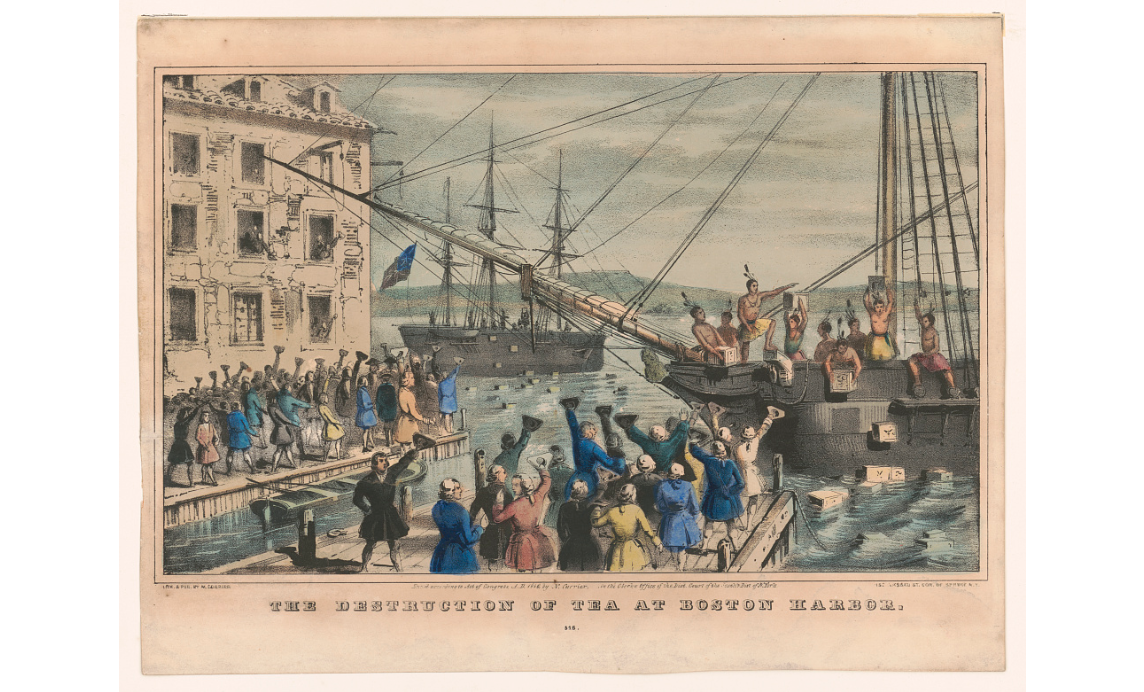
One commentator on social media dubbed this […] the moment when Heritage Minister Steven Guilbeault said that the Trudeau regime plans to license news websites as a “Boston Tea Pary moment.”
N. Currier. Destruction of tea at Boston Harbor, 1846. [New York: N. Currier]
Retrieved from the Library of Congress – https://www.loc.gov/item/91795889/She was referring to the protest, in December of 1773, when angry American colonists (many dressed as Native Americans to try and hide their true identities) dumped several hundred chests of tea, imported by the East India Company, into Boston harbour to protest the taxes, on almost everything, that had been imposed, by Westminster to pay for the Seven Years War. Westminster felt it was only fair to tax the colonists equally, along with the people of the British Isles, because much of the war, called the French-Indian War, now, by Americans, was fought to protect them and their vital commercial interests. The American colonists disagreed, many on the principle that they should not be taxed without being represented in parliament. We know where it all ended.
It’s a good question. Most commentators seem to agree with me that the Trudeau regime has seriously overreached in supporting the Broadcasting and Telecommunications Legislative Review Panel’s recommendations that, somehow, the distribution of “news” should be regulated by the government. That is a far, far greater intrusion into the liberty of free Canadian citizens than a tax on staples was to Americans in 1773.
Andrew Coyne, writing in the Globe and Mail, opines that “The whole thing is just breathtaking – a regulatory power grab without precedent, either in Canada or the democratic world. Nobody elsewhere is proposing anything like it, and for good reason: because it’s insane. This kind of bureaucratic micromanagement, with its obsession with ‘cultural sovereignty’ and ‘telling ourselves our own stories,’ would have been hopelessly outdated in 1990. In 2020, it’s just embarrassing.” He’s right to use the word “insane,” ~ the proposal is quite possibly unconstitutional, just for a start, it is, certainly based on a deeply mistaken idea of what the internet actually is ~ and he’s equally right to say that every Canadian who doesn’t, actively, protest against this must be embarrassed because each is, for no good reason at all that I can see, supporting a proposal that makes Canada less, far less, of a liberal democracy and more like Ethiopia and Senegal (both with scores below 6.0, the threshold for a Flawed Democracy in the well regarded Economist Intelligence Unit’s latest democracy index) where he will visit this week … perhaps to learn from the leaders of authoritarian regimes what his next steps should be to embarrass Canada further.
Michael Geist on the jaw-dropping performance of Trudeau’s Canadian Heritage Minister last weekend:
In June 2017, the Standing Committee on Canadian Heritage committee recommended implementing tax on Internet services in a report on media. Within minutes, Prime Minister Justin Trudeau was asked about the proposal at a press conference in Montreal. Trudeau’s answer – which literally came as committee chair Hedy Fry was holding a press conference on the report – was unequivocal: No. The government was not going to raise costs of Internet services with an ISP tax. The committee recommendation was minutes old and the government wasted absolutely no time in killing the proposal.
Last week, the Broadcasting and Telecommunications Legislative Review Panel proposed a far broader regulatory vision for the Internet. Indeed, it is difficult to give the full breadth of this plan its due. I will be posting this week on some of the most harmful aspects of the plan, including regulating media organizations around the world with penalties in the hundreds of thousands of dollars for failing to obtain licences, regulating streaming companies despite their massive investment in Canada, regulating everything from app stores to operating systems, creating liability for harmful content that violates Canada’s commitments in the USMCA, undermining net neutrality, and increasing the costs of Internet-based services for Canadian consumers.
Over the weekend, Canadian Heritage Minister Steven Guilbeault was asked about the proposal. In particular, he was asked about the proposal to licence foreign news sites (the example used was Breitbart but it could just as easily have been the New York Times, BBC, CNN, Fox or MSNBC). The answer should have been easy: no.
Instead of “no”, Minister Guilbeault’s response was that it was “no big deal.”
On Monday morning, the minister appears to have reconsidered being quite so blatant in indulging his inner authoritarian control freak:
Guilbeault walked back the comments on Monday, stating that the government had “no intention to impose licensing requirements on news organizations,” nor will the government “regulate news content.”
“… Our focus will be and always has been that Canadians have diversity to high-quality news sources,” said Guilbeault to reporters in Ottawa.
This announcement comes after deep criticism of a previous announcement by the Liberal government, where they said they would force news organizations to apply for a licence.
Guilbeault’s announcement faced intense scrutiny from across the political spectrum with some commentators suggesting that it would be a dangerous attack on the freedom of the press.
June 12, 2019
QotD: Militant Islam and the Western media
“I’m always willing to stand with the guys in Denmark,” says Steyn. “But the reason all these left-wing Europeans end up on a stage with an eccentric right-wing Canadian like me is that no real A-list stars will agree to be there. At the tenth anniversary both the American State Department and the British Foreign Office even issued official warnings to their citizens to stay away from the Danish Parliament, where we were holding the ceremony. What kind of signal does that send? Why don’t the artists show up for these things? Why aren’t the movie stars there? When Theo Van Gogh was assassinated, no one at the Oscars had a word to say about it. They didn’t even put him in the obituary montage. And yet they congratulate themselves on their moral courage. George Clooney wears a Je suis Charlie Hebdo pin. Helen Mirren wears a brooch. But they were not with Charlie. Those guys died alone. This is gesture politics. No one would stand with them. I honour the genuine courage of Ayaan Hirsi Ali. Ayaan’s point is absolutely right — in the end you have to share the risk. Charlie Hebdo supported the Danish cartoonists, but the rest of the world didn’t. If every newspaper had published those cartoons, there would have been no point in killing anyone because there would have been too many people to kill. Instead, nobody stands with them, and so the small publication that does ends up massacred. The writer of the comic strip Doonesbury in America [Garry Trudeau] attacked the decision of PEN to honour Charlie Hebdo. Well, they were lying on the floor, bleeding and dying. I don’t think they noticed.”
The Danish cartoon controversy was actually the first moment the American press had been challenged by Islam and could do something in response — and their reaction was a spectacular failure of will and principle. In several countries around the world, it was actually against the law to publish the Danish cartoons, but many editors stepped up, published them anyway, and suffered the civil and criminal consequences. In the United States — where there was no such law — no major publication would print them.
Mark Steyn, interviewed by John Bloom, “Mark Steyn, Cole Porter and Free Speech”, Quadrant, 2017-05-11.
November 24, 2018
May 9, 2018
Freedom of the Press … except where prohibited by (British) law
Wednesday is a critical day in the history of Britain, in the sense that a long-established freedom is at risk of being curtailed:
Press freedom is hanging by a thread in Britain. Tomorrow, the House of Commons will vote on the Data Protection Bill, and Labour MPs have added amendments to it that would effectively end 300 years of press freedom in this country.
That this profound affront to liberty had almost passed under the radar, until spiked and others began making noise about it over the weekend, shouldn’t surprise us. This vote is the culmination of a slow and covert war on the press that has been waged for the best part of a decade.
This story begins with the Leveson Inquiry, an effective showtrial of the press that sparked dozens of spurious trials of journalists and barely any convictions. Since then, press-regulation campaigners have had to find new and underhand ways to push their agenda on an industry and a public who clearly see right through it.
In the wake of Leveson, a new regulator, Impress, was established and given official recognition. It was an historic moment, in the worst possible sense: this was Britain’s first state-backed regulator since the days of Crown licensing. But it was also a stunningly bad bit of PR for the press-regulation lobby, in that Impress was staffed by tabloid-loathing hackademics and funded by tabloid-loathing millionaire Max Mosley.
No national newspaper signed up to it. And so the Hacked Off brigade has been pushing over the past few years for Section 40, a law that would force publications to sign up to a state-approved regulator, which at the moment means signing up to Impress. Those publications, like spiked, who would refuse on principle, would be required to pay the legal costs of any case brought against them, even if they win.
As such, Section 40 would be a gift to the powerful and the begrudged. It would enable anyone to launch lawsuits aimed at shutting down publications they dislike. This is an opportunity that people who have been exposed by the press would take in a heartbeat. It would undermine not only press freedom, but also natural justice.
And it isn’t just the press who are concerned about this. In 2016, the government opened a public consultation into press freedom, asking members of the public if it should implement Section 40 and commence the second part of the Leveson Inquiry. Out of a huge 174,730 responses, 79 per cent said No to Section 40 and 66 per cent said No to Leveson 2.
Update, 10 May: The vote was too damned close, but it was defeated by a nine-vote margin. Guido has the list of MPs voting in favour of muzzling the press here.
April 26, 2018
Britain drops down a league table that really matters, for a change
Mick Hume on the parlous state of press freedoms in Britain:
Britain prides itself on being an historic home of freedom and the free press. So how come we are languishing in 40th place in the international press-freedom table?
Imagine the crowds singing an updated version of Rule Britannia at the Last Night of the Proms, about how Britain ‘shall flourish great and free / The dread and envy of them all / Except for the 39 freer nations, obvs’.
According to the 2018 World Press Freedom Index, published on Wednesday by Reporters Without Borders (RSF), the UK is now ‘one of the worst-ranked countries in Western Europe in terms of respect for press freedom’.
Its 40th place puts the UK one ahead of Burkina Faso and two clear of Taiwan, and suggests that journalists working in Britain have less freedom to hold the powerful to account than those in such liberal states as South Africa, Chile or Lithuania.
British observers are far more likely to bemoan how far we have fallen down the world rankings in football, another field we claim to have invented. Unlike the glorious irrelevance of football, however, freedom of the press really is a matter of life and death for a democratic society.
The UK’s 40th place is unchanged from 2017. But that is 18 lower than its ranking in the first Index, published in 2002 – and 12 places down on six years ago, before the publication of the Leveson report.
That should give a clue as to the new threats press freedom faces in the UK. Unlike in some other illiberal parts of the world, we are not confronted by old-fashioned government repression and state control of the press. Instead, and especially since the Leveson Inquiry, press freedom in the UK has been threatened by a more underhand assault from allegedly liberal political and cultural elites – backed, to their shame, by the Labour Party leadership and the Corbynite left.
March 20, 2018
Free speech on the ropes
J.D. Tuccille says the right to freedom of speech isn’t dead, but it might not qualify for a new life insurance policy:
We have an environment in which the president of the United States is dismissive of the free speech rights of his opponents, prominent constitutional scholars sniff at free speech unless it’s used by the “right” people for their favored goals, and the country’s leading civil liberties organization is suffering an internal revolt by staffers who oppose “rigid” support for free speech protections.
Last October, President Trump said “It’s frankly disgusting the way the press is able to write whatever they want to write.” That came just hours after he tweeted, “With all of the Fake News coming out of NBC and the Networks, at what point is it appropriate to challenge their License? Bad for country!” And even before Trump took the oath of office, he’d huffed that protesters who burn American flags should face loss of citizenship or jail.
So if you’re an academic with expertise in constitutional law, and you have months to watch a populist politician who commands the power of the presidency fulminate about punishing those who criticize him, what do you do? If you’re Georgetown Law’s Louis Michael Seidman, you suggest that the president might be on to something.
In a forthcoming paper, Seidman’s main complaint is that free speech doesn’t inherently favor progressivism — it allows too much voice to people who disagree. “At its core, free speech law entrenches a social view at war with key progressive objectives,” writes Seidman.
Sure, “the speech right has instrumental utility in isolated cases,” he adds. But “significant upside potential”? Nah.
[…]
In its early days, the American Civil Liberties Union (ACLU) viewed free speech as a tool of social justice, suited to particular purposes under particular conditions,” wrote Weinrib, calling on the modern organization to rededicate itself to progressive political goals over civil libertarian advocacy.
The ACLU may be close to taking her advice. Last fall, about 200 of the organization’s staff members signed a letter objecting to the groups’ “rigid stance” on the First Amendment. The letter was characterized by former ACLU board member Michael Meyers as “a repudiation of free-speech principles.”
Huh. With a president who openly chafes at criticism and suggests media naysayers should be punished with the force of law, now seems like a perfect time for opponents to rally around unfettered debate and the First Amendment. Instead, lefty academics and activists are lining up to agree with Trump that a free press and individual rights to freedom of speech, belief, and association are indeed overrated overall.
March 6, 2018
Playboy‘s extortion attempt against Boing Boing dismissed
Back in January, I linked to the bizarre story of Playboy attempting to sue Boing Boing for the terrible crime of … linking. On the web. I’m not making this up. Thankfully, common sense finally did triumph as reported on Monday:
In January, we let you know that Playboy had sued us. On Valentine’s Day, a court tossed their ridiculous complaint out, skeptical that Playboy could even amend it. Playboy didn’t bother to try.
We are grateful this is over. We are grateful for the wonderful work of the EFF, Durie Tangri, and Blurry Edge, our brilliant attorneys who stood up to Playboy‘s misguided and imaginary claims. We are glad the court quickly saw right through them.
Playboy damaged our business. This lawsuit cost our small team of journalists, artists and creators time and money that would otherwise have been focused on Boing Boing‘s continued mission to share wonderful things.
February 9, 2018
John Perry Barlow, RIP
Gareth Corfield on the death of John Perry Barlow, author of the Declaration of the Independence of Cyberspace:
John Perry Barlow, a co-founder of the US Electronic Frontier Foundation, and also a lyricist for the Grateful Dead, has died aged 70.
Barlow passed away “quietly in his sleep” yesterday, according to the EFF, which he helped set up in 1990.
“It is no exaggeration to say that major parts of the Internet we all know and love today exist and thrive because of Barlow’s vision and leadership. He always saw the Internet as a fundamental place of freedom, where voices long silenced can find an audience and people can connect with others regardless of physical distance,” said the foundation’s executive director, Cindy Cohn.
The BBC reported that Barlow had been ill for several years but “few details were given about his medical problems”.
In the history of the Internet, Barlow will be forever remembered for his 1996 Declaration of the Independence of Cyberspace.
“I declare the global social space we are building to be naturally independent of the tyrannies you seek to impose on us. You have no moral right to rule us nor do you possess any methods of enforcement we have true reason to fear,” wrote Barlow, a bold vision of the future that, sadly, did not come to pass.
The EFF defended Barlow against the inevitable criticisms of the Declaration, with Cohn acknowledging that he was “sometimes held up as a straw man for a kind of naive techno-utopianism” but insisting that he understood “new technology could create and empower evil as much as it could create and empower good”.
I wasn’t a fan of the Grateful Dead, but I read his Declaration soon after it was released and found it inspiring (if not particularly realistic, even then). Few people can have a significant role in a single endeavour, but Barlow was undeniably prominent in the music scene and the early internet community. We’re all poorer for his passing.
January 19, 2018
Playboy sues Boing Boing for … linking?
I thought this sort of legal stupidity went out with the 90s …
A few weeks ago we were shocked to learn that Playboy had, without notifying us, sued us over this post (we learned about it when a journalist DM’ed us on Twitter to ask about it). Today, we filed a motion to dismiss, asking the judge to throw out this baseless, bizarre case. We really hope the courts see it our way, for all our sakes.
Playboy’s lawsuit is based on an imaginary (and dangerous) version of US copyright law that bears no connection to any US statute or precedent. Playboy — once legendary champions for the First Amendment — now advances a fringe copyright theory: that it is illegal to link to things other people have posted on the web, on pain of millions in damages — the kinds of sums that would put us (and every other small publisher in America) out of business.
Rather than pursuing the individual who created the allegedly infringing archive, Playboy is pursuing a news site for pointing out the archive’s value as a historical document. In so doing, Playboy is seeking to change the legal system so that deep-pocketed opponents of journalism can shut down media organizations that displease them. It’s a law that they could never get from Congress, but which they hope the courts will conjure into existence by wiping us off the net.
It’s not just independent publishers who rely on the current state of copyright law, either. Major media outlets (like Playboy!) routinely link and embed media, without having to pay a lawyer to research the copyright status of something someone else posted, before discussing, explaining or criticizing it.
The world can’t afford a judgment against us in this case — it would end the web as we know it, threatening everyone who publishes online, from us five weirdos in our basements to multimillion-dollar, globe-spanning publishing empires like Playboy.
As a group of people who have had long associations with Playboy, reading the articles (really!) and sometimes writing them, we hope the judge sees it our way — for our sakes… and for Playboy‘s.


