Quotulatiousness

July 4, 2022

(Very expensive) roads, bridges, and railways to nowhere

In Palladium, Brian Balkus wonders why American can’t build anything any more:
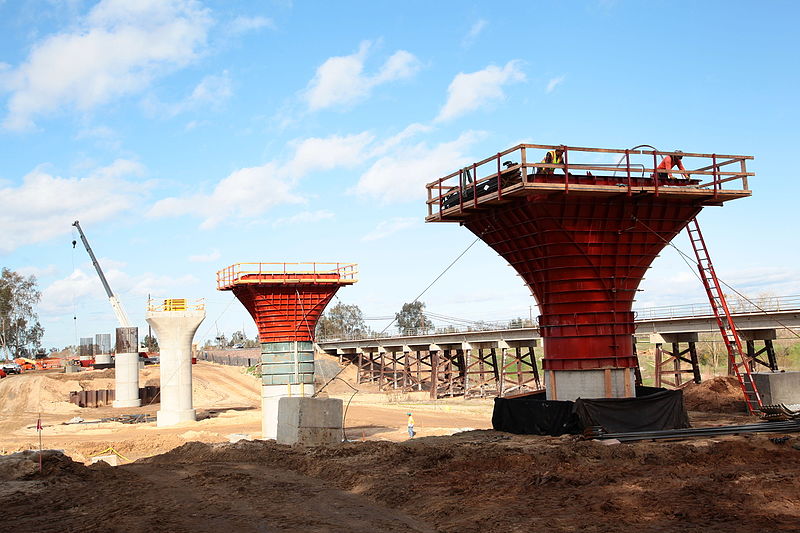
Construction of the Fresno River Viaduct in January 2016. The bridge is the first permanent structure being constructed as part of California High-Speed Rail. The BNSF Railway bridge is visible in the background.
Photo by the California High-Speed Rail Authority via Wikimedia Commons.

Sepulveda’s cost and schedule overrun aren’t even the worst of it. Just as unattainable as a shortened commute is the Californian dream of building a bullet train that could take you from Los Angeles to San Francisco in under three hours. In 2008, a year before the Sepulveda project began, the state tried to turn this dream into a reality after voters approved a 512-mile high-speed rail (HSR) project. Amid failing overseas wars and financial crises, at the time it could’ve become a symbol of renewal not just for California but the entire country. Instead, it came to exemplify a dysfunctional government that lacks the capacity to build.

At the time California began accelerating the development of its HSR system it only had 10 employees dedicated to overseeing what was the most expensive infrastructure project in U.S. history. It ended up 14 years (and counting) behind schedule and $44 billion over budget. Incredibly, the state has not laid a single mile of track and it still lacks 10 percent of the land parcels it needs to do so. Half of the project still hasn’t achieved the environmental clearance needed to begin construction. The dream of a Japanese-style bullet train crisscrossing the state is now all but dead due to political opposition, litigation, and a lack of funding.

Despite its failure, the HSR project inaugurated the U.S.’s megaproject era. Once a rare type of project, by 2018 megaprojects comprised 33 percent of the value of all U.S. construction project starts. An alarming number of these have spiraled out of control for many of the same reasons that killed the California bullet train. The decade that followed the financial crisis was a kind of inflection point in the industry; this was when construction projects became noticeably worse and when the long-term implications could no longer be ignored. One of the most cited studies of the U.S.’s declining ability to build reviewed 180 transit megaprojects across the country, revealing that today, U.S. projects take longer to complete and cost nearly 50 percent more on average than those in Europe and Canada.

Having joined Kiewit in 2010, I witnessed these changes first-hand. I have since moved on, but have remained in the broader industry, including working on what are called “strategic pursuits” — the process by which companies compete for megaprojects. This experience has provided insight into the mechanics of how these projects are awarded and why they so frequently fail.

Even if the construction had proceded close to schedule, the economic justification for California’s high speed rail line was never strong … and it’s unlikely the service would have come close to breaking even. It almost certainly would have added significant ongoing costs to Californian taxpayers, and due to the nature of high speed rail services, been effectively a subsidy from working-class Californians to the laptop elites of Los Angeles and the San Francisco Bay area.

All of that, however, are merely additional reasons to believe the project was doomed from inception. Broadly speaking, all major infrastructure projects in the United States are struggling with paperwork and compliance requirements mostly driven by state and federal environmental regulations passed with the best possible intentions (as the saying goes):

Sepulveda’s numerous lawsuits and stakeholder conflicts are an example of a phenomenon that can be traced back to the passage of the National Environmental Policy Act (NEPA) in 1969. NEPA mandates developers to provide environmental impact statements before they can obtain the permits necessary for construction on huge swathes of infrastructure.

Shortly following the passage of NEPA, California’s then-governor Ronald Reagan signed the California Environmental Quality Act (CEQA) into law, which required additional environmental impact analysis. Unlike NEPA, it requires adopting all feasible measures to mitigate these impacts. Interest groups wield CEQA and NEPA like weapons. One study found that 85 percent of CEQA lawsuits were filed by groups with no history of environmental advocacy. The NIMBY attitude of these groups has crippled the ability of California to build anything. As California Governor Gavin Newsom succinctly put it, “NIMBYism is destroying the state”.

It is also destroying the U.S.’s ability to build nationally. The economist Eli Dourado reported in The New York Times that “per-mile spending on the Interstate System of Highways tripled between the 1960’s and 1980’s.” This directly correlates with the passage of NEPA. If anything, the problem has gotten worse over time. Projects receiving funding through the $837 billion stimulus plan passed by Congress in the aftermath of the financial crises were subject to over 192,000 NEPA reviews.

The NEPA/CEQA process incentivizes the public agencies to seek what is often termed a “bulletproof” environmental compliance document to head off future legal challenges. This takes time, with the average EIS taking 4.5 years to complete. Some have taken longer than a decade. A cottage industry of consultants is devoted to completing these documents, earning themselves millions in fees.

June 6, 2022

“I ask, sir, what is the militia? It is the whole people except for a few public officials”

Filed under: Government, History, Military, USA — Tags: , , , , — Nicholas @ 05:00

George Mason, quoted in the title of this post, had a very expansive view of the US militia. Most Americans of the day did not seem to share this view, as Chris Bray explains:

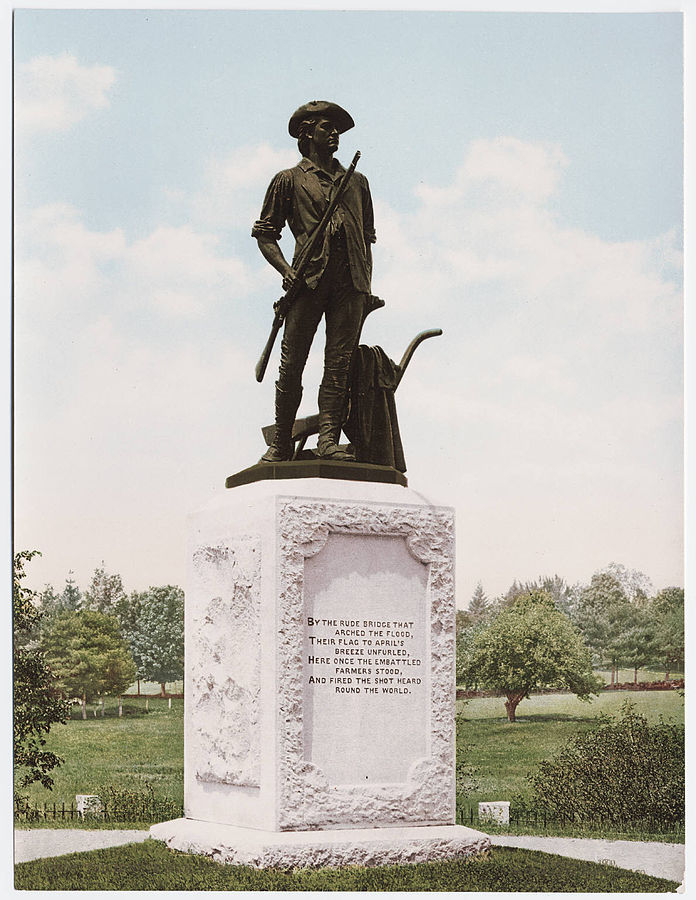
How Congress may have visualized the individual minutemen who would compose the militia of the United States after 1792.
Postcard image of French’s Concord Minuteman statue via Wikimedia Commons.

In the second Militia Act of 1792, Congress defined a uniform militia in all of the states:

    That each and every free able-bodied white male citizen of the respective States, resident therein, who is or shall be of age of eighteen years, and under the age of forty-five years (except as is herein after excepted) shall severally and respectively be enrolled in the militia … That every citizen, so enrolled and notified, shall, within six months thereafter, provide himself with a good musket or firelock, a sufficient bayonet and belt, two spare flints, and a knapsack, a pouch, with a box therein, to contain not less than twenty four cartridges, suited to the bore of his musket or firelock, each cartridge to contain a proper quantity of powder and ball … and shall appear so armed, accoutred and provided, when called out to exercise or into service, except, that when called out on company days to exercise only, he may appear without a knapsack.

So, by federal law, every military-age white male in the country (except men who were exempted by the states, like clergymen) had to report to the local militia commander to be enrolled in their local company, and had to own a long list of equipment, and had to show up to train with that equipment when ordered.

They mostly didn’t. For decades, states reported their militia enrollment to the War Department, and it sometimes appeared that some states, by trying really hard, sometimes almost made it to something in the neighborhood of half participation. In 1826, the Barbour Board — named after Secretary of War James Barbour — evaluated the unmistakable failure of the federally defined uniform militia, and suggested trying again with a smaller group of select militiamen. The board’s report was universally ignored, because by 1826 the federal government, like, couldn’t even: Everyone knew the model of widely shared militia service had failed.

Historians have usually described the failure of universal white male militia service in the early republic as a top-down policy blunder in which political leaders didn’t try hard enough to make the thing work. But a marginal historian named Chris Bray, in a dissertation that generated no excitement of any kind in academia, argued that the universal white male militia obligation was doomed by something else: widespread irritation and popular resistance. The militia obligation reached into the lives of militiamen in ways they didn’t expect and wouldn’t tolerate, so they stopped showing up.

There are many different ways to tell this story, but let’s do it quickly.

May 30, 2022

Technocratic meddling in developing countries at the local level

One of the readers of Scott Alexander’s Astral Codex Ten has contributed a review of James Ferguson’s The Anti-Politics Machine. The reviewer looked at a few development economics stories that illustrate some of the more common problems western technocrats encounter when they provide their “expert advice” to people in developing countries. This is one of perhaps a dozen or so anonymous reviews that Scott publishes every year with the readers voting for the best review and the names of the contributors withheld until after the voting is finished:

    But even if the project was in some sense a “failure” as an agricultural development project, it is indisputable that many of its “side effects” had a powerful and far-reaching impact on the Thaba-Tseka region. […] Indeed, it may be that in a place like Mashai, the most visible of all the project’s effects was the indirect one of increased Government military presence in the region

As the program continued to unfold, the development officials became more and more disillusioned — not with their own choices, but with the people of Thaba-Tseka, who they perceived as petty, apathetic, and outright self-destructive. A project meant to provide firewood failed because locals kept breaking into the woodlots and uprooting the saplings. An experiment in pony-breeding fell apart when “unknown parties” drove the entire herd of ponies off of cliffs to their deaths. Why, Ferguson’s official contacts bemoaned, weren’t the people of Thaba-Tseka committed to their own “development”?

Who could possibly be opposed to trees and horses? Perhaps, the practitioners theorized, the people of Thaba-Tseka were just lazy. Perhaps they “didn’t want to be better”. Perhaps they weren’t in their right mind or had made a mistake. Perhaps poverty makes a person do strange things.

Or, as Ferguson points out, perhaps their anger had something to do with the fact that the best plots of land in the village had been forcibly confiscated to make room for wood and pony lots, without any sort of compensation. The central government was all too happy to help find land for the projects, which they took from political enemies and put in the control of party elites, especially when it could use a legitimate anti-poverty program as cover. In Ferguson’s words, the development project was functioning as an “anti-politics machine” the government could use to pretend political power moves were just “objective” solutions to technical problems.

A local student’s term paper captured the general discontent:

    In spite of the superb aim of helping the people to become self-reliant, the first thing the project did was to take their very good arable land. When the people protested about their fields being taken, the project promised them employment. […] It employed them for two months, found them unfit for the work, and dismissed them. Without their fields and without employment they may turn up to be very self-reliant. It is rather hard to know.

Two things stand out to me from this story. First, the “development discourse” lens served to focus the practitioners’ attention on a handful of technical variables (quantity of wood, quality of pony), and kept them from thinking about any repercussions they hadn’t thought to measure.

This is a serious problem, because “negative effects on things that aren’t your primary outcome” are pretty common in the development literature. High-paying medical NGOs can pull talent away from government jobs. Foreign aid can worsen ongoing conflicts. Unconditional cash transfers can hurt neighbors who didn’t receive the cash. And the literature we have is implicitly conditioned on “only examining the variables academics have thought to look at” — surely our tools have rendered other effects completely invisible!

Second, the project organizers somewhat naively ignored the political goals of the government they’d partnered with, and therefore the extent to which these goals were shaping the project.

Lesotho’s recent political history had been tumultuous. The Basotho Nationalist Party (BNP), having gained power upon independence in 1965, refused to give up power after losing the 1970 elections to the Basotho Congress Party (BCP). Blaming the election results on “communists”, BNP Prime Minister Leabua Jonathan declared a state of emergency and began a campaign of terror, raiding the homes of opposition figures and funding paramilitary groups to intimidate, arrest, and potentially kill anyone who spoke up against BNP rule.

This had significant effects in Thaba-Tseka, where “villages […] were sharply divided over politics, but it was not a thing which was discussed openly” due to a fully justified fear of violence. The BNP, correctly sensing the presence of a substantial underground opposition, placed “development committees” in each village, which served primarily as local wings of the national party. These committees spied on potential supporters of the now-outlawed BCP and had deep connections to paramilitary “police” units.

When the Thaba-Tseka Development Project started, its international backers partnered directly with the BNP leadership, reasoning that sustainable development and public goods provision could only happen through a government whose role they primarily viewed as bureaucratic. As a result, nearly every decision had to make its way through the village development committees, who used the project to pursue their own goals: jobs and project funds found their way primarily to BNP supporters, while the “necessary costs of development” always seemed to be paid by opposition figures.

The funding coalition ended up paying for a number of projects that reinforced BNP power, from establishing a new “district capital” (which conveniently also served as a military base) to constructing new and better roads linking Thaba-Tseka to the district and national capitals (primarily helping the central government tax and police an opposition stronghold). Anything that could be remotely linked to “economic development” became part of the project as funders and practitioners failed to ask whether government power might have alternate, more concerning effects.

As we saw earlier, the population being “served” saw this much more clearly than the “servants”, and started to rebel against a project whose “help” seemed to be aimed more at consolidating BNP control than meeting their own needs. When they ultimately resorted to killing ponies and uprooting trees, project officials infatuated with “development” were left with “no idea why people would do such a thing”, completely oblivious to the real and lasting harm their “purely technical decisions” had inflicted.

May 27, 2022

Minoru Yamasaki and the Pruitt–Igoe urban housing project

Filed under: Architecture, Bureaucracy, Government, USA — Tags: , , , , , — Nicholas @ 05:00

Joseph Kast recounts the story of a post-war government scheme to demolish slums, re-house the slum-dwellers in a massive public housing project and the architect whose career was forever blighted by the failure of the design:

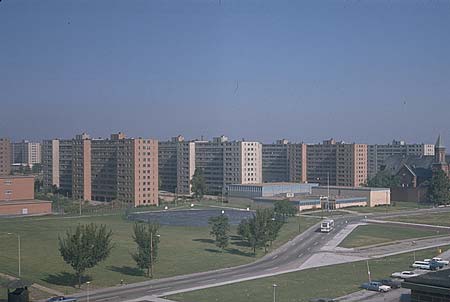
An undated overview of some of the 33 buildings of the Pruitt-Igoe complex in St. Louis, Missouri. Designed by Japanese-American architect Minoru Yamasaki and built in the early 1950s. All had been demolished by 1976.
Uncredited photo from Wikimedia Commons.

Can society be designed? Can an expert engineer alleviate people’s pains and struggles with a good-enough central plan and blueprint?

Minoru Yamasaki thought so.

Yamasaki was one of America’s most well-respected architects in the 20th century and was a member of the school of thought that people’s human nature could be improved (whether those people needed or wanted improving) by a properly planned building surrounding them.

Yamasaki got to test his theory by designing the public housing complex that promised to be a template for all public housing going forward. The complex, St. Louis’ Pruitt-Igoe, was made possible by post-war New Deal housing and urban development programs. And like many New Deal initiatives, Pruitt-Igoe was guided by the idea that good intentions, centralized planning, and strong government power would progress society more than protecting people’s rights or personal choices.

Pruitt-Igoe and Yamasaki’s designs were sold as the solution to poverty, crime, and housing in America’s major cities, but within just a few years, the complex would show the dangerous consequences when government planners take away people’s liberties and homes.

As with so many vast schemes to use the government’s power to reshape people’s lives, the hopes of the central planners quickly fell afoul of economic and social realities that the plan never took into account.

St. Louis quickly realized that Pruitt-Igoe was a problem. But it was unclear who, if anyone, could fix it. The federal government, the St. Louis Housing Authority, the state, and the City of St. Louis itself all shared responsibility for the complex. When a problem belongs to everyone, it belongs to no one.

Within five years of its launch, Yamasaki was regularly apologizing for his role in the project. Though the final design of the complex differed from his original vision, he came to question the core assumption behind the project: that people’s lives could be effectively engineered through urban design. He expressed regret for his “deplorable mistakes” with Pruitt-Igoe. By the late 1950s, he was giving eloquent speeches about the “tragedy of housing thousands in exactly look alike cells,” which “certainly does not foster our ideals of human dignity and individualism.”

To the Detroit Free Press, he put it more simply: “Social ills can’t be cured by nice buildings.”

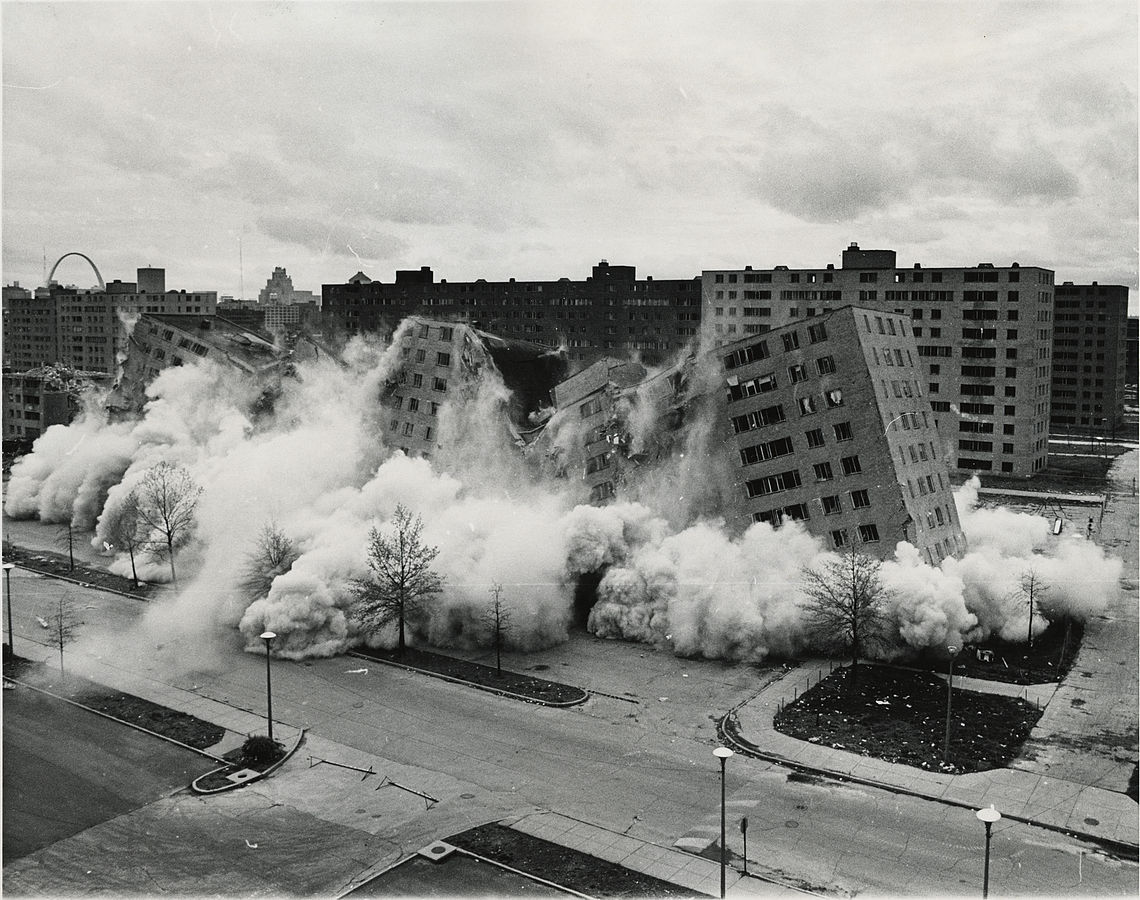
By the early 1970s, the 33 concrete tombstones lining St. Louis’ skyline were a cautionary tale for utopian housing schemes. It was a den of crime and misery, rather than anything anyone could call home. When the decision came to demolish the complex, occupancy was only 10 percent.

The day the demolitions began at Pruitt-Igoe, architectural historian Charles Jencks declared the death of high modernist architecture and its grand assumptions: “It was finally put out of its misery. Boom, boom, boom.”

Three towers were demolished in 1972. The last tower finally came down in 1976, leaving nothing of Pruitt-Igoe behind.

The demolition of one of the Pruitt-Igoe buildings, which began in 1972 with the final building demolished in 1976.
Uncredited image from Wikimedia Commons.

April 30, 2022

God Help These British Agents – WW2 – Spies & Ties 16

Filed under: Britain, Europe, Germany, History, Military, WW2 — Tags: , , , , , — Nicholas @ 04:00

World War Two
Published 28 Apr 2022

We’ve seen it time and time again in this war. Supposed Allies arguing with each other instead of fighting the enemy. But when SOE and MI6 begin vying for leadership of Britain’s secret war, it’s more than cross words. Now there are lives at stake.
(more…)

April 21, 2022

L8(T) Enfield: The British Army Fails to Make a Sniper

Filed under: Britain, History, Military, Weapons — Tags: , , , , , , — Nicholas @ 02:00

Forgotten Weapons
Published 14 Dec 2021

http://www.patreon.com/ForgottenWeapons

https://www.floatplane.com/channel/Fo…

Cool Forgotten Weapons merch! http://shop.forgottenweapons.com

We looked at the 7.62mm conversion of the No4 Enfield into Rifle L8 yesterday. Part of that program was an attempt to develop a new sniper rifle on the L8 platform. To this end, six good-quality No4(T) Lee Enfield sniper rifles were tested for accuracy, then made into L8 rifles and fitted with No.32 telescopic sights (the standard scope from the .303 days) and tested for accuracy again. Much to the chagrin of the Army, the new L8(T) rifles were barely able to match the performance of the .303 rifles they began as. The goal was to significantly improve on the No4(T) accuracy, and that was clearly not happening.

However, at this same time, British civilian competition shooters were having excellent success making 7.62mm versions of the No4. It was only when Enfield was willing to collaborate with the British NRA and others that they were able to successfully create the L42A1 rifle, which at last met the accuracy goals of the program.

The rifle we are looking at today is one of those original six trials L8(T) rifles. Many thanks to the generous collector who allowed me to film it for you!

Contact:
Forgotten Weapons
6281 N. Oracle 36270
Tucson, AZ 85740

March 15, 2022

For military procurement blunders, “no nation has mastered the ability to step on every bloody rake quite as well as Canada”

Germany has announced that they will be purchasing US F-35 stealth fighters as part of their re-armament program. My favourite headline on this was over at Blazing Cat Fur: “Germany To Buy 35 Lockheed F-35 Fighter Jets From U.S. Amid Ukraine Crisis … Canada Will Buy Cool ‘Fighter Jet Stickers’ With Eco-Friendly Adhesive”

On a more serious tone — but with sadly the same basic message — Mitch Heimpel looks at the multi-generational rolling catastrophe that is Canadian military procurement since the unification of the forces in 1968:

Browning High Power 9mm, the standard side-arm of the Canadian army since WW2. When I was in the reserves, we were told this was due for replacement in a few years. I was in the reserves from 1976-1980. It still hasn’t been replaced.

To say we have a checkered history with military procurement, fails to capture exactly how bad it is. Our political leadership has failed us continually over the course of half a century. No party has done it well. Some have done it better than others. But no one can claim any kind of bragging rights.

Fighter jet procurement in this country is so fraught it once caused the birth of a new political party. Trying to buy helicopters helped bring down a government. We only successfully bought those helicopters after they [the old helicopters] became a greater danger to the personnel manning them than they were to any potential adversary. We have been running a procurement for the next generation of fighter jets for an entire generation. Even Yes, Minister writers would have given up on something that absurd.

Our submarine fleet seems to be almost permanently in dry dock. Our most recent ship procurement resulted in the absolutely monstrous prosecution of one of the country’s most accomplished military leaders.

And we just issued a revised bid to finally replace our Second World War-era pistols … last week.

Just cataloguing that level of incompetence is exhausting. No leader or party looks good. The civil service, as the one constant through all these cartoonish blunders, surely has to wear some of this, too. The fact that we seem to repeat the same mistakes can, at least in part, be attributed to a significant institutional memory failure on the part of the people trusted with having the institutional memory.

Now, it is worth noting in fairness that no nation has an easy time with large scale military procurement. Ask the Americans about the development of the V-22 sometime. But, still, no nation has mastered the ability to step on every bloody rake quite as well as Canada.

I’m not a hardware expert. I can’t tell you which pistol we should buy. There’s also genuine policy questions here that need to be settled — I don’t know whether we should focus on the navy because we’re an Arctic nation, or the air force because it allows us to participate more readily in allied force projection exercises — like, say, no-fly zones? The necessary mix for Canada is no doubt some of both, and it’s fine to have disagreements between parties on what the right mix is.

But setting that aside, I want to talk about what it would take politically, to get us to start taking procurement seriously — just a few basic rules that any government would need to follow to procure anything that they chose was important for Canada to have.

February 21, 2022

OSS Flying Dragon: A Silent Poisoned Dart Gun

Filed under: History, Military, USA, Weapons, WW2 — Tags: , , , , , — Nicholas @ 02:00

Forgotten Weapons
Published 7 Apr 2018

The OSS experimented with a lot of … unorthodox weapons during World War Two, and one of their overarching goals was a weapon with a 100 yard lethal range but without flash or noise. To this end they experimented with a number of suppressed firearms as well as weird stuff like various crossbow designs, silenced dart gun pistol conversions, and in this case a CO2 powered dart gun. It was code-named the Flying Dragon, and first mentioned in documents in 1943. In the summer of 1945, 15 were manufactured, and 12 of these remained in OSS stocks at the end of the war.

In July 1945 testing, the Flying Dragon was found the be the second-quietest option (the William Tell crossbow was quieter, at 66 decibels to the Dragon’s 69 decibels). However, the testing board noted that a simple suppressed .22 pistol was pretty much just as good, and quite a lot cheaper (and more reliable, I would expect). The problem with a dart gun like this one is that if it is not reliably lethal, the whole point of it being silenced is lost. Anyone shot by that big dart and not killed by it (which would require a pretty significant muzzle velocity) will immediately start making a heck of a lot of noise. OSS investigated options for poison on the darts to give the weapon the necessary lethality, but was unable to find a suitable solution. This led to discussion of using a small hypodermic syringe as a projectile, an even less practical idea — but this was the freewheeling OSS, where such things were not uncommon to consider.

http://www.patreon.com/ForgottenWeapons

Cool Forgotten Weapons merch! http://shop.bbtv.com/collections/forg…

If you enjoy Forgotten Weapons, check out its sister channel, InRangeTV! http://www.youtube.com/InRangeTVShow

Contact:
Forgotten Weapons
6281 N Oracle #36270
Tucson, AZ 85704

January 31, 2022

The Ram | Canada’s Most Successful Failure

Filed under: Cancon, History, Military, Weapons, WW2 — Tags: , , , , , , — Nicholas @ 02:00

Red Wrench Films
Published 4 Dec 2020

A Canadian Franken-tank that pre-dated the M4 Sherman, the Ram would be an icon of Canada’s industry in the early war years. Ultimately a failure as a battle tank, variants of the vehicle would see combat in Normandy and beyond, as the Kangaroo APC which revolutionised mechanised warfare in 1944 and 1945.

Any feedback is greatly appreciated, I’m always trying to improve.

Any suggestions for the next video? Leave it down in the comments or message me. 🙂

((Like and subscribe))

Please note that the footage I can find on these vehicles is scarce and sometimes the video will not match properly or will perhaps be slightly inaccurate.

Sources:
https://tanks-encyclopedia.com/ww2/ca…
https://www.dday-overlord.com/en/mate…
https://www.friends-amis.org/index.ph…
http://panzerserra.blogspot.com/2015/…

Intuit256 by Kevin MacLeod is licensed under a Creative Commons Attribution 4.0 licence. https://creativecommons.org/licenses/…
Source: http://incompetech.com/music/royalty-…
Artist: http://incompetech.com/

January 22, 2022

1842 Retreat From Kabul

Filed under: Asia, Britain, History, Military — Tags: , , , , , — Nicholas @ 02:00

The History Guy: History Deserves to Be Remembered
Published 22 Sep 2021

On January 13, 1842, a single man on horseback approached the British garrison at Jalalabad, where soldiers were waiting for a retreating army of several thousand. Exhausted, the man had part of his skull shaved off by a sword and his horse was so exhausted that it would soon perish. As he was brought into the walls of the city the lone man was asked where the rest of the army was. “I am the army,” he replied. Thus ended a disastrous retreat from Kabul, where a British force of some 4,500 soldiers and thousands of civilians was almost entirely destroyed.

This is original content based on research by The History Guy. Images in the Public Domain are carefully selected and provide illustration. As very few images of the actual event are available in the Public Domain, images of similar objects and events are used for illustration.

You can purchase the bow tie worn in this episode at The Tie Bar:
https://www.thetiebar.com/?utm_campai…

All events are portrayed in historical context and for educational purposes. No images or content are primarily intended to shock and disgust. Those who do not learn from history are doomed to repeat it. Non censuram.

Find The History Guy at:

Patreon: https://www.patreon.com/TheHistoryGuy
Please send suggestions for future episodes: Suggestions@TheHistoryGuy.net

The History Guy: History Deserves to Be Remembered is the place to find short snippets of forgotten history from five to fifteen minutes long. If you like history too, this is the channel for you.

Awesome The History Guy merchandise is available at:
https://teespring.com/stores/the-hist…

Script by JCG

#history #thehistoryguy #Afghanistan

November 25, 2021

Why The Most Expensive US Martial Pistol Exploded A Lot

Filed under: History, Military, Technology, USA, Weapons — Tags: , , , , , — Nicholas @ 02:00

Forgotten Weapons
Published 12 Aug 2021

http://www.patreon.com/ForgottenWeapons

https://www.floatplane.com/channel/Fo…

Cool Forgotten Weapons merch! http://shop.forgottenweapons.com

The Colt Model 1847 Walker is one of the most valuable of all US military handguns in the collecting community, with examples sometimes breaking seven figures. However, the Walker was in many ways a remarkable failure as a service sidearm, mostly because it tended to explode. By today’s standards, it exploded quite a lot.

Why?

Basically, a combination of several factors:

– The Walker was made of wrought iron, and not always the best quality wrought iron. Cylinders had internal flaws that became weak points and failed upon firing.
– The Walker had a huge powder capacity in its chambers, between 50 and 60 grains depending on the projectile used. This was basically rifle size, and it left the cylinder design with a very small margin of safety.
– Powder composition and grain size was less standardized in the 1840s than it is today, making overpressure loads more likely than today.
– The Walker was designed for a conical “Pickett” bullet that was tricky to load correctly (point forward). Loading it backward could increase the powder volume in a chamber.

Of nearly 400 Walkers issued for the Mexican-American War, only 191 were returned after a year’s service, and only 82 of those were serviceable. Some of those missing guns were lost and stolen, but a substantial number — generally accepted to be 20%-30% — suffered burst barrels, burst cylinders, and broken cylinder arbors. Whoops!

Contact:
Forgotten Weapons
6281 N. Oracle 36270
Tucson, AZ 85740

October 7, 2021

Tank Chats #127 | Thornycroft Bison Concrete Armoured Lorry | The Tank Museum

Filed under: Britain, History, Military, WW2 — Tags: , , , — Nicholas @ 02:00

The Tank Museum
Published 28 May 2021

David Fletcher looks at the eccentric Thornycroft Bison, a concrete armoured lorry, created by the British to defend airfields in the early years of the Second World War.
(more…)

September 20, 2021

Canada was given advance notice of the AUKUS deal … about five minutes notice

Filed under: Australia, Britain, Cancon, Military, USA — Tags: , , , , , — Nicholas @ 03:00

When the news broke about a new western alliance involving Australia, the United Kingdom and the United States, the official line — belatedly — was that our allies had kept Canadian officials “in the loop”, about the negotiations. Now that everyone’s attention is on the vote-counting, it can be safely acknowledged that the Canadian government got a heads-up just a few minutes before the formal announcement, as Ted Campbell discusses:

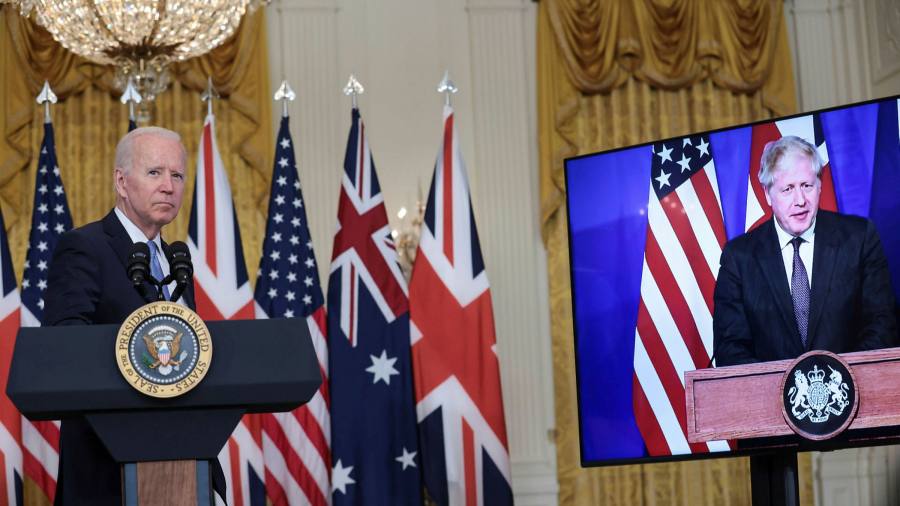
US President Joe Biden with British Prime Minister Boris Johnson (onscreen) during the AUKUS announcement.
Image from businesstelegraph.co.uk.

So, Steven Chase and Robert Fife say, in the Globe and Mail, that “The Canadian government was surprised this week by the announcement of a new security pact between the United States, Britain and Australia, one that excluded Canada and is aimed at confronting China’s growing military and political influence in the Indo-Pacific region, according to senior government officials [and] Three officials, representing Canada’s foreign affairs, intelligence and defence departments, told The Globe and Mail that Ottawa was not consulted about the pact, and had no idea the trilateral security announcement was coming until it was made on Wednesday by U.S. President Joe Biden, British Prime Minister Boris Johnson and Australian Prime Minister Scott Morrison.”

Not only did our oldest and closest friends and allies kick Canada out of the “inner circle”, they didn’t even bother to tell us that the political and diplomatic kick in the arse was coming, although, the Globe journalists say, the Australian and British defence ministers gave Harjit Sajjan a brief “heads up” just minutes before the announcement. Mr Sajjan’s spokesman said that Canada “had been kept in the loop”, I call BS.

Vice Admiral Mark Norman, someone who knows a lot about what happens at the highest echelons of government in Ottawa said that “if Mr. Trudeau was fully briefed” [on this new AUKUS pact, then] “he doesn’t understand what is going on internationally and he doesn’t understand what the significance of an arrangement like this is as it relates to international security.” I don’t think he had heard a word about this until Minister Sajjan’s senior aids called the PCO and PMO on Wednesday afternoon.

One can easily imagine the conversations on Wednesday and Thursday in some of the corridors of power in Ottawa: “ Biden us!” said one senior official. “No,” said another, even more senior, “this has been coming for a long time. It’s a shock, but it really shouldn’t be a surprise.” “They screwed us,” said a third, “we’ve done nothing to deserve this. It’s just because we aren’t spending as much as Biden and Morrison want on the military and it’s because we’re not sending more ships to Asia, more often.” “No,” the second person said, “it’s because we decided, all of us, you and me, too, to not do whatever it took to arrest the changes in our national strategic outlook.” “How can you say that?” the first speaker said, “We all protested, I wrote a long brief explaining why we needed to step up …” “We’re still here,” the more senior official said. “We didn’t resign and go public as soon as we saw how things were shaping up. Almost no one did.” “No one listens when senior officials or admirals or generals resign,” said the third official, “it wouldn’t have done any good.” “You’re right,” the most senior official answered, “resignations are, normally, not news and they rarely change politicians’ minds … not, anyway, when they’re done one at a time. Back in 2016, when many us started to see, clearly, how things were going we should have resigned en masse ~ and not just we three, but dozens of us from PCO, from Foreign Affairs and from DND and the military. If the senior public service had rebelled, as it should when the government makes destructive policy choice against our advice, then there would have been enormous, even irresistible political pressure. But we didn’t, did we? We all stayed on and wrote a couple of arse-covering briefing notes and went about our business. We are as much to blame for this as are those dimwits in Trudeau’s cabinet and inner circle. We failed Canada.”

Vice Admiral Norman, the article explains, “said the agreement goes far beyond access to U.S. submarine technology [which is Mr Trudeau’s lame excuse for why Canada was kicked out of the inner circle] This is about accessing both current and emerging technologies, from cyber and artificial intelligence, to acoustics and underwater warfare – a whole range of very important strategic capabilities.” Further, “Mr. Norman said Canada has many national interests in the Indo-Pacific – including trade, promoting the rule of law and democracy, and countering China’s aggressive behaviour and posturing – but he suspects close allies do not take Canadian defence commitments seriously [and he added] I don’t think our allies think we are serious when it comes to defence. I think they have concerns not just about our defence expenditures, but also the extent to which our [international] commitments are both lasting and meaningful.” This has been evident since 2015. Justin Trudeau effectively campaigned on doing less in the world. Everyone knew this was coming ~ especially those who voted for the Liberal Party … it is what they wanted. It’s what Canada got.

September 3, 2021

QotD: Drama critics

Filed under: Humour, Media, Quotations, USA — Tags: , , , — Nicholas @ 01:00

There is one thing that 99 percent of all critics share with one another: they are failures. I don’t mean failures as critics — my God, that’s understood. I don’t even mean they are failures as people; I mean something more painful by far: These people are failures in life.

It’s a second-rate job, folks. Being a drama critic on Broadway wouldn’t keep a decent mind occupied 10% of the time. So you don’t even get second-raters. You get the dregs, the stage-struck but untalented neurotic who eventually drifts into criticism as a means of clinging peripherally to the arts. And most of your cruel critics come this way: they are getting their own back.

William Goldman, The Season: A Candid Look at Broadway, 1969.

August 30, 2021

Mark Steyn on chocolate soldiers, tutti-frutti generals, and the ice-cream commander-in-chief

Filed under: Government, Media, Military, Politics, USA — Tags: , , , , , — Nicholas @ 03:00

When all that matters is not performance but performance art:

On the day that twelve US Marines and some 150 civilians were blown apart by suicide bombers, it was heartening to learn what real heroism is.

Until January 6th, the highlight of Michael Byrd’s “law-enforcement” career was leaving his loaded Glock in a congressional men’s room and paying no price. He “serves” with the grotesquely misnamed “Capitol Police”, which is not a police department but a praetorian guard – a personal security team for the praetors of Congress. Lieutenant Byrd shot and killed Ashli Babbitt, a 5’2″ unarmed woman, because “she was posing a threat to the US House of Representatives”.

All that has been known for months by anyone who wanted to know. The only real news in NBC’s Byrd exclusive was the level of his self-congratulation:

    I believe I showed the utmost courage on January 6.

His interviewer, Lester Holt, did not respond: “Er, hang on, isn’t that the kind of thing you’re meant to leave for someone else to say about you?”

And did he have to say “utmost”? Even in as unutterably vulgar an age as ours, is even Michael Byrd incapable of imagining any “courage” greater than his own?

Ah, well, don’t over-think it; it’s just one of those phrases, half-remembered by Byrd from some Rose Garden medal ceremony he caught on TV: “utmost” goes with “courage” like “white” goes with “supremacist” and “domestic” goes with “terrorist”.

America is a land that tends to the utmost in all things. At the end of the nineteenth century, Bernard Shaw popularized the term “chocolate soldier” — the dashing hussar who is useless in battle but looks good in a uniform. We have the tutti-frutti generals: Thoroughly Modern Milley and his chums, whose diversity ribbons from shoulder to scrotum advertise their own utmostness even as they explain why everything going wrong merely demonstrates how everything is going right.

The tutti-frutti generals report to the ice-cream commander-in-chief melting all over the lectern every afternoon. His predecessor was on telly all day every day; Mr Biden was sold to head-in-the-sand Americans as the quiet-life guy who wouldn’t be in your face. Unfortunately, when your countrymen get blown up by government blunders, the citizenry expects him to be in their faces at least every now and then. Across the Atlantic, Boris and the EU chaps were on the screen responding to an all too predictable atrocity. But in the White House Joe Biden’s meds hadn’t yet kicked in — or, conversely, they’d shot him the juice too early and it had worn off. So, as has become familiar, the melting waffle cone was hours late in tottering across the room, squinting into the camera and reading with woozy and wooden defiance. This time he gave it the full Corn Pop:

    To those who carried out this attack, as well as anyone who wishes America harm, know this: We will not forgive. We will not forget.

But Joe, a man who cannot reliably name his own Defense Secretary, has already forgotten.

« Newer PostsOlder Posts »

Powered by WordPress