
The Tank Museum
Published on 6 Oct 2018Tank Museum legend and Tank Chat superstar David Fletcher couldn’t possibly decide on a Top Five Tanks – so we asked him to pick the five worst!
Feel free to agree in the comments below, as we present David Fletcher’s Bottom Five Tanks
Visit The Tank Museum SHOP: ►https://tankmuseumshop.org/
Support the work of The Tank Museum on Patreon: ► https://www.patreon.com/tankmuseum Or donate http://tankmuseum.org/support-us/donateTwitter: ► https://twitter.com/TankMuseum
Tiger Tank Blog: ► http://blog.tiger-tank.com/
Tank 100 First World War Centenary Blog: ► http://tank100.com/ #tankmuseum #tanks
December 24, 2018
Bottom 5 British Tanks – David Fletcher | The Tank Museum
Comments Off on Bottom 5 British Tanks – David Fletcher | The Tank Museum
December 2, 2018
Canada’s initial WW1 infantry weapon, the Ross rifle
During the Boer War, the British were busy producing Lee-Enfield rifles for the British army and didn’t have enough extra manufacturing capacity to fulfill a modest Canadian order. The government of the day took this opportunity to try to find a distinctly Canadian weapon to equip the (tiny) Canadian militia. They ended up purchasing the Ross rifle, which is what the men of the Canadian Corps took into the field during the First World War. It didn’t go well, as the highly accurate Ross was not well-suited to the rough-and-tumble life of an infantry weapon in the trenches of Flanders. The mechanism was prone to jamming in muddy conditions and did not work well with low-quality ammunition. It became a national scandal, and eventually most of the Ross rifles were replaced with British Lee-Enfields, except for the sniper weapons (where the Ross was much better suited to the needs of the job). The National Interest has the story:
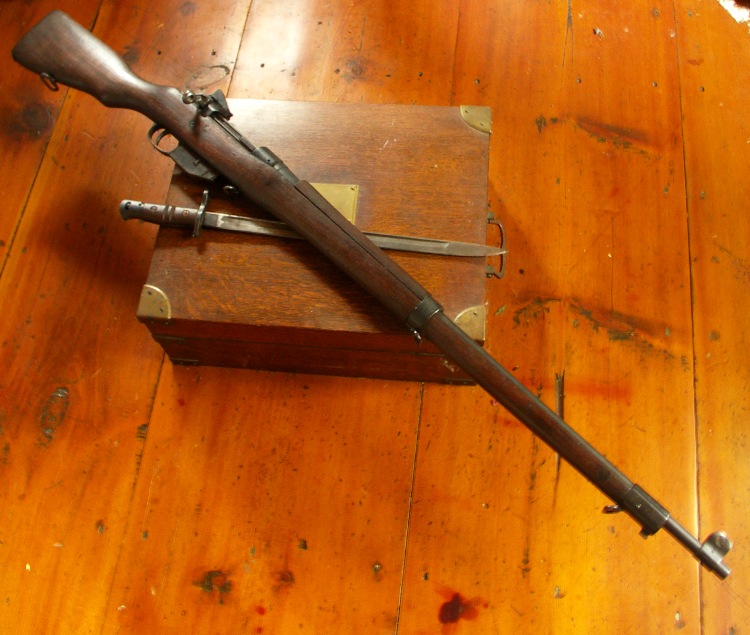
Ross rifle model 1910B
Photo by Vaarok via Wikimedia Commons.
Tested head to head with the Lee-Enfield Mark I, the Ross did well in some of the trials but came up short in other crucial ones, such as the endurance test. Some 1,000 rounds were fired through each rifle and, while the Lee-Enfield functioned well, the Ross repeatedly jammed. After the 300th round, the heat of firing melted away the foresight, which was fastened with common solder. Ross explained that prior tests had been conducted with ammunition of American and Austrian manufacture and that “the standard called for in the manufacture of British .303 cartridges is not of the same precision and quality of material hence greater limits have to be allowed.” His dubious explanation was accepted by the committee.
Already the enterprise was off on the wrong foot. Due to Borden’s choices, the investigative committee leaned in favor of the Ross. It was obvious that no accurate appraisal of anything can result from a biased investigative body. Hughes in particular championed the rifle, and his stubborn resistance to evidence that contradicted his opinions bordered on the irrational. To the end he would insist that the Ross was superior to the Lee-Enfield, even after thousands of Canadian soldiers had simply thrown theirs away on the battlefield.
If the weapon had flaws, so did the purchase contract. Under its terms, Ross was to provide 12,000 rifles during 1903 and 10,000 every year thereafter, with a 75 percent advance on all rifles ordered for the duration of the contract, which was not stipulated. The cost of the Ross was not to exceed that of a Lee-Enfield in Britain, yet the price set was $25, compared to $18.27 the War Office paid for a Lee-Enfield. The contract also stated that materials and machinery Ross needed to import to meet the manufacturing requirements were to be exempt from import taxes. Because there was no division outlined between military and sporting rifles, Ross could get all his imports duty-free, regardless of whether they were built for government contract or not. There was no guarantee Ross would provide more rifles in the event of a national emergency, only that he would provide 10,000 annually after the initial 12,000. There was also no mention in the contract of providing a bayonet.
[…]
The final verdict on the Ross was rendered in the vile ooze of mud, filth, and rotting corpses that characterized trench warfare during the Great War. From the first day of fighting, the frequent jamming of the Ross forced soldiers to strike the bolts with entrenching tools or boot heels to clear them. The problem was attributed to the British ammunition being used, which was slightly larger than Canadian- manufactured rounds, but a significant factor was faulty manufacturing that resulted in deformed firing chambers. Long and unwieldy, the Ross was also not well suited for use in narrow trenches. Soon, British Small Magazine Lee-Enfield rifles began appearing in the Canadian ranks, causing First Division commander Lt. Gen. E.A.H. Alderson to issue an order that his men were not permitted to be in possession of SMLE rifles. It was an order largely ignored.
If earlier investigations had repeatedly given the rifle a pass and rendered a skewed verdict, the Canadian soldiers in the trenches did not. In April 1915, after the bloody fight at the Second Battle of Ypres, Belgium, which also saw the first gas attacks of the war, 1,452 of the 5,000 surviving Canadian soldiers threw away their Ross rifles and picked up Lee-Enfields from British casualties. The verdict of the fighting soldier had been delivered. With confidence in the rifle badly damaged, British Commander in Chief Sir John French issued orders rearming the First Canadian Division with the SMLE.
Not all the reports from the line were negative; the superb accuracy and faster loading capability of the Ross made it an excellent sniper’s rifle, as Sergeant William Carey, one of Canada’s top snipers, discovered one morning at St. Eloi. He and a German sniper spotted each other at the same time and both fired, each missing the other. But the bolt action of the Ross gave Carey the edge; he was able to reload and fire faster than the German, and his next shot was lethal. Although it would be replaced as the standard issue service rifle, the Ross would remain a valuable sniper’s weapon.
Comments Off on Canada’s initial WW1 infantry weapon, the Ross rifle
November 17, 2018
Alistair Dabbs on the “Church of Failure”
He says he’s a recent convert:
“Work out loud,” my prospective new employer tells me, adding that “we are a team, not a family”. Sister Sledge need not apply.
I try to keep my best poker face but I can sense my left eyebrow raising by itself. When I first entered the work market in the 1980s, the prevailing language of corporate bullshit rolled its tongue around paradigm-shifting and envelope-breaking. Today, we talk about “high-bandwidth collaboration” and “it’s OK to fail”.
Come to think about it, my prospective employer just said something about “failing quickly and cheaply”. Earlier, they pontificated that “failure breeds success”. Clearly, failure is the key skill they’re looking for in an employee. I’m their man.
I come well-prepared for this onslaught of hipster interview gibberish: I grew some stubble, put on a lumberjack shirt, boned up on my IT certifications (just in case) and, most important of all, learnt the language of corporate culture decks. You too can master modern marketspeak for the digital era by reading Culture Decks Decoded by Brett Putter.
Unfortunately, the interviewer is now talking about “pseudo-harmony” and has just invited me to be “a no-ego doer”. My left eyebrow feels like it is travelling towards the back of my head.
It’s when he says “date the model, marry the mission” that I realise I couldn’t possibly keep up the pretence in such a workplace for more than five minutes. I can control it no longer. Visibly shaken by my sudden and uncontrollably explosive yell of laughter, my interviewer wishes me a good day. No worries, there are plenty of other organisations out there who’ll pay me handsomely to fail for them – quickly, cheaply and even frequently if that’s what’s required.
I am a recent convert to the Church of Failure. Previously, I regarded failure as undesirable and unnecessary if there was an option of not failing. My LinkedIn profile would list items under the “Experience” heading thus:
Provided consultancy to major newspaper group on how to maximise digital publishing productivity at minimal cost; was ignored; watched helplessly as six-figure sum poured needlessly into incompetent alternative system that inevitably failed; left company to work elsewhere; those who instigated embarrassing disaster received promotion.
Now I get the picture: bosses can forgive and even admire a brave failure, no matter how avoidable… but absolutely nobody likes a smart arse.
Comments Off on Alistair Dabbs on the “Church of Failure”
Modern houses are not flexible
Kate Wagner, of McMansion Hell fame, discusses the pressures that have combined to create the modern western house and why they are not as flexible in use as we really need:

Houses are a particular paradox. We expect them to serve as long-term, if not permanent, shelter — the word “mortgage” even has the prefix mort, death, implying that the house will live longer than we will — but we also expect them to shift in response to our needs and desires. As Christopher Alexander writes in his treatise The Timeless Way of Building, “You want to be able to mess around with it and progressively change it to bring it into an adapted state with yourself, your family, the climate … to reflect the variety of human situations.”
That is exactly what we want — and we’ve gone about it in exactly the wrong way. We’ve ended up with overstuffed houses that attempt to anticipate every direction our lives could go, when what we need are flexible houses that can adapt to the lives we’re actually living.
But flexibility rarely comes up, as [Stewart] Brand points out in his book [How Buildings Learn], in the fevered brouhaha of building and architectural consumption. And if we’re going to rethink how flexible our houses are, we need to do so at the level of our structures and the way they are built.
[…]
Of course, the premier example of a house designed for stuff is the McMansion, which, as I have argued at length elsewhere, is designed from the inside out. The reason it looks the way it does is because of the increasingly long laundry list of amenities (movie theaters, game rooms) needed to accumulate the highest selling value and an over-preparedness for the maximum possible accumulation of both people (grand parties) and stuff (grand pianos). This comes at the expense of structure, skin, and services. The structure becomes wildly convoluted, having to accommodate both ceilings of towering heights and others half that size, often within the same volume. Because of this, the rooflines are particularly complex, featuring several different pitches and shapes, and the walls are peppered with large great-room windows (a selling feature!), and other windows on any given elevation consist of many different sizes and shapes.
The skin — which often features many different types of cladding — and the roof are, due to their complexity, more prone to vulnerabilities, such as leaks. Because of the equally complex internal space plan, often following the trend of more and more open floorplans and large internal volumes, services like heating and cooling have to combat irregular volumes and energy leakage through features like massive picture windows. Rooms are programmed for specific activities: craft rooms, man caves, movie theaters. This is a kind of architectural stockpiling, devoting space to hobbies that could easily be performed in other parts of the house, out of a strange fear of not having enough space.
Comments Off on Modern houses are not flexible
September 23, 2018
The Nimrod MRA4 – the world’s most expensive bad aircraft
Back in 2011, I posted an article about the retirement of the Hawker Siddeley Nimrod from the Royal Air Force inventory. I referred to the Nimrod as
… expensive to buy, eye-wateringly expensive to upgrade, but it must be cheap to operate, right? No:
[…] our new fleet of refurbished De Havilland Comet subhunters (sorry, “Nimrod MRA4s”) will cost at least £700m a year to operate. If we put the whole Nimrod force on the scrapheap for which they are so long overdue right now, by the year 2019 we will have saved […] £7bn
The Register certainly got in the right ballpark with this helpful graphic:

Earlier this month, the Nimrod saga was detailed at Naval Gazing, if only as a way to show that someone can have worse procurement experiences than the United States military. Despite being a military development of a passenger jet famous for crashes, the initial marks of the Nimrod were able to meet the RAF’s needs. The problems began when a requirement was generated for a British AWACS aircraft and the Nimrod was deemed to be the best candidate for conversion (“best” probably meaning “only British competitor”):
Things began to go wrong in the mid-70s, when the British decided to introduce an AWACS aircraft to support their air defense efforts. They had several options. The E-2 Hawkeye and E-3 Sentry were both about to enter service, and were rapidly proving themselves to have excellent radar systems during trials. The British could have had either aircraft, or bought their radar systems to integrate into an aircraft of their own. Or they could have only bought a few subcomponents, like the antenna or the radar transmitter itself, and built the rest domestically.
They decided to take none of these options. Instead, they would produce an entirely new radar system. Instead of an American-style radome, separate antennas would be installed in the nose and tail, and the system would sweep through one, and then the other. This was far more expensive and much riskier than buying from the Americans, but it did produce a lot more jobs in the British defense industry, which was apparently the government’s prime concern. In 1977, a contract was placed, making BAE and GEC-Marconi co-leads on the project to convert 11 surplus Nimrod MR1 airframes to the new configuration.
As might be expected based on that kind of decision-making, the resulting airplane had problems. The computer system chosen wasn’t powerful enough to integrate all of the data, particularly the area where the nose and tail radars overlapped. It was also horribly unreliable, with a mean time between failures of only two hours, in a system which took 2.5 hours to load the mission data from the tape. The Nimrod, considerably smaller than the American Sentry, was unable to carry more equipment to solve this problem. Different electronics racks were earthed to different points in the airframe, and the resulting potential differences caused false tracks to appear, overloading the computer even more. To make matters worse, most of the electronics units weren’t interchangeable for reasons that were never entirely clear. If one unit failed, several spares had to be tried before one that worked was found. The only system that functioned reliably was the IFF system, which could only track friendly aircraft and airliners. This was a major handicap in an aircraft intended to detect incoming Soviet bombers.
It probably isn’t a surprise to hear that the planes were delayed. A lot. And delaying military projects tends to drive the overall price higher. What was anticipated to be a £200-300 million project was over £1 billion before the government of the day came to their fiscal senses and pulled the plug (they ended up buying Boeing E-3 Sentry aircraft instead).
A few years later, the RAF ran a competition to replace the Nimrod MR2 maritime patrol aircraft. Lockheed, Dassault and Airbus entered the competition, but somehow, the RAF ended up selecting BAE’s bid which involved rebuilding 30-year-old Nimrod frames with new electronics and all the modern conveniences.

RAF Nimrod MRA4 on 18 July 2009.
Detail of original photo by Ronnie Macdonald, via Wikimedia Commons.
In 1996, a contract was issued for the new aircraft, designated Nimrod MRA4. 21 aircraft were to be produced at a cost of £2.8 billion, and they would be essentially new airplanes, with only the fuselage structure being retained. The antique Spey engines would be replaced with modern BR700s. These engines were significantly larger, and required much more air, forcing BAE to design a new, larger wing. The combined effect of these two changes was to double the Nimrod’s range and improve performance. Inside, the flight deck was replaced with one derived from the A340 airliner, and the mission systems were to be all-new.
A fuselage was sent to be reverse-engineered for the design of the new wing, and BAE designed and built it, then pulled in another aircraft to make the modification. And discovered that the wing didn’t fit. Apparently, the problem dated back to the initial construction of the aircraft. When positioning the frames, Hawker Siddeley had not done what all sensible manufacturers did, and measured from a common baseline. Instead, they had positioned each frame with a tolerance relative to the previous one, which meant that the position of the wings varied by as much as a foot across the fleet. Worse, the aircraft they had designed the wings for was one of the most extreme in wing position, so the new wings didn’t fit most of the other aircraft. This forced a redesign of the wings, further delaying the program.
Spoiler: they missed their delivery deadline. By nearly a decade. And the original plan to build 21 aircraft shrank to only 4 … but the budget continued to grow, from the original £2.8 billion to over £4.1 billion at cancellation. Each of the surviving airframes had literally cost more than £1 billion. That’s why Bean gave the Nimrod his “Naval Gazing Worst Procurement Ever” trophy, and I think it was very well-deserved.
Comments Off on The Nimrod MRA4 – the world’s most expensive bad aircraft
August 22, 2018
The 10 Worst British Military Aircraft
Hush Kit
Published on 5 Feb 2018Patreon – https://www.patreon.com/hush_kit
PayPal – https://www.paypal.me/HushKit
Blog – https://hushkit.net/
If you want something done slowly, expensively and possibly very well, you go to the British. While Britain created the immortal Spitfire, Lancaster and Edgley Optica, it also created a wealth of dangerous, disgraceful and diabolical designs. These are just ten plucked from a shortlist of thirty. In defining ‘worst’- we’ve looked for one, or a combination, of the following: design flaws, conceptual mistakes, being extremely dangerous, being unpleasant to fly, or obsolete at the point of service entry (and the type must have entered service). Grab a cup of tea, and prepare for ire as you read about ten machines they wanted your dad, grandad or great grandad to fly to war. I’d love to hear your opinions below. The original article can be found here: https://hushkit.net/2016/03/02/the-te…
Comments Off on The 10 Worst British Military Aircraft
August 11, 2018
Cobray Terminator at the Range: The Worst Shotgun Ever
Forgotten Weapons
Published on 21 Jul 2018http://www.patreon.com/ForgottenWeapons
Most of the guns made by Cobray are pretty awful, but one can at least understand the market they were made for. The Terminator is different, because it really is rather incomprehensible who would have actually thought that a single shot, open bolt 12 gauge shotgun with a terrible stock would be a good thing to spend money on. Really the only explanation I can come up with is that it looks industrial and mean, and I suppose some people would have bought it just for that.
Having taken one to the range now, my suspicions of its terribleness have been fully confirmed. It actually is painful to shoot, and the open bolt slamfire mechanism does a great job of magnifying the inevitable flinch it will give you. It’s clunky and annoying to reload, and also to unload after firing. I never did figure out why it was failing to fire so much for me, unless it was simply a short firing pin with deep-set primers. To be honest, I don’t really care. I’m just happy to be able to send it back to the generous (if perhaps sadistic) viewer who loaned it to me.
If you enjoy Forgotten Weapons, check out its sister channel, InRangeTV! http://www.youtube.com/InRangeTVShow
Comments Off on Cobray Terminator at the Range: The Worst Shotgun Ever
July 29, 2018
A poor tank, a useless tank, and the worst tank in the world
Lindybeige
Published on 10 Jul 2018Tigers? Why talk about Tigers when one can talk about tanks that were even worse? More tank banter with The Chieftain.
Support me on Patreon: https://www.patreon.com/LindybeigeA low-tech tank with fragile armour, a tank that never saw the enemy, and the tank used to teach how not to build tanks. Thanks to Nicholas Moran (AKA The Chieftain) and Matt Sampson, the cameraman at Bovington Tank Museum.
The third of these three segments was shot with my new camera, and it really shows.
Lindybeige: a channel of archaeology, ancient and medieval warfare, rants, swing dance, travelogues, evolution, and whatever else occurs to me to make.
▼ Follow me…
Twitter: https://twitter.com/Lindybeige I may have some drivel to contribute to the Twittersphere, plus you get notice of uploads.
Facebook: https://www.facebook.com/Lindybeige (it’s a ‘page’ and now seems to be working).
Google+: “google.com/+lindybeige”
website: http://www.LloydianAspects.co.uk
Comments Off on A poor tank, a useless tank, and the worst tank in the world
July 28, 2018
June 8, 2018
The spiritual and aesthetic brutality of Brutalist architecture
In City Journal, Catesby Leigh looks at (and shudders at) some of the best-known examples of Brutalist architecture in the UK:
World War II left Britain in urgent need of rebuilding. The Blitz destroyed 200,000 homes and left another quarter-million uninhabitable. In the severely overcrowded urban slums, often blighted by industrial pollution, families lived without indoor plumbing, and they shared outdoor privies with neighbors. Others found shelter in temporary prefabricated homes produced by the aviation industry. In 1946, the government legislated the creation of new towns that, along with extensions of existing ones, would eventually be home to more than 2 million Britons. Aside from the new towns, a multitude of urban renewal and greenfield-development schemes emerged during the economically vigorous 1950s and 1960s. Housing “estates” erected by city and other local councils, mainly for lower-income residents, sprang up at a vertiginous rate, along with new office buildings, civic centers, shopping centers, parking garages, schools, hospitals, factories, and university buildings. Some 1.5 million prewar homes were demolished in the three decades following the war. Old urban centers were transformed: “Post-war Birmingham rebuilt itself in austere raw concrete, like Kuwait and Hanover and Manila,” Christopher Beanland enthuses in Concrete Concept: Brutalist Buildings Around the World. But by the late 1960s, it was obvious that most Englishmen weren’t keen on the idea of Birmingham looking like Kuwait and Hanover and Manila.
[…]
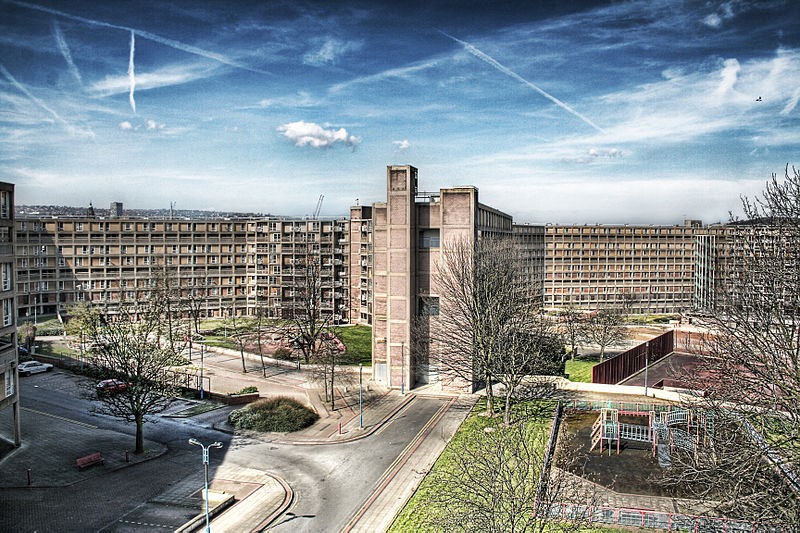
Park Hill, half-abandoned council housing estate, Sheffield, England
Photo via Wikimedia CommonsMany of the buildings that Harwood’s book covers make you wonder whether it is really about architecture at all. Consider Park Hill (1961), a huge council-housing estate containing nearly 1,000 duplexes and single-level flats that partially replaced a demolished slum overlooking downtown Sheffield — a crime-ridden precinct that, for all its problems, had housed a resilient community. Laid out as four long, interconnected slabs inflected so as to form an utterly antiurban, vermiculated footprint, Park Hill owed an enormous debt to the Unité d’habitation. At every third story, it featured elevated open-air “streets” or “decks” — the Corbusian fetish of the day — that ran indoors and out, connecting the slabs. As at the Unité, the imagery was nakedly industrial, with the apartments stashed in a “bottle-rack” grid of concrete that soon assumed a depressingly drab tincture and also proved prone to spalling. A ruthless rationalism likewise asserted itself in the level height maintained throughout the complex, which ranged from four to 13 stories, despite the irregular, sloping site. Park Hill was less a work of architecture than a huge, strange contraption inflicted on the urban skyline. Visual amenity, such as it was, came in the form of soft-hued brick within the concrete grid.
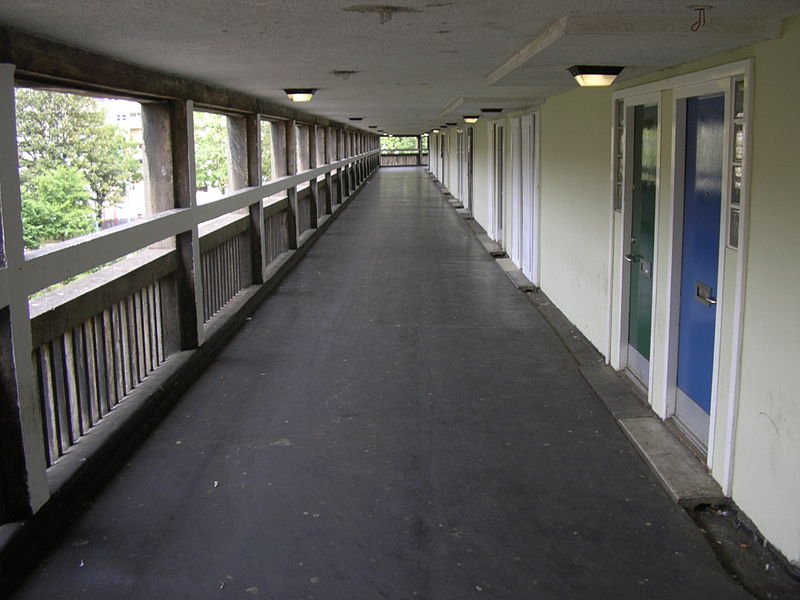
A typical deck in the Park Hill Flats, Sheffield.
Photo via Wikimedia Commons.As with many postwar housing projects, Park Hill offered practical amenities that residents had never before enjoyed: indoor plumbing, hot water, mechanical heating, even a sophisticated garbage-disposal system. Harwood mentions that, Britain’s many council-housing catastrophes notwithstanding, Park Hill “stood firm.” This is not true. By 1979, less than 20 years after its completion, Park Hill was an urban basket case — riddled with graffiti, terrorized by hooligans, afflicted with irruptions of black mold and the terrible stench resulting from waste-disposal blockages. Deserted decks and stairways provided criminals with multiple escape routes.
[…]
Local journalist Peter Tuffrey’s Sheffield Flats, Park Hill and Hyde Park: Hope, Eyesore, Heritage — whose title might seem to play ironically off Harwood’s but for the fact that the book appeared two years earlier — allows us to study a map and old photographs of the slum that Park Hill and Hyde Park supplanted. What we see are blocks, courts, and alleys teeming with row houses and low-rise tenements — streetscapes displaying a human scale, much solid construction, and considerable dereliction, all to be swept away by the desolation of the Corbusian superblocks.
Harwood doesn’t trouble herself with the Hulme Crescents (1972), another assemblage of concrete slabs on the vermiculated, “streets-in-the-sky” plan that rose from the blank slate of a demolished Manchester working-class district where 90,000 people once lived — “the human engine-room of the Industrial Revolution,” as Lynsey Hanley calls it in her largely autobiographical and often engrossing Estates: An Intimate History. The Crescents, designed to house more than 13,000, were conceived in emulation of Bath, the gorgeous Georgian city. Things didn’t work out that way.
“Almost immediately, the estate’s infrastructure began to suffer from the same problems that beset Park Hill and Broadwater Farm [a troubled north London estate]: leaky roof membranes, infestations of vermin and insects, uncontrollable damp, deserted walkways, and an endemic feeling of isolation,” Hanley notes. “The flats were so expensive to warm that many tenants never turned the central heating on, and communal areas were so difficult to maintain that the [city] council could not cope. When a small child died after falling off the top-floor ‘access deck’ of one of the Crescents in 1974, families decamped to the outskirts, belatedly following the rest of old Hulme.” The Crescents’ descent into chaos did make it possible for an anarchic punk scene to flourish in an upper-level hangout known as The Kitchen. The party ended with the estate’s demolition during the 1990s.
[…]
Still, the folly of concentrating lower-income populations in tall buildings eludes her, just as it eluded the Tory government that, in 1956, introduced hugely generous subsidies for the construction of high-rises, relative to row houses and semidetached houses. Not only are tall buildings much more expensive to build and maintain than houses; they were not even essential to achieving the residential densities that postwar planners sought. Tall buildings are highly artificial and complex structures housing temperamental machines, like elevators, that require a heightened degree of maintenance, often by highly paid technicians rather than handymen with toolboxes and stepladders, as Hanley observes. Tall buildings also require an elevated degree of social discipline, as well as security features like intercom systems, closed-circuit TV, and doormen or concierges. The tower blocks and high-rise slabs at the Barbican Estate, the carefully developed, elaborately landscaped, intensely picturesque Brutalist “bankers’ commune” in the City of London, have been very successful. The appropriate synecdoche for the Barbican’s low-end counterparts, however, might well be a broken-down elevator littered with trash, defaced by graffiti, and reeking of urine.
Comments Off on The spiritual and aesthetic brutality of Brutalist architecture
May 18, 2018
Missing the entire point of the capitalist system
At the Continental Telegraph, Tim Worstall tried to explain why the UK Commons committee looking into the Carillion collapse appear to misunderstand the current economic system in a big way:
Frank Field and his mates on the Commons work and pensions committee really do have some ‘splainin’ to do here. For they’ve entirely missed the structure of our current society and the reasons why that structure both exists and works. They go on about the greed at Carillion, the corporate vanity, the bad management. Then they complain that it’s gone bust. Finally, that we need a management system to prevent corporate greed and vanity from bankrupting companies.
No you fools, that Carillion went bust is the very point and purpose of the system. This is how we leach corporate vanity and greed out of the system, those who practise it leave the system.
[…]
What’s being missed is that this is good. Not the greed, obviously, for that’s something ever present in human nature. But what happens to those who act it out, bankruptcy.
[…]
And haven’t they come up with a likely candidate for making things worse? That a committee of bureaucrats should be making commercial decisions for companies instead of the directors and management. Really, that’ll work wonders, won’t it?
[…]
People who screw up, for whatever reason, disappear from the economic stage. Which is what we want of course, those who screw up to leave said economic stage. We have actually tried bureaucracy as a method of managing this and as the persistence of the National Coal Board, the very existence of British Leyland, show, that’s a system which doesn’t work. Either of those organisations would have disappeared at least a decade before they did without bureaucratic interference. Indeed, that’s how the bureaucracy’s actions were justified, to “save” them. That is, markets are more ruthless at weeding out failures than bureaucracies are.
What have we here? A complaint that markets weeded out a failure and to stop this we must have bureaucracy?
Carillion going bust is the very point of our having a market based economic system. Sure, they screwed up – bye bye Carillion. See, it works!
So why the hell are Frank Field and friends complaining? We already have a system which ensures that failures go kablooie – bankruptcy in our market economy.
Comments Off on Missing the entire point of the capitalist system
May 16, 2018
“Congrats, you have trained me to ignore Emergency Alerts”
The national emergency alert system for mobile phones just went online, and it’s already training people to ignore them:
When the siren-like sounds from an Amber Alert rang out on cellular phones across Ontario on Monday, it sparked a bit of a backlash against Canada’s new mobile emergency alert system.
The Ontario Provincial Police had issued the alert for a missing eight-year-old boy in the Thunder Bay region. (The boy has since been found safe.)
But gripes about the system soon began to pour in. Kingston police said they received “several complaints” regarding the Amber Alert notice. On social media, people startled by the alerts complained about the number of alerts they received and that they had received separate alerts in English and French.
“Sooo, is that emergency alert going to happen at like 4 a.m. with sleep mode enabled? Just asking for my heart health,” tweeted James G.
Meanwhile, others who were located far from the incident felt that receiving the alert was pointless.
“I’ve received two Amber Alerts today for Thunder Bay, which is 15 hours away from Toronto by car,” tweeted Molly Sauter. “Congrats, you have trained me to ignore Emergency Alerts.”
Mark Blevis, an Ottawa-based digital public affairs analyst, said he understands the importance of Amber Alerts, but system managers risk alienating cellphone users at some point if these types of alarms go off regularly.
“If they’re going to send out multiple alerts on the same thing, you need to find a way to streamline it so they don’t breed that apathy that causes the whole system to break down,” Blevis said.
At the very least, they should be able to figure out how to avoid the duplication of English and French alerts, he said.
Comments Off on “Congrats, you have trained me to ignore Emergency Alerts”
April 30, 2018
The Ferdinand: What Not To Do When Building a Tank
Potential History
Published on 11 Mar 2018A brief history of the VK 45.01 (P), or the Porsche Tiger, and the disaster it later became.
Comments Off on The Ferdinand: What Not To Do When Building a Tank
March 17, 2018
Tank Chats #24 Vickers A1E1 Independent | The Tank Museum
The Tank Museum
Published on 5 Aug 2016In the 24th Tank Chat, David Fletcher looks at the rather unusual Vickers A1E1 Independent. The Independent originated in 1922 with a War Office specification for a heavy tank. Ultimately it proved to be a failed project was abandoned in 1935, by which time it had cost more than £150,000, and sent to Bovington. It is the only tank of its kind in existence.
Comments Off on Tank Chats #24 Vickers A1E1 Independent | The Tank Museum
February 26, 2018
India’s largest newspaper on Justin Trudeau’s “disaster visit”
Paul Wells linked to this story in the world’s largest circulation English language newspaper, The Times of India:

Justin Trudeau and family during India visit
Image via NDTV, originally tweeted by @vijayrupanibjp
Canadian prime minister Justin Trudeau’s visit was a disaster that has little parallel in India’s recent diplomatic history. But as the Canadian prime minister returned home on Saturday after almost a week of recurrent diplomatic missteps, ironically, it may have provided the opportunity to reset relations between Canada and India.
On Saturday, Indian government officials were angry at suggestions by Canadian officials that India was responsible for Khalistani terrorist Jaspal Atwal getting a visa to India and used his presence to embarrass Trudeau.
Trudeau, in his meeting with prime minister Narendra Modi, also complained that his visit had been shadowed by a single issue. Atwal got a visa because he was taken off the blacklist some years ago. But he was part of a number of Trudeau’s own events that did not involve the Indian government at all.
A prime ministerial visit to a foreign country for a week with a thin official component is always fraught with danger. In addition, moving the official meetings to the very end of the trip indicated that the government meetings were an after-thought. Most foreign leaders who throw in other events almost always front-load the official meetings, and then go on to business or tourism events.
Here, it was clear from the start that Trudeau came to India to score with his Sikh constituency back home — four out of the six cabinet ministers who travelled with him were Sikh, as were an overwhelming number of MPs who also travelled with him. Until the media barrage in India forced the Canadian side to change tack, Trudeau was not even ready to meet Amarinder Singh, chief minister of Punjab. Even the Canadian high commissioner’s official reception was a celebration of Punjab with the prime minister himself waltzing in on bhangra beats.
Comments Off on India’s largest newspaper on Justin Trudeau’s “disaster visit”


