Quotulatiousness

July 15, 2013

Edward Snowden as the modern Prisoner

Filed under: Media, USA — Tags: , , , , — Nicholas @ 08:34

Justin Raimondo responds to Melissa Harris-Perry’s open letter to Edward Snowden:

Why didn’t Edward Snowden agree to be jailed, abused, silenced, and quite possibly tortured? This is what Melissa Harris-Perry wants to know.

Harris-Perry is one of MSNBC’s minor weekend anchors, a professor currently at Tulane University who started out retailing her academic pretensions as a sometime guest on the Rachel Maddow and Chris Hayes shows: her job was to inject fancy words like “discourse” and “paradigm” into the standard lefty-“progressive” boilerplate propaganda we’ve come to expect from that venue. With a magisterial tone bordering on the parodic, and complete protection from having to defend her views against any contrary opinions, Harris-Perry soon carved out a niche for herself as a dogged defender of the Obama administration, no matter what the circumstances. So when Snowden emerged as the biggest whistleblower in American history, exposing the existence of a secret surveillance apparatus that snakes into every aspect of American life, she sprang to the Dear Leader’s defense and delivered an “open letter” to Snowden that underscores why no one needs to take her seriously

[. . .]

Listening to Harris-Perry’s tirade, I wondered whether I had stumbled on a heretofore unknown episode of The Prisoner, the cult classic 1960s television series written by and starring Patrick McGoohan, in which a former British intelligence agent who has committed some unknown treason finds himself imprisoned in a place known as The Village. McGoohan’s pioneering series presents a prescient portrait of the anesthetizing Prozac-ed out mass culture of America today: the Village, with it’s pastel houses, outfitted with every comfort, are set in a garden-like “controlled community,” where calming voices are carried on the wind and daily medication prevents coherent thought. Everyone is subject to 24-hour surveillance, and cameras are everywhere. Each episode tells the story of one unsuccessful escape attempt after another, while McGoohan – the prisoner – probes ever deeper into the true nature of the Village. We don’t know what crime he’s been imprisoned for, but the clear implication is that it’s something big, almost Snowden-like. I’m surprised no one has brought up the McGoohan connection: the story lines are parallel if not identical. Snowden seems to be fleshing out McGoohan’s scripts in the front page headlines of every newspaper.

In the series, the Village employs its agents, who are constantly trying to entrap McGoohan into confessing to his alleged crimes, and giving up some Big Secret he supposedly possesses, but he resists. Harris-Perry, in her faux concern for the issues raised by Snowden’s exposure of massive government spying on innocent Americans, is straight out of an episode of The Prisoner, in which an agent of the Village tells him to give up his secret because his “level of celebrity” will somehow protect him. Really? Not, I suspect, if Harris-Perry and her fellow Madam Defarges over at MSNBC have anything to say about it.

I agree with Harris-Perry on one point: it is valid to discuss Snowden, his politics, his personal journey from agent of the state to enemy of the state, but unlike her I don’t think this detracts at all from the actual content of the documents he has made available to Glenn Greenwald and the staff of the Guardian newspaper. Greenwald tells a very interesting back story to all this in his talk given at the “Socialism” conference, in which he relates how and under what circumstances he met Snowden, and how that meeting inspired him to think about how real change comes about.

July 7, 2013

America’s Ministerium für Staatssicherheit

Filed under: Europe, Germany, Government, USA — Tags: , , , , — Nicholas @ 10:36

Rick Falkvinge looks at an interesting appropriate pairing: the former German Democratic Republic’s Ministerium für Staatssicherheit (Stasi) and the American NSA:

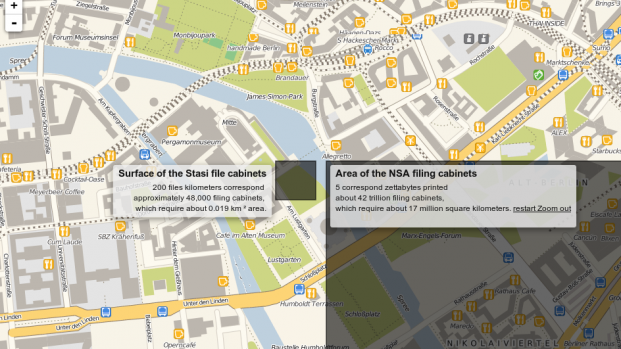
If you were to compare the evil, reprehensible Stasi to the NSA side by side in a visual comparison, who’s the worse surveillance hawk? The people over at OpenDataCity have put together a nice visual guide with astonishing results. We tend to think of Stasi-scale surveillance as the epitome of evil surveillance, and have completely lost track of what today’s governments are doing to their people.

When you go to this page (in German), you are presented with a nice map that compares the size of the Stasi archives — a large building in Berlin — with the corresponding NSA archives. It’s clear that the NSA’s archives — if used with Stasi technology, for an apples-to-apples comparison — would be quite a bit larger:

Comparison of the Stasi and NSA archives. The Stasi archives were a building in Berlin, the NSA archives seem to be more like a couple of entire blocks.

Comparison of the Stasi and NSA archives. The Stasi archives were a building in Berlin, the NSA archives seem to be more like a couple of entire blocks.

Keep reading … it’s like a “powers of ten” exercise.

June 30, 2013

The Observer has an embarrassing day

Filed under: Britain, Media, USA — Tags: , , , — Nicholas @ 10:56

In his Forbes column, Tim Worstall gleefully recounts the steps in a publishing cock-up by The Observer:

It looks like The Guardian/Observer* has managed to get itself mightily stung over a revelation about PRISM and the NSA. Which is all very amusing given the paper’s part in the Glenn Greenwald/Edward Snowden revelations. But what turns it into an absolute joy is that, while the news originally came from someone with, hmm, rather “out there” views, the actual information itself seems to be roughly true. And yet they’ve still taken the piece down.

The story starts here, at a site called The Privacy Surgeon. The site does an interview with an ex-NSA guy called Wayne Madsen. In which he claims that there are various European and other countries that cooperate with the NSA in the collection and then dissemination of information picked up from the monitoring of communications.

[. . .]

So, The Guardian/Observer has published a piece using allegations made by someone we’d already be predisposed to think of as being less than entirely correct in his descriptions of the real world. And, as a result, they’ve taken the piece down:

    This article has been taken down pending an investigation.

So far so good, just as in any other walk of life you think you’ve made a mistake you try to correct it. Just as Mother always told you you should. The slightly unfortunate thing is that the Sunday papers in the UK print quite early on the Saturday evening. Thus we get this front page of the physical paper:

Observer front page 20130630

The paper is now running as its front page a story that it has already retracted online. This is something of an “Ooops!” moment and as such one to be treasured as an example of the fallibility of both human beings and organisations that contain them.

However, the story really gets even better than this.

Steps towards a police state

Rick Falkvinge thinks that the United States is at the point of no return as far as civil liberties are concerned:

While this may seem a trivial observation, it is critical in this context: people tend to be focused on what affects them in the here and now. While some people can connect the dots and follow the line with their eyes into the future, the vast majority of people don’t bother with something that doesn’t affect them directly, personally, and in the present. In 1932, families were still skating in the park in Berlin on weekends. All that nasty stuff was theoretical, rumored, and somewhere else. People who look ahead and try to sound the alarm bell tend to be regarded as tinfoil hats, eccentric, and nuts.

One of the first things that happens past the point of no return into a police state is the persecution of reporters. As a society is closing down, those persecuted first are those with the audience and an interest in reporting the worrying trends that society seems to be closing. This is the proverbial canary in the coal mine. This is the alarm bell. Once that happens, get out of the mine.

An event horizon is a term from astrophysics. It is the edge of a black hole – so the event horizon appears like a black sphere, if you like. Nothing, not even light, can escape from within the event horizon – hence the term black hole. But if you were traveling through space, in direction of the black hole (which may be as large as an entire solar system), then you would notice absolutely nothing as you crossed the event horizon. You would pass a point of no return, and register not a single thing while doing so. The analogy is depressingly apt.

I’ve written before that I believe that the U.S. is lost to encroaching totalitarianism, which it will likely endure for a number of years before it collapses under its own weight (as all empires do sooner or later). With Edward Snowden being hunted relentlessly across the globe for leaking evidence of systematic abuse of power, Glenn Greenwald – who published Snowden’s leaks – was recently criticized for aiding and abetting the leak itself. This is a key choice of words, for aiding and abetting a crime is itself a crime – the wording suggested that the reporter who published evidence of abuse of power is himself a criminal.

June 25, 2013

Snowden’s character doesn’t matter – Snowden’s revelations matter a great deal

Filed under: Government, Law, Liberty, Technology — Tags: , , , , , — Nicholas @ 15:08

Gene Healy says that it doesn’t matter what you think about Edward Snowden, you should care a lot about what he’s revealed:

Here, the most disturbing aspect of the Snowden revelations is the NSA’s comprehensive, multiyear call-records database, with communication and phone-location information on millions of Americans. Especially if combined with metadata on emails, website visits and financial transactions that the agency is also amassing, that information is a potential treasure trove for political abuse — it can be used to ferret out the sort of information governments have historically used to blackmail and neutralize political opponents: who’s leaking, who’s organizing, who’s having an affair. The potential abuse of that information represents a grave threat to American liberty and privacy regardless of Snowden’s character and motivations.

In an post last week, Buzzfeed‘s Ben Smith makes the key point: “You Don’t Have to Like Edward Snowden.” Snowden, Smith argues, is “a source,” and the information sources convey is far more important than their “moral status” or the “fate of [their] eternal soul[s].”

Smith mentions Mark Felt, the FBI honcho who served as Woodward and Bernstein’s “Deep Throat” during their investigation of the Watergate burglary and cover-up. Felt, it turned out, was simply settling scores in a bureaucratic power struggle. He had no scruples against criminal violations of privacy — in 1980 he was convicted of conspiring to violate the constitutional rights of Americans through warrantless break-ins as part of the FBI’s COINTELPRO program.

It was important for Americans to know that their president was a crook. That Mark Felt was also a crook is neither here nor there. As Smith puts it, “who cares?”

June 23, 2013

Two remarkable press releases on the Snowden case

Filed under: China, Government, Law, Russia, USA — Tags: , , , , , — Nicholas @ 10:46

First, here’s the official Hong Kong government’s statement:

Mr Edward Snowden left Hong Kong today (June 23) on his own accord for a third country through a lawful and normal channel.

The US Government earlier on made a request to the HKSAR Government for the issue of a provisional warrant of arrest against Mr Snowden. Since the documents provided by the US Government did not fully comply with the legal requirements under Hong Kong law, the HKSAR Government has requested the US Government to provide additional information so that the Department of Justice could consider whether the US Government’s request can meet the relevant legal conditions. As the HKSAR Government has yet to have sufficient information to process the request for provisional warrant of arrest, there is no legal basis to restrict Mr Snowden from leaving Hong Kong.

The HKSAR Government has already informed the US Government of Mr Snowden’s departure.

Meanwhile, the HKSAR Government has formally written to the US Government requesting clarification on earlier reports about the hacking of computer systems in Hong Kong by US government agencies. The HKSAR Government will continue to follow up on the matter so as to protect the legal rights of the people of Hong Kong.

And here’s a statement from Wikileaks:

Mr Edward Snowden, the American whistleblower who exposed evidence of a global surveillance regime conducted by US and UK intelligence agencies, has left Hong Kong legally. He is bound for a democratic nation via a safe route for the purposes of asylum, and is being escorted by diplomats and legal advisors from WikiLeaks.

Mr Snowden requested that WikiLeaks use its legal expertise and experience to secure his safety. Once Mr Snowden arrives at his final destination his request will be formally processed.

Former Spanish Judge Mr Baltasar Garzon, legal director of Wikileaks and lawyer for Julian Assange has made the following statement:

“The WikiLeaks legal team and I are interested in preserving Mr Snowden’s rights and protecting him as a person. What is being done to Mr Snowden and to Mr Julian Assange — for making or facilitating disclosures in the public interest — is an assault against the people”.

To the vast amusement of many commentators, the reported route out of Hong Kong leads to Russia, with other stopping points including Cuba and Venezuela. It’s like a free press/civil liberties tour of the planet!

June 22, 2013

US charges against Snowden were filed on June 14th

Filed under: China, Government, Law, USA — Tags: , , , , — Nicholas @ 09:10

It apparently takes a week for the US government to publicize that it has laid charges

Federal prosecutors filed espionage charges against alleged National Security Agency leaker Edward Snowden, officials familiar with the process said. Authorities have also begun the process of getting Snowden back to the United States to stand trial.

The charges were filed June 14 under seal in federal court in Alexandria, Va. — and only disclosed Friday.

Snowden has been charged with three violations: theft of government property and two offenses under the espionage statutes, specifically giving national defense information to someone without a security clearance and revealing classified information about “communications intelligence.”

Each of the charges carries a maximum of 10 years in prison.

Snowden, who is a former employee of defense contractor Booz Allen Hamilton, leaked details about far-reaching Internet and phone surveillance programs to The Guardian and The Washington Post earlier this month. He revealed his identity while in Hong Kong, where it is believed he is still hiding.

It’s not clear whether the extradition will be straightforward:

Andy Tsang, Hong Kong’s police commissioner, said that if an extradition request was sent from a country that had a “mutual legal assistance agreement” with Hong Kong, its government would “handle it in accordance with current Hong Kong laws and systems.”

Simon Young, a professor at Hong Kong University’s faculty of law, suggested it was unclear whether Snowden would win or lose any attempt to fight extradition.

He said theft was listed in the U.S.-Hong Kong extradition treaty. “There is an offence listed in the treaty of unlawful handling of property, but this raises the question as to whether information is property and the answer is not clear,” he said in an email.

June 14, 2013

Reason.tv – Tap It: The NSA Slow Jam

Filed under: Government, Humour, Liberty, Technology, USA — Tags: , , , , — Nicholas @ 11:07

June 11, 2013

“Who hired this goofball?”

Filed under: Government, Media, USA — Tags: , , , , — Nicholas @ 09:22

Jim Geraghty talks about Edward Snowden and the NSA:

Everybody’s going to have an opinion on Edward Snowden, today the world’s most famous leaker.

In the coming days, you’re going to see a lot of people talking past each other, conflating two issues: one, did he do the right thing by disclosing all these details of the vast NSA system to gather data on Americans? And two, should he be prosecuted for it?

Of course, you can do the right thing and still break the law.

[. . .]

This may be a story with no heroes. A government system designed to protect the citizens starts collecting all kinds of information on people who have done nothing wrong; it gets exposed, in violation of oaths and laws, by a young man who doesn’t recognize the full ramifications of his actions. The same government that will insist he’s the villain will glide right past the question of how they came to trust a guy like him with our most sensitive secrets. Who within our national security apparatus made the epic mistake of looking him over — completing his background check and/or psychological evaluation — and concluding, “yup, looks like a nice kid?”

Watching the interview with Snowden, the first thing that is quite clear is that his mild-mannered demeanor inadequately masks a huge ego — one of the big motivations of spies. (Counterintelligence instructors have long offered the mnemonic MICE, for money, ideology, compromise, ego; others throw in nationalism and sex.)

Snowden feels he has an understanding of what’s going on well beyond most of his colleagues:

    When you’re in positions of privileged access like a systems administrator for the sort of intelligence community agencies, you’re exposed to a lot more information on a broader scale then the average employee and because of that you see things that may be disturbing but over the course of a normal person’s career you’d only see one or two of these instances. When you see everything you see them on a more frequent basis and you recognize that some of these things are actually abuses.

What’s more, he feels that no one listens to his concerns or takes them seriously:

    And when you talk to people about them in a place like this where this is the normal state of business people tend not to take them very seriously and move on from them. But over time that awareness of wrongdoing sort of builds up and you feel compelled to talk about. And the more you talk about the more you’re ignored. The more you’re told its not a problem until eventually you realize that these things need to be determined by the public and not by somebody who was simply hired by the government.”

My God, he must have been an insufferable co-worker.

    ‘Look, you guys just don’t understand, okay? You just can’t grasp the moral complexities of what I’m being asked to do here! Nobody here really gets what’s going on, or can see the big picture when you ask me to do something like that!’

    ‘Ed, I just asked if you could put a new bottle on the water cooler when you get a chance.’

Update: Politico put together a fact sheet on what we know about Edward Snowden. It’s best summed up by Iowahawk:

June 10, 2013

Edward Snowden is “one of America’s most consequential whistleblowers, alongside Daniel Ellsberg and Bradley Manning”

Filed under: Government, Liberty, Media, USA — Tags: , , , , , — Nicholas @ 08:03

The identity of the NSA whistleblower is revealed by the Guardian:

The individual responsible for one of the most significant leaks in US political history is Edward Snowden, a 29-year-old former technical assistant for the CIA and current employee of the defence contractor Booz Allen Hamilton. Snowden has been working at the National Security Agency for the last four years as an employee of various outside contractors, including Booz Allen and Dell.

The Guardian, after several days of interviews, is revealing his identity at his request. From the moment he decided to disclose numerous top-secret documents to the public, he was determined not to opt for the protection of anonymity. “I have no intention of hiding who I am because I know I have done nothing wrong,” he said.

Snowden will go down in history as one of America’s most consequential whistleblowers, alongside Daniel Ellsberg and Bradley Manning. He is responsible for handing over material from one of the world’s most secretive organisations — the NSA.

[. . .]

He does not fear the consequences of going public, he said, only that doing so will distract attention from the issues raised by his disclosures. “I know the media likes to personalise political debates, and I know the government will demonise me.”

Despite these fears, he remained hopeful his outing will not divert attention from the substance of his disclosures. “I really want the focus to be on these documents and the debate which I hope this will trigger among citizens around the globe about what kind of world we want to live in.” He added: “My sole motive is to inform the public as to that which is done in their name and that which is done against them.”

He has had “a very comfortable life” that included a salary of roughly $200,000, a girlfriend with whom he shared a home in Hawaii, a stable career, and a family he loves. “I’m willing to sacrifice all of that because I can’t in good conscience allow the US government to destroy privacy, internet freedom and basic liberties for people around the world with this massive surveillance machine they’re secretly building.”

June 9, 2013

QotD: Whistleblowers

Filed under: Government, Media, Quotations, USA — Tags: , , , , — Nicholas @ 09:36

The U.S. government is on a secrecy binge. It overclassifies more information than ever. And we learn, again and again, that our government regularly classifies things not because they need to be secret, but because their release would be embarrassing.

Knowing how the government spies on us is important. Not only because so much of it is illegal — or, to be as charitable as possible, based on novel interpretations of the law — but because we have a right to know. Democracy requires an informed citizenry in order to function properly, and transparency and accountability are essential parts of that. That means knowing what our government is doing to us, in our name. That means knowing that the government is operating within the constraints of the law. Otherwise, we’re living in a police state.

We need whistle-blowers.

Leaking information without getting caught is difficult. It’s almost impossible to maintain privacy in the Internet Age. The WikiLeaks platform seems to have been secure — Bradley Manning was caught not because of a technological flaw, but because someone he trusted betrayed him — but the U.S. government seems to have successfully destroyed it as a platform. None of the spin-offs have risen to become viable yet. The New Yorker recently unveiled its Strongbox platform for leaking material, which is still new but looks good. This link contains the best advice on how to leak information to the press via phone, email, or the post office. The National Whistleblowers Center has a page on national-security whistle-blowers and their rights.

Bruce Schneier, “What We Don’t Know About Spying on Citizens: Scarier Than What We Know”, The Atlantic, 2013-06-06

June 8, 2013

Don’t put too much faith in denials from Verizon and other companies…

Filed under: Business, Government, Law, Liberty, Technology — Tags: , , , , , — Nicholas @ 10:10

As Mic Wright points out, the companies named in the Prism leaks may not be acting as free agents:

Pastor Niemoller’s “First they came…” poem is over-quoted but with good reason. It is far too easy to be complacent. Addicted and reliant as many of us are on free web services, it’s more convenient to just accept the companies outright denials that they have been complicit with the NSA’s programme. But look closely at those statements and things become rather less clear, as Michael Arrington pointed out.

The tech industry’s denials have been carefully drafted and similarly worded. It is not unfeasible to imagine that those companies have turned over users’ personal information to the NSA in another fashion. Facebook founder and CEO Mark Zuckerberg’s statement was one of the strongest: “Facebook is not and has never been part of any program to give the US or any other government direct access to our servers. We have never received a blanket request or court order from any government agency asking for information…”

Zuckerberg’s words are reassuring until you consider that any company that receives an order under the Foreign Intelligence Surveillance Act Amendments Act — the legislation the Obama administration is using to justify the broad surveillance — is forbidden from disclosing they have received it or disclosing any information about it. It’s not surprising that no mea culpas have emerged from major tech firms or that Palantir — the big data surveillance company with the $5 billion valuation and CIA funding — denies any connection with the project. The NSA has been a Palantir client and one of the company’s co-founders, billionaire investor Peter Thiel, also sits on Facebook’s board.

Charles Stross talks about writing The Jennifer Morgue

Filed under: Books, Britain, Business, Media — Tags: , , , — Nicholas @ 09:07

If you haven’t yet read any of the “Laundry” books by Charles Stross, you really are missing out on a treat. The Jennifer Morgue was the second in the series and Charles has a blog post up about how the book came to be written:

All stories have several seeds. In the case of “The Jennifer Morgue”, the first seed was the surprising success of “The Atrocity Archives”. The novel my agent initially thought was unsaleable sold to Golden Gryphon, a small but respectable Lovecraftian publisher in the United States. It went gold, going into reprint and becoming their second-best selling title at the time. Then, to everyone’s surprise, the additional novella I wrote for the book (“The Concrete Jungle”) made the shortlist for the Hugo award in 2005. This was a stunning surprise. GG had only sold around 3000 copies of the book; the other novellas on the shortlist had all appeared in magazines or anthologies with four to ten times the number of copies sold! After some hurried email consultation, Gary and Marty at GG agreed to let me put the whole novella on the web, to make it more readily available to the Hugo voters. I don’t know if that’s what did the trick, or if there were additional home-mover effects from the Worldcon in 2005 being held in Glasgow (thus bringing more British voters in than normal) but at the end of August that year I became the dazed and surprised owner of a very shiny trophy.

(And the performance anxiety that had been haunting me for years—”I’m not a real writer, I’m just winging this”—went away for a while.)

But anyway. This success coincided with a French publisher making an offer for translation rights to “The Atrocity Archives”, which in turn got my agent’s attention. She proposed a sequel, and James Bond was so obvious that I don’t think I even considered any alternatives. It would have to be the Movie Bond franchise, for most people these days don’t grow up on the original Ian Fleming novels (the way I did); the humour would come from the incongruity of Bob Howard in James Bond’s shoes. We decided to auction the new book, along with paperback rights to “The Atrocity Archives”, and ended up cutting a deal whereby Golden Gryphon would publish “The Jennifer Morgue” in hardcover while Ace rolled “The Atrocity Archives” in trade paperback, and eventually in mass market. Which then left me pondering what to write … because every Bond movie (or novel) needs a Bond-sized plot device, doesn’t it?

By this time we were into late October 2005. One evening, we were eating a Chinese take-away in front of the TV, watching a documentary on the Discovery Channel about one of the most bizarre CIA projects to happen during the Cold War — Project Azorian (better, but mistakenly, known to the public as “Operation Jennifer”). Seriously, if you don’t know about it, go follow that link right now; it’s about how the CIA enlisted Howard Hughes to help them build a 63,000 ton fake deep-see mining ship, the Glomar Challenger, as cover for a deep-sea grapple that would descend 4,900 metres and raise the hull of a shipwrecked Soviet nuclear missile submarine, the K-129. (Project Azorian was so James Bond that the engineering crew working on the ship were cracking jokes about the bald guy stroking the white cat in his seat on the bridge. How post-modern can you go?)

June 7, 2013

Who is Glenn Greenwald?

Filed under: Government, Law, Liberty, USA — Tags: , , , , — Nicholas @ 08:14

The New York Times profiles Glenn Greenwald:

After writing intensely, even obsessively, for years about government surveillance and the prosecution of journalists, Glenn Greenwald has suddenly put himself directly at the intersection of those two issues, and perhaps in the cross hairs of federal prosecutors.

Late Wednesday, Mr. Greenwald, a lawyer and longtime blogger, published an article in the British newspaper The Guardian about the existence of a top-secret court order allowing the National Security Agency to monitor millions of telephone logs. The article, which included a link to the order, is expected to attract an investigation from the Justice Department, which has aggressively pursued leakers.

On Thursday night, he followed up with an article written with a Guardian reporter, Ewen MacAskill, that exposed an N.S.A. program, Prism, that has gathered information from the nation’s largest Internet companies going back nearly six years.

“The N.S.A. is kind of the crown jewel in government secrecy. I expect them to react even more extremely,” Mr. Greenwald said in a telephone interview. He said that he had been advised by lawyer friends that “he should be worried,” but he had decided that “what I am doing is exactly what the Constitution is about and I am not worried about it.”

June 1, 2013

QotD: Internet espionage

Filed under: China, Humour, Quotations, Technology — Tags: , , , — Nicholas @ 08:26

A new report says that the Chinese are hacking American computer networks at an alarming rate. This is hardly news. I’ve been including the phrase “早安,我抱歉有沒有在這封電子郵件中的商業秘密或加拿大色情。請停止殺害酷動物啄木鳥醫學。剛剛買了一些偉哥了” at the bottom of every e-mail for months (I put it just above where it says “Hello Mr. Holder!”). It means, according to Google translate: “Good Morning, I’m sorry there’s no trade secrets or Canadian porn in this e-mail. Please stop killing cool animals for pecker medicine. Just buy some Viagra already.”

What is new is the scope of the problem the report lays out. This is a thorny issue and I think the U.S. needs to be much, much more aggressive in combating it. Why it’s not a bigger issue for the WTO, for instance, is baffling to me. They are stealing our stuff, which strikes me as a bigger deal than taxing it at the border.

Explaining to the Chinese leadership that they shouldn’t be doing this because it’s wrong is like explaining to a dog licking its nethers that what he’s doing is bad manners: To the extent they understand at all, they couldn’t care less. They respect power. They understand when you put a price on bad behavior. So we need to put a price on Chinese hacking. It’s really that simple. The hard thing to figure out is how.

Jonah Goldberg, “Chiiiiiicoms in (Cyber) Spaaaaaaaaaaaace!”, The Goldberg File, 2013-05-31

« Newer PostsOlder Posts »

Powered by WordPress