Quotulatiousness

May 22, 2019

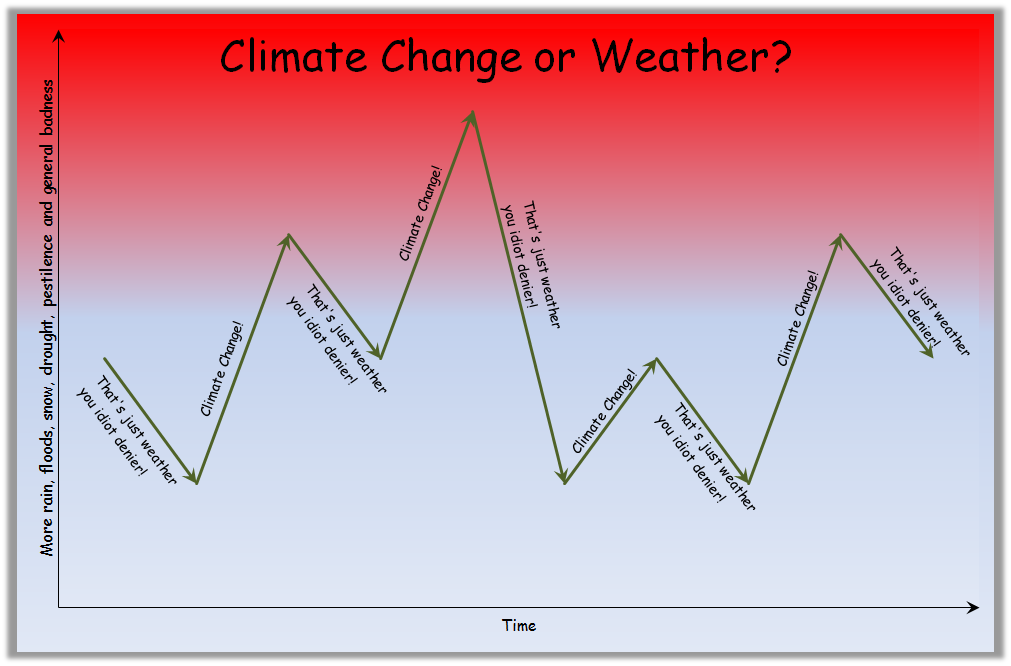
Climate change, no, climate crisis, no, climate catastrophe, no, we mean climate APOCALYPSE!!!

Filed under: Cancon, Economics, Environment, Politics — Tags: , , , — Nicholas @ 03:00

The official marching orders for journalists now insist that the language to use around what was formerly “global warming” or “climate change” will now be described in starker, more frightening terms. Canada’s Liberal Party, under Justin Trudeau, has been virtue signalling for pretty much its entire term in office on the climate issue and with a fall election coming into view, the rhetoric will become more extreme and shrill. Jay Currie discusses climate change and the Canadian election:

I suspect this divide between people who think “doing something” about climate change (no matter how futile) and people who do not accept the urgency of dealing with something they really don’t believe in will inform politics in the West for the next few years. Most particularly, it will inform the next Canadian federal election.

The Liberal Party of Canada has been going all in on its “tax on carbon pollution” (a fine bit of wordsmithing managing to attach “carbon” to “pollution”). Led by the remarkably scolding Catherine McKenna, the Libs seem to think that purporting to “do something” about climate change is a vote winner. So McKenna tours the country speaking to uncritical school children and assorted environmentalists about how important having a “carbon tax” is. The Liberals tax will save the planet, ensure sea level rise stops (easy because sea level is not actually rising), save the Arctic ice cap (already saving itself, thank you), keep polar bears from extinction (also easy because virtually all polar bear populations are growing) and reduce or eliminate climate change “caused” weather events. Plus, Canada will honour its Paris Accord commitments (we won’t) and serve as a beacon to lesser nations like China and India in their efforts to combat climate change (as if).

The Liberals think that the fact that a carbon dioxide tax in Canada will have a rounding error effect on worldwide emissions and no detectable effect on world temperature does not matter politically. What matters politically is that the Liberals believe that there is a large constituency out there which urgently wants to “do something”.

The NDP is fully on board and, of course, the Greens have been banging the climate change drum forever. Andrew Scheer’s Conservatives seem to be on the fence. Like the Coalition in Australia, the Conservatives endorse the “climate change is a problem” line and very few are willing to challenge the underlying science or economics for fear of being branded uncool “climate change deniers”. But the Conservatives seem to be, prudently in my view, dragging their feet on “doing something” about CO2.

Political virtue signalling on the climate file is the easy part. All that is really required is the abandonment of any sort of scientific judgement (easy when you are told that all the scientists agree that climate change is real and primarily human caused) and policy skepticism (we don’t need a cost benefit analysis, this is an emergency!). The hard part occurs when you try to “do something”. Because doing something means that people are going to see their expenses rise without actually seeing (in any tangible way) any actual benefit. In fact, as Ontario’s wonderfully disastrous adventure in wind energy demonstrated, tax dollars can be wasted and consumer prices increased all without making any difference at all to the climate.

May 14, 2019

Is Canada ready for a New Green Democratic Party?

Filed under: Cancon, Politics — Tags: , , , , — Nicholas @ 05:00

Ali Taghva explores the notion of the federal NDP and Green parties joining together:

With fundraising and polling numbers in sharp decline at the same time that experienced MPs and staff leave the party, it is evident, even the base of the NDP is beginning to lose faith in the current direction led by Jagmeet Singh.

Worryingly for every single NDP member in the country, this is occurring even when Justin Trudeau’s post-election honeymoon has long ended.

As a result, it appears that the Green Party has become the progressive vehicle gaining the most federal momentum. Their fundraising numbers are on the upswing, and if the trend in the latest by-election in B.C. holds up, they may be the preferred refuge for disenfranchised Liberal voters.

While the Green Party does have momentum, it will not be able to push forward as Canada’s progressive alternative, at least not alone.

The party is still astronomically behind the Conservatives and Liberals when it comes to fundraising, quality of candidates, and polling support.

Even in comparison to the NDP, the Greens are still behind in fundraising and polling, although the distance between the two parties is far more negligible.

With both parties too far back to do anything other than reducing the Liberal vote, ensuring a Conservative majority, it may be time for Canadian progressives to seriously consider a merger between the Green party and the New Democrats.

Okay, but why now? What would be the big draw … oh:

Perhaps most interestingly though, a united alternative progressive party could easily bring on-board the two highest-profile individuals who still have no declared party for the federal election, Jane Philpott and Jody Wilson-Raybould.

With most Canadians believing Jody Wilson-Raybould’s account over that of the Prime Minister’s, her entrance into the race along with Jane Philpott’s could be the final piece which catapults the party into contention for the role of governing party.

Of course, of course … the old celebrity candidates trick. That always works. Well, in urban downtown ridings, anyway.

April 28, 2019

More on the PEI Green Party “breakthrough”

Filed under: Cancon, Politics — Tags: , , — Nicholas @ 03:00

In the Prince Edward Island election last week, the voters threw out the incumbent Liberal government and instead opted for a minority Progressive Conservative replacement. One of the bigger surprises of the outcome was that the Green Party surged into the second-largest number of seats, to be the Official Opposition for the first time. Colby Cosh explains that the Greens ran on a more typically NDP platform that only vaguely gestured toward any traditional Green policies:

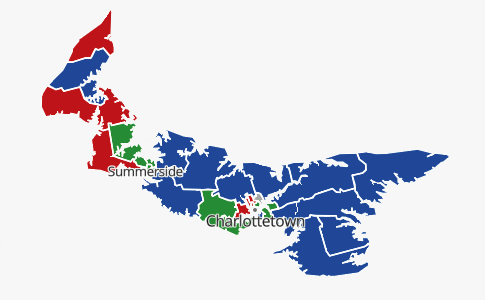
Election results map for the April 23, 2019 provincial election.
Blue – PC Red – Liberal Green – Green Party Orange – NDP (no seats won)
Map via CBC News – https://newsinteractives.cbc.ca/elections/pei/2019/results/

Breakthrough or letdown? The Green Party of Prince Edward Island won the second highest number of seats in the province’s election Tuesday, and leader Peter Bevan-Baker seems likely to become opposition chief facing a Conservative minority government. The P.E.I. Greens have been big news for a while now, doubly so because the Island has always stuck to the classic two parties, and in the run-up to the vote, polls had suggested that Bevan-Baker might end up as premier. This didn’t happen — or hasn’t yet! — and in the overall popular vote the Greens ended up beating the third-place incumbent Liberals by only a little over one percentage point.

In truth the P.E.I. Greens seem to be in a good position going forward, if we agree to overlook the general history of Green floundering in Canada. Bevan-Baker, a Scots dentist, has lost more elections than you’ve had hot meals, but his soft-spokenness and graciousness seem to have struck a belated chord with Islanders. A three-way vote split of 37-31-30 seems like a recipe for instability, even though the parties are issuing familiar gab about legislating in a co-operative, collegial way.

Everybody knows that P.E.I. is both an unusual place, with some of the features of an extended family, and a small place. What has worked for Bevan-Baker’s Greens might not scale up well to a much larger entity, such as Regina, Sask. This has not stopped commentators from speculating on the election being the possible starting gun for nationwide Green success. The idea is that Canadians, particularly the young, have finally taken the environmentalist message (whatever that is) into their hearts and are ready to defect from tedious mainstream neoliberal politics. The revolution is at hand! Any minute now!

If you followed the P.E.I. campaign at all, you know that there’s a major problem with this concept. It’s that the Green platform wasn’t especially, uh, green. Everybody who was actually on the Island political beat noticed this. The formal pitch included minor nods toward electric vehicles and solar power, of a kind you wouldn’t even be surprised to find in a Conservative election document nowadays, but Bevan-Baker himself emphasized the “pragmatic” nature and careful costing of the party’s platform. Almost as if he was conscious of having to overcome an inherited Green reputation for flakiness.

April 25, 2019

Prince Edward Island elects its very first minority government

Filed under: Cancon, Politics — Tags: , , — Nicholas @ 03:00

There’s not often news from Prince Edward Island, Canada’s smallest province, but in yesterday’s provincial election they did something they’ve never done before: elect a minority government and have the first Green Party official opposition.

Election results map for the April 23, 2019 provincial election.
Blue – PC (36.5% of the vote for 12 seats)
Red – Liberal (29.5% of the vote for 6 seats)
Green – Green Party (30.6% of the vote for 8 seats)
Orange – NDP (2.9% of the vote for 0 seats)
Map via CBC News – https://newsinteractives.cbc.ca/elections/pei/2019/results/

Prince Edward Island’s Liberal Premier Wade MacLauchlan lost his own seat to the province’s Progressive Conservatives, who will form the first ever minority government in PEI’s history.

PEI has traditionally had a two-party system, broken in 2015 with a familiar story: a lone Green seat. We saw it in Ontario, New Brunswick, British Columbia, and federally.

The PEI Greens, who for a long time looked poised to form government, will form the official opposition. They will become the only party other than the PCs and Liberals to do so. With a by-election to come in the next months, the Green Party won at least nine seats, a record number of elected Greens in Canada.

Elections in PEI often go unnoticed in most of the country, but this election gained special attention after the tragic news of the death of a candidate and his young son in a canoeing accident.

But Canadians have been keeping a closer eye to other province’s elections. Consider the unusual level of national attention generated by provincial elections in Alberta, Ontario, and elsewhere.

April 19, 2019

The next Euro-elections as “the second referendum”

Filed under: Britain, Europe, Politics — Tags: , , , , — Nicholas @ 03:00

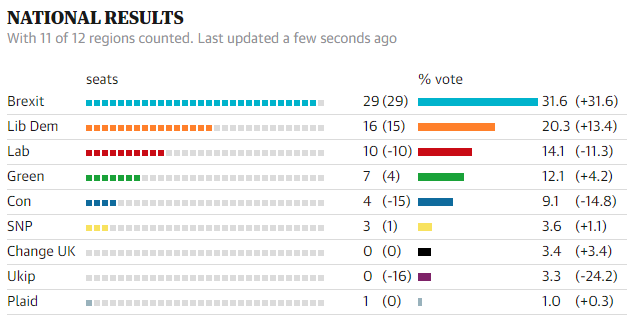
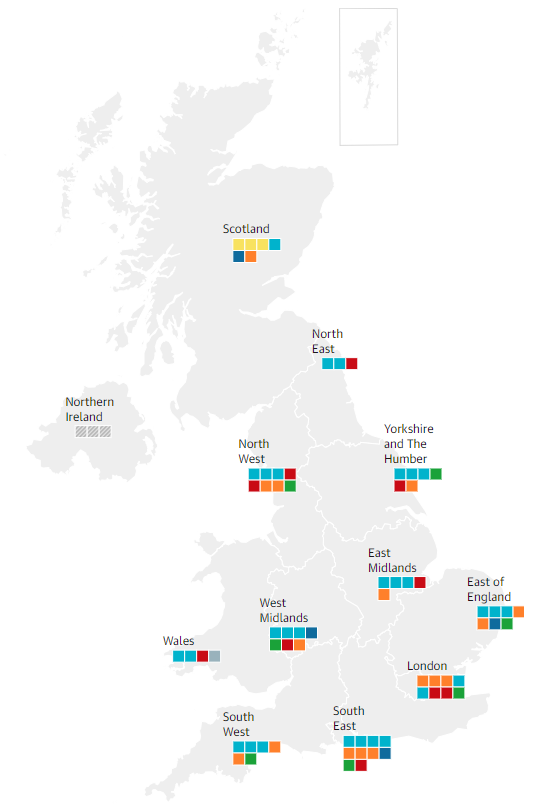
Julie Cook wonders why the Remoaners seem so eager to cast the May 23 European elections as the second referendum they’ve been eager to have, as the early indications show something less than full eagerness among British voters for any of the pro-remain groups:

Timothy Garton Ash is, I think, making something of a mistake here. For he’s calling for the upcoming euro-elections to be seen as a second referendum on our leaving the European Union. The point being that this is going to be something of a hostage to fortune.

Perhaps more importantly the more Remoaners call for it to be seen and treated as such the more likely we are to see what lying toads they are.

    Britain will have its second referendum – on 23 May. Don’t miss it
    Timothy Garton Ash This is a crucial chance to show politicians how we feel now about leaving Europe. The turnout must be huge

The point being, well, what if Leave wins?

    In just five weeks’ time, Britain will have a referendum on Brexit. This will take the form of elections to the European parliament, but in reality this will be a pre-referendum, or, if you like your neologisms ugly, a preferendum. So there is now one simple task: to maximise the vote for parties that support a confirmatory referendum on Brexit, giving the British people a democratic choice between accepting the negotiated Brexit deal and remaining in the EU.

And there’s the toad bit. There’s a significant portion of the population who’d prefer to just Leave. Don’t care about the terms, the deal, let’s just leave the b’tards to stew in their own juices and we’ll get on with solving whatever problems remain after we’ve not remained. And this is a significant portion – perhaps not a majority, maybe not even a plurality but that’s going to be the interesting test

Early polls show that Nigel Farage and his new Brexit Party are in the lead over both Labour and the Conservatives. Of course, he’ll have to weather a full month of unbridled hate and slander from the media, but what can they possibly say about him or his new party that they haven’t already screamed and bellowed before? Once you’ve fired all the invective in your shot locker, you don’t stand much chance of changing anyone’s opinion if they didn’t react the first dozen times.

March 21, 2019

“It’s back to normal, basically. The emperor is naked. Votes are for sale. Caveat emptor

Filed under: Cancon, Economics, Government, Politics — Tags: , , , , — Nicholas @ 03:00

Chris Selley somehow seems, I dunno, a bit … cynical about Prime Minister Trudeau and Finance Minister Morneau’s 2019 federal (election) budget:

Ahoy there, relatively young and middle-class Canadian! Did you vote Liberal in 2015? And are you, shall we say, somewhat less enthused about that prospect four years later, for various reasons we needn’t go into here?

Now, what if Justin Trudeau were to offer you a down payment on a shiny new condominium?

Well, that’s just the kind of guy he is. Starting this year, so long as your household income is below $120,000, the Canada Mortgage and Housing Corporation will pitch in 5 per cent of the price of your first home — 10 per cent if it’s a new home, the construction of which the government hopes to incentivize.

That’s Item One in the 460-page federal budget tabled Tuesday in Ottawa.

On a new $400,000 condo, you could put down your own $20,000; CMHC would chip in another $40,000; and your monthly mortgage payment, on a 25-year term at 3.25 per cent, would drop by a not inconsiderable 12 per cent. You would reimburse CMHC, interest-free, if and when you sell. Cost to the taxpayer: $121 million over six years.

If you’re worried giving home-seekers free money might just push the price of a $400,000 condominium nearer to $440,000, Finance Minister Bill Morneau would first of all like you to stop. (“You’re wrong,” he admonished a reporter who dared suggest it during a press conference in the budget lockup Tuesday.) But if all else fails and you’re forced to rent, the feds also found $10 billion extra over nine years to throw at the Rental Construction Financing Initiative, a CMHC program that offers low-interest loans to qualified builders. The goal is 42,500 new rental units in a decade.

Can’t even think of home ownership until you pay off your student loans? Again, the government is here to help: From now on you’ll pay the Bank of Canada’s prime interest rate, instead of prime plus 2.5 points. And for the first six months after you graduate, you’ll pay nothing. The budget document introduces us to Angela, a recent psychology grad carrying $13,500 in student debt who landed a job at “a medium-sized consumer goods company.” (It doesn’t matter where she works. The writers just wanted to add some colour.) Angela will save something like $2,000 in interest over 10 years.

There’s also the new Canada Training Benefit, which the government intends to help Canadians with “the evolving nature of work.” (Maybe your parents were right, Angela. Maybe that psych degree wasn’t the best idea, Angela.) Starting in 2020, the feds will chip in $250 a year, and you can use the accumulated credit to pay up to half the cost of courses or training. And you can draw on up to four weeks of EI to complete it.

March 5, 2019

It’s almost as if we elected the actor, but really wanted the character he’d played on TV instead

Filed under: Cancon, Media, Politics — Tags: , , , , — Nicholas @ 03:00

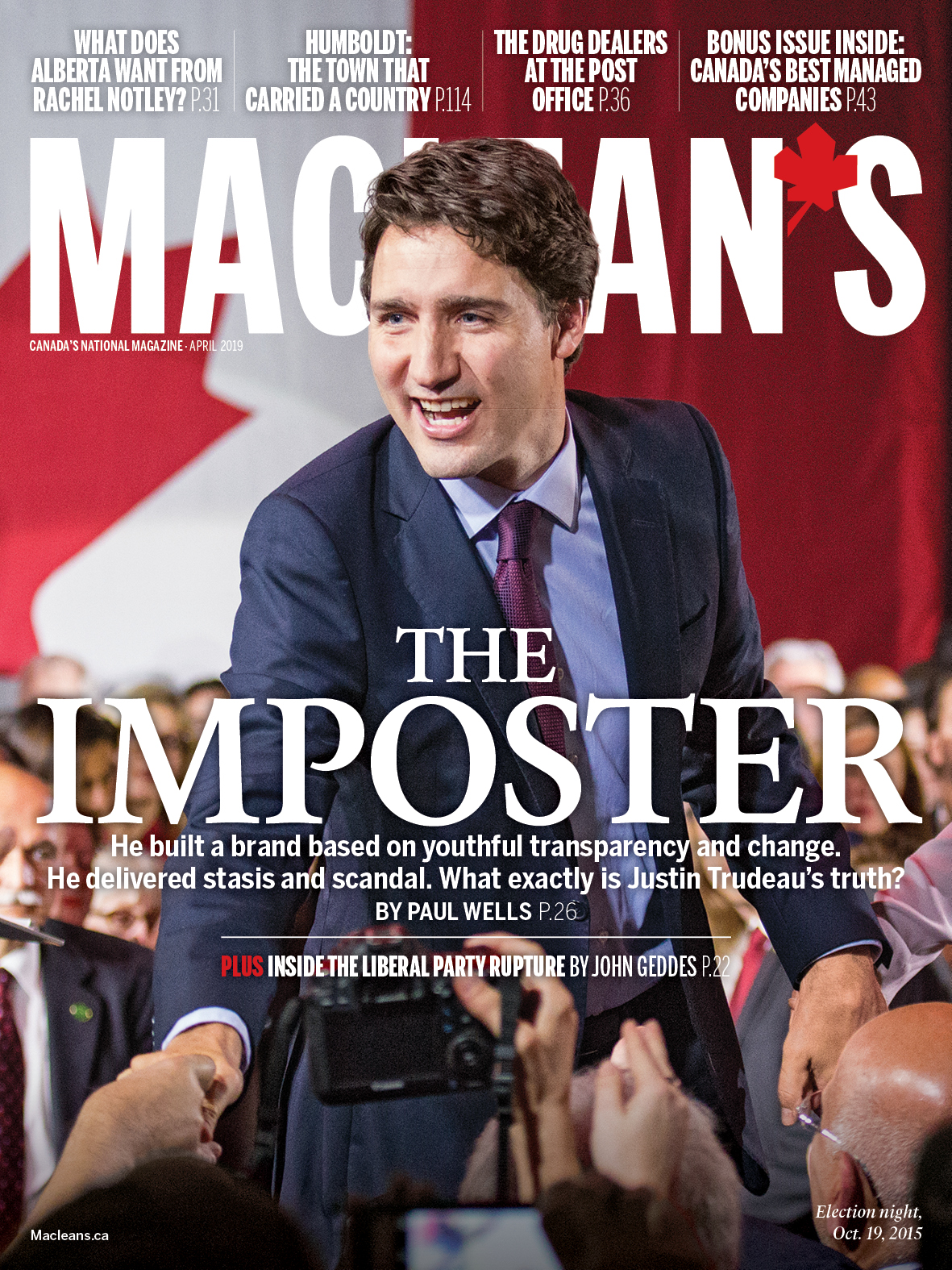
In Maclean’s, Paul Wells calls Justin Trudeau an imposter:

… the problem for Trudeau — who came to power promising a new era of transparency — is that this phoniness is a trait he shows all too often.

In 2016, when the Globe and Mail reported that the Prime Minister had attended a Vancouver fundraiser attended by Chinese billionaires — one of whom promptly donated money to the private Montreal foundation named for Trudeau’s father — the Liberal Party of Canada said no government business is discussed at such events. Trudeau later admitted they asked about policy and he talked about jobs.

Legalizing cannabis is one of the signature achievements of this government. But Trudeau has never been able to say he did it so affluent consumers could more readily get high. Instead, he had everyone in his government swear the goal was to drain the black market and keep the stuff out of the hands of teenagers. Neither goal has come anywhere close to being reached. Judged by the standards of a bake-off for the children of privilege, legalization has been a great success. Judged by the standards the Prime Minister claims, it’s a mess. The operating assumption seems to be that we’re simply supposed to read between the lines — that we’ll understand that when Trudeau speaks he is not to be taken seriously.

[…]

I could keep picking examples of Trudeau acting one way and talking another (climate change, Indigenous reconciliation) until the cows come home. But at some point you’d say, with reason, that this is not exactly innovative behaviour for an elected politician. But what’s so damaging about the SNC-Lavalin affair is that, in private, there’s no evidence Trudeau governs as the future-looking sophisticate he plays on TV.

[…]

There’s a stack of assumptions behind that strategy as long as your arm: that SNC does work so good it could never be replaced, that a trial would wreck it, that a mere judge couldn’t possibly weigh the company’s social contribution in determining its legal liability. And the biggest assumption of them all is that all of this is so obvious, none of it needed explaining in two years of feverish PMO activity. Not to the attorney general — she got earfuls of explanation, delivered in shifts working overtime, for months after she made what Trudeau felt was the wrong decision. And not to you and me. Trudeau never thought you and I deserved to know why he was trying to keep SNC out of a trial court. This makes a mockery of a simple idea: the consent of the governed.

It turns out that behind the curtain, the wizard from the woke future of politics was indulging the oldest of old-fashioned industrial policy. Navdeep Bains, the so-called innovation minister, might as well legally change his name to C.D. Howe for all the innovation going on here.

As for Wilson-Raybould’s diversity of background and perspective, it turned out to be inconvenient. She didn’t buy into a cozy meeting of minds along the Toronto-to-Montreal corridor. And the meeting of minds was what really mattered. Because it’s 2019.

The day got worse for Trudeau, as another cabinet minister resigned rather than stick around for the deck chairs to start floating away:

February 5, 2019

The looming threat of agents plotting to influence the next federal election

Filed under: Cancon, Politics — Tags: , , , — Nicholas @ 05:00

Andrew Coyne has the details:

I have an urgent warning for the people of Canada. Even now, certain agents are plotting to influence the result of the next election campaign by means of stealth and deception.

Posing as ordinary Canadians, they plan to use social media to spread falsehoods designed to inflame public opinion, using the latest micro-targeting technologies to tailor their messages to the reader’s particular fears and prejudices.

These agents are better known as the political parties.

One of the problems with the Liberal government’s recently announced plan to “defend Canadian democracy” from foreign interference, notably in the form of “fake news,” is the basic premise: that the principal threat to the integrity of the Canadian electoral process is posed by outsiders, third parties and foreign agents, rather than the participants.

If there is something ominous about the government involving itself, however indirectly, in deciding what is and is not fake news, there is something quite ludicrous about a political party raising the alarm over the spreading of falsehoods during an election campaign. Indeed, a good short definition of an election campaign would be “a sustained, intense, all-party burst of falsehood, slander and misrepresentation.”

There isn’t a lot else. A modern campaign consists mostly in what is gently termed “defining” opposing party leaders, in a way calculated to make them unrecognizable to their own mothers. The rest is devoted to deliberately misrepresenting the other parties’ positions, while making false or exaggerated claims about their own.

There remains a gentlemanly expectation that these falsehoods should not be obviously detectable as such — that is, that the lie should itself be artfully concealed, disguised as an elision, half-truth or what a Liberal MP recently called “rhetorical advantage,” rather than rubbed in the public’s faces in the manner pioneered by Donald Trump.

January 30, 2019

The high cost Canadians pay to support our oligopolies

In the National Post, Andrew Coyne compares the Liberal and Conservative parties’ respective claims to lower the cost of living for Canadians, and points out some examples that neither party is willing to address:

For example, there is the notorious system of agricultural quotas known as supply management — a price-fixing ring the government not only approves but organizes and enforces, whose effect is to double or even triple the prices of such basic food items as milk, cheese, eggs and chicken. For all their pretended concern for affordability, all parties and every MP, with the sole exception of Maxime Bernier, are publicly, nay fervently in favour of it.

But while the farm cartel gets a lot of ink, there are plenty of other examples. Canadians pay among the highest wireless telephone fees in the world, for starters — maybe even the highest — as study after study has found. The latest report from Tefficient, a European consultancy, found Canada’s carriers take in more revenue per gigabyte of data than their counterparts anywhere else in the world — 23 times more than in Finland.

Similarly, Canadians pay among the highest air fares in the world. The travel website Kiwi. com recently found flights from Canada on a full-service airline cost roughly five times as much per 100 kilometres as flights from the United States. The situation was a little better for domestic flights, where costs were only twice as high as in the U.S. The makers of Hopper, the travel app, note it is typically cheaper to fly from Vancouver to Hawaii than from Vancouver to Regina, though Regina is 3,000 km closer.

Finally, there are Canadian bank fees, also — you guessed it — among the highest in the world, particularly for mutual funds. What is the common thread among these three industries? All are highly concentrated oligopolies: three big wireless carriers, two big airlines and five big banks dominate their respective markets.

Rather than compete as vigorously as they might for Canadian consumers, these quasi-cartels are permitted, in effect, to harvest them. They do so, again, not only with the tolerance but the active participation of the government. Foreigners are effectively precluded from competing in any of them, whether by foreign-ownership restrictions or outright prohibitions on competition — foreign airlines may not fly from one Canadian city to another, for example.

None of the parties currently boasting of their desire to make life more affordable for Canadians proposes to change a line of this, either. Whatever else may be in (artificially) scarce supply, in Canadian politics there’s never any shortage of rank hypocrisy.

January 20, 2019

Identifying the real victim in the Burnaby South byelection mini-scandal

Filed under: Cancon, Media, Politics — Tags: , , , — Nicholas @ 03:00

Andrew Coyne suggests that we should sympathize with the true victim:

You have to feel for the Liberal Party of Canada, who are surely the real victims in the Karen Wang affair.

The party had innocently selected the B.C. daycare operator to run in next month’s byelection in Burnaby South based solely on her obvious merits as a failed former candidate for the provincial Liberals in 2017, and without the slightest regard to her Chinese ethnicity, in a riding in which, according to the 2016 census, nearly 40 per cent of residents identify as ethnically Chinese.

Imagine their shock when they discovered that she was engaging in ethnic politics.

In a now-infamous post on WeChat, a Chinese-language social media site, Wang boasted of being “the only Chinese candidate” in the byelection, whereas her main opponent — NDP Leader Jagmeet Singh — is “of Indian descent.”

The party was instantly and publicly aghast. Pausing only to dictate an apology to be put out under her name (“I believe in the progress that Justin Trudeau and the Liberal team are making for British Columbians and all Canadians, and I do not wish for any of my comments to be a distraction,” etc etc), party officials issued a statement in which they “accepted her resignation.” Her online comments, the statement noted, “are not aligned with the values of the Liberal Party of Canada.”

Certainly not! How she got the idea that the Liberal Party of Canada was in any way a home for ethnic power-brokers prized for their ability to recruit members and raise funds from certain ethnic groups, or that it would even think of campaigning in ridings with heavy concentrations of voters from a given ethnic group by crude appeals to their ethnic identity — for example by nominating a candidate of the same ethnicity — must remain forever a mystery.

January 17, 2019

Jagmeet Singh and the federal NDP

Filed under: Cancon, Media, Politics — Tags: , , , , , — Nicholas @ 03:00

Chris Selley on the political issues afflicting federal NDP leader Jagmeet Singh as he tries to win a byelection in British Columbia:

More and more New Democrats seem concerned that Jagmeet Singh mightn’t have been the best choice for leader, let alone deserving of a whopping 54 per cent first ballot victory. His various alleged crimes include rendering himself invisible for months, imposing draconian punishments on popular MPs, and going on TV to suggest we stop importing Saudi oil and get it from other countries instead — at a time when Alberta’s NDP government is fighting both for pipelines and for its continued existence.

[…]

Tom Mulcair was a pro. Dumping him appears to be the dumbest thing the NDP ever did. Still, if Singh wins his seat, there is reason to hope he might grow into the job. To skeptics he evinces a distinctly Trudeauvian brand of superficiality, and a similar gift for quotes that land well but fall to pieces if you actually read them back. That hasn’t hurt Trudeau, though — not much and not yet. Singh, a criminal lawyer, certainly boasts a more impressive resumé outside of politics. And goodness knows there are more than enough avenues for any NDP leader to attack a Liberal government that promised us the moon but left us conspicuously earthbound.

If Singh is an anchor on NDP fortunes, it doesn’t seem to be massively heavy one. Nanos Research has them at 15.4 per cent, as of last week — not good at all, but well within recovery distance of their 19.7 per cent performance in the 2015 election. Pre-campaign polls are generally held to be meaningless. Again assuming Singh wins his seat, he has plenty of time to introduce himself and his vision for the NDP.

It’s also possible, though, that the federal NDP in 2019 is a busted flush no matter who’s leading it. The combination of personal charisma and political circumstance that propelled it to Official Opposition status in 2011 might just be throttling back down toward cruising speed.

We shouldn’t overestimate just how improbable Jack Layton’s achievements were. He dragged the NDP to the political centre, where the votes are, marginalizing various breeds of crackpots along the way, while keeping the famously restive portside of the party relatively content. Then he stole a huge chunk of the Quebec nationalist vote in the dead of night.

When Jagmeet Singh was elected NDP leader, I really did think he’d be a significant challenge to Justin Trudeau due to the media’s apparent fascination with Singh (a love affair that appeared to be as deep and lasting as that of Justin’s teeny-bopper fan club for their darling), but it faded very quickly indeed. I guess as far as the Canadian media is concerned, there can only be one…

The byelection is looking pretty safe for Singh, as his Tory opponent beclowned himself quickly, and news broke on Wednesday that the Liberal candidate has withdrawn, after similarly beclowning herself:

January 15, 2019

Jagmeet Singh’s conservative opponent in Burnaby South

Filed under: Cancon, Politics — Tags: , , , , — Nicholas @ 03:00

Normally, the byelection campaign by a major party leader to gain a seat in the House of Commons doesn’t get quite this … snippy:

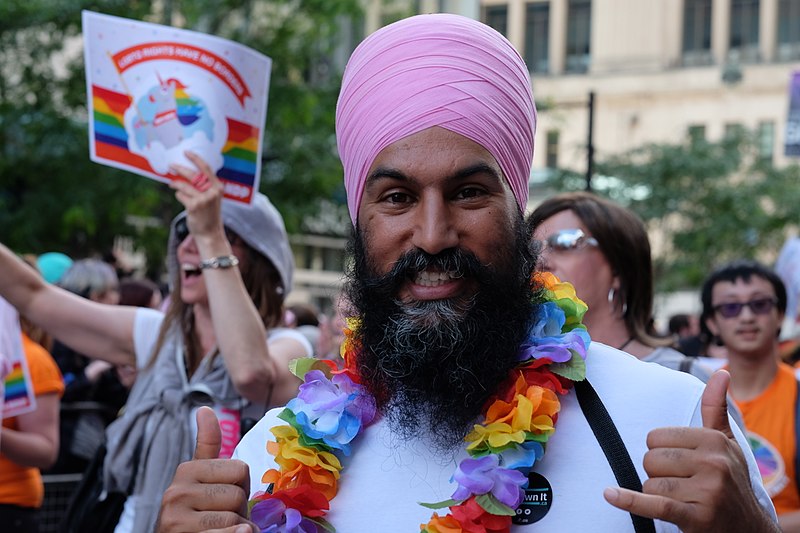
Federal NDP leader Jagmeet Singh taking part in a Pride Parade in June 2017 (during the leadership campaign).
Photo via Wikimedia.

Maybe someone should put in a kind word for Jagmeet Singh on the rare opportunities when an occasion presents itself. The federal NDP leader found himself on the right side of a ridiculous argument over the weekend as his byelection in the riding of Burnaby South got officially underway. Singh’s Conservative opponent for the open seat, commercial lawyer Jay Shin, promptly issued a press release suggesting that Singh was … apparently the wrong species of lawyer?

“While Jagmeet Singh has spent his pre-political career as a criminal defence lawyer keeping criminals out of jail, I have spent my legal career building Canadian businesses that create jobs and promote international trade,” Shin’s statement read.

When challenged by the Burnaby Now newspaper on his apparent suggestion that, as a former university instructor in International Mining Transactions, he was somehow ethically superior to the underpaid schmucks who provide criminal defence, Shin disavowed any such meaning.

Criminal lawyers “play an important role; everybody has a right to defence,” the Conservative candidate insisted. (Whew!) “What I’m saying is, he played that role. As a criminal lawyer, he defended criminals. That’s all I’m saying.”

One notices that even this characterization may leave a civil libertarian uneasy, since criminals aren’t criminals until the Crown successfully convicts them. A defence lawyer doesn’t “defend criminals”: he defends the accused. But maybe that is the sort of distinction you forget when you are busy building Canadian businesses, or trying to become a Conservative MP.

January 11, 2019

Jagmeet Singh’s plight

Filed under: Cancon, Media, Politics — Tags: , , , , — Nicholas @ 05:00

Federal NDP leader Jagmeet Singh will finally get his chance to win a seat in Parliament on February 25 in the Burnaby South byelection. Things have not been going well for Singh since he was elected leader in 2017. At that time, I thought he would be a serious threat to Justin Trudeau’s popularity with the media (Justin’s teeny-bopper fan club) and allow the NDP to be taken more seriously as a potential government. That hasn’t happened and Singh’s media coverage has been much more critical than any NDP leader might have expected. Andrew Coyne explains:

It is safe to say Singh has not proved quite the rock star New Democrats hoped when they elected him leader in October 2017. Undertaker would be closer to the mark. While the party trundles along at a little under 17 per cent in the polls, about its historic average, Singh himself is in single digits, slightly behind Elizabeth May as Canadians’ choice for prime minister.

Singh’s trajectory is a cautionary tale on the importance of experience in politics. With just six years in the Ontario legislature, Singh was barely ready for the job of provincial leader, still less the much sharper scrutiny to which federal leaders are subject. It has showed.

He appears frequently to be poorly briefed, on one memorable occasion having to ask a member of caucus, in full view of the cameras, what the party position was on a particular issue. He badly mishandled what should have been a softball question on where he stood on Sikh terrorism, and alienated many in the party with his knee-jerk expulsion of Saskatchewan MP Erin Weir for what appeared to be no worse a crime than standing too close to women at parties.

The decision not to seek a seat in the House until now has robbed him of what visibility the leader of a third party can expect, though his manifest weakness as a communicator makes it debatable whether this is a plus or a minus. Fundraising has dried up. Party morale is in freefall. Caucus members speak openly, if not on the record, of their desire to be rid of him.

For the Liberals, on the other hand, Singh is the answer to all their prayers. The prime minister’s own approval ratings may have dropped precipitously, but as long as the NDP vote can be kept to current levels of support or less the Liberals are unlikely to lose. (The NDP’s average share of the popular vote when the Conservatives win: 19.5 per cent. When the Liberals win: 14.8 per cent.) And nothing so guarantees a calamitous NDP showing as Singh’s continued leadership.

Hence the curious unspoken subtext of the Burnaby South race, with Liberals more or less openly rooting for him to win — and New Democrats hardly less publicly hoping he loses.

January 7, 2019

People tend to become more conservative as they age … let’s just lower the voting age to “fix” that “problem”

Filed under: Britain, Cancon, Politics, USA — Tags: , , , , — Nicholas @ 05:00

It is a truth universally acknowledged that as people age they tend to develop more conservative or even reactionary views. This can, in extreme cases, lead to deplorable results — as our American and British friends discovered in 2016 (fortunately, we Canadians were lucky enough to avoid such unpleasantness by having our election in 2015). Some advanced forward-thinking on how to best address this problem was reported in the Guardian on suggestions by Cambridge professor David Runciman, who advocated lowering the voting age to six, as younger voters are generally much more open to progressive ideas.

This extension of the franchise was not proposed by an inmate of an asylum for the crim­in­ally insane but by a professor, David Runciman, of the University of Cambridge, supposedly one of the best three or four such institutions in the world. But no mere criminal lunatic could have dreamt up such an idea. Is it any wonder that many people feel the world has gone mad?

Sure enough, Runciman’s idea was given serious consideration by a writer in The Guardian. Admittedly, the writer came down against the proposal, but only after giving it credence. Nevertheless, it gave an insight into the mindset of those whose political ideas are to themselves so self-evidently virtuous that the only possible explanation for the fact others do not share them is stupidity in the case of the poor and wickedness in the case of the rich.

At the head of the article were the words: “Allow six-year-olds to vote? No, but it’s not as crazy as it sounds. Children tend to be more progressive and idealistic than their parents.”

I think it’s safe to say that if the US election and the Brexit referendum had included all those woke six-year-olds, the results would have been much more amenable to our moral and intellectual superiors in the media. However, I suspect that Professor Runciman’s proposal is only half of the necessary solution. In addition to lowering the minimum voting age, we should give careful consideration to lowering the maximum voting age as well. I’m sure that a properly funded study would find that not only do older voters tend to become more conservative as they begin to fall apart physically, but it also tracks directly with mental incapacity. Our study — perhaps a pan-national group drawn from Harvard, Berkeley, Cambridge and the London School of Economics — would almost certainly conclude that a pattern of voting for more conservative options is a clear indication of enfeeblement of judgement and society would be doing a kindness to remove the franchise from those who can no longer responsibly exercise it.

Perhaps, rather than directly revoking oldsters’ voting rights, we could offer a more gentle option of designating a responsible young voter (ideally between the ages of six and eighteen) to exercise the franchise on their behalf. This way, they are still fully represented, but the vote will be directed by someone with a direct stake in the outcome, as the young will have to live for far longer with the result of any election (and the oldsters are all going to die soon, anyway).

It might also make sense to revise the voting system so that the votes of younger people carry more weight than those of older folks. Perhaps double the weight of their parents’ votes and quadruple the weight of their grandparents’? We can’t be short-changing the people who matter the most, after all … that would hardly be progressive, would it?

The use of the word progressive is telling. It implies not only that there is a clear path in hum­anity’s moral ascent to perfection but also that its route map has been vouchsafed to certain adults. For self-proclaimed progressives, there are no complexities or un­intended consequences, let alone ironies: there is only progress and its opposite, reaction.

For the writer of the article, children are born with a knowledge of the route map of the ascent to perfection, as salmon, cuckoos and swallows are born with a knowledge of where to migrate to. Only the corruption of age causes them to forget: “Children do tend towards the progressive, having a natural sense of justice … and an underdeveloped sense of self-interest.” But what has caused the realisation that children may be suitable for enfranchisement? Our author cannot be clearer: “Most of the arguments against giving six-year-olds a vote have been capsized by the (Brexit) referendum.”

In other words, because the electorate got the answer wrong, it is necessary to change the electorate. If only it had answered the question correctly, it is a fair guess no one would have thought of lowering the voting age to six.

Why, then, does our author fin­ally reject the vote for six year-olds? “If parents could be trusted to use their influence wisely and inculcate children with the politics it will take to assure a better future, then I wouldn’t necessarily have a problem with that, apart from, obviously, that culture is already wildly skewed towards parents … But that’s moot anyway, because parents can’t be trusted, otherwise we’d all already vote Green.”

November 16, 2018

The political wrangles ahead over the federal carbon tax

Andrew Coyne — for once not beating the drum for electoral reform — discusses the challenge facing the federal government in the wake of provincial resistance to their carbon tax plans:

But the real test, of course, is yet to come. The provinces cannot stop the tax on their own. The court challenges are likely to fail. Provinces that refuse to implement carbon pricing will simply find the federal “backstop” tax imposed in its place. It is the election that will decide the issue, not duelling governments. Or so Conservatives hope.

Certainly there are abundant grounds to doubt the political wisdom of the Liberal plan. A tax, or anything that resembles it, would be a hard enough sell on its own. But a tax in aid of a vast international plan to save the earth from a scourge that remains imperceptible to most voters, to which Canada has contributed little and against which Canada can have little impact, while countries whose actions would be decisive remain inert? Good luck.

What seems clear is that voters’ support for carbon pricing is shallow and tentative. The Conservative strategist who chortled to the National Post that the Liberals are asking Canadians “to vote with their hearts, not their wallets” — an impossibility, he meant — was correctly cynical. Just because people want to save the planet doesn’t mean they want to pay for it.

The best way to read the public’s mood is in the positions of the political parties, who are in their various ways each trying to assure them that it won’t cost them a dime. The Liberal version of this is to promise to rebate the extra cost of the federal tax to consumers — indeed, they pledge, 70 per cent of households will make a profit on the exchange.

The Conservatives have been less forthcoming, but it would appear their plan is to hide the cost, substituting regulations, whose effects are largely invisible to consumers, for the all-too-visible tax at the pump. Here, too, I suspect they may have a better (i.e. more cynical) read on popular opinion. The public often prefer to have the costs of government hidden from them, even if they know they are paying them — even if they know they are paying more this way, as indeed they are in this case. Do what you want to us, they seem to say, just don’t rub our faces in it.

So I would be skeptical about polls showing majority support for the federal plan: 54 per cent, according to Angus Reid, while Abacus finds 75 per cent would either support or at least accept it (versus 24 per cent opposed). These were taken shortly after the announcement of the federal rebates. Yet it is far from evident the rebates will still register with people a year from now. Indeed, the Conservatives barely paused to acknowledge them as inadequate before going on to pretend they had never been mentioned.

« Newer PostsOlder Posts »

Powered by WordPress