Quotulatiousness

October 25, 2018

It’s not a “bribe” … it’s an “incentive”!

Terence Corcoran explains why the federal government’s promised “incentive” isn’t in any way, shape, or form any kind of bribe:

Step right up, ladies and gentlemen. Welcome aboard the all-new Canadian Cynical Circular Carbon Circus, the amazing Liberal climate control spectacle that will send you on a great environmental ride into the future.

Come on in! We will pay you to not consume fossil fuels — as individuals and as industries. It’s an economic revolution that takes us beyond blockchain and cryptocurrencies and cannabis into a brave new universe in which money goes round and round and everybody wins. We will pay Canadians with their own money — more than $20 billion over five years in carbon taxes that will raise the price of gasoline by 11 cents a litre by 2022, and ever higher thereafter if not sooner. Everybody pays and everybody wins, except for those who don’t. And some people win more than they pay. It’s better than a lottery!

For the people of Ontario, Saskatchewan, Manitoba and New Brunswick, the federal carbon circus cash comes via a new “Climate Action Incentive Payment.” An Ontario family of four will receive $307 for this year, the amount to be claimed on 2018 income tax returns. A Saskatchewan family will get a Climate Action Incentive Payment of $609.

What’s the Climate Action Incentive Payment for? The Liberal plan unveiled by Prime Minister Justin Trudeau and Environment Minister Catherine McKenna Tuesday doesn’t specify. What are taxpayers in the four provinces being incented to do, exactly, with this new wad of free cash? There is only one explanation: Vote Liberal in 2019!

The payments are based on a 2019 carbon price of $20 a tonne, rising to $50 by 2022. As the carbon tax goes up, Ontario families will receive $718 in 2022 and Saskatchewan families $1,459. And there will be more to come, presumably, since the latest doomsday scenario from the UN Intergovernmental Panel on Climate Change — the font of all speculation and data manipulation on climate issues — warned that by 2030 (only 12 years from now) a carbon price of somewhere between $135 to $5,500 per tonne would be needed to keep global warming below 1.5 degrees Celsius.

October 24, 2018

Scheer’s campaign opening has about as much attraction as a cold bucket of sick

Filed under: Cancon, Politics — Tags: , , , — Nicholas @ 05:00

Some guy we’re supposed to believe is the leader of Her Majesty’s Loyal Opposition … Andrew Shear? Shea? No, that’s not it. Something like Scheer? Yeah, maybe it’s Scheer. He’s been in some kind of witness protection for the last year or so, I guess. Anyway, he’s finally emerged to announce the start of the Conservative Party’s year-long campaign to get Justin Trudeau re-elected and to protect our sacred Supply Management system.

No, wait. That’s not quite it. Oh, it’s to get Scheer elected? Okay, then. Got it.

In the National Post, Colby Cosh attempts to find reasons for Canadians to support the Tories next year:

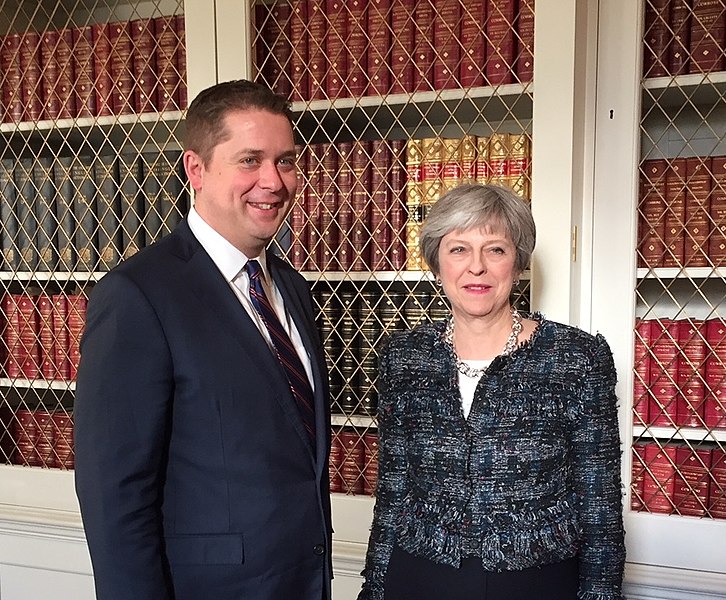
Andrew Scheer meets British Prime Minister Theresa May
Photo via Wikimedia Commons

Andrew Scheer published an “open letter to Canadians” in the Toronto Sun this Saturday. “Sunday marks exactly one year until the next federal election,” the federal Conservative leader observed, proceeding thereupon to a critique of Justin Trudeau’s government. As someone who is still trying to take stock of Scheer, I read the letter hoping for clues to his plan of attack for the 2019 election. I’m afraid it merely served to emphasize how much Scheer has remained on the defensive since winning the Tory leadership almost a year and a half ago.

That is part of the issue here: does it seem to you like a year and a half since Scheer became leader? Forgive me a very subjective observation, but I found myself hardly believing that we are much closer in time to the next election than we are to the choosing of an opposition leader who still seems like the enigmatic new guy. What are his signature issues? I am afraid the first answer that springs to mind is “dairy supply management” — which is a continuing controversy that has exposed Scheer to embarrassment, and has helped to split his party, albeit in what is likely to be an electorally insignificant way. (Maxime Bernier won’t be the next Prime Minister of Canada, but party morale is a thing in elections.)

The other major issues that have presented themselves to Scheer as opportunities haven’t proved much more helpful. When it comes to the federalization of carbon taxation, Scheer still has no good answers when he is called upon to reconcile his hypothetical support for emissions reductions with his opposition to the Trudeau plan. He doesn’t like carbon taxes, period, which will play well with climate skeptics who have three-SUV garages; I do not underestimate the impetus of that voting bloc, but the Conservatives own those voters already. Scheer also cornered himself into a lame position on the campus free-speech wars, and he is pulling sour faces about marijuana legalization, even though he is one of the few Canadian politicians who will admit to having smoked the stuff personally.

October 3, 2018

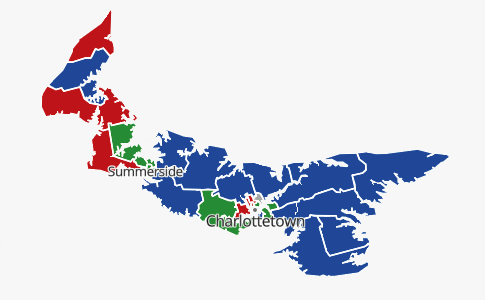
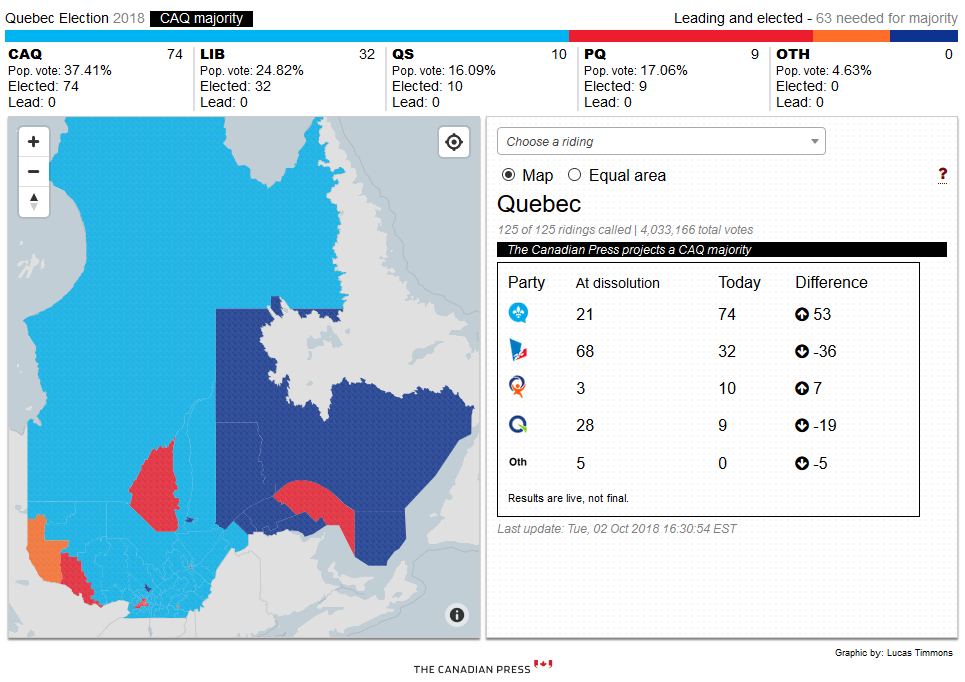
Quebec election results – Coalition Avenir Québec (CAQ) majority

Filed under: Cancon, Politics — Tags: , , , , — Nicholas @ 05:00

Global News rounds up the final poll results from Monday’s Quebec election:

After a 39-day election campaign, voters in Quebec headed to the polls Monday and elected the Coalition Avenir Québec (CAQ) to power.

The CAQ, headed by François Legault, won a majority of seats delivering a crushing blow to the Quebec Liberal Party, who had held power for 13 of the last 15 years.

The CAQ was elected in 74 of the province’s 125 ridings, compared to 32 for the Liberals.

The Parti Québécois (PQ) suffered a double blow going from 28 seats to 9 and is once again without a leader, after Jean-François Lisée announced he was stepping down after losing his riding of Rosemont.

I really haven’t been following Quebec politics at all, so I didn’t know much about the CAQ’s stance on the issues. Here, cribbed from the Wikipedia page are some of their issues gleaned from the party platform (selective emphasis mine):

  • CAQ Leader François Legault has promised to reduce the tax burden of Quebecers. A CAQ government, he says, will further harmonize school taxes across the province, a tax cut valued at $700 million.
  • A long-standing party proposal is to create a Quebec version of Silicon Valley, which they’ve dubbed “The Saint-Laurent Project”. It envisions turning the Saint-Lawrence Valley into a hub of innovation and entrepreneurship, with the collaboration of universities.
  • Hoping to eliminate tens of thousands of jobs from the province’s civil service.
  • As premier, Legault says he would temporarily reduce the number of immigrants Quebec accepts annually from 50,000 to 40,000.
  • To qualify for a Quebec selection certificate, the CAQ wants immigrants to pass a values and language test. Immigrants would also have to prove they have been looking for employment. Some experts have questioned the legality of the plan.
  • The party favours decentralizing health-care administration, while maintaining a universal free public health care system, Legault was quoted saying “The important thing is the universality of care. … I do not want more private. Our public [health care] is a jewel of Quebec.”
  • Like the PQ, the CAQ also vowed to renegotiate with the Quebec’s medical specialists in order to cut their compensation by an average of $80,000 per year. Legault believes the specialists will be open to striking a new deal.
  • Would overhaul the province’s longterm care system (CHSLDs) with a new network of smaller, more “humane” homes at an initial cost of $1 billion.
  • Wants to abolish school boards and replace them with service centres that would provide administrative support to schools. The party believes this would give schools greater autonomy and make the education system cheaper to run.
  • Wants to increase the mandatory age of staying in school to 18, to reduce the drop out rate.
  • Wants added homework help, extracurricular activities (sport and culture), additional funding for career guidance and tutors assigned to more vulnerable students.
  • The CAQ is also proposing to do away with progressive daycare pricing, though over a period of four years. All Quebec parents would be charged the same daily rate, regardless of their annual income.
  • Opposes the wearing of religious symbols, including the hijab, by police officers and others who wield coercive state power. The party would also ban school teachers from wearing religious symbols.
  • Would pass a “Secularism Charter” to reduce the scope of religious accommodations available to civil servants.
  • Calls itself nationalist. It wants more power for Quebec, but within Canada. Legault, a former PQ cabinet minister, has promised a CAQ government will never hold a referendum on Quebec sovereignty.
  • Legault wants to seek additional powers for Quebec, including control over immigration, increased fiscal capacity and a say in the nomination of Supreme Court justices. Some of these measures would require re-opening the Constitution.
  • Supports international greenhouse gas reduction targets and would promote “technological innovations to ensure their achievement”.

October 1, 2018

The rebirth of Quebec separatism?

Filed under: Cancon, Politics — Tags: , , , , , — Nicholas @ 05:00

Conrad Black wants to provoke clinical depression in anyone who was around for the last round of Quebec separatism, and warns that we’ve been ignoring the issue while it’s been reviving in La Belle Province:

Canada is very late and very laconically beginning to consider the implications of the Quebec election on Oct. 1. If, on Monday night, as polls indicate, 40 per cent of Quebecers have voted for overtly separatist parties (Québec solidaire and the Parti Québécois) and 30 per cent for a party that declines to say separation is undesirable, only that it will not hold a referendum (Coalition Avenir Québec, or CAQ), no one should imagine that this is not a threat to this country. I have written here before that Canada would regret the refusal of Stephen Harper and Justin Trudeau to discuss methods of reintegrating Quebec into the Constitution, which would not have solved the problem permanently, but would have greatly strengthened federalism.

The issue of separatism appeared to die, but that is the nature of Quebec nationalism: it never dies, it just becomes comatose for a time. And though almost no one yet describes this Quebec election in these terms, the governing Liberals of Premier Philippe Couillard seem to be about even at 30 per cent with François Legault’s moderate left, constitutionally ambiguous CAQ. Legault was long an explicit separatist, and has not renounced that view (and his wife, Isabelle Brais, thinks English Canada has no culture and should have no status in Quebec). The Quebec Liberal party, like the British Columbia Liberal party, is really a Liberal-Conservative coalition. It governed very efficiently these past four years, but became an ecologically obsessed and eccentric regime. While it retains the support of most of the non-French, it is now pulling only a very unfeasible 17 per cent of the French Quebec vote.

Though the CAQ has been slipping, it has been losing ground to Québec solidaire, a rabidly separatist party that proposes immediate, unconditional secession. It is led by a declared Marxist who opposes the right of the State of Israel to exist, and, astonishingly, it may hold the balance of power in the National Assembly. It threatens to pass the original separatist PQ of former premiers René Lévesque, Jacques Parizeau and Lucien Bouchard, which hasn’t changed its tune but is whistling it more softly. The independence of Quebec has not been much raised in the campaign, but the implications of the emerging voting patterns assure that it will re-emerge.

And no discussion of the separatism question is complete without at least a nod in the direction of the Charlatan Accord:

The Charlottetown agreement on a substantial decentralization, put to a countrywide referendum in 1992, was defeated by 54 per cent of Canadians, though it had been approved by the federal parliament and all the provincial legislatures. Bouchard, Mulroney’s most prominent Quebec MP, deserted the government, founded the separatist Bloc Québécois, and led the 1995 referendum campaign in Quebec after Parizeau was elected premier. It was a slightly more explicit separatist question than Lévesque had posed 15 years before. Chrétien was over-confident, mishandled the campaign, and gave a slightly panic-stricken appeal to Quebec voters on referendum-eve. It was 50.6 to 49.4 per cent for the federalists, a clear separatist victory for the French Quebecers, and the turnout was 93.4 per cent.

Chrétien somewhat redeemed himself with the Clarity Act of 1999, based on the results of a Supreme Court referral, which held that any secession had to be on the basis of a substantial majority supporting a clear referendum question to secede. (I was one of those who urged that the Act also provide that any county in a seceding province that had voted not to secede and was contiguous to another province, should secede from the province and remain in Canada. My precedents, though I never got to cite them, were West Virginia and Ulster.) Lucien Bouchard lost interest in the idea of independence, and the Liberal party has governed in Quebec for 13 of the past 15 years. The present premier, Couillard, is the most unambiguously federalist Quebec premier since Jean-Jacques Bertrand in 1970, and it will not be long before he is missed by those in Ottawa who declined to discuss these issues with him. If he is out on Monday night, Couillard’s successors will blow a cold wind on Ottawa and across Canada just as the Trudeau government appears to be set to break up the relationship with the United States, and our automobile industry prepares to repatriate to the U.S. Justin might do better as the next leader of the Quebec Liberals.

September 30, 2018

Contempt for the voters (even their own voters)

Filed under: Media, Politics, USA — Tags: , , , , — Nicholas @ 05:00

Steve Kates has been watching the confirmation hearings and associated circus acts in the US senate:

Let me start by explaining the basic framework. This is all politics. No one among the Democrat senators believes a word of Ford’s testimony. Not one of them would say a word were Kavanaugh a Democrat nominee. It is all show for the morons who vote for them. The disdain the Democrats have for their own voters is gigantic. They see them in the same way as I do: as low information, dumb beyond belief fools without a shred of common sense. They can see perfectly well that all of this has no other purpose but to make it harder for a government from the other party to govern. They want to pack the court with judges who will vote to do those things that cannot be done via a democratic legislative process. They understand perfectly well that they are trivialising accusations of rape. They comprehend without a shred of doubt that they are making the United States less governable. They can see without any hesitation that Ford is a stooge that has been put forward because the saps in their electorates across America eat all this up and hunger for more. They therefore do it because they enjoy the power this provides to them. They do it because they believe it will attract more voters than it will repel. They are making it as plain as day that they think their own constituency is ignorant and repulsive. But this is their line of work and if they are to keep their jobs, this is what they must do.

The Republicans think exactly the same – that Democrat voters are fools. And they know just as well as the Democrats that there is a proportion of the voting population that will make their vote depend on this and this alone. They understand rape is a terrible event in anyone’s life and would not nominate anyone if there were any genuine evidence that any of the accusations made against Kavanaugh are true. Aside from those members of their Senate caucus who prevented a majority vote from succeeding, they would have nevertheless taken the risk of the bad press that will follow when and if they confirm Kavanaugh’s nomination. They have a razor-thin majority in the Senate that can only survive a near-unanimous vote from their side of the aisle. They are counting on there being enough common sense and sound judgment left with the voting public to be able to succeed and retain the House and Senate majorities in November. They see the Democrat tactics for what they are.

As for the notion of sexual assault, to really believe that is the issue makes you so stupid that it is painful to see what nitwits politicians have to deal with routinely.

September 21, 2018

Doug Ford is a bit like Trump in the way he gets his critics to froth and fizz on demand

Filed under: Cancon, Media, Politics — Tags: , , , , — Nicholas @ 03:00

For all the claims that Doug Ford would be “just like Trump”, they’re not all that similar, but one way the Ontario Premier does resemble the American President is the way that they both can send their opponents into rhetorical hysteria almost without effort:

Doug Ford at the 2014 Good Friday procession in East York, Canada.

Photo via Wikimedia Commons.

As much as Ford’s government has violated political norms, we shouldn’t want the remedy to do likewise — whether it’s the feds invoking Disallowance (as a majority of Toronto city councillors voted to support) or the Lieutenant-Governor refusing Bill 31 Royal Assent (as requested Tuesday by various petitioners led by former lefty Toronto mayor John Sewell), or a judge undermining provincial authority over municipalities on grounds that collapse in higher courts.

So now, perhaps, Toronto can return to reality — or as close as you can get during an election campaign.

No, there was no magic brand of fit Mayor John Tory or hypothetical mayor Jennifer Keesmaat or anyone else could have pitched that would have stopped Ford in his tracks. Torontonians’ fits are a feature for Ford, not a bug. In defending Bill 5 he has repeatedly namechecked various left-leaning allegedly do-nothing councillors. Their apoplexy sustains him. In his book about Rob Ford, councillor John Filion quoted Doug Ford on his plans for Tory after losing the 2014 mayoral election: “He’s going to take off the sheets in bed at night and find my teeth wrapped around his nuts.”

Note that Chris Selley is careful to include the “allegedly” there … no need to invite lawsuits for the National Post.

And no, there is no real hope of relief in the ongoing appeals process over Bill 5. Even if the Supreme Court were to side with Belobaba, it would only repudiate the way in which the province wielded its powers — i.e., in the middle of an election — not the powers themselves. Had the government waited four years, or even legislated a two-year council term at 47 wards to be followed by an election at 25, it would have been on plenty-thick ice. It could easily re-legislate a 25-ward Toronto after such a ruling, and without using the notwithstanding clause.

Toronto politicians are destined to be Doug Ford’s favourite punching bag at least until they stop reacting so hysterically every time he so much as looks in their direction. He may not be a Twitter troll of the same mastery as Donald Trump, but he doesn’t appear to need social media to get his critics all panty-bunched.

Similarly, while there is no telling how much Ford might meddle in Toronto’s affairs in the coming years, at every step along the way he will make the idea of meddling in Toronto affairs more toxic for future non-Conservative governments. All provincial governments have screwed over Toronto now and again; as of this summer, screwing over Toronto is Something Doug Ford Does. And no Liberal or New Democrat wants to be like Doug Ford.

When things die down a bit, the opposition parties will have to take a break from denouncing Ford and explain what they’ll do in future to strengthen Toronto’s democracy: restore control over its political boundaries, provide more taxation powers, allow road tolling, whatever. It would be Pollyannaish to suggest Ford has caused a political awakening in Toronto, but he has certainly made it more attractive for the other parties to take Toronto more seriously, and concurrently much more risky for them to be seen reneging on such promises in future.

September 18, 2018

Mad Max and the 338-candidate promise

Filed under: Cancon, Liberty, Politics — Tags: , , — Nicholas @ 05:00

Colby Cosh offers some electoral advice to Maxime Bernier and the still-hot-off-the-presses PPC/PP proto-party:

Let’s say, for the sake of argument, that you have high hopes for the new Max Bernier Party. Perhaps you believe, as my colleague Andrew Coyne does, that there is still far too much fly-blown 1970s-style intervention and protectionism in Canada’s economy. Perhaps you are in favour of a more hard-headed approach to immigration policy, or you are allergic to “diversity” as a supreme ideal. Maybe you just appreciate Bernier’s devil-may-care swashbuckling spirit.

Assuming some or all of these things are true, as some or all of them are true of me: were you especially impressed by Friday’s launch of the People’s Party of Canada? Bernier, I have to say, does not seem at all sure about the order in which he wants to go about things. Sixteen months ago he came close to winning the leadership of the Conservative Party of Canada: perhaps it was on the day he lost (May 27, 2017) that he decided the big Conservative tent was, as he has now described it, “intellectually and morally corrupt,” meriting only destruction. That hypothesis makes his secession from the Conservatives seem like a spasm of arrogance.

[…]

So, to skip past those already familiar critiques of the Liste Maxime in the hope of adding a new one: why a full slate? Promising to run 338 candidates is a good way of maximizing the harm to the CPC, if this is just a plan for samurai revenge. A leader like Bernier, who is thoughtful about ideology and does enjoy recognition from coast to coast, would be a good central building block for a libertarian-ish or classical liberal political party, if you want such a party. But his party is bound to be judged by its 10 dumbest, least careful candidates. (They all are, with the possible exception of the Liberals!) Why couldn’t Bernier start out by using the first part of his 13 months to find 20 or 30 really good ones, and run only those?

As far as anyone knows, he is starting out with zero potential candidates who have any credibility or experience to speak of. There definitely weren’t any on the dais with him Friday. Nobody thinks Bernier is aiming to create a purely regional party, but if that is his concern, he would only have to make sure that his wedge of 10 or 20 or 50 candidates was spread around suitably.

Frankly, if I were the megalomaniac in charge of this thing, I would take some care not to launch my movement shortly before a general election, but as soon as possible after. You know what’s a good way to build an insurgent party? By-elections! In a by-elections, a party leader can work closely with a single candidate and move into the riding himself for personal appearances. Other non-cash resources can be concentrated. Turnout is usually low in by-elections, and the establishment candidates are often dire. But, then, I lived as a sullen, dopey teen in Deborah Gray’s riding, and have some memory of a thing called “Reform,” and they say those early-life experiences are often powerful obstacles to understanding.

I think this is quite sensible advice, as even finding a full slate of “paper” candidates can be a difficult task for small parties — and the PPC is quite small for the time being — so concentrating on finding credible candidates to run in winnable or merely competitive races makes a heck of a lot of sense. Even a limited slate of 30 still allows the media to find one or two who can be baited into making statements that can be played for all they’re worth by hostile editorialists, but over 300? The media sharks would be spoiled for choice. With a more limited group of viable candidates, there are fewer chances of a random blowhard (or a closet racist) suddenly being elevated by CBC anchors as the visible face of the new party.

September 15, 2018

Maxime Bernier announces the name of his new federal party: the People’s Party of Canada/Parti Populaire

Filed under: Cancon, Politics — Tags: , , — Nicholas @ 03:00

The new party’s website is here.

September 10, 2018

Speculation on an early federal election

Filed under: Cancon, Politics — Tags: , , , — Nicholas @ 03:00

Ted Campbell on the recent musings in the official party organ Toronto Star on the pros and cons of the Prime Minister going to the polls this fall rather than next year:

The Star, a pretty Liberal friendly journal, says, in an article by Robin Sears, a former NDP insider (in fact he was national director of the NDP for seven years), that “Liberal hawks, like those of a generation earlier, are heatedly debating a snap election call. Not entirely surprising, since [we] have not seen a decade since the ’50s when a government has not been forced by events, or decided to seize a strategic advantage, and called an early election … [and] … The Liberal hawks’ arguments are getting stronger. Neither of their opponents is ready, and each will likely be stronger a year from now. The Federal Court and Donald Trump have both just stuck a finger in the Prime Minister’s eye. This is an opportunity to return the favour with a much harder counterpunch, a strong new political mandate.“

[…]

I agree with Robin Sears … going [to] the polls sooner, in the fall of 2017, and running against Donald Trump (and the ghost of Stephen Harper) makes good political sense because it seems, to me, highly unlikely that Justin Trudeau and his gang that cannot shoot straight are going to get any better in the next year or so. In fact the Trudeau regime’s record, to date, suggests that a year from now the country might be in ruins.

Right now the NDP appears to be in shambles; Jagmeet Singh’s leadership is being questioned at pretty high levels, and the Conservatives are still reeling from Maxime’s Bernier’s defection. Waiting until October 2018 risks giving both the Conservatives and the NDP time to reorganize and present new, attractive programmes and, perhaps even new, more attractive leaders, too.

Will he go to the polls in 2017? Who knows? Parliament is due to reconvene, after the long summer recess, in a week ~ on 17 September. Many people were expecting a new Throne Speech outlining a pre-election platform filled with promises that will, most likely, never be kept, but Robin Sears makes a good case for Prime Minister Trudeau to go to the Governor General, next week, and to tell her that the situation is such that Canada’s government needs a new mandate.

August 26, 2018

Maxime Bernier’s proposed new federal party

Filed under: Cancon, Politics — Tags: , , — Nicholas @ 03:00

Andrew Coyne on the plan to create a new conservative party at the federal level:

No one with any familiarity with the modern Conservative Party could disagree with much of what its former-almost-leader Maxime Bernier now has to say about it.

“Intellectually and morally corrupt” might be a bit over the top, but “avoids important but controversial issues”, “afraid to articulate any coherent policy”, offers “a bunch of platitudes that don’t offend anybody but don’t mean anything [or] motivate anyone” while pandering to interest groups and buying votes “just like the Liberals”? Checks out, as many Conservatives would be the first to say.

Neither is there anything objectionable in principle about Bernier’s proposal to launch a new party of the right. Obviously it would not be in the partisan interest of the Conservative Party, but whether it would be harmful to the broader cause of conservatism, as so many reflexively insist, is less clear.

As I’ve argued before, the splitting of the left-of-centre vote between two (later three, and four) parties since 1935 has not stopped the Liberals from winning 16 out of 25 elections in that time. It may even have helped. The presence of two parties saying broadly similar things has entrenched progressivism as the default mode of Canadian politics, leaving the Conservatives, to the extent they have occasionally demurred, looking like the outliers.

Rather than simply splitting a fixed percentage of the vote, that is, the two parties may have combined to expand the pool of voters from which they both fish. An upstart conservative party, more robust in its advocacy, might play the same role as the NDP on the left, pushing out the boundaries of acceptable opinion and freeing the established Conservative Party to compete more aggressively for the median voter — in part by pulling the median to the right. If nothing else it would restore some balance to the equation.

But to say that a new conservative party might be a useful addition to the political landscape is not to say that this is that party, or that now is the time, or that Bernier is its leader.

The New Democrats have never come all that close to forming a government, but over the years, they’ve gotten the other two major parties to adopt and implement almost everything they’ve ever demanded … eventually. That does show that a party doesn’t necessarily need to win the vote to win the issues. As Jay Currie suggested a few days back, a new Bernier-led small-C conservative party might not automatically lead to another term for Justin Trudeau:

Bernier does not have to play the traditional Canadian political game. The world has changed. First off, he does not have to run a candidate in every single riding in Canada. While he said he would today, he needs to rethink that position. Thirty or forty will be more than enough to ensure his new party has a national presence. But, and this is important, he can make a virtue of this necessity by making sure not to run against the many actual conservatives who currently sit, silently, in Parliament. Even better, he can endorse them.

Using a targetted riding strategy would put paid to the idea that a vote for Max is a vote for the Liberals.

With a targetted riding strategy Max can also avoid the always looming disaster of a crazy person – actual Nazi, major anti-Semite, massive homophobe – gaining a nomination in a hopeless riding and then being pinned to the party by a hostile media. Finding 30 or 40 really excellent candidates and then backing them hard pre-Writ might create the conditions for multiple wins.

Which ridings to target will be a tough choice but other than making sure to have a couple in Toronto, Vancouver and Montreal – for media exposure – they should be ridings without a currently sitting Conservative and where the demographics do not massively favour the Liberals (thus suburban and rural). And they need to be air accessible because Bernier is going to spend his campaign on an airplane.

Most importantly, Bernier needs to create a positive message. One of the problems the Conservatives have is that they are barely against most of the Trudeau Liberal positions and don’t seem to have any of their own. Bernier needs to define a Canadian message. Free Trade, economic expansion, jobs are one side of it, Canadian unity instead of division could be the other. Bernier’s objection to increased immigration and the fragmentation of multiculturalism will resonate if he can package them in a “making Canada stronger” theme.

Right from the go Bernier should avoid any suggestion that his party will form a government. Instead he should be talking about keeping the politicians in Ottawa honest and in touch with Canadians. Balance of power is the goal.

August 6, 2018

QotD: Voting

Filed under: Politics, Quotations, USA — Tags: , — Nicholas @ 01:00

Most people vote in elections for the candidate they dislike the least, and perhaps this is as it should be: positive enthusiasm for candidates and politicians in general is likely to give them an inflated idea of their own importance and thereby promote the politicization of life.

Theodore Dalrymple, “Self-Anointed v. Resentful: A view from across the Atlantic”, City Journal, 2016-11-08.

July 3, 2018

Andrés Manuel López Obrador wins Mexican presidential election

Filed under: Americas, Government, Politics — Tags: , — Nicholas @ 03:00

Tom Phillips and David Agren report from Mexico City for the Guardian:

A baseball-loving leftwing nationalist who has vowed to crack down on corruption, rein in Mexico’s war on drugs and rule for the poor has been elected president of Latin America’s second-largest economy.

Andrés Manuel López Obrador, President-Elect of Mexico, who will assume office on 1 December, 2018
Photo via Wikimedia Commons

Andrés Manuel López Obrador, a silver-haired 64-year-old who is best known as Amlo and counts Labour leader Jeremy Corbyn among his friends, was elected with at least 53% of the vote, according to a quick count by Mexico’s electoral commission.

López Obrador’s closest rival, Ricardo Anaya from the National Action party (PAN), received around 22% while José Antonio Meade, a career civil servant running for the Institutional Revolutionary party, or PRI, which ruled Mexico for most of last century, came in third with around 16%.

Addressing the media after those results were announced, López Obrador vowed to repay the trust put in him by millions of Mexicans. “I will govern with rectitude and justice. I will not fail you. I will not disappoint you. I won’t betray the people,” he said.

Mexico’s president-elect vowed to rule for people of all social classes, all sexual orientations and all points of view. “We will listen to everyone. We will care for everyone. We will respect everyone,” he said. “But we will give priority to the most humble and to the forgotten.”

[…]

Analysts also expect him to pursue a less aggressive and less militarised approach to Mexico’s 11-old ‘war on drugs’ which has claimed an estimated 200,000 lives and is widely viewed as a calamity. During the campaign, Amlo has argued “you cannot fight violence with more violence, you cannot fight fire with fire” and proposed an amnesty designed to help low-level outlaws turn away from a life of crime.

Eric Olson, a Mexico and Latin America specialist from Washington’s Woodrow Wilson Centre, said he saw Mexico stepping back from regional affairs under its new leader. “Amlo is not an internationalist … we can expect him to play less of an active role in the region on Venezuela, on Nicaragua and other trouble spots.”

Olson also expected tense moments with US president Donald Trump whose family separation policy Amlo recently denounced as arrogant, racist and inhuman. “But it’s impossible for the US to walk away from Mexico or for Mexico to walk away from the US. They are joined at the hip and need to work together even if their presidents don’t like each other and don’t get along.”

Carlos Bravo, a politics expert from Mexico City’s Centre for Economic Research and Teaching, predicted President Amlo would make fighting poverty a flagship policy, just as former Brazilian president Luiz Inácio Lula da Silva did after his historic 2002 election with projects such as Bolsa Família and Zero Hunger. Under Amlo he foresaw “massive investment in social policy” which Mexico’s new president could use to show he was attacking not just poverty and inequality but also the social roots of crime and violence.

However, Bravo said the “motley coalition” behind Amlo’s election triumph was so diverse – featuring former communists, ultra-conservatives and everything in-between – that trying to guess how he might rule was a fool’s errand. “Quite frankly, right now there is a lot of uncertainty regarding what the López Obrador government will do.”

June 29, 2018

Justin Trudeau’s emotional thinking style resonates with female voters

Filed under: Cancon, Economics, Politics — Tags: , , — Nicholas @ 05:00

Brandon Kirby on, among other things, why Justin Trudeau polls consistently higher with women than with men:

Justin Trudeau and family during India visit
Image via NDTV, originally tweeted by @vijayrupanibjp

Justin Trudeau gave one of his worst interviews during the campaign with a Maritime reporter, Steve Murphy.

Murphy continually asked him for the numbers on his spending promises, to which Trudeau had none to give. Eventually he went on the offensive against Murphy and suggested that Murphy approached politics with a calculator while Trudeau can speak to Canadians. People who think in terms of STEM find this remarkably absurd.

It’s problematic that if the numbers don’t add up in Trudeau’s budgets, he won’t be helping Canadians at all. Wages will remain stagnant while power bills go up, grocery bills go up, and our tax bills will go up.

Trudeau is on the record claiming that he will grow the economy from the heart outward, but as the calculator dictates, his plans have serious economic consequences and the rhetoric that appears caring is actually destructive.

Rational thinkers find the empty rhetoric of growing the economy from the heart outward, while simultaneously making life harder on the poor and middle class, highly offensive.

Feminists have supplied us with the premise that on average, women don’t think in terms of STEM. Economics as a science requires an appraisal that is thoroughly calloused at times, which people who don’t appreciate STEM will find highly offensive.

The end result is that if women don’t think in terms of calloused rationalism, they won’t find libertarianism at all appealing.

If it were the case that only Canadian women were permitted to vote, Trudeau would win a majority government easily. If only Canadian men were to vote, Trudeau would be swiftly defeated.

George W. Bush was the most unpopular president in the U.S. during my lifetime, and yet his approval ratings are polled higher for Americans than Trudeau’s are among Canadian men.

There’s a discrepancy between men and women but that doesn’t imply individualism is wrong.

[…]

We do need to encourage women to adopt the calloused STEM approach. $99 per case of water isn’t how most women think, but unlike the opposing view it has the virtue of actually being getting water to people; going beyond stage-one-thinking – it’s actually compassionate.

June 9, 2018

Various comments on the Ontario election

Filed under: Cancon, Politics — Tags: , , — Nicholas @ 03:00

Once the voting was underway, I briefly checked my Facebook feed and, as expected, saw a lot of declared support for the NDP (even among those who normally lean Liberal), a few of the more outspoken Conservatives fighting their corner, but others I think of as Conservative-leaning were generally being very quiet. I didn’t bother with my Twitter feed, as relatively few of the people I follow are from Ontario, and the same for my Gab feed (Twitter biases as far left as Gab tends to the far right).

When I went in to vote (I had a Libertarian candidate in my riding), I asked the poll clerk if there had been any ballot refusals and she said “there’d been a few”. The preliminary results shown on the Elections Ontario site for my riding:

The Globe and Mail sent a tweet showing the overall shape of the PC victory:

David Warren commented on the election results:

My Chief Texas Correspondent leaps naturally upon the result of yesterday’s Ontario provincial election, in which our governing Liberals were annihilated. He sees this as a conventional “shift to the Right,” in Merican party terms, and celebrates it as such.

To which I reply: that the moronic city voters went not Right but over to the NDPee, which promised more spending than even the Liberals could imagine, and various grand new welfare schemes. (They are a zoological garden of various activist nutjobs.) Our outgoing premier’s personal charmlessness factored into the result. The winning Doug Ford is a total clown, and the media will have him for breakfast and snacks, yet for one brief glorious moment the Leftoids are in disarray. Ford is no Trump, though he might be able to match your esteemed President in straightforward vulgarity. He cannot have the fondest clew what he will do with the mess he has inherited, now that he is in power. He will have to betray that half of his constituency to which he promised the opposite of what he pledged to the other half, with unstudied vagueness. His caucus will be crawling with Suburban Saracens and other multicultural eccentrics — not the old solid Tory phalanx of white, Presbo-Methodist, rural hicks. Alas, though the ride may be wild, it won’t be fun to watch.

At BlogTO, Lauren O’Neil gathers a lot of Toronto-centric Twitter comments (not surprisingly, most are not complementary toward the Premier-elect (who, I’m informed we should more accurately be calling the Premier-designate instead)).

Kathy Shaidle posted on Facebook:

Am I relieved? You bet. But: Remember how close the polls were. The NDP got a lot of votes, and while our system means that the PCs won, the “popular” vote still shows how many leftoids there are in the province. And who else noticed that Doug’s “enthusiastic” official opening lines — “What a response. This is incredible.” — was scripted, and delivered with the stilted conviction of an Ed Wood stock player? On that note, I’ve seen less wooden Chippendale highboys…

June 1, 2018

QotD: Travelling with a political campaign

Filed under: Media, Politics, Quotations, USA — Tags: , , , — Nicholas @ 01:00

One of the constant nightmares of traveling with politicians is the need to keep them in sight at all times. Every presidential campaign has its own fearful litany of horror stories about reporters – and, occasionally, even a key staff member – who thought they had plenty of time to “run across the street for a quick beer” instead of hanging around in the rear of some grim auditorium half-listening to the drone of a long-familiar speech, only to come back in 20 minutes to find the auditorium empty and no sign of the press bus, the candidate or anybody who can tell him where they went. These stories are invariably set in places like Butte, Buffalo or Icepick, Minnesota, on a night in the middle of March. The temperature is always below zero, there is usually a raging blizzard to keep cabs off the street, and just as the victim remembers that he has left his wallet in his overcoat on the press bus, his stomach erupts with a sudden attack of ptomaine poisoning. And then, while crawling around on his knees in some ice-covered alley and racked with fits of projectile vomiting, he is grabbed by vicious cops and whipped on the shins with a night stick, then locked in the drunk tank of the local jail and buggered all night by winos.

These stories abound, and there is just enough truth in them to make most campaign journalists so fearful of a sudden change in the schedule that they will not even go looking for a bathroom until the pain becomes unendurable and at least three reliable people have promised to fetch them back to the fold at the first sign of any movement that could signal an early departure. The closest I ever came to getting left behind was during the California primary in 1972, when I emerged from a bathroom in the Salinas railroad depot and realized that the caboose car of McGovern’s “victory train” was about 100 yards further down the tracks than it had been only three minutes earlier. George was still standing outside on the platform, waving to the crowd, but the train was moving – and as I started my sprint through the crowd, running over women, children, cripples and anything else that couldn’t get out of my way, I thought I saw a big grin on McGovern’s face as the train began picking up speed….… I am still amazed that I caught up with the goddamn thing without blowing every valve in my heart, or even missing the iron ladder when I made my last-second leap and being swept under the train and chopped in half by the wheels.

Ever since then I have not been inclined to take many risks while traveling in strange territory with politicians. Even the very few who might feel a bit guilty about leaving me behind would have to do it anyway, because they are all enslaved by their schedules, and when it comes to a choice between getting to the airport on time or waiting for a journalist who has wandered off to seek booze, they will shrug and race off to the airport.

Hunter S. Thompson, “Fear and Loathing on the Campaign Trail ’76: Third-rate romance, low-rent rendezvous — hanging with Ted Kennedy, Jimmy Carter, and a bottle of Wild Turkey”, Rolling Stone, 1976-06-03.

« Newer PostsOlder Posts »

Powered by WordPress