
Quotulatiousness

January 26, 2017

Autarky is not the answer

Filed under: Economics, History, Japan, USA, WW2 — Tags: , , — Nicholas @ 02:00

Warren Meyer on the idiocy of Trump’s economic nationalist notions:

Think about the corollary of Trump’s economic nationalism, particularly if everyone followed this same approach. If one skews all the rules and taxes and prohibitions so everything must be sourced domestically, then if a country does not have some particular resource or skill domestically, it is out of luck. No domestic rare earth metals? Sorry.

But governments and powerful people seldom calmly accept that something they critically need is not available. They will be tempted to go and take it. The worst, most violent empire building of the last 100-150 years has occurred when countries have pursued economic nationalism. Think of the colonialism of the late 19th century. Today we happily trade with South Africa and other countries for valuable resources, but in that time of economic nationalism, if a country wanted access to these resources, it felt it had to control the land and the people. Hitler in the 1930’s wanted to make Germany self-sufficient in agricultural goods and certain other resources, and the only way to do that was to go and grab other people’s land and resources.

The best example of all of this phenomenon is, I think, Japan in the 1930’s. Japan felt that it was resource poor and under Trump’s theory of economic nationalism, it felt it had to control oil and other resources it did not have domestically. So it plotted to go take it. When the US instituted a trade embargo in these very goods to punish Japan’s aggressiveness in China, it just accelerated Japan’s thinking in this area, convincing it for good it had to control these resources, and it was soon invading the oil-rich islands of what is now Indonesia. This example is all the more telling because Japan actually found true prosperity after the war when it traded peacefully for these resources. Unfortunately, it adopted economic nationalism, via MITI, of another form and helped manage themselves into a 20-year recession, but that is another trade-related story for another day.

January 25, 2017

Protectionism can save jobs … at the cost of even more jobs than it “saves”

Filed under: Business, Economics, USA — Tags: , , , — Nicholas @ 03:00

Mark Perry provides some context to the claim that protectionist policies can save American jobs:

According to Team Trump’s website, we’re told that “blue-collar towns and cities have watched their factories close and good-paying jobs move overseas, while Americans face a mounting trade deficit and a devastated manufacturing base. By fighting for fair but tough trade deals, we can bring jobs back to America’s shores, increase wages, and support U.S. manufacturing.”

Actually, it’s been capital investments in labor-saving technologies like robotics and increasing worker productivity that have led to the large majority of US factory job losses, not trade or outsourcing, as I documented recently here. And there’s been no devastation of America’s manufacturing base; to the contrary, real US manufacturing output has reached all-time high levels in recent quarters.

What’s Trump’s solution to the loss of US manufacturing jobs? America’s “first authentic protectionist to win the White House since the 1920s” has outlined a series of protectionist trade measures including tariffs (30-40-50%), “tougher trade deals” (likely trade deals to protect US manufacturers from foreign competition), “Buy American” policies, and border adjustment taxes, among other strategies to “save American jobs.”

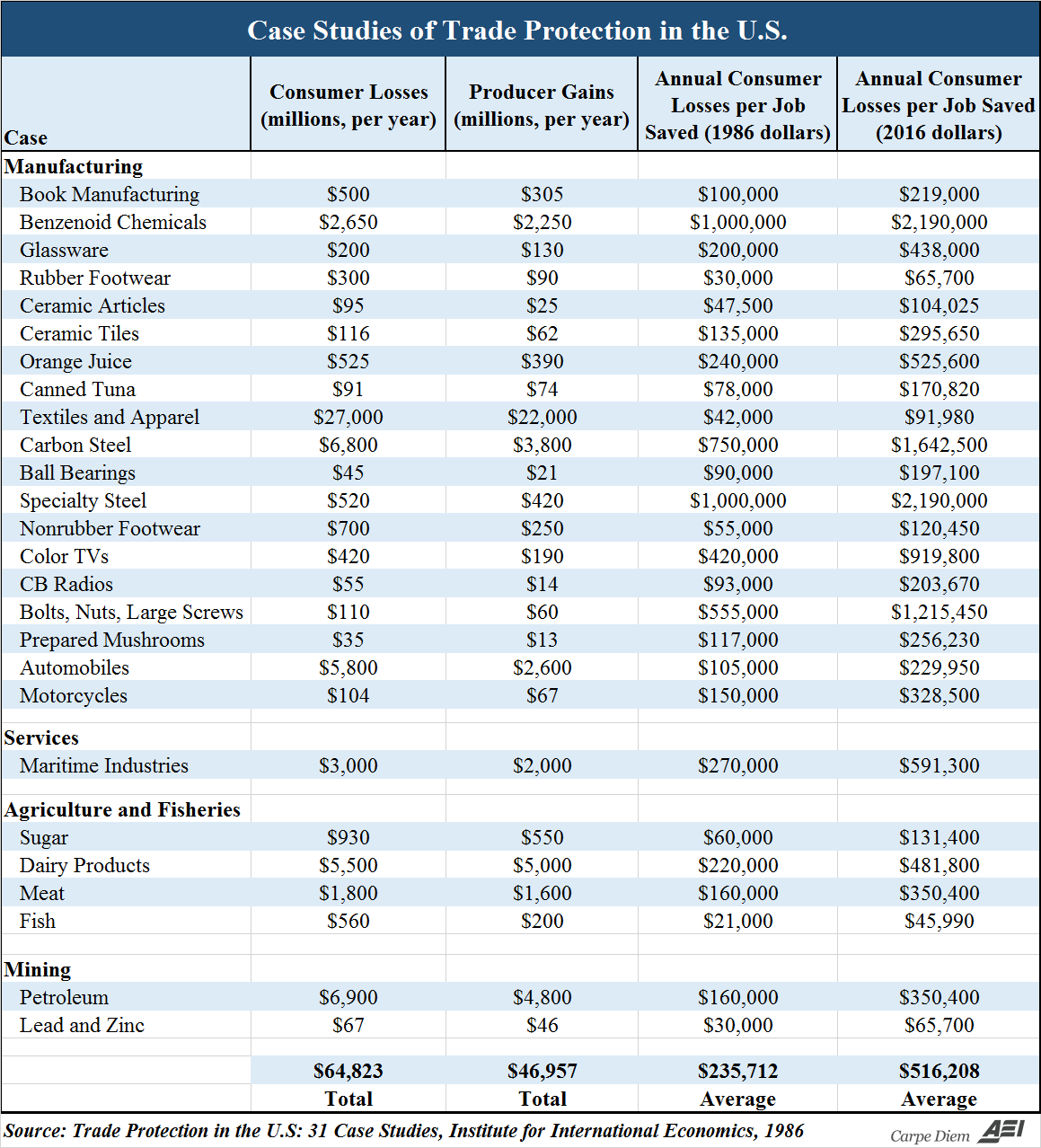
Here’s a relevant question to ask: How have protectionist trade policies in the past worked out for the US economy and how expensive is it to save American jobs with the protectionist trade policies Trump is proposing? We can find some answers to those questions in a Federal Reserve Bank of St. Louis research article published in 1988 by three economists “Protectionist Trade Policies: A Survey of Theory, Evidence and Rationale,” which presented a summary of the empirical evidence on trade protectionism from the 1986 book published by the Institute for International Economics Trade Protection in the United States: 31 Case Studies. Even though the research and empirical results are from the 1980s, this article and book provide useful empirical evidence on the costs of protectionism to bring some much-needed sanity to the debate on trade policy to counterbalance the favorable treatment being given to protectionism these days.

Click to see full-size table.

January 24, 2017

“In fact, Trump’s basically gaslighting [the press]”

Filed under: Media, Politics, USA — Tags: , , — Nicholas @ 04:00

Glenn “Instapundit” Reynolds on the relationship between Trump and the media:

First, the thing to understand is that, as I’ve said before, one of the changes going on with Trump generally is the renegotiation of various post-World War II institutional arrangements. One of those is the institutional arrangement involving the press and the White House. For decades, the press got special status because it was seen as both powerful, and institutionally responsible. (And, of course, allied with the Democrats who were mostly in charge of setting up those postwar institutional arrangements). Now those things have changed. If the press were powerful, it would have beaten Trump. If it were responsible, it wouldn’t be running away with fake news whenever it sees a chance to run something damaging to Trump. And, of course, there’s no alliance between Trump and the media, as there was with Obama.

So things will change. The press’s “insider” status — which it cherishes — is going to fade. (This is producing waves of status anxiety, as are many other Trump-induced institutional changes). And, having abandoned, quite openly, any pretense of objectivity and neutrality in the election, the press is going to be treated as an enemy by the Trump Administration until further notice.

In fact, Trump’s basically gaslighting them. Knowing how much they hate him, he’s constantly provoking them to go over the top. Sean Spicer’s crowd-size remarks are all about making them seem petty and negative. (And, possibly, teeing up crowd-size comparisons at next week’s March For Life, which the press normally ignores but which Trump will probably force them to cover).

January 21, 2017

Inauguration day

Filed under: Government, Liberty, Politics, USA — Tags: , — Nicholas @ 04:00

Warren Meyer on the downside of Inauguration Day for small government fans, regardless of which “team” won this time around:

Inauguration day is probably one of my 2 or 3 least favorite days in every decade. My feelings on the whole exercise are probably best encompassed by a conversation I had the other day at a social function.

A couple of my many liberal friends were complaining vociferously about the upcoming Trump Presidency. After a while, one observed that I seemed to be insufficiently upset about Trump. Was I a secret supporter?

I said to them something roughly as follows: You know that bad feeling you have now? That feeling of anger and fear and exasperation that some total yahoo who you absolutely disagree with has been selected to exercise power over you, power that offends you but you have to accept? Yeah, well I feel that after every Presidential election. Every. Single. One. At some point we need to stop treating these politicians as royalty and instead treat them as dangerous threats whose power needs to be circumscribed in every way we can find.

Trump and libertarian concerns

Filed under: Government, Liberty, USA — Tags: , , , , , — Nicholas @ 03:00

At Reason, Peter Suderman can only come up with nine reasons for libertarians to be worried about Il Donalduce‘s new regime:

Here are nine reasons why libertarians should be very concerned about a Trump presidency:

1) He has repeatedly promised to deport 11 million undocumented immigrants upon taking office, relying on a “special deportation force” to carry out the task. And even in the occasional moments in which he has seemed to recognize that this task would be logistically impossible, he has continued to insist that he will deport several million people right away, and that other undocumented immigrants who are in the country will not have a path to citizenship unless they leave the country first.

2) More generally, Trump’s attitude toward immigrants and outsiders ranges from disdain to outright hostility. He has called for a ban on Muslim immigration and the closure of mosques, and he opened his primary campaign by declaring that Mexican immigrants to the U.S. were rapists and criminals.

3) Trump has also promised to build a massive, expensive wall along the southern border, and has insisted that Mexico will pay for its construction, an absurd notion that is already crumbling, as the incoming administration has asked Congress, not Mexico, to pay for the wall.

4) Trump has made clear that his administration will take a much more aggressive stance on trade as well. During the campaign, he floated the idea of a 45 percent tariff on Chinese goods, which would be deeply harmful to consumers and the U.S. economy. Since winning the election, his administration has raised the possibility of a 10 percent tariff on all imports, a policy that could spark a global recession. After winning in November, he said he would pull the nation out of the Trans-Pacific Partnership trade agreement on day one of his presidency.

On the other hand, Nick Gillespie and Veronique de Rugy are a bit more upbeat about libertarian causes in Trump’s America:

Donald Trump is nobody’s idea of a libertarian but his presidency provides a tremendous opportunity to advance libertarian policies, outcomes, and aspirations in our politics and broader culture. Those of us who believe in reducing the size, scope, and spending of the federal government and expanding the autonomy, opportunities, and ability of people to live however they choose should welcome the Trump era. That’s not because of the new president’s agenda but because he enters office as the man who will inevitably close out a failing 20th-century model of governance.

Liberal, conservative, libertarian: We all understand that whatever the merits of the great political, economic, and cultural institutions of the last 70 years — the welfare state built on unsustainable entitlement spending; a military that spends more and more and succeeds less and less; the giant corporations (ATT, IBM, General Motors) that were “beyond” market forces until they weren’t; rigid social conventions that sorted people into stultifying binaries (black and white, male and female, straight and mentally ill) — these are everywhere in ruins or retreat.

The taxi cab — a paradigmatic blending of private enterprise and state power in a system that increasingly serves no one well — is replaced by ride-sharing services that are endlessly innovative, safer, and self-regulating. Libertarian Party presidential candidate Gary Johnson’s campaign slogan — Uber everything — was the one self-evident truth uttered throughout the 2016 campaign. All aspects of our lives are being remade according to a new, inherently libertarian operating system that empowers individuals and groups to pursue whatever experiments in living they want. As one of us (Nick Gillespie) wrote with Matt Welch in The Declaration of Independents, the loosening of controls in our commercial, cultural, and personal lives has consistently enriched our world. The sharing economy, 3D printing and instantaneous global communication means businesses grow, flourish, adapt, and die in ways that perfectly fulfill Schumpeterian creative destruction. We live in a world where consuming art, music, video, text, and other forms of creative expression is its own form or production and allows us to connect in lateral rather than hierarchical ways. Pernicious racial and ethnic categories persist but they have been mostly supplanted by a tolerance and a level of lived pluralism that was unimaginable even 20 years ago, when less than [50%] of Americans approved of interracial marriages. Politics, Welch and Gillespie wrote, is a lagging indicator of where America is already heading and in many cases has already arrived.

January 20, 2017

The White House press corps anomaly – “Journalists aren’t treated as housepets anywhere else”

Filed under: Media, Politics, USA — Tags: , , , , — Nicholas @ 05:00

Colby Cosh on the rumours that Trump was going to physically evict the press from the White House:

What struck me was that American journalists seemed to agree unanimously that this was a dangerous and alarming signal — as if they really could not do their jobs effectively without office space in the residence of the chief magistrate. No Canadian or other foreigner needs to have it explained how anomalous, downright freaky, this is. Journalists aren’t treated as housepets anywhere else. Even our royal family, which exists explicitly as a public spectacle, regards reporters more as a pack of wild animals to be chastised and fended off.

We are hearing a lot right now about the American press consciously transforming into a political opposition, rediscovering its appropriate, adversarial relationship with the American presidency. How wonderful, if true! But if it is, why did no American reporter say “Please, throw us out immediately: we dare you”? Imagine the opportunity to make a memorable scene: dozens of journalists turning in their White House security credentials simultaneously — maybe burning them! — then marching across the street in ranks to the Old Executive Office Building, carrying their heartbreaking little boxes full of notebooks, laptops, and desk totems. Why, it would be the most inspiring thing you ever saw.

Or maybe it would not serve to make journalists a little more popular for a moment. But, believe me, we have tried everything else. One might even ask why the White House press would wait to be kicked out. If it arranged a sort of pre-emptive general strike, of course, it would have to admit to being a tad hagiographical in the past. Specifically, over the past eight years.

There was a suggestion to defenestrate the media jackals after the election, but it came from outside Trump’s circle of advisors. While I liked the idea at the time, I think Cosh is right in his analysis:

It ought to be obvious why Priebus disavowed talk of evicting the press from the White House. A president who intends to operate by means of whispers, grumbles, threats, and hints needs to have the ears of the press close by. That is the entire historical reason it is close by. Reporters do not have to love Trump to serve his purposes. The glamour of going to work in the White House will do the work of seduction, as it has done down through the decades. I feel certain Trump would no more throw the press out of the West Wing than he will consider leaving Twitter.

Senate confirmation hearings are the American political version of Kabuki theatre

Filed under: Media, Politics, USA — Tags: , — Nicholas @ 04:00

Megan McArdle on the ongoing senate confirmation hearings for Trump nominees:

We might have hoped to get some sense of where things are headed from Wednesday’s Senate hearing on Price’s confirmation. We might also have hoped to get a bow-wrapped Lexus in the driveway this Christmas, but most of us probably didn’t.

Senate confirmation hearings are always more ritual than substance. The party of the nominee asks penetrating questions such as “Isn’t it true, Madam, that you once rescued an entire family of orphans from a burning building?”, with frequent pauses to thank the nominee for being there, and perhaps compliment them on their taste in confirmation hearing attire (confident, but understated, you understand). The opposition ranges from feigning outrage about things they have done themselves, to petulant whines about how much time they are being given to probe the vital matter of the parking ticket the nominee received in 1984 for depositing their car in a snowplow zone.

But the ritual is necessary. It allows us to maintain the polite fiction that our legislators actually care what the nominee thinks, rather than the partisan impact of confirming them. It can inform the public about issues with the nominee’s record that they should care about, even if they don’t. And occasionally, mostly by accident, actual new information does get tossed out.

January 19, 2017

Trump “is vulgar and offensive. That is my best argument for him”

Filed under: Media, Politics, USA — Tags: , , — Nicholas @ 02:00

David Warren responds to insinuations that he’s changed his opinion of Il Donalduce since the election:

Several correspondents who berated me (in fairly colourful language) for opposing Trump through the Republican primaries now congratulate me for “warming to him.” I find this odd, since most had said they wouldn’t be reading me any more. Too, I’m not aware of warming to Trump. Nor has my pleasure in the defeat of Hillary Clinton waned. (I did say from the start that Trump would win.) One of the two had to win the election, and while I was willing to concede Hillary’s particular merit — for corruption is a humanizing force, that works against leftish ideology — I could find no other. Perhaps the thought of having to look at her for another four years was another paradoxical plus. She might cure me of any remaining Internet addiction. There might also be peace and quiet, or at least quiescence from the progressive media, who only report on the scandals they invent.

Whereas, I have come to enjoy Trump’s turbulence: fat man waddling on the high wire. He may not represent anything resembling the sort of policies I could sincerely endorse, but he is hated by all the right people. Their gasps of horror suspend him aloft. And while he gives no promise of turning the clock back, in the manner I should wish it turned, his approach to the management of the Nanny State cannot be ham-fisted enough for me.

He is vulgar and offensive. That is my best argument for him. And while I am opposed to the existence of Twitter, I do enjoy his tweets. A surprisingly high proportion of them are true, which is what makes them so outrageous. He has found a way to get entirely around the “mainstream” newsmongers, thus hastening their extinction; and as a bonus he scares the bejeezus out of America’s enemies around the world. This is a happy change from Obama, who scared only America’s friends. As I once had the honour of explaining to one of George Dubya’s senior aides, I have nothing against appeasement: so long as your enemies are appeasing you.

January 15, 2017

How not to be politically persuasive, Hollywood edition

Filed under: Media, Politics, USA — Tags: , , , — Nicholas @ 02:00

Megan McArdle on the how the actual effect of Meryl Streep’s anti-Trump speech contrasts with her intent, and why:

Well, yes, celebrities are stupid about policy, often breathtakingly so. On the other hand, so is everyone else. You want to hear some really stupid ideas about policy? Grab a group of whip-smart financial wizards, or neurosurgeons, or nuclear physicists, and sit them down for a nice dinner to debate some policy outside their profession. You will find that they are pretty much just as stupid as anyone else, because policy is not about smart. I mean, smart helps. But policy is fundamentally about domain knowledge, and that knowledge is acquired only by spending a great deal of time thinking about a pretty small set of problems. Funnily enough, this is also how one gets good at finance, or neurosurgery, or nuclear physics.

The problem with Hollywood people making political speeches is not that their political ideas are worse than anyone else’s, or that they enjoy sharing their half-baked ideas. This is a minor and forgivable social sin, like arriving five minutes early for a party. No, the problem with Hollywood people making political speeches is that the speeches themselves are bad, at least at their presumed goal of producing political change.

Take Streep. She’s right that Trump should not have made fun of a disabled reporter. However, she surrounded that point with an extended discussion of how mean everyone was being to actors and journalists.

This was a double mistake. First, it accepted Trump’s frame: it’s a handful of liberal elites against the rest of the country. That’s an argument he just won, so it’s unwise to try for an immediate rematch. And second, there is in this whole world no sight less rhetorically compelling than that of successful people with fun and rewarding jobs, and a decent income, complaining that they’re victims of the unglamorous folks who labor at all the strenuously boring work required to make their lives nice. Even I, who have one of those jobs, am rolling my eyes and saying “Good heavens, suck it up.” The only people who don’t recoil from this sort of vacuous self-pity are those similarly situated in elite liberal institutions — but since those folks already hate Trump, you haven’t actually changed anything.

January 10, 2017

New Hickory?

Filed under: History, Politics, USA — Tags: — Nicholas @ 03:00

Camille Sweeney and Josh Gosfield on the parallels between the rise of Donald Trump and the rise of Andrew Jackson:

A real-estate-rich, thin-skinned, temperamental, yet charismatic celebrity who runs a tell-it-like-it-is political campaign attacking corrupt elites and promising a better life for the common man is accused of being unfit to serve, but after slogging through a mud-slinging campaign, complicated by sex scandals and an electoral college kerfuffle, he shocks the establishment and thrills his supporters by thrashing his more-experienced opponent and winning the ultimate prize — the highest office in the land.

Introducing the President of the United States … Andrew Jackson?

A handful of historians (as well as our current President-elect’s alt-right confidant Steve Bannon) have pointed out the eerie parallels between Andrew Jackson and Donald J. Trump.

If we want to know how our 45th POTUS-to-be will govern, instead of analyzing every late-night tweet and Trump Tower visitation, we invite you to climb with us into a time machine and go back nearly 200 years to explore the tumultuous and disruptive Presidency of Trump’s 19th Century doppelgänger, Andrew Jackson.

Five of Donald Trump’s biggest campaign promises were also made by Andrew Jackson. So let’s keep score. Did Jackson actually keep his promises when he got into office? How did it all work out? And what can Jackson’s presidency teach us about what a Trump presidency might be like?

January 6, 2017

The sustained denial of “gentry liberals”

Filed under: Politics, USA — Tags: , , — Nicholas @ 03:00

Glenn Reynolds on the many US liberals who refuse to come out of denial:

It’s been nearly two months since the election, and Democrats and leftists still haven’t settled down. The campus safe spaces and cry-ins immediately after the votes were counted were bad enough. But the craziness is still going on.

Why are they so upset? I think it’s because of status anxiety. Our privileged, college-educated left — what Joel Kotkin calls the gentry liberals — feels that its preeminent position in American society is under threat. And people care a lot about status.

What’s more, the people who seem to be lashing out the most are, in fact, just those gentry liberals: academics, entertainers, pundits, low-level tech types, and so on. As journalism professor Mark Grabowski reported, another academic texted him on election night: “Oh my God! We will be the ones ostracized if he wins.”

Maybe we shouldn’t “ostracize” people based on whether their candidate wins, but in a way this professor was right: A Trump victory is a blow to the status of the people who thought Hillary Clinton was their candidate — one that they feel even more deeply because gentry liberals, having been raised on the principle that the personal is political, seem to take politics pretty personally.

Another example that’s been circulating on the Internet comes from YouTube sex-talker Laci Green. When the election was still uncertain, she tweeted: “Regardless of the outcome, we are clearly a *deeply* divided and broken country. So much work ahead to mend, heal, and restore the U in USA.” Just a few hours later, when it became clear that Hillary had lost, she changed her tune: “We are now under total Republican rule. Textbook fascism. F____ you, white America. F___ you, you racist, misogynist pieces of s___. G’night.”

January 4, 2017

Gingrich explains Trump

Filed under: Politics, USA — Tags: , , , — Nicholas @ 08:50

ESR linked to this article, saying “This was kind of eye-opening. I’m not sure I believe all the fact claims, but it’s good for understanding what Donald Trump thinks he’s doing and why his opponents have consistently misunderestimated him.”

Think about this notion, that part of what Trumpism is about is applying Taleb’s model of, intellectual yet idiot. A good case study is Trump’s skepticism about consultants. Jeb Bush raised $110 million dollars, and had one delegate. Trump kept wondering why he was paying these, intellectual yet idiots, to run his campaign. It never occurred to Trump to hire people who were truly stupid to run a campaign, so Trump ran his own campaign. People said, well he doesn’t know anything. This is the guy who, The Apprentice was the number one TV show in the country, he’d been on the air 13 years, but they thought he didn’t know anything.

He had the most popular tie in the country. He ran a $10 billion dollar empire, but of course, he didn’t know anything. He made Miss Universe a success. They said, yeah, but what do you really know about the voters? Well, he knew that they were consumers. What does he know about consumers? Branding matters. What did he say from day one? Let’s Make America Great Again. If you’re on the left that’s a frightening concept, but if you are a normal, everyday, blue collar American, the kind of people who built Trump’s buildings, you thought, yeah, I like the idea of making America great again, so then they bought a hat. The hat didn’t say Trump. It said, Make America Great Again.

He went around the country, and he figured out, this is how you appeal to people. Start with the idea that using common sense, if I can get this through to the Pentagon, this will be one of the greatest revolutions in military affairs you’ve ever seen. […]

You have to get it in your head. The current system is broken. It is obsolete, so don’t try to fix it. Try to replace it. Trumpism also means they use modern technology. Trump has 25 million people on Twitter and Facebook. His great realization, which occurred around October of 2015, you can actually reach all these people for free. He decides on Tuesday, let’s do a rally in Tampa. They email, and Tweet, and Facebook, everybody in Florida that’s in their list, and says, hi, I’m going to be in Tampa on Friday at 5 o’clock, and 20,000 people show up.

The other candidates are all buying TV ads. He’s showing up at a mass rally, which is covered live on television. He then has 20,000 people with smartphones who take his picture. They all send it out on Facebook and Instagram. If you figure 40 people per person, a 20,000 person rally, is an 800,000 person system, about twice the size of MSNBC. For free. There’s no exchange rate you can create that makes sense. It’s like trying to compare Polish cavalry and the Wehrmacht in 1939. These are totally different exchange rates.

Trump also understands that you have to be on permanent offense. If you look at the Wehrmacht, the Army of Northern Virginia, and the Israeli Army, they all have the same doctrine. If you are surprised, one third of your forces go into defense, two thirds go on counterattack. You never give up the initiative. That’s Trump. Trump’s core model is, you hit me, I hit back, and I hit harder than you hit. He learned it in the New York media when he was a business man. He’s on permanent offense. He gets up in the morning figuring out, how am I going to stay on offense? He understands that the media has to chase rabbits, so he gives them rabbits to chase, because if he doesn’t give them rabbits to chase, they’ll invent a rabbit.

If you were to go back, for the last two weeks, and look at how many stories there were about Mitt Romney, and say to yourself, do you think Trump minded that the media was fascinated by whether or not Mitt Romney would be Secretary of State? He bought two weeks of non coverage because he gave them junk they could talk about, and the media has to talk about something. The simpler and more stupid it is, the easier it is for them to do it. He doesn’t try to give them lectures that are complicated, because they can’t cover it. He just releases a rabbit, often by tweet, and the media goes trotting after it happily.

December 16, 2016

ESR on the “Trump is Hitler!” meme

Filed under: Politics, USA — Tags: , , , , , , — Nicholas @ 02:00

He posted this the other day on Google+:

Reading this [link] put me in mind of a slightly different scenario. So I’m throwing this gauntlet down to anyone who has ever said the “Trump is Hitler” thing.

There are only two possibilities.

One is that you believe what you’re saying. in which case you have a moral duty to find Trump and kill him. With a scoped rifle. With a suicide vest. With hands and teeth. With anything.

The other is that you don’t actually believe Trump is Hitler, but find it advantageous to say so, posturing for demagogic political gain.

If you’re not a liar and a demagogue, why are you not strapping on weapons right now? Put the fuck up or shut the fuck up

December 9, 2016

QotD: Protest-theatre in Alberta

Filed under: Cancon, Media, Politics, Quotations — Tags: , , , — Nicholas @ 01:00

Protest-theatre is a creation of the political left, which uses it in an attempt to endow quotidian political fights with the dignity and importance of genuine popular struggles for fundamental rights. It is designed to endow debates over teacher pensions or hydraulic fracturing with the hysterical romance of revolution. In some cases, it is meant only to show that a movement is numerous enough to make trouble for own its sake.

It is, in other words, a form of cheap stakes-raising, with just a whisper of possible mob violence thrown in. The right, organized in this instance by Ezra Levant’s Rebel Media web-channel, is now borrowing the tactic. This was one of the Copernican political discoveries of the late Trump presidential campaign: a right-wing populist, if Trump is that, can use protest-theatre too.

The “lock her up” chant in Alberta’s capital was a sort of mangled, improvised collective allusion to Trump, whose crowds had chanted this about Hillary Clinton. They did that because Hillary Clinton has done a certain amount of stuff in her long political career that she probably could have been locked up for. I am not aware that this can be said of Premier Notley. She may have done unwise things, and has definitely made some inexplicable political errors, and may even have pursued unethical policies. But she has done it in legally legitimate ways, and her ministry has yet to face a major scandal in the traditional sense — an event that would have a reasonable person asking if the cops should be called.

Colby Cosh, “After the ‘lock her up’ fiasco, it seems Canada is fresh out of grown ups”, National Post, 2016-12-07.

November 30, 2016

Swept along in the wake of Trump’s election victory

Filed under: Politics, USA — Tags: , , , — Nicholas @ 03:00

Kathy Shaidle didn’t make any friends among the alt-Right with her most recent column:

Weeks later, Trump’s triumph still seems slightly unreal; I permitted myself to purchase Time magazine’s special commemorative issue — can you imagine how much it pained them to put that out? — to serve as cerebral smelling salts and snap me out of those sporadic “Holy shit, he’s the president!” flashes.

But that lapse aside, I put not my trust in princes.

Of course, not everyone shares my horror of personality cults, or the man never would have won. Twitter’s upstart counterpart Gab, for example, is overrun by Trump cheerleaders, for whom fun memes like that “Deplorables” Photoshop or “Donald Crossing the Delaware” aren’t just a split second’s amusement, but the bunting of a burgeoning civic religion.

[…]

Whatever the benefits of a Republican presidency, one of the unavoidable side effects is an emboldening of our side’s flakier elements, who weave two most unsavory obsessions — the occult and “pedophile rings” — into singularly elaborate and ultimately groundless conspiracy theories.

Sure enough, right on cue: Type “Pizzagate” into YouTube’s search engine and soak in the overblown paranoid hysteria.

These kooks and simpletons were harmlessly wrong about Harry Potter turning your kids into witches, and tragically mistaken about the “Satanic panic.” At the very least, they’re a colossal embarrassment, but they also undermine serious business undertaken by serious people.

A big difference this time around is that the president himself won’t be immune to the lure of such twisted, empty-calorie distractions. Trump used to be Birther-in-Chief, remember? And he’s on Twitter.

« Newer Posts — Older Posts »

Powered by WordPress

