Quotulatiousness

December 9, 2025

The age of Trump – “America has ‘walked away’ from its allies”

Filed under: Cancon, Government, Military, USA — Tags: , , , , , — Nicholas @ 05:00

In The Line, Matt Gurney talks about last month’s annual Halifax International Security Forum, where the biggest change from previous events was the official absence of US government representation:

Late last month, attending the Halifax International Security Forum, I was having the damndest feeling. Can you have déja vu for something that you only experienced via fiction? Because it was kind of like that.

The fiction in question was a novel by an Australian, published during the Second Iraq War. Anti-American sentiment was running rampant all over the world. The premise of the novel is out there in the realm of sci-fi — America disappears. Specifically, Americans disappear — some mysterious wave of energy scours most of North America clean of life. Virtually all of the U.S. is wiped out; most of Canada and Mexico, too. Somewhat to the surprise of the anti-Americans, this does not result in an improvement in life on Planet Earth.

Standing around at the forum, eating the delicious snacks and drinking the good coffee and chatting with friends old and new, that was what I kept thinking about. Where are the Americans? And what the hell are we going to do without them?

And, in case you’re wondering what’s up with that headline, here’s another question — what will we do if they one day try and come back?

The forum is an annual gathering of senior military officers, defence and intelligence officials from across the free world, and representatives from the media, think tanks, large companies and civil society organizations whose work relates to defence and security issues or in some way seeks to promote and preserve a healthy democratic world. Funded by NATO, the Canadian government and private-sector sponsors, the event is a major part of Canada’s “soft power” offering to our allies — we host the big party and show everybody a good time. The actual schedule is split between on-the-record panel talks or presentations, off-the-record sessions, and informal time for mingling and schmoozing. I am grateful to have been invited to participate again this year.

Especially this year. I’ve been going to the forum for years, and the event always had a strongly American flavour.

Not anymore! Yankee went home.

Like, literally. He was ordered to go home, or stay there. Secretary of Defense Pete Hegseth ordered the Pentagon to avoid a series of high-profile annual defence summits. That includes Halifax, and others in places like Munich and Singapore, and even inside the United States itself. The reason, according to the Pentagon’s press apparatus, was that, and I swear to God this is the actual quote, such events promote “the evil of globalism, disdain for our great country and hatred for the president of the United States”.

Oh. Well, then.

That’s what made the forum so fascinating this year. As I told my colleague Jen Gerson while I was in Halifax, the entire event felt a little bit like the first Thanksgiving after a divorce. It’s great to see everyone, but there’re some notable absences, is the thing.
December 3, 2025

Like him or loathe him, Trump’s response to the DC shootings was “spot on”

In The Conservative Woman, Richard North makes the case that US President Donald Trump is the only western political leader who can stop the migration crisis:

Like him or loathe him, question his inconsistencies and his many other flaws, but in my view Donald Trump’s response to the shooting of two members of the West Virginia National Guard in Washington DC by an Afghan migrant was spot on.

There was none of the pussyfooting “my thoughts are with …” etc. Without equivocation, he immediately branded the shooting “an act of evil, an act of hatred and an act of terror”, adding: “It was a crime against our entire nation”.

Shortly thereafter, Secretary of State Marco Rubio posted a tweet declaring: “President Trump’s State Department has paused visa issuance for ALL individuals travelling on Afghan passports. The United States has no higher priority than protecting our nation and our people.”

Attached was an official tweet from the Department of State making it clear that the ban was of immediate effect, with the Department “taking all necessary steps to protect US national security and public safety”.

This added to the ban in June when Trump imposed restrictions on citizens from 12 countries, including Afghanistan, but that ban did not revoke visas previously issued, and holders of Special Immigrant Visas (SIV) were exempt.

Now Trump has gone further. In a Thanksgiving message posted on X, he offered a salutation which, in Trumpian style, didn’t mince words. It started with: “A very Happy Thanksgiving salutation to all of our Great American Citizens and Patriots who have been so nice in allowing our country to be divided, disrupted, carved up, murdered, beaten, mugged, and laughed at, along with certain other foolish countries throughout the world, for being ‘politically correct’, and just plain STUPID, when it comes to immigration …”

That was only the start of a very long and quite extraordinary tweet which, if nothing else, can be criticised for a complete absence of paragraphs and sentences which rivalled in length those in a Dickens novel.

With his opening out of the way, Trump asserted that the official United States foreign population stands at 53million, most of whom, he averred, “are on welfare, from failed nations, or from prisons, mental institutions, gangs, or drug cartels”.

“They and their children,” Trump continued, “are supported through massive payments from patriotic American citizens who, because of their beautiful hearts, do not want to openly complain or cause trouble in any way, shape or form”.

Warming to his theme, he declared: “They put up with what has happened to our country, but it’s eating them alive to do so! A migrant earning $30,000 [£27,000] with a green card will get roughly $50,000 [£38,000] in yearly benefits for their family. The real migrant population is much higher.”

Pressing his point, he stated what none of Starmer’s motley crew will admit.

“This refugee burden is the leading cause of social dysfunction in America, something that did not exist after World War II (failed schools, high crime, urban decay, overcrowded hospitals, housing shortages, and large deficits, etc)”, the Donald wrote.

In a passage which might have got him arrested had he posted in the UK, with refreshing candour, the President gave the example of “hundreds of thousands of refugees from Somalia” who were “completely taking over the once great State of Minnesota”.

Somali gangs, he said, “are roving the streets looking for ‘prey’ as our wonderful people stay locked in their apartments and houses hoping against hope that they will be left alone”.

No matter which country they end up in, Somalis tend to be bad news. There are multiple reports stretching back to 2007 of a plague of criminal gangs among the 32,000 Somalis who have settled in Minnesota.

Recently the Minnesota gangs have been associated with a series of massive welfare fraud schemes, the proceeds of which may have been funnelled to the Somalia-based terror group al-Shabab.

The largest fraud scandal involving Somalis was the “Feeding Our Future” scheme. Prosecutors racked up 56 criminal convictions in what they alleged was a plot to steal $300million (£270million) from a federally funded programme meant to feed children during the covid event.

November 27, 2025

Carney – “Who cares?”

Filed under: Business, Cancon, Economics, Government, Media, Politics, USA — Tags: , , — Nicholas @ 03:00

On the social media site formerly known as Twitter, Melanie in Saskatchewan reacts to Prime Minister Mark Carney’s shrugging-off the economic concerns of ordinary Canadians with a casual “Who cares?”

Dear @MarkJCarney

“Who cares?”

That’s what you actually said when asked when you last bothered talking to Trump about the tariffs that are currently body-slamming Canadian jobs.

“Who cares? … It’s a detail.”

Really Mark? Let’s meet some of those “details”, Prime Minister.

The single mom juggling three gig jobs because the factory that used to pay her mortgage “paused investment” and then paused her entire livelihood: she’s just a detail.

The Windsor autoworker whose night shift got cancelled forever while you were busy perfecting your thoughtful squint for the cameras: tiny detail.

The steelworker in Hamilton burning through EI while the mill runs skeleton crews and you call the carnage a “temporary adjustment”: just a little detail.

The small-shop owner deciding which of her three employees to fire this month because 25% tariffs turned her cross-border contracts into suicide notes: who cares, right? Detail.

The rail worker staring at empty tracks where trains full of Canadian auto parts and steel used to roll: super minor detail.

The Saskatchewan electrician watching Nutrien build its next billion-dollar terminal in Washington State instead of BC because at least the Americans aren’t at war with their own economy: I guess that’s barely worth mentioning.

The welders and millwrights being told the next big plants are going up in Ohio and Texas, not Ontario or Alberta, because Canada’s too busy arguing about jurisdiction to actually fight for work: pfft, details.

The family parked on gurneys in an ER hallway at 3 a.m. because we never trained enough doctors and now the ones we have are bolting: honestly, who has time for that detail?

All those kids with degrees doing DoorDash because private-sector job growth is wheezing and every company is frozen waiting for the next Trump tweet or Trudeau shrug: whatever, details.

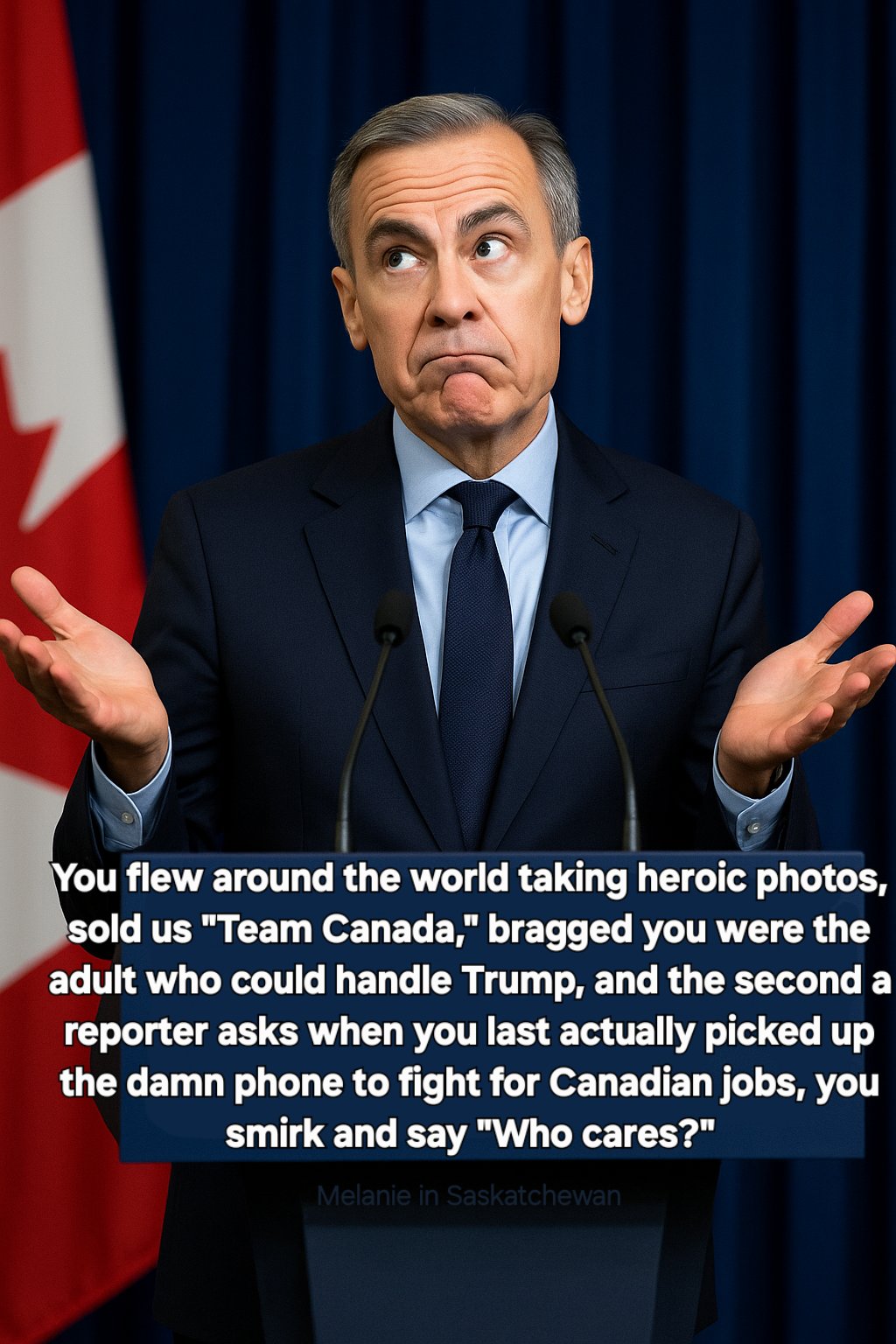
You flew around the world taking heroic photos, sold us “Team Canada”, bragged you were the adult who could handle Trump, and the second a reporter asks when you last actually picked up the damn phone to fight for Canadian jobs, you smirk and say “Who cares?”

Message received, loud and clear.

Those people I mentioned above? They care.

Every single one of them cares when the shift vanishes, the mortgage renews, the mill goes quiet, the doctor quits, the plant gets built south of the border, and their kids ask why Mom’s crying at the kitchen table again.

But you don’t care.

And the worst part? You didn’t even bother to lie about it.

You lied to every single Canadian to get elected, yet you don’t care.

Well Mark … we sure as hell do care.

And you WILL care.

When your greasy grifting ass is voted to the curb and we undo all the harm you’ve caused Canadians to fatten your coffers. You cant stand living in Canada and can’t wait to move back to the UK … remember?

We sure will.

Just watch us.

Sincerely,
One of the millions of Canadians tired of being your rounding error.

Melanie in Saskatchewan

Also published on her Substack.

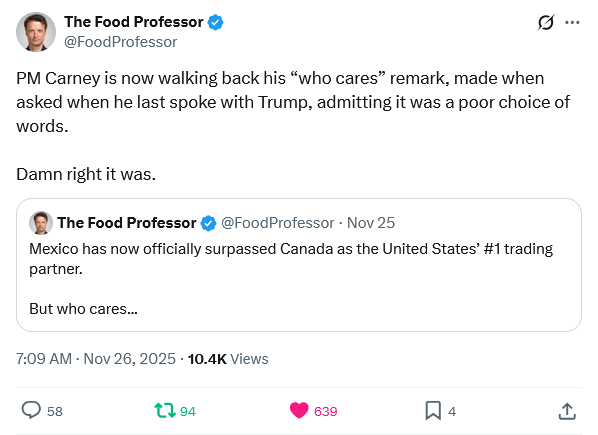
Apparently even the most detached of politicians can occasionally be persuaded to acknowledge an unforced error:

November 26, 2025

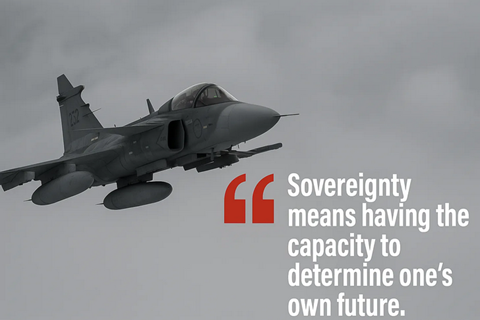
The RCAF needs either F-35s or Gripens … not both

Filed under: Cancon, Europe, Government, Military, USA, Weapons — Tags: , , , , , , — Nicholas @ 05:00

Although the Trump provocations are a unique situation for the Royal Canadian Air Force to find itself dealing with, the long-delayed decision on what the replacement for our current CF-18 fleet can’t be realistically put off for much longer. The government has committed to paying for the first 16 aircraft of an 88-plane order, but many pundits are crying out for the government to cancel the remaining portion of the order and instead purchase different aircraft … the leading contender being the Swedish Gripen. This might be the worst of all worlds for the RCAF, in needing to support two different airframes with zero parts compatibility. This two-fleet “solution” would make life much more difficult for RCAF training and logistics, but it’d be a performative eLbOwS uP to Trump, so there’s a strong chance it’ll happen despite military and economic reality. Bryan Moir makes the argument for the Gripen on his Substack:

Mark Carney loves the big phrases. “Build Canada strong.” “Rewire the economy.” “Generational investments.”

It’s good branding. But slogans don’t build nations — decisions do. And right now, one decision matters more than the rest:

Will Canada assemble the Saab Gripen fighter on Canadian soil — or will we lock ourselves into permanent military dependence through the F-35?

Let’s start with the truth no one in Ottawa wants to say out loud.

The F-35 is a 56% aircraft in a 100% environment.

The F-35 fleet’s mission-capable rate sits at 55–56%. That means a country buying 16 aircraft can expect maybe eight airborne on a good day. Eight jets to defend the Northwest Passage, the Arctic archipelago, and a coastline longer than Russia’s.

This isn’t speculation; it’s physics, logistics, and accounting.

Meanwhile, the United States fields 54 F-35s at Eielson AFB in Alaska — backed by billions in supporting infrastructure: software hubs, spares depots, rapid part cycling, and multiple layers of maintenance and training.

They can sustain the F-35 in the Arctic.

Canada cannot.

And pretending that we can — or worse, pretending that it doesn’t matter — is not national defence. It’s denial.

Gripen was designed for the world Canada actually lives in.

Gripen’s core design features are the ones Canada pretends the F-35 also has:

  • Cold-weather resilience
  • Short runway and road-base operations
  • Minimal crew requirements
  • Quick turnarounds
  • Low maintenance footprint
  • Sovereign sustainment

Gripen isn’t just compatible with Canada.

It was built for countries whose geography forces them to be independent.

November 19, 2025

US Democrats issue clarion call to the military: “You must refuse illegal orders”

Filed under: Government, Law, Military, USA — Tags: , , , , — Nicholas @ 05:00

Well, thank goodness that someone remembers Nuremberg! Apparently President Trump has been issuing illegal orders to the US Army, Navy, and Air Force, and these brave legislators are putting their careers — and even their lives — on the line to defend democracy. I’m unaware of what these specific orders may be, but as Chris Bray points out, he’s the Bad Orange Man so pretty much anything he orders must be illegal:

Note what they don’t say. They say that the American military is being “pitted against” their own countrymen, and they say to servicemembers that “you can refuse illegal orders …”

… they don’t say, even once, even in a pretty clear hint, precisely what illegal orders Trump has issued. He’s being vaguely bad, so you don’t have to obey him. The serious version would look like this: On [date here], the President of the United States ordered [unit name] to enter [place name] for the purpose of [specific action], and that order violated [explicit citation of US Code]. They mushmouth around a set of feelings-signals about Mean Orange Something, but they never quite manage to spit it out. What’s the illegal order anyone is supposed to disobey, and what makes it illegal? News reports suggest that they mean to refer to the boat strikes, but click on that link if you want to see more vagueness and weak hinting.

This is exactly what the Catholic bishops just did in their own stupid virtue performance, the precise mark of an absence of seriousness in a coven of drama queens, as they declared that they’re very concerned about questions that have arisen regarding certain situations involving immigrants. More mush from the wimps. Donald Trump is very bad, because mumble mumble mumble. Be precise and clear, or be silent.

This is an age of unseriousness, and here’s another heaping plate of it. Soldiers, you don’t have to obey the orders of your military superiors if you feel that they, that they, uh, oh hey look at the time anyway I have to go. It’s passive-aggressive bad girlfriendspeak as politics. I guess if you feel like you have to obey, that’s fine. No, it’s fine! I’m not mad! Let’s just go to dinner!

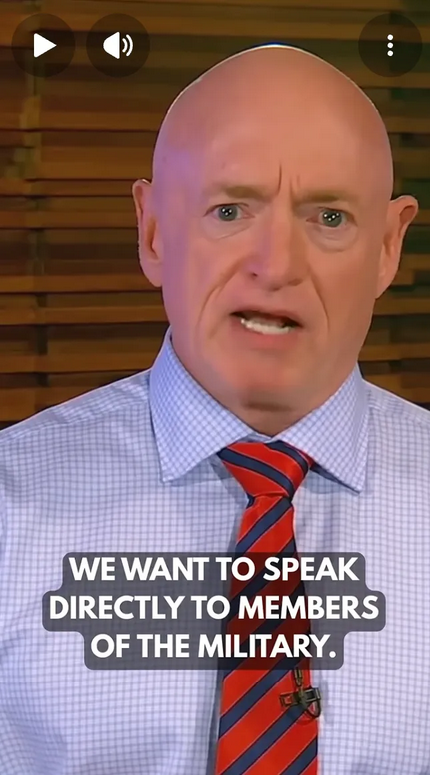
We want to speak directly to members of the military, but we don’t actually have anything to say. Just, you know, disobey the president. Small thought, not a big deal.

High school drama club president Elissa Slotkin has been banging on this drum in an especially insistent way, as she holds town hall meetings with veterans who mumble their own vague slogans about Trump bein’ against the Constitution real hard and stuff.

But all of their descriptions are stupid. Sending a few hundred National Guard troops to a city of hundreds of thousands of people with narrow orders about protecting federal facilities and personnel or patrolling to deter violence isn’t military conquest of the population or the militarization of all law enforcement. The hyperbole renders the argument insane. Related, the veterans in Slotkin’s video talk about the “systematic removal” of military leaders, and the “purge of the generals”. The US military has over 800 flag officers; the Trump administration has removed about 15. There’s a desperate stupidity to all of this panic-mongering that just renders it deeply tiring.

Actual servicemembers will be familiar with the rhetorical style of the shithouse lawyer, the idiot in the barracks who tells you that akshully they can’t order you to do that, it’s totally illegal.

You should just tell your drill sergeant that you refuse! He can’t even do nothin’ about it! He’ll just back right down!

November 17, 2025

The US Supreme Court considers whether Trump’s tariffs are legal

Filed under: Government, Law, Liberty, Media, Politics, USA — Tags: , , , , — Nicholas @ 05:00

Thanks to the staggering incompetence (and/or deliberate provocation for domestic political advantage) of the Carney government’s dealings with President Donald Trump, the current case before the Supreme Court is of significant interest to those of us on the north side of the US-Canadian border. On his Substack, David Friedman discusses the issues before the court:

There are three things wrong with Trump’s tariffs. The first is that they cannot be expected to provide the benefits claimed, can be expected to make both the US and its trading partners poorer; the arguments offered for them depend on not understanding the economics of trade. For an explanation of why that is true, see an earlier post.

The fact that the tariffs make us poorer may be the most important thing wrong with them but it is irrelevant to the Supreme Court; nothing in the Constitution requires the president to do his job well. The questions relevant to the Court are whether what Trump is doing was authorized by past Congressional legislation and whether it was constitutional for Congress to authorize it.

What Counts As An Emergency?

Tariffs are under the authority of Congress, not the president.1 Trump’s justification for setting them himself is congressional legislation, the International Emergency Economic Powers Act.

    (a) Any authority granted to the President by section 1702 of this title may be exercised to deal with any unusual and extraordinary threat, which has its source in whole or substantial part outside the United States, to the national security, foreign policy, or economy of the United States, if the President declares a national emergency with respect to such threat.

    (b) The authorities granted to the President by section 1702 of this title may only be exercised to deal with an unusual and extraordinary threat with respect to which a national emergency has been declared for purposes of this chapter and may not be exercised for any other purpose. (IEEPA, 50 U.S. Code § 1701, emphasis mine)

Trump declared that his Worldwide Reciprocal Tariffs were intended to deal with the US trade deficit.2 Whether the deficit is a threat and whether tariffs are a good way to deal with it are questions for economists3 but whether it is unusual is relevant to judges, since if it is not the IEEPA does not apply.

[…]

The Court on Trial

Delegating to the president the power to impose tariffs, a power explicitly given to Congress in the Constitution, is a major question. Under doctrine proclaimed by this court that means that the legislation claimed to delegate that power must be read narrowly. On a narrow reading, on anything but a very broad reading, the legislation fails to apply to President Trump’s tariffs for two independent reasons:

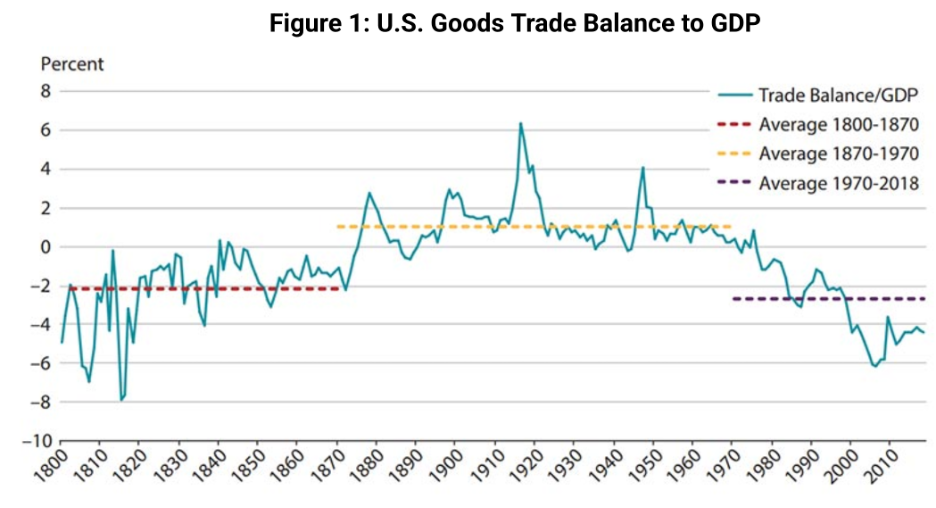
    It only grants power in an emergency, which under the language of the Act neither the trade deficit nor the illegal drug problem is; the deficit has existed since 1970, the War on Drugs was proclaimed in 1971.

    The powers granted to the president in the Act do not include the power to impose tariffs.

If the six conservative justices believe in the principles they claim, the administration will lose the case 9-0.


  1. The Congress shall have Power To lay and collect Taxes, Duties, Imposts and Excises … To regulate Commerce with foreign Nations … (U.S Constitution, Article I, Section 8).
  2. “I found that conditions reflected in large and persistent annual U.S. goods trade deficits constitute an unusual and extraordinary threat to the national security and economy of the United States that has its source in whole or substantial part outside the United States. I declared a national emergency with respect to that threat, and to deal with that threat, I imposed additional ad valorem duties that I deemed necessary and appropriate.” (Executive Order July 31, 2025).
  3. The answers are no and no.

November 1, 2025

MAGA is not a monolith, thank goodness

Filed under: Cancon, Government, Media, Politics, USA — Tags: , , , — Nicholas @ 04:00

In The Line, Alex Muir looks at Canada-US relations (such as they are currently) and why MAGA not being a monolith is something Canadian politicians need to understand to stand any chance of successfully navigating our dealings with President Trump and his administration:

If there’s one thing that we’ve seen in recent days, as Donald Trump plays an endless game of “deal or no deal” with countries around the world, it’s that the current administration is volatile.

Why? One answer to that question is factionalism — to an extent that has enshrined unpredictability as a core operating principle of the second Trump term.

Canadians are particularly exposed to this. From north of the 49th, it looks like American policy is oscillating between nationalist populism, business pragmatism, tech conservatism, and social traditionalism. That is, however, a misreading. Administration policy is remarkably consistent if you focus on the current rather than the waves. First and foremost, the president and his team obsess over visible status, a game you can play through flattery or strength and symbolic gesture — there are winning examples of both.

In concrete policy terms, the Trump administration expects us to help them on missile defence, border control, and maritime security. They expect access to our resource and energy assets, on their terms. And they want our manufacturing sector to relocate to America. They also expect Canada to know its place as a loyal American ally.

Zoom out to the bigger picture and all the daily clutter can be understood as moves to advance, or at least attempt to advance, those broad goals. And that understanding, in turn, can help inform a successful Canadian response to U.S. actions.

[…]

You cannot understand what is happening today if you do not understand what factions hold sway within this new structure. I recommend thinking of the United States as a monarchy wearing a representative democracy’s clothes. Decisions do not rest in the administrative state, or even in a political party (like Hungary), they rest in the attention of a restless and aging president and those known to have his ear, and his trust. How close to the president a decision-maker is, and who else has a voice on any given topic, goes a long way toward explaining outcomes.

The various MAGA factions colonizing D.C. share several important background beliefs on Canada. First, and arguably most important, they don’t notice it much, and care even less. Second, they assume all foreigners want to be Americans, or are somehow defective if they do not. Third, Canadians look and sound so much like Americans that the latter assumption is magnified.

Fourth, there is a wide streak of Manichaeism in several of the factions that make up the administration, and the MAGA movement more generally. This means resistance, or even evasion, is quite likely to be taken as evidence of ill intent — or even outright evil intent — as opposed to the furtherance of legitimate competing interests. All of these are wrapped up in a fairly magnificent degree of self-involvement. America is so big, so rich, and so strong, that all administrations overwhelmingly focus on domestic issues and domestic politics since nothing that happens outside their borders is generally seen as existential. (Whereas American elections and culture wars absolutely are.)

For Canada, this has meant many things, none of them positive. We’ve seen the rapid (and apparently random) escalation of tariffs (so far mostly on specific goods, or things not explicitly covered by USMCA), plus the endlessly repeated threats of higher duties in response to perceived Canadian provocations. There have been threats and intermittent moves to sideline Canada from vital security relationships, including the Five Eyes and NORAD. Canada has committed to some initiatives in order to satisfy American demands, like intensified border enforcement initiatives and committing new resources to national security priorities. It is difficult, however, to get out in front of a rapidly moving target in terms of the administration’s desired outcome.

And that’s the crux of the matter — what do the factions of the administration see when they look at Canada, and what do they want? Answering that question involves understanding what the factions are. The following summary of the factions within MAGA has been condensed from my other work, and should help Canadians understand the complexity of what we must face.

October 27, 2025

Trump versus Carney (and Ford, his court jester)

Another week, another set of bleak headlines about the trade relationship (or lack thereof) between Canada and the United States. For some, this is the story of how Trump Derangement Syndrome has consumed all levels of Canadian leadership, while for others it’s proof that you can’t deal with Trump as a rational adult and instead need to consider him an overgrown toddler with a nuclear arsenal at his disposal. Or perhaps it’s a little from column A and a bit from column B:

At the risk of overstating my own influence, it’s like the President of the United States read my piece saying he was acting like a toddler and decided, “oh yeah? I’ll show what ‘acting like a toddler’ means!” and did this, presumably once Bluey was over:

    U.S. President Donald Trump says he is raising tariffs on Canadian goods by 10 per cent, after accusing Canada of airing what he called a “fraudulent” advertisement that misrepresented former president Ronald Reagan’s stance on tariffs.

    In a post published on Truth Social at 4:30 p.m. Saturday, Trump wrote, “I am increasing the Tariff on Canada by 10% over and above what they are paying now.”

    Trump’s post cited his frustration over an advertisement produced by the Ontario government that used clips of Reagan warning about the dangers of protectionism and praising free trade.

    “Canada was caught, red handed, putting up a fraudulent advertisement on Ronald Reagan’s Speech on Tariffs,” he wrote.

    Earlier this week, Trump had cut off trade negotiations with Ottawa, explaining it was due to the “hostile” nature of the ad campaign.

    “Their Advertisement was to be taken down, IMMEDIATELY, but they let it run last night during the World Series, knowing that it was a FRAUD,” Trump further said in the Truth social post.

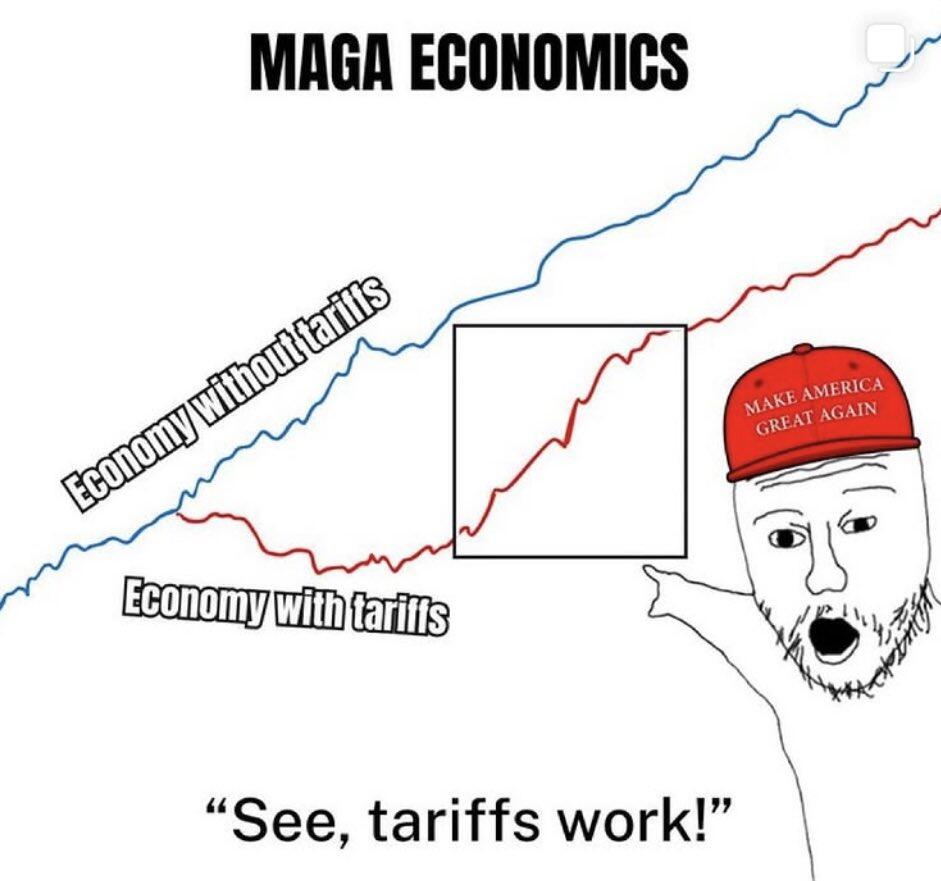
The good news is, at least Trump is coming right out and admitting that his “national security” tariffs are really about nothing more than his fragile ego, just in time for the Supreme Court to hear arguments about this very issue.

The bad news is, I think it’s exceptionally naive to think SCOTUS is going to save us from this madness.

Not because I think they’ll rule that what he’s doing is legal. That might be a bridge too far for even Justices Thomas and Alito.

But because this proposition rests on the assumption that Trump considers himself bound by Supreme Court rulings and that anyone else is going to exercise their power to ensure these rulings are followed.

Or, if you think Canadian leaders are deep in a TDS binge:

How The New Republic saw Donald Trump during the 2024 election campaign.

Trump Derangement Syndrome (TDS) is a widespread and serious issue. When one is afflicted by it, their capacity to sense-make becomes compromised. Emotions are a difficult thing for humans to control, and TDS-sufferers seem for the most part unaware of how much their negative, emotional feelings concerning Trump have hijacked their reason.

TDS types reveal themselves in so many ways. One specifically, which often goes unnoticed, is a general uncharitableness when it comes to interpreting the words and actions of Trump, or a general unwillingness to look beyond words – either Trump’s words or anyone else’s which have been inserted into Trump discourse. A prime example of this is the anti-tariff ad campaign involving a 1987 speech by former president Ronald Reagan which the Ford government paid $75 million to have broadcast to American audiences – key Republican areas – for the purpose of undermining President Trump’s economic policy.

Firstly, the uncharitable analysis does not allow that Trump has any right, or any good argument, or reason to be upset about Canada’s trade practices, such as supply management. The uncharitable analysis sees Canada as an innocent victim and Trump as a bully who is trying to destroy us and/or take us over.

[…]

Returning to reason and reality. Trump has justification for being upset with Canada over both our trade practices and in the under-handed and unfriendly tactics of Doug Ford and other Canadian leaders. The ad was an insult to Trump. His reaction or over-reaction to the ad, does not change the fact that what Ford did was antagonistic and not in the best interests of productive trade negotiations. The charitable analysis understands this, and does not lose sight of it, no matter how outlandish the things Trump does may be.

On the other side of the uncharitable Trump analysis concerning Ford’s Reagan ad blunder, is circulating the idea that Reagan was anti-tariff. Why is this idea believed? Because of Reagan’s rhetoric. You can find hundreds of clips of Reagan speaking about the dangers of high tariffs, or advocating for free trade. But the uncharitable analysis refuses to go beyond words. They ignore words that don’t support their argument, and act as if the words that do support their argument were the only ones spoken. Further, they act like words are the be all and end all, by not bothering to investigate the actions of those who speak the words, they pretend that word-speakers always do and intend exactly what they say. Reagan’s oratory contained lots of anti-tariff rhetoric, but his actions included lots of pro-tariff policy in an effort to deal with unfair trading partners.

None of this is difficult once you mea culpa from TDS. If you remain under the spell of TDS, you will not be rational or reasonable, and I for one, will not take you seriously. You will look increasingly foolish as time goes on and Trump’s policies turn out not to be the disasters you hysterical twits dreamed they would be. And the group of people like me, who shake their heads and roll their eyes at you, will grow and grow, under the weight of inevitable mass mea culpa. But you will remain shrouded from truth as you descend further into darkness and gloom and hate. It doesn’t have to be this way … just mea culpa FFS!

October 25, 2025

International FAFO – Ontario pokes Trump, Trump withdraws from trade talks

Filed under: Cancon, Government, Media, Politics, USA — Tags: , , , , — Nicholas @ 03:00

Canadian politicans seem unable to comprehend that Donald Trump is not a typical American leader — for both good and bad — and Ontario Premier Doug Ford seems to be the last one to figure it out. The Ontario government paid for ads featuring Ronald Reagan making anti-tariff comments to run in the US media and Trump reacted, strongly:

The Ontario government’s anti-U.S. tariff ad will run multiple times during the U.S. broadcast of baseball’s World Series game Friday, less than 24 hours after President Donald Trump “terminated” trade talks with Canada over the commercial.

In an email, Ontario Premier Doug Ford spokesperson Hannah Jensen confirmed information first reported by National Post that the ads will run throughout the World Series.

That means the ads, taken out by Ontario Premier Doug Ford’s government, will be playing to a primetime U.S. audience less than a day after Trump cited them as the reason he was ending trade talks with Canada.

The Toronto Blue Jays are vying for the World Series championship for the first time in over three decades.

The move suggests Ford is not ready to back down on his public campaign against U.S. tariffs on key Ontarian industries including auto manufacturing despite Trump’s ire.

Late Thursday evening, Trump took aim at Ontario’s ads which quote a 1987 speech by Ronald Reagan to fight against U.S. tariffs.

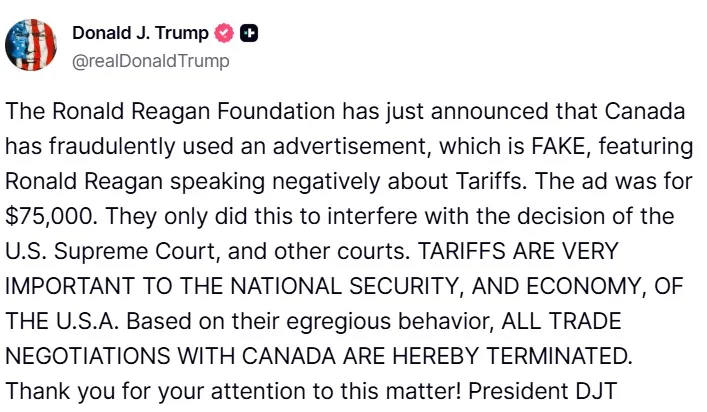
“The Ronald Reagan Foundation has just announced that Canada has fraudulently used an advertisement, which is FAKE, featuring Ronald Reagan speaking negatively about Tariffs. The ad was for $75,000,” Trump wrote on social media.

“They only did this to interfere with the decision of the U.S. Supreme Court, and other courts. TARIFFS ARE VERY IMPORTANT TO THE NATIONAL SECURITY, AND ECONOMY, OF THE U.S.A. Based on their egregious behavior, ALL TRADE NEGOTIATIONS WITH CANADA ARE HEREBY TERMINATED. Thank you for your attention to this matter! President DJT.”

On Friday, Prime Minister Mark Carney said Canada stands ready to resume trade talks with the Trump administration. But he stopped short of opining on if Ontario should cease running the ads.

If there’s a wrong way to deal with Donald Trump, you can be sure that some Canadian politician — often, but not always, Doug Ford — will find it:

Outside of the light conservatism found in the AM Talk radio circuit throughout the GTA, Ontarians didn’t really seem all that fired up when it was discovered that Premier Doug Ford spent $75 million on anti-tariff ads, the most contentious involving an audio clip of former Republican president Ronald Reagan, to be played in American cities targeting Republican audiences. They, for the most part, are also unlikely to appreciate the insult, and the damage it caused, by going directly to Trump’s base with a message that undermines the premise of his economic plan. In Canada, leaders like Ford and Carney, are permitted and even encouraged to talk tough on Trump, because it is well understood that Trump Derangement Syndrome is the leading cause of anxiety amongst Canadian leftists, and sadly, even many so-called conservatives. However, it has always been hollow, toothless, and pointless.

Carney’s elbow’s up nonsense is easily the most embarrassing thing produced by Canada in the last four decades (maybe longer). And Doug Ford is such a clueless dummy, conservative in name only, with NDP levels of TDS, and an incredibly irresponsible propensity to go off half-cocked, with such a careless abundance of volatility. No serious province can survive a leader like this. Ford is what Leftists think Trump is: a dangerous blundering idiot who can’t get anything right. But this thing with the Reagan ad is maybe the worst example in a long list of Ford blundering. Maybe Trump’s anger will blow over, maybe we will somehow come out of this episode embarrassed, yet again, but for the most part, unscathed. We will have to wait and see.

As much as I wish Canada was a force to be reckoned with, as it once was, the best I can muster is that some day in the distant future other countries might stop laughing at us. The sad reality is that generations of abysmal Laurentian elite leadership has destroyed the strength and respectability of Canada. We are a weak insignificant joke of a nation made that way by a grossly feminized ultra-weak leftist leadership class. Ford and Carney with their ineffective provocations directed at Trump in order to appease and win points with the TDS numbskull segment of the Canadian population, does little more than show the nation, and the world, the opportunism and lack of self-awareness indicative of all weak and clueless men of the social justice paradigm in the great feminized north.

To make matters worse, as if the largest and most rapidly expanding national debt in the history of Canada, the general complacency concerning government spending, or the massive affordability crises were not enough, it appears that Ford’s ad team manipulated the content of the Ronald Reagan speech they used in order to make it appear as if Reagan were anti-tariff. The ad stitches together non-consecutive segments of a five minute speech he gave in 1987. Again, the ad in question was part of a $75 million marketing campaign, paid for by Ontario tax-payers, which targeted American audiences.

The Ronald Reagan Presidential Foundation & Institute stated that “The ad misrepresents the presidential radio address, and the Government of Ontario did not seek nor receive permission to use and edit the remarks”.

Nice work, Doug. You can stop any time now …

Update: Fixed broken URL.

October 20, 2025

Carney’s trip to Egypt, without the pesky Canadian media tagging along

Filed under: Cancon, Media, Middle East, Politics, USA — Tags: , , , , , — Nicholas @ 05:00

I guess it’s slightly to Prime Minister Mark Carney’s credit that he was able to get a last-second invitation to attend President Trump’s latest international triumph … we all know how Mr. Carney loves him a nice photo op. But it was almost unprecedented that he nipped over to Egypt without taking any of the usual flappers and fart-catchers of the Canadian media along with him:

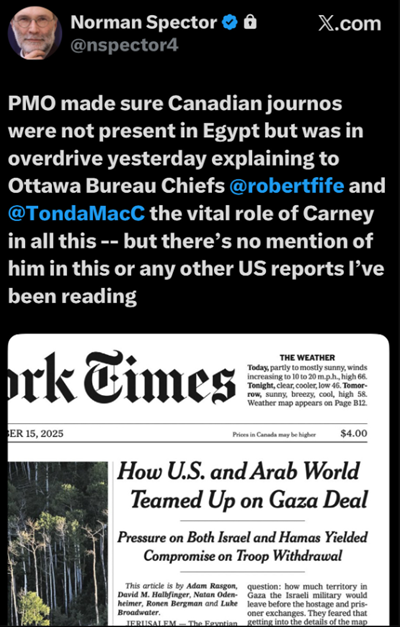
X-post by former PMO chief of staff Norman Spector, who noticed something was up concerning how the Prime Minister’s team got its message out
Image and caption from The Rewrite by Peter Menzies

Last week, the Parliamentary Press Gallery (PPG) and I had something in common.

We were both dismayed.

They, because they weren’t invited to join Prime Minister Carney on his last-minute trip to Egypt for a photo opp; Me because most of them didn’t seem all that interested in looking into the circumstances of the PM’s hasty departure and instead allowed themselves to be played in the most appallingly obvious manner.

What got the PPG’s knickers twisted was that they weren’t invited to accompany Carney when he departed Ottawa in a rush to get to the Egyptian resort of Sharm El Sheikh, a popular spot on the Red Sea for the world’s glitterati. It took PPG President Mia Rabson a couple of days to issue a statement, but she made it clear the PPG disapproved:

    The Parliamentary Press Gallery was not informed in advance of the Prime Minister’s trip to Egypt to participate in the Middle East Peace Ceremony on Oct. 12-13, […] The Gallery is disappointed and dismayed at the exclusion of Canadian media from the event and expresses in no uncertain terms that this must never happen again.

    It is unprecedented that Canadian media be entirely excluded from a Canadian prime minister’s foreign trip.

The only reporting I could find on this was in Politico, where it was recorded that the PMO had posted this notice: “6:30 p.m. The Prime Minister will depart for Sharm el-Sheikh, Egypt, to attend the signing of a Middle East peace plan. Closed to media.”

What first caused my jaw to drop and to become, like Rabin, disappointed and dismayed, were the stories left unpursued. On the morning of Oct. 12, Canada was not listed as among the countries invited to join in the “peace summit” associated with the ceasefire deal reached between Israel and Hamas. If it had been, the prime minister may not have had to charter a private jet because the usual Royal Canadian Air Force planes and crews were, as City News‘s Glen MacGregor reported, unavailable.

There are two lines of journalistic inquiry there, neither of which appears to have been of interest. The first is: how can Canada’s military be so poorly equipped that there isn’t at all times a fully-equipped aircraft and crew on standby and is this an issue that will be addressed in the future? The second is: how did we wind up getting invited to the peace summit? Comments by US President Donald Trump indicate that we weren’t initially considered important enough to be on site but phoned to ask if we could join the party. (The Line — which doesn’t accept government subsidies — noticed.)

Trump, in remarks to media said: “You have Canada. That’s so great to have, in fact. The president called and he wanted to know if it’s worth — well he knew exactly what it is. He knew the importance. Where’s Canada, by the way? Where are you? He knew the importance of this.”

What was pursued, at least in comments online by journalists, was Trump’s inability to identify Carney by his correct title. (In an exchange that followed, Carney sarcastically thanked Trump for elevating him and, in response, was told “at least I didn’t call you governor”. Ha ha.)

Everyone is free to make their own decisions, but if Canada had to call Trump to ask to be invited, Canadians need to know if that means we are in the president’s debt. Trump, after all, seems like the sort of guy who keeps score.

But it’s what followed that really got creepy. While Canadian reporters were not allowed to accompany the prime minister to Egypt, someone who says he or she was on the plane started phoning around to tell reporters what happened. And they went for it. The Globe and Mail, Toronto Star and Politico all reported unverified statements emanating from a single, unnamed source. The Globe‘s Robert Fife reported that “a senior government official” said that while Carney and others thought they were just in Egypt for a photo opp, during a four hour wait for Trump to arrive from Israel “Mr. Carney had back-and-forth conversations with a group of leaders”.

So, after a bit of ritual humiliation — par for the course with Trump and Carney — the PM got to have unstructured/unfocused chit-chat with other diplomatic rag-tag and bob-tail clinging to the President’s cape. Not a good look, but Canadians must be getting inured to their national leaders being treated as, at best, an afterthought.

October 19, 2025

Printed Maplewash from Random Penguin “Canada”

Filed under: Books, Business, Cancon, Media, Politics, USA — Tags: , , , , — Nicholas @ 06:00

In the latest SHuSH newsletter, Ken Whyte discusses one of the most cynical and blatant attempts to “Maplewash” US product as 100% home-grown Canadian: a book of essays by living and dead Canadian authors, titled with the Liberals’ moronic “Elbows Up” slogan … with all the profits going to Random Penguin’s US corporate headquarters:

Ever since the Trump tariffs against Canada were launched last spring, US firms operating in Canada have been engaged in a variety of maple-washing tactics to shield themselves from consumer backlash. Some are as simple as new labelling — “prepared in Canada!” More audacious was McDonald’s effort to make everyone forget it’s the White House’s caterer of choice: a partnership with Canada’s sweetheart, Shania Twain.

You might think the McDonald’s gambit would be hard to top, but Penguin Random House has done it.

Penguin Random House Canada is a division of Penguin Random House LLC, corporate headquarters at 1745 Broadway, 3rd Floor, New York, New York, 10019. Penguin Random House LLC is in turn controlled by Bertelsmann, a media conglomerate in Gütersloh, Germany, but legally and operationally, it is a US company. Its executive leadership, including CEO Nihar Malaviya, works out of the above address. Strategy and publishing priorities are set in New York, and profits in PRH’s many far-flung international divisions flow to New York. You can see why this firm, with its dominant position in the Canadian market, might feel vulnerable and want to camouflage its Americanness when everyone starts shouting “buy Canadian!”

[…]

There are at least four levels of cynicism to Elbows Up!

The first — let’s call it eye-popping — is that Penguin Random House Canada would use so many of its own authors as human shields in a trade war. I mean, that’s cold. You not only have to conceive it, you have to be confident the authors are so oblivious that they won’t notice — or so obliged that they won’t care — that they’re laundering the reputation and protecting the economic interests of a US multinational and that the net proceeds from their rousing defence of Canadian sovereignty are going straight to 1745 Broadway, 3rd Floor, New York, New York, 10019, along with the licensing rights to their contributions.

[…]

The third level of cynicism — gobsmacking — is that Penguin Random House Canada used its McClelland & Stewart imprint for this atrocity.

I’m not sure there’s ever been a more important Canadian cultural institution than M&S. In the second half of the twentieth century, it was synonymous with Canadian literature. It published the core of the modern Canadian canon — Margaret Atwood, Leonard Cohen, Alice Munro, Mordecai Richler, Mavis Gallant, Robertson Davies, Rohinton Mistry, and many others. More than that, M&S was a symbol of our cultural sovereignty. Its catalog is the closest thing we’ll ever have to the Elgin Marbles.

Jack McClelland, who built the company, ran into financial trouble and sold M&S to strip-mall baron Avie Bennett in 1986. In 2000, Bennett cashed out, selling 25 percent of M&S to Penguin Random House and granting 75 percent to the University of Toronto because federal rules required majority Canadian ownership of cultural enterprises. It was an ingenious deal: UofT played the stooge of Canadian control; PRH had its way with the jewel of Canadian publishing; M&S remained eligible for federal grants because of its “Canadian ownership”. Then, in 2011, the U of T quietly transferred its shares to PRH, giving the multinational full ownership, never mind the foreign-ownership rules. UofT explained that playing the stooge of Canadian control was no longer “a core business” of the university. The house that built Canadian literature, along with its full catalogue of Canadian classics was now fully domiciled at 745 Broadway, 3rd Floor, New York, New York, 10019. The feds didn’t lift a finger.

I don’t know what you’d call that but a cultural crime.

And I don’t know what you can say about PRH using M&S for its maple-washing exercise beyond that it’s gloating.

The final level of cynicism — this one’s just sad — is that Elbows Up! is a forgettable book. It has none of the freshness, quirkiness, and genuine intellectual engagement of The New Romans. It takes as its title a partisan Liberal slogan from the last election (an act of toadying that probably qualifies as its own level of cynicism). A few of the essays, particularly those by the younger writers, are interesting, but none of them has much to say about Canada’s current predicament or the nature of the Canada-US relationship. I was struck by how many of the contributors can’t see beyond their narrow professional or personal identities. It’s as though they’ve never before been called upon to consider Canada as a whole. They lack the vocabulary to contribute anything meaningful. Also, the emotional tone is oddly flat from start to finish.

October 18, 2025

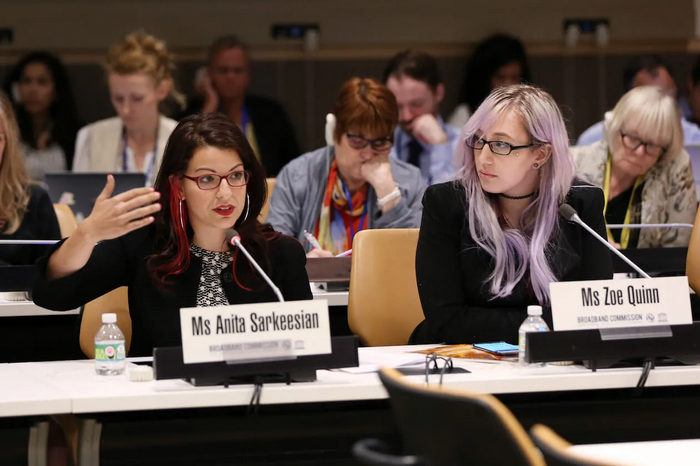
Remembering GamerGate

We’ve lived through such a tumultuous decade that it’s sometimes difficult to remember what things were like in the “before times”. On Substack chat, John Carter linked to this essay by Billionaire Psycho which helps refresh memories about one of the seminal events that kicked off the political and social chaos of the last decade:

GamerGate is maybe the most important event of the past 20 years which never receives mainstream media coverage. Lomez will be publishing an in-depth history of GamerGate, to serve as an official record going forward, and that’s crucial as part of building a foundation for a new culture — fighting the narrative war over how history is remembered, how history is interpreted, what events are recognized as significant and influential moments in culture, and how Western identity is defined.

GamerGate was only possible because a generation of incompetent Leftists inherited an empire built on propaganda that came without a legible instruction manual. Leftists forgot how to run their imperial machine. Video games sedated young white men, funneling their energy into a simulation of achievement, an illusory power fantasy of digital significance. Leftists forgot that porn, video games, movies, junk food, and other passive consumption activities primarily existed to prevent young white men from doing anything useful with their lives. And this zone of sedation was viewed as another industry to conquer so that DEI activists could bully the video game industry into providing overproduced elites with fake jobs.

This event was important for several reasons.

GamerGate exposed American Sharia laws. It unveiled the shibboleths, religious taboos, and blasphemy codes which were considered more important than Constitutional protections on “free speech”. A gulf emerged between written laws, and selective enforcement.

GamerGate was maybe the first time in 50 years that Leftists suffered a real, measurable defeat.

It functioned as a generational awakening: a catalyst that activated a decentralized army of shytpoasters, bloggers, podcasters, streamers, journalists, and RW activists.

It mapped out in real-time the architecture and OODA loop of the Leftist hivemind, providing empirical data on how the swarm intelligence perceives, coordinates, reacts, propagates … and suffers damage.

It educated critics of the hegemonic monoculture that rules the Global American Empire.

But I think the most important aspect of GamerGate was that it disproved the narrative illusion that everyone more or less accepted as conventional wisdom, the bedrock of the uniparty worldview. Before GamerGate, it was taken as a self-evident fact that America was a capitalist country, and that all of the evil in the world was caused by Wall Street corporations chasing “shareholder value” and advancing “the profit-motive”. Capitalism and racism were the invisible demons which could be used as scapegoats for anything bad that ever happened at any point and at any place in American society.

Leftism could do anything it wanted, no matter how dumb, destructive, intrusive, or evil — and then blame capitalism and racism for the consequences.

This illusion was shattered by GamerGate.

[…]

There’s one important thing that’s been lost since GamerGate (GG) and the Meme War of 2016, which is the adolescent fun, transgressive irreverence, and juvenile sense of humor which once characterized the RW youth. There was a brief window when video game enthusiasts believed they could meme their way to victory (they did), win a landslide election (they did), and reverse imperial decline (they didn’t). Ten years have passed since then. Countless accounts have been banned, doxxed, deplatformed, debanked. Dissidents have been prosecuted and imprisoned. The presidency of 2016 was stalled out and subverted, the election of 2020 was stolen, the election of 2024 almost ended in an assassination on live television. Covid lockdowns crashed the economy and trapped everyone in their homes, while Antifa and Black Lives Matter rioted outside in the name of George Floyd.

At some point, it stopped being fun, and the contest turned into a forever war.

Comedy turned serious.

But it should be remembered that in the aftermath of GamerGate, humor and a playful, childish energy fueled the engine of RW victories. That’s the secret ingredient.

Samizdat is the key to winning.

Always remember to keep having fun, and keep laughing, because our enemies are ridiculous.

October 17, 2025

Stellantis took the bribe, left Canada anyway

Filed under: Business, Cancon, Government, Politics, USA — Tags: , , , , , — Nicholas @ 04:00

The former American Motors plant in Brampton, now owned by Stellantis, was supposed to be the manufacturing site for a new Jeep vehicle. The federal government under Justin Trudeau handed about $15 billion to Stellantis to build an EV battery complex in Windsor, Ontario. It was apparently just assumed that this meant that Stellantis would keep the Brampton facility open and operating, but that assumption was faulty:

Stellantis has announced they’re leaving Brampton. That’s it. End of story.

Three thousand workers. Gone. A manufacturing base gutted. A city thrown into economic chaos. And a federal government left holding a $15 billion bag it handed over like a drunk tourist at a rigged poker table.

The Jeep Compass — the very vehicle they promised would anchor Ontario’s role in the so-called “EV transition” — will no longer be built in Canada. Production is moving to Belvidere, Illinois. The same company that cashed billions of your tax dollars under the banner of “green jobs” and “economic transformation” has slammed the door and walked out. And no, this isn’t a surprise. This was baked into the cake from day one.

Let’s rewind.

In April 2023, under Justin Trudeau’s government, Chrystia Freeland — then Finance Minister — and François-Philippe Champagne, the Industry Minister, announced what they called a “historic” agreement: a multi-billion-dollar subsidy package to Stellantis and LG Energy Solution to build an EV battery plant in Windsor, Ontario.

It was sold as a turning point. The future. A Green Revolution. Thousands of jobs. A new industrial strategy for Canada. But in reality? It was a Hail Mary pass by a government that had already crippled Canada’s energy sector and needed a shiny new narrative heading into an election cycle.

And here’s what they didn’t tell you: the deal had no enforceable commitment to keep auto production in Brampton. There were performance-based incentives — yes — but only for the battery plant. Not for the Brampton assembly line. Not for the existing workforce. And certainly not for ensuring the long-term health of Canada’s domestic auto industry.

They tied this country’s future to a globalist fantasy. A fantasy that assumed the United States would remain under the control of climate-obsessed technocrats like Joe Biden. A fantasy that required a compliant America pushing carbon neutrality, electric vehicle mandates, and billions in matching subsidies for green infrastructure.

But in November 2024, Americans said no.

Donald Trump was elected president. And just as he promised, he tore Biden’s green agenda to shreds. He pulled out of the Paris Climate Accord — again. He dismantled the EV mandates. He unleashed American oil and gas. But he didn’t stop there. Trump imposed a sweeping America First manufacturing policy, pairing 25% tariffs on imported goods with aggressive incentives to bring factories, jobs, and supply chains back onto U.S. soil.

And, as Conservative deputy leader Melissa Lantsman points out, it’s just the beginning:

You probably heard the news by now: Stellantis is cancelling its opening of a Jeep factory planned in Brampton, taking over 3,000 jobs and USD $600 million of investment out of Canada and moving it to the U.S.

This is the latest development in the growing trend of companies scaling back their operations in our country and choosing instead to grow in the US. Whisky maker Diageo found its name in the headlines last month when they announced they’d move their Crown Royal bottling facility south. GM laid off or cut down shifts for 750 autoworkers in Oshawa and 900 in Ingersoll while sending $4 billion to the U.S. Those are the ones that drew the headlines.

Why is this happening? Well – the reason on everyone’s mind right now is tariffs. And it’s true – tariffs are having a big impact on the Canadian economy and on our trading relationships. But there are other, deeper reasons at play, too.

Companies don’t just make decisions on a whim – especially those related to long-run production and fixed investments totalling hundreds of millions or even billions of dollars. Those decisions are made as part of detailed, multi-year analyses that take into account predicted economic conditions, market forces, and many other factors. A massive move of your production facility isn’t a temporary, six-month decision to be trifled over – it’s a permanent thing and that means they aren’t coming back.

The objective is to decrease uncertainty, cut costs, increase production, etc. etc. all to work in favour of any company’s ultimate goal, which is, of course, to make money.

So let me translate what all these investment and job cuts really mean: they’re not a knee-jerk reaction to the tariffs, although those play a part. They’re a statement about the long-term trajectory of the Canadian economy and the kind of climate that a decade of Liberal government has built for businesses in this country.

If these companies thought the U.S. tariffs would be transitory, a six-month blip, an economic fad – then they’d have no reason to cancel factories that will be producing goods for 20 or 30 years. That wouldn’t make financial sense.

[…]

If things get worse, the government might resort to its favourite strategy of just offering more hand-outs for businesses to try and entice them to stay here, but that only works for so long. That Stellantis plant in Brampton? The one that’s moving to the U.S.? The Ontario government promised them over $500 million just a few years ago – and the feds followed.

Turns out, you can promise to cut somebody a giant cheque and it’s still unprofitable for them to do business here.

As I mentioned, the continued trade uncertainty doesn’t help our situation, and the Prime Minister’s failure to get a deal is costing us big-time – especially as he promises to drive a trillion dollars of investment southbound at the expense of our workers here.

But as long as the Liberals keep the same old approach towards economics and business in this country, as long as the Liberals keep the taxes high, the productivity low, and the red tape piled up high — expect to see more headlines like the one about Stellantis, not fewer.

How many more job losses will it take for our leaders to realize that?

October 16, 2025

RIFfing the US federal workforce

Filed under: Government, Media, Politics, USA — Tags: , , , , — Nicholas @ 03:00

In Reason, J.D. Tuccille considers the impact of the US government shutdown on the federal civil service:

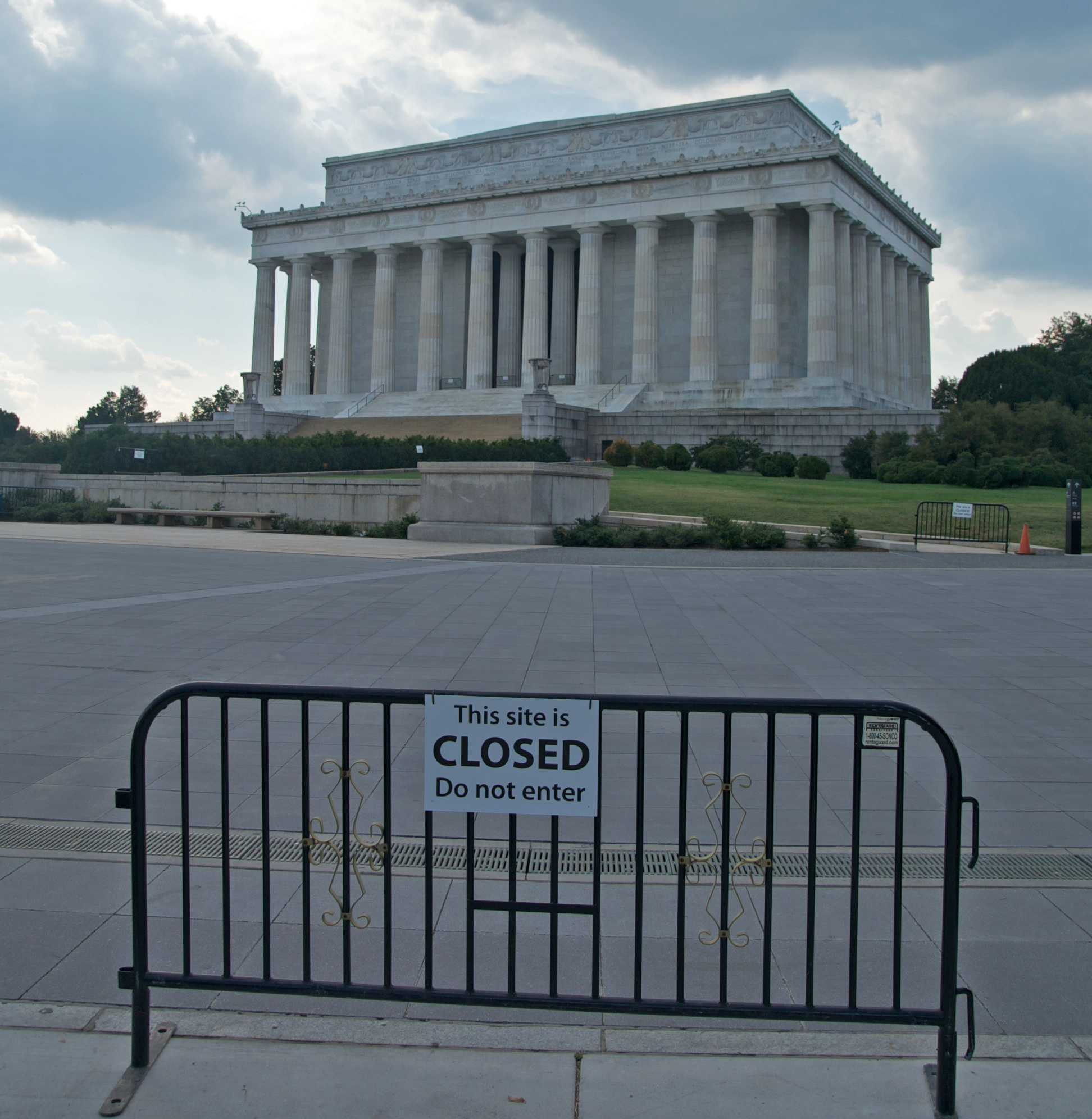
“Lincoln Memorial During Government Shutdown 2013” by Flickr user reivax is licensed under CC BY-SA 2.0 .

As promised — or threatened, if you wandered over to Reason by accident — the Trump administration has started using the government sort-of-shutdown as an opportunity to engage in mass layoffs of federal employees. In the game of chicken between Republicans and Democrats over just how much the government should overspend and on what, the losers so far appear to be some of the almost 3 million Americans who thought federal employment would be a comfortable way to collect a paycheck.

Setting thousands of former government workers loose to seek jobs elsewhere — preferably not involving money forcibly extracted from taxpayers — is a step in the right direction.

Shutdowns Are (Mostly) Political Theater

As we all should know by now, government shutdowns are largely political theater. National parks and museums are closed to inconvenience the public into believing something big is happening even as taxes keep getting collected and government enforcers continue twisting arms to make sure people comply with laws and rules that never should have been imposed.

The Brookings Institution’s David Wessel pointed out last week, “the Justice Department said 90% of its employees would be exempted from the furlough” and “the Department of Homeland Security said in its 76-page contingency plan that roughly 95% of its nearly 272,000 employees would remain on the job if a shutdown occurred”. Agencies accomplish this by defining “essential” employees who remain on the job in the broadest way possible.

Paychecks may be delayed during the shutdown. But after it ends, “employees who were required to perform excepted work during the lapse will receive retroactive pay” and “employees who were furloughed as the result of the lapse will receive retroactive pay for those furlough periods” according to the Office of Personnel Management. Basically, all federal employees eventually get paid whether they continue to work or are sent home for the duration of the “shutdown”.

An Opportunity To Reduce the Federal Workforce

At least, that’s how it usually works. This time is a little different because the Trump administration came into office promising to downsize the federal government. The Department of Government Efficiency (DOGE) was supposed to accomplish that goal, but the shutdown offers another opportunity. Even before furloughs began, the Office of Management and Budget (OMB) sent out a memo noting:

    With respect to those Federal programs whose funding would lapse and which are otherwise unfunded, such programs are no longer statutorily required to be carried out. Therefore, consistent with applicable law, including the requirements of 5 C.F.R. part 351, agencies are directed to use this opportunity to consider Reduction in Force (RIF) notices for all employees in programs, projects, or activities (PPAs) that satisfy all three of the following conditions: (1) discretionary funding lapses on October 1, 2025; (2) another source of funding, such as H.R. 1 (Public Law 119-21) is not currently available; and (3) the PPA is not consistent with the President’s priorities.

The White House is apparently taking this opportunity seriously. “Around 4,200 employees were laid off in total on Friday,” reports Eric Katz of Government Executive. The biggest cuts were at the Department of the Treasury (1,446 employees) and the Department of Health and Human Services (between 1,100 and 1,200 employees). The Department of Education, which President Trump proposes to totally eliminate, also experienced layoffs (466 or nearly 20 percent of its remaining workforce), as did the Environmental Protection Agency, Homeland Security, and Housing and Urban Development.

Everything this administration does seems to involve a bit of chaos, and the latest rounds of reductions in force are no different. While hundreds of employees of the Centers for Disease Control and Prevention (CDC) were included in the layoffs, some were fired by accident and immediately rehired.

Chris Bray notes that — stop me if you’ve heard this before — a district court judge has ruled that the President doesn’t have the power to do, well, pretty much anything to do with the federal workforce (what is it with the executive branch thinking they have powers that haven’t been explicitly approved by the judiciary?):

After a just absolutely bizarre hearing in a Northern California federal court, a judge has forbidden the Trump administration from laying off government employees. The hearing may have been held in the Court of the Red Queen: After Counsel to the Assistant Attorney General Elizabeth Hedges argued that she wasn’t going to get into the legal merits of the Trump administration’s layoffs because the court lacked jurisdiction and the plaintiffs hadn’t met the legal standards for filing a lawsuit, Judge Susan Illston warned that, actual quote, “This hatchet is falling on the heads of employees all across the nation and you’re not even prepared to address whether that’s legal?” Getting laid off is a hatchet attack, so we skip the arguments about ripeness and standing. It’s emotionally dire, a thing that feels very bad. Judges talk like this, now. OH GOD COUNSEL THIS IS LIKE A THING WITH A KNIFE THAT WOUNDS ME. Objection, your honor, inadequate trigger warning. […]

Illston declared the existence of a temporary restraining order from the bench, and I’ve been waiting for her written order to land on PACER. It’s here, and it’s … very … Well, okay: It has a lot of feelings. […]

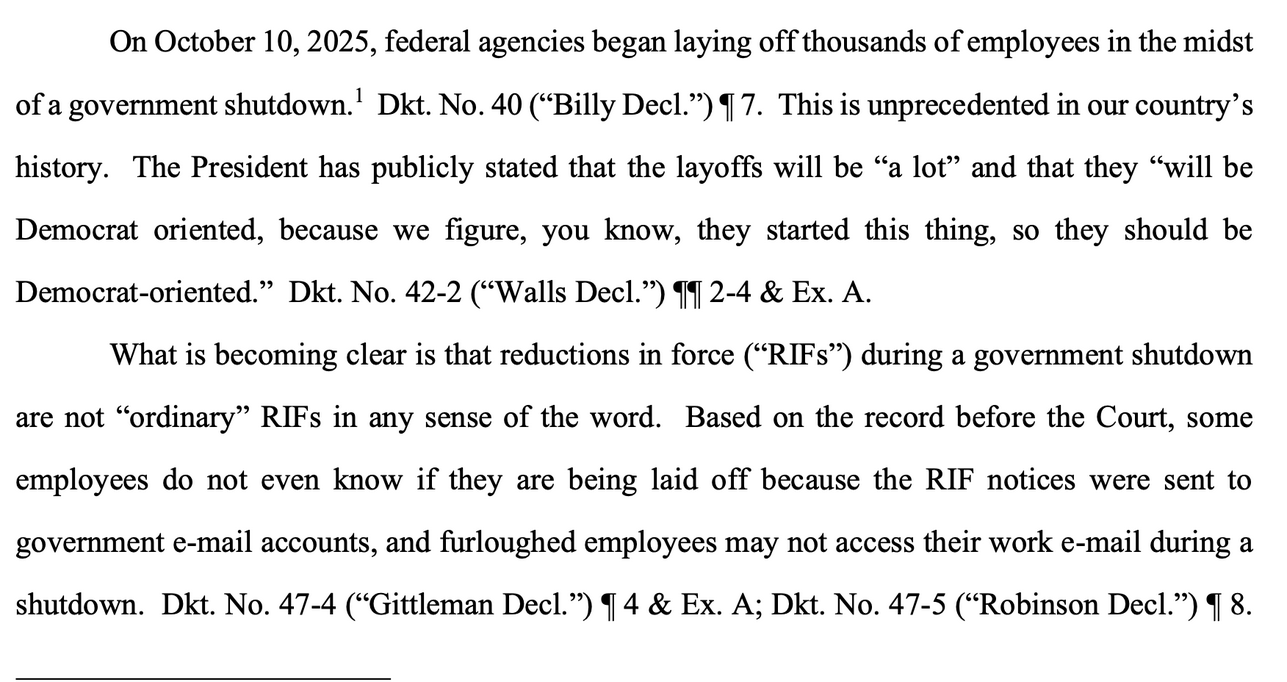
Opening paragraphs, first page:

Note that the first paragraph frames federal RIFs as historically unprecedented, while the second paragraph frames the current federal RIFS as not ordinary: different than the way RIFs are usually conducted. So this is unprecedented, but it has happened before, and the problem with the unprecedented thing is that it’s not being done the way the thing that has never been done before is usually done.

But anyway, a reduction in force of federal personnel during a shutdown is “unprecedented in our country’s history”. Of course, a reduction of force alone is not at all unprecedented, and the Clinton administration reduced the size of the federal bureaucracy by about 400,000 people. Illston doesn’t articulate a reason why reducing the bureaucracy during a shutdown is worse, or a reason why Clinton RIFs were good but Trump RIFs are a violent hatchet attack, but she clearly feels it. Of course, during a shutdown, the agencies being shrunk have no approved funding, so it would seem to make more sense to be careful about personnel costs, but this argument means that I just hurt people with a hatchet.

Above all, note that the argument out of the gate is a normative argument, not a legal argument. This is unprecedented! This is not ordinary! If a judge feels that something is a little off, she can order it stopped.

October 12, 2025

Restricting activism from the bench

Filed under: Britain, Government, Law, Liberty, Politics, USA — Tags: , , , , , — Nicholas @ 09:05

As we’ve seen far too many times in Canadian courts, when judges become politically active, they can produce far worse situations than the politicians who cynics might say are specialists in that discipline. British judges, however, are still well ahead of their Canadian counterparts:

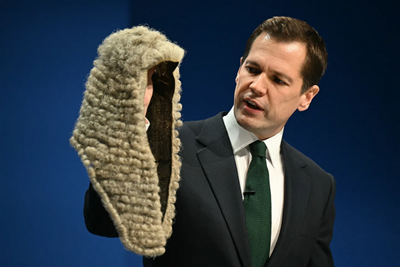
Until judges are replaced by robots, we will have to accept the reality of activist judges. Even the most august patriarch of the bench cannot wholly escape his innate human biases. And so perhaps there was something in Robert Jenrick’s speech at this week’s Conservative Party Conference, in which he announced that, if elected, the Tories would empower the Lord Chancellor to appoint judges and more carefully scrutinise their political activities.

Those who have supported the ideological capture of our major institutions were understandably furious. The New Statesman claimed that Jenrick had “declared war on the judiciary”. But then, the New Statesman is an activist publication which can make no serious claim to impartiality or sound journalistic standards. (Those in any doubt about its mendacity should take the time to read about its shameful treatment of Roger Scruton.)

The problem of an activist judiciary is currently preoccupying the White House, given that a number of federal judges have attempted to block executive policies or have issued nationwide injunctions. Trump himself was convicted on thirty-four felony counts by a judge who had made small political donations to Democratic-aligned causes. It seems clear that given these circumstances he ought to have recused himself. The entire case, of course, was an example of the law being twisted for politically partisan ends. (The best overview is by the senior legal analyst for CNN, Elie Honig, which can be read here.) Little wonder that Trump now appears to be seeking revenge through the courts.

In the UK, there have been a number of revelations of judges tied to political causes whose claim to impartiality seems shaky at best. During his speech, Jenrick spoke of those judges who have been associated with pro-immigration campaign groups and have “spent their whole careers fighting to keep illegal migrants in this country”. Many commentators have observed a generalised bias toward asylum applications, sometimes to an absurd extent. Who could possibly forget the Albanian criminal whose deportation was halted by an immigration tribunal on the grounds that his ten-year-old son did not like foreign chicken nuggets?

Leaving such outliers aside, most of us will have noticed patently ideological remarks occasionally uttered by judges during sentencing. In the Lucy Connolly case, the judge explicitly expressed his support for the creed of DEI before sentencing her to 31 months in prison for an offensive and hastily deleted post on social media. “It is a strength of our society that it is both diverse and inclusive”, he said. It couldn’t be much clearer than that.

That lawfare has become a major weapon in the settling of political disputes should trouble us all. Judges are not accountable to the electorate, and so any suggestion that they are exercising power for their own political ends is bound to be interpreted as a threat to democracy. Inevitably, Jenrick’s criticism of activist judges, and his call for them to be removed, has led to some commentators assuming that he would prefer judges who simply acted according to the government’s bidding. That way lies tyranny.

« Newer PostsOlder Posts »

Powered by WordPress