Quotulatiousness

April 15, 2012

Sarkozy reaps media benefit from video conference with Obama

Filed under: Europe, France, Government, Media, Politics — Tags: , , , — Nicholas @ 11:24

It’s often said that there’s no such thing as bad media exposure during an election campaign, and Nicolas Sarkozy is trying to take advantage of this in the run-up to the first round of voting:

Nicolas Sarkozy has been accused of using a video conference with Barack Obama to boost his election campaign. In an unprecedented move in French diplomacy, newscasts on several TV channels showed the first few minutes of a video link-up between the French president and his Washington counterpart.

Days before the 22 April first-round vote in the French presidential election, the rare glimpse of banter between world leaders shows Obama saying of the campaign, “It must be a busy time.” He adds: “I admire the tough battle you are waging.” Sarkozy replies, grinning and with arms folded: “We will win, Mr Obama. You and me, together.” The cameras leave before the presidents talk about Syria, Iran and oil.

The benefits to Sarkozy are quite clear: it allows him to appear presidential (always a trick the incumbent can use and the ambitious opponent is denied) and gives a subtle boost to French pride — their president is clearly on good personal terms with the American president. France’s representative is seen as being the equal of the superpower’s representative (it doesn’t have to be stated, but it’s a useful subliminal message in an election).

It’s not quite as beneficial to Obama, although this may be a marker put down to be redeemed later in the US presidential cycle. The same trick can be played for the benefit of Obama’s east coast voting base: look how well he deals with foreign dignitaries.

April 14, 2012

“The unipolar era has not been a success for America”

Filed under: Europe, Government, Middle East, USA — Tags: , , , , — Nicholas @ 10:55

Conrad Black examines the differences between the Cold War, when America had a clear mission, and the post-Cold War period, when America could be said to have completely lacked a coherent foreign policy:

Indeed, the overwhelming and relatively bloodless victory in the Cold War, the fruition of the brilliant American strategy of containment, left the United States as the only seriously Great Power in the world, a condition unique in the history of the nation-state, starting in the Middle Ages. As a result, there was, 20 years ago, a good deal of frothy (and, as it turns out, grossly premature) intellectual blather about the end of history and the political culmination of the world in democratic capitalism.

The unipolar era has not been a success for America. The great irony of these 20-something post-Cold War years has been that while the United States was the indispensable country in the triumph of capitalist democracy — its preservation from 1917 to 1941, and its outright victory in the following 50 years — it is not now one of the world’s best, or even better, functioning democracies.

Under the Clinton, Bush Jr., and Obama administrations, there has been no coherent strategy to replace the previous masterly and bipartisan missions to lead the West to victory in the Second World War and in the Cold War. Bill Clinton, on the world stage, as in America, and before that in the diminutive state of Arkansas, exuded bonhomous goodwill, extended free trade to Mexico, and expanded NATO into the former Soviet Union, suavely calling it “a partnership for peace.” He moved in the Balkans, but only when the Europeans, who started by calling the challenge posed by Bosnian massacres “The hour of Europe,” fell on their faces and started crying like frightened little pigs for America to end ethnic cleansing in the former Yugoslavia. And even then, nothing would have happened if the Republican leader in the Senate, Robert Dole, a bravely wounded veteran of the European theatre in the Second World War, had not legislated military orders (lift and strike) normally in the province of the commander-in-chief. There never really was a Clinton foreign policy: His responses to the early terrorist attacks (Khobar Towers, the African embassies, the USS Cole) were very inadequate.

George W. Bush, forced to deal with the monstrous outrage of the Sept. 11, 2001 terrorist attacks on New York and Washington, had a piercing, towel-snapping, locker room vision that since democracies do not engage in aggressive war, ergo, every country that was not already democratic should be propelled by the scruff of the neck and the small of the back toward democratization. Thus did Hamas replace Fatah in Gaza; the Muslim Brotherhood, (whose adherents had proudly murdered Anwar Sadat) is replacing Hosni Mubarak in Egypt; terrorist chaos is replacing Saleh in Yemen; and Hezbollah has more or less taken over from the Syrians in Lebanon. Trillions of dollars have been spent, along with over 6,000 American lives, in Afghanistan and Iraq, and it would be impetuous to forecast comparative stability and enlightenment in the near future of either country.

April 13, 2012

“Brzezinski[‘s] … realpolitik approach … is actually refreshing in today’s age of flippant air-bombing humanitarianism”

Filed under: Books, Economics, Government, History, Military, USA — Tags: , , , , , — Nicholas @ 08:24

Sean Collins reviews a pair of books that — rather than signing on to the idea of America as terminal-phase western Roman Empire — perhaps go too far in the other direction. The books are The World America Made by Robert Kagan and Strategic Vision: America and the Crisis of Global Power by Zbigniew Brzezinski:

It is clear that the US faces a number of challenges, especially with regard to its stagnant economy and gridlocked politics. But more and more, the country’s specific problems are overshadowed by creeping fears of national decline. This backdrop of decline extends beyond domestic economics to contemplating whether America’s influence in the world is diminishing, in particular relative to emerging powers like China.

[. . .]

Brzezinski is not only old, he’s old-school, too. His realpolitik approach, which includes Cold War concepts like containment, is actually refreshing in today’s age of flippant air-bombing humanitarianism. For example, he quite baldly comes out and calls for the US to lead an effort to expand the West (via NATO and the EU) to include Russia and Turkey. This, he says, is necessary to prevent Russia from striking out on its own, or allying with China. Brzezinski is also still very mindful that great-power politics have not disappeared, and could re-emerge more forcefully. More than once, he speculates that Asia today resembles Europe before the twentieth-century world wars, and argues for care to ensure that a new conflagration does not break out.

The two authors’ respective approaches to American relations with China illuminate their differences in approach. Kagan is blunt, arguing for an antagonistic stance. He calls on the US to ‘press for greater democratic and liberal reforms’ in China (and in other authoritarian nations), and to promote free trade and markets, and thus ‘push back’ against state capitalism in China. In contrast, Brzezinski urges a diplomatic approach, one that attempts to reach mutual agreement while preventing China from becoming a too-dominant regional power. He is opposed to the Obama administration’s recent ‘Asia pivot’, which calls for more US troops in the region. In an interview with Edward Luce in the Financial Times, Brzezinski warned: ‘We have to focus on Asia, but not in a manner that plays on everyone’s anxieties… It becomes very easy to demonise China and they will demonise us in return. Is that what we want?’

[. . .]

This is illustrated by their treatments of the recent wars in Iraq and Afghanistan. On the surface, the two seem to take very different lines. Kagan was bullish at the outset of both wars and, consistent with his general style in the book, he quickly skates right past such awkward issues. Brzezinski, in contrast, is damning, highlighting how the wars have undermined America’s ability to project its power. But the fact is that neither author really spends much time thinking about them. This is telling: both prefer to speculate about the future rather than face up to the reality of recent foreign-policy moves. Oddly, neither author examines either President George W Bush’s record or President Obama’s record. When Brzezinski does address the Bush administration’s foreign policy, his analytics go out the window and he just sneers. We are left believing that the interventions in Iraq and Afghanistan were nothing more than purely subjective mistakes made by Bush and his vice-president, Dick Cheney.

February 17, 2012

Colby Cosh on the current drama around the Falkland Islands

Filed under: Americas, Britain, History, Military — Tags: , , , , , — Nicholas @ 09:22

The last time Colby Cosh discussed the Falkland Islands, we had a bit of a discussion on Twitter, with my pessimism about Britain’s strategic situation finally persuading him to say “You’ve convinced me to worry about this a little more than I would’ve” (summary in this post). He’s now posted a new article at Maclean’s, which I think accurately captures the situation in the south Atlantic:

Argentina, the world press tells us, intends to rename its top soccer league the “Cruiser General Belgrano First Division”, in honour of the Argentine ship sunk by the Royal Navy during the 1982 Falklands War. Far be it from any outsider to prescribe how a country honours its war dead, but honour is not what the move is about: it’s part of a continuing, exhausting barrage of Falklands agitprop from Argentina’s Kirchner government. Kirchner is scrambling to keep Argentine economic growth rolling, barracking businesses and workers in the classic caudillo manner as inflation outpaces the dubious official statistics. She has tried, with some success, to close off Southern Hemisphere ports to boats flying the maritime flag of the Falklands and to weld traditionally UK-friendly neighbours into a regional bloc against “colonialism”. Tensions are high and the Falkland Islanders are feeling besieged.

Britain is passing through a phase of relative strategic vulnerability when it comes to the Falklands. The islands are garrisoned much more strongly than they were in 1982 and the RAF has a proper airfield. But the UK has sold off its Harrier fleet, and its naval force-projection capacity is a little threadbare; public austerity has forced the Royal Navy to wait until 2016 for a new Nimitz-sized aircraft-carrier class to come into play. General Sir Michael Jackson, often considered the top UK commentator on military affairs (how many General Sirs are there?), recently summed up the situation by suggesting that the Falklands could be defended—but if Argentina captured them in a coup de main, as it did in ’82, its soldiers could probably not now be driven off. From a game-theoretic standpoint, the situation is a nightmare.

Update, 21 February: Brendan O’Neill explains that in the modern celebrity-fuelled world, the Penn really is mightier than the sword:

Easily the most extraordinary thing about Sean Penn’s recent comments on the Falkland Islands is the impact that they made. The tidal wave of furious commentary has tended to focus on Penn’s undoubted combination of daftness and arrogance, with enraged British hacks asking ‘where does Mr Madonna get off holding a press conference to pontificate about the serious affairs of the South Atlantic?’. That is indeed a good question. But a better and more pressing one is this: how on earth did the musings of one muppet make such a massive impact, intensifying the stand-off between Argentina and Britain, generating acres of newsprint, and even provoking a huge protest in the Falkland Islands themselves under the banner ‘Falk You, Sean’?

[. . .]

The Penn affair confirms the extraordinary and terrifying power of celebrity today. It shows that in our celeb-obsessed era, the famous and allegedly fabulous are no longer used simply to advertise booze or to titillate the readers of gossip columns — they have become actual tools of global politics. (In both senses of the word ‘tool’ — ‘a device used to carry out a particular function’ and ‘one who lacks the mental capacity to know he is being used’.) Indeed, Kirchner’s use of Penn in her war of words with Britain shows that she is a sussed and wily leader — she recognises that, today, a comment from a celeb is a far more effective political manoeuvre than readying a warship or making a stern speech at the United Nations. Her message is basically: ‘I’ll see your Prince William and raise you Sean Penn…’

February 15, 2012

American consulate chooses not to give asylum to Wang Lijun, former Chongqing City official

Filed under: China, Politics, USA — Tags: , — Nicholas @ 10:08

I got an emailed link to this story at the Epoch Times, providing an account of former vice-mayor and chief of police Wang Lijun’s attempt to claim political asylum in the American consulate in Chengdu:

What exactly happened on the day Wang Lijun fled to the U.S. Consulate is not yet clear; but speculation and comments abound on China’s Internet. U.S. officials are also leaking information about what happened, and a congressional investigation into the affair has been promised.

Wang is the former vice-mayor and chief of police of the southwestern China megapolis of Chongqing City, and was the right-hand man of Bo Xilai, the city’s Communist Party chief who is known as an ultra-leftist hardliner, and who has been wrangling to win a position on the Standing Committee of the Politburo, the group of nine men who stand at the top of the Party’s hierarchy.

Wang was unexpectedly demoted on Feb. 2 from his posts and reassigned to handle “culture, education, and environmental protection.” On Feb. 5 he talked about the importance of his new job responsibilities at Chongqing Normal University and elsewhere. No one suspected that he would flee to the U.S. Consulate in Chengdu the next day.

[. . .]

While what exactly happened in the consulate in Chengdu cannot be confirmed, Bill Gertz of the Washington Free Beacon, citing an unnamed U.S. official, has reported that the Obama administration denied Wang Lijun asylum for fear of upsetting the Chinese regime.

U.S. Congressman Dana Rohrbacher (R-CA), chairman of the House Foreign Affairs subcommittee on oversight and investigations, has promised his subcommittee will investigate the handling of Wang’s case, Gertz also reports.

February 14, 2012

The surreal world of international aid

Filed under: Britain, India, Politics — Tags: , , , , , — Nicholas @ 10:16

Brendan O’Neill on the ludicrous display of a donor literally begging the intended recipient to continue accepting the offering:

The debate about whether Britain should continue giving aid to India will surely rank as one of 2012’s most ‘Alice in Wonderland’ political moments. An outsider to the world of international aid probably imagines that it is cash-strapped countries in the South who do the pleading, sometimes having to humiliate themselves by asking Western nations for financial assistance. Yet in the surreal affray over aid to India, it was the well-off giver — Britain — which was on its knees, begging, beseeching the Indians to continue accepting our largesse because if they didn’t, it would cause the Lib-Con government ‘great embarrassment’.

This unseemly spat sums up the problem with modern aid: it’s all about Us, not Them. The reason British ministers were prostrating themselves before India, effectively begging the Indians to remain as beggars, is because aid is now more about generating a moral rush in the big heads of politicians and activists over here than it is about filling the tummies of under-privileged people over there. It is designed to flatter and satisfy the giver rather than address the needs of the receiver, which means ‘aid to India’ is way more important to Britain than it is to India. And for that reason, because aid has been so thoroughly corrupted by the narrow needs of its distributors, it would indeed be a good thing to stop foisting it upon India and other nations.

There was something almost Pythonesque (and I never use that word) in the sight of British politicians saying ‘We must continue giving aid to India’ while Indian politicians were saying ‘We do not require the aid. It is a peanut in our total development spending.’ Those were the words of India’s finance minister, Pranab Mukherjee, who told his parliament that the nation should ‘voluntarily’ give up the £280million it receives from Britain each year. Cue outraged — and panicked — ministers and do-gooders in London kickstarting a PR campaign to show that the Indians are wrong — they do need British aid, because otherwise, according to Britain’s minister for international development Alan Duncan, in an article illustrated with a photograph of him accepting flowers from grateful little Indians, ‘millions could die’.

[. . .]

British historian William Hutton once said, ‘The charity that hastens to proclaim its good deeds ceases to be charity, and is only pride and ostentation’. That is pretty much all that remains in the world of aid: pride and ostentation. Indeed, it is striking that, in 2010, when DFID announced cuts to spending on the publicity side of ‘fighting global poverty’, various NGOs went ballistic, slamming the focus on ‘output-based aid’ over important things such as ‘increas[ing] public understanding of the causes of global poverty’ — that is, who cares about providing on-the-ground stuff, when there’s so much awareness-raising about the wonderfulness of NGOs to be done? Britain’s aid budget should be slashed, not because it costs the taxpayer too much money, as Daily Mail moaners argue, but because it costs too much in terms of the self-respect of nations in the South. Britain should have an emergency aid budget, of course, so that, like all civilised nations, it can assist quickly and generously when people are immediately threatened by starvation or disease, such as after the Haiti earthquake or the Pakistani floods. But the rest of the time, even sometimes struggling peoples don’t need the massive side orders of moralism and fatalism that come with Britain’s ‘peanuts’.

February 9, 2012

Paul Wells: Harper’s trip to China is going well

Filed under: Cancon, China, Economics, Media — Tags: , , , — Nicholas @ 11:22

In his Maclean’s column, Paul “Inkless” Wells talks about the state of play in prime minister Stephen Harper’s visit to China:

The old-timers in the press gallery know how to defuse an announcement like this. We dust a toolkit from the early Chrétien days off. A Canadian prime minister shows up in a fancy Beijing ballroom with a bunch of business executives wielding Montblanc pens. A big number is being tossed around — say, “$3 billion.” But if we subtract the deals that would have happened anyway, and then subtract the deals that aren’t really deals — then we can wear that number down to some innocuous nub.

But while individual elements of Stephen Harper’s signing ceremony Thursday night in a fancy Beijing ballroom may not pan out, at some point the weight of evidence starts to suggest something real is going on. The evidence at hand comes, not just from Canadian sources, but from Chinese.

The first source of the morning was the semi-official English-language China Daily, which reserves real excitement for vice-premier Xi Jingping’s upcoming trip to the United States but which has been respectful, and a little more than that, toward Stephen Harper all week.

Later in the day came Harper’s bilateral meeting with Hu Jintao. Here, no trace of scolding for time spent posturing in the early years of Harper’s term as prime minister. Now, Hu said, “Mr. Prime Minister, you put a lot of value on Canada’s relationship with China and are strongly committed to promoting the practical cooperation between our two countries. I appreciate your efforts.” Translation: You’re out of the doghouse. Come here, ya big lug.

Update: David Akin contrasts the glowing reviews Harper is getting in the Chinese press this time with his 2009 visit:

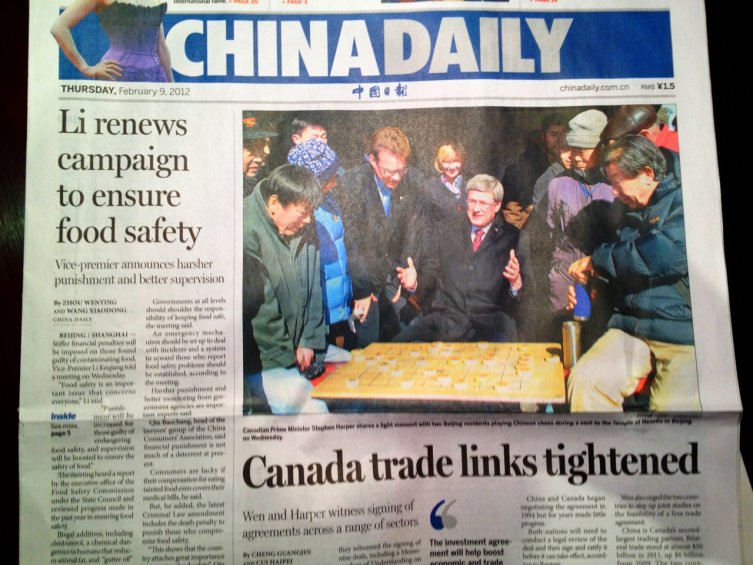
I’ve travelled to a lot of spots around the world covering Prime Minister Stephen Harper’s international travels and I cannot recall him ever generating the kind of positive press he’s getting in this morning’s China Daily, the English-language state-run daily newspaper here.

A picture of Harper chatting with Chinese chess players during a visit Wednesday to the Temple of Heaven is the front-page top-of-the-fold main art here with a generally positive article about the two countries improving trade relationship. Inside, there’s two other pieces involving Canada and Harper.

[. . .]

Read between the lines here and China’s government is approvingly showing Canada’s prime minister to be a decent, pious individual deserving of China’s friendship and support.

That’s a sharp contrast to the China Daily‘s coverage of Harper’s 2009 visit. There was front-page coverage then too — of how Premier Wen dressed down Harper for letting the China-Canada relationship languish. The narrative in 2009 was that the Canadian prime minister was a wayward supplicant coming to China to seek forgiveness for his sins. Not this time: He is being profiled in the press as the leader “of a strong delegation of five ministers and 40 business leaders” who, along with Wen, witnessd “the signing of nine deals.” The reader of the China Daily on this Harper visit is meant to be impressed.

February 6, 2012

What would follow a European Union crack-up?

Filed under: Bureaucracy, Economics, Europe, France, Germany, Politics — Tags: , , — Nicholas @ 10:13

If you listen to Angela Merkel and other European leaders, what would follow a break-up of the EU would be something out of Mad Max, a post-apocalyptic wasteland where the living would envy the dead. With no Brussels bureaucrats to direct everyone’s affairs, war, pestilence, starvation, looting, violence and unregulated bananas would proliferate. Bruno Frey isn’t quite as sanguine:

The major problem is that people do not see any alternative to the presently enacted European unification. The Europe-minded politicians even insist that, if the euro and the EU collapse, complete chaos will break out. The European continent will go back to the situation before World War II. The various nations will isolate themselves economically, and they will even start to fight each other. A war within the core of Europe, in particular between France and Germany, is taken to be a real possibility lurking in the background.

This view disregards the fact that the European unification process was made possible only because Germany and France stopped considering each other as enemies. They then saw themselves as the ‘motor’ of the European integration process, which started with the establishment of an economic union and then expanded to the political sphere. It is certainly wrong to think that the only thing that was needed to bring peace to Europe was a formal international treaty.

The claim that the downfall of the euro and the EU would produce chaos and war may be interpreted to be just a strategy necessary to get support for helping the highly indebted nations such as Greece, Portugal, Spain, or Italy with ever more financial support. However, conversations I have had with persons from various European countries suggest that many people really believe that Europe will disintegrate and that wars are looming if the EU dissolves. I hold this view to be seriously mistaken.

[. . .]

The individual countries in Europe will quickly form new treaties among themselves. Collaboration will be maintained in all those areas where it has worked well. Some countries will remain in a newly formed and smaller Eurozone, for which the appropriate treaties will be designed. A similar reconstitution will take place with respect to Schengen, which will then encompass different members. Only those countries that find it advantageous will join a new convention on the free movement of persons. In contrast, those nations that do not find such new treaties attractive, or that are not admitted to them by the other members, will not join.

The result will be a net of overlapping contracts between countries, which the various nations will join at will. These contracts will not be based on a vague notion of what ‘Europe’ may mean, but rather on functional efficiency. Crucially, the individual treaties will be stable because they will be in the interest of each member.

January 12, 2012

This time it’s India that gets the Top Gear treatment

Filed under: Humour, India, Media — Tags: , , , , , — Nicholas @ 12:12

I haven’t seen the Top Gear special in question, but from the complaints, it sounds like a pretty typical outing for the boys:

In the letter, published in the Daily Telegraph, the HCI criticised a lack of cultural sensitivity and called on the BBC to take action to pacify those offended.

One Indian diplomat told the BBC News website: “People are very upset because you cannot run down a whole society, history, culture and sensitivities.

“India is a developing country, we have very many issues to address, all that is fine but it is not fine to broadcast this toilet humour.”

He added: “There are many parts of the programme that people have complained about.

“It’s not only Indians, it’s also our British friends — it goes much beyond.”

The diplomat cited an “offensive” banner placed on the side of a train — reading “the United Kingdom promotes British IT for your company” — which read quite differently when the carriages were parted.

And he also criticised a scene in the programme which showed Clarkson taking off his trousers at a party to demonstrate how to use a trouser press.

Showing off the customised Jaguar, complete with toilet roll on its aerial, presenter Jeremy Clarkson said on the programme: “This is perfect for India because everyone who comes here gets the trots.”

Update: Jeremy Clarkson strikes again, this time agitating the folks on the Isle of Sheppey and recent immigrants:

Clarkson wrote: “Mostly, the Isle of Sheppey is a caravan site.

“There are thousands of thousands of mobile homes, all of which I suspect belong to former London cabbies, the only people on Earth with the knowledge to get there before it’s time to turn round and come home again.”

“And what of the locals? Well, they tend to be the sort of people who arrived in England in the back of a refrigerated truck or clinging to the underside of a Eurostar train.”

“And that reinforces my point rather well.

“Mboto has somehow evaded the gunmen and the army recruiters in his remote Nigerian village. He walked north, avoiding death and disease, and then somehow made it right across the Sahara desert to Algeria.

“Here, he managed to overwhelm the security men with their AK-47s and get on a boat to Italy, where he sneaked past the guards.”

The article in Top Gear mag adds: “He made it all the way across Europe to Sangatte, from which he escaped one night and swam to Kent.

“But that stumped him. Getting out of there was impossible, so he decided to make a new life in Maidstone.”

January 6, 2012

Paul Wells: Harper has big plans for 2012 … maybe

Filed under: Cancon, Government, History, Media — Tags: , , , — Nicholas @ 11:13

Yes, it’s the constantly threatening hidden agenda!

What does Stephen Harper want to do with his parliamentary majority? “I want to make sure that we use it,” he told CTV’s Lisa LaFlamme in a year-end interview. “You know, I’ve seen too many majority governments, the bureaucracy talks them into going to sleep for three years, and then they all of a sudden realize they’re close to an election.”

[. . .]

You don’t have to like this list. I’m not saying Harper’s predecessors were heroes. I am saying they were not sleeping. If the Prime Minister’s comments have any meaning, he must have something up his sleeve at least as big as those accomplishments. If he doesn’t, he won’t be the first politician to congratulate himself for his achievements before he fails to achieve them.

His interviews suggest Harper plans something big. Four times during his CTV interview, and once with the Chinese-language Fairchild network, he used the adjective “major” to describe his plans for 2012.

[. . .]

It’s striking how rarely Harper sounds bold when any discussion descends from slogans to details. Take foreign policy. On Syria, he pleads the lack of a Security Council resolution. On Egypt: “We’ll try and do what we can do to encourage stability and encourage the forces of democracy, but we don’t go into these things blind. There are some very real risks.”

A policy of bold action only where success is assured is a policy of offering help where none is needed. It is a bold decision to join others’ victory parades. There is nothing major about it.

Incidentally, the bureaucrats I talk to aren’t plotting to put Harper to sleep. On the contrary. Many wonder whether this government will wake up. One of Ottawa’s most experienced civil servants tells me the widespread belief is that Harper’s government is so obsessed with each morning’s headlines that it cannot plan. This official predicts a year of high-level early retirements from the civil service if Harper does not start using his majority.

December 22, 2011

Britain, Argentina, and the Falkland Islands

Filed under: Americas, Britain, History, Military — Tags: , , , , , — Nicholas @ 15:39

Yesterday, I sent a Twitter update linking an article about rising tensions between Argentina and the United Kingdom over the Falkland Islands:

The South American trade group Mercosur, wrapping up a two-day summit in Uruguay, has sided with Argentina in its ongoing dispute about the Falkland Islands, which it calls the Malvinas, announcing it will ban boats with Falkland Islands flags from their ports.

[. . .]

Note the flurry of activity since 2010. The dispute has become heightened over resources, as British firms explore for oil in the waters surrounding the islands.
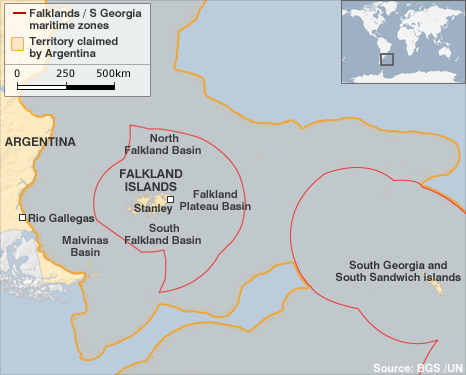
I described the article at the link as “early moves in the next Falklands War”. I then followed up with a another Tweet: “Of course, if Argentina decides to take the Falkland Islands, Britain no longer has the navy to stop them. No carriers = no force projection”

This struck Craig Chandler as seriously misunderstanding the risks: “War can still happen. Do not delude yourself.” I responded that I was “Not deluded about risk of war. Just realistic about outcome.” That is, I didn’t think Britain had any chance of pulling off a victory if Argentina resorted to the military option (again).

Craig had a remarkably positive view of British military power: “Britain would crush them. Missiles, Jets etc… Lot’s of ways to fight a modern war” and “Britain allies would join with them. An attack on one of us is an attack on all of us. Thus, victory would be 100% for Britain”. I responded “Even Reagan had to be cajoled into supporting Thatcher in 82. Obama? Doubt he feels any strong attachment to the UK.” “The UK would have to lodge protest in UN, impose trade sanctions, sit back and accept facts on the ground.”

I was starting to struggle with Twitter’s 140 character limit, as there was much I wanted to say that couldn’t easily be condensed into Twitter-friendly lengths. I’ve said on the blog that Britain’s scrapping of the Harriers and decommissioning/scrapping the remaining aircraft carriers was an open invitation to Argentina to try the Falklands issue again. Argentina’s President Cristina Kirchner wouldn’t be using words like “arrogant” (describing the British government) and characterizing the Prime Minister’s comments as an “expression of mediocrity and almost of stupidity” without good reason.
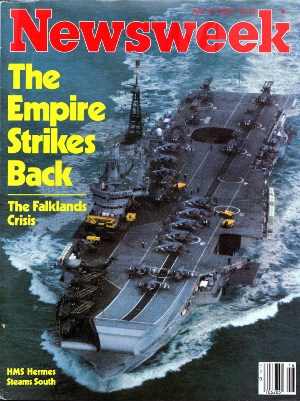
Britain was lucky in 1982, as the government of the day was desperately seeking economies in the budget and (as there was no war with anyone on the horizon), scrapping their aircraft carriers looked like a great way of reducing costs. They’d reduced their military presence in the South Atlantic in an attempt to both save money and appease Argentinian feelings. The announced reductions prompted Argentina’s military rulers to use an external war for internal political benefit. Argentina struck before the intended “economizing” took place. Had they waited six months, Britain would not have had the means to launch the counter-attack that retook the Falklands.
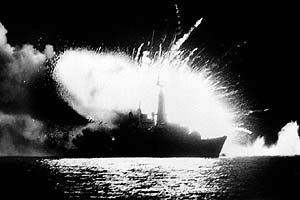
Even with the aircraft carriers HMS Hermes and HMS Invincible each operating several extra Harriers, the British were just barely able to keep enough aircraft going to fend off the majority of Argentinian attacks (losing two destroyers, two frigates, and several support ships sunk or severely damaged). With the Argentinian navy almost entirely confined to base after the sinking of the ARA Belgrano, the British could concentrate on air defence.

Having fought the fleet into position for the invasion, it was possible to pull the more vulnerable ships further out of range for Argentinian air strikes (as even at this stage, losing one of the carriers would endanger the entire mission). While it was much more than a “mere matter of marching”, the smaller but much better trained British forces (primarily Royal Marines, paratroops, Guards, and Gurkhas) were able to defeat the Argentinian troops and bring the military campaign to a close.

Anyway, Craig had an even more positive view of Britain’s likely political and military support today: “The USA owes the UK much for Iraq and Afghanistan there is also the entire Common Wealth. Argentina would be invaded.” “It would be all out war. No acceptance. The Common Wealth and other UK allies would come to support.” I think there’d be some forms of support short of military action: in 1982, for example, New Zealand sent a frigate to the Indian Ocean to replace a Royal Navy ship that was needed to support the Task Force. The rest of the Commonwealth gave verbal and diplomatic support, but no significant military assistance. Today’s Commonwealth is hardly a significant military player — Canada, Australia, and New Zealand combined could not even provide a full division of troops, and none of them would be willing to get involved in a land war in South America on Britain’s behalf.

As far as the islands themselves, there have been some significant changes since 1982, the most significant being a new Royal Air Force base with permanently stationed modern Typhoon fighters (although only four of them at last report). The island transportation net has vastly improved since 1982 — when the only permanent roads were within Port Stanley proper — with all-weather roads now linking all mainland settlements. In addition to the RAF base personnel, there is a British garrison force of a reinforced infantry company and supporting troops, and the Falkland Islands Defence Force which is a company-sized unit of part-time troops.

Argentina’s armed forces have also changed significantly since the war. Two of the most significant changes were post-war fall of the military Junta and the elimination of conscription (creating a more modern, better-trained professional army, navy and air force). The Argentinian navy no longer has a purpose-built landing ship (the ARA Cabo San Antonio was retired shortly after the war and replaced with a modified cargo vessel). They have three submarines in service (replacing the one sub active in 1982), and have replaced all their WW2-vintage ships with more modern designs from France and Germany. The marines, who were the best of the Argentinian troops in 1982, are organized in five battalions of infantry, with supporting artillery, anti-aircraft, engineering and special forces detachments.

Anyway, back to the Twitter exchange that started this. After I’d responded to Craig’s last comment, Colby Cosh joined the discussion: “Sign me up for a bet on 2 PARA if it comes to that, will you?”. I’ll just reproduce the rest of the exchange in approximately correct order below:

NR: “Admire the Paras, but you can’t drop from that far away.”
CC: “I guess they must have teleported onto Goose Green last time.”
NR: “They certainly didn’t fly in from Heathrow!”
CC: “I’m guessing they’ll use the Bay-class ships they built for pretty much that exact mission?”
NR: “Not without air cover.”
CC: “I’m no admiral, but somehow I did get the memo about the fetish for “capital ships” being obsolete.”
NR: “Carriers still relevant.”
CC: “Meanwhile, the Argie navy has not exactly thrived under civilian rule. Not sure if that’s relevant?”
NR: “For a short-haul invasion, you don’t need a massive navy. Air cover is the key. UK only has 1 sub in region normally.”
NR: “No way at all to prevent an invasion, but in 82 UK still had (barely enough) carrier air to cover counter-attack. No longer true”
CC: “Air cover *less* important for Bay class now with close-in antimissile guns. And RN is still operating two carriers, you know.”
NR: “UK paid off Ark Royal and Invincible. Replacement ships still years from launching.”
CC: “The RN just tried out HMS Ocean (I think it was Ocean) as a platform for Apache in the Gadhafi raids.”
CC: “Replacements for fixed-wing capability, yes. Ocean & Illustrious are configured for choppers now.”
NR: “Chopper-equipped force versus missile-armed fighters? Outcome not good for choppers without lots of luck.”
CC: “Helicopters are the name of the game in an amphib op anyway; hence the reconfig.”
NR: “For amphibious work, choppers are great support. Not designed to fight against fixed-wing fighters.”
CC: “We’re forgetting that the islands themselves are garrisoned much more heavily than in ’82.”
NR: “Still indefensible vs Arg”
CC: “The Typhoons that are there are certainly at the sharp end until RN’s Harriers are replaced.”
NR: “Not enough of them to matter.”
CC: “You’ve convinced me to worry about this a little more than I would’ve”
NR: “I’ll post a “Mission Accomplished” banner. ;-)”

Colby did point out some weaknesses in my original contention: for example, I’d forgotten about the construction of the new RAF base, but it isn’t equipped to fight a war: it’s an expensive trip-wire. Four aircraft aren’t going to be enough (especially as Britain had, as of the Libya campaign, only 69 qualified Typhoon pilots). I’ll admit I’m a bit less sanguine about Argentina just waltzing in to Port Stanley this time, but I still think if they can pull off a quick disabling strike followed by a landing, Britain will not be able to reverse the outcome like they did in 1982.

December 16, 2011

Lorne Gunter on the Kyoto cult: “Ottawa is right to get out of it while it could.”

Filed under: Cancon, Environment, Liberty, Media — Tags: , , , , — Nicholas @ 09:44

Much has been made — at least in the British press — about Canada announcing it will withdraw from the Kyoto agreement. Lorne Gunter agrees with the government that it was high time to leave:

It has been written in several places that should Canada fail to bring its emissions down drastically in the coming year, it could be subject to up to $19-billion in fines imposed by Ms. Figueres and the UNFCCC. How? The fines would be in the form of “carbon credits” — we would pay developing countries that aren’t current producing many emissions for their unused carbon. In other words, we could buy the equivalent of medieval indulgences to cover off our carbon sins. No emissions would be reduced, but the UN would be placated by this accounting device.

But what if we refuse to buy credits? In logic that would only ever make sense to UN bureaucrats, the UNFCCC then has the authority to penalize us by making us buy 30% more credits. That’s right, if we refuse to pay $19-billion in environmental baksheesh to cover off our extra emissions, the UN somehow thinks it will be able to convince us to pay $25-billion as a punishment.

Seriously, these people believe this stuff makes sense.

One of the reasons UN bureaucrats have begun using language such as “legal obligation” is that they are hoping to convince national supreme courts to enforce international treaties for them. At the Durban climate summit recently concluded in South Africa, delegates agreed to form an International Climate Court of Justice, partly in hopes that rulings from such a body would be enforced by domestic courts, even against countries, such as Canada, that withdraw from climate treaties.

The UN environmental cult becomes more dangerous to national sovereignty and personal freedom every day. Ottawa is right to get out of it while it could.

December 15, 2011

Mick Hume: Dispelling Euro-myths

Filed under: Britain, Europe, France, Germany, Politics — Tags: , , , — Nicholas @ 08:49

In this post at Spiked, Mick Hume pours cold water on five Euro-myths:

Euro-myth No 1: ‘It was a triumph for Cameron — or Sarkozy’

Depending on who you listen to, either UK prime minister David Cameron bravely stood alone for Britain by rejecting a new EU treaty, or else he was beaten by the wily French president Nicolas Sarkozy who got what he wanted by the UK’s omission from the new deal around the Eurozone.

In fact, what the rupture showed was that both the six-footer Cameron and the diminutive Sarkozy are, to coin a phrase, pygmies in political terms. And so are German chancellor Angela Merkel and the rest of Europe’s political elite. Far from a triumph for anybody, it marked an embarrassing failure of basic diplomacy among substandard statesmen and women. There are always tensions and ructions at international summits. But in other times they would have been kept under control by careful diplomatic preparation and consultation beforehand – not left to break out in a schoolboy spat on the day, with Cameron and Sarkozy reportedly almost coming to blows. Even far more strident Eurosceptics such as Margaret Thatcher knew how to play the great power game without tripping over their own laces. Europe’s destiny is now in the hands of self-regarding pygmies who think more of their next headline than the shared future of the continent.

As for the notion that Cameron struck a noble blow for the British people and ‘our’ national sovereignty — come off it. Indeed, one of his main motives appears to have been to avoid giving the British people any kind of say on the matter, by dodging both the referendum that would be demanded if he accepted an amended EU treaty, and the general election that would follow if he went too far the other way and broke up his coalition with the EU-loving Liberal Democrats. The government would rather fall out with the French than risk the wrath of British voters.

December 14, 2011

Eurosceptics described as “bunch of insular snobs who seem to have a hard time restraining their inner fascist”

Filed under: Britain, Europe, Media, Politics — Tags: , , , , — Nicholas @ 09:06

Frank Furedi exposes the real reasons behind the chattering classes’ abuse of David Cameron:

It is one thing to accuse Cameron of committing a diplomatic faux pas or the Foreign Office of ineptitude. But the criticisms currently being made of Cameron verge on the hysterical. When I listen to the hyperbole about what will apparently be the consequences of his destructive behaviour, it almost sounds as if he has committed an act of political betrayal in order to appease a handful of incorrigible reactionary Eurosceptics.

Why this over-the-top reaction to what could turn out to be a relatively minor case of diplomatic miscommunication?

Outwardly, the anger of the cosmopolitan clerisy is directed at Cameron’s alleged appeasement of Tory Eurosceptics. The term Eurosceptic has a special meaning for the adherents to cosmopolitan policymaking. In their view, Euroscepticism is associated with values they abhor: upholding national sovereignty, Britishness and a traditional way of life. The moralistic devaluation of these values was vividly communicated by the New York Times columnist Roger Cohen, who this week characterised Tory Eurosceptics as the ‘pinstriped effluence of an ex-imperial nation’. He seeks to dehumanise these people by arguing that this ‘specimen’s ascendancy’ was reflected in Cameron’s behaviour during the treaty negotiations. Cohen’s moral devaluation of Eurosceptics, his dismissal of them from the ranks of humanity, is captured in his description of them as a ‘bunch of insular snobs who seem to have a hard time restraining their inner fascist’.

The intemperate language suggests that the venomous anger directed at Eurosceptics cannot simply be driven by the clerisy’s love affair with the European ideal. Rather, what is at issue here is the clerisy’s preference for the technocracy-dominated and cosmopolitan-influenced institutions of Brussels. From their standpoint, the main virtue of the EU is that its leaders and administrators speak the same language as the UK clerisy. They read from the same emotional and cultural script, which they believe to be superior to the script and values associated with national sovereignty. That is why it isn’t surprising that a BBC journalist can casually ask the Estonian prime minister to have a go at her own national leader. The UK-based communications clerisy has a greater affinity with the outlook of EU technocrats and political administrators than it does with the outlook of its own people.

December 10, 2011

“It was not, all in all, Canada’s finest hour. Perhaps that’s why we still don’t talk about it much.”

Filed under: Books, Cancon, History, Media — Tags: , , , , , — Nicholas @ 12:48

Robert Fulford on the event in Ottawa that started the Cold War:

For just one moment in history, Canada found itself at the dangerous centre of global politics. That was in 1945, when Igor Gouzenko left the Russian embassy in Ottawa with documents proving the Soviet Union was spying on Canada with the help of Canadian communists.

Gouzenko’s revelations were the opening shot in the Cold War. A new book, Stalin’s Man in Canada: Fred Rose and Soviet Espionage by David Levy, takes a rambling, anecdotal approach to a major figure in the story, the only Canadian member of Parliament ever convicted of conducting espionage for a foreign state.

Official Ottawa reacted badly to the news that there were spies in its midst. The government arrested the suspects and locked them up for weeks, without access to lawyers or families. They were paraded before a secret royal commission and persuaded to incriminate themselves. Gouzenko was given a new identity to protect him from Soviet assassins but the Mounties leaked nasty stories about him. For decades journalists treated him as a money-grubbing clown rather than the hero that he was.

Today the case remains largely unexplored and poorly remembered. Among those involved, only Gouzenko described his experience in a book, This Was My Choice, a rather thin and hasty account. Twentieth Century Fox produced a forgettable adaptation, The Iron Curtain, with Dana Andrews as Gouzenko.

« Newer PostsOlder Posts »

Powered by WordPress


