
… in Germany most human faults and follies sink into comparative insignificance beside the enormity of walking on the grass. Nowhere, and under no circumstances, may you at any time in Germany walk on the grass. Grass in Germany is quite a fetish. To put your foot on German grass would be as great a sacrilege as to dance a hornpipe on a Mohammedan’s praying-mat. The very dogs respect German grass; no German dog would dream of putting a paw on it. If you see a dog scampering across the grass in Germany, you may know for certain that it is the dog of some unholy foreigner. In England, when we want to keep dogs out of places, we put up wire netting, six feet high, supported by buttresses, and defended on the top by spikes. In Germany, they put a notice-board in the middle of the place, “Hunden verboten,” and a dog that has German blood in its veins looks at that notice-board and walks away. In a German park I have seen a gardener step gingerly with felt boots on to grass-plot, and removing therefrom a beetle, place it gravely but firmly on the gravel; which done, he stood sternly watching the beetle, to see that it did not try to get back on the grass; and the beetle, looking utterly ashamed of itself, walked hurriedly down the gutter, and turned up the path marked “Ausgang.”
In German parks separate roads are devoted to the different orders of the community, and no one person, at peril of liberty and fortune, may go upon another person’s road. There are special paths for “wheel-riders” and special paths for “foot-goers,” avenues for “horse-riders,” roads for people in light vehicles, and roads for people in heavy vehicles; ways for children and for “alone ladies.” That no particular route has yet been set aside for bald-headed men or “new women” has always struck me as an omission.
In the Grosse Garten in Dresden I once came across an old lady, standing, helpless and bewildered, in the centre of seven tracks. Each was guarded by a threatening notice, warning everybody off it but the person for whom it was intended.
“I am sorry to trouble you,” said the old lady, on learning I could speak English and read German, “but would you mind telling me what I am and where I have to go?”
I inspected her carefully. I came to the conclusion that she was a “grown-up” and a “foot-goer,” and pointed out her path. She looked at it, and seemed disappointed.
“But I don’t want to go down there,” she said; “mayn’t I go this way?”
“Great heavens, no, madam!” I replied. “That path is reserved for children.”
“But I wouldn’t do them any harm,” said the old lady, with a smile. She did not look the sort of old lady who would have done them any harm.
“Madam,” I replied, “if it rested with me, I would trust you down that path, though my own first-born were at the other end; but I can only inform you of the laws of this country. For you, a full-grown woman, to venture down that path is to go to certain fine, if not imprisonment. There is your path, marked plainly — Nur für Fussgänger, and if you will follow my advice, you will hasten down it; you are not allowed to stand here and hesitate.”
“It doesn’t lead a bit in the direction I want to go,” said the old lady.
“It leads in the direction you ought to want to go,” I replied, and we parted.
In the German parks there are special seats labelled, “Only for grown-ups” (Nur für Erwachsene), and the German small boy, anxious to sit down, and reading that notice, passes by, and hunts for a seat on which children are permitted to rest; and there he seats himself, careful not to touch the woodwork with his muddy boots. Imagine a seat in Regent’s or St. James’s Park labelled “Only for grown-ups!” Every child for five miles round would be trying to get on that seat, and hauling other children off who were on. As for any “grown-up,” he would never be able to get within half a mile of that seat for the crowd. The German small boy, who has accidentally sat down on such without noticing, rises with a start when his error is pointed out to him, and goes away with down-cast head, brushing to the roots of his hair with shame and regret.
Not that the German child is neglected by a paternal Government. In German parks and public gardens special places (Spielplätze) are provided for him, each one supplied with a heap of sand. There he can play to his heart’s content at making mud pies and building sand castles. To the German child a pie made of any other mud than this would appear an immoral pie. It would give to him no satisfaction: his soul would revolt against it.
“That pie,” he would say to himself, “was not, as it should have been, made of Government mud specially set apart for the purpose; it was not manufactured in the place planned and maintained by the Government for the making of mud pies. It can bring no real blessing with it; it is a lawless pie.” And until his father had paid the proper fine, and he had received his proper licking, his conscience would continue to trouble him.
Jerome K. Jerome, Three Men on the Bummel, 1914.
July 5, 2015
QotD: Don’t walk on the grass!
July 4, 2015
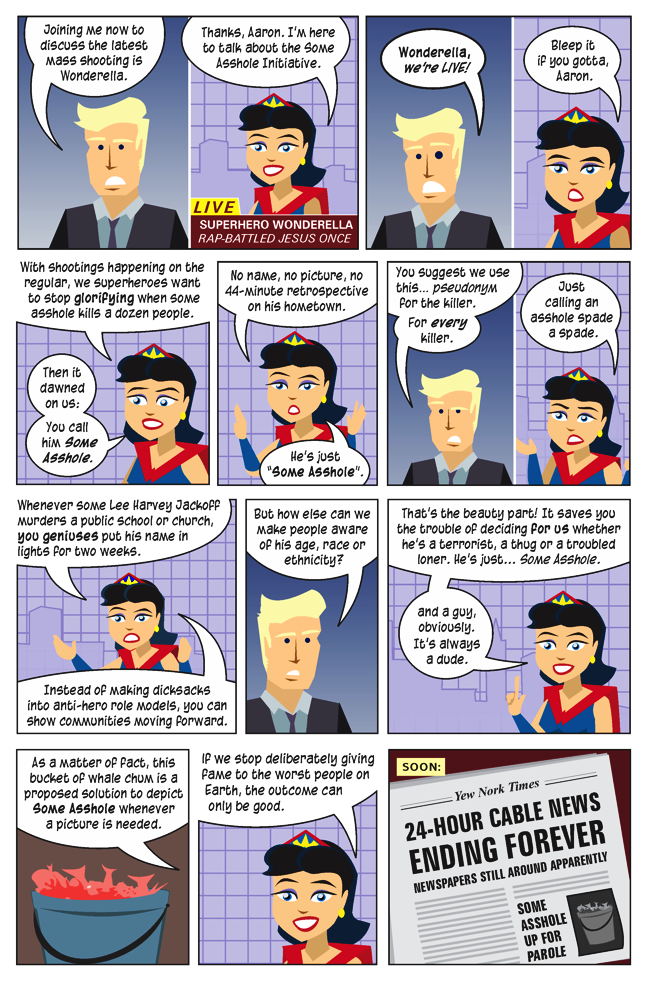
Please support the “Some Asshole” initiative!
By way of American Digest, let’s all get behind the “some asshole” initiative:
June 28, 2015
QotD: Getting into trouble in Imperial Germany (2)
Now, in Germany […] trouble is to be had for the asking. There are many things in Germany that you must not do that are quite easy to do. To any young Englishman yearning to get himself into a scrape, and finding himself hampered in his own country, I would advise a single ticket to Germany; a return, lasting as it does only a month, might prove a waste.
In the Police Guide of the Fatherland he will find set forth a list of the things the doing of which will bring to him interest and excitement. In Germany you must not hang your bed out of window. He might begin with that. By waving his bed out of window he could get into trouble before he had his breakfast. At home he might hang himself out of window, and nobody would mind much, provided he did not obstruct anybody’s ancient lights or break away and injure any passer underneath.
In Germany you must not wear fancy dress in the streets. A Highlander of my acquaintance who came to pass the winter in Dresden spent the first few days of his residence there in arguing this question with the Saxon Government. They asked him what he was doing in those clothes. He was not an amiable man. He answered, he was wearing them. They asked him why he was wearing them. He replied, to keep himself warm. They told him frankly that they did not believe him, and sent him back to his lodgings in a closed landau. The personal testimony of the English Minister was necessary to assure the authorities that the Highland garb was the customary dress of many respectable, law-abiding British subjects. They accepted the statement, as diplomatically bound, but retain their private opinion to this day. The English tourist they have grown accustomed to; but a Leicestershire gentleman, invited to hunt with some German officers, on appearing outside his hotel, was promptly marched off, horse and all, to explain his frivolity at the police court.
Another thing you must not do in the streets of German towns is to feed horses, mules, or donkeys, whether your own or those belonging to other people. If a passion seizes you to feed somebody else’s horse, you must make an appointment with the animal, and the meal must take place in some properly authorised place. You must not break glass or china in the street, nor, in fact, in any public resort whatever; and if you do, you must pick up all the pieces. What you are to do with the pieces when you have gathered them together I cannot say. The only thing I know for certain is that you are not permitted to throw them anywhere, to leave them anywhere, or apparently to part with them in any way whatever. Presumably, you are expected to carry them about with you until you die, and then be buried with them; or, maybe, you are allowed to swallow them.
In German streets you must not shoot with a crossbow. The German law-maker does not content himself with the misdeeds of the average man — the crime one feels one wants to do, but must not: he worries himself imagining all the things a wandering maniac might do. In Germany there is no law against a man standing on his head in the middle of the road; the idea has not occurred to them. One of these days a German statesman, visiting a circus and seeing acrobats, will reflect upon this omission. Then he will straightway set to work and frame a clause forbidding people from standing on their heads in the middle of the road, and fixing a fine. This is the charm of German law: misdemeanour in Germany has its fixed price. You are not kept awake all night, as in England, wondering whether you will get off with a caution, be fined forty shillings, or, catching the magistrate in an unhappy moment for yourself, get seven days. You know exactly what your fun is going to cost you. You can spread out your money on the table, open your Police Guide, and plan out your holiday to a fifty pfennig piece. For a really cheap evening, I would recommend walking on the wrong side of the pavement after being cautioned not to do so. I calculate that by choosing your district and keeping to the quiet side streets you could walk for a whole evening on the wrong side of the pavement at a cost of little over three marks.
In German towns you must not ramble about after dark “in droves.” I am not quite sure how many constitute a “drove,” and no official to whom I have spoken on this subject has felt himself competent to fix the exact number. I once put it to a German friend who was starting for the theatre with his wife, his mother-in-law, five children of his own, his sister and her fiancé, and two nieces, if he did not think he was running a risk under this by-law. He did not take my suggestion as a joke. He cast an eye over the group.
“Oh, I don’t think so,” he said; “you see, we are all one family.”
“The paragraph says nothing about its being a family drove or not,” I replied; “it simply says ‘drove.’ I do not mean it in any uncomplimentary sense, but, speaking etymologically, I am inclined personally to regard your collection as a ‘drove.’ Whether the police will take the same view or not remains to be seen. I am merely warning you.”
My friend himself was inclined to pooh-pooh my fears; but his wife thinking it better not to run any risk of having the party broken up by the police at the very beginning of the evening, they divided, arranging to come together again in the theatre lobby.
Jerome K. Jerome, Three Men on the Bummel, 1914.
June 22, 2015
Breaking – it’s a nation-wide crime wave (when you cherry-pick your data)
Daniel Bier looks at how Wall Street Journal contributor Heather Mac Donald concocted her data to prove that there’s a rising tide of crime across the United States:
Heather Mac Donald is back in the Wall Street Journal to defend her thesis that there is a huge national crime wave and that protesters and police reformers are to blame.
In her original piece, Mac Donald cherry picked whatever cities and whatever categories of crime showed an increase so far this year, stacked up all the statistics that supported her idea, ignored all the ones that didn’t, and concluded we are suffering a “nationwide crime wave.”
Of course, you could do this kind of thing any year to claim that crime is rising. But it isn’t.
The fifteen largest cities have seen a 2% net decrease in murder so far this year. Eight saw a rise in murder rates, and seven saw an even larger decline.
Guess which cities Mac Donald mentioned and which she did not.
This is how you play tennis without the net. Or lines.
And in her recent post, buried seven paragraphs in, comes this admission: “It is true that violent crime has not skyrocketed in every American city — but my article didn’t say it had.”
But neither did her article acknowledge that murder in big cities was falling overall — in fact, it didn’t acknowledge that murder or violent crime was declining anywhere. Apparently, in her view, it is acceptable to present a distorted view of the data as long as it isn’t an outright lie.
June 21, 2015
QotD: Getting into trouble in Imperial Germany
All three of us, by some means or another, managed, between Nuremberg and the Black Forest, to get into trouble.
Harris led off at Stuttgart by insulting an official. Stuttgart is a charming town, clean and bright, a smaller Dresden. It has the additional attraction of containing little that one need to go out of one’s way to see: a medium-sized picture gallery, a small museum of antiquities, and half a palace, and you are through with the entire thing and can enjoy yourself. Harris did not know it was an official he was insulting. He took it for a fireman (it looked like a fireman), and he called it a “dummer Esel.”
In German you are not permitted to call an official a “silly ass,” but undoubtedly this particular man was one. What had happened was this: Harris in the Stadgarten, anxious to get out, and seeing a gate open before him, had stepped over a wire into the street. Harris maintains he never saw it, but undoubtedly there was hanging to the wire a notice, “Durchgang Verboten!” The man, who was standing near the gates stopped Harris, and pointed out to him this notice. Harris thanked him, and passed on. The man came after him, and explained that treatment of the matter in such off-hand way could not be allowed; what was necessary to put the business right was that Harris should step back over the wire into the garden. Harris pointed out to the man that the notice said “going through forbidden,” and that, therefore, by re-entering the garden that way he would be infringing the law a second time. The man saw this for himself, and suggested that to get over the difficulty Harris should go back into the garden by the proper entrance, which was round the corner, and afterwards immediately come out again by the same gate. Then it was that Harris called the man a silly ass. That delayed us a day, and cost Harris forty marks.
I followed suit at Carlsruhe, by stealing a bicycle. I did not mean to steal the bicycle; I was merely trying to be useful. The train was on the point of starting when I noticed, as I thought, Harris’s bicycle still in the goods van. No one was about to help me. I jumped into the van and hauled it out, only just in time. Wheeling it down the platform in triumph, I came across Harris’s bicycle, standing against a wall behind some milk-cans. The bicycle I had secured was not Harris’s, but some other man’s.
It was an awkward situation. In England, I should have gone to the stationmaster and explained my mistake. But in Germany they are not content with your explaining a little matter of this sort to one man: they take you round and get you to explain it to about half a dozen; and if any one of the half dozen happens not to be handy, or not to have time just then to listen to you, they have a habit of leaving you over for the night to finish your explanation the next morning. I thought I would just put the thing out of sight, and then, without making any fuss or show, take a short walk. I found a wood shed, which seemed just the very place, and was wheeling the bicycle into it when, unfortunately, a red-hatted railway official, with the airs of a retired field-marshal, caught sight of me and came up. He said:
“What are you doing with that bicycle?”
I said: “I am going to put it in this wood shed out of the way.” I tried to convey by my tone that I was performing a kind and thoughtful action, for which the railway officials ought to thank me; but he was unresponsive.
“Is it your bicycle?” he said.
“Well, not exactly,” I replied.
“Whose is it?” he asked, quite sharply.
“I can’t tell you,” I answered. “I don’t know whose bicycle it is.”
“Where did you get it from?” was his next question. There was a suspiciousness about his tone that was almost insulting.
“I got it,” I answered, with as much calm dignity as at the moment I could assume, “out of the train.”
“The fact is,” I continued, frankly, “I have made a mistake.”
He did not allow me time to finish. He merely said he thought so too, and blew a whistle.
Recollection of the subsequent proceedings is not, so far as I am concerned, amusing. By a miracle of good luck — they say Providence watches over certain of us — the incident happened in Carlsruhe, where I possess a German friend, an official of some importance. Upon what would have been my fate had the station not been at Carlsruhe, or had my friend been from home, I do not care to dwell; as it was I got off, as the saying is, by the skin of my teeth. I should like to add that I left Carlsruhe without a stain upon my character, but that would not be the truth. My going scot free is regarded in police circles there to this day as a grave miscarriage of justice.
But all lesser sin sinks into insignificance beside the lawlessness of George. The bicycle incident had thrown us all into confusion, with the result that we lost George altogether. It transpired subsequently that he was waiting for us outside the police court; but this at the time we did not know. We thought, maybe, he had gone on to Baden by himself; and anxious to get away from Carlsruhe, and not, perhaps, thinking out things too clearly, we jumped into the next train that came up and proceeded thither. When George, tired of waiting, returned to the station, he found us gone and he found his luggage gone. Harris had his ticket; I was acting as banker to the party, so that he had in his pocket only some small change. Excusing himself upon these grounds, he thereupon commenced deliberately a career of crime that, reading it later, as set forth baldly in the official summons, made the hair of Harris and myself almost to stand on end.
German travelling, it may be explained, is somewhat complicated. You buy a ticket at the station you start from for the place you want to go to. You might think this would enable you to get there, but it does not. When your train comes up, you attempt to swarm into it; but the guard magnificently waves you away. Where are your credentials? You show him your ticket. He explains to you that by itself that is of no service whatever; you have only taken the first step towards travelling; you must go back to the booking-office and get in addition what is called a “schnellzug ticket.” With this you return, thinking your troubles over. You are allowed to get in, so far so good. But you must not sit down anywhere, and you must not stand still, and you must not wander about. You must take another ticket, this time what is called a “platz ticket,” which entitles you to a place for a certain distance.
What a man could do who persisted in taking nothing but the one ticket, I have often wondered. Would he be entitled to run behind the train on the six-foot way? Or could he stick a label on himself and get into the goods van? Again, what could be done with the man who, having taken his schnellzug ticket, obstinately refused, or had not the money to take a platz ticket: would they let him lie in the umbrella rack, or allow him to hang himself out of the window?
To return to George, he had just sufficient money to take a third-class slow train ticket to Baden, and that was all. To avoid the inquisitiveness of the guard, he waited till the train was moving, and then jumped in.
That was his first sin:
(a) Entering a train in motion;
(b) After being warned not to do so by an official.
Second sin:
(a) Travelling in train of superior class to that for which ticket was held.
(b) Refusing to pay difference when demanded by an official. (George says he did not “refuse”; he simply told the man he had not got it.)
Third sin:
(a) Travelling in carriage of superior class to that for which ticket was held.
(b) Refusing to pay difference when demanded by an official. (Again George disputes the accuracy of the report. He turned his pockets out, and offered the man all he had, which was about eightpence in German money. He offered to go into a third class, but there was no third class. He offered to go into the goods van, but they would not hear of it.)
Fourth sin:
(a) Occupying seat, and not paying for same.
(b) Loitering about corridor. (As they would not let him sit down without paying, and as he could not pay, it was difficult to see what else he could do.)
But explanations are held as no excuse in Germany; and his journey from Carlsruhe to Baden was one of the most expensive perhaps on record.
Jerome K. Jerome, Three Men on the Bummel, 1914.
June 14, 2015
QotD: The law-abiding Germans
Another excellent piece of material for obtaining excitement in Germany is the simple domestic perambulator. What you may do with a “kinder-wagen,” as it is called, and what you may not, covers pages of German law; after the reading of which, you conclude that the man who can push a perambulator through a German town without breaking the law was meant for a diplomatist. You must not loiter with a perambulator, and you must not go too fast. You must not get in anybody’s way with a perambulator, and if anybody gets in your way you must get out of their way. If you want to stop with a perambulator, you must go to a place specially appointed where perambulators may stop; and when you get there you must stop. You must not cross the road with a perambulator; if you and the baby happen to live on the other side, that is your fault. You must not leave your perambulator anywhere, and only in certain places can you take it with you. I should say that in Germany you could go out with a perambulator and get into enough trouble in half an hour to last you for a month. Any young Englishman anxious for a row with the police could not do better than come over to Germany and bring his perambulator with him.
In Germany you must not leave your front door unlocked after ten o’clock at night, and you must not play the piano in your own house after eleven. In England I have never felt I wanted to play the piano myself, or to hear anyone else play it, after eleven o’clock at night; but that is a very different thing to being told that you must not play it. Here, in Germany, I never feel that I really care for the piano until eleven o’clock, then I could sit and listen to the “Maiden’s Prayer,” or the Overture to “Zampa,” with pleasure. To the law-loving German, on the other hand, music after eleven o’clock at night ceases to be music; it becomes sin, and as such gives him no satisfaction.
The only individual throughout Germany who ever dreams of taking liberties with the law is the German student, and he only to a certain well-defined point. By custom, certain privileges are permitted to him, but even these are strictly limited and clearly understood. For instance, the German student may get drunk and fall asleep in the gutter with no other penalty than that of having the next morning to tip the policeman who has found him and brought him home. But for this purpose he must choose the gutters of side-streets. The German student, conscious of the rapid approach of oblivion, uses all his remaining energy to get round the corner, where he may collapse without anxiety. In certain districts he may ring bells. The rent of flats in these localities is lower than in other quarters of the town; while the difficulty is further met by each family preparing for itself a secret code of bell-ringing by means of which it is known whether the summons is genuine or not. When visiting such a household late at night it is well to be acquainted with this code, or you may, if persistent, get a bucket of water thrown over you.
Also the German student is allowed to put out lights at night, but there is a prejudice against his putting out too many. The larky German student generally keeps count, contenting himself with half a dozen lights per night. Likewise, he may shout and sing as he walks home, up till half-past two; and at certain restaurants it is permitted to him to put his arm round the Fraulein’s waist. To prevent any suggestion of unseemliness, the waitresses at restaurants frequented by students are always carefully selected from among a staid and elderly classy of women, by reason of which the German student can enjoy the delights of flirtation without fear and without reproach to anyone.
They are a law-abiding people, the Germans.
Jerome K. Jerome, Three Men on the Bummel, 1914.
May 29, 2015
The legacy of the great satanic sex abuse panic still resonates today
Radley Balko reports on the recent release of two former Austin, Texas daycare owners … who’ve been in prison since 1992 on the testimony of a toddler and “expert evidence” from a satanic ritual expert and how the moral panic of the day made it impossible for the courts to see how utterly unlikely the case actually was:
The panic actually began in the 1980s. It was instigated and perpetuated mostly by groups of fundamentalist Christians who saw Satan in every heavy metal album, “Smurfs” episode, and Dungeons & Dragons game, along with a quack cadre of psychotherapists who were convinced they could dig up buried memories through hypnosis. What they did instead was shed some light on just how potent the power of suggestion can be. Remarkably, children were convinced to testify about horrifying — and entirely fictional — violations perpetrated on them by care workers and, in some cases, by their own parents.
But it wasn’t just children. As the Kellers’ conviction shows, the panic was so overwhelming, it could convince trained medical professionals to see abuse where there was none. Some defendants were convicted of gruesome crimes such as the aforementioned dismembering of babies despite the fact that there were no corpses and no babies missing from the immediate area.
[…]
That the highest court in Texas still can’t bring itself to declare the couple innocent, in spite of all that we know now, shows just how difficult it can be to undo the damage caused by a moral panic and junk science in the courtroom.
[…]
Here’s an observation from the panic that I don’t think has been fully explored: These kids didn’t make up these stories. In this case and dozens of others, the kids were telling tales with details about geography, history and current events about which kids of their age couldn’t have known. That’s likely what made their stories seem somewhat credible. But the fact that it all was fictitious reveals a particularly unsettling truth: These sick, lurid, unimaginable abuses could only have been a product of the imaginations of the therapists, social workers, cops and/or prosecutors who interviewed the children. If the memories were implanted, those are the only people who could have implanted them. That means that the same people entrusted to protect these kids, and in whom these communities trusted to police the streets, prosecute crimes and administer therapy, were ultimately the ones capable of dreaming up detailed sexual fantasies that put children in bizarre rituals involving violence, animals, corpses and so on.
There’s a lot to be learned from these cases. For one, there are lessons about professional accountability: Not only were the vast majority of the prosecutors who put these innocent people in prison in these cases never sanctioned, but also most went on to great professional success, sometimes because of their role in these high-profile cases, and sometimes even after it was widely known that the people they prosecuted were innocent. There are other lessons here about how we screen “expert” witnesses, and how bad science gets into the courtroom. There are lessons about the power of suggestion that could be applied to eyewitness testimony and how we conduct police lineups.
But the drawing of lessons is something we typically do once a crisis is over. This one still isn’t. There are still people in prison awaiting exoneration in these cases.
May 24, 2015
Charles Stross proposes “The Evil Business Plan of Evil”
Well, “proposes” isn’t quite the right word:
Let me describe first the requirements for the Evil Business Plan of Evil, and then the Plan Itself, in all it’s oppressive horror and glory.
Some aspects of modern life look like necessary evils at first, until you realize that some asshole has managed to (a) make it compulsory, and (b) use it for rent-seeking. The goal of this business is to identify a niche that is already mandatory, and where a supply chain exists (that is: someone provides goods or service, and as many people as possible have to use them), then figure out a way to colonize it as a monopolistic intermediary with rent-raising power and the force of law behind it. Sort of like the Post Office, if the Post Office had gotten into the email business in the 1970s and charged postage on SMTP transactions and had made running a private postal service illegal to protect their monopoly.
Here’s a better example: speed cameras.
We all know that driving at excessive speed drastically increases the severity of injuries, damage, and deaths resulting from traffic accidents. We also know that employing cops to run speed traps the old-fashioned way, with painted lines and a stop-watch, is very labour-intensive. Therefore, at first glance the modern GATSO or automated speed camera looks like a really good idea. Sitting beside British roads they’re mostly painted bright yellow so you can see them coming, and they’re emplaced where there’s a particular speed-related accident problem, to deter idiots from behaviour likely to kill or injure other people.
However, the idea has legs. Speed cameras go mobile, and can be camouflaged inside vans. Some UK police forces use these to deter drivers from speeding past school gates, where the speed limit typically drops to 20mph (because the difference in outcome between hitting a child at 20mph to hitting them at 30mph is drastic and life-changing at best: one probably causes bruises and contusions, the other breaks bones and often kills). And some towns have been accused of using speed cameras as “revenue enhancement devices”, positioning them not to deter bad behaviour but to maximize the revenue from penalty notices by surprising drivers.
This idea maxed out in the US, where the police force of Waldo in South Florida was disbanded after a state investigation into ticketing practices; half the town’s revenue was coming from speed violations. (Of course: Florida.) US 301 and Highway 24 pass through the Waldo city limits; the town applied a very low speed limit to a short stretch of these high-speed roads, and cleaned up.
Here’s the commercial outcome of trying to reduce road deaths due to speeding: speed limits are pretty much mandatory worldwide. Demand for tools to deter speeders is therefore pretty much global. Selling speed cameras is an example of supplying government demand; selling radar detectors or SatNav maps with updated speed trap locations is similarly a consumer-side way of cleaning up.
And here’s a zinger of a second point: within 30 years at most, possibly a lot sooner, this will be a dead business sector. Tumbleweeds and ghost town dead. Self-driving cars will stick to the speed limit because of manufacturer fears over product liability lawsuits, and speed limits may be changed to reflect the reliability of robots over inattentive humans (self-driving cars don’t check their Facebook page while changing lanes). These industry sectors come and go.
May 9, 2015
A rather satisfying way to punish an in-game cheater
BBC News picked up the story of a Guild Wars 2 player who’d been cheating on a massive scale:
A character controlled by a hacker who used exploits to dominate online game Guild Wars 2 has been put to death in the virtual world.
The character, called DarkSide, was stripped then forced to leap to their death from a high bridge.
The death sentence was carried out after players gathered evidence about the trouble the hacker had caused.
This helped the game’s security staff find the player, take over their account and kill them off.
Over the past three weeks many players of the popular multi-player game Guild Wars 2 have been complaining about the activities of a character called DarkSide. About four million copies of the game have been sold.
Via a series of exploits the character was able to teleport, deal massive damage, survive co-ordinated attacks by other players and dominate player-versus-player combat.
To spur Guild Wars‘ creator ArenaNet to react, players gathered videos of DarkSide’s antics and posted them on YouTube.
The videos helped ArenaNet’s security head Chris Cleary identify the player behind DarkSide, he said in a forum post explaining what action it had taken. Mr Cleary took over the account to carry out the punishment.
H/T to MassivelyOP for both the original story and the BBC News link.
May 5, 2015
Interesting jobs for foreigners in China
I’ve had a few friends over the years who seemed to somehow be able to spend extended time in China. This article may explain how at least a few of them funded their stays:
In 2010, Mitch Moxley wrote a story for The Atlantic entitled “Rent a White Guy,” relating the story of his trip to Dongying where he pretended to be the representative of a non-existent California-based company that was allegedly building a factory in the city. His Canadian friend Ernie, hired to play the role of director, delivered a speech before a large crowd in which he “boasted about the company’s long list of international clients.” After the speech, “confetti blasted over the stage, fireworks popped […] and Ernie posed for a photo with the mayor.” The article has nothing to say about the extent of the scam. Were Mitch Moxley and his friend Ernie giving a boost to a local company or were the attendees being asked to invest in a company that didn’t exist?
A 2010 CNN report cited one ad posted on The Beijinger by a company called “Rent A Foreigner.” The story describes one foreigner who had police knock on his door one day, “after a financial company he worked at for a couple of months in Xi’an […] allegedly swindled millions of yuan out of clients.”
It’s commonplace in China to see expats paid exorbitant fees as dancers, singers, musicians, or models, often regardless of talent. I have seen unattractive models, dancers who couldn’t dance, and singers who couldn’t sing. One of my friends was once paid handsomely to play bass at a live concert. The thing was, he didn’t know how to play bass — so they left his instrument unplugged and he plucked at the strings as if he had some clue as to what he was doing. Several of the musicians were also pantomiming to a prerecorded track, but the track had no bass, so my friend was pretending to play a part that didn’t exist. No one in the crowd seemed to notice though, and he was paid more than twice what the Chinese band members, who were actually rather talented musicians, earned.
April 29, 2015
A simple, four-step plan to assist African-Americans
At Coyote Blog, Warren Meyer lays out his simple but effective plan to help African-Americans:
- Legalize drugs. This would reduce the rents that attract the poor into dealing, would keep people out of jail, and reduce a lot of violent crime associated with narcotics traffic that kills investment and business creation in black neighborhoods. It would also reduce the main excuse for petty harassment by police that falls disproportionately on young black men. No its not a good thing to have people addicted to strong narcotics but it is worse to be putting them in jail and having them shooting at each other.
- Bring real accountability to police forces. When I see stories of folks absurdly abused by police forces, I can almost always guess the race of the victim in advance. I used to be a law-and-order Conservative that blindly trusted police statements about every encounter. The advent of cell-phone video has proven this to be supremely naive.
- Eliminate the minimum wage (compromise: eliminate the minimum wage before 25). Originally passed for racist reasons, it still (if unintentionally) keeps young blacks from entering the work force. Dropping out of high school does not hurt employment because kids learn job skills in high school (they don’t); it hurts because finishing high school is a marker of responsibility and other desirable job traits. Kids who drop out can overcome this, but only if they get a job where they can demonstrate these traits. No one is going to take that chance at $10 or $15 an hour**
- Voucherize education. It’s not the middle class that is primarily the victim of awful public schools, it is poor blacks. Middle and upper class parents have the political pull to get accountability. It is no coincidence the best public schools are generally in middle and upper class neighborhoods. Programs such as the one in DC that used to allow urban poor to escape failing schools need to be promoted.
You could argue that decriminalizing drugs is somehow wrong … but if you’re looking at the harm inflicted by drug abuse and comparing it to the harm to African-American communities in particular, you would have to admit that it’s significantly worse with drug prohibition than it would be under a legal drug-use scenario. Reforming the police? Check what kinds of stuff show up in my Militarization-tagged posts — if that doesn’t convince you, you can’t be convinced.
The minimum wage is one of those issues that seems beneficial to the poor, because it means they get a higher wage on the job than they might get otherwise — what isn’t seen is that this limits the number of jobs that a poor person may have access to. Our education system is not adequately equipping people for the working world, and the more we expect the schools to teach, the less they can teach in the way of life-skills. A bad school can negatively impact someone’s entire working life. In education especially, one size does not fit all. Having more varied educational offerings makes it much more likely that children will be able to get the kind of education they need to succeed in life.
April 22, 2015
QotD: Volunteer armies, conscription, and corporal punishment in Starship Troopers
I hate conscription. I regard it as human slavery of the vilest sort and do not think it can be justified under any circumstances whatever. To those who say “Yes, but without the draft we could not defend the United States” I answer violently, “Then let the bloody United States go down the drain! Any nation whose citizens will not voluntarily fight and die for her does not deserve to live.”
I despise jails and prisons almost as much, and for the same reasons, and I am contemptuous of punishment by fining because it is basically unjust, being necessarily uneven and discriminatory in application — e.g., there is a reckless driver in this neighbourhood who is quite wealthy. A $500 fine to him is nothing at all, less than nothing. To me it is an annoyance and one which might well cut into my luxuries and spoil my plans. But to my neighbour across the street, a cook with two children, a $500 fine would be a major disaster.
Yet $500 is what our local courts would charge any of the three of us for drunken driving.
I suggest that ten lashes would be equally rough on each of us — and would do far more to deter homicide-by-automobile.
Both of these ideas, opposition on moral grounds to conscription and to imprisonment, are essential parts of Starship Troopers. So far as I know, no reviewer noticed either idea.
Robert A. Heinlein, letter to Theodore Sturgeon 1962-03-05, quoted in William H. Patterson Jr., Robert A. Heinlein, In Dialogue with His Century Volume 2: The Man Who Learned Better, 2014).
April 20, 2015
Everything is “interstate commerce”
Last month, Elizabeth Nolan Brown reported on another case where the “interstate commerce” excuse is used to justify federal charges for a purely intra-state activity:
Until 2010, Oregon entrepreneur Lawrence George Owen, 73, owned one restaurant, eight strip clubs, and two adult-video stores in the Portland area. At these businesses, Owen installed ATM machines in case customers needed to take out cash. With that cash, customers could do an assortment of things — tip dancers, buy food and drinks, leave the establishment and go grocery shopping. And sometimes, customers used the cash to privately pay some strippers for sex.
Now Owen faces federal charges for “conspiring to use interstate commerce” in promotion of prostitution.
The charges are the results of a nine year joint-effort by Portland’s vice squad and the FBI. Between 2006 and 2009, undercover Portland police officers arranged for 18 acts of prostitution with dancers at three of the clubs. After that federal agents took over, searching Owen’s businesses and the homes of his alleged co-conspirators and seizing $843,000 in cash.
Owen, it should be noted, was living in Mexico most of this time. He is currently on a U.S. Marshall’s hold in a Portland jail, after being detained by federal agents in late February.
You might be wondering how Owen faces federal charges if all of the alleged prostitution-promoting took place in Portland. Promoting prostitution is only a federal crime under certain circumstances, such as when the perpetrator transports or coerces an individual across state lines for prostitution purposes. Using mail, telephone calls, or other “facilities of interstate commerce” in service of prostitution will also do the trick. But the FBI has no evidence that Owen enticed or transported strip-club employees from outside Oregon, nor that he used mail or telephone calls to help facilitate their prostitution efforts.
When the FBI wants to make a case against someone, however, they’ll find a way. In this case, the FBI decided that ATM machines count as “facilities of interstate commerce.”
April 6, 2015
The Progressive world view on campus is shutting out liberals
In the Claremont Independent, Taylor Schmitt describes how even long-standing liberals are becoming less welcome in the Progressive movement, both on- and off-campus:
A recent study by the Pew Research Center found that Fox News spends only 45 percent of its airtime on factual reporting, while it spends 55 percent of its airtime on opinion pieces and commentary. It was unsurprising that a news source frequently lampooned as opinion-driven and biased spends the majority of its time reporting opinion pieces. But why is Fox News considered such a horrible and untrustworthy network when the same study showed that the liberal MSNBC network spends a whopping 85 percent of its airtime on opinion segments and only 15 percent on factual reporting? If Fox’s penchant for focusing on opinion is worthy of criticism, doesn’t MSNBC’s more egregious example of the same sin merit even more? The contempt for Fox I hear coming from liberals coupled with a lack of criticism towards MSNBC suggests that many within the liberal movement don’t want factual journalism at all, but rather opinionated journalism with a liberal bent. In fact, though they would have you believe they merely support truth in journalism, many liberals openly disregard the truth – and criticize those who don’t – when it conflicts with their worldview.
The most recent example that comes to mind is the death of Michael Brown in Ferguson. My fellow liberals decided from day one that Darren Wilson, the police officer who shot and killed Brown, was in the wrong. Before autopsy results were released, without reading the eyewitness testimony, and with no regard for forensic evidence, the left prejudged Wilson as guilty. Although I personally prefer to hear evidence before forming an opinion, I can understand why –especially in light of the slanted media reporting on the case – many people would leap to the conclusion that Wilson was guilty. What was appalling to me, however, was that when the evidence that was released proved far from sufficient to suggest Wilson’s guilt, the vast majority of the left was still calling for Wilson to be punished. Protests predicated on the assumption of Wilson’s guilt, like the march to Claremont City Hall, were held nationwide after a grand jury failed to indict Wilson, seemingly unconcerned with the fact that the evidence against him was inconclusive at best.
Campus liberals acted similarly in the case of Emma Sulkowicz, the Columbia University student who has vowed to carry a mattress around campus with her until her alleged rapist leaves the school. Rallies in support of Sulkowicz were held at college campuses across the nation, including here in Claremont. Despite the fact that criminal charges were never filed and the man who ostensibly assaulted her was found not responsible by Columbia, supporters of Sulkowicz have continued to refer to him as her “rapist” and harass him on and off campus (have they never heard of the Scottsboro Boys?). The Columbia Spectator decided to print the name of the accused despite the fact that the university had not found him responsible for any wrongdoing (did the Spectator learn nothing from the media’s handling of the Duke Lacrosse case?). This uproar will affect the man for the remainder of his time at Columbia and will continue to follow him for the rest of his life. Because the alleged assault fit into campus liberals’ dominant narrative on sexual assault, the overwhelmingly liberal students of Columbia, the Claremont Colleges, and other elite institutions were eager to risk ruining a potentially innocent man’s life by naming him a rapist, even as new evidence emerges, all of which seems to support the alleged attacker’s innocence.
To question the guilt of Darren Wilson was to be a racist, and to question the veracity of Sulkowicz’s story was to be a sexist rape apologist. Doing either of these things would almost certainly get you branded as a conservative. As a liberal who did both of these things, I have been appalled by the irrational mob mentality displayed by my fellow liberal students at events like the Ferguson protest and the “Carry That Weight” march in support of Sulkowicz. I am struggling to come to terms with this new reality wherein sticking to an objective view of the facts is considered a conservative trait. The campus left’s complete unwillingness to adjust their opinions of these cases to fit with the facts shows a thought process completely devoid of reason. Facts are apolitical. To question prevailing liberal thought on Ferguson and Columbia because of the evidence (or lack thereof) is not a conservative position. It is a realistic one. To question prevailing liberal thought on Ferguson and Columbia is not to deny the existence of racism in law enforcement or sexual assault on college campuses, but to acknowledge that not every individual case fits those patterns.
March 28, 2015
Singapore
Back in 2009, the government of Singapore used some of Bryan Caplan’s writing to defend their policies against accusations of authoritarianism. In return, Caplan pointed out some aspects of Singapore’s government he finds appalling:
1. Conscription. Though they laughed at me in Singapore, this is clearly state slavery — and there are plenty of less draconian means to defend the city-state from conquest. (Like… paying soldiers market wages). Only a democratic fundamentalist would imagine that the right to vote is more important than the right to say “No” to a job offer.
2. The death penalty for drug trafficking. Jailing people for capitalist acts between consenting adults is bad enough. Murdering people for selling intoxicants to willing buyers is sheer barbarism.
3. State ownership. While Singapore’s state-owned companies act surprisingly like capitalist firms, why settle for second-best? And if you needed further empirical evidence that state ownership undermines personal freedom even if it is “run like a business,” take a look at the Straits Times or Singaporean television.
4. Defamation law. Letting people sue people who badmouth them is bad enough. But Singapore takes defamation law to its logical, absurd conclusion: You can’t even badmouth government officials unless you can prove that your charges are true. The problem with these laws isn’t that they’re undemocratic — after all, Singapore still allows criticism of policies. The problem is that they violate human freedom. People should be allowed to say what they like about whoever they like, whether or not they can prove it, and whether or not they’re right.
5. Censorship. The Internet has made Singaporean censorship largely obsolete, but it’s still an outrage that you need the government’s approval to stage a public performance.
Bottom line: Singapore’s critics have plenty of genuine grievances to denounce. (And under Singaporean law, it’s legal to do so — just don’t get personal!) So why do the critics keep complaining about “lack of democracy” when the real story is that most Singaporeans persistently prefer the PAP to the opposition?


