Quotulatiousness

April 16, 2014

Russia’s long and brutal relationship with Crimea

Filed under: History, Russia, WW2 — Tags: , , , — Nicholas @ 10:39

In History Today, Alexander Lee talks about the historical attitude of Russia toward the Crimean peninsula and some of the terrible things it has done to gain and retain control over the region:

… Russia’s claim to Crimea is based on its desire for territorial aggrandizement and – more importantly – on history. As Putin and Akysonov are keenly aware, Crimea’s ties to Russia stretch back well back into the early modern period. After a series of inconclusive incursions in the seventeenth century, Russia succeeded in breaking the Ottoman Empire’s hold over Crimea with the Treaty of Küçük Kaynarca (1774), before formally annexing the peninsula in 1784. It immediately became a key factor in Russia’s emergence as a world power. Offering a number of natural warm-water harbours, it gave access to Black Sea trade routes, and a tremendous advantage in the struggle for the Caucasus. Once gained, it was not a prize to be willingly surrendered, and the ‘Russianness’ of Crimea quickly became a cornerstone of the tsars’ political imagination. When a spurious dispute over custody of Christian sites in the Holy Land escalated into a battle for the crumbling remnants of the Ottoman Empire in 1853, Russia fought hard to retain its hold over a territory that allowed it to threaten both Constantinople and the Franco-British position in the Mediterranean. Almost a century later, Crimea was the site of some of the bitterest fighting of the Second World War. Recognising its military and economic importance, the Nazis launched a brutal attempt to capture the peninsula as a site for German resettlement and as a bridge into southern Russia. And when it was eventually retaken in 1944, the reconstruction of Sevastopol – which had been almost completely destroyed during a long and bloody siege – acquired tremendous symbolic value precisely because of the political and historical importance of the region. Even after being integrated into the Ukrainian Soviet Socialist Republic and – later – acknowledged as part of an independent Ukraine after the fall of the USSR, Crimea’s allure was so powerful that the new Ukrainian President, Leonid Kraychuk, claimed that Russia’s attempts to assert indirect control of the peninsula betrayed the lingering force of an ‘imperial disease’.

[…]

The non-Russian population of Crimea was to suffer further even worse under the Soviet Union, and between 1921 and 1945, two broad phases of persecution devastated their position in the peninsula. The first was dominated by the fearsome effects of Stalinist economic policy. In keeping with the centralised aims of the First Five-Year Plan (1928-32), Crimean agricultural production was collectivised, and reoriented away from traditional crops such as grain. On top of this, bungling administrators imposed impossibly high requisition quotas. The result was catastrophic. In 1932, a man-made famine swept through the peninsula. Although agronomists had warned their political masters of the danger from the very beginning, the Moscow leadership did nothing to relieve the situation. Indeed, quite the reverse. As starvation began to take hold, Stalin not only prosecuted those who attempted to collect left-over grain from the few remaining collectivised farms producing grain, but also hermetically sealed regions afflicted by shortages. He was using the famine to cleanse an ethnically diverse population. A true genocide, the Holodmor (‘extermination by hunger’) – as this artificial famine is known – killed as many as 7.5 million Ukrainians, including tens of thousands of Crimeans. And when it finally abated, Stalin took the opportunity to fill the peninsula with Russians, such that by 1937, they accounted for 47.7% of the population, compared to the Tatars’ 20.7%.

The second phase – covering the period between 1941 and 1945 – compounded the terrible effects of the Holodmor. On its own, the appalling casualties caused by the savage battle for Crimea would have decimated the peninsula. Some 170,000 Red Army troops were lost in the struggle, and the civilian population suffered in equal proportion. But after the Soviet Union regained control, the region was subjected to a fresh wave of horror. Accusing the Tatars of having collaborated with the Nazis during the occupation, Stalin had the entire population deported to Central Asia on 18 May 1944. The following month, the same fate was meted out to other minorities, including Greeks and Armenians. Almost half of those subject to deportation died en route to their destination, and even after they were rehabilitated under Leonid Brezhnev, the Tatars were prohibited from returning to Crimea. Their place was taken mostly by ethnic Russians, who by 1959 accounted for 71.4% of the population, and – to a lesser extent – Ukrainians.
April 15, 2014

Ukraine suffering Russian version of “Death by A Thousand Cuts”

Filed under: Europe, Military, Politics, Russia — Tags: , , , — Nicholas @ 08:02

In the Telegraph, former UK ambassador Charles Crawford says that Vladimir Putin is using Ukraine as a testing ground for rebuilding a new Russian empire:


Russian President Vladimir Putin visits the Cosmonautics Memorial Museum on April 11, 2014 in Moscow, Russia. Russia celebrates the Cosmonaut Day, marking the pioneering flight into space of Yuri Gagarin on April,12,1961.

It is no exaggeration to say that the historic deal that ended the Cold War is now unravelling. That deal was simple. Russia itself (largely on its own initiative) ended the Soviet Union in favour of a bold democratic modernisation process to be achieved in partnership with Western capitals. Confrontation in Europe and around the world would be replaced by cooperation. Huge sums of Western money would be made available to Russia on generous terms, to help it move from communism to sane economic and security policies. All the other Soviet republics would become independent countries and begin their own transitions in a similar partnership spirit.

[…]

Outside Russia’s already vast borders Putin is throwing down a momentous challenge to the rest of the world: “What if Russia drops all this namby-pamby European soft-power rubbish and decides instead to reclaim one way or the other historic Russian lands?”

That question does not fit any category of thinking that today’s Western leaders and their advisers can muster. Western leaders have come to see agreed rules and interminable meetings as a source of strength. Putin sees agreed rules and boring meetings as a source of weakness. Hence the Western and wider international response is muted and uncertain. The focus is on stepping up “economic pressure” on Russia in general and key Russians in particular. There is logic to this. Europe needs Russian energy, but Russia needs European money. Russia really has moved on from the Cold War period and joined the international marketplace. It ought to be impressed by the threat of investment bans and other targeted financial measures.

That approach does not, however, address the key problem. Putin might see the Russian economy hurting and ask Russians another question: “What if we reclaim historic Russian lands but at the cost of eating turnips again for a while?” A noisy majority of Russians might think that that is a sacrifice well worth making. This gives Putin hard policy options unavailable to Western leaders, for whom any equivalent question would be electoral suicide.

Ukraine is now the luckless space where Putin is experimenting with different ways to roll back the Cold War settlement and then reassert Russian imperial power in other parts of the former Soviet Union. Crimea has been annexed, but the rest of Ukraine is far bigger and much more complicated. All sorts of methods are being deployed both in Ukraine and through a sophisticated global propaganda operation to destabilise Ukraine. The key immediate goal is to make Ukraine ungovernable except on Russia’s terms. This means preventing a new legitimate government emerging in the forthcoming elections.

March 26, 2014

Russia has seized 80% of the Ukrainian navy so far

Filed under: Europe, Military, Russia — Tags: , , — Nicholas @ 08:08

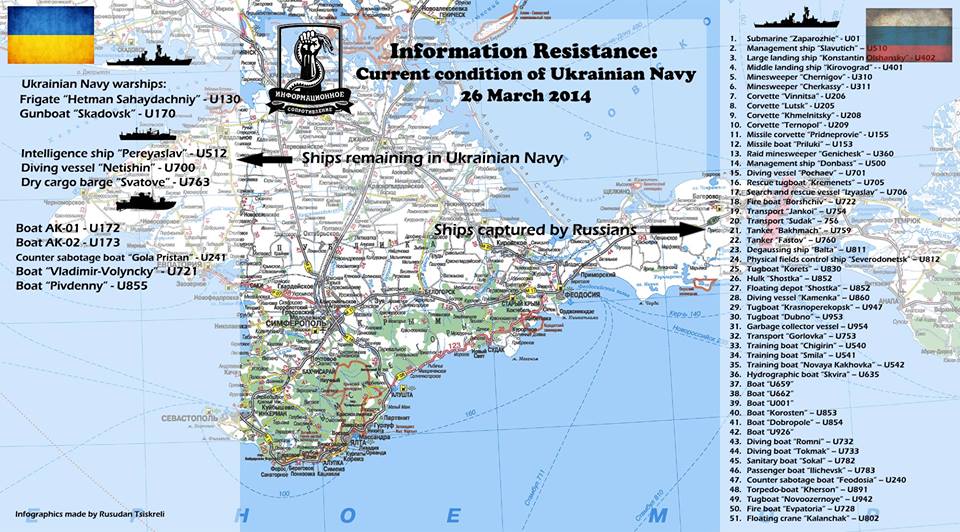
The Kyiv Post has a report including this graphic, showing the current state of Ukraine’s naval forces:

Ukraine ships captured by Russia - March 2014

Among the Ukrainian vessels reportedly captured by the Russians are submarine Zaporizhia, management ship Slavutych, landing ship Konstantin Olshansky, landing ship Kirovohrad, minesweeper Chernihiv and minesweeper Cherkasy.

The Cherkasy was the last of the ships to have been overtaken following weeks of threats and ultimatums to surrender. It was finally chased down and overtaken by the Russian navy on March 25 after failing to slip past a blockade of two ships intentionally sunk by the Russians to trap it and other vessels in a narrow gulf, keeping them from escaping into the Black Sea.

H/T to Tony Prudori for the link.

March 25, 2014

NATO’s existential moment

Filed under: Europe, Military, Russia — Tags: , , , , — Nicholas @ 09:35

In the Telegraph, Con Coughlin says that if NATO doesn’t stand up to Vladimir Putin’s aggressions, it’s done for:

For anyone who still takes the security of the West seriously — and I fear I am in a distinct minority — the manner in which Russian President Vladimir Putin has effortlessly achieved his audacious land grab in the Crimea should serve as a dramatic wake-up call for Nato.

And yet, to judge by the mood music coming from the meeting of Western leaders in The Hague this week, the likelihood of Nato doing anything to dissuade Moscow’s macho man from undertaking any further acts of military adventurism in central Europe or the Baltic states does not seem at all encouraging.

[…]

When faced with a crisis, the default position of Nato member states, as we have seen recently over Libya and Syria, is to bicker amongst themselves over how to respond, rather than coming up with an effective programme that safeguards its interests.

But if Nato leaders fail to come up with an adequate response to Putin’s new mood of military aggression, they might as well dissolve the alliance and start negotiating peace terms with Moscow.

NATO member states in blue, Ukraine in yellow, Russia in red (for tradition's sake)

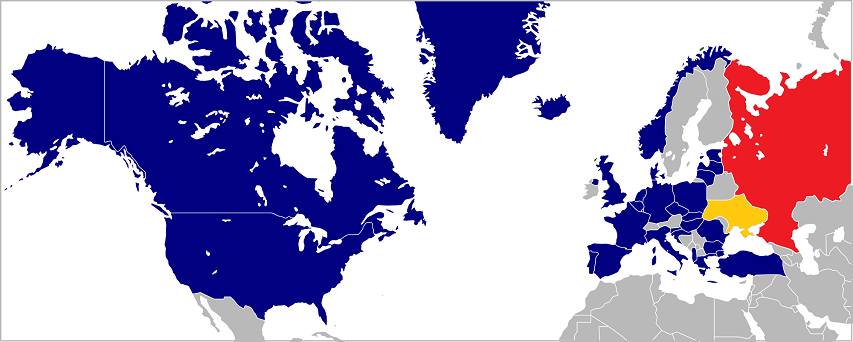
NATO member states in blue, Ukraine in yellow (including Crimea), Russia in red (for tradition’s sake)

Update: Poland is recalling reservists for military refresher training.

Next time you take a tray of tea and custard creams to the nice gang of Polish builders renovating your semi, they may seem a little distracted and anxious. Ask them why, and they will answer that some of them have in the last few weeks received call-up papers as army reservists.

This happened to a friend of mine in London at the end of last week. At least 7,000 reservists have been recalled to the colours for immediate exercises lasting between 10 and 30 days.

They’re told by the Polish authorities that the call-ups are “routine”: but the men say they haven’t been asked before and they’re well aware of the growing alarm in Warsaw at President Putin’s aggression. Three weeks ago, their Prime Minister, Donald Tusk, called a press conference to warn that “the world stands on the brink of conflict, the consequences of which are not foreseen… Not everyone in Europe is aware of this situation.”

My own view is that Putin was initially more concerned with righting a specific historical wrong in Crimea than starting a new Cold War. This is still probably the case despite the dawning truth that the EU/Nato Emperor really has no clothes at all.

But in the worst case scenario of a truly revanchist Russia, Poland certainly has the borders from hell. Starting from the top, it abuts Kaliningrad (the Russian exclave on the Baltic carved at the end of the war from East Prussia), Lithuania, Belarus and Ukraine.

March 7, 2014

Gunboat diplomacy for the 21st century

Filed under: Europe, Military, Russia, USA — Tags: , , , — Nicholas @ 08:38

680News reports that a US warship will be patrolling the Black Sea:

A U.S. Navy warship is heading to the Black Sea as tensions in Ukraine continue to divide world powers, according to multiple published reports.

Turkey has given the USS Truxtun permission to pass through the Bosphorus into the Black Sea.

U.S. officials say it is a “routine” deployment that was scheduled before the crisis erupted in Ukraine.

However, the show of military hardware is coinciding with NATO’s show of military support over Baltic countries with its use of air patrols and F-15 fighter jets.

Meantime, President Barack Obama’s warnings to Russia are being brushed aside by Russian President Vladimir Putin, who appears to only be speeding up efforts to formally stake his claim to Ukraine’s Crimean Peninsula.

The USS Truxtun is a new Arleigh Burke-class guided missile destroyer, commissioned in 2009.
While we may be relatively sure that the Truxtun is a powerful vessel (the Wikipedia article describes the class as “larger and more heavily armed than most previous ships classified as guided missile cruisers”), no single ship is going to be particularly effective in putting pressure on Russia over their Ukraine deployment. The Black Sea is a small body of water, geostrategically speaking, and is totally dominated by land-based airpower. Should the situation turn grave, Truxton isn’t likely to weigh heavily in the military balance. She’s there as a token, not as a military asset.

May 28, 2013

Charles Joseph Minard died for our (infographic) sins

Filed under: History, Media, Russia — Tags: , , , — Nicholas @ 00:01

Do you remember seeing the amazingly informative diagram by Charles Joseph Minard on the statistical side of Napoleon’s disastrous march on Moscow:

Charles Joseph Minard's famous graph showing the decreasing size of the Grande Armée as it marches to Moscow (brown line, from left to right) and back (black line, from right to left) with the size of the army equal to the width of the line. Temperature is plotted on the lower graph for the return journey (Multiply Réaumur temperatures by 1¼ to get Celsius, e.g. −30 °R = −37.5 °C)

Charles Joseph Minard’s famous graph showing the decreasing size of the Grande Armée as it marches to Moscow (brown line, from left to right) and back (black line, from right to left) with the size of the army equal to the width of the line. Temperature is plotted on the lower graph for the return journey (Multiply Réaumur temperatures by 1¼ to get Celsius, e.g. −30 °R = −37.5 °C)

That is what a really good infographic can be. But, as Tim Harford points out, they’re not all that good:

Camouflage usually means blending in. That wasn’t an option for the submarine-dodging battleships of a century ago, which advertised their presence against an ever-changing sea and sky with bow waves and smokestacks. And so dazzle camouflage was born, an abstract riot of squiggles and harlequin patterns. It wasn’t hard to spot a dazzle ship but the challenge for the periscope operator was quickly to judge a ship’s speed and direction before firing a torpedo on a ponderous intercept. Dazzle camouflage was intended to provoke misjudgments, and there is some evidence that it worked.

Now let’s talk about data visualisation, the latest fashion in numerate journalism, albeit one that harks back to the likes of Florence Nightingale. She was not only the most famous nurse in history but the creator of a beautiful visualisation technique, the “Coxcomb diagram”, and the first woman to be elected as a member of the Royal Statistical Society.

Data visualisation creates powerful, elegant images from complex data. It’s like good prose: a pleasure to experience and a force for good in the right hands, but also seductive and potentially deceptive. Because we have less experience of data visualisation than of rhetoric, we are naive, and allow ourselves to be dazzled. Too much data visualisation is the statistical equivalent of dazzle camouflage: striking looks grab our attention but either fail to convey useful information or actively misdirect us.

[. . .]

Those beautiful Coxcomb diagrams are no exception. They show the causes of mortality in the Crimean war, and make a powerful case that better hygiene saved lives. But Hugh Small, a biographer of Nightingale, argues that she chose the Coxcomb diagram in order to make exactly this case. A simple bar chart would have been clearer: too clear for Nightingale’s purposes, because it suggested that winter was as much of a killer as poor hygiene was. Nightingale’s presentation of data was masterful. It was also designed not to inform but to persuade. When we look at modern data visualisations, we should remember that.

August 28, 2012

Rehabilitating Florence Nightingale’s reputation

Filed under: Britain, Health, History, Military, Russia — Tags: , , , , — Nicholas @ 08:31

History Today has a defence of the much-maligned Florence Nightingale:

Jamaican-born Mary Seacole (1805-81), voted top of the list of the 2004 ‘100 Great Black Britons’ poll, is now slated to replace Florence Nightingale (1820-1910) as the true ‘heroine’ of the Crimean War. She is to be honoured as no less than the ‘Pioneer Nurse’ with a massive statue to be erected at St Thomas’ Hospital in London. This in spite of the strong links between Nightingale and the hospital, her base for over 40 years. It was there she established the first secular school for nurses in 1860 with funds raised in her name for her work in the Crimean War during the conflict of 1854-56. The Nightingale School operated for over a century from the hospital, whose redesign in the 1860s Nightingale also influenced.

[. . .]

The campaign promoting Seacole over Nightingale builds on 30 years of books, articles and films denigrating the latter. While she always had detractors, the serious assault on Nightingale’s reputation can be dated to 1982, with the publication of the Australian historian F.B. Smith’s Florence Nightingale: Reputation and Power (Croom Helm, 1982). The next major hit came in 1998 with Florence Nightingale: Avenging Angel (Constable, 1998) by a retired management consultant Hugh Small, which argues that Nightingale was actually responsible for the high death rates of the Crimean War and had a nervous breakdown as a result when she supposedly recognised this. Neither claim is supported by any serious documentation. Social media goes even further: see Facebook ‘Florence Nightingale was a Murdering Bitch’, later renamed ‘Florence Nightingale: The World’s Worst Nurse’, where she is described as a ‘deluded power hungry bitch’, who ‘looks like an uptight bitch’, so that ‘the day she died’ was ‘the best thing that ever happened to the field of nursing’.

[. . .]

The French were the instigators of the Crimean War, sent more troops and were better prepared than the British. Their death rates were lower in the first year. But the British government learned from the commissions it sent out and made enormous changes. British death rates fell dramatically, from 23 per cent in the first winter to 2.5 per cent in the second — no greater than deaths among soldiers in peacetime barracks in London, as Nightingale proudly showed in a chart. In contrast, the French (lower) 11 per cent death rate in the first winter, rose to 20 per cent in the second winter. Since the French were late in publishing their statistics, neither Nightingale nor the royal commission could use them for comparison. However French doctors themselves credited the British reforms for their superior performance. Once they were properly cleansed and functioning Nightingale was proud of the Crimean hospitals. In her own charts she separated the two periods, before and after the sanitary and supply commissions, to emphasise the crucial role they played in reducing mortality.

Her analysis of what went wrong was widely accepted and led to major changes to health care in the British Army. The ‘Nightingale Fund’ raised in her honour for that work paid for the training school at St Thomas’, which led to raising nursing to the level of a profession throughout much of the world. Her experience of the war, and her reputation and research as a result of it, grounded all the social and public health work she did for the rest of her life. Her vision for health reform included bold statements, such as the belief that the poor should receive as good quality hospital care as private patients and warnings as to the dangers of hospital acquired infections. Nightingale, in short, is no mere historical figure. Her lamp should not be retired but shone brightly onto the hospital and health care problems of today.

April 7, 2011

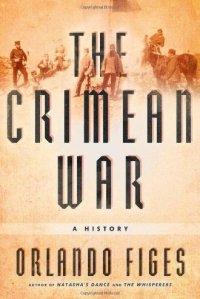
Briefly noted – The Crimean War by Orlando Figes

Filed under: Britain, France, History, Middle East, Russia — Tags: , — Nicholas @ 13:24

I just picked this up last night at the “World’s Biggest Bookstore” in Toronto. I’m quite enjoying it, as it discusses much more than just the war itself: about 50 pages in, I think I’ve learned far more about middle eastern history and Russia’s geostrategic problems.

The various books and articles I’ve read on this conflict have pretty uniformly concentrated on the purely military aspects, and generally just on the battles involving British and French troops. One reason for the relative obscurity of such a major conflict is that the background is essential to understand just why Britain and France were fighting Russia on the Black Sea coast. Without that background, the war appears totally senseless and this is heightened by the well-worn tales of military incompetence (the Charge of the Light Brigade), brief moments of heroism (the “Thin Red Line”), and criminally awful medical and sanitary situation (Florence Nightingale).

If the remaining 450 pages are as good as the first 50, this will be one of my candidates for book of the year.

May 17, 2010

Bureaucracy, Crimean War style

Filed under: Britain, Bureaucracy, History, Military, Russia — Tags: , — Nicholas @ 08:39

A. A. Nofi reminds us that no matter what the technology of the day, the bureaucracy is eternal:

One night a particularly exposed British redoubt suddenly found itself the object of a strong Russian attack. Although the British managed to hold the Russians, they were consuming ammunition at a prodigious rate.

Fearing that his position would soon be overrun, the officer commanding the post tore a leaf from a pocket note book. On it he scrawled “In great danger. Enemy pressing hotly. For Heaven’s sake send us some ammunition,” the officer signed his name, handed it to an orderly and sent the man to the rear.

The fighting grew more intense, and as ammunition began running low the officer awaited the return of his messenger. Time passed, as the situation seemed to grow ever more desperate. Then, almost as suddenly as it began, the Russian assault ebbed, even as the British troops were virtually down to their last rounds.

Just about then the orderly returned, bearing a message from the Ordnance officer. One wonders what went through the officer’s mind when he read, “All communications to this Department must be written on foolscap paper with a two-inch margin.”

« Newer Posts

Powered by WordPress