Quotulatiousness

November 27, 2019

The Deep State versus the President

Filed under: Bureaucracy, Government, Politics, USA — Tags: , — Nicholas @ 03:00

David P. Goldman reviews a new book by Andrew McCarthy on the ongoing conflict between the elected President of the United States and the permanent bureaucracy:

Donald Trump addresses a rally in Nashville, TN in March 2017.
Photo released by the Office of the President of the United States via Wikimedia Commons.

America’s Central Intelligence Agency in concert with foreign intelligence services manufactured the myth of Donald Trump’s alleged collusion with Russia, argues Andrew McCarthy, a distinguished federal prosecutor turned public intellectual.

A contributor to Fox News and a prolific writer for The National Review and other conservative media, McCarthy well knows how to build a case and argue it before a jury. His latest book Ball of Collusion should be read carefully by everyone with an interest in American politics. It is exhaustively documented and brilliantly argued, and brings a wealth of evidence to bear on behalf of his thesis that an insular, self-perpetuating Establishment conspired to sandbag an outsider who threatened its perspectives and perquisites.

From my vantage point as an American, the constitutional issue is paramount: The American people elected Donald Trump, and it is horrifying to consider the possibility that a cabal of unelected civil servants supported by the mainstream media might nullify a presidential election. That is why I support the president unequivocally and without hesitation against his detractors.

But this sordid business has deep implications for America’s allies as well as her rivals. Trump is not a popular president overseas, except in Poland, Hungary, and Israel. In the eyes of polite opinion, McCarthy writes, “Donald Trump was anathema: a know-nothing narcissist – as uncouth as Queens – riding a populist-nationalist wave of fellow yahoos that threatened their tidy, multilateral post-World War II order.” China (and not only China) views Trump as a bully who presses American advantage at the risk of disruption to the global economy.

Donald Trump has one quality for which the rest of the world should be grateful: He really does not care how China, Russia, or any other country manages its affairs. By “America First,” he simply means that he cares about what happens in America, and is incurious about what happens outside America unless it affects his country directly. That stands in sharp contrast to view of all the wings of America’s political Establishment – progressive, “realist” and neoconservative – who believe that America should bring about the millenarian End of History by bringing democracy to Iraq and Afghanistan, by expanding NATO into a giant social-engineering project, by pressing China to transform itself into a Western-style democracy, and so forth.

McCarthy reports in persuasive detail how the spooks set up the president. There is more to be said, though, about why they did it. I will summarize McCarthy’s findings, and afterward discuss the motivation.

November 23, 2019

Sir Charles Trevelyan, head of the Irish relief efforts during the potato famine, and creator of the modern civil service

By happenstance, after posting the OSP video on the history of Ireland, a post at Samizdata covered one of the questions I had from OSP’s summary, specifically that the famine was worsened by British “laissez-faire mercantilism”. Mercantilism is rather different from any kind of laissez-faire system, so it was puzzling to hear Blue link them together as though they were the same thing. Of course, I live in a province currently governed by the Progressive Conservative party, so it’s not like I’m unable to process oxymorons as they go by…

Anyway, this post by Paul Marks looks at the man in charge of the relief efforts:

Part of the story of Sir Charles Trevelyan is fairly well known and accurately told. Charles Trevelyan was head of the relief efforts in Ireland under Russell’s government in the late 1840s – on his watch about a million Irish people died and millions more fled the country. But rather than being punished, or even dismissed in disgrace, Trevelyan was granted honours, made a Knight Commander of the Order of the Bath (KCB) and later made a Baronet, not bad for the son of the Cornishman clergyman. He went on to the create the modern British Civil Service – which dominates modern life in in the United Kingdom.

Charles Edward Trevelyan (contemporary lithograph). This appeared in one of the volumes of “The drawing-room portrait gallery of eminent personages principally from photographs by Mayall, many in Her Majesty’s private collection, and from the studios of the most celebrated photographers in the Kingdom / engraved on steel, under the direction of D.J. Pound; with memoirs by the most able authors”. Many libraries own copies.
Public domain, via Wikimedia.

With Sir Edwin Chadwick (the early 19th century follower of Jeremy Bentham who wrote many reports on local and national problems in Britain – with the recommended solution always being more local or central government officials, spending and regulations), Sir Charles Trevelyan could well be described as one of the key creators of modern government. If, for example, one wonders why General Douglas Haig was not dismissed in disgrace after July 1st 1916, the first day of the Battle of the Somme when twenty thousand British soldiers were killed and thirty thousand wounded for no real gain (the only officers being sent home in disgrace being those officers who had saved some of them men by ordering them stop attacking – against the orders of General Haig), then the case of Sir Charles Trevelyan is key – the results of his decisions were awful, but his paperwork was always perfect (as was the paperwork of Haig and his staff). The United Kingdom had ceased to be a society that always judged someone on their success or failure in their task – it had become, at least partly, a bureaucratic society where people were judged on their words and their paperwork. A General, in order to be great, did not need to win battles or capture important cities – what they needed to do was write official reports in the correct administrative manner, and a famine relief administrator did not have to actually save the population he was in charge of saving – what he had to do was follow (and, in the case of Sir Charles, actually invent) the correct administrative procedures.

But here is where the story gets strange – every source I have ever seen in my life, has described Sir Charles Trevelyan as a supporter of “Laissez Faire” (French for, basically, “leave alone”) “non-interventionist” “minimal government” and his policies are described in like manner. […]

Which probably explains why Blue used the term in the previous video. Then these “laissez-faire” policies are summarized, which leads to this:

None of the above is anything to do with “laissez faire” it is, basically, the opposite. Reality is being inverted by the claim that a laissez faire policy was followed in Ireland. A possible counter argument to all this would go as follows – “Sir Charles Trevelyan was a supporter of laissez faire – he did not follow laissez faire in the case of Ireland, but because he was so famous for rolling back the state elsewhere (whilst spawning the modern Civil Service) – it was assumed that he must have done so in the case of Ireland“, but does even that argument stand up? I do not believe it does. Certainly Sir Charles Trevelyan could talk in a pro free market way (just as General Haig could talk about military tactics – and sound every inch the “educated soldier”), but what did he actually do when he was NOT in Ireland?

I cannot think of any aspect of government in the bigger island of the then UK (Britain) that Sir Charles Trevelyan rolled back. And in India (no surprise – the man was part of “the Raj”) he is most associated with government road building (although at least the roads went to actual places in India – they were not “from nowhere to nowhere”) and other government “infrastructure”, and also with the spread of government schools in India. Trevelyan was passionately devoted to the spread of government schools in India – this may be a noble aim, but it is not exactly a roll-back-the-state aim. Still less a “radical”, “fanatical” devotion to “laissez faire“.

November 19, 2019

No matter who you vote for the (permanent) government always gets in

Filed under: Bureaucracy, Government, Politics — Tags: , — Nicholas @ 05:00

Arthur Chrenkoff on the differences between the theoretical role of civil servants and what they actually do:

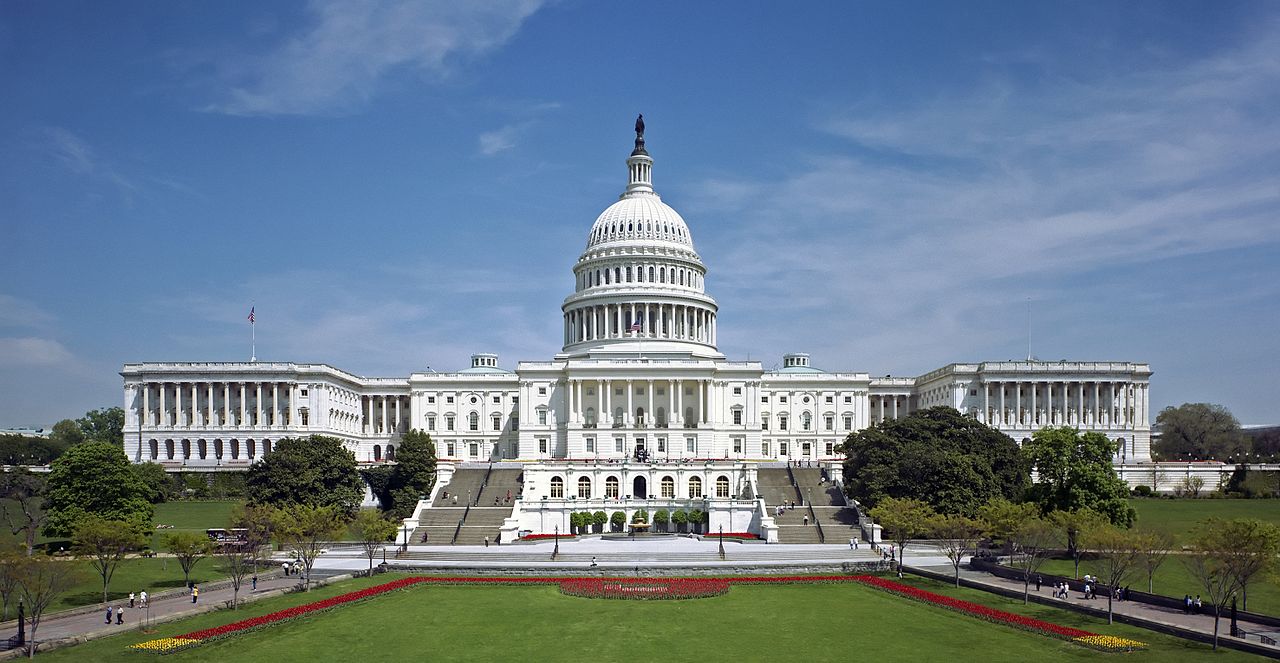
The western front of the United States Capitol. The Neoclassical style building is located in Washington, D.C., on top of Capitol Hill at the east end of the National Mall. The Capitol was designated a National Historic Landmark in 1960.
Photo via Wikimedia Commons.

Public servants consider themselves more intelligent and expert in their areas of competence than politicians. In many cases they are right. This only adds to the frustration. Because it’s not the job of public servants to make policy but to give advice to elected officials and to implement their decisions. And it certainly is not their job, if elected officials choose not to accept and act on that advice, to sabotage their efforts or even try to engineer the downfall of their political masters.

If you are a public servants who disagrees with the direction the politicians are taking, you have a simple, binary choice: you can clench your teeth, stay in your job and implement the politicians’ will or you can resign – at which stage you have every right as a concerned citizen to publicly campaign against people and policies you disagree with. There are more legitimate avenues of dissent and opposition outside than inside the system.

The ideal of the public service is a completely apolitical and impartial workforce, which faithfully assists government of the day in implementing its agenda, whatever that agenda might be. The reality is that while many bureaucrats are able to separate their personal beliefs from their professional duty, some can’t and won’t. For the reasons that are both obvious and unnecessary to go into detail here, public sector attracts those on the left, the way private sector attracts those on the right. Thus, left wing governments rarely encounter the problem of bureaucratic dissent, unless they really act out of the traditional left-wing box. The right wing governments, by contrast, face at best dutiful but unenthusiastic and sullen cooperation. There are no vast and organised conspiracies; this is a systemic phenomenon where organisations are required to do things that go against the conventional institutional wisdom and against the individual beliefs of the majority of members who shape the informal internal culture. This is the Shallow State. Bureaucracy will always cheer on the expansion of its numbers and powers and shriek at the prospect of shrinking the state. It will embrace and run with the policies it approves and stumble with the policies it doesn’t.

Forgetting the rank and file of the public service, which is unmovable and unchangeable, the reason why new governments enjoy the power of key appointments, including diplomatic ones, is not simply the patronage of rewarding supporters and the faithful but more importantly ensuring that the key administrative positions in bureaucracy are occupied by people who share their vision and can therefore be counted on to enthusiastically pursue the government’s agenda within the particular organisation. This, of course, only kicks the basic problem down the line, in that the top government appointees then have to struggle with the “permanent” employees on the levels below. The lower ranks might still succeed in frustrating their superiors, or worse, in “capturing” the political appointees by converting them to the institutional consensus. But for the government, having its own people in top positions is better than having no support at all. In an ideal world, of course, none of this would be necessary and happening because the impartial public service would be working well with whoever is in power. This is not an ideal world; certainly not for right wing governments. The Shallow State is always the reality. The Deep State is nothing more and nothing less than the Shallow State going well beyond the usual sullen uncooperativeness and taking a particularly strong stance against the government they disagree with. It’s a difference between passive resistance and active resistance.

It is not the job of bureaucracy to resist the government. Hence the current vogue for insubordination and sabotage is necessitating a rather radical redefinition of public service. Recently, we seem to have finally crossed the threshold from years of obfuscation (“The Deep State is a right wing conspiracy theory”) to acknowledging the reality (“The Deep State are patriots trying to protect America and the American people from the president”). But for all the talk about the supposed collusion, treason, crimes and corruption of the Trump administration, which could thus justify the resistance, the only thing that the endless agitation and investigation has succeeded in showing over the past three years is policy differences. Quite simply, the public service is vehemently opposed to the president’s views on a whole range of matters, and they are outraged that he has not followed their conventional wisdom.

November 15, 2019

“In a functioning system, the head of the government sets foreign policy and the diplomats enact it. So naturally there’s not a chance of that in Washington”

Filed under: Bureaucracy, Government, Politics, Russia, USA — Tags: , , , — Nicholas @ 03:00

Mark Steyn on the foggiest of Foggy Bottom diplomatic bafflegab on the first day of the :

Yesterday I caught a bit of the impeachment theatre en route to a lunchtime speaking engagement. To be honest, if they’d come round and performed it live in my hotel room, I’d still have fled. If universally respected eminent lifelong career foreign-service bigshots Bill Taylor and George Kent are Adam Schiff’s star witnesses, their chief purpose seems to be to get Democrats pining for the charisma of Bill de Blasio and the self-effacement of John Kerry.

In a functioning system, the head of the government sets foreign policy and the diplomats enact it. So naturally there’s not a chance of that in Washington. When Taylor and Kent whine that there seemed to be a “shadow foreign policy”, the shadow is theirs; they spent a day testifying that everything had been going ticketty-boo for decades just as they’d always done things – and then Trump came along and took a different view. Oh, my! Anyone would think that, as Barack Obama once proposed, “elections have consequences”.

First up was George Kent, the “Deputy Assistant Secretary of State for Eastern Europe and the Caucasus”. He warmed up the crowd with some extensive biographical material about the “nearly sixty years” of George Kents (I believe he’s George III or some such) who have “chosen” to endow America with the blessings of their “public service”. It didn’t help that he wore a bow tie. Eventually he stopped talking about himself and started talking about Ukraine:

    Our strategic aim for the entirety of my foreign service career is not possible without a Ukraine whole, free, and at peace, including Crimea and Donbas, territories currently occupied by Russia.

Crimea is, of course, familiar to anyone who’s read “The Charge of the Light Brigade”:

    Theirs not to reason why
    Theirs but to do or die…

Or, in the case of low-level diplomats who’ve never had a single conversation with the President, theirs not to reason why, theirs but to do or tender their resignations after first ensuring that their pensions won’t be affected. Instead:

    Into the valley of the SCIF
    Rode the six hundred hearsay witnesses…

As I said, any Tom, Dick or Harry can bandy Crimea, but it takes a career striped-pants Foggy Bottom public servant to toss in “Donbas” with gay abandon. It would have been interesting to see whether Adam Schiff or anyone else in the room could have found Donbas on a map. The odds of pinning the tail on the Donbas blindfolded are better. It’s bordered to the north, east and south-east by Russia, so it’s akin to the Russian foreign ministry regarding northern Mexico as a vital national-security interest of Moscow’s.

In fact, northern Mexico is a vital national-security interest of America’s, but, under the mass wankerization of public policy, Perma-Beltway cares more about the borders of Ukraine than it does about the borders of the United States.

October 25, 2019

Civil servants tend to be of the left … this should be no surprise to anyone

Filed under: Bureaucracy, Government, Politics, USA — Tags: , — Nicholas @ 03:00

Arthur Chrenkoff on the political tendencies of people who work for the government:

The western front of the United States Capitol.
Photo via Wikimedia Commons.

You could believe the whole “protect[ing] the interests… of the American people” shtick if after all this time and the incalculable amount of energy and effort expended on bringing down the President, all those patriotic public servants have been able to show something – anything – for it. So instead of disinterested paragons of civic virtue, it increasingly looks like the federal bureaucracy is full of hard core progressives and liberals who can’t stomach a non-Democrat usurper who doesn’t share their values, ideas and objectives.

It’s not a shocking revelation that public service is overwhelmingly staffed by left-of-centre people. Government work attracts the left the same way that private sector and military attract the right. The left believes in the power of government to affect change and implement its vision. Even the spooks are no different. A couple of years ago I wrote briefly about the myth that the intelligence community is a hive of shady right-wing types. In reality, the CIA – just like the Department of Education – has always been a liberal institution. That so many people believe that the intelligence community is some sort of a vast-right wing conspiracy instead of another part of the liberal establishment, is a testament to the narrative power of the far-left, for whom indeed anyone to the right of selves is right wing, including everyone from John F Kennedy to Hillary Clinton.

Most public servants can be professional enough to work under any government, even if they would clearly prefer that government to be of the left – forever. But others can’t stomach working for people whom they believe not merely wrong but positively evil. The honourable thing to do in such circumstances, of course, is to resign; if you can’t in good conscience work to implement policies you strenuously object to, you should make room for someone who can. But why quit your often lucrative job and watch from the sidelines as the country is in your opinion going to hell in a hand basket, when you can stay on and try to sabotage the government and save the world? Thus you can convince yourself you are protecting the people, even if in reality it’s the people who voted in your new, unsavoury masters. It’s easy if you try; like so many others in the recent past you can argue that the people did not in fact elect the government, which is therefore illegitimate, or you can default to the standard left-wing position that the people don’t know what’s good for them, so their democratic choice as expressed at the ballot box has no decisive meaning. We know what’s best for everyone, hence taking a different position is equated to “the war on… expertise”.

It’s an interesting, if of course also self-serving theory, that public servants don’t work for the government of the day, but for “the people”. As Cottle’s logic demonstrates, it gives you a licence to essentially do whatever you want instead of what your political bosses tell you. The problem, as I mentioned above, is that “the people” don’t vote for bureaucrats, they vote for their elected representatives, based on which policy program they like best – or hate least. Seeing that we – still – live in a democracy, the people are given the opportunity to judge their politicians every few years. If they consider that their interests have been negatively affected by the executive’s excesses, they will vote somebody else in. The problem is that the progressives only like the people if the people agree with them. By and large, however, the people can’t be trusted; like children or mentally handicapped they need someone – like the government, or if the government is in hostile hands, the public service – to look after them. It’s the unspoken technocratic mantra and it justifies the existence of an in loco parentis state, deep or otherwise.

September 25, 2019

QotD: Big government is not human

Filed under: Bureaucracy, Government, Quotations — Tags: , , — Nicholas @ 01:00

An email from a correspondent, who is not in Guam, reminds me to remind gentle reader of a truth I take for self-evident, but perhaps others don’t. We personalize the State. I do myself, when I refer to it as Big Brother, Big Sister, Twisted Nanny, &c. But this is a conceit. As anyone caught in the jaws of Big Shark should realize, it doesn’t think like a human. It thinks more like a mechanism. Of course, when the mechanism has selected one’s own person for food — I am thinking here of the Revenue Department, but government agencies are all much the same — little can be done. One might beg for mercy, but the thing is not designed to dispense mercy. That is not its function. Its function is to absorb protein.

Guvmint agents themselves — the cells and their switches — are task-oriented. Each signed off his right to make humane judgements when he took the job.

We used to have reactionary courts, to restrain the creature. Now we have progressive courts, to urge it on.

Among the foibles of democracy, is the notion that “the peeple” are somehow in control. The people, however, consist of persons, with their quite various moral flaws, which tend to cancel each other. They elect politicians for show. This helps them put a human face on the enterprise, so they have someone to blame at the electoral intervals. It is true that a government with a majority and a will can alter the course of history: usually by putting more sharks in the tank. And that the policy wonks are, arguably, human. But they are cells themselves, within Leviathan.

We live, I say from time to time, in an age of “total war” and “total peace.” The one condition resembles the other: a command economy, focused on results. We have, as it were, totalitarianism with a human face. It is a kind of smiley face, painted on the tip of the missile.

David Warren, “Notes from the sheepfold”, Essays in Idleness, 2017-08-11.

August 19, 2019

UBI: threat or menace?

Filed under: Economics, Government, Politics — Tags: , , , — Nicholas @ 03:00

At Samizdata, Samizdata Illuminatus outlines the arguments for some form of Universal Basic Income (UBI) or Negative Income Tax (NIT) and argues that it’s a terrible idea that should not be implemented anywhere:

Cartoon that appeared with Michael K. Spencer’s article “Is Universal Basic Income really a solution?” at https://medium.com/@Michael_Spencer/is-universal-basic-income-really-a-solution-c0d6d95f100e

For those that are not familiar with the term, UBI (Universal Basic Income) means, roughly, “the government should guarantee everyone some minimum level of income whether they work or not”.

The notion began simply enough. Some economists observed that there are a myriad of intersecting government programs for the poor (in many countries, dozens) which distort behaviour in horrible ways and which cost a fortune in overhead to administer. This is where the problem of UBI begins, in the hubris of the armchair philosopher. “What if”, these economists asked, “we can’t get rid of the dole entirely (even though that would be better) but we could at least make it efficient by replacing the entire morass with a single program, say a negative income tax?”

Trained to explore ideas (no matter how bad) for a living, said academic economists then vigorously explored this impossible hypothetical world in which they could not get rid of the dole but could somehow get politicians to perfectly implement their hypothetical improved alternative, and proceeded to write lots of papers about it.

Again, this academic musing was already a utopian impossibility, for in the real world, there are interests that would act to block the elimination of existing welfare schemes and insist that the new scheme be added to the current ones rather than replacing them. This sort of thing is routine, of course; originally, VAT schemes were thought of by academic economists as a less distorting replacement for income taxes but ended up added in addition.

The interest groups arrayed against replacement of existing welfare schemes range from the bureaucrats whose job it is to administer said schemes (and who for whom “efficiency” means unemployment), to the vast range of contractors employed in providing benefits of one sort or another, to the politicians who get votes and power in exchange for largesse paid for with other people’s money, to the current recipients of existing benefit schemes who will correctly reason that the notion behind “efficiency” is not to increase their benefits. There’s no advantage in replacement for any member of the existing system, and thus, it was a non-starter to begin with.

This did not, however, prevent many people from falling in love with the idea, as wouldn’t-it-be-ever-so-elegant-if-it-could-happen so often trumps this-is-reality in the minds of those saying “what if” over a pint or seven late in the evening at the pub next to the economics department offices.

Oh, and of course, a form of the negative income tax was created in the United States under the name of the “earned income tax credit”; as might have been predicted in advance, it was added to existing welfare programs rather than in any way replacing them.

From this simple yet benighted beginning as a completely unrealistic thought experiment, the idea of UBI gained traction and then, as most cancers do, developed a mutant and even more virulent cell line, one that allowed it to spread and grow in the minds not only of leftists (who are already inclined towards redistribution of all sorts) but those on the right who are inclined to view ordinary people as useless.

We are now informed that UBI is a solution to a different problem as well. We are informed, in not-so-hushed tones, that the rise of new technologies like Artificial Intelligence will soon automate away most jobs, resulting in a vast class of people who will be unemployable in any trade whatsoever, which will consequently lead to mass unemployment, and that said permanently unemployable people will starve to death if we don’t find ways to provide them with income.

We are told we thus must guarantee a minimum income for all, without regard to whether they are capable of earning a living on their own, or we’ll have riots on our hands once AI based systems become ubiquitous. They claim that we should, nay, must, promise everyone some minimal subsistence income, whether they work or not. This will provide the masses with the ability to survive, and thus society will be preserved.

June 4, 2019

What do you get for your tax money?

Filed under: Britain, Bureaucracy, Government — Tags: , , — Nicholas @ 05:00

Alex Noble conducts a small experiment:

I suggest we stop thinking about taxes as paying for something useful – this type of thinking paralyses us and causes us to refuse to do that which needs doing. Because our taxes are supposed to pay for it.

We are no longer charitable, because our taxes pay for dole money.
We no longer look after the verge outside our homes, because our taxes are supposed to pay for a council worker with a strimmer.
We don’t repair potholes in our roads, because council workmen are supposed to fill them in.

Just to check that last one, I contacted my local council.

    “I was wondering if I could personally pay a local company to make repairs to the potholes that are causing damage to my car out of my money, and if so, would they be granted permission to close the road while my privately-funded repairs were being carried out?”

And they said…………

    “It would not be possible for you undertake these repairs, and no permission would be given to close the road.”

So I proposed I make a payment to them, to be spent on repairing the road:

    “…could I instead make a voluntary tax contribution on the condition the money is to be spent on these road repairs?”

And they said…

    “…the County Council will not accept payment from members of the public for the provision of highway maintenance over and above that already collected via the Council Tax”

I made one last attempt…

    “I have obtained quotes for the work which are acceptable to me and my neighbours – is there really no way we can as private individuals simply pay for the repairs to our road?”

They responded:

    “…it is not possible to accept any from of funding other than that accepted via the Council Tax and Central Government.”

So I just went out and bought a bag of sand and pounded it into the hole one night. A temporary fix, admittedly.

£5 of sand and five minutes of my time.

No doubt the council are scouring CCTV as we speak in an attempt to bring to justice the criminal that repaired the road.

May 18, 2019

Justin Trudeau expects more than just ordinary loyalty from civil servants

Filed under: Cancon, Government, Politics — Tags: , , , — Nicholas @ 03:00

In the Post Millennial, Mika Ryu summarizes Trudeau’s un-statesman-like behaviour through the Admiral Norman persecution — including his decision not to be in the house when a motion was passed apologizing to Norman — and offers an explanation for Trudeau’s oddities:

… according to a Globe and Mail report published around 6am on Friday by their Ottawa Bureau Chief Robert Fife, who also broke the SNC-Lavalin story in February of this year.

In the new bombshell report, Mr. Trudeau is alleged to have been furious about the leak that prevented the Liberal government from cancelling a massive ship building contract that was already well on its way to being executed.

The prime minister is alleged to have felt “betrayed” by the leak, after “all he had done” for the public service after a decade under Harper. This is very similar to the reason why he yelled at MP Celina Caesar-Chavannes when she told him that she would not run for re-election.

It is becoming clear that defeating Harper has turned Trudeau into a hero in his own mind, for which the entire country and all of its citizen owe him an infinite debt.

It was already known that the Privy Council Office had called in the RCMP to investigate the person behind the collapse of a would-be sweetheart deal for the well-connected “Rockefellers of Atlantic Canada”. This was a very unusual move, which was supported by alleged “Irving’s Boy”.

It continues to paint a troubling picture of the prime minister, a man who perhaps might not have “been so forward” with his corruption if he knew that the national newspapers would report on it, even in the face of the state’s increasing use of sinister carrots and sticks in the run-up to the election.

April 18, 2019

QotD: Roadblocks to deregulating the US healthcare market

Filed under: Bureaucracy, Government, Health, Quotations, USA — Tags: , , , — Nicholas @ 01:00

One problem America has is simply that our government administration isn’t very good. That’s not true across the board — our government statistics are, IMHO, the finest in the world. But there’s stuff that other countries can do that we can’t, either because our government is more decentralized, or because our civil service just isn’t as prestigious (and therefore as full of competent, motivated people) as those in other countries. And our regulatory approach — rules rather than principles based, and highly adversarial — is also suboptimal, and hard to change.

Given how much the government now interferes in health care, that’s a big problem. Given our lack of administrative competency, our first step should be pulling back where we can — trying to push more ordinary expenses onto consumers, for example, who can manage those the same way they manage their aspirin and antacid purchases now. And eliminating the tax deduction for employer sponsored health care would be major. But I fear, politically impossible.

Megan McArdle, “Ask Me Anything”, Reddit, 2017-04-10.

December 29, 2018

English public health officials angling to ban most restaurant meals due to excess calorie counts

Filed under: Britain, Bureaucracy, Food, Government, Health — Tags: , — Nicholas @ 05:00

The bureaucrats at Public Health England (PHE) apparently want the English to go back to those gloriously hungry days of rationing during and after the Second World War, at least based on their diktats on the allowable limits for calories in purchased meals:

The idea of the government controlling the number of calories in meals is so outlandish that few people have taken it seriously, despite PHE explicitly stating that this is what they are working on. They have been busy setting calorie limits for almost every food product available in shops, cafés, pubs and restaurants. The plan was to publish them in the spring but Laura Donnelly at the Telegraph has got hold of them and has leaked them today.

They are astonishing, not only because they are so low but because they are so comically precise. Sandwiches and main meal salads will be capped at 550 calories, ready meals will be capped at 544 calories and main courses in restaurants will be capped at 951 calories. Vol-au-vents or onion bhajis will be capped at 134 calories and salad dressing capped at 145 calories. The spurious precision of these numbers is presumably meant to imply that they have been worked out scientifically. They haven’t, of course (why is OK to have a 900 calorie lunch in a restaurant but not OK to have a 600 calorie microwave dinner?). There is no way of working out how much energy a single meal should contain. The concept is ludicrous.

But the detailed proposals have infuriated manufacturers – who say they are far too complex and confusing to be workable.

No kidding.

These are not legal limits. Not yet. The plan is for the bureaucrats at PHE to ‘work with’ the food industry to magically remove calories from their products without destroying flavour. PHE have no knowledge to bring to the table so their part in the ‘partnership’ amounts to setting targets, issuing threats and naming and shaming businesses.

Some of the companies will attempt to play along, mainly by reducing portion sizes, but it is a doomed enterprise. The government initially planed to use the threat of advertising restrictions to make the companies play ball, but it has already capitulated to the ‘public health’ lobby on this, so the only thing left is to threaten them with mandatory calorie limits.

If that happens, it will mean an effective prohibition on many of Britain’s best loved dishes. Steak and kidney pudding far exceeds the 951 calorie limit for out-of-home food, as does ham, egg and chips, the all day breakfast, fish and chips, and beer and ale pie (based on Wetherspoons’ nutritional information). So does a normal Christmas dinner.

As for foreign cuisine, you can kiss goodbye to kebabs, curries, pizzas and Chinese food. But it’s a treat, you say! Tough luck. No exceptions.

December 23, 2018

Parliamentary renovations

Filed under: Cancon, Government — Tags: , , — Nicholas @ 05:00

Andrew Coyne on the as-yet unclear path forward for the required renovations to the Parliament buildings in Ottawa:

Centre Block on Parliament Hill in Ottawa.
Photo by S Nameirakpam via Wikimedia Commons.

… nobody seems to know much of anything about the project: not only how long it will take (Public Services and Procurement has already begun backing away from the original 10-year estimate for completion), but how much it will cost (just to move the Commons and Senate into their temporary digs in the West Block and Government Conference Centre, respectively, is estimated to cost over $1 billion; there are no cost estimates as yet for the renovation itself), or even what exactly it entails.

The building itself, constructed in 1916-27 after a fire destroyed the original, is part of the mystery: no one knows quite how it was built, or what went into it. Officials explain they will have to get in and gut the place before they can assess what needs to be done to restore it, let alone update it with such mod cons as air conditioning or Wi-Fi. But part of it is, as usual, a problem of governance. Responsibility for the project seems to have been assumed to be a matter between bureaucrats at Public Services and the House of Commons, who took it upon themselves to make decisions on project design, cost etc with little to no input from those affected: MPs, Senators, or staff, let alone the public who will have to pay for it all.

Not only has there been no consultation, there is no body formally tasked with conducting it: when the Commons Procedure and House Affairs Committee temporarily assigned itself the role last week, it was very much stepping into a void. Like the renovation itself, the oversight process gives every appearance of being improvised on the fly.

It’s all a little too symbolic: the renovation of the “people’s house,” the home of our democracy, is proceeding with no budget, no timetable, no plan and only the most rudimentary democratic oversight. The one consolation is that it is likely to get far worse.

Assuming MPs now get their hooks into it, and pouring through the breech after them every interest group and activist organization in the country, the whole thing is likely to devolve into the same chaotic tangle of cross-purposes that is the fate of every other attempt at large-scale collective enterprise in this country — Trans Mountain meets the Meech Lake Accord. There are children not yet born, I’d wager, who will be voting in their first election before this is completed, at a cost of God knows how many billions.

September 11, 2018

How the Media and Literati Class Determines the Politics of a Nation

Filed under: Britain, Government, Humour — Tags: , , — Nicholas @ 02:00

rubatirabbit
Published on 15 Oct 2016

From Yes Prime Minister S02E05 Power To The People

The prime minister intends to introduce a professor’s scheme for enacting bottom-up government. The civil service and reformists reacts to this scheme.

September 4, 2018

“So now we know what ‘the resistance’ really is. It’s the establishment”

Filed under: Government, Media, Politics, USA — Tags: , , , — Nicholas @ 03:00

Brendan O’Neill on the funeral of “maverick” Republican senator John McCain:

So now we know what ‘the resistance’ really is. It’s the establishment. It’s the old political order. It’s that late 20th-century political set, those out-of-touch managerial elites, who still cannot believe the electorate rejected them. That is the take-home message of the bizarre political spectacle that was the burial of John McCain, where this neocon in life has been transformed into a resistance leader in death: that while the anti-Trump movement might doll itself up as rebellious, and even borrow its name from those who resisted fascism in Europe in the mid 20th-century, in truth it is primarily about restoring the apparently cool, expert-driven rule of the old elites over what is viewed as the chaos of the populist Trump / Brexit era.

The response to McCain’s death has bordered on the surreal. The strangest aspect has been the self-conscious rebranding of McCain as a searing rebel. In death, this key establishment figure in the Republican Party, this military officer, senator, presidential candidate and enthusiastic backer of the exercise of US military power overseas, has been reimagined as a plucky battler for all that is good against a wicked, overbearing political machine. ‘John McCain’s funeral was the biggest resistance meeting yet’, said a headline in the New Yorker, alongside a photo of George W Bush, Bill Clinton, Hillary Clinton, Al Gore, and soldiers from the US Army, the most powerful military machine on Earth. This is ‘the resistance’ now: the former holders of extraordinary power, the invaders of foreign nations, the Washington establishment.

The New Yorker piece, like so much of the McCain commentary, praises to the heavens the anti-Trump theme of McCain’s funeral. McCain famously said Trump couldn’t attend his funeral. And that in itself was enough to win him the posthumous love of a liberal commentariat that now views everything through the binary moral framework of pro-Trump (evil, ill-informed, occasionally fascistic) and anti-Trump (decent, moral, on a par with the warriors against Nazism). Even better, though, was the fact that orators at the funeral, including McCain’s daughter Meghan and both Bush and Obama, used the church service to slam Trumpism, without explicitly mentioning it, and in the process to big-up what came before Trumpism, which of course was their rule, their politics, their establishment. The Washington political and media set might seem bitterly bipartisan, said the New Yorker writer, but it is also ‘more united’ in one important sense – ‘in its hatred of Donald Trump’.

[…]

The religious allusions, the talk of vengeance against Trump, the misremembering of McCain’s life so that it becomes a moral exemplar against the alleged crimes of Trumpism, exposes the infantile moralism of the so-called resistance. Albert Burneko, assessing some of the madder McCain commentary, says there is now a ‘condition’ that he calls ‘Resistance Brain’, where people display an ‘urge to grab and cling on to anything that seems, even a little bit, like it might be the thing that Finally Defeats Donald Trump’. Even if the thing they’re grabbing on to is actually a bad thing. Like a seemingly endless FBI investigation into the elected presidency. Or George W Bush, whose moral rehabilitation on the back of Anti-Trumpism has been extraordinary. Or neoconservatism: this was the scourge of liberal activists a decade ago, yet now its architects are praised because they subscribe to the religion of Anti-Trumpism. Being against Trump washes away all sins.

June 28, 2018

US Supreme Court rules on the Janus case

Filed under: Law, Liberty, Politics, USA — Tags: , , , , — Nicholas @ 05:00

Eric Boehm reported soon after the decision was announced on Wednesday morning:

More than four decades after the Supreme Court ruled that public sector workers could be required to pay dues to unions even if they do not join one, a 5–4 majority on the high court overturned that precedent in a closely watched case that could have major ramifications for the future of public sector unions.

“Under Illinois law, public employees are forced to subsi­dize a union, even if they choose not to join and strongly object to the positions the union takes in collective bar­gaining and related activities,” Justice Samuel Alito wrote in the majority opinion. “We conclude that this arrangement violates the free speech rights of nonmem­bers by compelling them to subsidize private speech on matters of substantial public concern.”

In the short-term, the ruling in Janus v. American Federation of State, County and Municipal Employees means that plaintiff Mark Janus was successful in his decade-long fight to prevent the union from taking $50 out of his paycheck every two weeks. Over the years, Janus estimates, he’s contributed more than $6,000 to the union.

More broadly, Wednesday’s ruling could end the automatic deduction of union dues from millions of public employees’ paychecks, forcing unions like AFSCME to convince workers to voluntarily contribute dues — something workers would do, presumably, only if they have a reason to do so.

“So many of us have been forced to pay for political speech and policy positions with which we disagree, just so we can keep our jobs. This is a victory for all of us,” said Janus in a statement. “The right to say ‘no’ to a union is just as important as the right to say ‘yes.’ Finally our rights have been restored.”

The ruling is “a landmark victory for rights of public-sector employees,” said Mark Mix, president of the National Right to Work Legal Defense Foundation, which supported Janus’ lawsuit.

While today’s ruling certainly shifts the balance towards worker freedom, groups like the National Right to Work Legal Defense Foundation, which represented Janus, say they are already prepared for additional rounds of litigation. In states that previously have embraced right-to-work policies, unions have often tried to make it as difficult as possible for workers to renounce their membership.

At Hot Air, Jazz Shaw highlights a few of the key points:

Justice Alito wrote the decision and it followed along with the expectations of those who watched the case play out before the court. Also as expected, this was a 5-4 decision, split along partisan lines. At the heart of Janus was the question of whether or not unions can forcibly extract dues from workers’ paychecks without the worker proactively volunteering to contribute. In parallel to that, the court had to determine whether or not those extracted fees, being put toward lobbying efforts, constituted involuntary political speech on the part of the worker. The ruling answers both questions definitively.

You can read the full decision here [PDF] but I’ve extracted a couple of the key points from the syllabus. First is the issue of whether the previous ruling in Abood (which went in the unions’ favor) erred in allowing the forcible extraction of dues. Alito leaves no room for doubt.

    The State’s extraction of agency fees from nonconsenting public sector employees violates the First Amendment. Abood erred in concluding otherwise, and stare decisis cannot support it. Abood is therefore overruled.

The second question was the one about subsidizing the speech of others when it runs contrary to your personal beliefs. Again, Alito is definitive.

    Forcing free and independent individuals to endorse ideas they find objectionable raises serious First Amendment concerns. E.g., West Virginia Bd. of Ed. v. Barnette, 319 U. S. 624, 633. That includes compelling a person to subsidize the speech of other private speakers.

A union official, Paul Shearon, the IFPTE Secretary-Treasurer, put out an immediate statement saying that this was based on, “a bogus free speech argument.” He went on to say that the justices voting in the majority “are little better than political hacks.” That was followed up by a threat to take it to the streets.

    In the short run, the Janus decision may hurt some unions financially, but in the long run it will serve to make unions and their members more militant and force a stronger culture of internal organizing. The recent statewide teacher strikes demonstrate that when public sector workers face limitations on their bargaining rights they take their case to the streets.

This is going to send shockwaves through not just the unions, but the Democratic Party at large. The amount of money that the unions flush into Democratic coffers every year is likely more than most of you imagine.

Steven Malanga in City Journal provides some rough figures on how much money was at stake for the unions and their political activities:

With the appointment of Justice Neil Gorsuch, unions feared the outcome of the Janus case. After all, many union members have stated that they would give up their memberships if the court ruled that compulsory fees were illegal. An officer of the Communications Workers of America, which represents government employees in New Jersey, told an AFL-CIO convention last fall that only 54 percent of its 60,000 members said that they would remain in the union if they could opt out of paying fees. The California Teachers Association, meanwhile, crafted a 2019 budget that anticipated that as many as 23,000 members would leave if the court overturned the Illinois law. The union will also suffer from the loss of revenues from 28,000 nonmembers who’ve been paying agency fees, and will presumably stop doing so now that they’re no longer compelled. The union, according to a published report, estimated it could suffer a loss of some $20 million annually as a result.

Even before the ruling, government unions were reeling. Their membership has declined from a peak of 7.9 million in 2009 to 7.2 million today — a drop of nearly 9 percent. The portion of government workers in unions, which peaked in the mid-1990s at 38.7 percent, is now down to 34.4 percent, according to unionstats.com. Some of the decline is due to a significant reduction in the number of government workers after the 2008 financial crisis; even today, nine years into a recovery, the total number of government workers remains 10 percent lower than before the recession — a loss of 233,000 positions. But unions have suffered an even bigger falloff, because when government employment began trending back upward in 2014, union membership stayed flat. Many of the gains in government jobs since then have been in nonunion positions.

Unions have suffered big losses in Wisconsin, which banned compulsory unionization in the public sector in 2011. Some 140,000 union positions have dried up as workers chose not to retain their memberships. But other states that continued to compel workers to join a union or pay agency fees have also seen major losses, including New York, where union membership has fallen by 150,000, Illinois (down 88,000), Pennsylvania (down 54,000), and New Jersey (down 50,000). Those declines are reflected in union numbers, too. The National Education Association, the largest teachers’ union, has lost nearly 250,000 members, or about 8 percent of its membership, since 2009. AFSCME’s national membership has shrunk by 200,000, or 13 percent.

« Newer PostsOlder Posts »

Powered by WordPress