Quotulatiousness

March 17, 2022

Irish Stew From 1900 & The Irish Potato Famine

Filed under: Britain, Europe, Food, History — Tags: , , , , , , — Nicholas @ 02:00

Tasting History with Max Miller
Published 16 Mar 2021

Help Support the Channel with Patreon: https://www.patreon.com/tastinghistory
Tasting History Merchandise: crowdmade.com/collections/tastinghistory

Follow Tasting History here:
Instagram: https://www.instagram.com/tastinghist…
Twitter: https://twitter.com/TastingHistory1
Tiktok: TastingHistory
Reddit: r/TastingHistory
Discord: https://discord.gg/d7nbEpy

LINKS TO INGREDIENTS & EQUIPMENT**
Sony Alpha 7C Camera: https://amzn.to/2MQbNTK
Sigma 24-70mm f/2.8 Lens: https://amzn.to/35tjyoW
Le Creuset Cast Iron Round Casserole: https://amzn.to/2N5rTJK

LINKS TO SOURCES**
Tamales Video: https://www.youtube.com/watch?v=s2JyN…
Quesadilla Video: https://www.youtube.com/watch?v=NPxjQ…
The History of the Great Irish Famine of 1847 by John O’Rourke: https://amzn.to/3qCM8fD
Great Irish Potato Famine: https://amzn.to/3kZg58j

**Some of the links and other products that appear on this video are from companies which Tasting History will earn an affiliate commission or referral bonus. Each purchase made from these links will help to support this channel with no additional cost to you. The content in this video is accurate as of the posting date. Some of the offers mentioned may no longer be available.

Subtitles: Jose Mendoza

PHOTO CREDITS
Saint Patrick Catholic Church: By Nheyob – Own work, CC BY-SA 4.0, https://commons.wikimedia.org/w/index…
Kindred Spirits: By Gavin Sheridan – Own work, CC BY-SA 4.0, https://commons.wikimedia.org/w/index…

MUSIC CREDITS
“Fiddles McGinty” by Kevin MacLeod is licensed under a Creative Commons Attribution 4.0 license. https://creativecommons.org/licenses/…
Source: http://incompetech.com/music/royalty-…
Artist: http://incompetech.com/

“Achaidh Cheide – Celtic” by Kevin MacLeod is licensed under a Creative Commons Attribution 4.0 license. https://creativecommons.org/licenses/…
Source: http://incompetech.com/music/royalty-…
Artist: http://incompetech.com/

#tastinghistory #stpatricksday #ireland

September 19, 2021

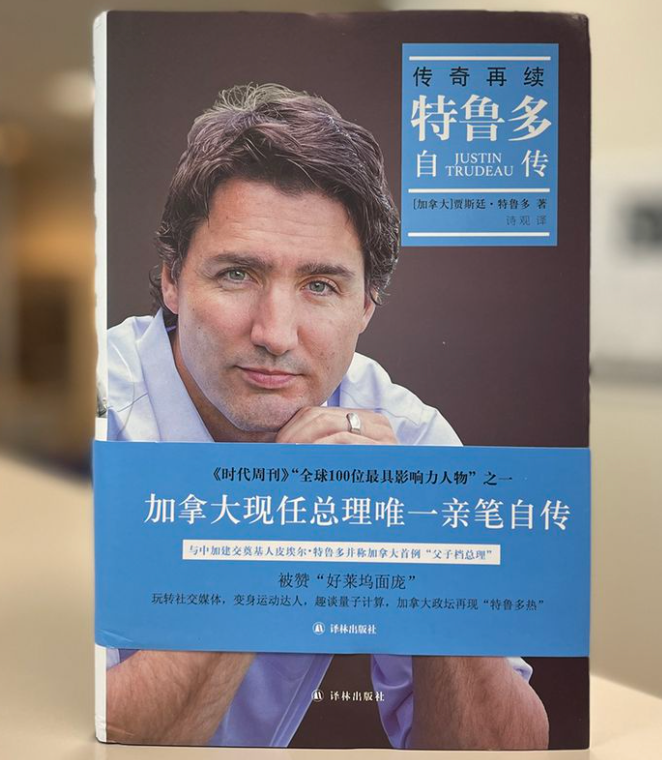
A communist-party-connected publisher reprinted Justin Trudeau’s 2014 book Common Ground

Filed under: Books, Cancon, China, Politics — Tags: , , , , , — Nicholas @ 03:00

Aha! I thought … yet more scandal! This time with direct pay-offs to Trudeau from his Beijing paymasters! Sadly, for the conspiracy minded among us, it’s not much more significant or scandalous than Barack Obama’s endorsement of Trudeau, as Kenneth Whyte explains:

… the Globe & Mail reported that Justin Trudeau’s 2014 memoir Common Ground was republished in a Chinese edition in 2016.

Doesn’t sound like much of a story, does it? Foreign editions of Canadian books are released all the time.

What’s different in this case, says the Globe, is that the Chinese publisher is Yilin Press of Nanjing, part of the state-owned enterprise Jiangsu Phoenix Publishing and Media, which “takes operational direction from the propaganda department of the Jiangsu provincial communist party committee.”

Why would a propaganda wing of the communist party make such a deal? The Globe quotes foreign policy experts who say that the republication of Trudeau’s book is “a classic ploy” by Beijing to flatter a foreign leader. “They are trying to do anything they can to encourage him to look positive on China and the Chinese state,” according to one of the experts.

Says another: “Clearly, by publishing his biography they wanted to please him. They are the masters of propaganda.”

What do the Chinese hope to get out of courting Trudeau? “Beijing had high hopes it could persuade Canada to sign a free-trade agreement and was seeking Canada’s help in its global campaign Operation Fox Hunt to track down people it called criminals, many of whom were Chinese dissidents,” writes the Globe.

The Globe also finds it notable that the Liberals, at the time, were trotting Trudeau out to private events at the homes of wealthy Chinese-Canadians. The PM would do a little dance and the money would flow:

    Chinese billionaire and Communist Party official Zhang Bin attended a May 19, 2016, fundraiser at the home of Benson Wong, chair of the Chinese Business Chamber of Canada. A few weeks later, Mr. Zhang and his business partner, Niu Gensheng, donated $200,000 to the Pierre Elliott Trudeau Foundation and $50,000 to erect a statue of Mr. Trudeau’s father.

So it all looks a bit unseemly.

I poked around and was reliably informed by someone in a position to know that Trudeau and his agent sold worldwide rights to Common Ground to HarperCollins Canada. That means it was up to HarperCollins to publish the book in Canada and also sell rights to its republication in as many foreign markets as possible. Trudeau would get a cut of revenues from those sales.

Except, as he further reveals, Trudeau had long since assigned any profits from the book to a charity, so he’s not being secretly bribed by copious amounts of money from the Chinese Communist Party’s propaganda budget (at least, not in this case, hedging just a bit …).

Should the PM, or someone in his office, have asked questions about Yilin Press and its connections to the communist party? Maybe, but it’s not like there was a free-market alternative down the street from Yilin. Every publisher in China is accountable to the communist party in one way or another. To get an ISBN number in the Chinese market, you have to go through the state, not because the state provides the service, but because it monitors all publications. Si Limin, chairman of the China Book Publishing Industry Association, is the former director of the News and Newspapers Department of the State Administration of Press, Publication, Radio, Film and Television. And so on.

As for the trade deal the Chinese were supposedly eager for Trudeau to sign? It was more the other way around. In 2017, the Liberals tried to convince Beijing to adopt Trudeau-style progressivism in return for free-trade with Canada. They were laughed out of town. The Chinese couldn’t even be bothered to pretend an interest in human rights to get a deal signed.

I have all kinds of problems with the ethical standards of the Liberal party, Trudeau’s personal judgment, those cash for access meetings, and his Chinese policy, but there’s nothing much to see here.

June 11, 2021

The concept of philanthropy is another one with conflicting meanings to the left and to the right

Filed under: Government, Politics, USA — Tags: , , , , — Nicholas @ 05:00

In the Daily Chrenk, Arthur Chrenkoff has a bit of fun outlining the recent kerfuffle over Alexandria Ocasio Cortez’s attempt to use her grandmother’s situation in Puerto Rico for scoring political points, and then explains why the notion of philanthropy is a very different thing to progressives than it is to conservatives:

“Charity in the dictionary” by HowardLake is licensed under CC BY-SA 2.0

Well may we laugh about (and be disgusted by) the hypocrisy, corruption and indifference shown by prominent members of the left towards the very people they supposedly care about. But it would be to miss the broader point relating to how the left views the world, the role of politics, and the place of the individual.

It might surprise many that the caring and compassionate left isn’t actually all that big on philanthropy and charity, i.e. people helping other people. What could be wrong with that? Wouldn’t the world be a better place if even more people helped even more other people? Well, no, the left would say, because it’s not something that people should be doing in the first place; it’s not their responsibility. It is up to the state to solve all the social and economic problems; our role as citizens (as well as, thanks to the open borders advocates, non-citizens) is to be the grateful recipients of the government’s largesse. For the more elite group (no pun intended) – “the rich” – their role is to pay for all this with their taxes. Private initiative is by its very nature limited and patchy; only the all-seeing and all-powerful state can ensure that everyone who needs “free” assistance (and that’s literally everyone) gets it in a comprehensive, uniform and fair way. Hence, AOC won’t lift a finger to help her grandmother because it’s the state’s duty to help everyone rebuild their lives after a natural disaster. Occasional Cortex already contributes with her taxes on the hard-earned Congressional salary, and in any case, she’s not some billionaire, you know.

With that attitude, needless to say, you won’t be surprised to learn that much of what goes for the left-wing philanthropy does not actually go to help those in need to solve their problems and provide them what they are lacking. Instead, it is largely channels to finance political agitation by the activist-industrial complex to make the government (whether through lobbying, campaigning or helping elect sympathetic law-makers) take responsibility instead. That’s what people like Soros, Laurene Powell-Jobs (Steve Jobs’ widow) and MacKenzie Scott (Jeff Bezos’ ex) are all about – billions spent to create more activist jobs to agitate for the state to create more public sector jobs to run the “Big Daddy”.

But it goes deeper than that, back to Marx himself in fact and to his analysis of what’s wrong with the world and how to fix it. According to Marxism, both in its original class-based iteration and the more recent race/gender/sexuality variants, every society is divided into two mutually antagonistic groups: the powerful oppressors and the powerless oppressed, with the society structured in the interest of the former by facilitating in every possible way the exploitation and keeping down of the latter. Thus, all the problems, ills and injustices are “systemic” in nature; they are a feature, not a bug. To solve them and so to help the downtrodden you need to overthrow the entire old unjust system and build a new one that benefits the masses. Based on this sort of understanding of the world – to which, coincidentally, people like AOC and BLM founders all subscribe – any private charity is bound to be ineffectual and shortcoming. After all, what can a person, however generous with their money and time – even if there are multitudes of them – do to solve problems that are the direct (and intended) consequence of the way the society has been set up? Nothing, of course. You can’t mend it, you have to end it. But not only is it naïve and pointless to try, it’s actually counter-productive and therefore positively wrong. Because while no philanthropic effort can solve systemic problems, it can actually provide some limited and temporary relief. Such relief, however, by its very nature is a band-aid solution, i.e. not a solution at all. All it does it momentarily numbs the pain, and that is bad, because the oppressed masses need to feel the pain and feel it good in order to spur them into revolutionary action to overthrow their oppressors and on the ruins of the old build the utopian new society of equality and justice. This is the far-left’s accelerationism: the worse it gets, the better it gets (for the prospects of radical change).

October 6, 2020

QotD: Herbert Hoover and the Belgian relief program

Filed under: Britain, Europe, Food, Germany, History, Quotations, WW1 — Tags: , , , , , — Nicholas @ 01:00

Just as Hoover is preparing to rest on his laurels, he receives a cry for help. Germany has occupied and blockaded Belgium. The blockade prevents this tiny, heavily urban country from importing food, and the Belgians are starving. Germany needs its own food for its own armies, and is refusing to help. The Belgians order a thousand tons of grain from Britain, but when their representative comes to pick it up, Britain refuses to let them transport it, nervous at sending food into enemy-occupied territory. During tense negotiations, someone suggests using neutral power America as a go-between. But America is 5,000 miles away and busy with its own problems. So the US Ambassador to Britain asks his new best friend Herbert Hoover if he has any ideas.

Hoover invites Emile Francqui, a Belgian mining engineer he knows, to Britain. Together, they plan a Committee For The Relief of Belgium, intended not just to help transport the thousand tons of grain at issue, but to develop a long-term solution to the impending Belgian famine. Nothing like this has ever been tried before. Belgium has seven million people and almost no food. No government is offering to help, and they don’t have enough money to feed seven million people even for one day, let alone indefinitely. Hoover springs into action …

… by crushing all competing attempts to provide food for Belgium. He attacks the Rockefeller Foundation, which is trying to help, with a blitz of press coverage accusing it of various forms of insensitivity and interference, until it finally backs off. Then he gets to work on the government:

    The letter bore several Hoover watermarks, beginning with its heavy load of facts and figures organized in point form. It noted that myriad relief committees were springing up both inside and outside of Belgium, and urged consolidation. “It is impossible to handle the situation except with the strongest centralization and effective monopoly, and therefore the two organizations [Hoover outside Belgium and Francqui inside it] will refuse to recognize any element except themselves alone.” The letter also contained Hoover’s usual autocratic and slightly paranoid demands for “absolute command” of his part of the enterprise.

Control attained, Hoover springs into action actually feeding Belgium. He launches one of the largest public relations campaigns the world has ever seen, sending letters to newspapers around the world asking for donations. He “urged reporters to investigate the famine conditions in Belgium and play up the ‘detailed personal horror stuff’. He personally arranged for a motion picture crew to capture footage of food lines in Brussels, and he hired famous authors, including Thomas Hardy and George Bernard Shaw, to plead for public support of the rescue effort.” He constantly telegrams his exasperated wife and children, now safely back in Palo Alto, demanding they raise more and more money from the West Coast elite.

He browbeats shipping conglomerates until they agree to ship his food for free, then browbeats railroads until they agree to carry it. By telegraph and letter he coordinates banks, railroads, docks, ships, and relief workers on both sides of the Atlantic. But that’s just the prelude. His real problem is the governments. Britain doesn’t want food shipped to Belgium, because right now the starving Belgians are Germany’s problem, and they don’t want to solve an enemy’s problem for them. But Germany also doesn’t want food shipped to Belgium, because the Belgians are resisting the occupation, and they figure starvation will make them more compliant. Shuttling back and forth across the North Sea, Hoover tries to get them to switch theories: Germany needs to think starving Belgians are their problem which it would be helpful to solve, and Britain needs to think starvation would make Belgians more compliant with the German occupation. In the end, both countries allow the shipments.

He goes on a fact-finding mission to Belgium, and managed to somehow offend everyone in the country that he is, at that very moment, saving from mass starvation […] By 1915, Hoover is, indeed, feeding millions of Belgians, indefinitely, using only private funding. He is also almost broke. Millions of Brits and Americans have given him contributions, from tycoons donating fortunes to ordinary people donating their wages, but it’s not enough. His expenses pass $5 million a month, which would be about $100 million today; all these bills are starting to catch up to him. In an act of supreme sacrifice, Hoover pledges his entire personal fortune as collateral for the Committee’s loans, then takes out more money. The grain shipments continue to flow, but his credit is at its end.

He continues beating on the doors of every government official he can find – British, German, American – demanding help. They all say their budgets are already occupied with the war effort. He begs them, lectures them, tells them that millions of people are doing to die. He goes all the way to the top, finagling an opportunity to meet with British Prime Minister David Lloyd George. Lloyd George later calls Hoover’s presentation “the clearest he had [ever] heard on any subject”, but he can offer only moral support.

What finally works is going to Germany and meeting with their top military brass. The brass are unimpressed; they still think that Belgium starving is as likely to help them as hinder. But the contact spooks top British officials, who agree to meet with Hoover again. Hoover feeds them carefully crafted lies, saying that the German brass have told him that British aid to Belgium would be a disaster to the Central Powers and so they, the Germans, are going to fund everything Hoover wants and more. “Oh no they don’t!” say the British, who promise to give Hoover even more funding than his imaginary German partners. The Committee for the Relief Of Belgium is finally back in the black. And what a black it is:

    The scope and powers of the Committee For Relief of Belgium were mindboggling. Its shipping fleet flew its own flag. Its members carried special documents that served as CRB passports. Hoover himself was granted a form of diplomatic immunity by all belligerents, with the British permitting him to cross the Channel at will and the Germans providing him a document saying “this man is not to be stopped anywhere under any circumstances”. Hoover had privileged access to generals, diplomats, and ministers. He enjoyed personal contacts with the heads of warring governments. He negotiated treaties with the belligerents, advised them on policy, and delivered private messages among them. Great Britain, France, and Belgium would soon be turning over to him $150 million a year, enough to run a small country, and taking nothing for it beyond his receipt. As one British official observed, Hoover was running “a piratical state organized for benevolence.”

Scott Alexander, “Book Review: Hoover”, Slate Star Codex, 2020-03-17.

September 13, 2020

Are the Kielburgers fleeing before the real story breaks?

Filed under: Cancon, Government, Politics — Tags: , , , , — Nicholas @ 05:00

Ted Campbell listened to an Evan Solomon radio report recently and spells out the key points:

The Kielburgers, he notes are neither newcomers nor naifs. Mark Kielburger is a Rhodes Scholar and Craig Kielburger has, he say, “been rubbing shoulders with politicians since he was 12 years old.” They have, Mr Solomon says, been selling the “halo effect” to politicians and other celebrities, a list which he tells us includes Justin Trudeau, Barack Obama, Oprah Winfrey and Erin O’Toole and the “halo effect” says, in effect, if you come out and make us look good then we, being a famous, big-league charity will make you look good, too. It’s all part of an astute marketing plan.

But then Evan Solomon gets to the real question: if Tylenol, he says, can survive a scandal in which people died then why are the Kielburgers reacting so dramatically to what is, really, on the surface, a minor league scandal? So the Kielburgers paid Margaret Trudeau a few hundred thousand dollars to make a few charity appearances, is that such a big deal? I mean the Trudeaus are wealthy, aren’t they? They can’t be bought, can they? Well, most if us don’t have million dollar plus trust funds and most of us didn’t earn $450,000 in speaking fees in a year, but the Trudeau family is unlikely to have just forgotten about $250,000 in speaking fees paid to Margaret Trudeau. Bill Morneau may have forgotten about owning a villa in France, but unlike the Trudeaus, Mr Morneau is rich … really rich. So are the Kielburgers. The commercial property part of their WE empire, alone, is worth $50 Million. Could a few thousands dollars per appearance (she made 28 over four years, about one every couple of months) paid to Margaret Trudeau really threaten the entire WE empire?

[…]

My guess, and that’s all it is, is that there is real fear in the WE boardrooms and in WE’s legal department that Prime Minister Trudeau might be guilty of something more than just conflict of interest. Someone like Pierre Poilievre or the Lobbying Commissioner, for example, might think that further, deeper investigations are needed and those questions might lead investigators to look more deeply into why and how Justin Trudeau and the Kielburger brothers, themselves, cooked up the idea of WE Charity running a multi-hundred-million-dollar government programme and then trying to cover-up the whole thing.

Might those questions be enough to bring Justin Trudeau down?

Might those questions be enough to threaten the Kielburgers’ fortunes, even their freedom?

August 23, 2020

QotD: Herbert Hoover and the American tourists

Count up the victims of World War I, and American tourists will be pretty far down the list. But victims they were. When the conflict broke out, thousands of Americans were overseas visiting the cathedrals of Florence or the museums of London. They woke up one morning to find the ships that were supposed to take them back had been conscripted into the war effort, or refused to sail for fear of enemy fire. The banks that were supposed to cash their travelers’ checks were panicking, or devoting all their funds to the war effort, or dealing with a million other things. The hotels that were supposed to house them were closed indefinitely, their employees rushing to enlist out of patriotic fervor. And so thousands of frantic Americans, stuck in a foreign continent with no money and nowhere to stay, showed up at the door of the US Embassy in London and said – help!

The US Consulate in London didn’t know how to solve these problems either. But Herbert Hoover, still high on his decision to pivot to philanthropy and public service, calls them up and asks if he can help. They say yes, definitely. Hoover gets in touch with his rich friends, passes around the collection plate, and organizes a Committee For The Assistance Of American Travelers. Then he gets to work, the way only he can:

    Within 24 hours, Hoover’s committee had its own stationery, and within forty-eight it was operating a booth in the ballroom of the Savoy Hotel as well as three other London locations. Through his business connections, Hoover managed to bypass restrictions on telegraph service and open a transatlantic line to allow Americans to wire money to stranded friends and relatives. In a city suddenly flooded with refugees, he reserved for American travelers some two thousand rooms in hotels or boardinghouses. He issued a press release proclaiming that his Residents’ Committee was assuming charge of all American relief work in the city, and that in doing so it had the blessings of its honorary chairman, Walter Hines Page, the US ambassador to London.

… which is totally false. Hoover is starting to display a pattern that will stick with him his whole life – that of crushing competing charities. He begins a lobbying effort to get the US Embassy to ban all non-Hoover relief work, focusing on the inefficiency of having multiple groups working on the same problem. When the US Assistant Secretary Of War arrives in London to coordinate a response, he is met on the dock by Hoover employees, who demand he consult with Hoover before interfering in the US tourist issue. Eventually the Embassy, equally exasperated by Hoover’s pestering and impressed with his results, agrees to give him official control of the relief effort.

After two months of work, Hoover and his Committee have repatriated all 120,000 US tourists, supporting them in style until it could find them boat tickets. All of its loans and operating costs have been repaid by grateful tourists, and its budget is in the black. The rescued travelers are universal in their praise for Hoover, partly because Hoover has threatened to ruin any of them who get too critical:

    Other complainants were received with less patience, including a hotheaded professor of history from the University of Michigan, who wrote to accuse the Residents’ Committee of mistreatment. Hoover refuted his charges indignantly and comprehensively, copying his response to the president of the university and its board of regents. After a meeting with his employer, the professor returned Hoover an abject retraction and apology.

Scott Alexander, “Book Review: Hoover”, Slate Star Codex, 2020-03-17.

August 1, 2020

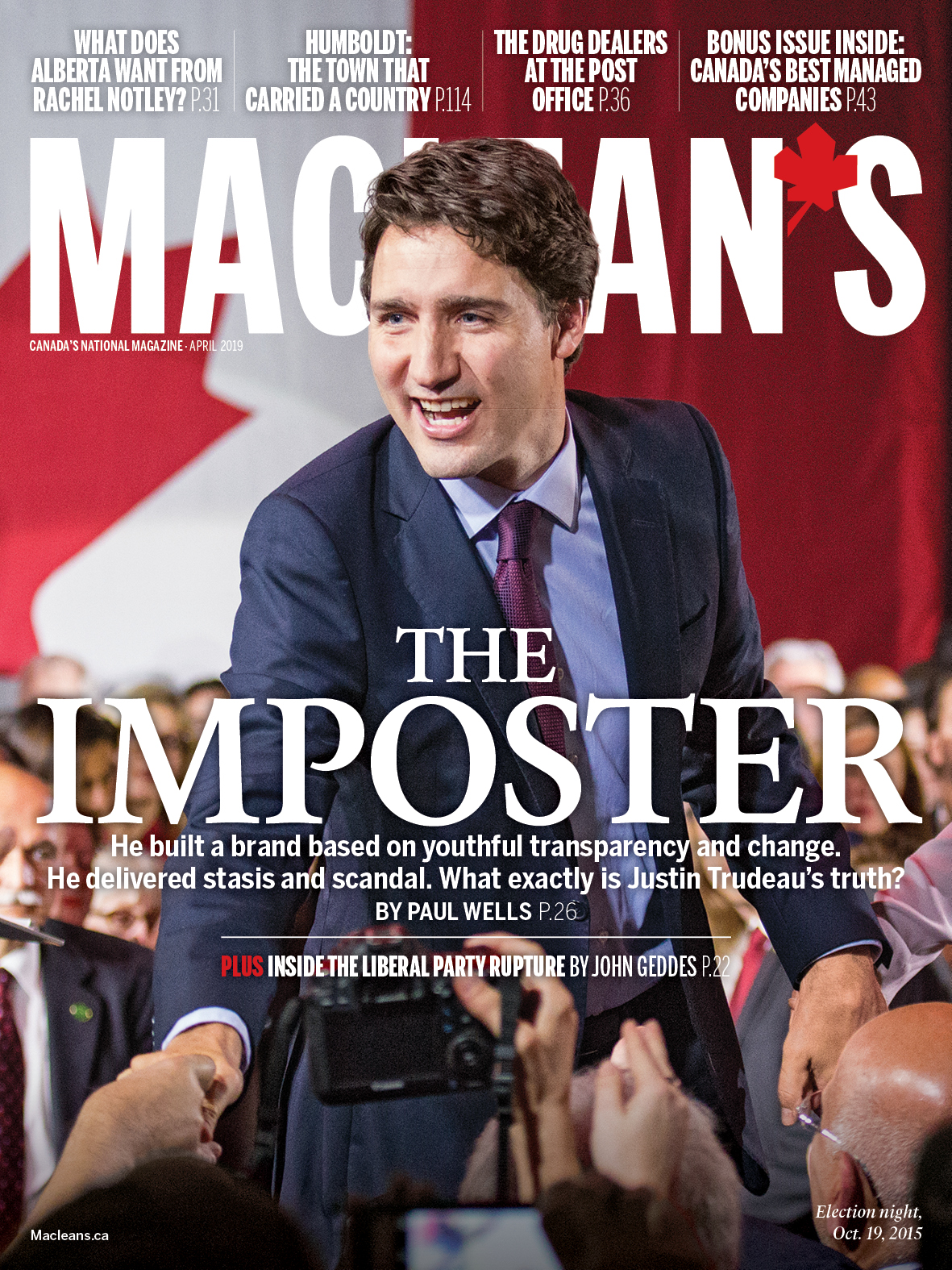
“All style and no substance made it the perfect match for Trudeau”

Filed under: Cancon, Government, Politics — Tags: , , , , , — Nicholas @ 03:00

Andrew Lawton on the Prime Minstrel’s performance in “explaining” his role in the WE scandal:

“Don’t look at me – I’m just the prime minister.”

That about sums up Justin Trudeau’s defense in a Canadian scandal starring grifters, shell corporations, virtue signallers and a federal ethics probe.

The WE-Scam, as it’s come to be known in Canadian circles, is, on its surface, a simple one.

Trudeau’s government created a $912 million government program to pay students to volunteer – formerly known as “working” if memory serves – and outsourced the administration of it to WE Charity, one of those purported international development charities more known for holding glitzy, celebrity-filled parties than digging any wells in Africa.

All style and no substance made it the perfect match for Trudeau.

WE would have netted about $44 million from the program had the government not pulled the plug amid the backlash. The charity would also have had a budget to pay teachers up to $12,000 each to funnel their students into the paid volunteer channels.

The program itself was a boondoggle, but bad policy became a scandal because Trudeau and virtually everyone in his immediate family have personal and financial connections to WE, as do at least two of his cabinet ministers, not to mention his chief of staff – all of whom say their relationships had nothing to do with WE getting the sole-sourced contract.

After weeks of ducking scrutiny from his political opponents, Trudeau made a rare appearance before the parliamentary finance committee Thursday, though his testimony was heavy on the sanctimony and light on the details.

July 17, 2020

Justin Trudeau IS the Liberal Party and he’s not planning to go away

Filed under: Cancon, Government, Politics — Tags: , , , — Nicholas @ 03:00

The government is doing what it can to ride out the storm of yet another ethics investigation into the Trudeau family entanglements with WE, and no rational person expects Justin Trudeau to be even a bit chastened by the experience — he genuinely has no idea what the fuss is all about, and he has no inclination to step aside from his patrimony. Even if he did … the Liberals have nobody who could credibly step up:

Some, however, are wondering whether it’s time for the Liberals to start thinking about life after Justin Trudeau. It would be understandable if his leadership were in jeopardy. The ethics commissioner is commencing his office’s third official investigation into events that could have been avoided had the prime minister simply not done unnecessary things: vacationed on the Aga Khan’s island; inserted himself in the prosecutorial chain of command to “save” 9,000 jobs at SNC-Lavalin that were not in jeopardy; sole-sourced a giant jobs program to his buddies Craig and Marc. This theory holds that Chrystia Freeland is ready and willing and able to take over. And then everything would be, somehow, better.

There doesn’t seem to be much to hang it on. Exactly one MP, Toronto backbencher Nathaniel Erskine-Smith, appears willing to put his name to complaints about the Trudeau Gang’s latest easily-avoided snafu, and he’s not being impolite about it. Polling shows little sign that the scandal is leaving a mark on Liberal voting intentions: Canadians seem very grateful for the federal government’s terrible-to-middling performance during the pandemic. “Snap election, Trudeau super-majority” remains a competing Ottawa narrative.

But it’s an intriguing thought: The Justin Trudeau Liberals, without Justin Trudeau — intriguing because it’s basically a black hole. Way back in the Michael Ignatieff era there was this idea that the Liberals would assemble the best minds of various generations and turn themselves into a party that believed in things and behaved as such in government. There was to be a conference in Montreal, modelled on Lester Pearson’s 1960 think-fest in Kingston, Ont., which spawned various useful ideas including the Canada Pension Plan.

No one remembers much about the 2010 think-fest, which was, coincidentally enough, titled “Canada 150,” because all this “ideas” mumbo jumbo soon became a moot point. Justin finally agreed to run for leader, and he might as well have been unopposed, and it turned out he was really good at doing what Liberals have always believed in: winning.

Get rid of the Trudeau brand, warts and all, and what do you have? Freeland is an impressive person, though she’s also deputy prime minister and was presumably in the cabinet room as this WE disaster was conceived and implemented. You have a couple of very useful and competent veteran ministers in Carolyn Bennett and Marc Garneau. You have some greener ministers who might shine in a less top-down power structure. But mostly you have a flaky centre-left operation that doesn’t know how to do anything better than spend money and broadcast its own self-styled virtue.

Trudeau is damn good at that. Everything suggests he would walk away with an election held next week. Surely it’s unlikely he’s going anywhere he doesn’t want to.

July 15, 2020

QotD: State and private charity

Filed under: Economics, Government, Quotations — Tags: , , , — Nicholas @ 01:00

Some social and political analysts regard private help as a bad thing. They speak of the “problem” of food banks, and of America’s “miserly” support for poorer countries. In fact food banks are a solution, not a problem. Private generosity has leapt into the breach to help tide people over temporary problems. The great majority of food bank users do so only once.

Similarly with US aid to poorer countries. The United States is regularly berated for being very low on the list of aid givers, but this only applies to government-to-government aid. Once the private contributions made by Americans to people in poorer countries are counted in, the US rises to the top. In fact US private help is better spent, usually going to people to spend in towns and villages in the local economy, rather than on gold palaces and white elephant steel mills in the desert.

Part of this mismatch arises from the fact that these analysts seem to wear spectacles that admit only light of a political wavelength and ignore private generosity. The latest victim of this myopia is the “bank of mom and dad.” It is assumed to be a bad thing that young people should turn to mom and dad to help out with deposits and mortgages.

“Richard”, “Is Private Help a Bad Thing? – Political Spectacles of the Left”, Continental Telegraph, 2018-04-02.

July 13, 2020

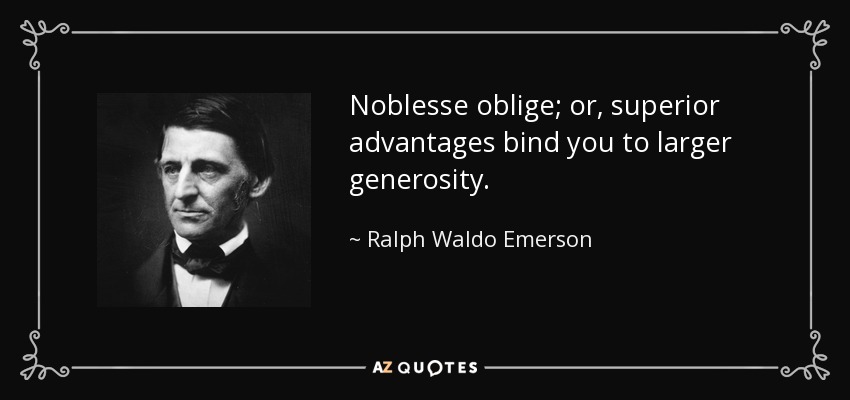
Sarah Hoyt on noblesse oblige

In the latest edition of the Libertarian Enterprise, Sarah Hoyt explains how noblesse oblige can and is used as a tool to benefit the powerful:

Of all the traps a culture can fall into, the fact that Americans tend to fall into Noblesse Oblige traps says very good things about us. It also doesn’t make the trap any less dangerous.

Noblesse Oblige, aka “nobility obligates” was a way that the excesses of a hierarchical society was kept in check. While the peasants were obligated to obey the nobleman, the nobleman was obligated to look after them/not put extreme demands on them/behave in certain paternalistic ways. (One of these days I need to do a post on paternalistic versus patriarchal. remind me.)

It is what is notably lacking from ideologically driven totalitarianisms and hierarchies, probably because their basis being atheistic they don’t seem the humans they have power over as being worth anything or commanding any duty from them. This is why in places like Cuba, Venezuela or China, the officials of the “democratic” government give themselves airs as long-suffering public servants while treating the people under their power worse than any of us would treat a stray animal (let alone a pet.)

In the US — where the citizen is king! — we have evolved a form of noblesse oblige best described as “Them who can, do what they can for those who can’t.”

[…]

But the noblesse oblige that affects the common individual in America is the foundation of worse traps.

Most of the idiotic compliance with ridiculous Winnie the Flu rules and restrictions hooked directly into Noblesse Oblige. For instance, the brilliant idea that you should wear masks to show you care even though we pretty much know they are completely ineffective and quite deleterious for a vast swath of people.

The idea that our kids should be forced to perform “volunteer” labor to graduate school, to “teach them to care for others.” The idea that you can always do a little more/sacrifice a little more for “those worse off” (Who often aren’t.)

When Noblesse Oblige turns into toxic altruism, it can take society apart.

Much of the “Green” mania is part of the noblesse oblige trap. They’re trying to convince us that if we just do these little things — most of them counterproductive, like, say recycling, which uses more resources and causes more issues than just using stuff — we’ll make it better for everyone.

In a bigger sense, they’re trying to make it so that we commit polite suicide so that “others live better.”

It can result in truly horrible racism, too. A great part of the left’s being convinced, say, that meritocracy is white supremacy comes from the fact that, being white, (and racist) they assume that they’re more competent than any other race, and therefore following “merit” causes white people to rise to the top.

June 23, 2020

QotD: Scientific discoveries despite “research” and “planning”

Filed under: Bureaucracy, Health, Quotations, Science — Tags: , , , , — Nicholas @ 01:00

We live in a culture of “research” and “planning.” I’m not against honest research (which is rare), but mortally opposed to “planning.” The best it can ever achieve is failure, when some achievement comes despite its ham-fisted efforts. Countless billions, yanked from the taxpayers’ pockets, and collected through highly professional, tear-jerking campaigns, are spent “trying to find a cure” for this or that. When and if it comes, it is invariably the product of some nerd somewhere, with a messy lab. Should it be noticed at all, more billions will be spent appropriating the credit, or more likely, suppressing it for giving “false hope.” The regulators will be called in, as the police are to a crime scene.

For from the “planning” point of view, the little nerd has endangered billions of dollars in funding, and thus the livelihoods of innumerable bureaucratic drudges. That is, after all, why they retain the China Wall of lawyers: to prevent unplanned events from happening. But glory glory, sometimes they happen anyway.

David Warren, “That’s funny”, Essays in Idleness, 2018-03-08.

December 8, 2019

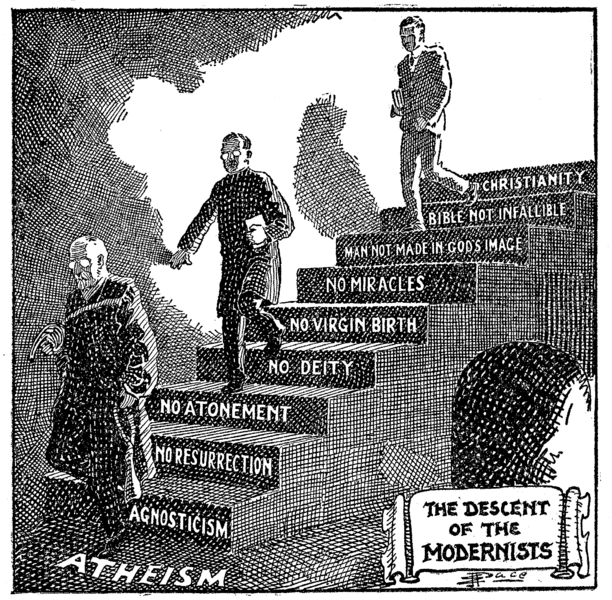
The “Church of Atheism” doesn’t get charitable status … this time

Filed under: Cancon, Law, Religion — Tags: , , , , , — Nicholas @ 03:00

Colby Cosh on the recent court decision on the Church of Atheism’s attempt to qualify as a church — and receive the tax benefits — under Revenue Canada’s rules:

“The Descent of the Modernists”, by E.J. Pace, first appearing in his book Christian Cartoons, published in 1922.
Public domain via Wikimedia Commons.

Last week the Federal Court of Appeal upheld Revenue Canada’s rejection of an application for charitable status made by a “Church of Atheism” tucked away in Ontario’s Lanark Highlands. The idea of making a gesture like this has probably occurred to every atheist who looks around at a world of tax-exempt churches and wonders why his kind is excluded from the gravy train. (Clergymen pay tax on their income, but they have access to a generous residential deduction, and any professional expenses covered by the church go untaxed.)

The fact is that the “Church’s” efforts were a bit amateurish and confused. But they may, like a doomed military reconnaissance, have revealed weaknesses in the anomalous exclusion of atheists from religious tax exemptions.

These weaknesses cannot be any big secret. You probably remember the Supreme Court’s Mouvement laïque québécois v. Saguenay decision of 2015 — that’s the case in which the Quebec Court of Appeal had ruled that a statue of Christ with an electrically illuminated Sacred Heart was “devoid of religious connotation.” The Supreme Court, perhaps suppressing a chuckle or two, proceeded to unanimously overturn the Quebec ruling and expound the concept that the Canadian state has a Charter-based “duty of religious neutrality” (except, of course, where the constitution explicitly specifies otherwise, as with Catholic schools). Government, the SCC insisted, “must neither favour nor hinder any particular belief, and the same holds true for non-belief.”

Given that this is our law, what can be the problem with a “Church of Atheism”? Good question! Justice Marianne Rivoalen, writing on behalf of a three-judge Federal Court panel, confirmed the general point that there is a state duty of religious neutrality; in fact, even Revenue Canada, acting as the respondent, conceded this.

But the court simply ruled, without any logical elucidation, that “the Minister (of Revenue)’s refusal to register the appellant as a charitable organization does not interfere in a manner that is more than trivial or insubstantial with the appellant’s members’ ability to practise their atheistic beliefs. The appellant can continue to carry out its purpose and its activities without charitable registration.”

October 23, 2019

QotD: Climbing Maslow’s Pyramid again

Filed under: Britain, Environment, Food, Quotations — Tags: , , — Nicholas @ 01:00

[Commenting on a story about the re-introduction of heritage apples to the British market through the work of the wildlife charity People’s Trust for Endangered Species.]

If people want little orchards of native (well, you know) apples then people should have little orchards of native apples. As long as, of course, they’re creating and maintaining those little orchards of native apples at their own expense. This is, after all, what liberalism means, that the peeps get to do what the peeps want. And if we’re to add some Burkean conservatism so that it’s the little platoons sorting it out for themselves then all the better.

As long as no one is being forced to pay for this through taxation then what could possibly be the problem?

At another level this is climbing Maslow’s Pyramid again. At one level of income we’ll take fruit in the only way we can, seasonally and in a limited manner. We get richer, technology advances, we can have apples year round – but that does mean trade, commercially sized operations and the inevitable limited selection. We get richer again and now we’ve more than sufficiency, let’s have that variety back again.

After all, it’s not as if we’re not seeing this right across the food chain, is it?

That roast beef of Olde Englande was most certainly better than the bully beef from Argentina or the Fray Bentos pie. As is the best grass fed British beef of today. But we moved through the cycle to get from most not being able to eat any beef, to all being able to have bad beef, to now again thinking more about the quality – we have a more than sufficiency of beef and can be picky about it.

Tim Worstall, “I fully approve of this”, Tim Worstall, 2017-10-22.

February 24, 2018

“Oxfam, like many large British charities, has long been a villainous organisation”

Filed under: Africa, Americas, Britain — Tags: , , , , , — Nicholas @ 03:00

Theodore Dalrymple puts the boots to Oxfam:

It is very wrong, morally, to take pleasure in the misfortunes of others, but I cannot disguise from myself the intense pleasure, amounting almost to joy, with which I learned of the public exposure of the wrongdoings of Oxfam in Haiti, Chad, and elsewhere. Its workers, sent to bring relief to the acute and chronic sufferings of those countries, used the charity’s money, partly derived from voluntary contributions and partly from government subventions (the British government and the European Union are by far the largest contributors to British Oxfam), to patronise local prostitutes, some of them underage, and also to conduct orgies, no doubt at a fraction of what they would have cost to conduct at home.

Oxfam, at least in Britain, has long been one of the most Pecksniffian of organisations, much give to auto-beatification. Mr. Pecksniff, in Dickens’ Martin Chuzzlewit, introduces his daughters, called Charity and Mercy, to Mrs. Todgers, adding ‘Not unholy names, I hope.’ It is therefore of the hypocritical Mr. Pecksniff that I think whenever I pass the Oxfam shop in my small town, with its unctuous slogan, Thank you for being humankind, posted in the window. It is only with difficulty that I resist the urge to throw a brick through it.

Of course, Oxfam, like many large British charities, has long been a villainous organisation — and the sexual exploits (or should I say exploitations?) of its workers in Haiti and elsewhere are the least of it. In the moral sense, though not the legal, it has for many years been guilty of fraud, of misleading the public.

I first realised this some years ago when I found a used book dealer of my long acquaintance poring in his shop over Oxfam’s annual accounts.

‘Look at this,’ he said, but I saw nothing until he pointed it out to me.

Oxfam, in common with many other charities in Britain, runs thrift stores in practically every British town and city. Such thrift stores are now more numerous even than Indian restaurants: they allow people to give away their unwanted belongings in the belief that, by so doing, they are furthering a good cause.

My acquaintance pointed out that, despite receiving their goods free of charge, paying practically nothing for their labour (which was voluntary), and paying much reduced local taxes, Oxfam shops made a profit on turnover of a mere 17 per cent, much less than his own, despite his incomparably greater expenses. How was such a thing possible, by what miracle of disorganisation (or malversation of funds)?

Until then, I had carelessly assumed that the great majority of any money that I gave to a large charity went to serve its ostensible end, say the relief of avoidable suffering. I was not alone in this, of course. When I asked the volunteer ladies in a local shop run on behalf of the British Red Cross what percentage of the money I paid for a book there went to the Red Cross, they looked at me as if I were mad.

‘Why, all of it of course,’ piped up one of the ladies.

The real average figure at the time for Red Cross thrift stores was 8 per cent; but the volunteer ladies supposed, because the goods they sold were free to the Red Cross and they themselves were not paid, that (apart from a small amount for unavoidable expenses) all the money raised went directly to victims of earthquakes and the like.

July 26, 2017

QotD: From local private charity to national government social program

Filed under: Bureaucracy, Education, Government, History, Quotations — Tags: , , — Nicholas @ 01:00

In a small town, the impulse to assist the poor and disorganized was direct, and the people being helped were known to everyone. Big cities with their concentrated slums of poor immigrants led to social service agencies, funded at first by churches and cities, and then by state and federal governments. As the source of the assistance became impersonal, so did the aid — and the direct contact between those assisting and those assisted declined. Instead of the local church matrons with their bourgeois ideas of proper behavior and work, harassed social workers with enormous caseloads processed cases quickly, and the ideology of government assistance changed so that any behavioral expectation of the client population was viewed as an affront to their dignity.

In time, the government assistance ethos spread to every corner of the country and crowded out the local community services. Meanwhile, locally-controlled schools were gradually taken over by higher levels of government and distant union bureaucracies so that the influence of local parents was minimized. This was viewed as “progressive,” since distant elites thought local school boards and parents were too parochial and backward to be entrusted with decisions, and would get in the way of teaching the correct materials.

The incorrect application of emotions of sympathy and support to faceless categories of people like “the poor” and “the undocumented” removes any possibility of understanding the real situations of each of the category’s members. A hazy idealized poor family is envisioned, then a response that would be appropriate if that family lived next door (help them!) leads to voting for politicians that offer new programs to help “people like that.” By misapplying family and community feelings to higher levels of government, voters put into place a bureaucracy that misses most of the social signalling features of local groups and takes tax money to grow itself, crowding out local groups (and the valuable social signals that maintained bourgeois standards.)

Jeb Kinnison, “Real-life ‘Hunger Games'”, According to Hoyt, 2015-09-25.

« Newer PostsOlder Posts »

Powered by WordPress