Quotulatiousness

February 24, 2026

The political spectrum in Canadian media runs from the far left all the way to the left-of-centre

Filed under: Cancon, Government, Media, Politics — Tags: , , , , , , — Nicholas @ 05:00

The federal government isn’t noted for being good with money. Yes, I know, understatement of the century … But they did make one investment that has been fantastically beneficial. For the Liberal Party, if not for Canadians in general. That investment was buying the support of almost all of the surviving mainstream media outlets by directly subsidizing their payrolls. Most media folks lean left anyway, but once their paycheque literally depended on keeping the Liberals happy, they joyfully co-operated in ways that 1930s German newspapers would blush at. On her Substack, Melanie In Saskatchewan explains just how far away from representative the media political spectrum has drifted (leftwards, of course, always leftwards):

If you were to draw a Venn diagram of the real Canadian political landscape and the pundit ecosystem on legacy networks, you’d find they barely overlap.

Rosemary Barton is the undisputed matriarch of the CBC’s political brand. As host of At Issue and Rosemary Barton Live, she shapes the entire panel tone for CBC political discourse and anchors the network’s election coverage. She has been at the helm of federal election panels since 2016, interviewing party leaders and moderating debates from coast to coast.

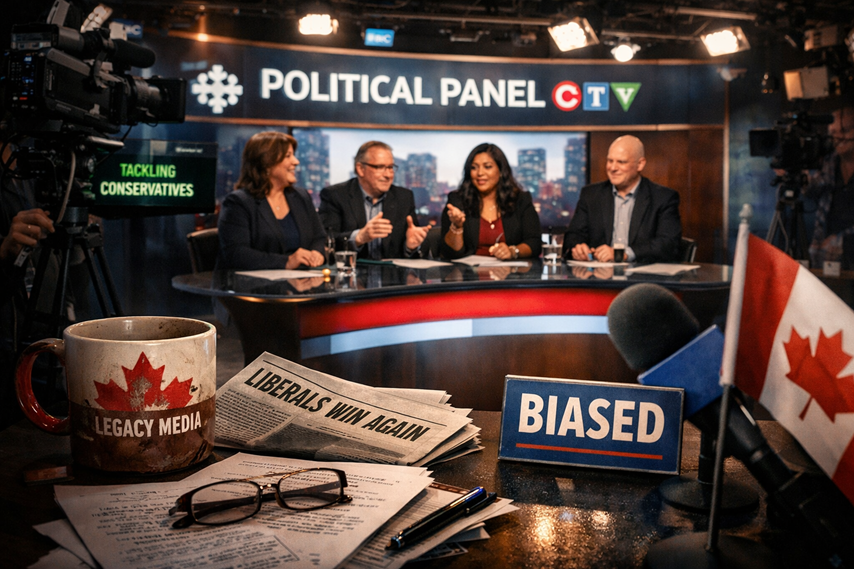
Canada’s mainstream media as Liberal Party propagandists.
Image from Melanie In Saskatchewan

Now ask yourself this: if half the population consistently feels unheard by these panels, is that a coincidence, or the predictable result of decades of the same ideological herd wandering through the same studios?

Here is the rub. The At Issue panel rarely rotates through voices that actually represent today’s conservative electorate. Instead, it routinely features professional journalists and political insiders who debate among themselves, talking about conservatives far more often than they engage with conservatives whose voters make up a massive share of the country. That is not centrism. It is an echo chamber assembled by committee.

Then there is Andrew Coyne. He is often presented as the token ideological counterweight on At Issue, the panel’s supposed nod to conservatism. After all, he has spent decades as a columnist and editorial thinker, comfortably critiquing governments from a well upholstered perch.

But let us be clear. Coyne is not remotely representative of today’s conservative electorate. He is not a reflection of the current Conservative Party base. He is not channeling the instincts of voters outside the Ottawa and Toronto corridor.

Positioning him as the conservative voice on a national panel is not balance. It is branding. It allows producers to claim ideological diversity without ever inviting someone who actually carries the convictions, tone, or priorities of the modern conservative movement. Coyne is not a grassroots conservative. He is a professional pundit whose worldview fits tidily within the Ottawa insider class. That is not ideological contrast. It is controlled opposition dressed up as pluralism.

Meanwhile, audiences have been increasingly vocal online about the sense that these panels sound like academic seminars, not reflections of the lived experience of Canadians who didn’t spend their twenties in Ottawa press galleries.
February 2, 2026

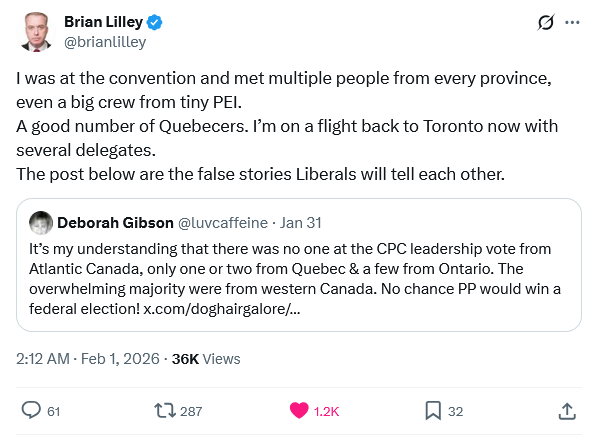
Pierre Poilievre barely squeaks by leadership review with a mere 87.4% approval

Filed under: Cancon, Humour, Media, Politics — Tags: , , , , , — Nicholas @ 03:00

If the Canadian media were clamouring for Poilievre to be drummed out of the Conservative leadership in shame and disgrace (and they were), the leadership vote results were … disappointing. At Small Dead Animals, Kate helpfully edits the CBC’s report to more accurately reflect the corporation’s inner feelings:

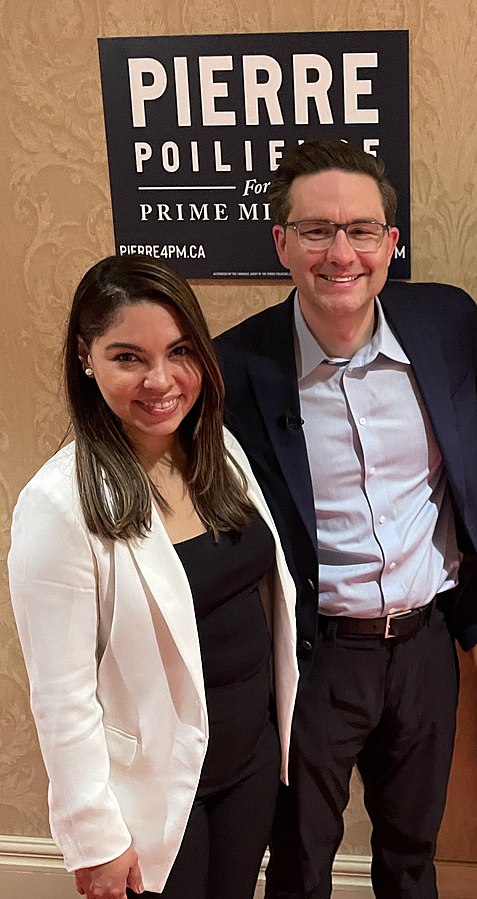
Pierre and Ana Poilievre at a Conservative leadership rally, 21 April, 2022.
Photo by Wikipageedittor099 via Wikimedia Commons.

Poilievre waltzed into that redneck rodeo town and the whole room of racist trucker-hat-wearing western deplorables lost their minds cheering like he just invented beer or something. He crushed that leadership review with 87% or whatever the hell it was, the party faithful slobbering all over him, screaming like it’s the second coming. Pathetic.

That was the easy part. But the rest of Canada? Please. These un-Canadian clowns don’t speak for the country—they’re just the loudmouth Maple MAGA fringe who love Donald Trump and think affordability means more oil subsidies. He still hasn’t convinced normal people he’s fit to run anything bigger than a backyard BBQ. Hammered the same tired lines about prices and taxes, sure, but dodged anything real that might scare off his adoring hicks.

They say more details are coming, he’s gonna tour and talk. Yeah, sure he is. If he wants anyone outside that echo chamber to take him seriously as PM material, he better start sounding like he wants pandas from Beijing instead of pandering to those yahoos. God, it makes me sick—he was supposed to crash and burn, and instead these idiots propped him right back up.

As I wrote in a mostly US discussion group:

Pro tip: Never let your national government directly subsidize the media that reports on them. Canada did this, and the media reward the party that did it with the kind of fawning coverage that North Korean media might envy. A recent example is the opposition Conservative party leader won a record level of support at the party conference this week. It was reported as if he’d just barely survived roving packs of feral Conservative opponents wandering the convention floor with pitchforks and burning torches. To cap it off, one of the main networks, CTV, reported on record Conservative fundraising numbers … and included a direct link to the Liberal Party’s donations page.

We can’t hate the bought-and-paid-for Canadian media enough.

September 27, 2025

Dislike of Trump prompts the CBC to spread faulty medical advice

Filed under: Cancon, Health, Media, Politics, USA — Tags: , , , , — Nicholas @ 03:00

It’s a long-running joke that US progressives — and the legacy media, BIRM — are programmed to respond to anything Donald Trump says by doing the exact opposite of what he says:

The CBC apparently felt the need to do the meme:

It was not controversial for news outlets like CBC to report in 2016, and later 2021, on new medical research raising concerns about the impact of Tylenol use on pregnancy and fetal development. But in 2025, those studies (among others) have become the basis for a new cautionary approach by the U.S. government that critics and media are trying to debunk.

On Monday, the U.S. Department of Health and Human Services announced that, as part of a bigger strategy in quelling autism, it would be issuing a “physician notice and begin the process to initiate a safety label change for acetaminophen”.

President Donald Trump relayed this to the press, stating the medication “can be associated with a very increased risk of autism”.

“So taking Tylenol is not good, all right? I’ll say it; it’s not good. For this reason, they are strongly recommending that women limit Tylenol use during pregnancy unless medically necessary. That’s, for instance, in cases of extremely high fever that you feel you can’t tough it out.”

[…]

The statement was reported in the mainstream news — including CBC, which found Canadian doctors who seemed to support the cautionary approach. The impression from these experts was that this wasn’t cause for panic and that more evidence was needed, but it was an occasion for discussion. The advice back then? Take the smallest amount for the shortest period of time, and don’t use it as a first resort to managing pain, which is consistent with the U.S. guidance.

Indeed, no major figure in this story is advocating for total avoidance because unmitigated pain and fever are bad for pregnancy, and in small amounts, Tylenol seems to be fine. That said, the manufacturer doesn’t recommend it for pregnant women (which they can’t really do without extensive testing, even if doctors generally consider it safe for mothers in minimized amounts when medically indicated).

More recently, a review of other studies by a team including Harvard University’s public health dean found similar “evidence of an association” between the drug and neurodevelopmental conditions. The dean released a statement saying that the “association is strongest when acetaminophen is taken for four weeks or longer”. That should be uncontroversial, because nobody is supposed to take Tylenol for that long, pregnant or not.

But perhaps, as the Babylon Bee suggests, it’s all Trumpian 4D Chess:

September 26, 2025

A ministry for “Heritage” should not be funding hate publications

Filed under: Cancon, Government, Media, Politics — Tags: , , , , — Nicholas @ 04:00

I’m with Dan Knight that the government shouldn’t be funding any private networks, magazines, or newspapers, but since it does provide a lot of funds through various programs, it should at the very least strive to avoid funding open hatred toward ordinary Canadians:

Steven Guilbeault at a happier stage of his life, before joining the Liberal cabinet.

In a fiery exchange at the Standing Committee on Canadian Heritage (CHPC), Conservative MP Rachel Thomas dismantled Liberal Minister Hon. Steven Guilbeault, P.C., M.P., Minister of Canadian Identity and Culture and Minister responsible for Official Languages, over taxpayer money funneled into groups publishing hate-laced screeds and smearing everyday Canadians.

Thomas zeroed in on Cult MTL, a publication receiving federal heritage funds. She read into the record a headline published the very day after reports of Charlie Kirk’s assassination attempt: “To Hell with Charlie Kirk”.

“Minister, do you think that is wrong? Taxpayer dollars are funding this group. Will you revoke their funding?” Thomas demanded.

Guilbeault looked blindsided. He admitted he had no idea the government was bankrolling a tabloid openly celebrating political violence. His answer:

    I have not been made aware of this. I will verify with the department and report back to you. Obviously, spreading hate has no place in Canada, and if this is the case, we will make the necessary verifications and take the necessary steps.

Thomas didn’t stop there. She turned to the Canadian Anti-Hate Network, which she said has already pocketed about $1 million from Guilbeault’s department. Documents show the group paid an “investigative journalist” to hunt down so-called “far-right” targets — defining the term so broadly it included Catholics and pro-life Canadians — before seeding the stories into mainstream news outlets.

[…]

Conservative MP Rachel Thomas quoted former CBC anchor Travis Dhanraj, who launched a human rights complaint this summer […]

    To be honest, this has been the hardest period of my life. What happened at CBC really broke me.

Then she put it directly to Guilbeault:

    Have you reached out to the CEO of the CBC regarding this situation and the toxic work environment that is being accused there?

Guilbeault’s answer? Bureaucratic shrugging:

    The government role is not to get mixed into the daily operations and management of the organization. That is the purview of the organization, in this case, the public broadcaster.

Translation: $1.4 billion of your money flows into CBC every year, but the minister says he can’t pick up the phone when staff say they’re being harassed.

July 31, 2025

“You can see what a monster this very dangerous person is”

Filed under: Cancon, Government, History, Media, Politics — Tags: , , , , — Nicholas @ 04:00

Chris Bray looks north to the Dysfunctional Dominion and our governments’ inability to deal with the narrative of the Residential Schools and the lack of actual evidence to support that narrative:

Kamloops Indian Residential School, 1930.
Photo from Archives Deschâtelets-NDC, Richelieu via Wikimedia Commons.

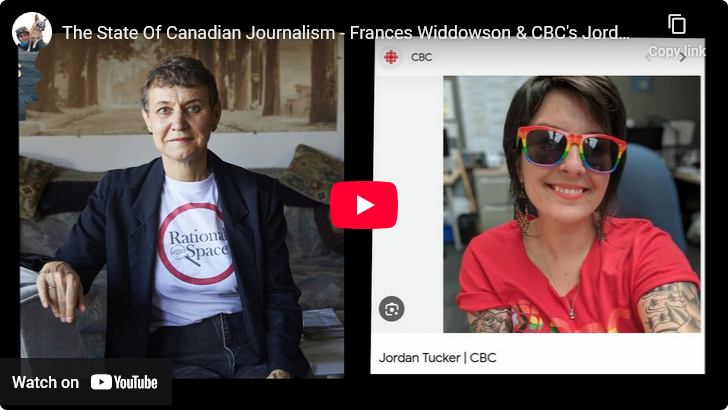
Frances Widdowson is a cantankerous career academic, an evidence-first Canadian scholar who doesn’t suffer fools. Her personal disregard for sanctimonious performativity has gotten her in some trouble, and now she’s a former professor, though her termination was found to be improper. A few months ago, the CBC interviewed her for a story about how mean she is, because Widdowson has questioned the much-chanted sacred story about the dead children at Kamloops.

If you don’t know the Kamloops story, an anthropologist used ground-penetrating radar to supposedly identify the location of a secret burial ground for 215 dead children near the site of the long-defunct Kamloops Indian Residential School, uncovering evidence of what has been constantly called a hidden genocide. But no human remains have ever been recovered at the site, and the radar evidence of disturbed earth aligns well with the path of an old septic trench. More detailed background here.

Widdowson recorded the entire interview, so we can hear the inner workings of the sausage factory.

Throughout the discussion, CBC reporter Jordan Tucker, speaking with the obligatory vocal fry and upspeak, keeps warning Widdowson to stop shouting at her, which Widdowson obviously isn’t doing, and to watch her tone. She’s presumptively pre-outraged by the existence of a Very Bad Person, conducting an outrage-performance in the form of asking questions.

But then Widdowson flips the script. You can hear this excerpted two-minute high point here. Tucker argues that government officials say there are bodies buried in the apple orchard at Kamloops, so is Widdowson somehow making the outrageous claim that government officials might be wrong? “Are all those different governments lying? Are all those different people just not telling the truth, or they’re going along with these stories imagined by people, by indigenous people?”

Government says, but still Widdowson doesn’t concede. You can see what a monster this very dangerous person is. “How is it that all these government officials have been so connived?” Tucker asks, obviously flabbergasted.

Widdowson responds with an argument about evidence, and about the standards of evidence for the claim. What do we know? What have we seen? What would we need to see to prove a claim of this type? Who has the burden of proof?

And then: “As a journalist, are you satisfied with the evidence?”

The response to this question — just past the 1:30 mark in the excerpted video linked above — is remarkably telling. It produces, first, a short silence, and then a long burst of stammering and high-pitched incredulity: “I am. Of course I am.”

Widdowson, sharpening the direct question: “You think there’s 215 children buried in the apple orchard at Kamloops?”

Listen to Tucker’s shaking voice. This question is a threat. It makes her extremely nervous. “I think that, at this point, there has been enough documentation, there have been enough — there’s enough social and archaeological consensus to say that, to say that, we can just believe indigenous people, and move on with trying to do our best by them as a society.”

So two people are arguing about truth. What is true? How can we know what is true? One person keeps asking what is the evidence. The other person keeps deflecting to identity, authority, and social status. The government says so, there is social consensus, “believe indigenous people”. No human remains have been found, but there are human remains, because government officials and indigenous people say so, and other people with the status to matter say that they agree. Truth is consensus. Defaulting to evidence is cruel. Why would you do such a horrible thing?

  • What’s the evidence?
  • Are you refusing to submit to the narrative consensus?
  • Yes, what’s the evidence?
  • (shocked gasping and trembling voice)

This is the mechanism of woke narrative control: It has been said that this is true. The people who say it possess authority — they are officials — or they possess privileged identities. It is now disinformation to say that government plus indigenous people might not be correct, and an act of dangerous extremism to mention questions of evidence.

July 15, 2025

What the CBC calls a “360-degree view of a story”

Filed under: Cancon, Media, Politics — Tags: , , , — Nicholas @ 03:00

On the social media site formerly known as Twitter, Harrison Lowman provides a detailed example of how the CBC prefers to present stories to Canadians — which signally fail to present a “360-degree view” because the CBC actively avoids including actual disagreement on any given topic:

THREAD: When you make complaints about patterns of bias or skewed reporting on the CBC, you are often met by CBC supporters who proceed to demand a list of examples.

When they don’t receive it immediately from you, they proceed to tell you you’re the biased one …. that “it’s in your head”. It feels like a bit of gaslighting to be honest.

So let me, as someone who has worked at the CBC, provide you a prime example of CBC coverage I think is glaringly biased and you can tell me what you think:
/1

Earlier this summer, the CBC published this radio/TV story. The webpage version is headlined “Supervised drug site at Kingston prison has only had one visitor despite being open since 2023”

The story details a trial project where prisoners at a Kingston-area prison have been given the ability to inject, snort, or swallow the drugs they’ve smuggled into their cells under the supervision of a nurse.

The news hook is that only ONE inmate has visited the site since its inception more than a YEAR ago.

https://cbc.ca/player/play/video/9.6802851
/2

The CBC journalist then proceeds to interview three people: 1. someone running the program, 2. a retired academic expert sympathetic to the program wanting it expanded, and 3. a former inmate who was not in jail when the program started. All sources appear generally in approval of the pilot program.

In the story:
– At no time does the journalist speak to someone who sees this pilot program as the wrong approach. Keep in mind a recent Abacus poll shows a mere 19% of Canadians support expanding safe injection sites. (You’re literally ignoring the vast majority of the population here.)

– At no time does the journalist reveal the cost of said program: a whopping $517,000 taxpayer dollars so that a SINGLE inmate could get high.

– Nor do they speak to someone who says (as many in the public would rightly ask) if given the cost and almost non-existent use, whether it’s worth continuing the program, or whether there’s a better way to spend this money within the corrections system- rehabilitation etc.

/3

Instead the CBC journalist exclusively focusses on the “barriers” to using the jail drug program, implying this all that can change- ie. look at making it easier for the inmates to use drugs.

The coverage, highlighting barriers:
– implies that they should operate at night, because it’s current hours “don’t line up with when inmates want to get high.”;
-In the written version of the article: source: “They’d prefer to take drugs during their free time after supper.”

– That prisoners need to be allowed to smoke crystal meth as part of the program.

– That prisons need to make it so using the program won’t mean users getting unwanted attention from fellow inmates, officers…etc.
/4

Last week, CBC News’ general manager and editor in chief Brodie Fenlon said:

“The job of a CBC News journalist is to report facts, to proportionately surface the variety of viewpoints that exist about those facts, to provide context and counter narratives where they exist, and to ensure credible analysis is in the mix. The goal is to give you a 360-degree view of a story so you can draw your own conclusions.”

“… We don’t shy away from contrarian views or perspectives that challenge orthodoxy.” “The best journalism often involves facts and viewpoints that challenge our own worldview.”

In what world is this a 360 degree view of this story? In what world is this a story that challenges orthodoxy?

Instead, this coverage appears to tell viewers the CBC approves of safe injection sites … for criminals, and doesn’t prioritize taxpayer $ waste in its coverage.

With this story, CBC is just clearly not meeting their own journalistic standards, and are failing to adequately inform the public.

There’s your example. Tell me I’m wrong.

The CBC must do better.

I plan to launch a complaint with the CBC ombudsman. It won’t be my first.

https://cbc.ca/news/editorsblog/cbc-news-platforming-1.7580219

Among the responses was this one from Andrew Kirsch:

I wrote the 1st ever memoir about being a Canadian spy. It was a National bestseller but largely positive about the org. I desperately tried to get on CBC (and TVO) to promote it. They weren’t interested. A while later my ex-colleague wrote a memoir about her career with a focus on institutional racism at CSIS. She was interviewed and her book was featured all over the website. I don’t want to take anything away from the other book. I just felt like mine was also a Canadian story worth telling.

July 4, 2025

As they say, “you don’t hate the media enough”

Filed under: Cancon, Media, Politics — Tags: , , , , — Nicholas @ 05:00

In the National Post, Chris Selley points out that it was literally just the media who got their panties twisted up over flying the Canadian flag during and after the Freedom Convoy protests in 2022:

One of the stupidest arguments to emerge during Canada’s pandemic experience was the idea that by flying the Canadian flag, the Freedom Convoy types had ruined the Canadian flag for everyone else. And that Canadians, as a result, were hesitant to display the flag lest they be thought of as anti-vaxxers, COVID-deniers or outright Nazis.

It’s not true, and the idea was completely absurd. If you’re driving through, say, Vermont and see the stars and stripes flying on someone’s front lawn, do you assume they supported the Jan. 6, 2021 attack on the Capitol? When you see the St. George’s Cross waved at an English soccer game, do you assume the flag-waver supports the English Defence League? When you see the French tricolour do you instantly think of Marine Le Pen and the far-right Front National?

You don’t, because that would be stupid. People advancing causes that they feel to be of national importance tend to deploy national flags. Rarely are those causes universally supported. Few causes are.

At the time I ascribed the narrative mostly to COVID-induced hysteria. The Globe and Mail‘s and Toronto Star‘s comment pages always reflect a somewhat, shall we say, limited perspective on Canadian society. But the pandemic trapped opinion writers behind their keyboards and in their online echo chambers more than ever before. It was febrile. People across the political spectrum went just a bit nuts, and I don’t exclude myself.

But with the pandemic behind us, with the keyboard class mostly resigned-to-happy with how it went (better than America is all that really counts, right?) I was a bit surprised to see this narrative exhumed, dressed up in a Hawaiian shirt and dragged around town for Canada Day in triumph. The narrative: We have our flag back!

“The dissidents stole our flag,” Gary Mason wrote in the Globe. “They flew our flag from their trucks. They hung it over their encampments. By the end, many Canadians associated the red-and-white Maple Leaf with the so-called Freedom Convoy.

June 16, 2025

Why Orwell’s choristers wouldn’t solve the CBC problem

Filed under: Britain, Bureaucracy, Cancon, Government — Tags: , , — Nicholas @ 03:00

Peter Stockland was looking for a George Orwell quote in the four-volume Essays, Journalism and Letters collection, but instead he found something that painfully briefly gave him hope on how to resolve the eternal CBC problem:

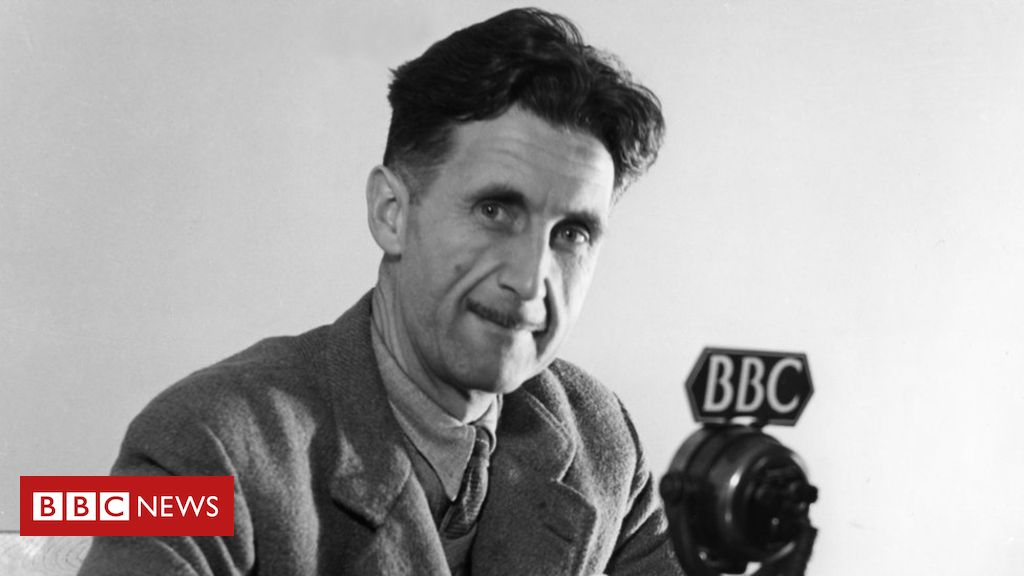
Orwell had been employed by the BBC for about nine months at the time. He writes of the Beeb’s “atmosphere (being) somewhere halfway between a girls’ school and a lunatic asylum (where) all we are doing is useless, or slightly worse than useless”. But that didn’t prevent him observing the following and writing it down for potential reference:

    The only time one hears people singing in the BBC is in the early morning, between 6 and 8. That is the time when the charwomen are at work. A huge army of them arrives all at the same time. They sit in the reception hall waiting for their brooms to be issued to them and making as much noise as a parrot house, and then they have wonderful choruses, all singing together as they sweep the passages. The place has quite a different atmosphere at this time from what it has later in the day.

There’s no overt opining. No proselytizing. No being a loud mouthed schnook. No. Instead, there’s quiet observing. Passerby paying attention. After the fact drafting of an attempt at understanding. All of it brings us journalistically face to face with the vitality – the potential for beauty – of ordinary, practical work using the tools available. It stands in stark contrast to the “useless or slightly worse than useless” abstractionism going on among the great, the good, and the self-important in the BBC bureaucracy.

When I first read the diary entry, it stirred me with eureka-like enthusiasm. That’s it! That’s the solution! We can finally let go of the never-never-land fantasy of abolishing the CBC/Radio Canada. Parliament can instead issue an immediate edict for Mother Corp to hire a “huge army” of cleaning persons, issue them brooms, and unleash them to sing their hearts out. They would soon sweep away the journalistic detritus and parrot droppings in the Corpse’s downtown Toronto and Montreal buildings. A little bit of hallway husbandry married to some glorious working class song: That would fix the GD CBC.

Alas, I was quickly shaken by remembering: This is Canada. Bureaucratism is the irreversible necrosis of the national spirit.

Within months – weeks? – there would be a follow up Clean Canada Choristers Control Act. A federal agency with a $50 million annual starter budget would police against misinformation being sung by the cleaners. It would deploy a gender equitable intersectional analysis to prevent settler colonial bias affecting distribution of bass, tenor, alto and soprano voices. Above all, it would regulate the size and status of the brooms to prevent any unionized chorister feeling unsafe or excluded.

I exaggerate? Not so much. Consider this week’s confirmation that Prime Minister Mark Carney’s urgency to “fast track” projects deemed of “national interest” is about to spawn its own Major Federal Projects Office – a bureaucracy to reduce the bureaucracy of getting down to work and building Canadian things that Canadians need.

You might think some journalist somewhere might ask, like, you know, “Why can’t they just reduce the bureaucracy instead of, like, you know, creating another one with more bureaucrats? Kind of, you know, play DOGE Ball North: ‘You! Bureaucrats! You’ve been tagged! You’re out!!'”

But no. Remember, as I was obliged to, this is Canada. Those kinds of questions aren’t asked even by journalists who should be asking them because … those kinds of thoughts are no longer thunk here. (I don’t think they’re actually illegal. Yet.)

April 18, 2025

Notes on the French debate

Paul Wells jotted down some notes in his Substack Chat after the leaders’ debate last night:

A few notes on last night’s post-election scrum fiasco, when reporters from Rebel News and Juno News got most of the questions. Some of the commentary this morning about this, from people who think it was a disaster (I think it’s unfortunate but not quite a disaster), is alarmingly superficial.

So here are some thoughts, threaded.

1. The debate commission didn’t just take it into their fool heads to invite these alt-right news organizations. They tried hard to block them in 2021, got hauled into court, and lost big. Remembering this very recent news event should, it seems to me, be a basic requirement for your pundit’s license. https://globalnews.ca/news/8174634/rebel-news-election-debates-court-challenge/

My first thought was that it’s apparently ok for Mr. Singh to refuse to engage with certain media, but if Mr. Poilievre remarks on CBC bias, he’s the enemy.

2. I’m not fond of Ezra, but in declaring that Rebel News had five divisions, he was engaging in not entirely unfunny satire about the way the CBC shows up with French and English radio and TV to every event. You may not like the joke! But it was clearly, to some extent, obvious satire about an obvious target.

3. I remain astonished that any political leader shows up for scrums after any debate. They just talked for two hours! The only possible newsworthy outcome from a scrum afterwards is, you walk all over the message you prepped for weeks to deliver. We had scrums after our 2015 Maclean’s debate. Stephen Harper just didn’t show up for them. That’s an option! Carney has worked hard since January to control and limit access to his regal person, and then he wanders into a scrum after what would be, for any anglophone, an exhausting two hours in French, as though somebody told him it was where he could get a sandwich? People are weird.

Once upon a time — at least in theory — one of the functions of the mainstream media was to help keep our political leaders under observation for the voters. That fantasy has long since vanished in Canada, as almost all the surviving mainstream media outfits are slavering propagandists, lickspittles, and fart-catchers for the Liberal Party and especially for its leader-of-the-moment. In The Line, a media outlet that isn’t directly funded by the federal government, Andrew MacDougall offers a parable about the Canadian media:

My eldest daughter is nine. Her little sister is five. The little one adores her big sister and believes everything she says.

I, on the other hand, am 49. My eldest often tries to convince me of things. But I am a skeptic when it comes to the things my children tell me, as any good parent should be. And because I push back on the eldest’s arguments, she often comes back moments later with much sharper ones. Sometimes I even change my mind.

Yes, this is a parable about the media and its role in public life, including during this federal election. And yes, we can debate the mechanics of media — who gets access, how many questions, and so on — but this is to both bury the lede and miss the story. There is much more at stake than whether the Toronto Star or the Globe gets a question at a tightly-managed press event.

What’s at stake is whether anyone in power will ever again have a parent to satisfy. Or whether those in power will be nine-year-olds, forever seeking the smoke blown up their asses by the five-year-olds in their life.

The ability to act like a nine-year-old in power is an entirely new phenomenon. In the Before Times, when a politician (or corporate leader) used to have to exchange credible arguments with a member of the media in return for access to the distribution network of their publication or broadcast, serious conversations were par for the course. It wasn’t perfect, no, but it was an adult time. There was no point rocking up to the microphone with a wild ad hominem attack, or armed with a list of faulty facts, because it wouldn’t have passed muster. There was no rolling 24/7 coverage, and easily discredited arguments wouldn’t have made the cut in what was then limited news real estate. Now, thanks to social media, there is an infinite and constantly updating canvas. You don’t even need a credit card, let alone an argument, in order to access and speak to your audience — and then tell them any damn thing you want, no matter its level of adherence to the truth.

It wasn’t supposed to be this way. In their pre-algorithmic infancy, the major social media platforms promised access and connection. In this more gentle, less attention-hogging iteration, the major benefit of the social media platforms and other owned channels was that they allowed you to go — unfiltered — to your intended audiences. A clean message, straight to the target voter. What politician wouldn’t want that? How could that be a bad thing? Well, other than the fact that politicians and other people in positions of power have been known to lie and try to cover up bad things.

April 25, 2024

“… good Lord, is [Chrystia Freeland] ever terrible at politics”

Filed under: Cancon, Media, Politics — Tags: , , , , , , — Nicholas @ 05:00

In The Line, Matt Gurney recounts Deputy Prime Minister Chrystia Freeland’s terrible response to a topical question from a reporter:


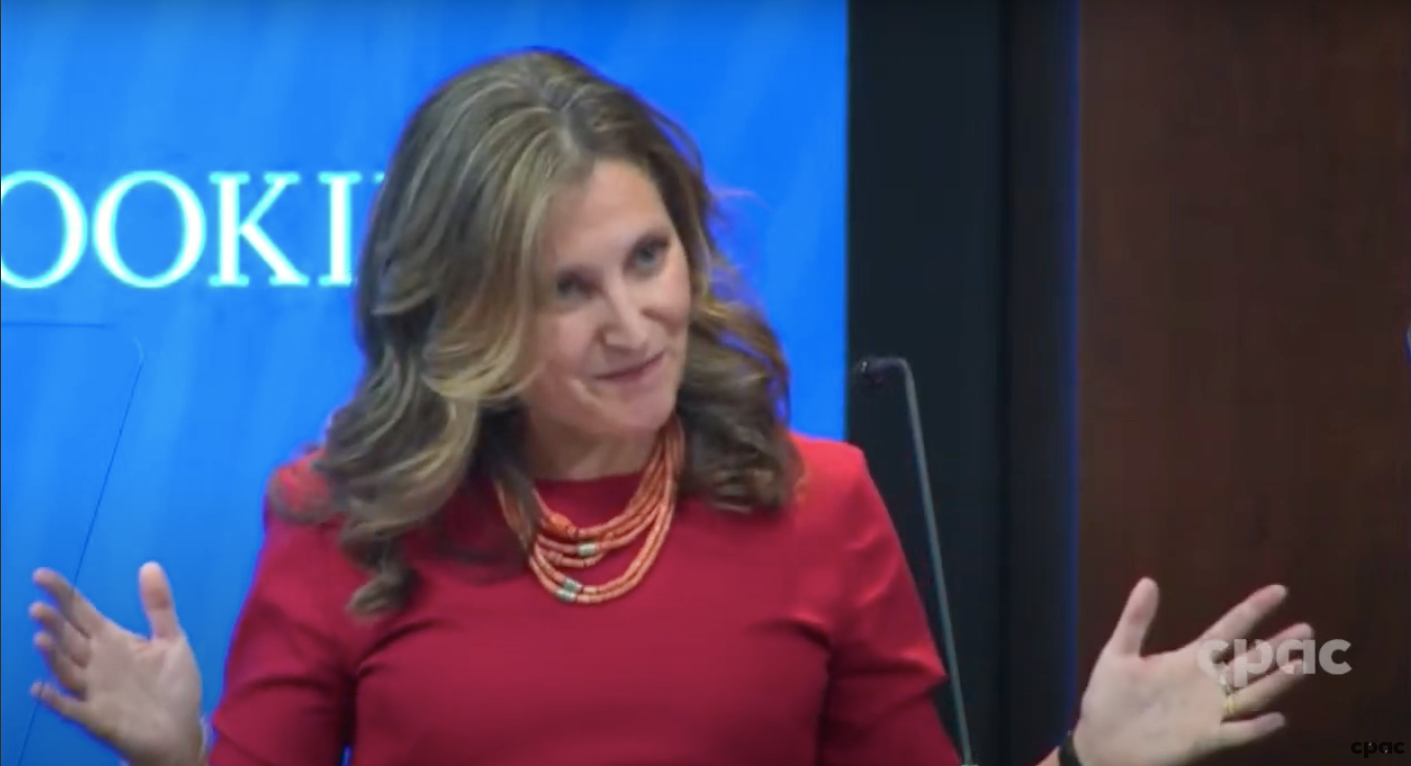
Screencap from a CPAC video of Chrystia Freeland speaking in October, 2022.

In fairness, noting that Freeland, she of the infamous Disney+ flop, is bad at politics is not an original observation. I confess that. But, still. Yikes! What the hell was that?!

I’m referring to Monday’s unfortunate gaffe. Freeland was in Montreal doing post-budget stuff with the small business minister, and after touring a business, took questions from reporters. Sarah Leavitt from the CBC asked a question related to a particularly vile eruption of overt antisemitism at a protest in Ottawa last weekend. A man leading the crowd in chants said “Our resistance attacks are proof that we are almost free … Oct. 7 is proof that we are almost free. Long live Oct. 7, long live the resistance, long live the intifada, long live every form of resistance.”

Oct. 7, of course, means the Hamas rape-and-murder pogrom of Oct. 7.

By the time Leavitt quizzed Freeland, the comments in Ottawa had already been widely disseminated and, critically, condemned. Among the condemners: Freeland’s boss, Prime Minister Justin Trudeau. He’d commented via Twitter a day before Freeland faced Leavitt’s question. This ought to have been an extremely easy exchange for Freeland.

As it turns out, though, not so much, actually.

In the interests of transparency, let’s simply see in full both what Leavitt asked, and how Freeland replied.

The question was clear enough: “Over the weekend, protesters in Ottawa were heard chanting, among other things, ‘Long live October 7’ and ‘October 7 is proof that we are almost free’. Is this hate speech?”

[…]

Let’s walk through her answer, putting her reply into the discrete points she’s been trained to hit.

Phase One: Ass covering. “I wasn’t in Ottawa over the weekend. And I’m not aware of those specific reports. And so it would be just wrong of me to comment on something that I am not specifically aware of.”

Phase Two: Banal statement that favours no group in particular but mentions the key stakeholders. “What I will say is, today is a time in Canada, when antisemitism and Islamophobia are on the rise. When we have a lot … there are a lot of Canadians who are not feeling safe. In my own riding of University-Rosedale, the JCC, a really important centre for Jewish Canadians but also for all Canadians, has faced a lot of pressure. And I’ve been there to meet with people there. There’s also a mosque in my riding that faced pressure and attacks and I’ve met with the leaders there.”

Phase Three: Attempt to sound like you’re engaging with the actual question, even though you are not. “Hate speech is absolutely not acceptable. Glorifying … I mean, I can’t even say the word because it’s … you shouldn’t. It’s too terrible. And what happened on October 7 was a heinous terrorist attack. People were killed. People were raped. Women, men, children … totally unprovoked attack on civilians. That is not acceptable.”

Phase Four: Pivot back to approved talking points. “Canada recognizes Hamas as a terrorist entity and our government is very, very clear on that. We have also been really clear that there needs to be a ceasefire, that a humanitarian catastrophe is happening right now in Gaza, and Canada and Canadians are there to support the people, the suffering people, there, too.”

This is how the PM answers questions, too. It’s a pattern that, once seen, will never been unseen. The problem for Freeland is that the PM is better at it. He’s smoother and quicker on his feet. His evasive non-answers sound more natural, but have begun to get old in recent years, as foreign journalists are generally better at pointing out than Canadian ones. Freeland has never been comfortable doing talking-point politics, and has always sounded extremely unconvincing when she tries.

April 23, 2024

Justin Trudeau’s legacy may not be something he ever wanted (or imagined)

Tristin Hopper outlines some of the attitudinal changes among Canadian voters during Trudeau’s term in office, with opinions shifting away from things we used to consider settled once and for all. Canada’s Overton Window is moving (relatively) quickly:

Front view of Toronto General Hospital in 2005. The new wing, as shown in the photograph, was completed in 2002.
Photo via Wikimedia Commons.

It’s been among the most volatile and untouchable third rails in Canadian politics: The adoption, at any level, of a private health-care system.

In the last federal election, a Conservative statement about “public-private synergies” was all it took for Deputy Prime Minister Chrystia Freeland to brand it as a right-wing assault on the “public, universal health-care system”.

But a new Ipsos report shows that “two tier health care” is not the threat it once was.

Among respondents, 52 per cent wanted “increased access to health care provided by independent health entrepreneurs”, against just 29 per cent who didn’t.

Perhaps most shocking of all, almost everyone agreed that private health care would be more efficient. Seven in 10 respondents agreed that “private entrepreneurs can deliver health care services faster than hospitals managed by the government” – against a mere 15 per cent who disagreed.

“People understand that the endless waiting lists that characterize our government-run health systems will not be solved by yet another bureaucratic reform”, was the conclusion of the Montreal Economic Institute, which commissioned the poll.

As Canada reels from simultaneous crises of crime, affordability, productivity, health-care access and others, it’s prompting a political realignment unlike anything seen in a generation. But it’s not just a trend that can be seen in the millions of disaffected voters stampeding to a new party. As Canadians shift rightwards, they are freely discarding sacred cows that have held for decades.

If Canadians are suddenly open to health-care reform, it helps that they’ve never been more dissatisfied with the status quo. The past calendar year even brought the once-unthinkable sight of the U.S. being officially called in to bail out failures in the Canadian system.

February 27, 2024

Thank goodness we don’t get all the CBC we pay for!

Filed under: Cancon, Government, Media, Politics — Tags: , , , , , — Nicholas @ 05:00

In the dim, dark recesses of history … say twenty-five years ago … the CBC was what the government still seems to believe it is: a credible, trusted source of news and entertainment. In truth, it was never as loved as some might claim, as it had a deep bias in favour of Quebec and Ontario issues and tended to only occasionally remember the rest of the country. The federal government has been subsidizing the CBC, yet the network’s audience has shrunk to the point that it’s rare to encounter anyone who consumes very much of the programming on offer. Part of that is just the sheer variety of other options available to Canadians and part of it is the CBC’s sour, toxic, hectoring tone when lecturing about “the current thing”. Far from being a major player in upholding Canadian culture, the CBC is clearly one of the major factors that are destroying it:

… looking at the viewer and listener stats for the CBC, our national behemoth, which eats up $1.5 billion annually, and which amounts to 50% of the media dollars spent, is equally disheartening. The state spends another $600 million supporting once-successful media because “internet”. CBC television is watched by 3.9% of Canadians and only 0.8% watch CBC News. Again, half of all media dollars, half. Half is spent engaging less than 4% of Canadians. CBC radio is considered reasonably good, and is listened to by 10%, despite its vindictive calling out of anyone who disagrees with their hard socialist stance. As to other mainstream media, propped up by government via hundred of millions, it is still shedding staff and readers in double digits.

Despite every conceivable advantage, advertising on the CBC dropped 20% during the pandemic. In fact, they are so disliked that CBC is hiring “close protection security” for the next two years. They are so disliked, they have turned off commenting on their various programs. They are so disliked that there is a brand of coffee called “Defund the CBC”. This isn’t passive ignoring, this is active dislike to the point of needing bodyguards.

Why? Because our media show us to ourselves as racist, stupid, sexist, stupid, stupid and more stupid. And while they are at it, shallow and violent. That is the real reason, and the only reason CanCon is dying. They hate us. Why? The only people who have thrived during the past twenty years in Canada when private and public wealth doubled then doubled again, are the ones who live off the government, whether through mandated consulting in the enviro and other business, or direct granting or though quasi-private-sector jobs that are heavily subsidized. Public Private Partnerships have to be the most fiendish way to flat out loot the public ever been invented. Or straight up public sector jobs which are among the most lushly funded and unionized in the known universe, the number of which have grown 400% in the last ten years. Do or did you get six weeks of paid holiday a year?

And do they hate us, in fact correcting us is how they get the grants, the jobs, the subsidy. Everything they do is meant to fix us deplorable Canadians.

Sit at a downtown Toronto dinner party as I have, with say, the head of CBC drama, as I have and listen to just how much they hate the rest of Canada. Why? They hate the rest of Canada because they feel guilty. They know they are cheating and they know they are stealing. I tell ya, I needed close protection security — this woman was terrifying. “Sit Down While I’m Talking to You“, she roared at me.

August 24, 2023

“Facebook has made a calculated business decision about the value of its fucks. These fucks are expensive. So they won’t give any.”

In The Line, Jen Gerson fought the good fight as long as she could, but finally had to load up the old shotgun and share both barrels with the participants in the ongoing clusterfarce over the Online News Act (the artist formerly known as Bill C-18):

Look, I’ve largely said my piece on the Online News Act: it’s poorly conceived legislation that risked terrible outcomes. It’s pointless, now, with those terrible outcomes unfolding, to say “I told you so”.

But the response to the news that Meta has decided to continue blocking news — even in the face of devastating wildfires in B.C. and the Northwest Territories — has been such disingenuous dumbfuckery from every corner that I have failed to bestill my cursed fingertips.

Let’s start with this quote from Prime Minister Justin Trudeau, who at a recent press conference, said: “Right now in an emergency situation where up-to-date local information is more important than ever, Facebook’s putting corporate profits ahead of people’s safety, ahead of supporting quality local journalism … This is not the time for that”.

Wait, a major global corporation that has been labelled as actually literally evil by both progressives and conservatives in recent years is putting its own profits and self-interest ahead of the priorities and values of politicians and pundits?

Sir, surely thou art in jest.

Is this government only now figuring out that major global corporations exist to extract profits; that whatever social corporate responsibility roles they may choose to enact, they aren’t a public service? Is Trudeau shocked — shocked, I say! — to just this very moment discover that Meta isn’t actually some combination of the Red Cross and Reuters?

I mean … welcome to the adult world, I guess, and please leave your copy of Adbusters near the coat check at the door.

But if Meta is as evil as all that, why did so few politicos or pundits anticipate that the company would follow through on its explicit threat to block news if C-18 were passed? This is like watching an Allied general who says: “I think these Nazi fellows are the baddies!” and then gets flustered when the guys with skulls on their caps pull out their guns and start shooting in the midst of afternoon trench tea. “Well, I never. That’s hardly sporting!” This is some Black Adder comedy, friends, and we may be on the side of the angels, but our angels also happen to be a little slow in the head.

Oh, but surely Meta wouldn’t block news to put their own self interest “ahead of people’s safety”, hmmmm?

With advance apologies, but is our antipathy toward Meta so intense that we’re going to straight-face pretend that AM radio, FM radio, emergency text alerts and broadcasts, municipal and provincial emergency websites, formal and informal social media networks and chat groups, and local news broadcasts with websites that can be accessed directly through web browsers all just ceased to exist, simultaneously, the very moment that CBC stopped being able to post news links to Instagram?

If Facebook is actually putting lives in danger, that’s an admission of impotence and incompetence from our entire communications infrastructure, including government, private and public media. It is an incredible and embarrassing self-own.

January 12, 2023

QotD: Describing the CBC to Americans

Filed under: Cancon, Government, Media, Politics, Quotations — Tags: , , , , — Nicholas @ 01:00

    an audience of any size has yet to be found

So far so CBC, then.

I’m not sure how to describe the CBC to American viewers. The BBC routinely produces content that’s quite entertaining (deliberately, I mean) so it’s not a good analogy. I suppose the best analog would be if NPR and PBS merged and were run by the CPUSA with $20 billion dollars of taxpayer money, and still managed to produce nothing anyone wanted to watch.

Daniel Ream, commenting on David Thompson, “The Giant Testicles Told Me”, DavidThompson, 2022-10-10.

December 16, 2022

The Online News [Shakedown] Act passes the House of Commons

Filed under: Business, Cancon, Government, Media — Tags: , , , , , , , , — Nicholas @ 03:00

Michael Geist summarizes the farcical progress of Justin Trudeau’s legalized theft from the “tech giants”:

Later today, the House of Commons will vote to approve Bill C-18, the Online News Act, sending it to the Senate just prior to breaking for the holidays. While Canadian Heritage Minister Pablo Rodriguez and media lobbyists will no doubt celebrate the milestone, it should not go unremarked that the legislative process for this bill has been an utter embarrassment with an already bad bill made far worse. The government cut off debate at second reading, actively excluded dozens of potential witnesses, expanded the bill to hundreds of broadcasters that may not even produce news, denigrated online news services as “not real news”, and shrugged off violations of international copyright law. All the while, it acknowledged that mandated payments for links are the foundation of the bill with officials stating that individual Facebook posts accompanied by a link to a news story would be caught by the law. As for the purported financial benefits, the government’s own estimates are less than half those of the Parliamentary Budget Officer, who also concluded that more than 75% of the revenues will go to broadcasters such as Bell, Rogers, and the CBC. The end result is a bill that will undermine competition and pose a threat to freedom of expression, while potentially leading Facebook to block news sharing in Canada and Google to cancel dozens of existing agreements with Canadian news outlets.

As I’ve chronicled for months, Bill C-18 is the product of an intense lobbying campaign from some of Canada’s largest media companies. While the Globe and Mail broke from the pack at the last minute, years of one-sided editorials — even devoting full front pages to the issue — had its effect. Indeed, Canadian newspapers would be exhibit #1 for how government intervention in the media space has a direct impact on an independent press. From the moment of its introduction, the consequences were immediately obvious as payments for links serves as the foundation for a law that treats “facilitating access to news” as compensable. Canadians can be forgiven for thinking the bill is about compensating for reproduction of news stories. It is not, since the platforms don’t do that. Instead, it is about requiring payments for links, indexing or otherwise directing traffic to the news organizations who are often the source of the link itself. In most circumstances, recipients pay for the benefits that come from referral traffic. With Bill C-18, the entities providing the referrals pay for doing so.

Further, the bill is about far more than struggling Canadian newspapers as it expands eligibility into broadcasters such as the CBC, foreign news outlets such as the New York Times, and hundreds of broadcasters licensed by the CRTC that are not even required to produce news. The end goal is negotiated payments for links, backed by the threat of a one-sided arbitration process overseen by the CRTC in which the arbitration panel can simply reject offers if it believes it fails to meet the government’s policy objectives. That isn’t a commercial deal, it is a shakedown.

I’ve been operating on the assumption that the government is betting that the big internet companies won’t do the obvious and ban linking to any Canadian media outlet on their respective platforms, but the feds don’t have a great track record of predictions in recent years …

In a later post, Michael Geist illustrated the literal misinformation that was pushed by government MPs during Bill C-18’s path through to final reading by quoting some of Liberal MP Lisa Hepfner’s contributions:

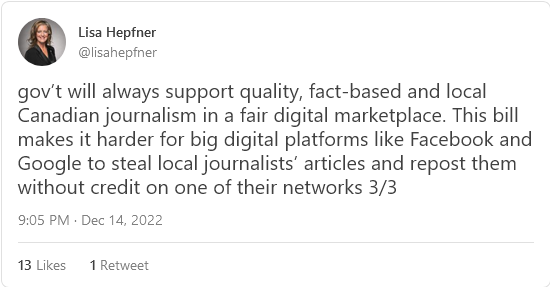
Last month, Liberal MP Lisa Hepfner shocked Canadian online news outlets by stating that “they’re not news. They’re not gathering news. They’re publishing opinion only.” The comments sparked instant criticism from news outlets across the country, leading Hepfner to issue a quick apology. In the aftermath of the comments, Hepfner said nothing for weeks at Heritage committee studying Bill C-18. That bill passed third reading yesterday – I posted on the embarrassing legislative review – and Hepfner was back at it. Rather than criticizing online news outlets, this time she targeted the Internet platforms, saying the bill would make it “harder for big digital platforms like Facebook and Google to steal local journalists’ articles and repost them without credit.” 

[…]

Hepfner’s comment not only provide a troubling example of an MP engaging in misinformation about links who has effectively labelled her own Facebook posts as theft, but strikes at the heart of the problem with Bill C-18. As government officials have acknowledged, the entire foundation of the bill is based on paying for links. In fact, when a proposal to remove links from the bill was raised at committee, government MPs described the change as a loophole and voted against it. In the case of the CBC links, the government confirmed that Hepfner could write about the availability of children’s medications (ie. “Great news! CBC reports a million bottles of pain medication are on the way”) but once she added a link to provide a source for the claim, Bill C-18 is triggered.

These examples highlight the absurdity of a law that treats links as compensable and MPs who equate those links to theft. To be clear, there is nothing wrong with Hepfner or anyone else providing a link to a story on greater availability of children’s medicine. In fact, the CBC story has effectively already been paid for by the public and should be shared widely without the government creating barriers to sharing that information. What is wrong that is ill-informed MPs have voted for Bill C-18, creating a framework in which the government is imposing a mandatory payment scheme for some platforms for hosting links. The bill is now headed to the Senate which will hopefully make the necessary amendments to set Hepfner’s mind at ease that her own Facebook posts do not make her an accomplice to theft.

Older Posts »

Powered by WordPress