Quotulatiousness

April 7, 2020

Leopold II of Belgium: The Biggest Coverup In European History

Filed under: Africa, Europe, History — Tags: , , , , , — Nicholas @ 06:00

Biographics
Published 26 Sep 2018

Credits:
Host – Simon Whistler
Author – Shannon Quinn
Producer – Jack Cole
Executive Producer – Shell Harris

April 1, 2020

Curator’s Tank Museum Tour: Tank Story Hall – WW1 | The Tank Museum

Filed under: Britain, Europe, France, Germany, History, Military, WW1 — Tags: , , , , , — Nicholas @ 05:00

The Tank Museum
Published 31 Mar 2020

Join Curator David Willey as he takes you on a tour of The Tank Museum’s Tank Story Hall, which houses over 30 key vehicles from Little Willie to Challenger 2. In this section he looks at the First World War vehicles and gives you a potted history of WW1.

Support the work of The Tank Museum on Patreon: ► https://www.patreon.com/tankmuseum
Visit The Tank Museum SHOP & become a Friend: ► https://tankmuseumshop.org/

Twitter: ► https://twitter.com/TankMuseum
Instagram: ► https://www.instagram.com/tankmuseum/
Tiger Tank Blog: ► http://blog.tiger-tank.com/
Tank 100 First World War Centenary Blog: ► http://tank100.com/
#tankmuseum #tanks

March 13, 2020

“The Price of a Mile” – The Battle of Passchendaele – Sabaton History 058 [Official]

Filed under: Britain, Germany, History, Media, Military, WW1 — Tags: , , , , — Nicholas @ 04:00

Sabaton History
Published 12 Mar 2020

So tell me what’s the price of a mile? The Battle of Passchendaele in 1917 is often remembered as a dismal and dreadful campaign. Fighting over endless mud, waterlogged shell-holes and unrecognizable, bombed out ground, the battle became a slog where everybody was just miserable. Hundreds of thousands of men became casualties for the advance of a handful of miles.

The Art of War online: https://sites.ualberta.ca/~enoch/Read… [PDF]

Support Sabaton History on Patreon: https://www.patreon.com/sabatonhistory

Listen to “Price of a Mile” on the album The Art of War:
CD: http://bit.ly/TheArtOfWarStore
Spotify: http://bit.ly/TheArtOfWarSpotify
Apple Music: http://bit.ly/TheArtOfWarAppleMusic
iTunes: http://bit.ly/TheArtOfWariTunes
Amazon: http://bit.ly/TheArtOfWarAmz
Google Play: http://bit.ly/TheArtOfWarGooglePlay

Check out the trailer for Sabaton’s new album The Great War right here: https://www.youtube.com/watch?v=HCZP1…

Listen to Sabaton on Spotify: http://smarturl.it/SabatonSpotify
Official Sabaton Merchandise Shop: http://bit.ly/SabatonOfficialShop

Hosted by: Indy Neidell
Written by: Markus Linke and Indy Neidell
Directed by: Astrid Deinhard and Wieke Kapteijns
Produced by: Pär Sundström, Astrid Deinhard and Spartacus Olsson
Creative Producer: Joram Appel
Executive Producers: Pär Sundström, Joakim Broden, Tomas Sunmo, Indy Neidell, Astrid Deinhard, and Spartacus Olsson
Post-Production Director: Wieke Kapteijns
Edited by: Karolina Kosmowska
Sound Editing by: Marek Kaminski
Maps by: Eastory – https://www.youtube.com/c/eastory

Archive by: Reuters/Screenocean https://www.screenocean.com
Music by Sabaton.

Sources:
– Imperial War Museum: Q 20705;Q 45462;Q 5989;6Q 2890;Q 3117 Q 3008;Q 2712;Q 23779;Q 7806;Q 5937;Q 5726;Q 2902;Q 2713;Q 57299;Q 57247;Q 45390;Q 51569;Q 1426;Q 540;Q 17868;Q 50237;Q 47725;Q 45382;Q 2639;Q 29088;Q 42251;Q 5714;Q 2868;Q 5938;Q_005935;Q 2625;Q 5723;Q 2627;Q 29090;Q 52862;Q 88098;Q 88017;Q 2706;Q 5936;Q 5904;Q 5940;Q 5941;Q 5902;Q 47741;Q 3001;Q 5947;Q 6458;Q 3252;Q 29088;Q 5767;Q 45461;Q 42251;Q 2682;Q 20705;Q 6346;Q 6223;Q 11688;Q 2708.;Q 47719;Q 3103;Q 2679;;Q 2640;Q 2858;Q 2735;Q 2707;Q 2757;Q 5901;Q 3006.;Q 5904;Q 5928;Q 3104;Q5903;Q 29089;Q 5865;Q 11668;Q 3002;Q 2978;Q 3121;Q5706;Q 47741;Q 2755;Q 55558;Q 3012;Q 5874;Q 5888;Q 7806;Q 6327;Q 54408;Q 2866;Q 56567;Q 6047;Q 6049;Q 3252; 3140;Q 2868;Q 61034;Q 42250;Q 3025;Q 7814.;Q 2893;Q 2737;E00777;Q 3029;Q 2763;Q 5773;Q 2756;Q 47741;Q 45369;Q 2707;Q 6327;Q 5902.;Q 3006;Q 5871;Q 5733; CO 1757;CO 2241;CO 1757;CO 2252;CO 2241;CO 1757;CO 2246;CO 2252;CO 1763;CO 2241; E(AUS) 941;(E(AUS) 719);E(AUS) 1233.;(E(AUS) 719),
– Art IWM: ART 1921; ART 1150,
– The Australian War Memorial: E00693; E04678; E01912; E00874; E00807; E00874; E01229; A02653; E00927
– National Army Museum: 1952-01-33-55-391; 1985-04-48-412; 2001-02-256-96;1997-12-75-81; 2010-01-56-40; 1994-12-31-1; 1978-11-157-24-36;
1965-10-209-27; 1972-08-67-1-40; 1917-07-31,
– Canadian War Museum: CWM 19930013-511;CWM 19890222-001;CWM 19930013-464;CWM 19930013-511;CWM 19710261-0093.;
165-BO-1503,
– Library and Archives Canada: 040139

An OnLion Entertainment GmbH and Raging Beaver Publishing AB co-Production.

© Raging Beaver Publishing AB, 2019 – all rights reserved.
March 11, 2020

Carton de Wiart – A Man For All Seasons – WW2 Biography Special

Filed under: Africa, Britain, Europe, History, Italy, Military, WW1, WW2 — Tags: , , , , , — Nicholas @ 06:00

World War Two
Published 10 Mar 2020

Carton de Wiart was a remarkable figure in World War One, but his story continues in World War Two, where he rolls from one adventure into the next.

Join us on Patreon: https://www.patreon.com/TimeGhostHistory
Or join The TimeGhost Army directly at: https://timeghost.tv

Follow WW2 day by day on Instagram @World_war_two_realtime https://www.instagram.com/world_war_t…
Between 2 Wars: https://www.youtube.com/playlist?list…
Source list: http://bit.ly/WW2sources

Hosted by: Indy Neidell
Written by: Francis van Berkel
Produced and Directed by: Spartacus Olsson and Astrid Deinhard
Executive Producers: Bodo Rittenauer, Astrid Deinhard, Indy Neidell, Spartacus Olsson
Creative Producer: Joram Appel
Post-Production Director: Wieke Kapteijns
Research by: Keith Kevelson
Edited by: Mikołaj Cackowski

Colorizations by:
Julius Jääskeläinen – https://www.facebook.com/JJcolorization/

Sources:
IWM Q 101768, Q 82958, Q 15472, Q 53680, Q 92257, Q 4511, Q 11429, Q 92207, Q 92214, N 228, N 110, N 68, H 7393, HU 128168, E(MOS) 1315, SE 3547, A 31225, A 20588, Q 92218
Skull by Mahmure Alp from the Noun Project
foot bone by Maxicons from the Noun Project
Ear by Vectors Market from the Noun Project
Hip Bones by ProSymbols from the Noun Project
Collection of Auckland Museum Tamaki Paenga Hira, 2001.25.480 Brent Mackrell Collection
Narodowe Archiwum Cyfrowe
Picture of Combe, Carton de Wiart, Todhunter and Gambier-Parry in Vincigliata Castle Prison, courtesy Michael Todhunter

Soundtracks from the Epidemic Sound:
Hakan Eriksson – “Epic Adventure Theme 3”
Jo Wandrini – “Dawn of Civilization”
Rannar Sillard – “March of the Brave 4”
Johannes Bornlof – “Death And Glory 3”
Farrell Wooten – “Blunt Object”
Philip Ayers – “Trapped in a Maze”
Phoenix Tail – “At the Front”

Archive by Screenocean/Reuters https://www.screenocean.com.

A TimeGhost chronological documentary produced by OnLion Entertainment GmbH.

From the comments:

World War Two
40 minutes ago (edited)
This episode was made thanks to our research volunteer Keith Kevelson. It is also the first of its kind, being the first proper Biography Special of our World War Two series. We will do one of these every other week, so be prepared to get to know the main protagonists of the Second World War up close and personal. Please support us on Patreon so we can continue making these. Sign up at www.patreon.com/timeghosthistory or https://timeghost.tv.

Cheers,
Joram

February 25, 2020

The Prototype .280 FAL from 1950s NATO Trials

Filed under: Britain, Europe, History, Military, USA, Weapons — Tags: , , , , , , — Nicholas @ 04:00

Forgotten Weapons
Published 24 Feb 2020

http://www.patreon.com/ForgottenWeapons

https://www.floatplane.com/channel/Fo…

Cool Forgotten Weapons merch! http://shop.bbtv.com/collections/forg…

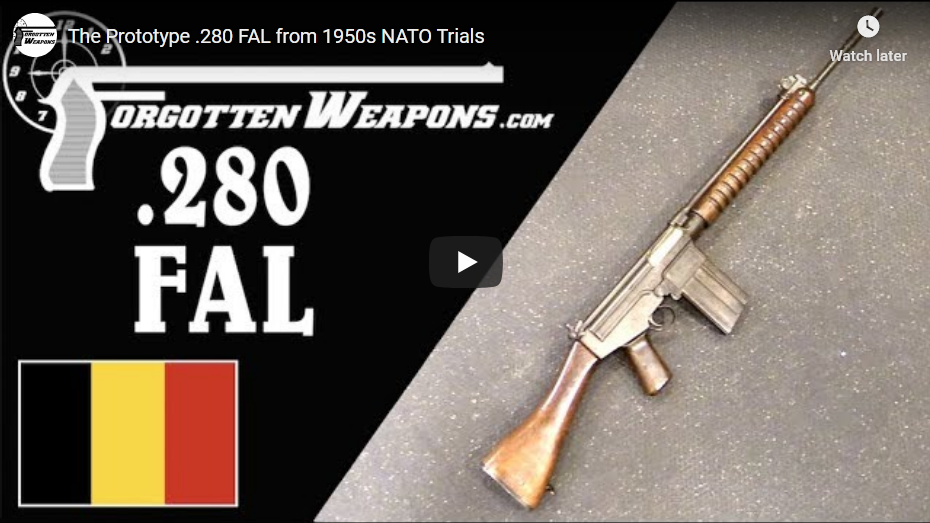
After World War Two, the new NATO defense alliance held a series of trials to adopt a standard cartridge and infantry rifle. This would eventually devolve and the goal of a standardized rifle would be abandoned, but during the early trials there were three main contenders: the British EM-2, the American T-25, and the Belgian FAL. The Fusil Automatique Leger was designed by Dieudonne Saive and originally presented to the British government in 8mm Kurz, before being scaled up to accommodate the British request to use the .280 cartridge. A small number of these prototype FAL rifles in .280 were delivered by FN, and used in the 1950 NATO rifle trials.

Many thanks to the Royal Armouries for allowing me to film and disassemble this very scarce trials rifle! The NFC collection there — perhaps the best military small arms collection in Western Europe — is available by appointment to researchers:

https://royalarmouries.org/research/n…

You can browse the various Armouries collections online here:

https://royalarmouries.org/collection/

Contact:
Forgotten Weapons
6281 N. Oracle #36270
Tucson, AZ 85740

February 22, 2020

The FAL for British Troop Trials in 1954: X8E1 & X8E2

Filed under: Britain, History, Military, Weapons — Tags: , , , , , , — Nicholas @ 04:00

Forgotten Weapons
Published 21 Feb 2020

http://www.patreon.com/ForgottenWeapons

https://www.floatplane.com/channel/Fo…

Cool Forgotten Weapons merch! http://shop.bbtv.com/collections/forg…

The NATO rifle trials of the early 1950s eventually chose the 7.62mm x 51mm cartridge, and the British and Belgians agreed on the FAL rifle to shoot it (and they thought the US would as well, but that’s another story). The British government formally accepted the FAL for troop trials, and in 1954 an order for 4,000 X8E1 rifles (with iron sights) and 1,000 X8E2 rifles (with SUIT 1x optical sights) was placed. These rifles were mechanically the same as what would be finalized as the L1A1 rifle, but they include a number of differing features. Both models had 3-position selector switches allowing automatic fire, and they also had manual forward assists on the bolt handles. The iron sights had top covers with integrated stripper clip guides, as there was concern that troops would have to manually reload their magazines, and stripper clips would speed this process up.

Many thanks to the Royal Armouries for allowing me to film these very scarce trials rifles! The NFC collection there — perhaps the best military small arms collection in Western Europe — is available by appointment to researchers:

https://royalarmouries.org/research/n…

You can browse the various Armouries collections online here:

https://royalarmouries.org/collection/
Contact:
Forgotten Weapons
6281 N. Oracle #36270
Tucson, AZ 85740

February 18, 2020

Royal Resistance in Benelux and Scandinavia 1940 – WW2 – War Against Humanity 008

Filed under: Europe, Germany, History, Military, WW2 — Tags: , , , , , , , — Nicholas @ 06:00

World War Two
Published 17 Feb 2020

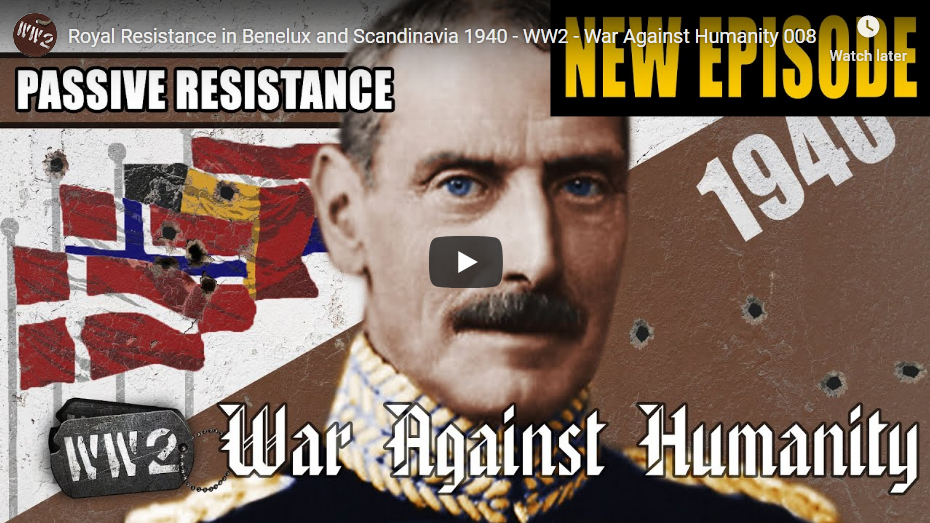
When the Racism of Naziism hits the Nationalism of Monarchism, it doesn’t quite go like Hitler would have imagined.

Join us on Patreon: https://www.patreon.com/TimeGhostHistory
Or join The TimeGhost Army directly at: https://timeghost.tv

Follow WW2 day by day on Instagram @World_war_two_realtime https://www.instagram.com/world_war_t…
Join our Discord Server: https://discord.gg/D6D2aYN.
Between 2 Wars: https://www.youtube.com/playlist?list…
Source list: http://bit.ly/WW2sources

Written and Hosted by: Spartacus Olsson
Produced and Directed by: Spartacus Olsson and Astrid Deinhard
Executive Producers: Bodo Rittenauer, Astrid Deinhard, Indy Neidell, Spartacus Olsson
Creative Producer: Joram Appel
Post-Production Director: Wieke Kapteijns
Research by: Spartacus Olsson
Edited by: Mikołaj Cackowski
Map animations: Eastory (https://www.youtube.com/c/eastory)

Colorizations by:
Norman Stewart – https://oldtimesincolor.blogspot.com/
Julius Jääskeläinen – https://www.facebook.com/JJcolorization/
Sources:
National Museum of Denmark https://natmus.dk/museer-og-slotte/fr…
Archive of I.M. Bondarenko
Regionaal Archief Nijmegen
CegeSoma, n°34706
NationalSocialistMovementintheNetherlands (1).png by Ec1801011 from wikimedia commons https://commons.wikimedia.org/wiki/Fi…
Resistance_15_December_1940 by SiefkinDR from wikimedia commons https://en.wikipedia.org/wiki/File:Re…
IWM (FL 24877, HU 66187)
The Dubbo Liberal and Macquarie Advocate (NSW : 1894 – 1954), p. 3 http://nla.gov.au/nla.news-article132…
Yousuf Karsh, National Archives of the Netherlands / Fotocollectie Anefo
Narodowe Archiwum Cyfrowe
Delphin, Rigmor Dahl, Oslo Museum

Soundtracks from the Epidemic Sound:
Johannes Bornlof – “Deviation in Time”
Farrell Wooten – “Blunt Object”
Wendel Scherer – “Reunion”
Fabien Tell – “Last Point of Safe Return”
Howard Harper-Barnes – “London”
Hakan Eriksson – “The End of The World 2”
Phoenix Tail – “At the Front”

Archive by Screenocean/Reuters https://www.screenocean.com.

A TimeGhost chronological documentary produced by OnLion Entertainment GmbH.

From the comments:

Spartacus Olsson
3 days ago
You’d think that the Nazis would know how nationalism works … well, it turns out that when Hitler’s fantasies of race meet the very real nationalism of the old European monarchies, race doesn’t have the trump. Now, in 1940 nationalism isn’t that old, but it’s anchored in old traditions that the monarchies now occupied by the Nazis have managed to reconcile with modernity rather successfully. And here’s an important point: nationalism is often decried as the root of all of these conflicts, and perhaps it is, but in some places it’s also proved to be fertile ground for modern democracy. Perhaps there’s a lesson to be learnt somewhere in there, and maybe that’s that in the end it’s not what, but how that makes a difference. What’s particularly interesting, in for instance the Netherlands with the February Strike or in the Germany resistance rings, is that when faced with a common enemy to the nation, patriotism unites people across the political spectrum, well except those obsessed with the idea of race.

FN Grand Browning: The European 1911 that Never Happened

Filed under: Europe, History, Military, Weapons, WW1 — Tags: , , , , — Nicholas @ 04:00

Forgotten Weapons
Published 17 Feb 2020

http://www.patreon.com/ForgottenWeapons

https://www.floatplane.com/channel/Fo…

Cool Forgotten Weapons merch! http://shop.bbtv.com/collections/forg…

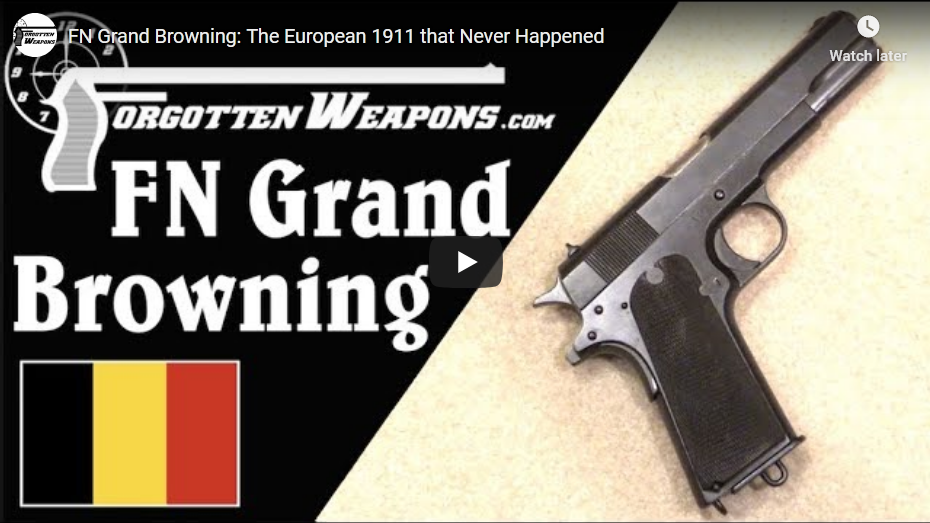
When John Browning licensed his handgun patents, the North American rights were granted to Colt, and the Western European rights to FN in Belgium. Browning provided the patents and patent model guns to the companies, and they were then free to interpret the design however they thought best. In the case of the shrouded-hammer blowback system, the Colt interpretation (the Pocket Hammerless) was a civilian concealed pistol in .32ACP, while the FN interpretation (Model 1903) was a substantially larger gun in 9×20 Browning Long intended for military service.

The locked-breech patent was the same. Colt developed it into the Model 1911 adopted by the US military, and FN built a slightly smaller version in 9.65x23mm intended for European military service. However, while the Colt pistol became tremendously popular, FN’s development was disrupted by World War One, and never completed in its aftermath. Only a couple dozen examples of the Grand Browning, as it was called, were made before the war, and just a few survive today. We will never know how European militaries would have responded to a Browning locked-breech pistol at the time…

Contact:
Forgotten Weapons
6281 N. Oracle #36270
Tucson, AZ 85704

January 26, 2020

The Diamond of Collector FALs: The G-Series

Filed under: Europe, History, USA, Weapons — Tags: , , , , — Nicholas @ 02:00

Forgotten Weapons
Published 2 Apr 2018

Sold for $17,250.

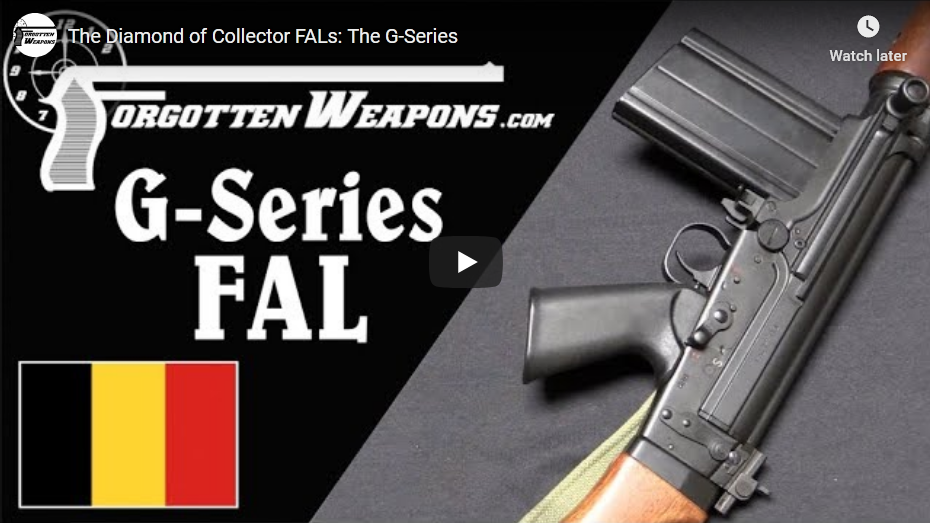
When the Browning Arms Company first began importing semiautomatic FAL rifles from FN in 1959, the submitted an example for evaluation, and ATF determined that it was not a machine gun. The rifle was made with a selector that could not be moved to the fully automatic position, and did not have the automatic sear required for full auto firing. This was acceptable at the time, and Browning would import 1,836 of these rifles (mostly standard configuration, but some heavy barrel and paratrooper patterns) by January 10, 1963. On that date, ATF changed its standard, and ruled the FAL as currently being imported now would be considered a machine gun subject to the NFA. In order to be acceptable now, the rifle must not be able to accept an automatic sear at all, not merely be made without one. However, ATF ruled that the previously imported guns would be grandfathered in, and remain legally owned as semiautomatic rifles. They were listed by serial number (an additional 12 guns were added in 1974 which were imported by “administrative error”), and remain exempted from the NFA to this day. For the FAL collector, these G-series rifles are desirable because they are completely authentic and original early FN production guns, without any of the design changes that would be required later for importation.

Exempt serial number list: http://www.gseriesfal.com/docpages/91…

http://www.patreon.com/ForgottenWeapons

Cool Forgotten Weapons merch! http://shop.bbtv.com/collections/forg…

If you enjoy Forgotten Weapons, check out its sister channel, InRangeTV! http://www.youtube.com/InRangeTVShow

December 13, 2019

“Resist And Bite” – Chasseurs Ardennais – Battle of Belgium – Sabaton History 045 [Official]

Filed under: Europe, Germany, History, Media, Military, WW2 — Tags: , , , , , — Nicholas @ 04:00

Sabaton History
Published 12 Dec 2019

As Germany invades France and the Benelux countries in May 1940, the main bulk of their panzers are heading towards the Ardennes and the Meuse River in an effort to cut the Allied forces in half. However, two small units of Belgian infantry are standing in their way. They are the Chasseurs Ardennais and have one objective: To delay the Germans by every means necessary…

Support Sabaton History on Patreon: https://www.patreon.com/sabatonhistory

Listen to Heroes (where “Resist And Bite” is featured):
CD: http://bit.ly/HeroesStore
Spotify: http://bit.ly/HeroesSpotify
Apple Music: http://bit.ly/HeroesAppleMusic
iTunes: http://bit.ly/HeroesiTunes
Amazon: http://bit.ly/HeroesAmz
Google Play: http://bit.ly/HeroesGoogleP

Watch the official lyric video of “Resist And Bite” here:
https://www.youtube.com/watch?v=iGtEH…

Listen to Sabaton on Spotify: http://smarturl.it/SabatonSpotify
Official Sabaton Merchandise Shop: http://bit.ly/SabatonOfficialShop

Hosted by: Indy Neidell
Written by: Markus Linke and Indy Neidell
Directed by: Astrid Deinhard and Wieke Kapteijns
Produced by: Pär Sundström, Astrid Deinhard and Spartacus Olsson
Creative Producer: Joram Appel
Executive Producers: Pär Sundström, Joakim Broden, Tomas Sunmo, Indy Neidell, Astrid Deinhard, and Spartacus Olsson
Post-Production Director: Wieke Kapteijns
Production Intern: Rune Væver Hartvig
Edited by: Iryna Dulka
Sound Editing by: Marek Kaminski
Maps by: Eastory – https://www.youtube.com/c/eastory

Archive by: Reuters/Screenocean https://www.screenocean.com
Music by Sabaton.

Colorizations:
– Julius Jääskeläinen – https://www.facebook.com/JJcolorization/
– Olga Shirnina, a.k.a. Klimbim – https://klimbim2014.wordpress.com/

An OnLion Entertainment GmbH and Raging Beaver Publishing AB co-Production.

© Raging Beaver Publishing AB, 2019 – all rights reserved.

From the comments:

Sabaton History
2 days ago (edited)
Today we again turn towards the Second World War — to be more specific the 1940 German invasion of France and the Benelux. Here two small Belgian units bravely attempted to delay the advance of the Wehrmacht. We hope you all appreciate this video! And much like the Chasseur Ardennais supported the war effort of the Belgians, our awesome Patrons support the war effort of us, the Sabaton History team! So if you haven’t, you most certainly should consider supporting us on https://www.patreon.com/sabatonhistory.

Oh and if you’re interested in World War Two, you should definitely check out Indy’s World War Two Channel (http://www.youtube.com/c/worldwartwo) where he covers WW2 Week-by-week. Last May, he covered the invasion of the Benelux and France, which you can check out right here: https://youtu.be/DLN8NHXiMy0

Cheers, the Sabaton History team!

December 5, 2019

Edith Cavell, before her execution, “patriotism is not enough. I must have no hatred or bitterness toward anyone”

Filed under: Britain, Germany, History, Military, WW1 — Tags: , , — Nicholas @ 05:00

At the Foundation for Economic Education, Lawrence W. Reed relates the story of British nurse Edith Cavell:

Nazi Germany forced France to surrender on June 22, 1940. A day later, Adolf Hitler himself toured the conquered capital of Paris, where he personally ordered the destruction of two memorials to heroes from the First World War. Today — December 4, 2019 — is the 154th anniversary of the birth of one of them, a remarkable woman named Edith Cavell.

Edith Louisa Cavell
Photograph from the Wellcome Trust via Wikimedia Commons.

Her story is an example of the age-old tragedy that repeats itself every single minute somewhere in the world: a genuinely good individual whose life is snuffed out by some lousy government for a pointless purpose.

Born in 1865 in Swardeston, England, Edith Cavell was 30 when she chose nursing as a professional career. The inspiration had come to her while caring for her father during a serious illness, from which he recovered. During her training, she worked at several hospitals and later traveled around southeastern England treating patients in their homes for diseases from appendicitis to cancer. She earned a sterling reputation for her attention to detail, a congenial bedside manner and, says one biographer, a “ferocious sense of duty.”

At the insistence of a surgeon in Brussels, she went to Belgium in 1907 and became instrumental in the founding of Belgium’s first school of nursing. According to Kathy Warnes of the website Windows to World History, Cavell was soon training aspiring nurses for three hospitals, 24 schools, and 13 kindergartens in Belgium. She became the first matron of the Berkendael Institute in Brussels.

[…]

When Germany occupied Belgium in the fall of 1914, the Kaiser’s troops allowed Cavell, a citizen of an enemy country (England), to stay in charge of her Institute but they kept their eyes on her as she treated combatants from both sides in the hospital and training school. […] German suspicions led to Cavell’s arrest on August 3, 1915. Accused of treason, she was court-martialed, found guilty, and sentenced to death by firing squad.

Among the notes she wrote while incarcerated was a September 14 letter to a group of nurses, thanking them for flowers they had sent to the jail. She ended it with these words:

    In everything one can learn new lessons of life, and if you were in my place you would realize how precious liberty is and would certainly undertake never to abuse it. To be a good nurse one must have lots of patience; here, one learns to have that quality, I assure you.

At her subsequent trial, the prosecution posed only a dozen questions. From the first, she answered truthfully and boldly. Yes, she had helped hundreds to escape and she was proud of it. When asked if she realized what she was doing was “to the disadvantage of Germany,” she bravely replied that her preoccupation was “to help the men who applied to me to reach the frontier; once across, they were free.”

October 17, 2019

England in 1550 was a remarkably unpromising location for the later industrial revolution

Filed under: Britain, Economics, Europe, History — Tags: , , , , , , — Nicholas @ 03:00

Anton Howes, in his investigations on the Industrial Revolution looks back in time to see where or even if England deviated from the rest of Europe in ways that made the revolution possible, thinks he’s located the crucial time:

If a peaceful extraterrestrial visited the world in 1550, I often wonder where it would see as being the most likely site of the Industrial Revolution – an acceleration in the pace of innovation, resulting in sustained and continuous economic growth. So many theories about why it happened in Britain seem to have a sense of inevitability about them, but our extraterrestrial visitor would have found very few signs that it would soon occur there. There were many better candidates, on a multitude of metrics.

[…]

But England in 1550 was by global standards quite poor. Historical GDP per capita measures are notoriously difficult to obtain, even for some countries in the twentieth century let alone the sixteenth. The historical GDP per capita of England – by far the most studied region – is still hotly debated among economic historians. Nonetheless, according to the most recent collection of estimates – the Maddison project’s database of 2018 – in 1550 our extraterrestrial visitor would have been much more interested in Belgium. England at that stage lagged behind almost all of the areas for which we have estimates: Holland, Spain, Italy, Sweden, and France. In 1600, it was behind Portugal and India. Here are the figures in 2011 dollars; the colours are by row:

Such estimates should of course be taken with a hefty boulder of salt. (Note, also, that these particular figures, called “CGDPpc”, are something of an innovation by the team compiling the Maddison Project Database – they use multiple benchmarks to improve how we compare countries’ relative incomes in any particular year, which comes at the cost of not being able to compare their growth rates, for which there are separate figures. In other words, you should read the figures by row, not by column.) But it is worth noting that the more recent research on historical GDP per capita, finally filling in some details for regions other than England and Holland, often results in those other countries seeming richer in the sixteenth and seventeenth centuries. The more we know, the more the traces of an early English divergence seem to disappear.

Even without access to such statistics, however, our visitor would have noticed that in the mid-1550s England suffered severe food shortages. Indeed, the threat of famine would be present right up until the beginning of the eighteenth century: there was a major famine in the north of England in 1649, and even a famine in the 1690s that killed between five and fifteen percent of Scotland’s population. Britain would one day become perhaps the first famine-free region, but that did not occur until much later, when innovation had already begun to accelerate. It may even have been its result.

And England in 1550 was not just poor; it was also weak. If our visitor thought, as some historians do, that conquest and exploitation were essential for future growth, then it was Spain that had the major overseas empire, followed by Portugal. England in 1550 had no colonies in the New World, and its attempts to found them all failed until the seventeenth century, by which stage the Dutch and French had also begun to extend their own empires too. It was not until the eighteenth century that Britain began to exceed them.

August 26, 2019

Belgian GP35: The First Military Browning High Power

Filed under: Europe, History, Military, Weapons, WW2 — Tags: , , , , — Nicholas @ 02:00

Forgotten Weapons
Published on 29 Jul 2019

http://www.patreon.com/ForgottenWeapons

Cool Forgotten Weapons merch! http://shop.bbtv.com/collections/forg…

The Grande Puissance — High Power — was John Browning’s last firearms design. In fact, he only began the design; it was taken to completion by his protege Dieudonné Saive at FN in Belgium. It was the best military handgun of the time, with a double-stack 13-round magazine capacity, and chambered for the 9x19mm cartridge. Belgium was the first nation to adopt it for military service, purchasing 1,000 guns for field trials and approving them in 1935 for standard issue as the GP-35.

The Belgian trials guns have a distinctive oval ejection port, which would be changed on production models. They were also fitted with flat board shoulder stocks and tangent sights adjustable up to 500 meters. These features would last until German occupation of the FN factory complex during World War Two, when the guns were simplified under German occupation production.

Contact:
Forgotten Weapons
PO Box 87647
Tucson, AZ 85754

August 16, 2019

QotD: It’s not really accurate to call the French “cheese-eating surrender monkeys”

Filed under: Europe, France, Germany, History, Military, Quotations, WW2 — Tags: , , — Nicholas @ 01:00

It is a truth universally acknowledged that, en masse if not individually, E2 has a slight nagging tendency towards anti-French sentiment. For the Brits it’s sort of traditional/historic, dating back to the Hundred Years War and all that (in which the English gloriously won, as they will be sure to note, at Crecy and Agincourt; strangely, at the end of it all, the French owned all of France, including the bits that the English had owned previously) and quite a lot of subsequent ones, mainly fought in Belgium, while for the Americans it seems to be something to do with the fact that they needed French help to run a revolution properly, along with the proximity of uppity Quebeckers and the fact that the French are marginally less prepared than the rest of the world to roll over and be McDisneyfied™; not being one I can’t say definitively. But I digress.

When it comes to military history, this particular bias mostly comes out in references to three weeks in May 1940, and specifically one piece of particularly crap judgement by General Gamelin and one bypassed fortress line. The fact that that the allied participants — France, Britain, the Netherlands and Belgium — have spent most of the time since blaming each other and trying to work out who sold out whom has been allowed to mask the fact that this particular campaign was successful beyond all reasonable expectations for the Germans, and that when the French actually had troops in the right places, they were perfectly capable of fighting the advancing Panzers to a standstill at a tactical or operational level. Visitors to Paris may wish to note that the big — rather bigger than you think until you actually see it in the flesh — structure at one end of the Champs Elysées is called the Arc de Triomphe, and not the Arc de Defaite; it bears an admittedly tedious and tasteless, but indubitably long, list of battles at which the French did rather well. The fact that your school history lessons may have taught you rather more about Paul Revere or Clive of India than about Charles Martel is not relevant in the greater scheme of things.

Albert Herring, “Why neither the French nor the Italians are the worst military nation”, Everything2, 2002-01-07.

July 10, 2019

An Overview of the Pinfire Revolver System

Filed under: Europe, France, History, Technology, Weapons — Tags: , , , , , — Nicholas @ 02:00

Forgotten Weapons
Published on 4 May 2019

(Video reuploaded to removed an allegedly copyrighted still image)

http://www.patreon.com/ForgottenWeapons
Cool Forgotten Weapons merch! http://shop.bbtv.com/collections/forg…

The pinfire system was an early cartridge type which saw widespread use in Europe, but was not widely adopted in the United States. First invented by a French designer named Pauly, it was made commercially feasible by Casimir Lefacheaux. It was Casimir’s son Eugene, however, who took the pinfire cartridge to its full potential, garnering a French military contract in the 1850s and building Lefacheaux into one of the largest French/Belgian non-government arms manufacturers in the mid 1800s.

Todays we are looking at an assortment of pinfire revolvers, to get some basic idea for the sort of variety that was made over the decades. Small to large, plain to fancy, and with all manner of quirky details (like folding bayonets and Lefacheaux’s triple-action fire control system).

Contact:
Forgotten Weapons
PO Box 87647
Tucson, AZ 85754

« Newer PostsOlder Posts »

Powered by WordPress