Quotulatiousness

December 9, 2009

Hyping space travel

Filed under: Space, Technology — Tags: , , — Nicholas @ 10:09

Colby Cosh finds the marketing hype from Virgin Galactic to be more than a little over the top:

I continue to be awestruck at Sir Richard Branson’s gift for hype. On Monday he rolled out Virgin Galactic’s “SpaceShipTwo”, dutifully described by Wired magazine as “the first commercial spacecraft” and “the first commercial spaceship”. This must be galling for the folks at the spaceflight research firm SpaceX. In July of this year, to little fanfare, they successfully put a Malaysian satellite into low earth orbit using a privately designed and built unmanned rocket, the Falcon 1. This is definitely commerce, and RazakSat is definitely up there in space, bleeping away in Malay. Surely everything else is Bransonian semantics?

SpaceShipTwo, despite the name, is an airplane — a very sophisticated and impressive airplane, designed to make brief suborbital hops after being carried aloft by another airplane. Branson’s hundreds of more-money-than-they-know-what-to-do-with customers are buying the aviation experience of a lifetime, one that nobody returns from unmoved. But it will be an aviation experience. “Space” is defined in custom, international law, and Virgin marketing literature as “high enough that airplanes mostly don’t work anymore”. To get there as an airplane passenger, by virtue of a few seconds of rocket boost tacked onto a conventional flight, seems a little like a technical cheat — the equivalent of trying to join the Mile High Club by oneself in the john.

December 8, 2009

India grounds their SU-30 fighters (again)

Filed under: India, Military, Russia — Tags: , — Nicholas @ 08:26

The Indian military has grounded their fleet of Russian SU-30 fighters after a crash involving a more advanced version:

For the second time this year, India has grounded its Su-30 fighters because one of the aircraft crashed. This time, the grounding of the 98 Su-30s in service is expected to last only a few days. Earlier this year, in May, its Su-30 fighters were grounded for a month after one of them appeared to develop engine problems and crashed. One of the pilots survived, but the parachute of the other failed to open. Four days before the Indian Su-30 went down, a Russian Su-35 also crashed because of engine problems. The Su-35 is an advanced version of the Su-30, and uses a similar engine. Earlier this year, Russia grounded all its MiG-29 fighters to check for structural problems, after one of them came apart in flight. All this is particularly upsetting to Indians, who had been assured by the Russians that the Su-30 was a modern (built to Western standards of reliability) aircraft. Such assurances were necessary because of earlier Indian experience with the MiG-21, and Russian aircraft in general. So far this year, India has lost twelve military aircraft, most of them of Russian design.

December 2, 2009

Thought for tension-reduction for air travellers

Filed under: Middle East, Randomness — Tags: , , — Nicholas @ 13:43

Just think how therapeutic it would be for air travellers, having had to go through the Security Theatre production of shoe removal to, in some small way, pay back the man who brought it to them? Place life-sized statues of Richard Reid at the clearance point for all airport security lines. You’d have the opportunity to embrace an old Iraqi custom of using shoes to show your lack of respect . . . and they’d already be off your feet, ready for deployment.

November 17, 2009

F-35B to be too hot to handle?

Filed under: Military, Technology, USA — Tags: , , , , — Nicholas @ 16:59

Well, handling isn’t really the issue . . . it’s landing where there’s some strong concern for US Navy carrier captains:

It’s now official. The new generation of high-tech hovering aircraft — namely the famous V-22 “Osprey” tiltrotor and the upcoming F-35B supersonic stealth jump-jet — have an unforeseen flaw. Their exhaust downwash is so hot as to melt the flight decks of US warships, leading Pentagon boffins to look into refrigerated landing pads.

[. . .]

The jarheads* will want to operate their new machines from their existing helicopter-carrier amphibious assault vessels, which can’t practically be torn apart and refitted with massively reinforced upper decks as this would be likely to make them capsize. Similarly it would be extremely difficult to refrigerate the whole deck from beneath.

Hence the Marines would like someone to invent “a system that can be installed on top of the existing decks”, capable of resisting the hot breath of the F-35B and less than one inch thick. It should also, of course, be tough enough not to suffer any damage from the aircraft landing on it. This miracle fridge-sheet assembly should be covered with “thermally stable non-skid” finish — this latter perhaps incorporating “amorphous metal coatings”.

November 16, 2009

Harrier replacement moves to next stage

Filed under: Britain, Military, Technology, USA — Tags: , , , , — Nicholas @ 13:28

The F-35B has been delivered to an American base for testing of its vertical take-off and hover capabilities:

The F-35 “Lightning II” B model will, like other versions of the same aircraft, offer supersonic performance and stealth technology – a combo so far offered in only one aircraft in the world, the famous F-22 Raptor ultrasuperfighter. But the F-35B, unlike its tailhook and normal-runway counterparts, is also equipped with a central lift fan mounted in a shaft through the fuselage and can swivel its jet exhaust downwards too.

This means that an armed and fuelled F-35B should be able to make a very short takeoff run to get airborne and then, having burned fuel and perhaps released weapons, make a vertical landing supported entrirely by engine thrust. This Short Takeoff and Vertical Landing (STOVL) capability has so far been offered in the Western-aligned world only by the famous Harrier, originally developed in Britain and now in service with the RAF, the Royal Navy and the US Marines.

Of course, Britain’s interest is moving toward being purely intellectual . . . the bookies are offering long odds on Britain ever commissioning even one of those two new aircraft carriers, never mind both of them. Back story here, here, and here.

November 13, 2009

Follow-up on Northwest’s overflight situation

Filed under: Bureaucracy, Military, USA — Tags: , , — Nicholas @ 19:41

The New York Times reports on the FAA’s investigation into the October 21st incident (see blog post here, including commmentary from one of the spokesmen involved):

Air traffic control supervisors delayed nearly an hour in notifying Norad, the military air defense command, that a Northwest Airlines jetliner was not responding to radio calls, the head of the Federal Aviation Administration said on Friday. The delay was a violation of detailed procedures put in place after the quadruple hijackings of Sept. 11, 2001.

The lapse probably made no difference to Norad, said the administrator, J. Randolph Babbitt, because while the Air Force did ready fighter jets in the incident, it never decided to order them into the air.

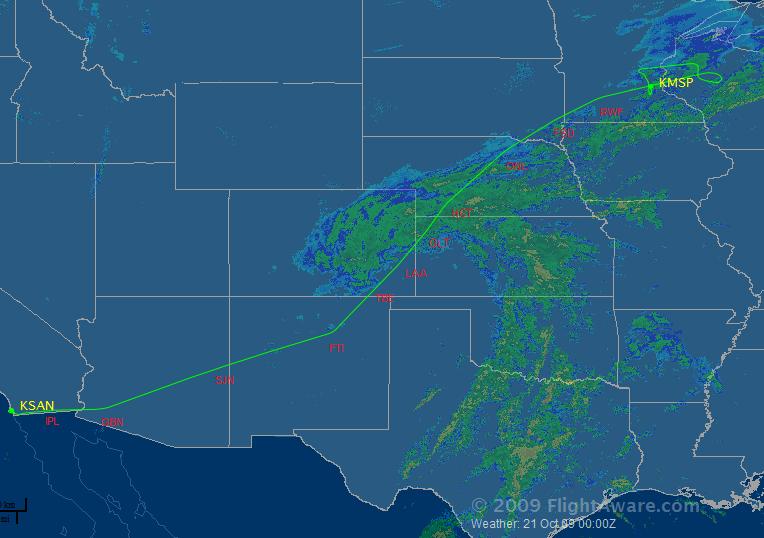
Decisions on how to handle planes that do not respond to air traffic control instructions are based on a variety of factors, Mr. Babbitt said. Among them are whether the plane is in a metropolitan area, whether it is flying erratically and whether it is sending signals that it has been hijacked. None of those was the case on Oct. 21, when Northwest Flight 188, from San Diego to Minneapolis, flew about 150 miles past the airport.

November 3, 2009

When they say “Don’t touch anything”, they mean it

Filed under: Military — Tags: , , — Nicholas @ 13:11

This man didn’t pay attention, and took a more exciting ride than he expected:

It probably is best not to fiddle with switches or controls when riding in the back seat of an air force plane.

A man who failed to obey that principle found himself hurtling out of the cockpit, smashing through the Perspex canopy and into space after grabbing the black- and yellow-striped handle between his legs. He had inadvertently pulled the eject lever and found himself blasted 100 metres into the sky on his rocket-powered seat.

The South African air force has confirmed the incident that took place last Wednesday, when the passenger took off for a flight with an experienced pilot from South Africa’s Silver Falcons air display team. Investigators are assuming that the passenger tried to steady himself while the pilot was putting the Pilatus PC-7 Mk II through its paces by grabbing the eject lever.

The passenger survived, with only minor injuries. That’s more than a little surprising:

“We train for this and if you don’t get it right, and are not in the correct ejection posture, you can sustain severe spinal cord injuries or even worse.”

H/T to Jeff Scarbrough for the link.

November 2, 2009

UAV market increases for Israeli manufacturer

Filed under: Australia, Cancon, Middle East, Military — Tags: , , — Nicholas @ 08:39

The American Predator UAV is selling very well — but the manufacturer can’t keep up with current domestic demand, so other nations are adopting the Israeli Heron as a worthwhile alternative:

Australian troops in Afghanistan begun using Israeli Heron UAVs two months ago. Last July, Australian troops went to Canada to receive training on the Heron, which Canadian troops have also adopted. Canada received its first Heron about a year ago. This model of the Heron is very similar to the 1.1 ton U.S. Predator. This Heron has a 500 pound payload capacity and can stay in the air for more than 24 hours per sortie. While Australia and Germany are buying its Herons, Canada is leasing them.

Last year, Canada also ordered half a dozen of the larger Israeli Heron TP UAVs. Equipped with a powerful (1,200 horsepower) turbo prop engine, the 4.6 ton aircraft can operate at 45,000 feet. That is, above commercial air traffic, and all the air-traffic-control regulations that discourage, and often forbid, UAV use at the same altitude as commercial aircraft. The Heron TP has a one ton payload, enabling it to carry sensors that can give a detailed view of what’s on the ground, even from that high up. The endurance of 36 hours makes the Heron TP a competitor for the U.S. MQ-9 Reaper (or Predator B), which is the same size as Heron.

October 24, 2009

“Controllers have a heightened sense of vigilance . . . post-9/11”

Filed under: Bureaucracy, Military, USA — Tags: , , — Nicholas @ 00:04

Maybe I’m just being hyper-critical here, but an aircraft being out of communication with air traffic control “over two states” does not equate with the claimed “heightened sense of vigilance”. Especially as “worried officials alerted National Guard jets to go after the airliner from two locations, although none of the military planes got off the runway”:

A report released by airport police Friday identified the pilot as Timothy B. Cheney and the first officer as Richard I. Cole. The report said the men were “co-operative, apologetic and appreciative” and volunteered to take preliminary breath tests that were zero for alcohol use. The report also said the lead flight attendant told police she was unaware of any incident during the flight.

The pilots, both temporarily suspended, are to be interviewed next week by investigators of the National Transportation Safety Board. The airline, acquired last year by Delta Air Lines, also is investigating. Messages left at both men’s homes were not immediately returned.

Investigators do not know whether the pilots may have fallen asleep, but NTSB spokesman Keith Holloway said Friday that fatigue and cockpit distraction will be looked into. The plane’s flight recorders were brought to the board’s Washington headquarters.

Voss, the Flight Safety Foundation president, said a special consideration was that the many safety checks built into the aviation system to prevent incidents like this one, or to correct them quickly, apparently were ineffective until the very end. Not only were air traffic controllers and other pilots unable raise the Northwest pilots for an hour, but the airline’s dispatcher should have been trying to reach them as well. The three flight attendants onboard should have questioned why no preparations for landing were ordered. Brightly lit cockpit displays should have warned the pilots it was time to land. Despite cloudy weather, the city lights of Minneapolis should have clued them in that they had reached their destination.
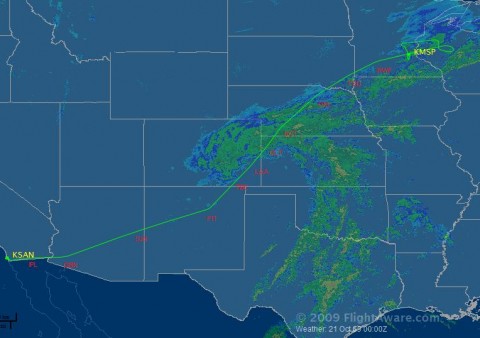
NWA188_flight_path

I don’t know how involved a discussion has to be to get you to ignore your duties for that long, but if I were in charge of either air traffic control (ATC) or inteceptor aircraft for central North America, I’d be asking very pointed questions of my subordinates. A large commercial passenger aircraft should not be out of contact with sequential ATC points without some alarms being raised . . . yes, it could be communication equipment failure, but after 9/11, any unexpected communications failure with commercial aircraft should have raised red flags. The reported lack of scrambled interceptor aircraft implies either bureaucratic incompetence or criminal negligence.

As one or two people have pointed out, the flight was headed into non-critical airspace (Wisconsin, then Ontario), so perhaps the perceived need to scramble fighters was lower than if the flight profile had deviated toward Chicago or somewhere “important”.

Update: Doug Church of the National Air Traffic Controllers Association provides a clarification in the comments.

Update, 13 November: FAA indicates that air traffic controllers should have alerted NORAD much earlier than they did.

October 23, 2009

Corruption quadruples the price of military transport aircraft

Filed under: Africa, Military — Tags: , , , — Nicholas @ 12:33

South Africa has a serious corruption problem with their yet-to-be delivered A400M military transport planes:

Yet another corruption case in South Africa. This time, members of parliament are asking why the military is suddenly paying $809 million each for eight A400M four engine transports. The price other nations are paying for the aircraft are under $200 million each. The price South Africa agreed to pay, in 2005, was about $279 million, and included training, maintenance support and some spare parts. It is believed that the price went up so that government officials could siphon off large bribes. Meanwhile, the A400M aircraft is four years behind schedule, and has not flown yet. It was originally to start deliveries to European customers this year. South Africa is supposed to begin getting its A400Ms in seven years. South Africa has already paid $400 million for its A400Ms, and more progress payments will soon be due.

Such blatant corruption is not new in South Africa, but lately the crooks have been winning. Last year, the South African parliament passed a law disbanding an elite government investigation unit nicknamed the “Scorpions.” Investigations by this unit had led to dozens of corruption prosecutions of government officials. That’s why the unit is being dismantled. Corruption is a major problem throughout Africa, and many nations are now setting up units like the Scorpions, after having realized that corruption was the major cause of the poverty and civil wars that afflict most Africans.

October 10, 2009

Where High Speed Trains can beat short-haul flight

Filed under: Economics, Europe, Railways, Technology — Tags: , , — Nicholas @ 11:46

Spain has a new high speed railway (HSR) network that appears to be a huge success, according to the Guardian:

Last year’s drop in air travel, which was also helped by new high-speed lines from Madrid to Valladolid, Segovia and Malaga, marks the beginning of what experts say is a revolution in Spanish travel habits.

In a country where big cities are often more than 500km (300 miles) apart, air travel has ruled supreme for more than 10 years. A year ago aircraft carried 72% of the 4.8 million long-distance passengers who travelled by air or rail. The figure is now down to 60%.

“The numbers will be equal within two years,” said Josep Valls, a professor at the ESADE business school in Barcelona.

Two routes, from Barcelona to Malaga and Seville, opened last week. Lines are also being built to link Madrid with Valencia, Alicante, the Basque country and Galicia. The government has promised to lay 10,000km of high-speed track by 2020 to ensure that 90% of Spaniards live within 30 miles of a station. The prime minister, José Luis Rodríguez Zapatero, boasts it will be Europe’s most extensive high-speed network.

While I’m always skeptical of HSR advocates’ larger-than-life claims, the Spanish system may be in a good position to permanently claim a big share of the short-haul air passenger market. The situation works to the strengths of HSR: relatively dense population corridors, short-to-medium length journeys, and government subsidy of construction costs.

HSR cannot be run on the same tracks as regular freight trains and commuter passenger trains: the signalling, degree of curvature of track, and speed differential between the HSR and ordinary trains creates too many risks. HSR must have its own right of way, which pretty much always means that governments must get involved to condemn existing properties and expropriate them for the benefit of the railway.

That HSR is, or may become, a success in densely populated European countries does not make the case for North American HSR efforts, as I’ve posted a few times before.

September 14, 2009

The RAF sets a record, but not a good one

Filed under: Britain, Military — Tags: , — Nicholas @ 07:54

The RAF‘s most expensive aircraft had just made its first flight:

The Nimrod MRA4 programme was initiated back in 1996 by TV presenter, one-time director of BAE Systems and former New Statesman theatre critic Michael Portillo, who was defence minister at the time. Under the original deal, BAE Systems would be paid a “fixed price” of £2.2bn to rebuild, rearm and upgrade the RAF’s fleet of 21 Nimrod MR2s, the last De Havilland Comet airframes left flying in the world, to the point where they would effectively be new aircraft. This would have meant a cost of just over £100m per plane. The project was then known as “Nimrod 2000”, rather optimistically as it turned out.

As time went by it became clear that the price was not fixed, and that “2000” wasn’t a good name for the project at all: it was re-dubbed Nimrod MRA4. BAE Systems has just announced that the first flight of a production-standard MRA4 took place last week, though the aircraft is not yet ready for handing over to the RAF — that will probably take place next year. Then there will be more delay before the type can be declared operationally capable.

Meanwhile the MoD now estimates the programme’s overall price tag as £3.6bn, an increase of more than two-thirds. In fact the situation is much worse than this, as the number of planes has had to be slashed to prevent even worse cost overruns. The RAF will now receive just 9 aircraft rather than 21.

As a result the cost per plane has actually quadrupled: each MRA4 will now have cost the taxpayers a cool £400m, better than $660m at current rates.

On a pure economic level, this is quite a price increase, but it’s typical of military equipment contracts: the very small number of items means that there are no economies of scale to be reaped, and all the design, test, and administration costs must be recouped over a much shorter production run. It still looks very bad . . . unless you happen to be in opposition right now, in which case it’s a great campaign talking point.

September 7, 2009

Toronto air show photos

Filed under: Cancon — Tags: , — Nicholas @ 21:40

No, no, not mine . . . while I was caught in traffic along Lakeshore Boulevard on Saturday afternoon during the Snowbirds portion of the show, I took no photos. Aside from the occasional glimpse of one or more Snowbird aircraft, I managed to get a brief look at HMCS Ville de Quebec and a Canadian Coast Guard vessel.

Chris Taylor (proprietor and chief pilot of Taylor Empire Airways), however, is an air buff, and can be depended upon to be there with camera (and charged batteries), and to take photos.

September 4, 2009

Survey of military use of UAV assets

Filed under: Military, Technology — Tags: , — Nicholas @ 08:17

There’s a useful overview of how Unmanned Aerial Vehicles (UAVs) are changing the tactical situation for troops on the ground in this week’s Economist Technology Quarterly section:

Drones are much less expensive to operate than manned warplanes. The cost per flight-hour of Israel’s drone fleet, for example, is less than 5% the cost of its fighter jets, says Antan Israeli, the commander of an Israeli drone squadron. In the past two years the Israeli Defence Forces’ fleet of UAVs has tripled in size. Mr Israeli says that “almost all” IDF ground operations now have drone support.

Of course, small and comparatively slow UAVs are no match for fighter jets when it comes to inspiring awe with roaring flyovers — or shooting down enemy warplanes. Some drones, such as America’s Predator and Reaper, carry missiles or bombs, though most do not. (Countries with “hunter-killer” drones include America, Britain and Israel.) But drones have other strengths that can be just as valuable. In particular, they are unparalleled spies. Operating discreetly, they can intercept radio and mobile-phone communications, and gather intelligence using video, radar, thermal-imaging and other sensors. The data they gather can then be sent instantly via wireless and satellite links to an operations room halfway around the world — or to the hand-held devices of soldiers below. In military jargon, troops without UAV support are “disadvantaged”.

Of course, it wouldn’t be a current-day Economist article without at least one gloomy caveat:

There is a troubling side to all this. Operators can now safely manipulate battlefield weapons from control rooms half a world away, as if they are playing a video game. Drones also enable a government to avoid the political risk of putting combat boots on foreign soil. This makes it easier to start a war, says P.W. Singer, the American author of “Wired for War”, a recent bestseller about robotic warfare. But like them or not, drones are here to stay. Armed forces that master them are not just securing their hold on air superiority — they are also dramatically increasing its value.

I don’t particularly credit this risk . . . as Chris Taylor pointed out in a comment on a recent post, “degrading the comm links is the easiest way to render UCAVs largely toothless. In their current incarnation they are only good for permissive environments where the other guy can’t really harm your aircraft or comms. When they get autonomous then they’ll be more practical for warfighting against advanced foes.”

Actually, go read the comment thread on that post. Between Chris and “cirby”, I think they cover the technical side very well indeed.

August 27, 2009

The only Canadian conspiracy theory

Filed under: Cancon, Military, Technology — Tags: , , , , — Nicholas @ 08:29

American conspiracy enthusiasts have plenty to choose from, but their Canadian confreres don’t have much . . . but they do have the Avro Arrow controversy:

InnovationCanada.ca spoke with Campagna 50 years after the only examples of Canada’s premier jet fighter were cut into pieces.

InnovationCanada.ca (IC): What would most Canadians be shocked to find out about the Arrow, 50 years after its demise?

Palmiro Campagna (PC): Most people don’t know that the order to destroy the Arrow did not come from Prime Minister John Diefenbaker. One theory was that Diefenbaker decided to cancel as this was a Liberal project and he had problems with A.V. Roe president Crawford Gordon. But the reports I had declassified showed that was clearly not the case.

The decision to cut the Arrows into scrap was blamed on Diefenbaker as an act of vengeance, but it was actually an act of national security. The Arrow was an advanced piece of military technology, and the Canadian government didn’t want the test planes to go to a Crown disposal group that would be allowed to auction them off to anyone in the world.

I’ve written a little bit about the Arrow controversy back in 2004:

I hate to sound like a killjoy, but everything I’ve read about the AVRO Arrow says that, while Dief was widely viewed as an idiot for destroying the . . . finished planes, it would never have been a viable military export for Canada. The plane was great, there seems to be no question about that, but it was too expensive for the RCAF to be the only purchaser, and neither the United States nor the United Kingdom was willing (at that time) to buy from “foreign” suppliers. With no market for the jet, regardless of its superior flying and combat qualities, there was little point in embarking on full production.

Also, given the degree of penetration by Soviet spies, the Canadian government took the easiest option in destroying the prototypes. That doesn’t make it any less tragic if you’re a fan, but it does put it into some kind of perspective, I hope.

« Newer PostsOlder Posts »

Powered by WordPress


