Quotulatiousness

April 26, 2020

Where have all the airships gone? | James May’s Q&A (Ep 8) | Head Squeeze

Filed under: Britain, Germany, History, Military, Technology, WW1 — Tags: , — Nicholas @ 02:00

BBC Earth Lab
Published 21 Feb 2013

James May talks us through the rise and fall of airships.

James May’s Q&A:
With his own unique spin, James May asks and answers the oddball questions we’ve all wondered about from “What Exactly Is One Second?” to “Is Invisibility Possible?”

April 23, 2020

Quintinshill, the Worst Railway Disaster in British History

Filed under: Britain, History, Military, Railways, WW1 — Tags: , , , — Nicholas @ 02:00

The History Guy: History Deserves to Be Remembered
Published 15 Sep 2018

Railroads played a critical role for the United Kingdom in the Great War. But the increased burden on the nation’s railways had its cost. In the early morning hours of May 22, 1915, a crowded schedule resulted in the 1915 Quintinshill Rail Disaster, the worst railway disaster in British history. Its victims, mostly men of the 1/7 Royal Scots regiment, deserve to be remembered.

The History Guy uses media that are in the public domain. As photographs of actual events are sometimes not available, photographs of similar objects and events are used for illustration.

The episode includes historical photos involving the Great War and a 1915 railway disaster. Those photos are provided in context of the historical events. No graphic violence is shown.

Patreon: https://www.patreon.com/TheHistoryGuy

The History Guy: History Deserves to Be Remembered is the place to find short snippets of forgotten history from five to fifteen minutes long. If you like history too, this is the channel for you.

Awesome The History Guy merchandise is available at:
https://teespring.com/stores/the-hist…

The episode is intended for educational purposes. All events are portrayed in historical context.

#quintinshill #wwi #thehistoryguy

April 17, 2020

Charles De Gaulle – The Flame of French Resistance? – WW2 Biography Special

Filed under: France, History, Military, WW1, WW2 — Tags: , , , , — Nicholas @ 06:00

World War Two
Published 16 Apr 2020

Charles De Gaulle is a towering figure in history, and not just because of his height. Becoming increasingly political in the interwar years due to his unorthodox views on military strategy, The Fall of France will thrust him into the limelight.

Join us on Patreon: https://www.patreon.com/TimeGhostHistory
Or join The TimeGhost Army directly at: https://timeghost.tv

Follow WW2 day by day on Instagram @World_war_two_realtime https://www.instagram.com/world_war_t…
Between 2 Wars: https://www.youtube.com/playlist?list…
Source list: http://bit.ly/WW2sources

Hosted by: Indy Neidell
Written by: Francis van Berkel
Director: Astrid Deinhard
Producers: Astrid Deinhard and Spartacus Olsson
Executive Producers: Astrid Deinhard, Indy Neidell, Spartacus Olsson, Bodo Rittenauer
Creative Producer: Joram Appel
Post-Production Director: Wieke Kapteijns
Research by: Catherine Burton
Edited by: Mikołaj Cackowski
Sound design: Marek Kamiński
Map animations: Eastory (https://www.youtube.com/c/eastory)

Colorizations by:
Carlos Ortega Pereira, BlauColorizations, https://www.instagram.com/blaucoloriz…
Dememorabilia – https://www.instagram.com/dememorabilia/
Norman Stewart – https://oldtimesincolor.blogspot.com/
Adrien Fillon – https://www.instagram.com/adrien.colo…
Sources:
Outdoor family portrait, with lurkers (c.1920), courtesy pellethepoet https://flic.kr/p/ompxgf
IWM A 1464, E 2324, D 1966
Frederick Milthorp collection

Soundtracks from the Epidemic Sound:
Max Anson – “Ancient Saga”
Farell Wooten – “Blunt Object”
Johannes Bornlof – “Deviation in Time”
Reynard Seidel – “Deflection”
Johannes Bornlof – “The Inspector 4”
Phoenix Tail – “At the Front”

Archive by Screenocean/Reuters https://www.screenocean.com.

A TimeGhost chronological documentary produced by OnLion Entertainment GmbH.

“Diary Of An Unknown Soldier” – Lost in the Great War – Sabaton History 063 [Official]

Filed under: Britain, France, History, Media, Military, WW1 — Tags: , , — Nicholas @ 04:00

Sabaton History
Published 16 Apr 2020

The bells rang on Armistice Day 1920 in the 11th hour, and two minutes of silence followed. One minute for the soldiers that had fought in the Great War and had come back. The second for those who did not. Those unfortunate souls that had been left behind. They had died like so many others, but had been denied a final resting place due to the violence of war. They had vanished, without a trace, without an identity. Those men where the Unknown Soldiers.

Support Sabaton History on Patreon: https://www.patreon.com/sabatonhistory

Listen to “Diary of an Unknown Soldier” on the album The Last Stand:
CD: http://bit.ly/TheLastStandStore
Spotify: http://bit.ly/TheLastStandSpotify
Apple Music: http://bit.ly/TheLastStandItunes
iTunes: http://bit.ly/TheLastStandItunes
Amazon: http://bit.ly/TheLastStandAmz
Google Play: http://bit.ly/TheLastStandGooglePlay

Watch the official lyric video of “Diary Of An Unknown Soldier” here:
https://www.youtube.com/watch?v=Jhkz5…

Check out the trailer for Sabaton’s new album The Great War right here: https://www.youtube.com/watch?v=HCZP1…

Listen to Sabaton on Spotify: http://smarturl.it/SabatonSpotify
Official Sabaton Merchandise Shop: http://bit.ly/SabatonOfficialShop

Hosted by: Indy Neidell
Written by: Markus Linke and Indy Neidell
Directed by: Astrid Deinhard and Wieke Kapteijns
Produced by: Pär Sundström, Astrid Deinhard and Spartacus Olsson
Creative Producer: Joram Appel
Executive Producers: Pär Sundström, Joakim Broden, Tomas Sunmo, Indy Neidell, Astrid Deinhard, and Spartacus Olsson
Post-Production Director: Wieke Kapteijns
Edited by: Iryna Dulka
Sound Editing by: Marek Kaminski
Maps by: Eastory – https://www.youtube.com/c/eastory

Archive by: Reuters/Screenocean https://www.screenocean.com
Music by Sabaton.

Sources:
– National Library of Scotland
– National Library of France
– Imperial War Museum: Q 10378, Q 100373, Q 57227, Q 100624, Q 53727, Q 29155, ART 3991 a, Q 109517, Q 100928, Q 100699, Q 100913, Q 45814, Q 23706, Q 14963, Q 31518, Q 31494, RAF-T 3129, Q 31514, Q 909, Q 87441, Documents.5323, Q 100486, Q 48929A, Q 78614

An OnLion Entertainment GmbH and Raging Beaver Publishing AB co-Production.

© Raging Beaver Publishing AB, 2019 – all rights reserved.

From the comments:

Sabaton History
2 days ago
Something different this time. Since we already have two episodes about the fighting in the Argonne, we thought this time we’d talk about the sacrifice and the legacy of the “Unknown Soldier”. Of those who fought and died but were not fortunate enough to have a last known resting place. We hope you still enjoy the episode!

Prototype Mauser 1917 Trench Carbine

Filed under: Germany, History, Military, Weapons, WW1 — Tags: , , , — Nicholas @ 02:00

Forgotten Weapons
Published 20 Dec 2019

http://www.patreon.com/ForgottenWeapons

Cool Forgotten Weapons merch! http://shop.bbtv.com/collections/forg…

In the latter stages of World War One, the German military was looking for new arms for its Sturmtruppen. Without a reliable self-loading rifle design to use, they instead focused on pistol-caliber arms. The first to be used was the existing P08 artillery Luger, fitted with a drum magazine. At the very end of the war, these were being replaced by Bergmann MP-18,I submachine guns. But there was another gun that was tested but not adopted — the 1917 trench carbine variation of Mauser’s C96 “Broomhandle” pistol. Only about 40 of these guns were made as prototypes and trials models, and they were not adopted for reasons that are not entirely clear (but cost is probably a significant element). Only a few examples survive, and they vary substantially in their details. In addition, they are substantially different from both standard C96 pistols and also the sporting carbines made before the war.

All the 1917 trench carbines used a magazine developed from the 1906/08 pistol; an excellent double-stack, double-feed type. Magazines of 10, 20, and 40-round capacity were made, although all known examples were only semiautomatic (the full-auto Schnellfeuer Mausers would not come until the early 1930s).

Contact:
Forgotten Weapons
6281 N. Oracle #36270
Tucson, AZ 85704

April 14, 2020

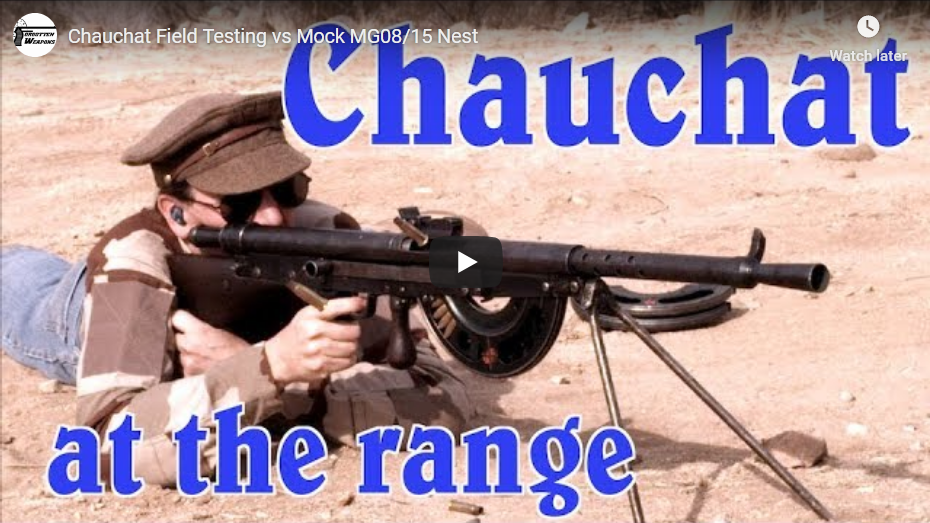
Chauchat Field Testing vs Mock MG08/15 Nest

Filed under: France, History, Military, USA, Weapons, WW1 — Tags: , , — Nicholas @ 02:00

Forgotten Weapons
Published 14 Dec 2019

http://www.patreon.com/ForgottenWeapons

Cool Forgotten Weapons merch! http://shop.bbtv.com/collections/forg…

Out at the range today with the Chauchat, testing accuracy against a simulated MG08/15 nest at 150 yards. I’ll try out semiauto and full auto (in short bursts), and see how they compare. For reference, the US Army recommended never using the Chauchat beyond 400 yards, as it was not sufficiently accurate to be effective at greater distance.

To see a set of original WW1 American Expeditionary Force Chauchat manuals, check here:

https://www.forgottenweapons.com/chau…

Contact:
Forgotten Weapons
6281 N. Oracle #36270
Tucson, AZ 85704

April 12, 2020

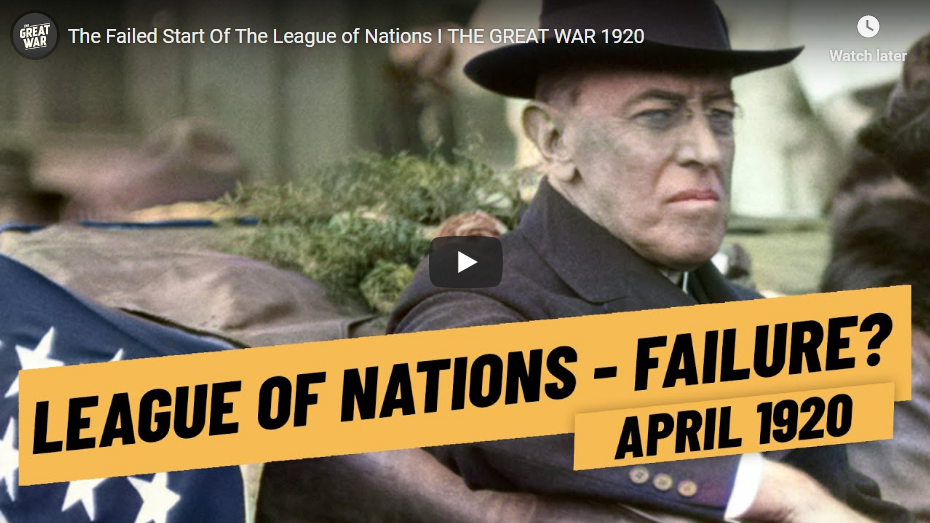
The Failed Start Of The League of Nations I THE GREAT WAR 1920

Filed under: Europe, History, Military, USA, WW1 — Tags: , , , , — Nicholas @ 04:00

The Great War
Published 10 Apr 2020

Sign up for Curiosity Stream and Nebula – and get 40% off annual plans right now: https://curiositystream.com/thegreatwar

The League of Nations was US President Woodrow Wilson’s tool for a new and peaceful world after the war of 1914-1918 — and the US should have been their most important member. But the United States never joined and today the League of Nations is often seen as a failure. Was it doomed from the start?

» SUPPORT THE CHANNEL
Patreon: https://www.patreon.com/thegreatwar
Merchandise: https://shop.spreadshirt.de/thegreatwar/

» SOURCES
“The Treaty of Peace with Germany (The Treaty of Versailles),” June 28, 1919, United States Statutes at Large, art. 1-440.

Walters, F.P. A History of the League of Nations. (Oxford, UK: Oxford University Press, 1952)

Link, Arthur et al., eds., The Papers of Woodrow Wilson, vol. 45 (1984)

Ray S. Baker and William E. Dodd, eds, The Public Papers of Woodrow Wilson: Authorized Edition, Vol. 1, (New York, 1924)

Matz, Nele, “Civilization and the Mandate System under the League of Nations as Origin of Trusteeship” in von Bogdandy, A and Wolfrum, R (eds.), Max Planck Yearbook of United Nations Law, Volume 9, 2005

Braumoeller, Bear F. “The Myth of American Isolationism”, Foreign Policy Analysis Vol. 6, No. 4 (OCTOBER 2010), pp. 349-371

“March 19, 1920: Senate Rejects Treaty of Versailles for Second and Final Time” New York Times, https://learning.blogs.nytimes.com/20… /march-19-1920-senate- rejects-treaty-of-versailles-for-second-and-final-time/

Egerton, George W, “The Lloyd George Government and the Creation of the League of Nations”, The American Historical Review, Vol. 79, No. 2 (Apr., 1974), pp. 419-444

Burkman, Thomas W. “Japan and the League of Nations: AN ASIAN POWER ENCOUNTERS THE ‘EUROPEAN CLUB'”, World Affairs, Vol. 158, No. 1, Woodrow Wilson and the League of Nations: Part Two (SUMMER 1995), pp. 45-57

Rappart, William E. “Small States in the League of Nations”, Political Science Quarterly Vol. 49, No. 4 (Dec., 1934), pp. 544-575

Cox, James Middleston, Journey Through My Years, (Simon & Schuster: New York, 1946)

“THE BRITISH EMPIRE, THE LEAGUE OF NATIONS, AND THE UNITED STATES”, Advocate of Peace through Justice, Vol. 82, No. 7 (JULY, 1920), pp. 229-231

Dorsey, Leeroy G, “Woodrow Wilson’s Fight for the League of Nations: A Reexamination”, Rhetoric and Public Affairs, Vol. 2, No. 1 (Spring 1999), pp. 107-135

“The Covenant of the League of Nations” AVALON PROJECT, Yale Law School, https://avalon.law.yale.edu/20th_cent…

“Woodrow Wilson’s 14 Points”, AVALON PROJECT, Yale Law School, https://avalon.law.yale.edu/20th_cent…

Riddell, George Allardice, The Riddell diaries, 1908-1923, (London ; Dover, N.H. : Athlone Press, 1986)

» SOCIAL MEDIA
Instagram: https://instagram.com/the_great_war
Twitter: https://twitter.com/WW1_Series
Reddit: https://reddit.com/r/TheGreatWarChannel

»CREDITS
Presented by: Jesse Alexander
Written by: Mark Newton, Jesse Alexander
Director: Toni Steller & Florian Wittig
Director of Photography: Toni Steller
Sound: Toni Steller
Editing: Toni Steller
Mixing, Mastering & Sound Design: http://above-zero.com
Maps: Daniel Kogosov (https://www.patreon.com/Zalezsky)
Research by: Jesse Alexander
Fact checking: Florian Wittig

Channel Design: Alexander Clark
Original Logo: David van Stephold

A Mediakraft Networks Original Channel

Contains licensed material by getty images
All rights reserved – Real Time History GmbH 2020

April 10, 2020

“In Flanders Fields” – Sabaton History 062 [Official]

Filed under: Britain, Cancon, History, Media, Military, WW1 — Tags: , , — Nicholas @ 06:00

Sabaton History
Published 9 Apr 2020

“In Flanders fields the poppies blow, between the crosses, row on row.” These words, written by John McCrae in his famous war poem “In Flanders Fields”, immortalize death and dying in the Great War like only a few others. It is said, that shortly after the death of his dear friend, McCrae looked over the parapet and onto the battlefield once more. In all the mayhem, the smoke, the exploding shells and the dead bodies on the ground, he saw that the little red flowers, the poppies, still grew. After a strong wind, their pedals would fly across the field, and lay there strewn, like the blood that was shed by the soldiers that had to die there.

Support Sabaton History on Patreon: https://www.patreon.com/sabatonhistory

Listen to “In Flanders Fields” on the Album The Great War here:
CD: http://nblast.de/SabatonTheGreatWar
Spotify: https://sabat.one/TheGreatWarSpotify
Apple Music: https://sabat.one/TheGreatWarAppleMusic
iTunes: https://sabat.one/TheGreatWarItunes
Amazon: https://sabat.one/TheGreatWarAmazon
Google Play: https://sabat.one/TheGreatWarGooglePlay

Watch the Official Lyric Video of “In Flanders Fields” here:
https://www.youtube.com/watch?v=ZPgZn…

Check out the trailer for Sabaton’s new album The Great War right here: https://www.youtube.com/watch?v=HCZP1…

Listen to Sabaton on Spotify: http://smarturl.it/SabatonSpotify
Official Sabaton Merchandise Shop: http://bit.ly/SabatonOfficialShop

Hosted by: Indy Neidell
Written by: Markus Linke and Indy Neidell
Directed by: Astrid Deinhard and Wieke Kapteijns
Produced by: Pär Sundström, Astrid Deinhard and Spartacus Olsson
Creative Producer: Joram Appel
Executive Producers: Pär Sundström, Joakim Broden, Tomas Sunmo, Indy Neidell, Astrid Deinhard, and Spartacus Olsson
Post-Production Director: Wieke Kapteijns
Edited by: Karolina Dołęga
Sound Editing by: Marek Kaminski
Maps by: Eastory – https://www.youtube.com/c/eastory

Archive by: Reuters/Screenocean https://www.screenocean.com
Music by Sabaton.

An OnLion Entertainment GmbH and Raging Beaver Publishing AB co-Production.

© Raging Beaver Publishing AB, 2019 – all rights reserved.

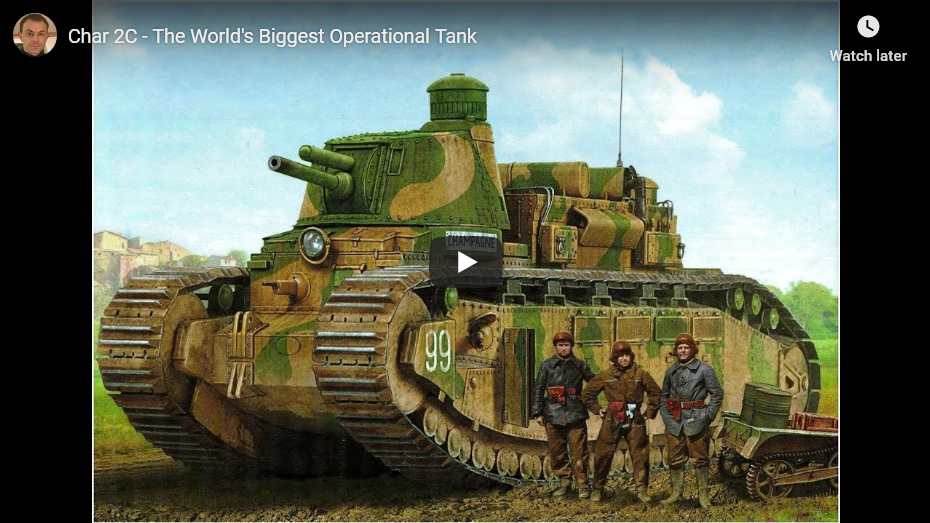
Char 2C – The World’s Biggest Operational Tank

Filed under: France, History, Military, Weapons, WW1, WW2 — Tags: , , — Nicholas @ 02:00

Mark Felton Productions
Published 15 Nov 2019

Find out the unbelievable story of the biggest operational tanks in history – the French Char 2C, and their peculiar fate.

Help support my channel:
https://www.paypal.me/markfeltonprodu…
https://www.patreon.com/markfeltonpro…

Disclaimer: All opinions and comments expressed in the ‘Comments’ section do not reflect the opinions of Mark Felton Productions. All opinions and comments should contribute to the dialogue. Mark Felton Productions does not condone written attacks, insults, racism, sexism, extremism, violence or otherwise questionable comments or material in the ‘Comments’ section, and reserves the right to delete any comment violating this rule or to block any poster from the channel.

Credits: YouTube Creative Commons; WikiCommons; Google Commons; Mark Felton Productions
Music: “Pursuit” and “Dogma” licenced to iMovie by Apple, Inc.

H/T to @AnonymousFred514 for the link.

April 9, 2020

Lawrence of Arabia | Based on a True Story

Filed under: Britain, History, Media, Middle East, Military, WW1 — Tags: , , , , , — Nicholas @ 02:00

The Cynical Historian
Published 6 Nov 2015

The classic film Lawrence of Arabia, is one of the most beautiful movies of all time, but it has its flaws.
————————————————————
references:
https://en.wikipedia.org/wiki/Lawrenc…

http://www.wordandfilm.com/2013/08/wh…

http://www.pri.org/stories/2013-12-16…

most beautiful movies list:
https://www.youtube.com/watch?v=kj73a…
————————————————————

LET’S CONNECT:
https://twitter.com/Cynical_History
————————————————————
wiki:
Lawrence of Arabia is a 1962 epic historical drama film based on the life of T. E. Lawrence. It was directed by David Lean and produced by Sam Spiegel through his British company Horizon Pictures, with the screenplay by Robert Bolt and Michael Wilson. The film stars Peter O’Toole in the title role. It is widely considered one of the greatest and most influential films in the history of cinema. The dramatic score by Maurice Jarre and the Super Panavision 70 cinematography by Freddie Young are also highly acclaimed.
The film was nominated for ten Oscars at the 35th Academy Awards in 1963; it won seven in total: Best Picture, Best Director, Best Original Score, Best Cinematography (Color), Best Art Direction (Color), Best Film Editing and Best Sound Mixing. It also won the Golden Globe Award for Best Motion Picture – Drama and the BAFTA Awards for Best Film and Outstanding British Film.

The film depicts Lawrence’s experiences in the Arabian Peninsula during World War I, in particular his attacks on Aqaba and Damascus and his involvement in the Arab National Council. Its themes include Lawrence’s emotional struggles with the personal violence inherent in war, his own identity, and his divided allegiance between his native Britain and its army and his new-found comrades within the Arabian desert tribes. As well as O’Toole, the film stars Alec Guinness, Jack Hawkins, Anthony Quinn, Omar Sharif, Anthony Quayle, Claude Rains and Arthur Kennedy.
————————————————————
Hashtags: #History #LawrenceOfArabia #WWI #Review #BasedOnATrueStory

April 8, 2020

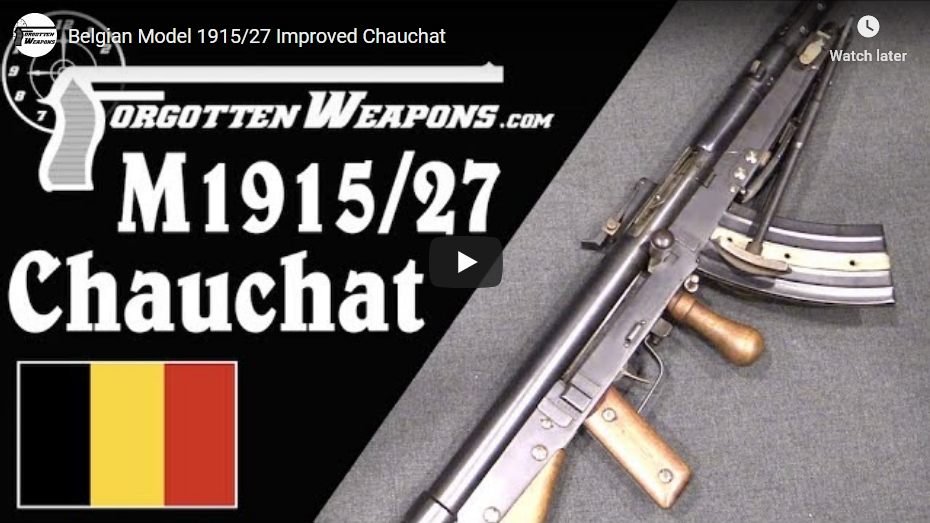
Belgian Model 1915/27 Improved Chauchat

Filed under: Europe, France, History, Military, Weapons, WW1 — Tags: , , , , — Nicholas @ 02:00

Forgotten Weapons
Published 9 Dec 2019

http://www.patreon.com/ForgottenWeapons

Cool Forgotten Weapons merch! http://shop.bbtv.com/collections/forg…

The Belgian Army was the second to adopt the Chauchat automatic rifle, after the French. Almost all of Belgium was under German occupation during World War One, leaving Belgium significantly dependent on French aid for arms during the war. The initial Belgian purchases were standard 8mm Lebel CSRGs, but by 1917 Belgian engineers were working on a solution to convert the guns to the Belgian standard 7.65mm Mauser cartridge. This was completed by the end of the war, and the Chauchat remained a standard arm of the Belgian military after the war.

Work to improve the design continued, and an upgrades version was formally adopted in 1927. This included the 7.65mm conversion, with the best magazines made for any model of the Chauchat, as well as a series of dust covers to close off every hole in the gun (magazine well, ejection port, charging handle slot, and barrel shroud vents). The Belgians also replaced the original bipod with a much better type (similar to what they would use on the FN BAR), simplified the feed system, and added a tension latch to ensure reliable operation.

This new pattern of CSRG would be standard Belgian front-line armament until the FN BAR was adopted in 1930. The Chauchats were still in service with some units at the beginning of World War Two though, and saw service at that time.

Thanks to the Liege Arms Museum for access to film this for you! If you are in Belgium, definitely plan to stop into the museum, part of the Grand Curtius. They have a very good selection of interesting and unusual arms on display.

https://www.grandcurtius.be

Contact:
Forgotten Weapons
6281 N. Oracle #36270
Tucson, AZ 85704

April 1, 2020

Curator’s Tank Museum Tour: Tank Story Hall – WW1 | The Tank Museum

Filed under: Britain, Europe, France, Germany, History, Military, WW1 — Tags: , , , , , — Nicholas @ 05:00

The Tank Museum
Published 31 Mar 2020

Join Curator David Willey as he takes you on a tour of The Tank Museum’s Tank Story Hall, which houses over 30 key vehicles from Little Willie to Challenger 2. In this section he looks at the First World War vehicles and gives you a potted history of WW1.

Support the work of The Tank Museum on Patreon: ► https://www.patreon.com/tankmuseum
Visit The Tank Museum SHOP & become a Friend: ► https://tankmuseumshop.org/

Twitter: ► https://twitter.com/TankMuseum
Instagram: ► https://www.instagram.com/tankmuseum/
Tiger Tank Blog: ► http://blog.tiger-tank.com/
Tank 100 First World War Centenary Blog: ► http://tank100.com/
#tankmuseum #tanks

Woodrow Wilson (pt.2) | Historians Who Changed History

The Cynical Historian
Published 8 Feb 2018

This is the second part of a 2 part episode. The first covered Woodrow Wilson from his early years to the 1912 election. This episode is covering his presidency. I highly recommend you go see the previous one, because I’m going to refer to stuff in it a lot here.

They only allow 5 cards, so here are all the previous episodes referenced:
Wilson Part 1: https://youtu.be/Hm0Gzz53YJo
Birth of a Nation: https://youtu.be/zzsvOBjRXew
Philippine Insurrection: https://youtu.be/mmYk0xxjDDA
WWI causes: https://youtu.be/NTrk7XktTrc
WWI effects: https://youtu.be/G3vKUgoTghg
Border Wars: https://youtu.be/qs4Lp39Y8W8
Russian Intervention: https://youtu.be/1mC1bmzbgxY
1919 Red Scare: https://youtu.be/S4Pi2nYcYNw
————————————————————
[Full references in the YouTube description]

Support the channel through Patreon:
https://www.patreon.com/CynicalHistorian
or pick up some merchandise at SpreadShirt:
https://shop.spreadshirt.com/cynicalh…

LET’S CONNECT:
https://twitter.com/Cynical_History
————————————————————
Wiki:
The presidency of Woodrow Wilson began on March 4, 1913 at noon when Woodrow Wilson was inaugurated as President of the United States, and ended on March 4, 1921. Wilson, a Democrat, took office as the 28th United States president after winning the 1912 presidential election, gaining a large majority in the Electoral College and a 42 percent plurality of the popular vote in a four–candidate field. Four years later, in 1916, Wilson defeated Republican Charles Evans Hughes by nearly 600,000 votes in the popular vote and secured a narrow majority in the Electoral College by winning several swing states with razor-thin margins. He was the first Southerner elected as president since Zachary Taylor in 1848, and the first Democratic president to win re-election since Andrew Jackson in 1832.
————————————————————
Hashtags: #History #WoodrowWilson #PresidentWilson #KKK #BirthOfANation #Segregation #JimCrow #Wilsonianism #Interventionism #EspionageAct #SeditionAct

March 18, 2020

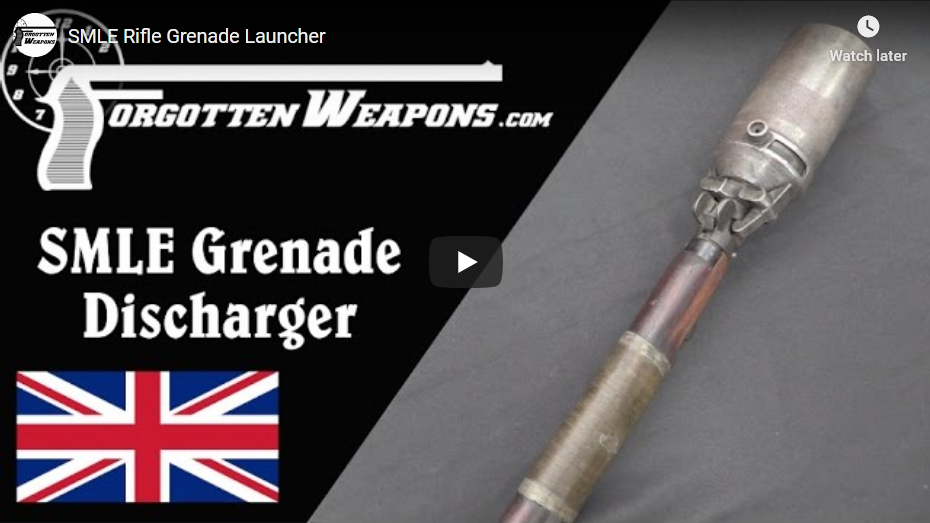
SMLE Rifle Grenade Launcher

Filed under: Britain, History, Military, Weapons, WW1, WW2 — Tags: , , — Nicholas @ 02:00

Forgotten Weapons
Published 2 Feb 2017

While rifle-launched grenades date back hundreds of years, they first came into widespread use during World War One, on all sides of the conflict. The first years of the war saw the use of rod grenades, but their downsides (mediocre accuracy, bulkiness, and a propensity to damage rifle bores) led to the British adopting a 2.5” cup grenade discharger in late 1917. This new launcher used slightly modified Mills bomb hand grenades, and could launch them with significant accuracy from 80 to 200 yards. They would become a staple of WWI combined arms infantry tactics, and be used clear through WW2 until replaced by the 22mm NATO style spigot grenades.

http://www.patreon.com/ForgottenWeapons

Cool Forgotten Weapons merch! http://shop.bbtv.com/collections/forg…

If you enjoy Forgotten Weapons, check out its sister channel, InRangeTV! http://www.youtube.com/InRangeTVShow

March 15, 2020

M1918 BAR: America’s Walking Fire Assault Rifle

Filed under: History, Military, USA, Weapons, WW1 — Tags: , , , — Nicholas @ 02:00

Forgotten Weapons
Published 14 Oct 2017

Sold for $34,500 (transferrable).

John Browning developed the Browning Automatic Rifle for use by American troops in World War One, taking inspiration from the other light automatic weapons in service including the Chauchat, Lewis, and MG08/15. Rather than being used as a light machine gun as we would understand it today, the BAR was an “automatic rifle”, intended to be used in much the same way as the Germans would use the Sturmgewehr in WWII. It would be fired in semiautomatic mode from the shoulder or hip while advancing on the enemy, using steady fire to keep them pinned down. Once troops broke into close contact, the gun could be switched to fully automatic to provide overwhelming firepower for the final assault on a position. While the walking fire from the hip was not particularly realistic in practice, the fully automatic firepower was a huge boon to the infantry. While it filled the game role as the Chauchat, the BAR was a much more refined weapon and much easier to use effectively.

The BAR was showed to the US Ordnance Department in 1917, and the first order for them was placed with Colt in July of 1917. In short order further contracts would be placed with Winchester and Marlin-Rockwell, although it would take many months to fabricate the production tooling and perfect the design for mass production. A few hand-fitted guns were ready in February 1918 for a public demonstration, but significant quantities were not being built until July of 1918.

These guns would be shipped to France for use by the AEF, but not actually put into combat service until the Meuse-Argonne offensive in late September of 1918, due to General Pershing’s desire to keep them secret from the Germans until a large number could be used at once. As a result, the guns saw only very limited use before the war ended on November 11th. In total 102,173 BARs would be built, about half of them being finished into 1919, after the armistice. They would go on to be changed and updated for use in World War Two, but that is a discussion for another day. This particular gun is an excellent example of an M1918 BAR in correct World War One configuration, which is a rare find today.

http://www.patreon.com/ForgottenWeapons

Cool Forgotten Weapons merch! http://shop.bbtv.com/collections/forg…

If you enjoy Forgotten Weapons, check out its sister channel, InRangeTV! http://www.youtube.com/InRangeTVShow

« Newer PostsOlder Posts »

Powered by WordPress